

Green Rust: The Simple Organizing ‘Seed’ of All Life?
Open accessThe DOI matches its Crossref record; 288 of the 293 references it cites were found in a registry or an index.
Abstract
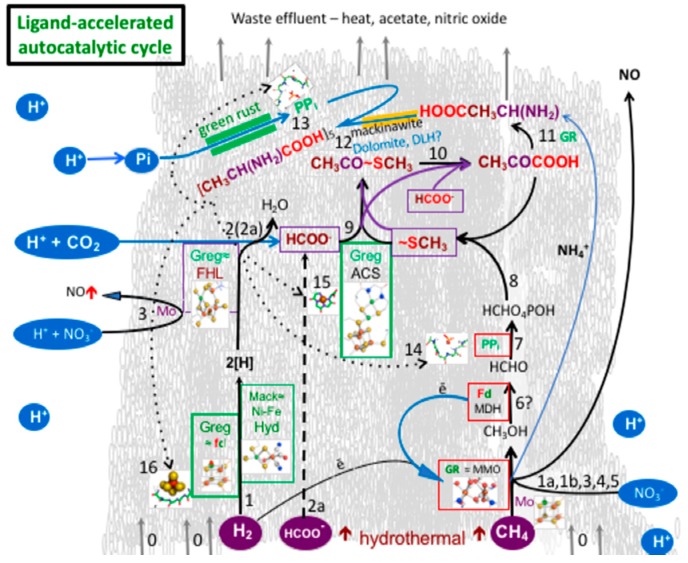
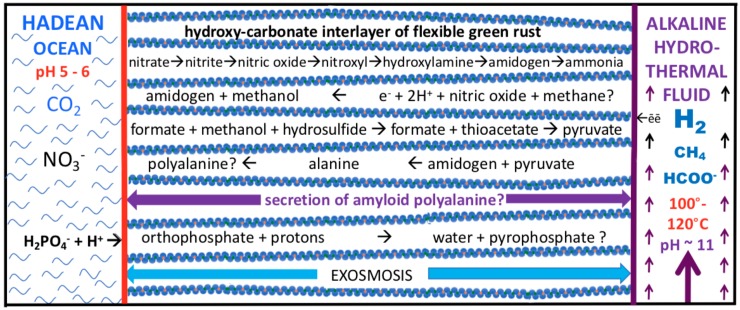
Korenaga and coworkers presented evidence to suggest that the Earth’s mantle was dry and water filled the ocean to twice its present volume 4.3 billion years ago. Carbon dioxide was constantly exhaled during the mafic to ultramafic volcanic activity associated with magmatic plumes that produced the thick, dense, and relatively stable oceanic crust. In that setting, two distinct and major types of sub-marine hydrothermal vents were active: ~400 °C acidic springs, whose effluents bore vast quantities of iron into the ocean, and ~120 °C, highly alkaline, and reduced vents exhaling from the cooler, serpentinizing crust some distance from the heads of the plumes. When encountering the alkaline effluents, the iron from the plume head vents precipitated out, forming mounds likely surrounded by voluminous exhalative deposits similar to the banded iron formations known from the Archean. These mounds and the surrounding sediments, comprised micro or nano-crysts of the variable valence FeII/FeIII oxyhydroxide known as green rust. The precipitation of green rust, along with subsidiary iron sulfides and minor concentrations of nickel, cobalt, and molybdenum in the environment at the alkaline springs, may have established both the key bio-syntonic disequilibria and the means to properly make use of them—the elements needed to effect the essential inanimate-to-animate transitions that launched life. Specifically, in the submarine alkaline vent model for the emergence of life, it is first suggested that the redox-flexible green rust micro- and nano-crysts spontaneously precipitated to form barriers to the complete mixing of carbonic ocean and alkaline hydrothermal fluids. These barriers created and maintained steep ionic disequilibria. Second, the hydrous interlayers of green rust acted as engines that were powered by those ionic disequilibria and drove essential endergonic reactions. There, aided by sulfides and trace elements acting as catalytic promoters and electron transfer agents, nitrate could be reduced to ammonia and carbon dioxide to formate, while methane may have been oxidized to methyl and formyl groups. Acetate and higher carboxylic acids could then have been produced from these C1 molecules and aminated to amino acids, and thence oligomerized to offer peptide nests to phosphate and iron sulfides, and secreted to form primitive amyloid-bounded structures, leading conceivably to protocells.
Overview
The claims and statistics of this paper haven’t been checked yet.
Free: it reads the open-access text and checks the first 5 claims that cite a source we can check. Create a free account to check every claim.
Integrity signals
Registry
Cites
Statistics
Figures
Verification
Claims the paper makes
The claims and statistics of this paper haven’t been checked yet.
Free: it reads the open-access text and checks the first 5 claims that cite a source we can check. Create a free account to check every claim.
Claims other papers make about this one
Each is checked against this paper’s own text: does it say what the citing paper says it does?
The cited source says what the claim attributes to it.
In the citing paper
“Many of the minerals precipitated in and around hydrothermal systems would also have included ambient water that was confined and somewhat immobilized through hydrogen bonding, e.g. between 'brucite' layers (e.g. in [Fe 4 2+ Fe 2 3+ (OH) 12 ][CO 3 ] •3H 2 O, green rust; Russell 2018), or within pores in the mineral precipitates, e.g.silica gel or adjacent hydrothermal sediments (Ding et al. 2016;”
From The Emergence of Life (2019) · cites this paper as Russell 2018
Self-check
Percentages, sums and reported differences re-computed from the paper’s own numbers.
The self-check needs the paper’s full text.
Citations
Cites
Flemming, H.-C., & Wingender, J. (2010) · Nature Reviews Microbiology · doi:10.1038/nrmicro2415 · Cited by 10,137
Walker, J. E., Saraste, M., Runswick, M. J., & Gay, N. J. (1982) · The EMBO Journal · doi:10.1002/j.1460-2075.1982.tb01276.x · Cited by 5,312
Agmon, N. (1995) · Chemical Physics Letters · doi:10.1016/0009-2614(95)00905-j · Cited by 3,482 · cited 1×
“This is because the effective viscosity therein is similar to that of bulk water—strongly favoring the rapid diffusion of excess protons via the Grotthuss mechanism [177,178].”
BackgroundThe Microbial Engines That Drive Earth's Biogeochemical Cycles
Falkowski, P. G., Fenchel, T., & Delong, E. F. (2008) · Science · doi:10.1126/science.1153213 · Cited by 3,379 · cited 1×
“4 species, and at the same time increase the durability of the membrane.[20,34,35,36,37,38] Much of any H2 generated in these conditions would be absorbed in the sulfides which could act as H2 stores as well as – through the re-reduction of the greigite to mackinawite – induce a homeostatic pH regulating mechanism.”
BackgroundStochastic thermodynamics, fluctuation theorems and molecular machines
Seifert, U. (2012) · Reports on Progress in Physics · doi:10.1088/0034-4885/75/12/126001 · Cited by 3,300 · cited 1×
“Rather, the engine managing the conversion causes individual fluctuation events that dissipate the driving reaction contingent on the coincident occurrence of an endergonic (reverse) fluctuation in another thermodynamically weaker process, thereby creating a disequilibrium in that process [3,7,14,199,200].”
BackgroundWater as an active constituent in cell biology
Ball, P. (2008) · Chemical Reviews · doi:10.1021/cr068037a · Cited by 2,177 · cited 1×
“However, as Ball reminded us, water is not only “life’s solvent”, but acts as a shell to, and interacts with, both proteins and their substrates [162].”
BackgroundIron-sulfur clusters: nature's modular, multipurpose structures
Beinert, H., Holm, R. H., & Münck, E. (1997) · Science · doi:10.1126/science.277.5326.653 · Cited by 1,944
Feynman, R. (2017) · The MIT Press eBooks · doi:10.7551/mitpress/11068.001.0001 · Cited by 1,881
Natural engineering principles of electron tunnelling in biological oxidation–reduction
Page, C. C., Moser, C. C., Chen, X., & Dutton, P. L. (1999) · Nature · doi:10.1038/46972 · Cited by 1,872 · cited 1×
“Mackinawite is also known to be an excellent conductor, suggesting that electron-hopping along the iron layers in mackinawite could be coupled to proton transfer using intermolecular hydrogen-bonds through fluctuation and sequential H-bonding, as observed in peptides [21,231,233].”
BackgroundBiofilms: the matrix revisited
Branda, S. S., Vik, Å., Friedman, L., & Kolter, R. (2005) · Trends in Microbiology · doi:10.1016/j.tim.2004.11.006 · Cited by 1,791
Research works printed but not linked: 12
- Allmann, R. Das Bindungsprinzip der doppelschichtstrukturen mit brucitähnlichen schichtionen. Fortschr. Miner. 1971, 48, 24-30.
- Russell, M.J.; Hall, A.J.; Fallick, A.E.; Boyce, A.J. On hydrothermal convection systems and the emergence of life. Econ. Geol. 2005, 100, 419-438.
- Goldschmidt, V.M. Geochemical aspects of the origin of complex organic molecules on Earth, as precursors to organic life. New Biol. 1952, 12, 97-105.
- Zharkov, 2000, On the history of the lunar orbit, Astron. Vesn., 34, 1
- Helgeson, H.C.; Delany, J.M.; Nesbitt, H.W.; Bird, D.K. Summary and critique of the thermodynamic properties of rock-forming minerals. Am. J. Sci. 1978, 278, 1-229. 170.
- Matsubara, 1992, Tochilinite in ultrabasic rock from Kurotani, Gifu Prefecture, central Japan, Bull. Nat. Sci. Mus. Tokyo Ser. C, 18, 117
- Zolensky, 1984, Hydrothermal alternation of CM carbonaceous chondrites: Implications of the identification of tochilinite as one type of meteoritic PCP, Meteoritics, 19, 346
- Wicken, J.S. (1987). Evolution, Thermodynamics and Information: Extending the Darwinian Program, Oxford University Press.
- Polanyi, M. (1952). Personal Knowledge, Towards a Post-critical Epistemology, Routledge and Kegan Paul.
- Pasteur, 1861, Mémoire sur les corpuscules organisés qui existent en suspension dans l’atmosphère. Examen de la doctrine des générations spontanées (Extrait), Comptes Rend. Chim., 52, 1142
- Bock, G.R., Goode, J.A., Eds.; John Wiley & Sons: London, UK, 1996. 296.
- Cairns-Smith, A.G. (1982). Genetic Takeover: And the Mineral Origins of Life, Cambridge University Press.
Cited by
Confinement-Controlled Aqueous Chemistry within Nanometric Slit Pores: Focus Review
Muñoz-Santiburcio, D., & Marx, D. (2021) · Chemical Reviews · doi:10.1021/acs.chemrev.0c01292 · Cited by 166
On the roles of function and selection in evolving systems
Wong, M. L., Cleland, C. E., Arend, D., Bartlett, S., Cleaves, H. J., Demarest, H., Prabhu, A., Lunine, J. I., & Hazen, R. M. (2023) · Proceedings of the National Academy of Sciences · doi:10.1073/pnas.2310223120 · Cited by 229
“Minerals could not have formed without prior nucleosynthesis, while life (by most accounts) could not have emerged without minerals (132–138).”
BackgroundCamprubí, E., de Leeuw, J. W., House, C. H., Raulin, F., Russell, M. J., Spang, A., Tirumalai, M. R., & Westall, F. (2019) · Space Science Reviews · doi:10.1007/s11214-019-0624-8 · Cited by 84
“…that was confined and somewhat immobilized through hydrogen bonding, e.g. between ‘brucite’ layers (e.g. in [Fe42+Fe23+(OH)12][CO3] ·3H2O, green rust; Russell 2018), or within pores in the mineral precipitates, e.g. silica gel or adjacent hydrothermal sediments (Ding et al. 2016; Westall et al.…”
BackgroundInfluentialSelf-citationOrigin of Life’s Building Blocks in Carbon- and Nitrogen-Rich Surface Hydrothermal Vents
Rimmer, P. B., & Shorttle, O. (2019) · Life · doi:10.3390/life9010012 · Cited by 83
Defining Lyfe in the Universe: From Three Privileged Functions to Four Pillars
Bartlett, S., & Wong, M. L. (2020) · Life · doi:10.3390/life10040042 · Cited by 77
“Recently, green rust (formally known as fougerite), an Fe2+/Fe3+ oxyhydroxide, has been suggested as the fundamental seed of life [90].”
BackgroundSerpentinite and the search for life beyond Earth
Vance, S. D., & Daswani, M. M. (2020) · Philosophical Transactions of the Royal Society A Mathematical Physical and Engineering Sciences · doi:10.1098/rsta.2018.0421 · Cited by 81
Templeton, A. S., Ellison, E. T., Glombitza, C., Morono, Y., Rempfert, K. R., Hoehler, T. M., Zeigler, S. D., Kraus, E., Spear, J. R., Nothaft, D. B., et al. (2021) · Journal of Geophysical Research Biogeosciences · doi:10.1029/2021jg006315 · Cited by 78
“…catalyzing abiotic reduction of CO2 and/or condensations, transformations and reductive aminations of small molecules under the ambient conditions (Barge et al., 2019; Cody et al., 2004; Hudson et al., 2020; Russell, 2018; Russell & Journal of Geophysical Research: Biogeosciences TEMPLETON ET AL.”
BackgroundToward the Separation of Different Heating Mechanisms in Magnetic Particle Hyperthermia
Myrovali, E., Papadopoulos, K., Charalampous, G., Kesapidou, P., Vourlias, G., Kehagias, T., Angelakeris, M., & Wiedwald, U. (2023) · ACS Omega · doi:10.1021/acsomega.2c05962 · Cited by 62
“46 Thus, on increasing the OH − (high pH values), the MNPs are grown by slow diffusion of Fe(OH) 2 species to the primary particles as a result of larger magnetite particles.”
Liu, T., Tyburski, R., Wang, S., Fernández‐Terán, R. J., Ott, S., & Hammarström, L. (2019) · Journal of the American Chemical Society · doi:10.1021/jacs.9b08189 · Cited by 64
Diverse geochemical conditions for prebiotic chemistry in shallow-sea alkaline hydrothermal vents
Barge, L. M., & Price, R. E. (2022) · Nature Geoscience · doi:10.1038/s41561-022-01067-1 · Cited by 50
“…have been emphasized in the alkaline hydrothermal vent theory include pH/redox gradients between seawater and alkaline H 2 - and CH 4 -containing hydrothermal fluid 1,2,4 , and precipitation of reactive iron-bearing minerals that could drive CO 2 reduction and/or organic/phosphorus chemistry 1,5 .”
Microfluidic Production of Pyrophosphate Catalyzed by Mineral Membranes with Steep pH Gradients
Wang, Q., Barge, L. M., & Steinbock, O. (2019) · Chemistry - A European Journal · doi:10.1002/chem.201805950 · Cited by 46
Continuous production of magnetic iron oxide nanocrystals by oxidative precipitation
Asimakidou, T., Makridis, A., Veintemillas-Verdaguer, S., Morales, M. P., Kellartzis, I., Mitrakas, M. G., Vourlias, G., Angelakeris, M., & Simeonidis, K. (2020) · Chemical Engineering Journal · doi:10.1016/j.cej.2020.124593 · Cited by 46
Leong, J. A. M., Howells, A. E. G., Robinson, K. J., Cox, A. D., Debes, R. V., Fecteau, K. M., Prapaipong, P., & Shock, E. L. (2021) · Journal of Geophysical Research Solid Earth · doi:10.1029/2020jb020756 · Cited by 52
“The alkaline and reduced environments resulting from serpentinization are also proposed to have facilitated the emergence of life on Earth (e.g., Holm et al., 2006; Martin & Russell, 2007; Martin et al., 2008; Russell, 2018; Russell et al., 2010; Sleep et al., 2004).”
BackgroundRussell, M. J., & Ponce, A. (2020) · Life · doi:10.3390/life10110291 · Cited by 47
Self-citationThe “Water Problem”(sic), the Illusory Pond and Life’s Submarine Emergence—A Review
Russell, M. J. (2021) · Life · doi:10.3390/life11050429 · Cited by 48
Self-citationLife as a Guide to Its Own Origins
Harrison, S. A., Rammu, H., Liu, F., Halpern, A., Palmeira, R. N., & Lane, N. J. (2023) · Annual Review of Ecology Evolution and Systematics · doi:10.1146/annurev-ecolsys-110421-101509 · Cited by 52
Fougerite: the not so simple progenitor of the first cells
Duval, S., Baymann, F., Schoepp-Cothenet, B., Trolard, F., Bourrié, G., Grauby, O., Branscomb, E., Russell, M. J., & Nitschke, W. (2019) · Interface Focus · doi:10.1098/rsfs.2019.0063 · Cited by 44
“The structural affinities between specific minerals and the reactive metal clusters of certain bioenergetic enzymes are striking and have been discussed before [23,24].”
BackgroundSelf-citationLayered Double Hydroxides in Bioinspired Nanotechnology
Arrabito, G. D., Pezzilli, R., Prestopino, G., & Medaglia, P. G. (2020) · Crystals · doi:10.3390/cryst10070602 · Cited by 42
Lezcano, M. Á., Moreno‐Paz, M., Carrizo, D., Prieto‐Ballesteros, O., Fernández-Martínez, M. Á., Sánchez‐García, L., Blanco, Y., Puente‐Sánchez, F., de Diego-Castilla, G., García‐Villadangos, M., et al. (2019) · Astrobiology · doi:10.1089/ast.2018.2004 · Cited by 45
“Despite the existence of different hypotheses for explaining the origin of life on Earth, such as the submarine hydrothermal vents theory (Russell, 2018), the possibility of a geothermal land-based life emergence strengthens the astrobiological relevance of the terrestrial geothermal sites (Van…”
BackgroundOn the why's and how's of clay minerals' importance in life's emergence
Duval, S., Branscomb, E., Trolard, F., Bourrié, G., Grauby, O., Heresanu, V., Schoepp‐Cothenet, B., Zuchan, K., Russell, M. J., & Nitschke, W. (2020) · Applied Clay Science · doi:10.1016/j.clay.2020.105737 · Cited by 43
“The reasons for this choice are manifold, ranging from the stunning analogies in pH and electrochemistry between these vents and extant cells (Lane, 2010; Schoepp-Cothenet et al., 2013) to fundamental thermodynamic considerations (Branscomb and Russell 2018b).”
BackgroundSelf-citationVisualizing RNA polymers produced by hot wet-dry cycling
Hassenkam, T., & Deamer, D. W. (2022) · Scientific Reports · doi:10.1038/s41598-022-14238-2 · Cited by 41
Sánchez‐García, L., Fernández-Martínez, M. Á., García‐Villadangos, M., Blanco, Y., Cady, S. L., Hinman, N. W., Bowden, M., Pointing, S. B., Lee, K. C. Y., Warren-Rhodes, K., et al. (2019) · Frontiers in Microbiology · doi:10.3389/fmicb.2018.03350 · Cited by 36
“, 2017), in contrast to the classical sub-marine hydrothermal-vents theory including the alkaline hydrothermal vent model (Russell, 2018).”
BackgroundResultInfluentialThe origin of life: the submarine alkaline vent theory at 30
Cartwright, J. H. E., & Russell, M. J. (2019) · Interface Focus · doi:10.1098/rsfs.2019.0104 · Cited by 40
“…as templates in the direct instruction of peptide growth and sequencing within fougerite galleries, so initiating the RNA world [25]; all-in-all resulting in the germination and first flowering of the organic evolutionary tree as it emerged from the hydroponically fertilized green rust seed [24].”
BackgroundSelf-citationCaraballo, M. A., Asta, M. P., Perez, J. P. H., & Hochella, M. F. (2021) · Gondwana Research · doi:10.1016/j.gr.2021.11.009 · Cited by 40
Altair, T., Borges, L. G. F., Galante, D., & Varela, H. (2021) · Life · doi:10.3390/life11080777 · Cited by 35
Electron transport chains as a window into the earliest stages of evolution
Goldman, A. D., Weber, J. M., LaRowe, D. E., & Barge, L. M. (2023) · Proceedings of the National Academy of Sciences · doi:10.1073/pnas.2210924120 · Cited by 32
White, L. M., Shibuya, T., Vance, S. D., Christensen, L. E., Bhartia, R., Kidd, R. D., Hoffmann, A., Stucky, G. D., Kanik, I., & Russell, M. J. (2020) · Astrobiology · doi:10.1089/ast.2018.1949 · Cited by 32
“…mackinawite ( * FeS), greigite ( * Fe 3 S 4 ), and, perhaps, ephemeral dolomite (CaMg(CO 3 ) 2 ) (Macleod et al. , 1994; Russell and Hall, 1997; White et al. , 2015; Gourcerol et al. , 2016; Tosca et al. , 2016; Ga¨b et al. , 2017; Halevy et al. , 2017; Russell et al. , 2017; Russell, 2018).”
InfluentialSelf-citationPossible mechanisms of CO 2 reduction by H 2 via prebiotic vectorial electrochemistry
Vasiliadou, R., Dimov, N., Szita, N., Jordan, S. F., & Lane, N. (2019) · Interface Focus · doi:10.1098/rsfs.2019.0073 · Cited by 27
On the beneficent thickness of water
Branscomb, E., & Russell, M. J. (2019) · Interface Focus · doi:10.1098/rsfs.2019.0061 · Cited by 27
Self-citationGreenalite Nanoparticles in Alkaline Vent Plumes as Templates for the Origin of Life
Rasmussen, B., Muhling, J. R., & Fischer, W. W. (2021) · Astrobiology · doi:10.1089/ast.2020.2270 · Cited by 29
Trolard, F., Duval, S., Nitschke, W., Ménèz, B., Pisapia, C., Nacib, J. B., Andréani, M., & Bourrié, G. (2021) · Earth-Science Reviews · doi:10.1016/j.earscirev.2021.103910 · Cited by 27
Aqueous electrochemistry: The toolbox for life's emergence from redox disequilibria
Nitschke, W., Schoepp‐Cothenet, B., Duval, S., Zuchan, K., Farr, O., Baymann, F., Panico, F., Minguzzi, A., Branscomb, E., & Russell, M. J. (2022) · Electrochemical Science Advances · doi:10.1002/elsa.202100192 · Cited by 28
Self-citationPrabhu, A., Morrison, S. M., Fox, P., Ma, X., Wong, M. L., Williams, J., McGuinness, K. N., Krivovichev, S. V., Lehnert, K. A., Ralph, J., et al. (2023) · American Mineralogist · doi:10.2138/am-2022-8613 · Cited by 28
“…by catalyzing critical biomolecular reactions, templating the formation of biopolymers, influencing the homochirality of organic molecules, or performing redox transformations and carbon fixation (Hazen and Sholl 2003; Hazen 2005; Hazen and Sverjensky 2010; Nitschke et al. 2013; Russell 2018).”
BackgroundBrunk, C. F., & Marshall, C. R. (2021) · Life · doi:10.3390/life11070690 · Cited by 23
Why the Submarine Alkaline Vent is the Most Reasonable Explanation for the Emergence of Life
Branscomb, E., & Russell, M. J. (2019) · BioEssays · doi:10.1002/bies.201800208 · Cited by 22
Self-citationWhat are inorganic nanozymes? Artificial or inorganic enzymes
Huang, X. (2022) · New Journal of Chemistry · doi:10.1039/d2nj02088b · Cited by 25
Russell, M. J. (2023) · Frontiers in Microbiology · doi:10.3389/fmicb.2023.1145915 · Cited by 25
“1989; Branscomb and Russell, 2018; Shibuya and Takai., 2022).”
BackgroundMethodInfluentialSelf-citationZhao, D., Bartlett, S., & Yung, Y. L. (2020) · Life · doi:10.3390/life10120338 · Cited by 21
Synthesis and Characterization of Mixed-Valent Iron Layered Double Hydroxides (“Green Rust”)
Aguirre, V. P., Jocic, S., Webster, P. C., Buser, C., Moss, J. A., Barge, L. M., Tang, Y., Guo, Y., & Baum, M. M. (2020) · ACS Earth and Space Chemistry · doi:10.1021/acsearthspacechem.0c00272 · Cited by 19
Hybrid organic–inorganic structures trigger the formation of primitive cell-like compartments
Holler, S., Bartlett, S., Löffler, R. J. G., Casiraghi, F., Diaz, C. I. S., Cartwright, J. H. E., & Hanczyc, M. M. (2023) · Proceedings of the National Academy of Sciences · doi:10.1073/pnas.2300491120 · Cited by 17
Simulated early Earth geochemistry fuels a hydrogen-dependent primordial metabolism
Helmbrecht, V., Reichelt, R., Grohmann, D., & Orsi, W. D. (2025) · Nature Ecology & Evolution · doi:10.1038/s41559-025-02676-w · Cited by 19
“In the absence of sulfidic fluids, green rust was probably a major constituent of Hadean and Archaean chemical gardens under ferruginous conditions 47,48 .”
Huang, X. (2024) · iScience · doi:10.1016/j.isci.2024.109555 · Cited by 22
Methanol on the rocks: green rust transformation promotes the oxidation of methane
Farr, O., Gaudu, N., Danger, G., Russell, M. J., Ferry, D., Nitschke, W., & Duval, S. (2023) · Journal of The Royal Society Interface · doi:10.1098/rsif.2023.0386 · Cited by 16
Self-citationProbing complexity: thermodynamics and computational mechanics approaches to origins studies
Bartlett, S., & Beckett, P. (2019) · Interface Focus · doi:10.1098/rsfs.2019.0058 · Cited by 19
Feder, F., Trolard, F., Bourrié, G., & Klingelhöfer, G. (2018) · Soil Systems · doi:10.3390/soilsystems2040054 · Cited by 15
“Under the geochemical and thermodynamic conditions prevailing in the oceans during the Precambrian era, GRs played a fundamental role in the genesis of iron formation [13] and even likely in the origin of life [14].”
BackgroundBarge, L. M., Flores, E., Weber, J. M., Fraeman, A. A., Yung, Y. L., VanderVelde, D. G., Martinez, E., Castonguay, A. E., Billings, K. J., & Baum, M. M. (2022) · Geochimica et Cosmochimica Acta · doi:10.1016/j.gca.2022.08.038 · Cited by 15
“…vent emergence of life theory (Russell and Hall 2006) is the proposal that NO 3 (cid:1) /NO 2 (cid:1) could be reduced to NH 3 / NH 4+ in hydrothermal Fe-hydroxide precipitates, and thus drive alanine formation from pyruvate (Russell and Nitschke, 2017; Russell 2018; Barge et al. 2019).”
BackgroundCells as the first data scientists
Wong, M. L., & Prabhu, A. (2023) · Journal of The Royal Society Interface · doi:10.1098/rsif.2022.0810 · Cited by 13
“…how abiotic systems could have begun transforming environmental data into meaningful information, including but not limited to RNA template-driven replication (e.g. [39]), amy-loidal self-propagation (e.g. [40]), mineral templating (e.g. [41,42]) and associative learning in chemical systems [43].”
BackgroundWhite and green rust chimneys accumulate RNA in a ferruginous chemical garden
Helmbrecht, V., Weingart, M., Klein, F., Braun, D., & Orsi, W. D. (2023) · Geobiology · doi:10.1111/gbi.12572 · Cited by 14
“…mineral in the emergence of life at AHVs, since green rust can form inorganic membranes to maintain disequilibria between the acidic ocean and the alkaline interior of the vents (Altair et al., 2021; Arrhenius, 2003; Barge et al., 2015; Duval et al., 2019; Halevy et al., 2017; Russell, 2018).”
BackgroundControls on Mineral Formation in High pH Fluids From the Lost City Hydrothermal Field
Aquino, K. A., Früh‐Green, G. L., Bernasconi, S. M., Bontognali, T. R. R., Foubert, A., & Lang, S. Q. (2024) · Geochemistry Geophysics Geosystems · doi:10.1029/2023gc011010 · Cited by 12
“These mineral membranes may act as a barrier separating a reduced, electron‐rich interior from an oxidized external environment (Duval et al., 2019; Russell, 2018).”
BackgroundChemical gardens as analogs for prebiotic chemistry on ocean worlds
Marlin, T. C., Weber, J. M., Sheppard, R. Y., Perl, S. M., Diener, D., Baum, M. M., & Barge, L. M. (2024) · Chem · doi:10.1016/j.chempr.2024.08.012 · Cited by 11
Iron reduction as a viable metabolic pathway in Enceladus’ ocean
Roche, M. J., Fox‐Powell, M. G., Hamp, R. E., & Byrne, J. M. (2023) · International Journal of Astrobiology · doi:10.1017/s1473550423000125 · Cited by 11
“…alkaline vent systems such as the Lost City , recent studies are showing that multivalent green rust minerals such as fougèrite should form naturally in these environments where they could play key roles in the development of primitive iron-based metabolisms (Russell, 2018; Trolard et al. , 2021).”
BackgroundBernhardt, H. S. (2019) · Life · doi:10.3390/life9010019 · Cited by 11
Carman, N., Hausrath, E. M., Celestian, A. J., Chavez, J., Hermis, N. Y., LaRowe, D. E., Fraeman, A. A., Sheppard, R. Y., Adcock, C. T., Tschauner, O., et al. (2024) · ACS Earth and Space Chemistry · doi:10.1021/acsearthspacechem.4c00109 · Cited by 10
Fe2+ disproportionation within iron-rich alkaline vent analogues reveals proto-bioenergetic systems
Truong, C., Gaudu, N., Farr, O., Clouet, A., Ferry, D., Guyot, F., Ona-Nguéma, G., Ruby, C., Nitschke, W., Grauby, O., et al. (2025) · Nature Communications · doi:10.1038/s41467-025-65716-w · Cited by 13
Gutiérrez‐Ariza, C. M., Barge, L. M., Ding, Y., Cardoso, S. S. S., McGlynn, S. E., Nakamura, R., Giovanelli, D., Price, R. E., Lee, H., Huertas, F. J., et al. (2024) · Progress in Earth and Planetary Science · doi:10.1186/s40645-023-00603-w · Cited by 13
“…only known alkaline basalt-hosted hydrothermal vent (Price et al. 2017; Barge and Price 2022, Rucker et al. 2023), and thus represents a crucial analogue for early Earth alkaline hydrothermal systems that could be amenable for origin-of-life processes (Rus-sell and Hall 1997; Russell 2018, 2023).”
BackgroundInfluentialZimmermann, J., Basar, A. B., & Moran, J. (2024) · Angewandte Chemie International Edition · doi:10.1002/anie.202410698 · Cited by 11
Kubicová, L., Bachmann, G., Weckwerth, W., & Chobot, V. (2022) · Cells · doi:10.3390/cells11060958 · Cited by 10
Autocatalytic Selection as a Driver for the Origin of Life
Williamson, M. P. (2024) · Life · doi:10.3390/life14050590 · Cited by 17
“Green rust (a mixed iron oxide) may also have played a similar role [30,31].”
BackgroundAltair, T., Dragoti, E.-S., Sojo, V., Li, Y., Skiffington, S., Sullivan, W. A., Drozd, G. T., McGlynn, S. E., Galante, D., Varela, H., et al. (2025) · Journal of the American Chemical Society · doi:10.1021/jacs.5c01948 · Cited by 10
Ilan, Y. (2025) · Computational and Structural Biotechnology Reports · doi:10.1016/j.csbr.2025.100040 · Cited by 10
Iron‐Silicate Chemical Garden Morphology and Silicate Reactivity with Alpha‐Keto Acids
Weber, J. M., & Barge, L. M. (2021) · ChemSystemsChem · doi:10.1002/syst.202000058 · Cited by 8
Structural transformation and performances of green rust for water decontamination: A review
Jia, Q., Wang, M., Liu, Y., Gu, Y., Wang, X., Yang, T., & Huang, L. (2025) · Water Research · doi:10.1016/j.watres.2025.124289 · Cited by 7
Opinion: The Key Steps in the Origin of Life to the Formation of the Eukaryotic Cell
Brunk, C. F., & Marshall, C. R. (2024) · Life · doi:10.3390/life14020226 · Cited by 5
“In addition, many ionic molecules were already present in the vent flux and lined the microchamber walls, including green rust (foug é rite), enhancing the biochemical pathways [101,122].”
BackgroundFifer, L. M., & Wong, M. L. (2024) · Astrobiology · doi:10.1089/ast.2023.0109 · Cited by 5
“…hydrothermal systems ( e.g., Lane et al., 2010; Lane, 2017; Hudson et al., 2020), transition metal– bearing minerals ( e.g., Nitschke et al., 2013; Russell, 2018; Vasiliadou et al., 2019), and the presence of nitrogen oxides (NO x ) as a high-potential electron acceptor and source of fixed…”
Ponce, A. (2019) · Interface Focus · doi:10.1098/rsfs.2019.0085 · Cited by 5
Interactions of Perrhenate (Re(VII)O4−) with Fe(II)-Bearing Minerals
Kilber, A. W. N., Boyanov, M. I., Kemner, K., & O’Loughlin, E. J. (2024) · Minerals · doi:10.3390/min14020181 · Cited by 4
Lee, H., Russell, M. J., & Nakamura, R. (2024) · ChemistryEurope · doi:10.1002/ceur.202400038 · Cited by 9
Self-citationThe rise of computer modeling in prebiotic chemistry
Ugliengo, P. (2019) · Physics of Life Reviews · doi:10.1016/j.plrev.2019.03.013 · Cited by 4
Emergence, Construction, or Unlikely? Navigating the Space of Questions Regarding Life's Origins
Bartlett, S., & Wong, M. L. (2023) · Wiley eBooks · doi:10.1002/9781119555568.ch3 · Cited by 4
Sugiyama, I., & Halevy, I. (2025) · Geochimica et Cosmochimica Acta · doi:10.1016/j.gca.2025.03.018 · Cited by 4
Spark of Life: Role of Electrotrophy in the Emergence of Life
Pillot, G., Santiago, Ó., Kerzenmacher, S., & Liebgott, P.-P. (2023) · Life · doi:10.3390/life13020356 · Cited by 4
Sanden, S., Butch, C. J., Bartlett, S., Virgo, N., Sekine, Y., & McGlynn, S. E. (2024) · iScience · doi:10.1016/j.isci.2024.111088 · Cited by 3
“45 However if life started in a hot acidic environment, itmay havestarted with a sole reliance onthioesters; at neutralpH, early thermophilic life may have preferred thioacids.”
Martian Smectites Formation Regulated by Environmental CO 2 and Si
Zhang, T., Tao, Q., Qin, X., Wu, Y., Xi, J., Liang, X., He, H., & Komarneni, S. (2025) · Journal of Geophysical Research Planets · doi:10.1029/2024je008619 · Cited by 3
“For example, green rust (GR), a Fe(II)Fe(III)‐hydrotalcite, serves as a critical precursor in suboxic environments, influencing element cycles and the potential emergence of life (Halevy et al., 2017; Russell, 2018).”
Rethinking “Prebiotic Chemistry”
Wong, M. L., Christensen, M., & Bartlett, S. (2025) · Perspectives of Earth and Space Scientists · doi:10.1029/2025cn000275 · Cited by 7
“…et al., 2019; Muchowska et al., 2019, 2020; Nitschke & Russell, 2013; Nitschke et al., 2022; Russell et al., 2013; Smith & Morowitz, 2004, self‐replicating amyloids, Greenwald et al., 2018; Maury, 2015, 2018, self‐ replicating clays, Cairns‐Smith, 1966, 1985; Cairns‐Smith et al., 1992, etc.).”
Factors in Protobiomonomer Selection for the Origin of the Standard Genetic Code
Saralov, A. I. (2021) · Acta Biotheoretica · doi:10.1007/s10441-021-09420-4 · Cited by 3
“2010; Russell 2018).”
Russell, M. J. (2019) · Interface Focus · doi:10.1098/rsfs.2019.0050 · Cited by 5
Self-citationThe Inorganic Origins of Biocatalysis: Electron Logic in Iron-Based NanomaterialsPreprint
Huang, X. (2025) · ChemRxiv · doi:10.26434/chemrxiv-2025-gdqgh · Cited by 5
Gaudu, N., Truong, C., Farr, O., Clouet, A., Grauby, O., Ferry, D., Parent, P., Laffon, C., Ona-Nguéma, G., Guyot, F., et al. (2025) · Life · doi:10.3390/life15040671 · Cited by 2
“Given the high concentration of carbonates in the early AHV setup, our experiments focused on carbonate green rust as the one being predominantly precipitated in these geochemical conditions [33,113].”
Teece, B. L., Cannelli, S. M. C., Garibello, C. F., McGlynn, S. E., & Barge, L. M. (2025) · Earth-Science Reviews · doi:10.1016/j.earscirev.2025.105311 · Cited by 4
Huang, X. (2026) · Proceedings of the Royal Society A Mathematical Physical and Engineering Sciences · doi:10.1098/rspa.2025.0570 · Cited by 4
Chemical Evolution Mediated by Metal Sulfides and the Origin of Iron-sulfur Proteins
Igarashi, K., & Kakizawa, S. (2020) · Journal of Geography (Chigaku Zasshi) · doi:10.5026/jgeography.129.853 · Cited by 2
“とくに重要な酵素や補因子の活性中心に硫化 鉄と構造的に類似した鉄(ニッケル)イオウ クラスターが使われており,鉱物に駆動され た進化の痕跡を反映している。 AcCoA経路依存的に生存している生物は,お もに酢酸生成菌(バクテリア)とメタン菌(アー キア)である。両生物は,この経路によって,二 酸化炭素と水素から独立栄養の代謝を行う点で共 通しており代謝の副産物としてそれぞれ酢酸とメ タンを生成する。両生物で経路の詳細をみてみる とメチル基合成は異なる分子と酵素が関与するも のの,反応自体は類似していることがわかる。そ して,カルボニル基の合成と,それに続くアセチ ル CoAの合成反応は両生物で共通している(図 1 )。 III.鉄…”
InfluentialSolvation Properties of Neutral Gold Species in Supercritical Water Studied By THz Spectroscopy
Noetzel, J., Schienbein, P., Forbert, H., & Marx, D. (2024) · Angewandte Chemie · doi:10.1002/ange.202402120 · Cited by 2
Decorated Vesicles as Prebiont Systems (a Hypothesis)
Fisk, M. R., & Popa, R. (2023) · Origins of Life and Evolution of Biospheres · doi:10.1007/s11084-023-09643-0 · Cited by 2
“…systems could have been associated with clay minerals (Bernal 1951, 1967; Cairns-Smith 1982; Cairns-Smith and Hartman 1986; Subramaniam et al. 2011), iron sulfides (Baross and Hoffman 1985; Wächtershäuser 1990; Martin and Russell 2003; Russell 2018) or water droplets in aerosol phases (Woese 1979).”
Figuring out how life first took off is (much like) rocket science!
Russell, M. J. (2019) · Planetary and Space Science · doi:10.1016/j.pss.2019.05.008 · Cited by 2
Self-citationThe Origin and Early Evolution of Life: Prebiotic Chemistry of Biomolecules
Fiore, M. (2019) · MDPI eBooks · doi:10.3390/books978-3-03921-607-9 · Cited by 2
Yoshimura, A., & Seki, M. (2024) · Biology · doi:10.3390/biology14010003 · Cited by 1
“Protons and electrons are supplied to the chambers of extant alkaline vents (Supplementary Figure S1B) [18,19,131–137].”
Ruby, C., Sdiri, W., Coustel, R., Ounacer, M., Cornu, D., Nelson, A., Ona-Nguema, G., Despas, C., Mallet, M., André, E., et al. (2026) · Surfaces and Interfaces · doi:10.1016/j.surfin.2026.108518 · Cited by 2
Surface‐Driven Protocell Formation in Geologically Relevant Early Earth Environment
Knoll, P., & Holler, S. (2026) · ChemSystemsChem · doi:10.1002/syst.202500062 · Cited by 2
Functional abiotic metabolite assembly hypothesis for the early events in the origin of life
Chakraborty, P., Yuan, C., Levkovich, S. A., Bar‐Yosef, D. L., Yan, X., & Gazit, E. (2026) · Nature Communications · doi:10.1038/s41467-026-77921-2 · Cited by 1
Zimmermann, J., Basar, A. B., & Moran, J. (2024) · Angewandte Chemie · doi:10.1002/ange.202410698 · Cited by 1
Understanding hydrothermal vent electrochemical behaviour: a short-circuited fuel cell modelPreprint
Panico, F., Alessandri, I., Ghigna, P., Russell, M. J., Minguzzi, A., & Vertova, A. (2025) · ChemRxiv · doi:10.26434/chemrxiv-2025-q54x9 · Cited by 1
Self-citationOn Irish bacteriometallogenesis and its wider connotations
Russell, M. J. (2023) · doi:10.61153/pbic1076 · Cited by 1
Self-citationГрадов, О., & Gradova, M. A. (2023) · Preprints.org · doi:10.20944/preprints202310.0887.v1
La investigación sobre el origen de la vida y sus presupuestos filosóficos
Marambio, J. T. A. (2023) · Veritas · doi:10.4067/s0718-92732023000300081
Solvation Properties of Neutral Gold Species in Supercritical Water Studied By THz Spectroscopy
Noetzel, J., Schienbein, P., Forbert, H., & Marx, D. (2024) · Angewandte Chemie International Edition · doi:10.1002/anie.202402120 · Cited by 1
A Survey of the Battlefield for the Origin of Life
Gordon, R. (2024) · Wiley eBooks · doi:10.1002/9781119901228.ch11
Geochemical and geophysical controls on hydrothermal fluxes on habitable worldsPreprint
Tutolo, B. M., Tutolo, B. M., & Tosca, N. J. (2024) · doi:10.22541/essoar.173524579.93173881/v1
Huang, X. (2025) · ChemRxiv · doi:10.26434/chemrxiv-2025-rnx68 · Cited by 1
Geochemical and Geophysical Controls on Hydrothermal Fluxes on Habitable Worlds
Tutolo, B. M., & Tosca, N. J. (2025) · Geophysical monograph · doi:10.1002/9781394229185.ch14 · Cited by 1
Metadata
- Authors
- Russell, M. J.
- Affiliations
- California Institute of Technology (US)
- Corresponding author
- Russell, Michael J.
- ORCID
- Russell, Michael J.
- Venue
- Life
- Publisher
- MDPI AG
- Published
- 2018-08-27
- Volume
- 8
- Issue
- 3
- Pages
- 35
- ISSN
- 2075-1729 (ISSN-L)
- PMC
- PMC6161180
- OpenAlex
- W2889035376
- Cited by
- 101
- References
- 293
- Citations by year
- 2026: 5 · 2025: 13 · 2024: 18 · 2023: 17 · 2022: 6 · 2021: 10 · 2020: 12 · 2019: 17 · 2018: 3
- FWCI
- 0.94
- Type
- journal article
- Language
- en
- Open access
- gold
- dx.doi.org
- Licence
- Locations
- Life (publishedVersion, cc-by)
- Europe PMC (PubMed Central) (publishedVersion, cc-by)
- PubMed Central (publishedVersion, cc-by)
- PubMed (publishedVersion)
- DOAJ (DOAJ: Directory of Open Access Journals) (submittedVersion, cc-by-sa)
- Funders
- NASA Astrobiology Institute (No. NNH13ZDA017C)
- Topics
- Physical Sciences › Physics and Astronomy › Astronomy and Astrophysics › Origins and Evolution of Life
- Physical Sciences › Earth and Planetary Sciences › Paleontology › Paleontology and Stratigraphy of Fossils
- Physical Sciences › Earth and Planetary Sciences › Geochemistry and Petrology › Geochemistry and Elemental Analysis
- Keywords
- green rust, origin of life, alkaline hydrothermal vents, iron oxyhydroxide, iron sulfide, protocells, amino acid synthesis, nitrate reduction, carbon dioxide reduction, banded iron formations, Archean, serpentinization, exhalative deposits
About these checks
Registry, retraction, Cites and statistics results are computed, not judged, with one exception: a printed reference that no index lists is read once by a model before it counts as a citation error. Claims are extracted by a model and kept only when their quote appears verbatim in the text; each cited source is then checked, with a model’s help, for whether it says what the claim relies on. Those verdicts can be wrong — read the claim’s quote and the cited source before relying on one.
Statistics and arithmetic are recomputed, not judged.
Confidence bands are shown only for fields calibrated on our annotated test set. None is calibrated yet, so no band is shown.
What counts as a claim ›How we measure confidence ›How we check this ›
Are you an author, or do you see a problem with this page? Request a review
Data sources
Bibliographic data: Semantic Scholar, OpenAlex, Crossref.
Contains information from the Semantic Scholar Academic Graph Datasets, made available under the ODC Attribution License (ODC-BY 1.0).
Semantic Scholar’s data is described in: Kinney, R., et al. (2023). The Semantic Scholar Open Data Platform. arXiv:2301.10140.
