

Slag Blended Cement Paste Carbonation under Different CO2 Concentrations: Controls on Mineralogy and Morphology of Products
Open accessThe DOI matches its Crossref record; 37 of the 38 references it cites were found in a registry or an index; 7 of the 19 sources its claims cite were checked for support.
Abstract
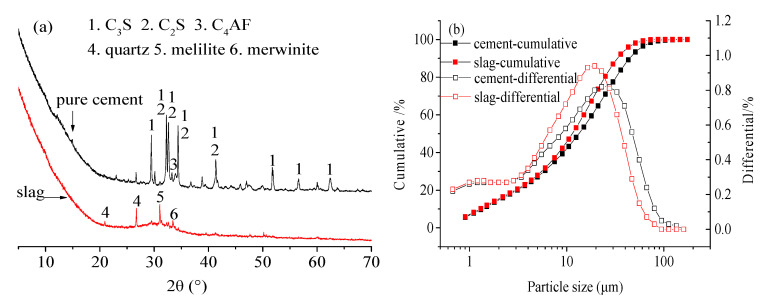
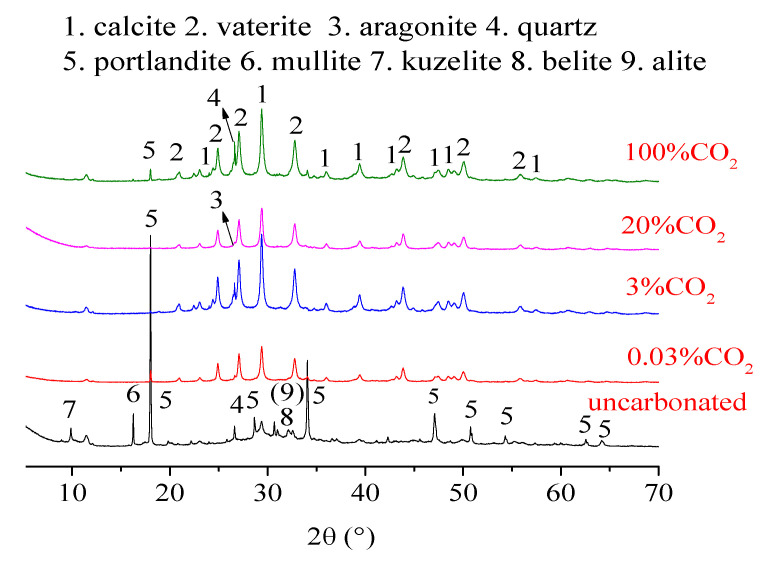
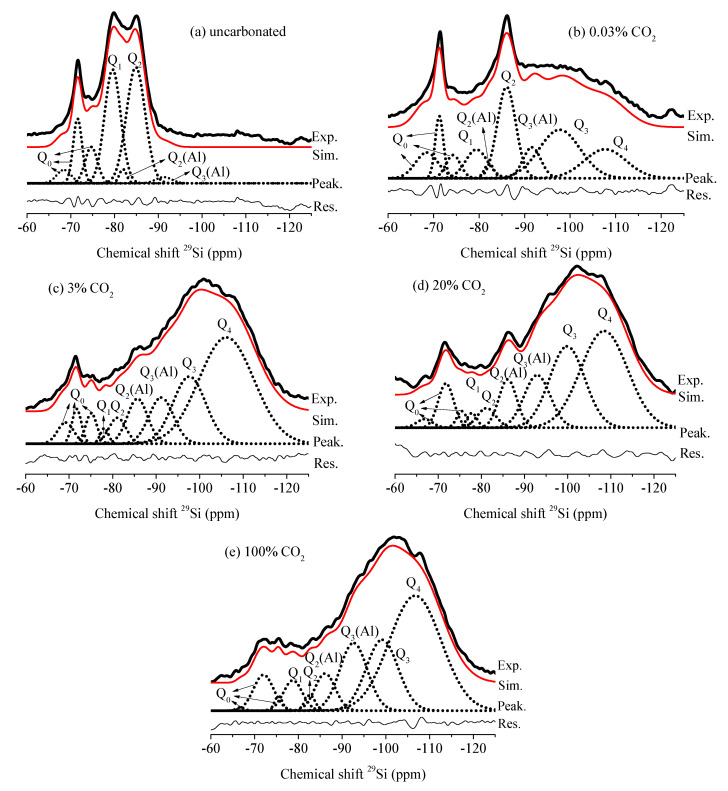
To investigate the effect of different CO2 concentrations on the carbonation results of slag blended cement pastes, carbonation experiments under natural (0.03% CO2) and accelerated conditions (3, 20, and 100% CO2) were investigated with various microscopic testing methods, including X-ray diffraction (XRD), 29Si magic angle spinning nuclear magnetic resonance (29Si MAS NMR) and scanning electron microscopy (SEM). The XRD results indicated that the major polymorphs of CaCO3 after carbonation were calcite and vaterite. The values of the calcite/(aragonite + vaterite) (c/(a + v)) ratios were almost the same in all carbonation conditions. Additionally, NMR results showed that the decalcification degree of C-S-H gel exposed to 0.03% CO2 was less than that exposed to accelerated carbonation; under accelerated conditions, it increased from 83.1 to 84.2% when the CO2 concentration improved from 3% to 100%. In SEM observations, the microstructures after accelerated carbonation were denser than those under natural carbonation but showed minor differences between different CO2 concentrations. In conclusion, for cement pastes blended with 20% slag, a higher CO2 concentration (above 3%) led to products different from those produced under natural carbonation. A further increase in CO2 concentration showed limited variation in generated carbonation products.
Overview
CoChat Summary
TL;DR
This study tested how natural carbonation (0.03% CO2) and accelerated carbonation (3%, 20%, 100% CO2) affect slag-blended cement paste, using XRD, 29Si MAS NMR, and SEM-EDS. The main result is that slag-blended pastes were relatively insensitive to CO2 concentration above 3%: CaCO3 polymorph ratios stayed similar, C-S-H decalcification changed only slightly, and microstructure differences were modest.
Key findings
- After carbonation, the main CaCO3 polymorphs were calcite and vaterite, with a small amount of aragonite; the paper reports that the c/(a + v) ratios were “almost the same” across carbonation conditions.
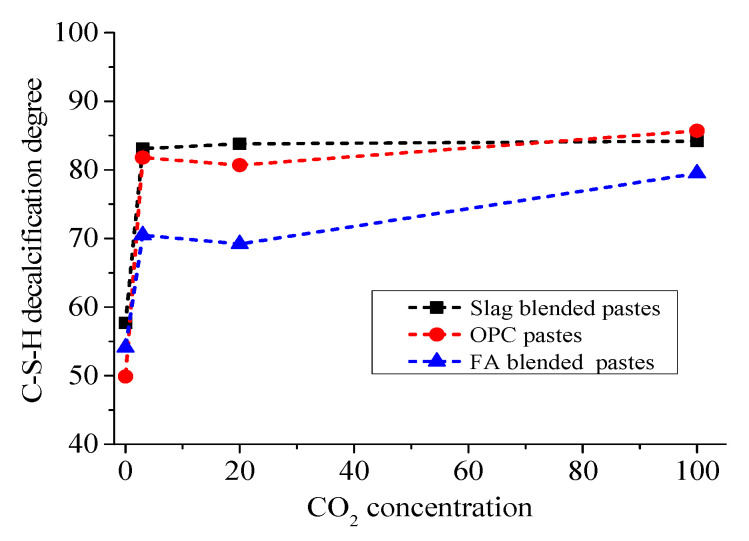
- The C-S-H decalcification degree was 57.7% under natural carbonation (0.03% CO2), versus about 84% under accelerated carbonation; within accelerated carbonation it increased only slightly from 83.1% to 84.2% as CO2 rose from 3% to 100%.
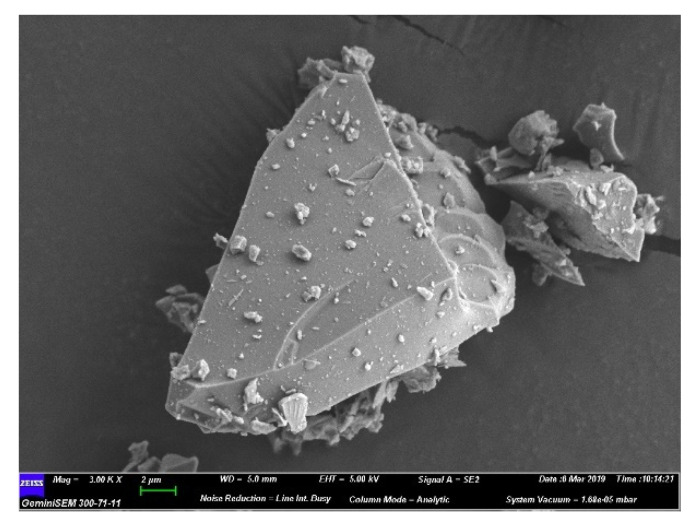
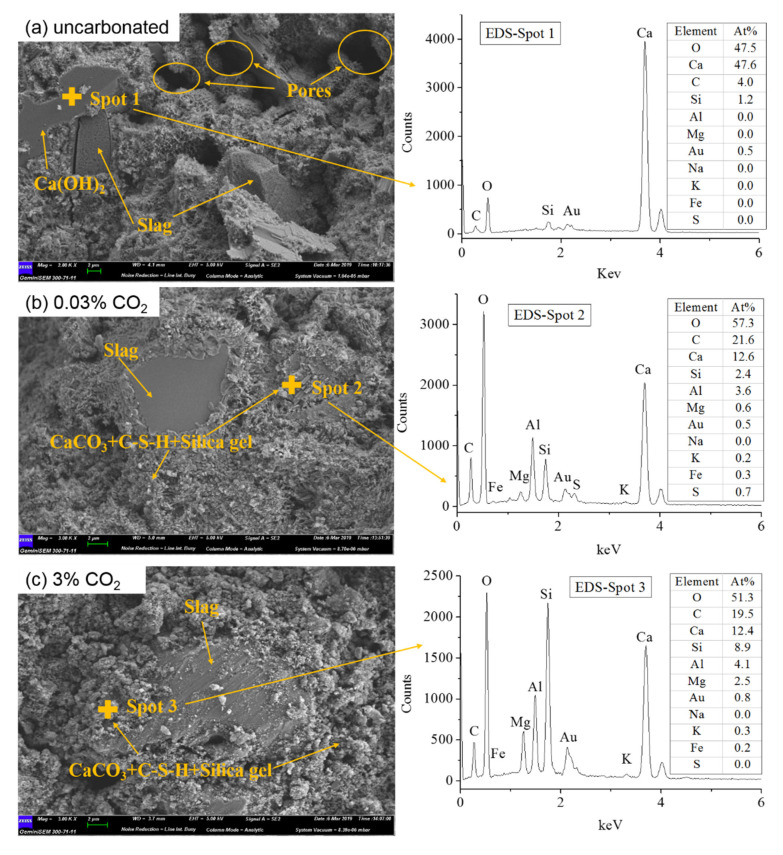
- SEM showed that samples carbonated under accelerated conditions were more compact and denser than those under natural carbonation, but morphology changed only modestly between 3%, 20%, and 100% CO2.
- The authors conclude that for paste with 20% slag replacement, CO2 concentrations above 3% produce carbonation products different from natural carbonation, but further increases in CO2 concentration cause limited additional change.
Methods
- Experimental design: cement paste with 20 wt.% cement replacement by slag, water-to-binder ratio 0.56, cured 60 days at 20 °C and 99% RH, then carbonated under 0.03% CO2 (natural) or 3%, 20%, 100% CO2 (accelerated).
- Analyses: XRD for mineral phases and CaCO3 polymorphs, 29Si MAS NMR for C-S-H decalcification, and SEM-EDS for microstructure and elemental composition.
- Carbonation was run for 90 days; the naturally carbonated sample had a carbonation depth of about 3 mm, and only the top 1 mm was used for micro measurements.
Limitations
- Stated in the paper: the study focuses on one slag replacement level (20%) and one paste system, so the conclusions are specific to that material mix.
- Evident from the text: natural carbonation was only analyzed in the near-surface region because the carbonation depth reached only about 3 mm, which limits comparison with the fully carbonated zone.
- Evident from the text: the paper compares four CO2 conditions but does not report longer-term field exposure or mechanical performance, so the findings are limited to mineralogy and morphology.
Model-written summary. Check it against the paper before relying on it.
Integrity signals
Registry
Cites
Statistics
Figures
Verification
Claims the paper makes
6 Valid · 0 Not valid · 6 Not checked · 38 Own results and interpretations
The cited sources support only part of this claim — read each source’s verdict below.
In the paper
“In contrast with the slag blended pastes, the decalcification degree in OPC and FA blended pastes was further improved when CO2 concentrations varied from 3% to 100%, as shown in Figure 5 [20,31].”
§ Slag Blended Cement Paste Carbonation under Different CO2 Concentrations: Controls on Mineralogy and Morphology of Products > 4. Results and Discussion > 4.2. NMR Spectra
What the sources say
- Partly supportedcites [20] Liu W. Li Y. Tang L. Dong Z. XRD and 29Si MAS NMR study on carbonated cement paste under accelerated carbonation using different concentration of CO2 Mater. Today Commun. 2019 19 464 470 10.1016/j.mtcomm.2019.05.007 sourceExperimental — accuracy not yet measured
The Materials and preparation section describes paste made from Portland cement and water, not a fly-ash blend. The Results (section 4.2, Table 4) show greater decalcification at 50% and 100% CO₂ than at 3%–20%, but the Discussion says decalcification was similar from 3% to 20%; the paper therefore does not support a steady increase across the full range or the claim about FA-blended paste. Page numbers are unavailable in our copy. (LLM, conf=0.90)
- Not checked — no full text of the sourcecites [31] Liu W. Li Y. Lin S. Tang L. Dong Z. Xing F. Dong B. Changes in chemical phases and microscopic characteristics of fly ash blended cement pastes in different CO2 concentrations Constr. Build. Mater. 2020 257 119598 10.1016/j.conbuildmat.2020.119598 source
plainstates a cause- Asserted: passes — The authors put it forward as true.
- Checkable: passes — It can be checked against evidence.
- Load-bearing: passes — The paper’s conclusions depend on it.
- Based: passes — The paper gives a reason why it holds.
- Rests on an assumption not shown here.
- Partly supported
The cited sources support only part of this claim — read each source’s verdict below.
In the paper
“while it was more compact and denser under accelerated carbonation, causing a potential decrease in the transport speed of CO2 [12,37].”
§ Slag Blended Cement Paste Carbonation under Different CO2 Concentrations: Controls on Mineralogy and Morphology of Products > 4. Results and Discussion > 4.3. SEM-EDS Results
What the sources say
- Partly supportedcites [12] Wu B. Ye G. Development of porosity of cement paste blended with supplementary cementitious materials after carbonation Constr. Build. Mater. 2017 145 52 61 10.1016/j.conbuildmat.2017.03.176 sourceExperimental — accuracy not yet measured
Our copy supports the densification half of the sentence: the MIP results section states that 'the total porosity of Portland cement paste (mortar, or concrete) is decreased after the carbonation (natural or accelerated)', and that both total and effective capillary porosity of P100 and F30 decrease after carbonation, with carbonation causing 'an apparent clogging of the microstructure between 0.01-0.1 um'. However, no passage in our copy links that denser microstructure to a decrease in the transport speed / diffusivity of CO2; the paper discusses transport-related work only by citing others (e.g. Villain and Thiery 2005 'Impact of carbonation on microstructure and transport properties of concrete', Song and Kwon 2007 on permeability) without making the CO2-transport inference itself. Additionally, for the high-BFS blends (B70, F10B54, F30B30) our copy reports the opposite microstructural trend — increased total and effective capillary porosity and a coarser pore structure — so the 'more compact and denser' description holds only for the Portland/FA pastes. (LLM, conf=0.72)
- Not checked — no full text of the sourcecites [37] Wang J. Xu H. Xu D. Du P. Zhou Z. Yuan L. Cheng X. Accelerated carbonation of hardened cement pastes: Influence of porosity Constr. Build. Mater. 2019 225 159 169 10.1016/j.conbuildmat.2019.07.088 source
hedgedstates a possible cause- Asserted: passes — The authors put it forward as true.
- Checkable: passes — It can be checked against evidence.
- Load-bearing: unclear — It is unclear whether the paper’s conclusions depend on it.
- Based: passes — The paper gives a reason why it holds.
- Partly supported
The cited sources support only part of this claim — read each source’s verdict below.
In the paper
“As seen from the results, decalcified C-S-H coexisted with the other phases in the carbonated sample, including unreacted clinkers, Ca-modified silica and CaCO3, which has been reported in the literature [20,36].”
§ Slag Blended Cement Paste Carbonation under Different CO2 Concentrations: Controls on Mineralogy and Morphology of Products > 4. Results and Discussion > 4.2. NMR Spectra
What the sources say
- Supportedcites [20] Liu W. Li Y. Tang L. Dong Z. XRD and 29Si MAS NMR study on carbonated cement paste under accelerated carbonation using different concentration of CO2 Mater. Today Commun. 2019 19 464 470 10.1016/j.mtcomm.2019.05.007 source
The Conclusions report that decalcified C-S-H coexists with other C-S-H phases after carbonation. Table 3 shows unhydrated material and Ca-modified silica gel in the carbonated samples, while the Discussion reports calcium carbonate polymorphs in those samples. Page numbers are unavailable in our copy. (LLM, conf=0.90)
- Partly supportedcites [36] Li Y. Liu W. Xing F. Wang S. Tang L. Lin S. Dong Z. Carbonation of the synthetic calcium silicate hydrate (C-S-H) under different concentrations of CO2: Chemical phases analysis and kinetics J. CO2 Util. 2020 35 303 313 10.1016/j.jcou.2019.10.001 sourceExperimental — accuracy not yet measured
Our copy supports most of the phase assemblage: Section 3.1 (p. 6) states that under accelerated conditions all C-S-H is decalcified and that the compositions of decalcified C-S-H include 'calcium modified silica gel and silica gel', while the Abstract (p. 2) and Section 3.2 (p. 6) / Conclusion (p. 11) report vaterite, aragonite and calcite (CaCO3) coexistent after carbonation alongside residue/decalcified C-S-H (Section 4.2, p. 10). However, the 'unreacted clinkers' element is not this paper's finding: its material is pure synthetic C-S-H powder (Ca/Si = 1.0), and Section 3.1 (p. 4) explicitly attributes the absence of isolated Q0 tetrahedra to 'the absence of C3S and C2S', i.e. no clinker phases were present. So the clinker part of the attributed assemblage is unsupported (indeed contrary) for this source, which discusses cement-paste/clinker systems only by citing others ([30] Auroy et al., [38] Liu et al.). (LLM, conf=0.78)
plain- Asserted: passes — The authors put it forward as true.
- Checkable: passes — It can be checked against evidence.
- Load-bearing: unclear — It is unclear whether the paper’s conclusions depend on it.
- Based: passes — The paper gives a reason why it holds.
- Supported
A result the paper reports from its own data — it cites no other source for it, so there is none to check. The quote shows it is in the paper.
In the paper
“under accelerated conditions, it increased from 83.1 to 84.2% when the CO2 concentration improved from 3% to 100%.”
- Also stated in: § 4.2. NMR Spectra · plain
“For the slag blended pastes, it was found that the degree of decalcification slowly improved from 83.1 to 84.2%, with an increase in CO2 concentration from 3% to 100% (Table 4 and Figure 5).”
§ Slag Blended Cement Paste Carbonation under Different CO2 Concentrations: Controls on Mineralogy and Morphology of Products > Abstract
plainstates a cause- Asserted: passes — The authors put it forward as true.
- Checkable: passes — It can be checked against evidence.
- Load-bearing: passes — The paper’s conclusions depend on it.
- Based: passes — The paper gives a reason why it holds.
- Also stated in: § 4.2. NMR Spectra · plain
A result the paper reports from its own data — it cites no other source for it, so there is none to check. The quote shows it is in the paper.
In the paper
“but showed minor differences between different CO2 concentrations.”
- Also stated in: § 4.3. SEM-EDS Results · plain
“No big differences were found for the samples carbonated from 3% to 100% CO2”
- Also stated in: § 5. Conclusions · plain
“Once the CO2 concentration exceeded 3%, differences in morphology were relatively modest.”
§ Slag Blended Cement Paste Carbonation under Different CO2 Concentrations: Controls on Mineralogy and Morphology of Products > Abstract
plain- Asserted: passes — The authors put it forward as true.
- Checkable: passes — It can be checked against evidence.
- Load-bearing: passes — The paper’s conclusions depend on it.
- Based: passes — The paper gives a reason why it holds.
- Also stated in: § 4.3. SEM-EDS Results · plain
31 more claims
Create a free account to see all 50 claims and to verify the 2 references still open.
- It may state two separate claims as one. 12
- Probably not a substantial claim. 4
Citations
Cites
Supplementary cementitious materials
Lothenbach, B., Scrivener, K., & Hooton, R. D. (2011) · Cement and Concrete Research · doi:10.1016/j.cemconres.2010.12.001 · Cited by 3,406 · cited 1×
“In concrete manufactured with slag to supplement Portland cement, the CH generated from cement hydration can be partially consumed, which decreases the alkalinity of the admixture and generates the C-S-H with a Ca/Si ratio of about 1 [15,16].”
BackgroundFERNANDEZBERTOS, M., SIMONS, S., HILLS, C., & CAREY, P. (2004) · Journal of Hazardous Materials · doi:10.1016/j.jhazmat.2004.04.019 · Cited by 1,079
Reinforcement corrosion in concrete structures, its monitoring and service life prediction––a review
Ahmad, S. (2003) · Cement and Concrete Composites · doi:10.1016/s0958-9465(02)00086-0 · Cited by 1,048
Bernal, S. A., Provis, J. L., Walkley, B., San Nicolas, R., Gehman, J. D., Brice, D. G., Kilcullen, A. R., Duxson, P., & van Deventer, J. S. J. (2013) · Cement and Concrete Research · doi:10.1016/j.cemconres.2013.06.007 · Cited by 1,019 · cited 1×
“, calcite, aragonite and vaterite) were generated accompanied with silica gel after the carbonation of C-S-H [4,10].”
MethodCarbonation of cement paste: Understanding, challenges, and opportunities
Šavija, B., & Luković, M. (2016) · Construction and Building Materials · doi:10.1016/j.conbuildmat.2016.04.138 · Cited by 866 · cited 2×
“The decalcification degree of C-S-H, defined as the proportions of decalcified C-S-H, can be calculated using Equation (1) [26]: L = 1 − Q + Q Al + Q Q + Q Al + Q × 100% (1)”
MethodThiery, M., Villain, G., Dangla, P., & Platret, G. (2007) · Cement and Concrete Research · doi:10.1016/j.cemconres.2007.04.002 · Cited by 755 · cited 3×
“, calcite, vaterite and aragonite) exist in natural environments [4,11].”
BackgroundMethodPapadakis, V. G. (2000) · Cement and Concrete Research · doi:10.1016/s0008-8846(99)00249-5 · Cited by 713
Villain, G., Thiery, M., & Platret, G. (2007) · Cement and Concrete Research · doi:10.1016/j.cemconres.2007.04.015 · Cited by 711 · cited 2×
“To explain these results, although CH is carbonated prior to C-S-H from a thermodynamic point of view [30], for the cement pastes blended with slag, abundant C-S-H generated from the pozzolanic reaction may hinder the CH in contact with the CO2 and to be carbonated as calcite.”
BackgroundCarbonation of cement-based materials: Challenges and opportunities
Ashraf, W. (2016) · Construction and Building Materials · doi:10.1016/j.conbuildmat.2016.05.080 · Cited by 657 · cited 1×
“Even 100% CO2 was used by some researchers to speed up the rate of carbonation [9,19].”
BackgroundFundamental Modeling and Experimental Investigation of Concrete Carbonation
(1991) · ACI Materials Journal · doi:10.14359/1863 · Cited by 598 · cited 4×
“03% in volume); thus, according to Fick’s second law [6], the diffusion of CO2 into the cement matrix is much slower than that in accelerated carbonation due to the small concentration of atmospheric CO2 at its interface with the surface of the concrete.”
BackgroundMethodInfluential
Cited by
Hay, R., Li, J., & Çelik, K. (2021) · Cement and Concrete Research · doi:10.1016/j.cemconres.2021.106683 · Cited by 128
“This is in line with other studies where the CO 2 concentration, temperature, and RH in the vicinity of the values adopted in this study were implemented to accelerate the carbonation of cementitious materials [37,74 – 77].”
BackgroundResultFang, Z., Liu, L., He, W., Han, K., Lan, H., Gao, Y., Sun, W., Han, Z., Xia, L., & Yang, P. (2024) · Journal of environmental chemical engineering · doi:10.1016/j.jece.2024.111975 · Cited by 36
He, W. F., Liu, L., Fang, Z., Wei, B., Jia, Q., Zhu, M., Wang, R., Qu, H., Gao, Y., & Xia, L. (2024) · Process Safety and Environmental Protection · doi:10.1016/j.psep.2024.12.052 · Cited by 29
Beskopylny, A. N., Stel’makh, S. A., Shcherban’, E. M., Маилян, Л. Р., Meskhi, B., Beskopylny, N., El'shaeva, D. M., & Kotenko, M. (2022) · Gels · doi:10.3390/gels8090530 · Cited by 28
CO2-mineralization strategy and mechanism of alkali-activated slag paste
Zheng, D., Ni, L., Zhang, C., Yang, S., & Cui, H. (2025) · Construction and Building Materials · doi:10.1016/j.conbuildmat.2025.140086 · Cited by 9
Factors Influencing the Carbonation Kinetics of Calcium Silicate-Based Binders—An Overview
Šiaučiūnas, R., Smigelskyte, A., & Aliukonyte, N. (2025) · Sustainability · doi:10.3390/su17094191 · Cited by 15
Buritatum, A., Horpibulsuk, S., Suddeepong, A., Yaowarat, T., Hoy, M., Aiamsri, K., Akkharawongwhatthana, K., & Arulrajah, A. (2025) · Construction and Building Materials · doi:10.1016/j.conbuildmat.2025.142193 · Cited by 8
Experimental Study on Carbonation Durability of Kaolin Strengthened with Slag Portland Cement
Wang, Q., Ma, Y., Wang, F., Shi, Z., You, H., Tian, Y., Liu, Y., Hu, Z., Song, H., Wang, D., et al. (2022) · Materials · doi:10.3390/ma15031240 · Cited by 7
“[10] observed through X-ray diffraction (XRD) tests that the main polycrystalline form of carbonated ordinary Portland cement is calcite (CaCO3).”
BackgroundAhmad, M. A., Ranaivomanana, H., Bonnet, S., et al. (2026) · European Journal of Environmental and Civil engineering · doi:10.1080/19648189.2026.2661732 · Cited by 4
Wei, P., Wang, W., Ma, X., Li, N., Wang, C., Liu, Y., Jiang, P., & Sun, M. (2026) · Journal of Environmental Management · doi:10.1016/j.jenvman.2026.130264 · Cited by 5
Sustainable utilization of industrial furnace slags as CO2-reactive materials for construction
Yong, C. L., Tan, A. Q., Zhang, F., Lee, H. V., & Mo, K. H. (2025) · Ain Shams Engineering Journal · doi:10.1016/j.asej.2025.103920 · Cited by 2
Hardening of Mortars from Blended Cement with Opoka Additive in CO2 Environment
Šiaučiūnas, R., Prichockiene, E., Valančius, Z., & Elsteris, A. (2024) · Ceramics · doi:10.3390/ceramics7040086 · Cited by 1
“W. Liu et al. investigated the effect of different CO 2 concentrations on the carbonation results of slag-blended cement pastes [24].”
Co2 Mineralization Mechanism of Alkali-Activated Slag Paste Under High-Humidity Carbonation CuringPreprint
Zheng, D., Ni, L., Yang, S., & Cui, H. (2024) · SSRN Electronic Journal · doi:10.2139/ssrn.4864781
Hu, Y., Yin, H., Xin, Y., Lv, J., Tang, Y., Ren, X., Yuan, H., Liu, Y., & Wu, B. (2026) · Journal of Building Engineering · doi:10.1016/j.jobe.2026.116040 · Cited by 2
Miao, C., 于淑会, Sun, K., Guo, X.-H., Tiejun, S., & Ke, G. (2026) · Journal of Building Engineering · doi:10.1016/j.jobe.2026.116944
Hydration and Microstructural Evolution of Cement Pastes Incorporating Submerged Arc Welding Slag
Rodríguez, C., Fernández, F. J. H., Sánchez, M., Gómez, P., Hernández, M., & Sanchez, I. (2026) · Infrastructures · doi:10.3390/infrastructures11080268
“This issue is particularly relevant because pore structure refinement, carbonate formation and CH consumption are closely interrelated in blended systems, and their combined interpretation generally requires complementary techniques such as MIP, TGA and XRD [6,7,13].”
Kim, I., Her, S., Park, D., & Wi, K. (2026) · Construction and Building Materials · doi:10.1016/j.conbuildmat.2026.147725
Metadata
- Authors
- Liu, W., Lin, S., Li, Y., Long, W., Dong, Z., & Tang, L.
- Affiliations
- Shenzhen University (CN)
- Guangdong Provincial Key Laboratory of Durability for Marine Civil Engineering, College of Civil and Transportation Engineering, Shenzhen University, Shenzhen 518060, China
- Shenzhen Institute of Information Technology (CN)
- Chalmers University of Technology (SE)
- Venue
- Materials
- Publisher
- MDPI AG
- Published
- 2020-08-01
- Volume
- 13
- Issue
- 15
- Pages
- 3404
- ISSN
- 1996-1944 (ISSN-L)
- PMC
- PMC7435485
- OpenAlex
- W3046334143
- Cited by
- 17
- References
- 38
- Citations by year
- 2026: 6 · 2025: 4 · 2024: 4 · 2022: 2 · 2021: 1
- FWCI
- 0.44
- Type
- journal article
- Language
- en
- Open access
- gold
- doi.org
- Licence
- Locations
- Materials (publishedVersion, cc-by)
- PubMed Central (publishedVersion, cc-by)
- PubMed (publishedVersion)
- DOAJ (DOAJ: Directory of Open Access Journals) (submittedVersion, cc-by-sa)
- Chalmers Research (Chalmers University of Technology) (submittedVersion)
- Funders
- National Natural Science Foundation of China (51678368, 51978408)
- The Science and Technology Project of Shenzhen, China (JCYJ20180305124844894)
- Topics
- Physical Sciences › Engineering › Civil and Structural Engineering › Concrete and Cement Materials Research
- Physical Sciences › Environmental Science › Environmental Engineering › CO2 Sequestration and Geologic Interactions
- Physical Sciences › Environmental Science › Environmental Engineering › Microbial Applications in Construction Materials
- Keywords
- slag-blended cement, CO2 concentration, accelerated carbonation, natural carbonation, calcite, vaterite, calcium carbonate polymorphs, carbonation products, microstructure
About these checks
Registry, retraction, Cites and statistics results are computed, not judged, with one exception: a printed reference that no index lists is read once by a model before it counts as a citation error. Claims are extracted by a model and kept only when their quote appears verbatim in the text; each cited source is then checked, with a model’s help, for whether it says what the claim relies on. Those verdicts can be wrong — read the claim’s quote and the cited source before relying on one.
The claim verdicts this report counts are experimental: their accuracy is not yet measured.
A language model drew the claims from the paper on 2026-10-10, under version 3 of the claim definition (model deepseek-v4.1-flash, prompt extract-v3).
A second model labelled each claim on 2026-10-10 (model jev-1.13-20260917, definition revision gold-guideline-v0.2).
Cited sources are checked with a language model’s help (gpt-6-sol and qwen3.8-omni-flash).
Statistics and arithmetic are recomputed, not judged.
Confidence bands are shown only for fields calibrated on our annotated test set. None is calibrated yet, so no band is shown.
What counts as a claim ›How we measure confidence ›How we check this ›
Are you an author, or do you see a problem with this page? Request a review
Data sources
Bibliographic data: Semantic Scholar, OpenAlex, Crossref.
Contains information from the Semantic Scholar Academic Graph Datasets, made available under the ODC Attribution License (ODC-BY 1.0).
Semantic Scholar’s data is described in: Kinney, R., et al. (2023). The Semantic Scholar Open Data Platform. arXiv:2301.10140.
