

The DOI matches its Crossref record; the references it cites are not checked yet.
Stabilization of a Clayey Soil with Ladle Metallurgy Furnace Slag Fines
Open accessAbstract
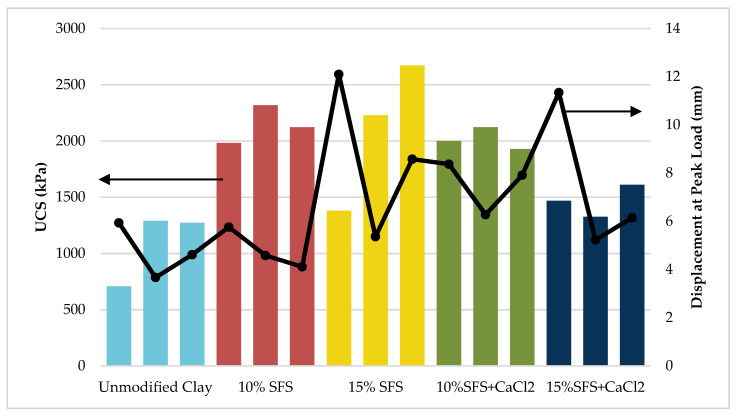
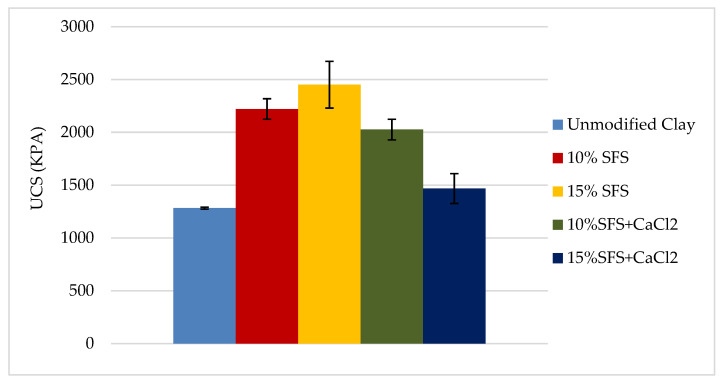
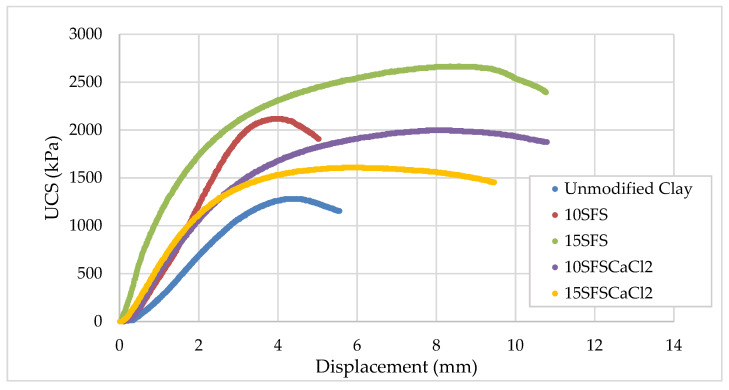
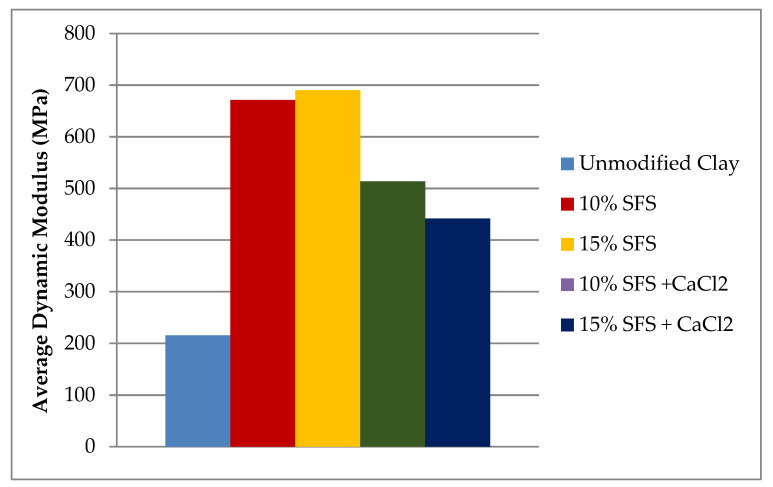
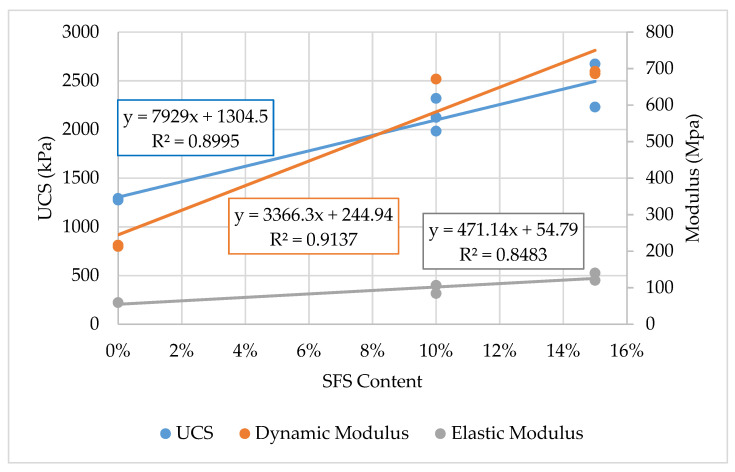
The research study described in this paper investigated the potential to use steel furnace slag (SFS) as a stabilizing additive for clayey soils. Even though SFS has limited applications in civil engineering infrastructure due to the formation of deleterious expansion in the presence of water, the free CaO and free MgO contents allow for the SFS to be a potentially suitable candidate for clayey soil stabilization and improvement. In this investigation, a kaolinite clay was stabilized with 10% and 15% ladle metallurgy furnace (LMF) slag fines by weight. This experimental study also included testing of the SFS mixtures with the activator calcium chloride (CaCl2), which was hypothesized to accelerate the hydration of the dicalcium silicate phase in the SFS, but the results show that the addition of CaCl2 was not found to be effective. Relative to the unmodified clay, the unconfined compressive strength increased by 67% and 91% when 10% and 15% LMF slag were utilized, respectively. Likewise, the dynamic modulus increased by 212% and 221% by adding 10% and 15% LMF slag, respectively. Specifically, the LMF slag fines are posited to primarily contribute to a mechanical rather than chemical stabilization mechanism. Overall, these findings suggest the effective utilization of SFS as a soil stabilization admixture to overcome problems associated with dispersive soils, but further research is required.
Overview
The claims and statistics of this paper haven’t been checked yet.
Run the check — free, no account needed. It reads the open-access text and checks the sources it cites.
Integrity signals
Registry
Cites
Statistics
Figures
Verification
Claims the paper makes
The claims and statistics of this paper haven’t been checked yet.
Run the check — free, no account needed. It reads the open-access text and checks the sources it cites.
Self-check
Percentages, sums and reported differences re-computed from the paper’s own numbers.
The self-check needs the paper’s full text.
Citations
The citation lists haven’t been fetched yet
References 92 · Cited by 57
Research works printed but not linked: 95
- Bergaya, F., and Lagaly, G. (2013). Mechanical properties of clays and clay minerals. Handbook of Clay Science, Elsevier. · DOI
- Desir, 2003, Causes of the catastrophic failure of an earth dam built on gypsiferous alluvium and dispersive clays (Altorricón, Huesca Province, NE Spain), Environ. Geol., 43, 842, 10.1007/s00254-002-0700-2 · DOI
- Werneck, 1983, Embankment failure on clay near Rio de Janeiro, J. Geotech. Eng., 109, 1460, 10.1061/(ASCE)0733-9410(1983)109:11(1460) · DOI
- Fletcher, 2002, Contrasting failure behaviour of two large landslides in clay and silt, Can. Geotech. J., 39, 46, 10.1139/t01-079 · DOI
- Petry, 2002, Review of stabilization of clays and expansive soils in pavements and lightly loaded structures—History, practice, and future, J. Mater. Civ. Eng., 14, 447, 10.1061/(ASCE)0899-1561(2002)14:6(447) · DOI
- Ikeagwuani, 2019, Emerging trends in expansive soil stabilisation: A review, J. Rock Mech. Geotech. Eng., 11, 423, 10.1016/j.jrmge.2018.08.013 · DOI
- Rafalko, 2007, Rapid chemical stabilization of soft clay soils, Transp. Res. Rec., 2026, 39, 10.3141/2026-05 · DOI
- Wilkinson, 2010, Stabilisation of clayey soils with industrial by-products: Part A, Proc. Inst. Civ. Eng. Improv., 163, 149
- Wilkinson, 2010, Stabilisation of clayey soils with industrial by-products: Part B, Proc. Inst. Civ. Eng. Improv., 163, 165
- Nidzam, 2010, Sustainable soil stabilisation with blastfurnace slag—A review, Proc. Inst. Civ. Eng. Mater., 163, 157
- James, 2016, Industrial wastes as auxiliary additives to cement/lime stabilization of soils, Adv. Civ. Eng., 2016, 1267391
- Jalal, 2020, On the recent trends in expansive soil stabilization using calcium-based stabilizer materials (CSMs): A comprehensive review, Adv. Mater. Sci. Eng., 2020, 1510969, 10.1155/2020/1510969 · DOI
- Shi, 2004, Steel slag—Its production, processing, characteristics, and cementitious properties, J. Mater. Civ. Eng., 16, 230, 10.1061/(ASCE)0899-1561(2004)16:3(230) · DOI
- Wang, G.C. (2016). The Utilization of Slag in Civil Infrastructure Construction, Woodhead Publishing. · DOI
- Motz, 2001, Products of steel slags an opportunity to save natural resources, Waste Manag., 21, 285, 10.1016/S0956-053X(00)00102-1 · DOI
- Yildirim, I.Z., and Prezzi, M. (2011). Chemical, mineralogical, and morphological properties of steel slag. Adv. Civ. Eng., 2011. · DOI
- Balcázar, N., Kühn, M., Baena, J.M., Formoso, A., and Piret, J. (1999). Summary report on RTD in iron and steel slags: Development and perspectives. Proceedings No. EUR 19066 EN, European Commission.
- Brand, 2015, Steel furnace slag aggregate expansion and hardened concrete properties, Cem. Concr. Compos., 60, 1, 10.1016/j.cemconcomp.2015.04.006 · DOI
- Deniz, 2010, Evaluation of expansive characteristics of reclaimed asphalt pavement and virgin aggregate used as base materials, Transp. Res. Rec., 2167, 10, 10.3141/2167-02 · DOI
- Dayioglu, 2014, Preventing swelling and decreasing alkalinity of steel slags used in highway infrastructures, Transp. Res. Rec., 2401, 52, 10.3141/2401-06 · DOI
- Senior, S.A., Szoke, S.I., and Rogers, C.A. (1994, January 3–7). Ontario’s experience with reclaimed materials for use as aggregates. Proceedings of the Transportation Association of Canada (TAC) Conference, Calgary, AB, Canada.
- Erlin, 2003, Forces of hydration that can cause havoc in concrete, Concr. Int., 25, 51
- Crawford, 1969, Building damage from expansive steel slag backfill, J. Soil Mech. Found. Div., 95, 1325, 10.1061/JSFEAQ.0001344 · DOI
- Gnaedinger, 1987, Open hearth slag—A problem waiting to happen, J. Perform. Constr. Facil., 1, 78, 10.1061/(ASCE)0887-3828(1987)1:2(78) · DOI
- Armaghani, 1988, Design related distress in concrete pavements, Concr. Int., 10, 43
- Cherian, 2015, A critical appraisal of the role of clay mineralogy in lime stabilization, Int. J. Geosynth. Gr. Eng., 1, 8, 10.1007/s40891-015-0009-3 · DOI
- Jha, 2020, Lime stabilization of soil: A physico-chemical and micro-mechanistic perspective, Indian Geotech. J., 50, 339, 10.1007/s40098-019-00371-9 · DOI
- Diamond, 1965, Mechanisms of soil-lime stabilization: An interpretive review, Highw. Res. Rec., 92, 83
- Aldeeky, H., and Al Hattamleh, O. (2017). Experimental study on the utilization of fine steel slag on stabilizing high plastic subgrade soil. Adv. Civ. Eng., 2017. · DOI
- Ameen, H., Jamiolkowski, M., Manassero, M., and Shehata, H. (2019). Treatment of clayey soils with steel furnace slag and lime for road construction in the South West of Iran. Recent Thoughts in Geoenvironmental Engineering, Springer.
- Chan, 2011, Reusing dredged marine clay by solidification with steel slag: A study of compressive strength, Int. J. Civ. Struct. Eng., 2, 270
- Chan, 2014, Some insights to the reuse of dredged marine soils by admixing with activated steel slag, Adv. Civ. Eng., 2014, 345134
- Manso, 2013, The use of ladle furnace slag in soil stabilization, Constr. Build. Mater., 40, 126, 10.1016/j.conbuildmat.2012.09.079 · DOI
- Shen, J., Xu, Y., Chen, J., and Wang, Y. (2019). Study on the stabilization of a new type of waste solidifying agent for soft soil. Materials, 12. · DOI
- Xu, 2019, Soft clay stabilization using ladle slag-ground granulated blastfurnace slag blend, Appl. Clay Sci., 178, 105136, 10.1016/j.clay.2019.105136 · DOI
- Shalabi, 2017, Effect of by-product steel slag on the engineering properties of clay soils, J. King Saud Univ. Eng. Sci., 29, 394
- Ashango, 2016, Behavior of expansive soil treated with steel slag, rice husk ash, and lime, J. Mater. Civ. Eng., 28, 6016008, 10.1061/(ASCE)MT.1943-5533.0001547 · DOI
- Ismail, 2019, The utilization of electric arc furance slag in soil improvement, Geotech. Geol. Eng., 37, 401, 10.1007/s10706-018-0619-3 · DOI
- Akinwumi, 2014, Soil modification by the application of steel slag, Period. Polytech. Civ. Eng., 58, 371, 10.3311/PPci.7239 · DOI
- Akinmusuru, 1991, Potential beneficial uses of steel slag wastes for civil engineering purposes, Resour. Conserv. Recycl., 5, 73, 10.1016/0921-3449(91)90041-L · DOI
- Yildirim, I.Z., Prezzi, M., Vasudevan, M., and Santoso, H. (2013). Use of Soil-Steel Slag-Class-C Fly Ash Mixtures in Subgrade Applications, Joint Transportation Research Program. Report FHWA/IN/JTRP-2013/06. · DOI
- Poh, 2006, Soil stabilization using basic oxygen steel slag fines, J. Mater. Civ. Eng., 18, 229, 10.1061/(ASCE)0899-1561(2006)18:2(229) · DOI
- Maslehuddin, 2017, Method and mechanisms of soil stabilization using electric arc furnace dust, Sci. Rep., 7, 46676, 10.1038/srep46676 · DOI
- Zumrawi, 2017, Laboratory study of steel slag used for stabilizing expansive soil, Asian Eng. Rev., 4, 1, 10.20448/journal.508.2017.41.1.6 · DOI
- Denies, 2012, Stabilizing clays using basic oxygen steel slag (BOS), Recent Research, Advances and Execution Aspects of Ground Improvement Works, II, 403
- Abdi, 2011, Effects of basic oxygen steel slag (BOS) on strength and durability of kaolinite, Int. J. Civ. Eng., 9, 81
- Wang, 2010, Hydration properties of basic oxygen furnace steel slag, Constr. Build. Mater., 24, 1134, 10.1016/j.conbuildmat.2009.12.028 · DOI · Paper page
- Belhadj, 2012, Characterization and activation of basic oxygen furnace slag, Cem. Concr. Compos., 34, 34, 10.1016/j.cemconcomp.2011.08.012 · DOI
- Shi, 2002, Characteristics and cementitious properties of ladle slag fines from steel production, Cem. Concr. Res., 32, 459, 10.1016/S0008-8846(01)00707-4 · DOI
- Montenegro, 2013, Ladle furnace slag in the construction of embankments: Expansive behavior, J. Mater. Civ. Eng., 25, 972, 10.1061/(ASCE)MT.1943-5533.0000642 · DOI
- 2009, Characterization of ladle furnace basic slag for use as a construction material, Constr. Build. Mater., 23, 1788, 10.1016/j.conbuildmat.2008.10.003 · DOI
- Brand, 2018, Interfacial transition zone of cement composites with steel furnace slag aggregates, Cem. Concr. Compos., 86, 117, 10.1016/j.cemconcomp.2017.11.012 · DOI
- Mindess, S., Francis, Y.J., and Darwin, D. (2003). Concrete, Prentice Hall. [2nd ed.].
- Muhmood, 2009, Cementitious and pozzolanic behavior of electric arc furnace steel slags, Cem. Concr. Res., 39, 102, 10.1016/j.cemconres.2008.11.002 · DOI
- Mahieux, 2014, Quantification of hydraulic phase contained in a basic oxygen furnace slag, J. Mater. Civ. Eng., 26, 593, 10.1061/(ASCE)MT.1943-5533.0000867 · DOI
- Murphy, 1997, Enhancement of the cementitious properties of steelmaking slag, Can. Metall. Q., 36, 315, 10.1179/cmq.1997.36.5.315 · DOI
- Adolfsson, 2011, Influence of mineralogy on the hydraulic properties of ladle slag, Cem. Concr. Res., 41, 865, 10.1016/j.cemconres.2011.04.003 · DOI
- Conjeaud, 1981, A new steel slag for cement manufacture: Mineralogy and hydraulicity, Cem. Concr. Res., 11, 85, 10.1016/0008-8846(81)90012-0 · DOI
- Gebhardt, R.F. (1988). Rapid Methods for Chemical Analysis of Hydraulic Cement, American Society for Testing and Materials. · DOI
- Lee, 2017, Quantitative evaluation of free CaO in electric furnace slag using the ethylene glycol method, Constr. Build. Mater., 131, 676, 10.1016/j.conbuildmat.2016.11.047 · DOI
- Kneller, 1994, Determination of original free lime content of weathered iron and steel slags by thermogravimetric analysis, Transp. Res. Rec., 1434, 17
- Gupta, 1994, Characterization of base and subbase iron and steel slag aggregates causing deposition of calcareous tufa in drains, Transp. Res. Rec., 1434, 8
- Coomarasamy, 1995, Effects of moisture on surface chemistry of steel slags and steel slag-asphalt paving mixes, Transp. Res. Rec., 1492, 85
- Brand, 2016, Expansive and concrete properties of SFS–FRAP aggregates, J. Mater. Civ. Eng., 28, 1, 10.1061/(ASCE)MT.1943-5533.0001403 · DOI
- Chandru, P., Karthikeyan, J., and Natarajan, C. (2020). Steel slag—A strong and sustainable substitute for conventional concreting materials. Sustainable Materials in Building Construction, Springer. · DOI
- Javellana, 1982, Extraction of free lime in portland cement and clinker by ethylene glycol, Cem. Concr. Res., 12, 399, 10.1016/0008-8846(82)90088-6 · DOI
- Anday, 1961, Accelerated curing for lime-stabilized soils, Highw. Res. Board Bull., 304, 1
- Malhotra, V.M. (2006). Nondestructive tests. Significance of Tests and Properties of Concrete and Concrete-Making Materials, ASTM International. · DOI
- Nauleau, 2013, Free-Free resonance testing of in situ deep mixed soils, Geotech. Test. J., 36, 283, 10.1520/GTJ20120058 · DOI
- Nazarian, 1999, Structural field testing of flexible pavement layers with seismic methods for quality control, Transp. Res. Rec., 1654, 50, 10.3141/1654-06 · DOI
- Hilbrich, 2007, Rapid alternative for laboratory determination of resilient modulus input values on stabilized materials for AASHTO mechanistic-empirical design guide, Transp. Res. Rec., 2026, 63, 10.3141/2026-08 · DOI
- 2011, Assessment of stabilised soil strength with geophysical methods, Proc. Inst. Civ. Eng. Improv., 164, 109
- Reiffsteck, 2018, Influence of drying on the stiffness and strength of cement-stabilized soils, Geotech. Geol. Eng., 36, 1463, 10.1007/s10706-017-0401-y · DOI
- Toohey, 2012, Seismic modulus growth of lime-stabilised soil during curing, Geotechnique, 62, 161, 10.1680/geot.9.P.122 · DOI
- Emery, J.J. (1982). Slag utilization in pavement construction. Extending Aggregate Resources, American Society for Testing and Materials. ASTM Special Technical Publication 774. · DOI
- Geiseler, 1996, Use of steelworks slag in Europe, Waste Manag., 16, 59, 10.1016/S0956-053X(96)00070-0 · DOI
- Pellegrino, 2013, Experimental behavior of reinforced concrete beams with electric arc furnace slag as recycled aggregate, ACI Mater. J., 110, 197
- Halikia, 1993, Application of various methods of nonisothermal kinetic analysis to magnesium hydroxide decomposition, Int. J. Chem. Kinet., 25, 609, 10.1002/kin.550250803 · DOI
- 2019, Relations between static and dynamic moduli of sedimentary rocks, Geophys. Prospect., 67, 128, 10.1111/1365-2478.12711 · DOI
- Gheibi, A., and Hedayat, A. (2018, January 10–13). The relation between static Young’s modulus and dynamic bulk modulus of granular materials and the role of stress history. Proceedings of the Geotechnical Earthquake Engineering and Soil Dynamics V, Austin, TX, USA. · DOI
- Tutuncu, 1998, Nonlinear viscoelastic behavior of sedimentary rocks, Part I: Effect of frequency and strain amplitude, Geophysics, 63, 184, 10.1190/1.1444311 · DOI
- 2009, Static and dynamic moduli of a weak sandstone, Geophysics, 74, WA103, 10.1190/1.3052113 · DOI
- AnhDan, 2002, Comparison of Young’s moduli of dense sand and gravel measured by dynamic and static methods, Geotech. Test. J., 25, 349, 10.1520/GTJ11290J · DOI
- Bell, 1996, Lime stabilization of clay minerals and soils, Eng. Geol., 42, 223, 10.1016/0013-7952(96)00028-2 · DOI
- Prusinski, 1999, Effectiveness of portland cement and lime in stabilizing clay soils, Transp. Res. Rec., 1652, 215, 10.3141/1652-28 · DOI
- Mishra, 2019, Subgrade soil stabilization using stone dust and coarse aggregate: A cost effective approach, Int. J. Geosynth. Gr. Eng., 5, 20, 10.1007/s40891-019-0171-0 · DOI
- Soosan, 2005, Utilization of quarry dust to improve the geotechnical properties of soils in highway construction, Geotech. Test. J., 28, 391, 10.1520/GTJ11768 · DOI
- Okagbue, 1999, Potential of marble dust to stabilise red tropical soils for road construction, Eng. Geol., 53, 371, 10.1016/S0013-7952(99)00036-8 · DOI
- Igwe, 2017, Alternative approach to clay stabilization using granite and dolerite dusts, Geotech. Geol. Eng., 35, 1657, 10.1007/s10706-017-0200-5 · DOI
- Taylor, H.F.W. (1997). Cement Chemistry, Thomas Telford. [2nd ed.]. · DOI
- Wanatowski, 2017, Strength improvement of lime-treated clay with sodium chloride, Geotech. Res., 4, 192, 10.1680/jgere.17.00001 · DOI
- Davoudi, 2011, Interaction of lime and sodium chloride in a low plasticity fine grain soils, J. Appl. Sci., 11, 330, 10.3923/jas.2011.330.335 · DOI
- Lees, 1982, Sodium chloride as an additive in lime-soil stabilization, Highw. Eng., 29, 2
- Belhadj, 2014, Properties of hydraulic paste of basic oxygen furnace slag, Cem. Concr. Compos., 45, 15, 10.1016/j.cemconcomp.2013.09.016 · DOI
- 2004, Chemical assessment of the electric arc furnace slag as construction material: Expansive compounds, Cem. Concr. Res., 34, 1881, 10.1016/j.cemconres.2004.01.029 · DOI
Metadata
- Authors
- Brand, A. S., Singhvi, P., Fanijo, E. O., & Tutumluer, E.
- Affiliations
- Virginia Tech (US)
- University of Illinois Urbana-Champaign (US)
- Corresponding author
- Brand, Alexander S.
- Venue
- Materials
- Publisher
- MDPI AG
- Published
- 2020-09-24
- Volume
- 13
- Issue
- 19
- Pages
- 4251
- ISSN
- 1996-1944 (ISSN-L)
- PMC
- PMC7579171
- OpenAlex
- W3088808738
- Cited by
- 57
- References
- 92
- Citations by year
- 2026: 8 · 2025: 11 · 2024: 12 · 2023: 11 · 2022: 9 · 2021: 5 · 2020: 1
- FWCI
- 3.80
- Type
- journal article
- Language
- en
- Open access
- gold
- doi.org
- Licence
- Locations
- Materials (publishedVersion, cc-by)
- PubMed Central (publishedVersion, cc-by)
- PubMed (publishedVersion)
- VTechWorks (Virginia Tech) (submittedVersion, cc-by)
- DOAJ (DOAJ: Directory of Open Access Journals) (submittedVersion, cc-by-sa)
- Funders
- University of Illinois at Urbana-Champaign
- Division of Materials Research
- Topics
- Physical Sciences › Engineering › Civil and Structural Engineering › Geotechnical Engineering and Soil Stabilization
- Physical Sciences › Engineering › Building and Construction › Materials Engineering and Processing
- Physical Sciences › Engineering › Civil and Structural Engineering › Geotechnical and construction materials studies
- Keywords
- steel slag, soil stabilization, clay soil, kaolinite, unconfined compressive strength, dynamic modulus, dispersive soils, industrial by-product utilization
About these checks
Registry, retraction, Cites and statistics results are computed, not judged, with one exception: a printed reference that no index lists is read once by a model before it counts as a citation error. Claims are extracted by a model and kept only when their quote appears verbatim in the text; each cited source is then checked, with a model’s help, for whether it says what the claim relies on. Those verdicts can be wrong — read the claim’s quote and the cited source before relying on one.
Statistics and arithmetic are recomputed, not judged.
Confidence bands are shown only for fields calibrated on our annotated test set. None is calibrated yet, so no band is shown.
What counts as a claim ›How we measure confidence ›How we check this ›
Are you an author, or do you see a problem with this page? Request a review
How to cite
Cite CoChat for the checks on this page, and the paper for its own findings.
- This page
- CoChat. (2026). Citation check: Stabilization of a Clayey Soil with Ladle Metallurgy Furnace Slag Fines. https://app.cochat.ai/papers/10.3390/ma13194251
- The paper
- Brand, A. S., Singhvi, P., Fanijo, E. O., & Tutumluer, E. (2020). Stabilization of a Clayey Soil with Ladle Metallurgy Furnace Slag Fines. Materials. https://doi.org/10.3390/ma13194251
