

Prediction of the Compressive Strength of Recycled Aggregate Concrete Based on Artificial Neural Network
Open accessThe DOI matches its Crossref record; 66 of the 66 references it cites were found in a registry or an index; none of the 31 sources its claims cite is checked for support yet.
Abstract
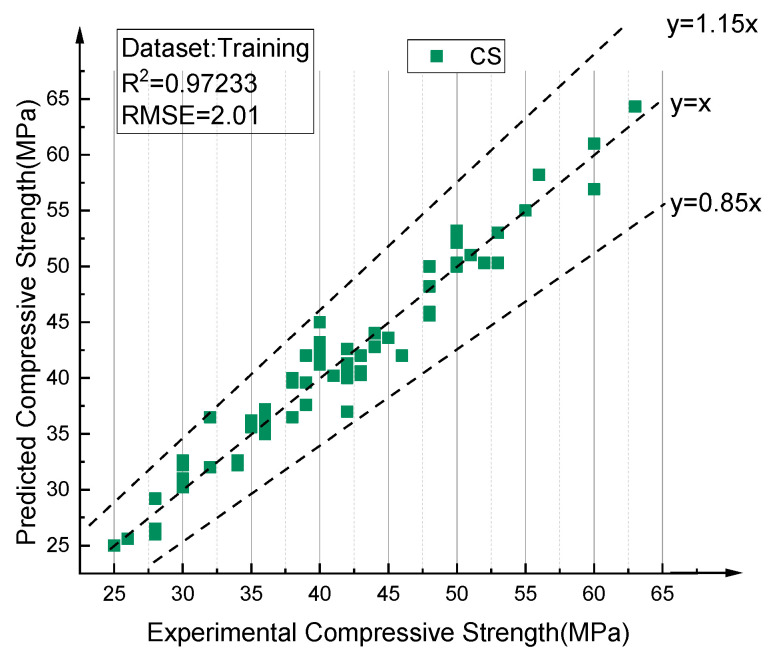
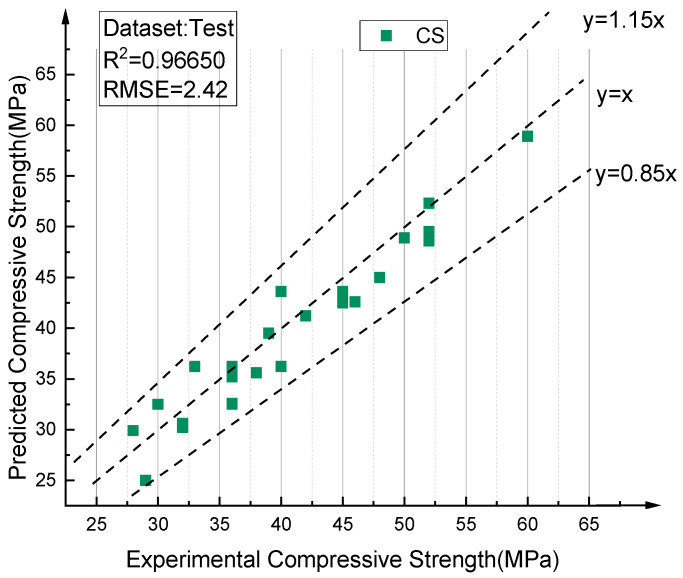
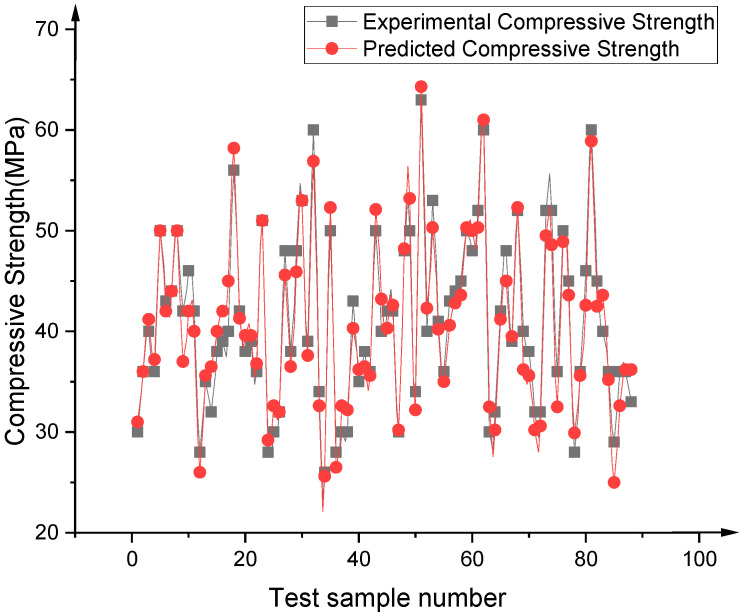
Recycled aggregate concrete (RAC), due to its high porosity and the residual cement and mortar on its surface, exhibits weaker strength than common concrete. To guarantee the safe use of RAC, a compressive strength prediction model based on artificial neural network (ANN) was built in this paper, which can be applied to predict the RAC compressive strength for 28 days. A data set containing 88 data points was obtained by relative tests with different mix proportion designs. The data set was used to develop an ANN, whose optimal structure was determined using the trial-and-error method by taking cement content (C), sand content (S), natural coarse aggregate content (NCA), recycled coarse aggregate content (RCA), water content (W), water–colloid ratio (WCR), sand content rate (SR), and replacement rate of recycled aggregate (RRCA) as input parameters. On the basis of different numbers of hidden layers, numbers of hidden layer neurons, and transfer functions, a total of 840 different back propagation neural network (BPNN) models were developed using MATLAB software, which were then sorted according to the correlation coefficient R2. In addition, the optimal BPNN structure was finally determined to be 8–12–8–1. For the training set, the correlation coefficient R2 = 0.97233 and RMSE = 2.01, and for the testing set, the correlation coefficient R2 = 0.96650 and RMSE = 2.42. The model prediction deviations of the two were both less than 15%, and the results show that the ANN achieved pretty accurate prediction on the compressive strength of RAC. Finally, a sensitivity analysis was carried out, through which the impact of the input parameters on the predicted compressive strength of the RAC was obtained.
Overview
CoChat Summary
TL;DR
An artificial neural network was developed to predict the 28-day compressive strength of recycled aggregate concrete using 88 experimental mix proportions and eight input parameters. The optimal 8–12–8–1 BPNN achieved testing R² = 0.96650 and RMSE = 2.42, with cement content identified as the most influential input.
Key findings
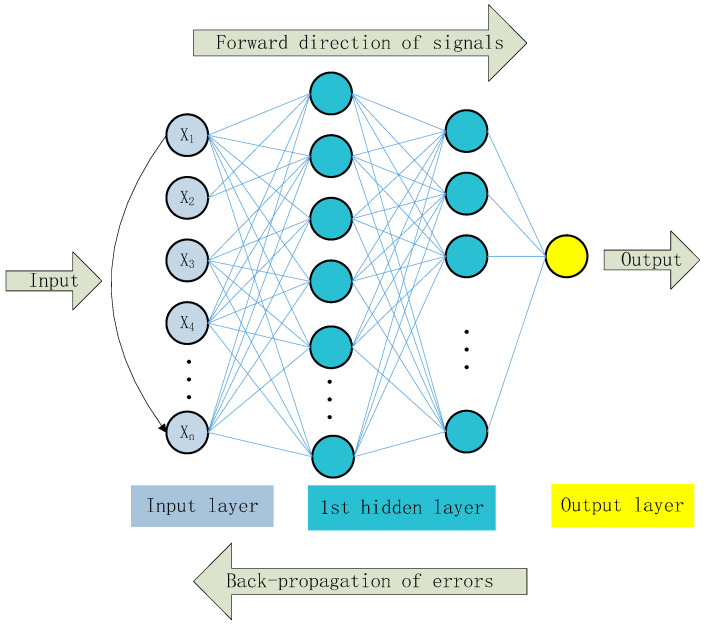
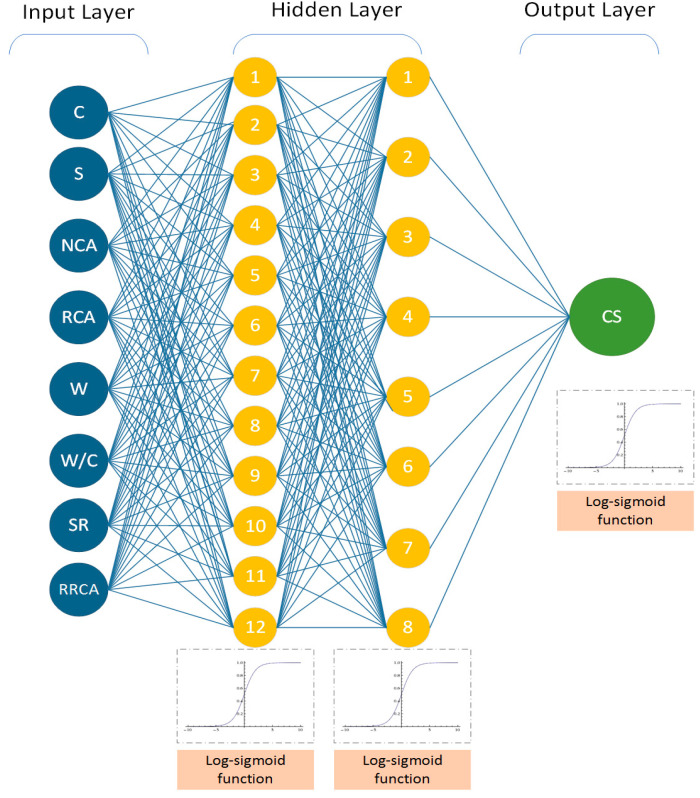
- The optimal BPNN structure was 8–12–8–1, with two hidden layers containing 12 and 8 neurons and a Log-sigmoid activation function; training performance was R² = 0.97233 and RMSE = 2.01, while testing performance was R² = 0.96650 and RMSE = 2.42. Prediction deviations for all samples were controlled to within 15%.
- A total of 840 BPNN models were developed using a trial-and-error approach; the data set contained 88 mix proportions, with 62 (70.45%) used for training and 26 (29.55%) for testing.
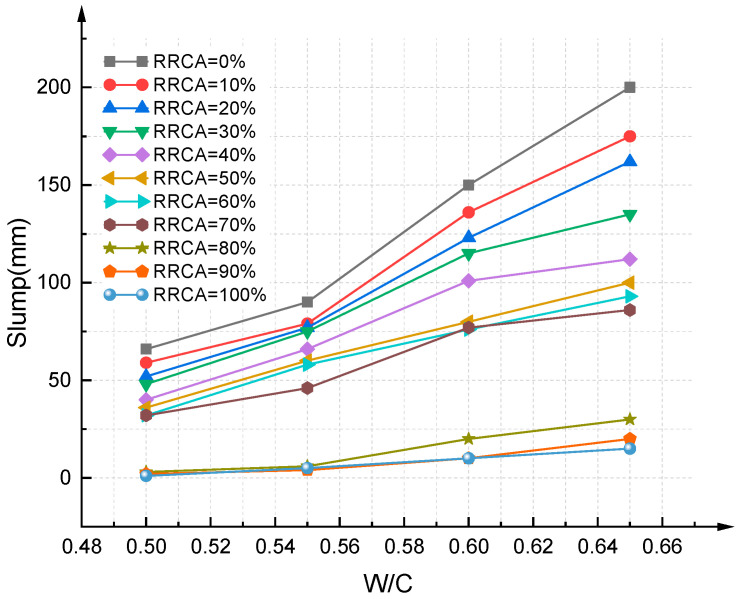
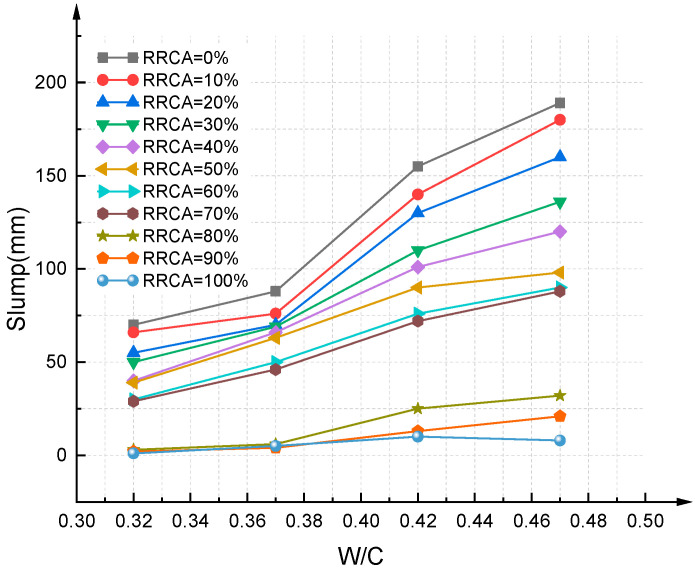
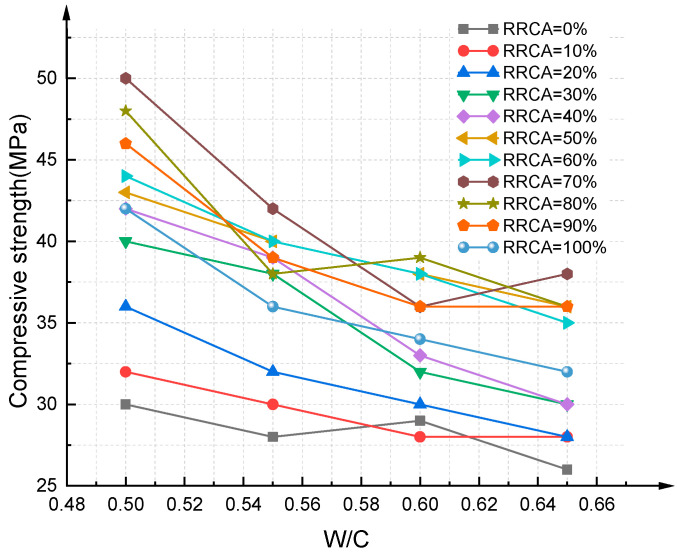
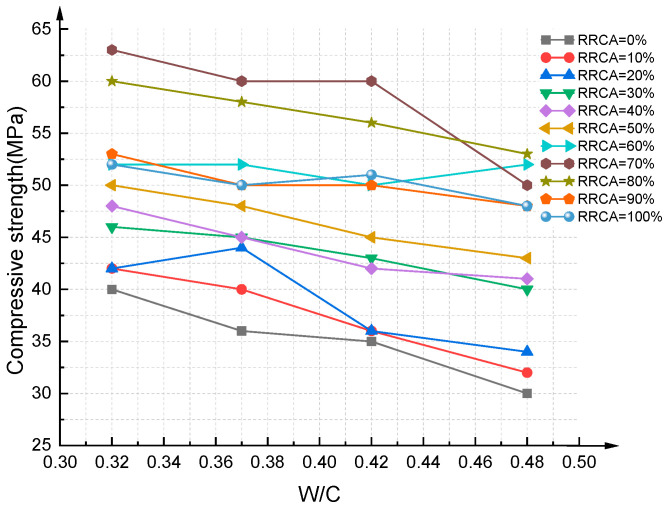
- Experimentally, RAC compressive strength reached as high as 63 MPa, and the best replacement rate of recycled aggregate was 70%; slump increased with increasing water–cement ratio and decreased with increasing RRCA at constant water–cement ratio.
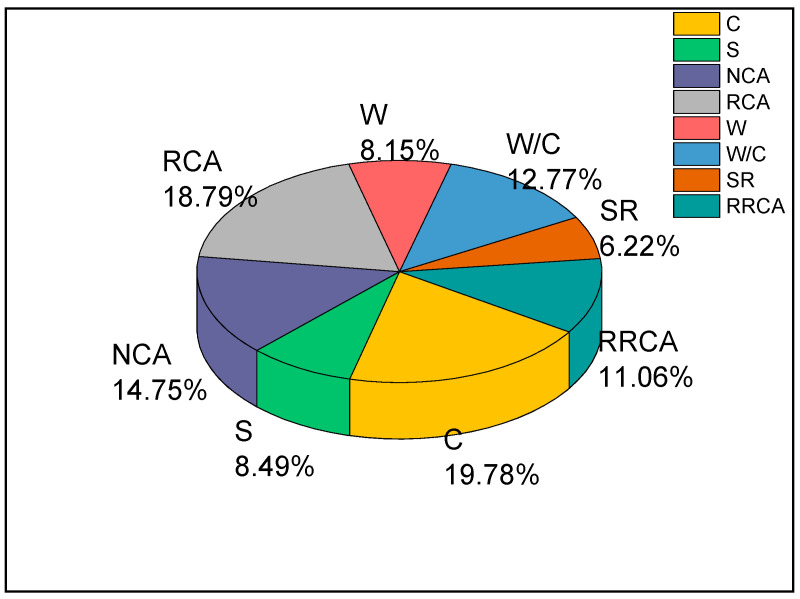
- Sensitivity analysis showed cement content had the largest impact factor at 19.78%, followed by RCA (18.79%), NCA (14.75%), W/C (12.77%), RRCA (11.06%), S (8.49%), W (8.15%), and SR (6.22%); all eight inputs had impact factors above 2%.
Methods
- Experimental data came from 88 RAC mix proportions designed with variables C, S, NCA, RCA, W, WCR, SR, and RRCA; RRCA was set from 0–100% at 10% intervals, and three 150 mm × 150 mm × 150 mm specimens were made per mix, cured for 28 days at 20 ± 2 °C and 95% relative humidity, and tested according to GB/T50081-2002.
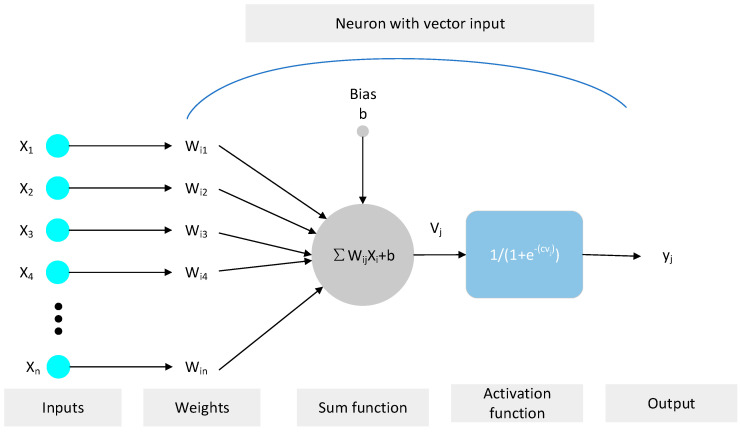
- The prediction model was a back propagation neural network with 8 input parameters and 1 output parameter (compressive strength), implemented in MATLAB; data were standardized to [0, 1], and the Levenberg-Marquardt algorithm and sigmoid transfer functions were used.
- Model development used a trial-and-error method to vary hidden layers, hidden neurons, and transfer functions, producing 840 BPNN models; models were evaluated using R², MSE, and RMSE, and a weight-based sensitivity analysis was performed to assess input parameter importance.
Limitations
- The paper states that the study may not be perfect due to limitations with respect to the authors’ time and knowledge, and that more sample groups can be set in practical applications to achieve more accurate and reliable prediction.
- The text makes evident that the model was developed and tested on a single experimental data set of 88 mix proportions, with no external validation beyond the 26-sample test split.
- The text also makes evident that the sensitivity analysis is based on ANN connection weights and is used to rank input contributions, not to establish causal relationships.
Model-written summary. Check it against the paper before relying on it.
Integrity signals
Registry
Cites
Statistics
Figures
Verification
Claims the paper makes
0 Valid · 1 Not valid · 14 Not checked · 42 Own results and interpretations
The paper states this without a source or data behind it here, so there is nothing to check it against. The quote shows it is in the paper.
In the paper
“In addition, the best RRCA rate is 70%.”
§ Prediction of the Compressive Strength of Recycled Aggregate Concrete Based on Artificial Neural Network > 7. Conclusions
plain- Asserted: passes — The authors put it forward as true.
- Checkable: passes — It can be checked against evidence.
- Load-bearing: passes — The paper’s conclusions depend on it.
- Based: unclear — It is unclear why the paper says it holds.
A result the paper reports from its own data — it cites no other source for it, so there is none to check. The quote shows it is in the paper.
In the paper
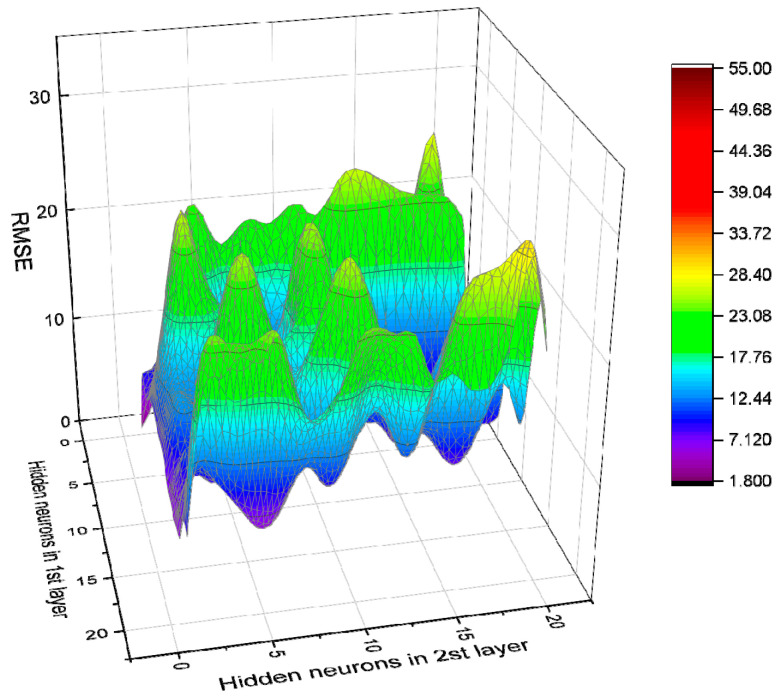
“Based on different settings of BPNN parameters, a total of 840 BPNN models were studied and developed.”
- Also stated in: § 5. Results · plain
“A total of 840 BPNN models were developed based on different numbers of hidden layers, hidden layer neurons, and transfer functions.”
- Also stated in: § 7. Conclusions · plain
“A total of 840 BPNN models were developed using a trial-and-error approach, for which the C (kg/m3), S (kg/m3), NCA (kg/m3), RCA (kg/m3), Water (kg/m3) W/C, SR (%), and RRCA (%) were taken as the input parameters.”
§ Prediction of the Compressive Strength of Recycled Aggregate Concrete Based on Artificial Neural Network > 4. Discussion > 4.2. BPNN Model Development
plain- Asserted: passes — The authors put it forward as true.
- Checkable: passes — It can be checked against evidence.
- Load-bearing: passes — The paper’s conclusions depend on it.
- Based: passes — The paper gives a reason why it holds.
- Rests on an assumption not shown here.
- Also stated in: § 5. Results · plain
A result the paper reports from its own data — it cites no other source for it, so there is none to check. The quote shows it is in the paper.
In the paper
“For the training set, the correlation coefficient R2 = 0.97233 and RMSE = 2.01”
§ Prediction of the Compressive Strength of Recycled Aggregate Concrete Based on Artificial Neural Network > Abstract
plainstates an association- Asserted: passes — The authors put it forward as true.
- Checkable: passes — It can be checked against evidence.
- Load-bearing: passes — The paper’s conclusions depend on it.
- Based: passes — The paper gives a reason why it holds.
A result the paper states — it cites no source for it, so there is none to check. The quote shows it is in the paper.
In the paper
“A total of 88 different mix proportions of RAC were designed”
§ Prediction of the Compressive Strength of Recycled Aggregate Concrete Based on Artificial Neural Network > 7. Conclusions
plain- Asserted: passes — The authors put it forward as true.
- Checkable: passes — It can be checked against evidence.
- Load-bearing: passes — The paper’s conclusions depend on it.
- Based: passes — The paper gives a reason why it holds.
A result the paper reports from its own data — it cites no other source for it, so there is none to check. The quote shows it is in the paper.
In the paper
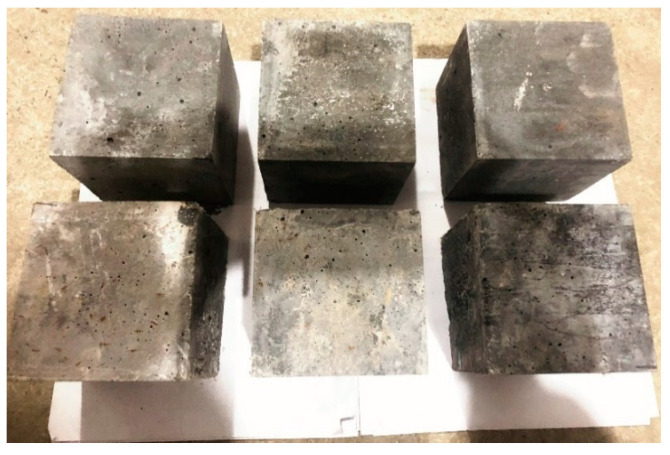
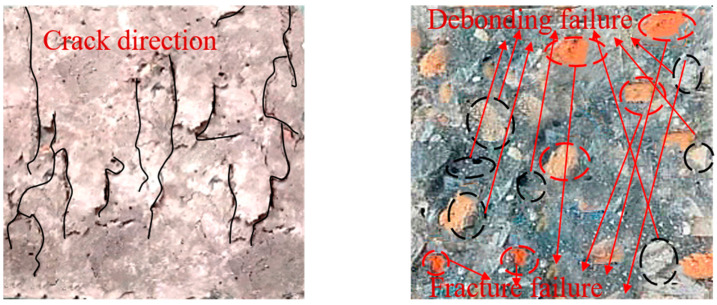
“It can be seen that the cracks on the RAC surface are mostly vertical.”
§ Prediction of the Compressive Strength of Recycled Aggregate Concrete Based on Artificial Neural Network > 2. Experiment Plan > 2.3. Experiment Process
plain- Asserted: passes — The authors put it forward as true.
- Checkable: passes — It can be checked against evidence.
- Load-bearing: unclear — It is unclear whether the paper’s conclusions depend on it.
- Based: passes — The paper gives a reason why it holds.
32 more claims
Create a free account to see all 57 claims and to verify the 31 references still open.
- It may state two separate claims as one. 13
- Probably not a substantial claim. 7
Self-check
Percentages, sums and reported differences re-computed from the paper’s own numbers.
Each contradiction between two passages listed here was confirmed by an independent check.
Rated minor: it would not touch a result — a value no result rests on, a p-value that stays on the same side of the significance level, or a conflict that is clerical, resolved elsewhere in the paper, or outside its own findings.
In the paper
§ Prediction of the Compressive Strength of Recycled Aggregate Concrete Based on Artificial Neural Network > 7. Conclusions
“with water–cement ratios of 0.35–0.65, and RRCA of 0–100%.”
§ Prediction of the Compressive Strength of Recycled Aggregate Concrete Based on Artificial Neural Network > 2. Experiment Plan > 2.2. Design of Mixing Proportion
“As for G5–G8, the sand ratio was 30%, while the water–cement ratios were 0.32, 0.37, 0.42, and 0.47, respectively.”
Rated minor: it would not touch a result — a value no result rests on, a p-value that stays on the same side of the significance level, or a conflict that is clerical, resolved elsewhere in the paper, or outside its own findings.
In the paper
§ Prediction of the Compressive Strength of Recycled Aggregate Concrete Based on Artificial Neural Network > 3. Strength Prediction Model > 3.3. Transfer Function
“All ranges of input data are acceptable to this function, which can further control the output within a range of [0, 1].”
§ Prediction of the Compressive Strength of Recycled Aggregate Concrete Based on Artificial Neural Network > 3. Strength Prediction Model > 3.3. Transfer Function
“(5) Tan-sigmoid:g(x)=2/(1+e⁻²ⁿ)−1”
Cited works that were retracted
Works this paper cites that were later retracted, from the retraction notices publishers deposit. Major when the notice came out before this paper was published.
A note, not an issue: for example, a cited work that was retracted only after this paper was published, which its authors could not have known.
In the paper
“Lv, 2020, Study on settlement prediction model of deep foundation pit in sand and pebble strata based on grey theory and BP neural network, Arab. J. Geosci., 13, 1238, 10.1007/s12517-020-06232-7”
Cited work 10.1007/s12517-020-06232-7 · retracted 2022-04-09 · notice 10.1007/s12517-022-10082-w · this paper published 2021-07-14
Citations
Cites
1 retracted
Lv, Y. L., Liu, T., Ma, J., Wei, S., & Gao, C. (2020) · Arabian Journal of Geosciences · doi:10.1007/s12517-020-06232-7 · Cited by 27
RetractedLearning Internal Representations by Error Propagation
Rumelhart, D. E., Hinton, G. E., & Williams, R. J. (1985) · doi:10.21236/ada164453 · Cited by 16,172
An introduction to computing with neural nets
Lippmann, R. (1987) · IEEE ASSP Magazine · doi:10.1109/massp.1987.1165576 · Cited by 7,825
Behera, M., Bhattacharyya, S. K., Minocha, A. K., Deoliya, R., & Maiti, S. (2014) · Construction and Building Materials · doi:10.1016/j.conbuildmat.2014.07.003 · Cited by 1,188
Bartlett, P. L. (1998) · IEEE Transactions on Information Theory · doi:10.1109/18.661502 · Cited by 1,166
Microstructural analysis of recycled aggregate concrete produced from two-stage mixing approach
Tam, V. W. Y., Gao, X. F., & Tam, C. M. (2005) · Cement and Concrete Research · doi:10.1016/j.cemconres.2004.10.025 · Cited by 997
Neural Networks in Civil Engineering: 1989–2000
Adeli, H. (2001) · Computer-Aided Civil and Infrastructure Engineering · doi:10.1111/0885-9507.00219 · Cited by 884
Use of recycled concrete aggregate in high-strength concrete
Limbachiya, M. C., Leelawat, T., & Dhir, R. K. (2000) · Materials and Structures · doi:10.1007/bf02480538 · Cited by 714
Naderpour, H., Rafiean, A. H., & Fakharian, P. (2018) · Journal of Building Engineering · doi:10.1016/j.jobe.2018.01.007 · Cited by 603
Duan, Z. H., & Poon, C. S. (2014) · Materials & Design · doi:10.1016/j.matdes.2014.01.044 · Cited by 588
Oikonomou, N. D. (2005) · Cement and Concrete Composites · doi:10.1016/j.cemconcomp.2004.02.020 · Cited by 564
Prediction of compressive strength of recycled aggregate concrete using artificial neural networks
Duan, Z. H., Kou, S. C., & Poon, C. S. (2013) · Construction and Building Materials · doi:10.1016/j.conbuildmat.2012.04.063 · Cited by 509
Use of recycled aggregates in molded concrete bricks and blocks
Poon, C. S., Kou, S.-C., & Lam, L. (2002) · Construction and Building Materials · doi:10.1016/s0950-0618(02)00019-3 · Cited by 506
Prediction of concrete strength using ultrasonic pulse velocity and artificial neural networks
Trtnik, G., Kavčič, F., & Turk, G. (2009) · Ultrasonics · doi:10.1016/j.ultras.2008.05.001 · Cited by 463
Concrete compressive strength using artificial neural networks
Asteris, P. G., & Mokos, V. G. (2020) · Neural Computing and Applications · doi:10.1007/s00521-019-04663-2 · Cited by 435
Delen, D., Sharda, R., & Bessonov, M. (2006) · Accident Analysis & Prevention · doi:10.1016/j.aap.2005.06.024 · Cited by 432
The influence of the use of recycled aggregates on the compressive strength of concrete: a review
Silva, R. V., de Brito, J., & Dhir, R. K. (2015) · European Journal of Environmental and Civil Engineering · doi:10.1080/19648189.2014.974831 · Cited by 366
Recycled Aggregate Concrete Structures
Xiao, J. (2017) · Springer tracts in civil engineering · doi:10.1007/978-3-662-53987-3 · Cited by 359
The use of recycled aggregate in concrete in Hong Kong
Poon, C.-S., & Chan, D. (2007) · Resources, Conservation and Recycling · doi:10.1016/j.resconrec.2006.06.005 · Cited by 321
Khademi, F., Jamal, S. M., Deshpande, N., & Londhe, S. (2016) · International Journal of Sustainable Built Environment · doi:10.1016/j.ijsbe.2016.09.003 · Cited by 321
Prediction of FRP-confined compressive strength of concrete using artificial neural networks
Naderpour, H., Kheyroddin, A., & Amiri, G. G. (2010) · Composite Structures · doi:10.1016/j.compstruct.2010.04.008 · Cited by 280
Concretes with aggregates from demolition waste and silica fume. Materials and mechanical properties
González-Fonteboa, B., & Martínez-Abella, F. (2008) · Building and Environment · doi:10.1016/j.buildenv.2007.01.008 · Cited by 266
Topçu, İ. B., & Sarıdemir, M. (2007) · Computational Materials Science · doi:10.1016/j.commatsci.2007.06.011 · Cited by 255
Wang, Y., Chen, J., & Geng, Y. (2015) · Engineering Structures · doi:10.1016/j.engstruct.2015.01.007 · Cited by 250
Getahun, M. A., Shitote, S. M., & Abiero Gariy, Z. C. (2018) · Construction and Building Materials · doi:10.1016/j.conbuildmat.2018.09.097 · Cited by 247
Asteris, P. G., Tsaris, A. K., Cavaleri, L., Repapis, C. C., Papalou, A., Di Trapani, F., & Karypidis, D. F. (2016) · Computational Intelligence and Neuroscience · doi:10.1155/2016/5104907 · Cited by 243
Pedro, D., de Brito, J., & Evangelista, L. (2015) · Materials and Structures · doi:10.1617/s11527-014-0456-7 · Cited by 239
Properties of concrete incorporating fine recycled aggregates from crushed concrete wastes
Fan, C.-C., Huang, R., Hwang, H., & Chao, S. (2016) · Construction and Building Materials · doi:10.1016/j.conbuildmat.2016.02.154 · Cited by 238
Chandwani, V., Agrawal, V., & Nagar, R. (2015) · Expert Systems with Applications · doi:10.1016/j.eswa.2014.08.048 · Cited by 228
Tang, Z., Li, W., Tam, V. W. Y., & Xue, C. (2020) · Resources, Conservation & Recycling: X · doi:10.1016/j.rcrx.2020.100036 · Cited by 227
Strength prediction model and methods for improving recycled aggregate concrete
Younis, K. H., & Pilakoutas, K. (2013) · Construction and Building Materials · doi:10.1016/j.conbuildmat.2013.09.003 · Cited by 226
Deshpande, N., Londhe, S., & Kulkarni, S. (2014) · International Journal of Sustainable Built Environment · doi:10.1016/j.ijsbe.2014.12.002 · Cited by 207
Chopra, P., Sharma, R. K., & Kumar, M. (2016) · Advances in Materials Science and Engineering · doi:10.1155/2016/7648467 · Cited by 205
Performance Analysis of Various Activation Functions in Artificial Neural Networks
Feng, J., & Lu, S. (2019) · Journal of Physics: Conference Series · doi:10.1088/1742-6596/1237/2/022030 · Cited by 192
Feed-Forward Neural Network Prediction of the Mechanical Properties of Sandcrete Materials
Asteris, P., Roussis, P., & Douvika, M. (2017) · Sensors · doi:10.3390/s17061344 · Cited by 187
Prediction of self-compacting concrete strength using artificial neural networks
Asteris, P. G., Kolovos, K. G., Douvika, M. G., & Roinos, K. (2016) · European Journal of Environmental and Civil Engineering · doi:10.1080/19648189.2016.1246693 · Cited by 186
Prediction of properties of waste AAC aggregate concrete using artificial neural network
Topçu, İ. B., & Sarıdemir, M. (2007) · Computational Materials Science · doi:10.1016/j.commatsci.2007.03.010 · Cited by 160
Chen, X., Li, Q., & Lu, X. (2019) · Automation in Construction · doi:10.1016/j.autcon.2019.102994 · Cited by 150
Artificial neural network for predicting drying shrinkage of concrete
Bal, L., & Buyle-Bodin, F. (2013) · Construction and Building Materials · doi:10.1016/j.conbuildmat.2012.08.043 · Cited by 149
Prediction of the compressive strength of self-compacting concrete using surrogate models
Asteris, P. G., Ashrafian, A., & Rezaie-Balf, M. (2019) · Computers and Concrete, an International Journal · doi:10.12989/cac.2019.24.2.137 · Cited by 138
González-Taboada, I., González-Fonteboa, B., Martínez-Abella, F., & Pérez-Ordóñez, J. L. (2016) · Construction and Building Materials · doi:10.1016/j.conbuildmat.2015.12.136 · Cited by 118
Four-layer perceptron approach for strength prediction of UHPC
Abellán-García, J. (2020) · Construction and Building Materials · doi:10.1016/j.conbuildmat.2020.119465 · Cited by 112
Wagh, V. M., Panaskar, D. B., Muley, A. A., Mukate, S. V., Lolage, Y., & Aamalawar, M. L. (2016) · Modeling Earth Systems and Environment · doi:10.1007/s40808-016-0250-3 · Cited by 108
Prediction of density and compressive strength for rubberized concrete blocks
Ling, T.-C. (2011) · Construction and Building Materials · doi:10.1016/j.conbuildmat.2011.04.074 · Cited by 103
Asteris, P., Moropoulou, A., Skentou, A., Apostolopoulou, M., Mohebkhah, A., Cavaleri, L., Rodrigues, H., & Varum, H. (2019) · Applied Sciences · doi:10.3390/app9020243 · Cited by 102
Feature selection using neural networks with contribution measures
Milne, L. (1995) · UNSWorks (University of New South Wales, Sydney, Australia) · doi:10.26190/unsworks/378 · Cited by 85
Effect of cement and admixture on the utilization of recycled aggregates in concrete
Tahar, Z.-E.-A., Ngo, T.-T., Kadri, E.-H., Bouvet, A., Debieb, F., & Aggoun, S. (2017) · Construction and Building Materials · doi:10.1016/j.conbuildmat.2017.04.152 · Cited by 80
Use Of Recycled Aggregate In Concrete
Sonawane, T. R., & Pimplikar, S. S. (2013) · Cited by 70
Application of artificial neural networks to predict compressive strength of high strength concrete
Hakim, S. J. S., Noorzaei, J., Jaafar, M. S., Jameel, M., & Mohammadhassani, M. (2011) · UTHM Institutional Repository (Universiti Tun Hussein Onn Malaysia) · doi:10.5897/ijps11.023 · Cited by 70
An Overview of Bayesian Methods for Neural Spike Train Analysis
Chen, Z. (2013) · Computational Intelligence and Neuroscience · doi:10.1155/2013/251905 · Cited by 68
Gupta, S. (2013) · Civil Engineering and Architecture · doi:10.13189/cea.2013.010306 · Cited by 62
Franceschini, S., Gandola, E., Martinoli, M., Tancioni, L., & Scardi, M. (2018) · Scientific Reports · doi:10.1038/s41598-018-22761-4 · Cited by 32
Prediction of compression strength of high performance concrete using artificial neural networks
Torre, A., Fernández, F. G., Nakata, I. M., Espinoza, P. A., & Acuña, L. (2015) · Journal of Physics Conference Series · doi:10.1088/1742-6596/582/1/012010 · Cited by 31
Ullah, S., Tanyu, B. F., & Zainab, B. (2021) · Road Materials and Pavement Design · doi:10.1080/14680629.2020.1773304 · Cited by 30
Properties of Concrete made with Waste Clay Brick as Sand Incorporating Nano SiO2
Tavakoli, D. (2014) · Indian Journal of Science and Technology · doi:10.17485/ijst/2014/v7i12.1 · Cited by 30
Fastening application in concrete using recycled tunnel excavation material
Dengg, F., Zeman, O., Voit, K., & Bergmeister, K. (2017) · Structural Concrete · doi:10.1002/suco.201600200 · Cited by 30
Using of Backpropagation Neural Network in Estimation of Compressive Strength of Waste Concrete
Heidari, A., Hashempour, M., & Tavakoli, D. (2017) · Journal of Soft Computing in Civil Engineering · doi:10.22115/scce.2017.48040 · Cited by 28
Spectral representation-based neural network assisted stochastic structural mechanics
Giovanis, D. G., & Papadopoulos, V. (2015) · Engineering Structures · doi:10.1016/j.engstruct.2014.11.044 · Cited by 26
Durability of lightweight concrete made concurrently with waste aggregates and expanded clay
Ruipérez, C. M., Sáiz, Á. R., Junco, C., Fiol, F., & Calderón, V. (2018) · Structural Concrete · doi:10.1002/suco.201700209 · Cited by 13
Lamanna, J., Malgaroli, A., Cerutti, S., & Signorini, M. G. (2012) · Computational Intelligence and Neuroscience · doi:10.1155/2012/704673 · Cited by 13
Lauritzen, E. K. (1993) · CRC Press eBooks · doi:10.1201/9781482271270-47 · Cited by 10
Predicting the Shear Strength of RC Beams without Stirrups Using Bayesian Neural Network
O., I., M., G., K., P., & K., N. (2010) · Proceedings of the 4th International Workshop on Reliable Engineering Computing Robust Design – Coping with Hazards, Risk and Uncertainty – REC 2010 · doi:10.3850/978-981-08-5118-7_067
(2015) · doi:10.6703/ijase.2015.13(3).187
(2014)
(2007)
Research works printed but not linked: 3
- Buck A.D. Recycled concrete Highw. Res. Board 1973 402 1 38
- JGJ52-2006 Standard for Technical Requirements and Test Method of Sand and Crushed Stone (or Gravel) for Ordinary Concrete China Architecture and Building Press Beijing, China 2006 (In Chinese)
- GB/T50081-2002 Standard for Test Method of Mechanical Properties on Ordinary Concrete China Architecture and Building Press Beijing, China 2002 (In Chinese)
Cited by
Compressive strength of concrete material using machine learning techniques
Paudel, S., Pudasaini, A., Shrestha, R. K., & Kharel, E. (2023) · Cleaner Engineering and Technology · doi:10.1016/j.clet.2023.100661 · Cited by 194
Beskopylny, A. N., Stel’makh, S. A., Shcherban’, E. M., Маилян, Л. Р., Meskhi, B., Razveeva, I., Chernil'nik, A. A., & Beskopylny, N. (2022) · Applied Sciences · doi:10.3390/app122110864 · Cited by 131
Bayraktar, O. Y., Eshtewı, S. S. T., Benli, A., Kaplan, G., Toklu, K., & Gunek, F. (2021) · Construction and Building Materials · doi:10.1016/j.conbuildmat.2021.125508 · Cited by 95
Nguyen, T.-D., Cherif, R., Mahieux, P.-Y., Lux, J., Aït‐Mokhtar, A., & Bastidas‐Arteaga, E. (2023) · Journal of Building Engineering · doi:10.1016/j.jobe.2023.105929 · Cited by 94
Zhao, Z., Liu, Y., Lu, Y., Ji, C., Lin, C., Yao, L., Pu, Z., & de Brito, J. (2024) · Journal of Building Engineering · doi:10.1016/j.jobe.2024.109516 · Cited by 72
Metadata
- Authors
- Bu, L., Du, G., & Hou, Q.
- Affiliations
- Hunan University (CN)
- Hunan Hongli Civil Engineering Inspection and Testing Co., Ltd., Changsha 410299, China
- Corresponding author
- Bu, Liangtao
- Du, Guoqiang
- Venue
- Materials
- Publisher
- MDPI AG
- Published
- 2021-07-14
- Volume
- 14
- Issue
- 14
- Pages
- 3921
- ISSN
- 1996-1944 (ISSN-L)
- PMC
- PMC8304198
- OpenAlex
- W3178838978
- Cited by
- 54
- References
- 66
- Citations by year
- 2026: 8 · 2025: 14 · 2024: 12 · 2023: 11 · 2022: 7 · 2021: 2
- FWCI
- 3.34
- Type
- journal article
- Language
- en
- Open access
- gold
- doi.org
- Licence
- Locations
- Materials (publishedVersion, cc-by)
- PubMed Central (publishedVersion, cc-by)
- PubMed (publishedVersion)
- Funders
- National Natural Science Foundation of China (51278187)
- Topics
- Physical Sciences › Engineering › Building and Construction › Recycled Aggregate Concrete Performance
- Physical Sciences › Engineering › Civil and Structural Engineering › Innovative concrete reinforcement materials
- Physical Sciences › Engineering › Civil and Structural Engineering › Concrete and Cement Materials Research
- Keywords
- recycled aggregate concrete, compressive strength prediction, artificial neural networks, BP neural network, recycled coarse aggregate, concrete mix design, sensitivity analysis, 28-day compressive strength
About these checks
Registry, retraction, Cites and statistics results are computed, not judged, with one exception: a printed reference that no index lists is read once by a model before it counts as a citation error. Claims are extracted by a model and kept only when their quote appears verbatim in the text; each cited source is then checked, with a model’s help, for whether it says what the claim relies on. Those verdicts can be wrong — read the claim’s quote and the cited source before relying on one.
A language model drew the claims from the paper on 2026-11-27, under version 3 of the claim definition (model deepseek-v4.1-flash, prompt extract-v3).
A second model labelled each claim on 2026-11-27 (model jev-1.13-20260917, definition revision gold-guideline-v0.2).
Statistics and arithmetic are recomputed, not judged.
Confidence bands are shown only for fields calibrated on our annotated test set. None is calibrated yet, so no band is shown.
What counts as a claim ›How we measure confidence ›How we check this ›
Are you an author, or do you see a problem with this page? Request a review
Data sources
Bibliographic data: Semantic Scholar, OpenAlex, Crossref.
Contains information from the Semantic Scholar Academic Graph Datasets, made available under the ODC Attribution License (ODC-BY 1.0).
Semantic Scholar’s data is described in: Kinney, R., et al. (2023). The Semantic Scholar Open Data Platform. arXiv:2301.10140.
