

The DOI matches its Crossref record.
Review: Clay-Modified Electrodes in Heterogeneous Electro-Fenton Process for Degradation of Organic Compounds: The Potential of Structural Fe(III) as Catalytic Sites
Abstract
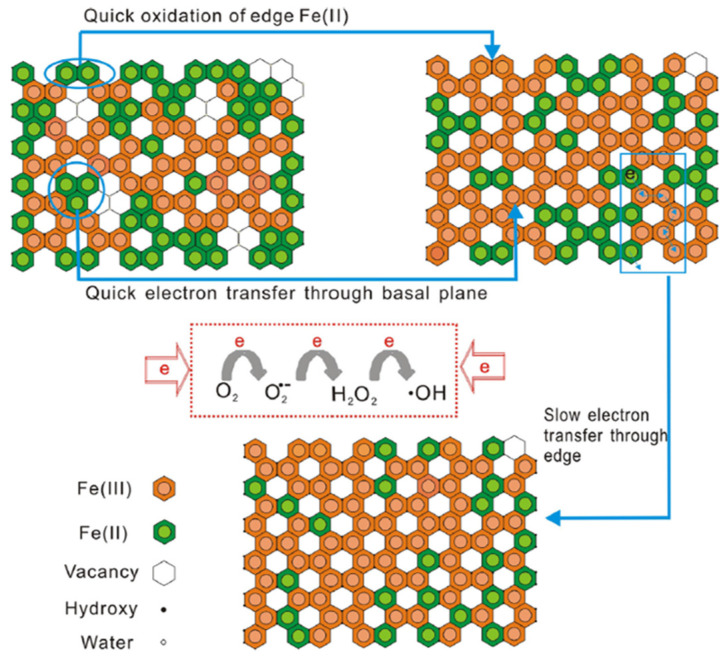
Advanced oxidation processes are considered as a promising technology for the removal of persistent organic pollutants from industrial wastewaters. In particular, the heterogeneous electro-Fenton (HEF) process has several advantages such as allowing the working pH to be circumneutral or alkaline, recovering and reusing the catalyst and avoiding the release of iron in the environment as a secondary pollutant. Among different iron-containing catalysts, studies using clay-modified electrodes in HEF process are the focus in this review. Fe(III)/Fe(II) within the lattice of clay minerals can possibly serve as catalytic sites in HEF process. The description of the preparation and application of clay-modified electrodes in the degradation of model pollutants in HEF process is detailed in the review. The absence of mediators responsible for transferring electrons to structural Fe(III) and regenerating catalytic Fe(II) was considered as a milestone in the field. A comprehensive review of studies investigating the use of electron transfer mediators as well as the mechanism behind electron transfer from and to the clay mineral structure was assembled in order to uncover other milestones to be addressed in this study area.
Overview
The claims and statistics of this paper haven’t been checked yet.
Run the check — free, no account needed. It reads the open-access text and checks the sources it cites.
Integrity signals
Registry
Cites
Statistics
Figures
Verification
Claims the paper makes
The claims and statistics of this paper haven’t been checked yet.
Run the check — free, no account needed. It reads the open-access text and checks the sources it cites.
Claims other papers make about this one
Each is checked against this paper’s own text: does it say what the citing paper says it does?
In the citing paper
“Apart from chrysotile, the exceptional redox reactivity of tetrahedral Fe (Fe tet ) has also been described for nontronites, in which Fe 3+ tet is preferentially reduced over octahedral Fe (Fe oct ), suggesting a lower redox potential of Fe tet than of Fe oct .[40][41][42][43][44]”
From Redox Cycling of Tetrahedral Iron Drives the Fenton Reactivity of Chrysotile Asbestos (2024) · cites this paper as [43]
Self-check
Percentages, sums and reported differences re-computed from the paper’s own numbers.
The self-check needs the paper’s full text.
Citations
Cites
No references could be resolved yet.
Research works printed but not linked: 120
- Brillas, 2014, Electrochemical Advanced Oxidation Processes: Today and Tomorrow: A Review, Environ. Sci. Pollut. Res., 21, 8336, 10.1007/s11356-014-2783-1 · DOI · Paper page
- Idowu, S.O., Capaldi, N., Zu, L., and Gupta, A.D. (2013). Stockholm Convention on Persistent Organic Pollutants (POPs). Encyclopedia of Corporate Social Responsibility, Springer. · DOI
- Brillas, 2009, Electro-Fenton Process and Related Electrochemical Technologies Based on Fenton’s Reaction Chemistry, Chem. Rev., 109, 6570, 10.1021/cr900136g · DOI · Paper page
- Deng, 2015, Advanced Oxidation Processes (AOPs) in Wastewater Treatment, Curr. Pollut. Rep., 1, 167, 10.1007/s40726-015-0015-z · DOI
- Mousset, 2021, Electrochemical Technologies Coupled with Biological Treatments, Curr. Opin. Electrochem., 26, 100668, 10.1016/j.coelec.2020.100668 · DOI
- Mansour, 2015, Mineralization of Synthetic and Industrial Pharmaceutical Effluent Containing Trimethoprim by Combining Electro-Fenton and Activated Sludge Treatment, J. Taiwan Inst. Chem. Eng., 53, 58, 10.1016/j.jtice.2015.02.022 · DOI
- Oturan, N., and Oturan, M.A. (2018). Electro-Fenton Process: Background, New Developments, and Applications. Electrochemical Water and Wastewater Treatment, Elsevier. · DOI
- Nidheesh, 2012, Trends in Electro-Fenton Process for Water and Wastewater Treatment: An Overview, Desalination, 299, 1, 10.1016/j.desal.2012.05.011 · DOI
- Ganiyu, 2018, Heterogeneous Electro-Fenton and Photoelectro-Fenton Processes: A Critical Review of Fundamental Principles and Application for Water/Wastewater Treatment, Appl. Catal. B Environ., 235, 103, 10.1016/j.apcatb.2018.04.044 · DOI
- Zhao, 2012, Electro-Fenton Oxidation of Pesticides with a Novel Fe3O4@Fe2O3/Activated Carbon Aerogel Cathode: High Activity, Wide PH Range and Catalytic Mechanism, Appl. Catal. B Environ., 125, 120, 10.1016/j.apcatb.2012.05.044 · DOI
- Rosales, 2018, Current Advances and Trends in Electro-Fenton Process Using Heterogeneous Catalysts—A Review, Chemosphere, 201, 399, 10.1016/j.chemosphere.2018.03.002 · DOI
- Fourcade, 2020, Iron Oxide Nanoparticles as Heterogeneous Electro-Fenton Catalysts for the Removal of AR18 Azo Dye, Environ. Technol., 41, 2146, 10.1080/09593330.2018.1557258 · DOI
- Huang, 2020, Coupling Quinoline Degradation with Fe Redox in Clay Minerals: A Strategy Integrating Biological and Physicochemical Processes, Appl. Clay Sci., 188, 105504, 10.1016/j.clay.2020.105504 · DOI
- Zeng, 2017, Degradation of 1, 4-Dioxane by Hydroxyl Radicals Produced from Clay Minerals, J. Hazard. Mater., 331, 88, 10.1016/j.jhazmat.2017.01.040 · DOI
- Khaled, 1991, Iron Oxidation State Effects on Cation Fixation in Smectites, Soil Sci. Soc. Am. J., 55, 550, 10.2136/sssaj1991.03615995005500020045x · DOI
- Schulze, D.G. (2005). Clay Minerals. Encyclopedia of Soils in the Environment, Elsevier. · DOI
- Bleam, W. (2017). Clay Mineralogy and Chemistry. Soil and Environmental Chemistry, Elsevier. · DOI
- Manceau, 2000, Oxidation-Reduction Mechanism of Iron in Dioctahedral Smectites: I. Crystal Chemistry of Oxidized Reference Nontronites, Am. Mineral., 85, 133, 10.2138/am-2000-0114 · DOI
- Huggett, J.M. (2019). Clay Minerals. Reference Module in Earth Systems and Environmental Sciences, Elsevier.
- Carrado, 1992, Preparation of Hectorite Clays Utilizing Organic and Organometallic Complexes during Hydrothermal Crystallization, Ind. Eng. Chem. Res., 31, 1654, 10.1021/ie00007a011 · DOI
- Slade, 1991, Crystalline Swelling of Smectite Samples in Concentrated NaCl Solutions in Relation to Layer Charge, Clays Clay Miner., 39, 234, 10.1346/CCMN.1991.0390302 · DOI
- Meunier, A. (2005). Clays, Springer.
- Sivaiah, 2012, Catalytic Wet Peroxide Oxidation of Phenol over Iron or Copper Oxide-Supported Allophane Clay Materials: Influence of Catalyst SiO2/Al2O3 Ratio, Microporous Mesoporous Mater., 162, 189, 10.1016/j.micromeso.2012.06.038 · DOI
- Gorski, 2012, Redox Properties of Structural Fe in Clay Minerals. 1. Electrochemical Quantification of Electron-Donating and -Accepting Capacities of Smectites, Environ. Sci. Technol., 46, 9360, 10.1021/es3020138 · DOI
- Mora, 2013, Characterization of Nanostructured Allophane Clays and Their Use as Support of Iron Species in a Heterogeneous Electro-Fenton System, Appl. Clay Sci., 86, 153, 10.1016/j.clay.2013.10.001 · DOI
- Stucki, 1984, Effects of Reduction and Reoxidation of Structural Iron on the Surface Charge and Dissolution of Dioctahedral Smectites, Clays Clay Miner., 32, 350, 10.1346/CCMN.1984.0320502 · DOI
- Goodman, 1976, A MÖssbauer and I.R. Spectroscopic Study of the Structure of Nontronite, Clays Clay Miner., 24, 53, 10.1346/CCMN.1976.0240201 · DOI
- Drits, 2000, A Model for the Mechanism of Fe3+ to Fe2+ Reduction in Dioctahedral Smectites, Clays Clay Miner., 48, 185, 10.1346/CCMN.2000.0480204 · DOI
- Jaynes, 1986, Multiple Cation-Exchange Capacity Measurements on Standard Clays Using a Commercial Mechanical Extractor, Clays Clay Miner., 34, 93, 10.1346/CCMN.1986.0340112 · DOI
- Ilgen, 2012, Role of Structural Fe in Nontronite NAu-1 and Dissolved Fe(II) in Redox Transformations of Arsenic and Antimony, Geochim. Cosmochim. Acta, 94, 128, 10.1016/j.gca.2012.07.007 · DOI
- Chen, 2018, The Effects of Fe-Bearing Smectite Clays on OH Formation and Diethyl Phthalate Degradation with Polyphenols and H2O2, J. Hazard. Mater., 357, 483, 10.1016/j.jhazmat.2018.06.030 · DOI · Paper page
- Schaefer, 2011, Spectroscopic Evidence for Interfacial Fe(II)−Fe(III) Electron Transfer in a Clay Mineral, Environ. Sci. Technol., 45, 540, 10.1021/es102560m · DOI
- Jaisi, 2008, Partitioning of Fe(II) in Reduced Nontronite (NAu-2) to Reactive Sites: Reactivity in Terms of Tc(VII) Reduction, Clays Clay Miner., 56, 175, 10.1346/CCMN.2008.0560204 · DOI
- Liu, 2017, Oxidation of Trichloroethylene by the Hydroxyl Radicals Produced from Oxygenation of Reduced Nontronite, Water Res., 113, 72, 10.1016/j.watres.2017.02.012 · DOI
- Keeling, 2000, Geology and Characterization of Two Hydrothermal Nontronites from Weathered Metamorphic Rocks at the Uley Graphite Mine, South Australia, Clays Clay Miner., 48, 537, 10.1346/CCMN.2000.0480506 · DOI
- Brown, 2017, Kinetics and Products of Chromium(VI) Reduction by Iron(II/III)-Bearing Clay Minerals, Environ. Sci. Technol., 51, 9817, 10.1021/acs.est.7b02934 · DOI
- Gorski, 2013, Redox Properties of Structural Fe in Clay Minerals: 3. Relationships between Smectite Redox and Structural Properties, Environ. Sci. Technol., 47, 13477, 10.1021/es403824x · DOI
- Tong, 2016, Production of Abundant Hydroxyl Radicals from Oxygenation of Subsurface Sediments, Environ. Sci. Technol., 50, 214, 10.1021/acs.est.5b04323 · DOI
- Latta, 2017, Fe(II)–Fe(III) Electron Transfer in a Clay Mineral with Low Fe Content, ACS Earth Space Chem., 1, 197, 10.1021/acsearthspacechem.7b00013 · DOI
- Hu, 1999, Electrocatalytic Reduction of Molecular Oxygen on a Sodium Montmorillonite-Methyl Viologen Carbon Paste Chemically Modified Electrode, J. Electroanal. Chem., 463, 253, 10.1016/S0022-0728(98)00445-8 · DOI
- Wang, 2014, Probing the Importance of Planar Surfaces and Crystal Edges for Electron Transfer within Iron-Bearing Clays, RSC Adv., 4, 31476, 10.1039/C4RA04521A · DOI
- Hubbart, 2002, Adsorption of Dyes on Clay Surfaces, Encyclopedia of Surface and Colloid Science, Volume 1, 307
- Essington, M.E. (2015). Soil Minerals. Soil and Water Chemistry: An Integrative Approach, CRC Press. · DOI
- Gorski, 2012, Redox Properties of Structural Fe in Clay Minerals. 2. Electrochemical and Spectroscopic Characterization of Electron Transfer Irreversibility in Ferruginous Smectite, SWa-1, Environ. Sci. Technol., 46, 9369, 10.1021/es302014u · DOI
- Su, 2013, A Review of Microbial Redox Interactions with Structural Fe in Clay Minerals, Clay Miner., 48, 543, 10.1180/claymin.2013.048.3.10 · DOI
- Polubesova, 2010, Adsorption And Oxidative Transformation Of Phenolic Acids By Fe(III)-Montmorillonite, Environ. Sci. Technol., 44, 4203, 10.1021/es1007593 · DOI
- Yong, 1997, Influence of PH and Exchangeable Cation on Oxidation of Methylphenols by a Montmorillonite Clay, Appl. Clay Sci., 12, 93, 10.1016/S0169-1317(96)00043-9 · DOI
- Wang, 2020, Transformation and Toxicity of Environmental Contaminants as Influenced by Fe Containing Clay Minerals: A Review, Bull Environ. Contam. Toxicol., 104, 8, 10.1007/s00128-019-02747-2 · DOI
- Jia, 2015, Exchangeable Cations-Mediated Photodegradation of Polycyclic Aromatic Hydrocarbons (PAHs) on Smectite Surface under Visible Light, J. Hazard. Mater., 287, 16, 10.1016/j.jhazmat.2015.01.040 · DOI
- Isaacson, 1983, Sorption and Transformation of Phenols on Clay Surfaces: Effect of Exchangeable Cations, Clay Miner., 18, 253, 10.1180/claymin.1983.018.3.03 · DOI
- Neumann, A. (2021, January 4–9). Assessing the Redox Reactivity of Tetrahedral Fe in Clay Minerals. Proceedings of the Presented at Goldschmidt Virtual 2021, Lyon, France. · DOI
- Neumann, 2008, Assessing the Redox Reactivity of Structural Iron in Smectites Using Nitroaromatic Compounds As Kinetic Probes, Environ. Sci. Technol., 42, 8381, 10.1021/es801840x · DOI
- Nzengung, 2001, Abiotic Transformation of Perchloroethylene in Homogeneous Dithionite Solution and in Suspensions of Dithionite-Treated Clay Minerals, Environ. Sci. Technol., 35, 2244, 10.1021/es001578b · DOI
- Neumann, 2009, Reduction of Polychlorinated Ethanes and Carbon Tetrachloride by Structural Fe(II) in Smectites, Environ. Sci. Technol., 43, 4082, 10.1021/es9001967 · DOI
- Entwistle, 2019, Abiotic Degradation of Chlorinated Solvents by Clay Minerals and Fe(II): Evidence for Reactive Mineral Intermediates, Environ. Sci. Technol., 53, 14308, 10.1021/acs.est.9b04665 · DOI
- Xie, 2020, Contaminant Degradation by •OH during Sediment Oxygenation: Dependence on Fe(II) Species, Environ. Sci. Technol., 54, 2975, 10.1021/acs.est.9b04870 · DOI
- Hug, 2003, Iron-Catalyzed Oxidation of Arsenic(III) by Oxygen and by Hydrogen Peroxide: PH-Dependent Formation of Oxidants in the Fenton Reaction, Environ. Sci. Technol., 37, 2734, 10.1021/es026208x · DOI
- Rosso, 2002, Outer-Sphere Electron Transfer Kinetics of Metal Ion Oxidation by Molecular Oxygen, Geochim. Cosmochim. Acta, 66, 4223, 10.1016/S0016-7037(02)01040-2 · DOI
- Gournis, 2002, Formation of Hydroxyl Radicals Catalyzed by Clay Surfaces, Phys. Chem. Miner., 29, 155, 10.1007/s002690100215 · DOI
- Nidheesh, 2018, An Overview on the Removal of Synthetic Dyes from Water by Electrochemical Advanced Oxidation Processes, Chemosphere, 197, 210, 10.1016/j.chemosphere.2017.12.195 · DOI
- Zhang, 2013, Three-Dimensional Electrochemical Process for Wastewater Treatment: A General Review, Chem. Eng. J., 228, 455, 10.1016/j.cej.2013.05.033 · DOI
- He, 2014, Preparation of Novel Kaolin-Based Particle Electrodes for Treating Methyl Orange Wastewater, Appl. Clay Sci., 99, 178, 10.1016/j.clay.2014.06.030 · DOI
- Zhang, 2019, Three-Dimensional Electro-Fenton Degradation of Rhodamine B with Efficient Fe-Cu/Kaolin Particle Electrodes: Electrodes Optimization, Kinetics, Influencing Factors and Mechanism, Sep. Purif. Technol., 210, 60, 10.1016/j.seppur.2018.07.084 · DOI
- Ciobanu, M., Wilburn, J.P., Krim, M.L., and Cliffel, D.E. (2007). Fundamentals. Handbook of Electrochemistry, Elsevier. · DOI
- Fourcade, 2013, Electrochemical Reduction Prior to Electro-Fenton Oxidation of Azo Dyes: Impact of the Pretreatment on Biodegradability, Water Air Soil Pollut., 224, 1385, 10.1007/s11270-012-1385-0 · DOI
- Wang, 2015, Iron–Copper Bimetallic Nanoparticles Supported on Hollow Mesoporous Silica Spheres: An Effective Heterogeneous Fenton Catalyst for Orange II Degradation, RSC Adv., 5, 69593, 10.1039/C5RA10826H · DOI
- Su, 2019, A Carbon Nanotube-Confined Iron Modified Cathode with Prominent Stability and Activity for Heterogeneous Electro-Fenton Reactions, J. Mater. Chem. A, 7, 24408, 10.1039/C9TA07491K · DOI
- Qiao, 2016, Novel Bentonite Particle Electrodes Based on Fenton Catalyst and Its Application in Orange II Removal, Desalin. Water Treat., 57, 36
- Qiao, 2015, Design of a Neutral Three-Dimensional Electro-Fenton System with Various Bentonite-Based Fe Particle Electrodes: A Comparative Study, Mater. Res. Innov., 19, S2-137, 10.1179/1432891715Z.0000000001315 · DOI
- Choe, 2018, Fe3S4/Fe7S8-Promoted Degradation of Phenol via Heterogeneous, Catalytic H2O2 Scission Mediated by S-Modified Surface Fe2+ Species, Appl. Catal. B Environ., 233, 272, 10.1016/j.apcatb.2018.03.110 · DOI
- Liu, 2018, Degradation and Mineralization of Carbamazepine Using an Electro-Fenton Reaction Catalyzed by Magnetite Nanoparticles Fixed on an Electrocatalytic Carbon Fiber Textile Cathode, Environ. Sci. Technol., 52, 12667, 10.1021/acs.est.8b03916 · DOI
- Divyapriya, 2017, An Innate Quinone Functionalized Electrochemically Exfoliated Graphene/Fe3O4 Composite Electrode for the Continuous Generation of Reactive Oxygen Species, Chem. Eng. J., 316, 964, 10.1016/j.cej.2017.01.074 · DOI
- Wang, 2016, Highly Ordered Mesoporous Fe3O4@Carbon Embedded Composite: High Catalytic Activity, Wide PH Range and Stability for Heterogeneous Electro-Fenton, Electroanalysis, 28, 169, 10.1002/elan.201500488 · DOI
- Ai, 2007, Fe@Fe2O3 Core−Shell Nanowires as an Iron Reagent. 3. Their Combination with CNTs as an Effective Oxygen-Fed Gas Diffusion Electrode in a Neutral Electro-Fenton System, J. Phys. Chem. C, 111, 14799, 10.1021/jp073617c · DOI
- Li, 2009, Design of a Neutral Electro-Fenton System with Fe@Fe2O3/ACF Composite Cathode for Wastewater Treatment, J. Hazard. Mater., 164, 18, 10.1016/j.jhazmat.2008.07.109 · DOI
- Pujol, 2020, Degradation of Phenols by Heterogeneous Electro-Fenton with a Fe3O4-Chitosan Composite and a Boron-Doped Diamond Anode, Electrochim. Acta, 337, 135784, 10.1016/j.electacta.2020.135784 · DOI
- Drobek, 2019, Application of Fe-MFI Zeolite Catalyst in Heterogeneous Electro-Fenton Process for Water Pollutants Abatement, Microporous Mesoporous Mater., 278, 64, 10.1016/j.micromeso.2018.11.021 · DOI
- Fitch, 1990, Clay-Modified Electrodes: A Review, Clays Clay Miner., 38, 391, 10.1346/CCMN.1990.0380408 · DOI
- Zen, 2004, Peer Reviewed: The Prospects of Clay Mineral Electrodes, Anal. Chem., 76, 205A, 10.1021/ac041566z · DOI
- Charradi, 2009, H2O2 Determination at Iron-Rich Clay Modified Electrodes, Electrochim. Acta, 54, 4237, 10.1016/j.electacta.2009.02.078 · DOI
- Ganiyu, 2018, Electrochemical Mineralization of Sulfamethoxazole over Wide PH Range Using FeIIFeIII LDH Modified Carbon Felt Cathode: Degradation Pathway, Toxicity and Reusability of the Modified Cathode, Chem. Eng. J., 350, 844, 10.1016/j.cej.2018.04.141 · DOI
- Ganiyu, 2017, A Hierarchical CoFe-Layered Double Hydroxide Modified Carbon-Felt Cathode for Heterogeneous Electro-Fenton Process, J. Mater. Chem. A, 5, 3655, 10.1039/C6TA09100H · DOI
- Jiang, 2016, An Fe–Mn Binary Oxide (FMBO) Modified Electrode for Effective Electrochemical Advanced Oxidation at Neutral PH, Electrochim. Acta, 194, 104, 10.1016/j.electacta.2016.02.075 · DOI
- Nsubuga, 2019, An Enhanced Beta-Blockers Degradation Method Using Copper-Boron-Ferrite Supported Graphite Electrodes and Continuous Droplet Flow-Assisted Electro-Fenton Reactor, Sep. Purif. Technol., 221, 408, 10.1016/j.seppur.2019.03.095 · DOI
- Shen, 2020, In Situ-Formed PdFe Nanoalloy and Carbon Defects in Cathode for Synergic Reduction–Oxidation of Chlorinated Pollutants in Electro-Fenton Process, Environ. Sci. Technol., 54, 4564, 10.1021/acs.est.9b05896 · DOI
- Trellu, 2019, Electrochemical Advanced Oxidation Processes Using Novel Electrode Materials for Mineralization and Biodegradability Enhancement of Nanofiltration Concentrate of Landfill Leachates, Water Res., 162, 446, 10.1016/j.watres.2019.07.005 · DOI
- Marco, 2016, Preparation and Characterization of Bimetallic Fe–Cu Allophane Nanoclays and Their Activity in the Phenol Oxidation by Heterogeneous Electro-Fenton Reaction, Microporous Mesoporous Mater., 225, 303, 10.1016/j.micromeso.2016.01.013 · DOI
- Lezana, 2017, Electrochemical and photo-electrochemical processes of methylene blue oxidation by Ti/TiO2 electrodes modified with Fe-allophane, J. Chil. Chem. Soc., 62, 3529, 10.4067/S0717-97072017000200021 · DOI
- Theng, 2010, Clays and Oxide Minerals as Catalysts and Nanocatalysts in Fenton-like Reactions—A Review, Appl. Clay Sci., 47, 182, 10.1016/j.clay.2009.11.044 · DOI
- Lee, 2013, Effective Peroxidase-like Activity of a Water-Solubilized Fe-Aminoclay for Use Inimmunoassay, Biosens. Bioelectron., 42, 373, 10.1016/j.bios.2012.10.092 · DOI
- Lee, 2013, Self-Assembled Graphene Oxide with Organo-Building Blocks of Fe-Aminoclay for Heterogeneous Fenton-like Reaction at near-Neutral PH: A Batch Experiment, Appl. Catal. B Environ., 142–143, 494, 10.1016/j.apcatb.2013.05.066 · DOI
- Miron, 2019, Development of a New Cathode for the Electro-Fenton Process Combining Carbon Felt and Iron-Containing Organic–Inorganic Hybrids, Comptes Rendus Chimie, 22, 238, 10.1016/j.crci.2018.11.012 · DOI
- Bergaya, F. (2008). Developments in Clay Science. Handbook of Clay Scienc, Elsevier. [1st ed.]. reprint.
- Cheng, 2008, Catalytic Activity of Iron Species in Layered Clays for Photodegradation of Organic Dyes under Visible Irradiation, Appl. Catal. B Environ., 77, 355, 10.1016/j.apcatb.2007.08.006 · DOI
- Zhou, 2019, Chemical Oxygen Demand (COD) Removal from Bio-Treated Coking Wastewater by Hydroxyl Radicals Produced from a Reduced Clay Mineral, Appl. Clay Sci., 180, 105199, 10.1016/j.clay.2019.105199 · DOI
- Song, 2006, Decomposition of Hydrogen Peroxide Driven by Photochemical Cycling of Iron Species in Clay, Environ. Sci. Technol., 40, 4782, 10.1021/es060624q · DOI
- Ilgen, 2019, “Switching on” Iron in Clay Minerals, Environ. Sci. Nano, 6, 1704, 10.1039/C9EN00228F · DOI
- Stucki, 2002, Effects of Iron Oxidation State on the Surface and Structural Properties of Smectites, Pure Appl. Chem., 74, 2081, 10.1351/pac200274112145 · DOI
- Gan, 1992, Reduction of Structural Iron in Ferruginous Smectite by Free Radicals, Clays Clay Miner., 40, 659, 10.1346/CCMN.1992.0400605 · DOI
- Stucki, 1996, Oxidation-Reduction Mechanisms in Iron-Bearing Phyllosilicates, Appl. Clay Sci., 10, 417, 10.1016/0169-1317(96)00002-6 · DOI
- Tor, 2000, Trifluralin Degradation under Microbiologically Induced Nitrate and Fe(III) Reducing Conditions, Environ. Sci. Technol., 34, 3148, 10.1021/es9912473 · DOI
- Vodyanitskii, 2007, Reductive Biogenic Transformation of Fe(III)-Containing Phyllosilicates (Review of Publications), Eurasian Soil Sci., 40, 1355, 10.1134/S1064229307120137 · DOI
- Oyama, 1986, Catalysis of the Electroreduction of Hydrogen Peroxide by Montmorillonite Clay Coatings on Graphite Electrodes, J. Electroanal. Chem. Interfacial Electrochem., 199, 467, 10.1016/0022-0728(86)80020-1 · DOI
- Swearingen, 2004, Use of Ferrocenyl Surfactants of Varying Chain Lengths to Study Electron Transfer Reactions in Native Montmorillonite Clay, Environ. Sci. Technol., 38, 5598, 10.1021/es030645+ · DOI
- Stucki, 1977, Oxidation-Reduction Mechanism for Structural Iron in Nontronite1, Soil Sci. Soc. Am. J., 41, 808, 10.2136/sssaj1977.03615995004100040041x · DOI
- Zen, 1996, Catalysis of the Electroreduction of Hydrogen Peroxide by Nontronite Clay Coatings on Glassy Carbon Electrodes, J. Electroanal. Chem., 408, 157, 10.1016/0022-0728(96)04539-1 · DOI
- Xiang, 1995, Electrodes Modified with Synthetic Clay Minerals: Evidence of Direct Electron Transfer from Structural Iron Sites in the Clay Lattice, J. Electroanal. Chem., 381, 21, 10.1016/0022-0728(94)03629-H · DOI
- White, 1986, Clay Modified Electrodes: Part IV. The Electrochemistry and Electron Spin Resonance of Methyl Viologen Incorporated into Montmorillonite Films, J. Electroanal. Chem. Interfacial Electrochem., 197, 233, 10.1016/0022-0728(86)80152-8 · DOI
- Rudzinski, 1986, Clay Modified Electrodes: Part VI. Aluminum and Silicon Pillared Clay-Modified Electrodes, J. Electroanal. Chem. Interfacial Electrochem., 199, 323, 10.1016/0022-0728(86)80007-9 · DOI
- King, 1987, On the Nature of Electroactive Sites in Clay-Modified Electrodes, J. Electroanal. Chem. Interfacial Electrochem., 236, 43, 10.1016/0022-0728(87)88017-8 · DOI
- Villemure, 1990, Clay Modified Electrodes: Part 9. Electrochemical Studies of the Electroactive Fraction of Adsorbed Species in Reduced-Charge and Preadsorbed Clay Films, J. Electroanal. Chem. Interfacial Electrochem., 282, 107, 10.1016/0022-0728(91)85092-4 · DOI
- Villemure, 1990, Clay Modified Electrodes: Part 10. Studies of Clay-Adsorbed Ru(Bpy)2+3 Enantiomers by UV-Visible Spectroscopy and Cyclic Voltammetry, J. Electroanal. Chem. Interfacial Electrochem., 283, 403, 10.1016/0022-0728(90)87404-8 · DOI
- Lear, 1985, Role of Structural Hydrogen in the Reduction and Reoxidation of Iron in Nontronite, Clays Clay Miner., 33, 539, 10.1346/CCMN.1985.0330609 · DOI
- Manceau, 2000, Oxidation-Reduction Mechanism of Iron in Dioctahedral Smectites: II. Crystal Chemistry of Reduced Garfield Nontronite, Am. Miner., 85, 153, 10.2138/am-2000-0115 · DOI
- Alexandrov, 2013, Electron Exchange and Conduction in Nontronite from First-Principles, J. Phys. Chem. C, 117, 2032, 10.1021/jp3110776 · DOI
- Yuan, 2018, Mechanisms of Electron Transfer from Structrual Fe(II) in Reduced Nontronite to Oxygen for Production of Hydroxyl Radicals, Geochim. Cosmochim. Acta, 223, 422, 10.1016/j.gca.2017.12.025 · DOI
- Chemtob, 2017, Oxidative Alteration of Ferrous Smectites and Implications for the Redox Evolution of Early Mars: Oxidation Products of Ferrous Smectites, J. Geophys. Res. Planets, 122, 2469, 10.1002/2017JE005331 · DOI
- Hofstetter, 2003, Reactivity of Fe(II) Species Associated with Clay Minerals, Environ. Sci. Technol., 37, 519, 10.1021/es025955r · DOI
- Liu, 2014, A Novel Photosensitized Fenton Reaction Catalyzed by Sandwiched Iron in Synthetic Nontronite, RSC Adv., 4, 12958, 10.1039/c3ra47359g · DOI
- Stucki, 2011, A Review of the Effects of Iron Redox Cycles on Smectite Properties, Comptes Rendus Geosci., 343, 199, 10.1016/j.crte.2010.10.008 · DOI
Cited by
Sorted by citations
Redox Cycling of Tetrahedral Iron Drives the Fenton Reactivity of Chrysotile Asbestos
Walter, M., Schenkeveld, W. D. C., Geroldinger, G., Gille, L., & Kraemer, S. M. (2024) · ACS Earth and Space Chemistry · doi:10.1021/acsearthspacechem.3c00189 · Cited by 7
Metadata
- Authors
- Cipriano Crapina, L., Dzene, L., Brendlé, J., Fourcade, F., Amrane, A., & Limousy, L.
- Venue
- Materials
- Publisher
- MDPI AG
- Published
- 2021-12-15
- Volume
- 14
- Issue
- 24
- Pages
- 7742
- ISSN
- 1996-1944
- PMC
- PMC8703352
- Cited by
- 19
- References
- 0
- Language
- en
About these checks
Registry, retraction, Cites and statistics results are computed, not judged, with one exception: a printed reference that no index lists is read once by a model before it counts as a citation error. Claims are extracted by a model and kept only when their quote appears verbatim in the text; each cited source is then checked, with a model’s help, for whether it says what the claim relies on. Those verdicts can be wrong — read the claim’s quote and the cited source before relying on one.
Statistics and arithmetic are recomputed, not judged.
Confidence bands are shown only for fields calibrated on our annotated test set. None is calibrated yet, so no band is shown.
What counts as a claim ›How we measure confidence ›How we check this ›
Are you an author, or do you see a problem with this page? Request a review
How to cite
Cite CoChat for the checks on this page, and the paper for its own findings.
- This page
- CoChat. (2026). Citation check: Review: Clay-Modified Electrodes in Heterogeneous Electro-Fenton Process for Degradation of Organic Compounds: The Potential of Structural Fe(III) as Catalytic Sites. https://app.cochat.ai/papers/10.3390/ma14247742
- The paper
- Cipriano Crapina, L., Dzene, L., Brendlé, J., Fourcade, F., Amrane, A., & Limousy, L. (2021). Review: Clay-Modified Electrodes in Heterogeneous Electro-Fenton Process for Degradation of Organic Compounds: The Potential of Structural Fe(III) as Catalytic Sites. Materials. https://doi.org/10.3390/ma14247742
