

The DOI matches its Crossref record.
Physico-Mechanical Evaluation of Geopolymer Concrete Activated by Sodium Hydroxide and Silica Fume-Synthesised Sodium Silicate Solution
Open accessAbstract
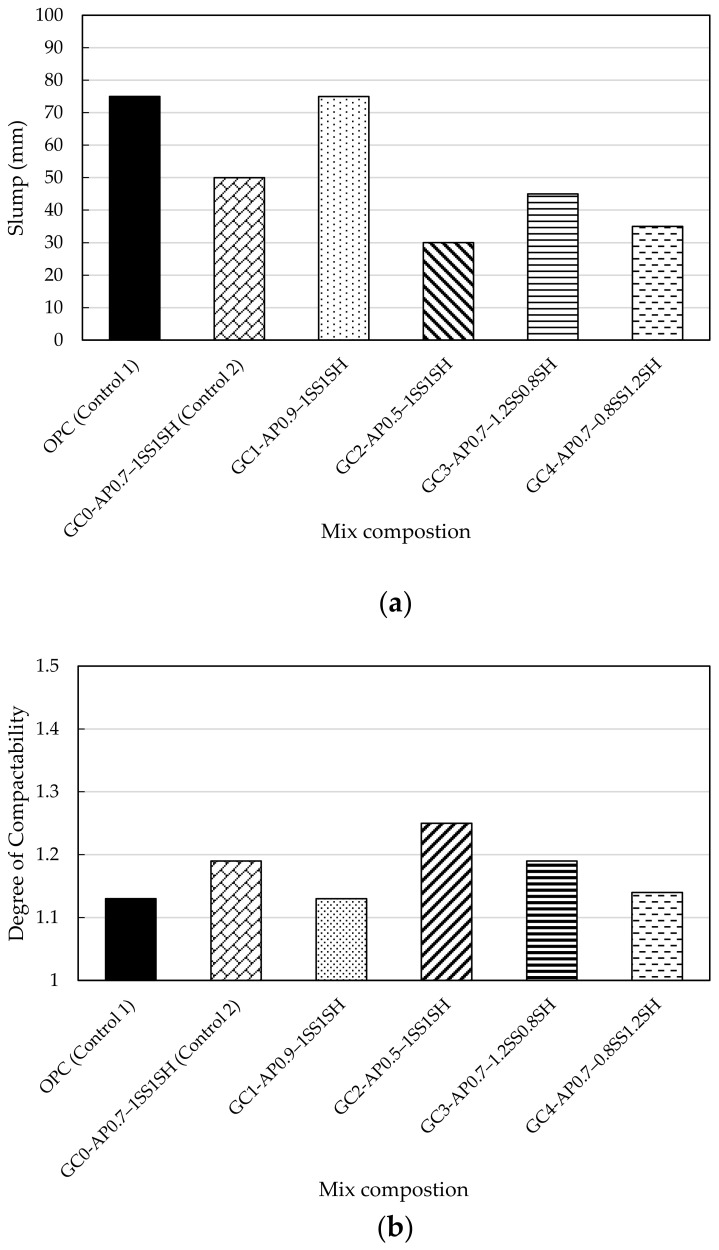
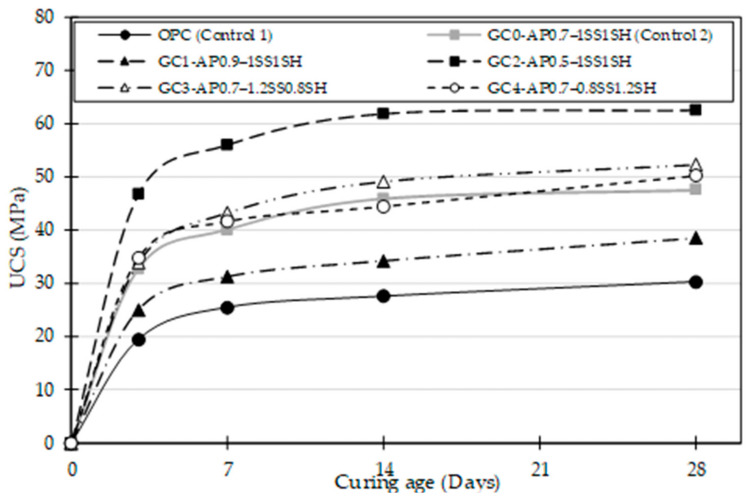
Commercial sodium hydroxide (NaOH) and sodium silicate (SS) have remained two of the leading alkaline activators widely used in producing geopolymer concrete, despite some identified negatives regarding their availability and additional CO2 emissions relating to the overall manufacturing process. This study reports the viability of developing geopolymer concrete using a laboratory-synthesised silica fume (SF)-derived SS solution in combination with NaOH at a molarity of 10M as an alternative binary alkali-alkaline activator to Ground Granulated Blast Furnace slag (GGBS). The use of SF in the development of geoolymer activators will pave the way for the quality usage of other high-silica content by-products from nature, industry, and agriculture. In the currently reported proof of concept, four geopolymer concrete batches were produced using different alkaline activator/precursor-A/P ratios (0.5 and 0.9) and SS to NaOH-SS/SH volume ratios (0.8/1.2 and 1.2/0.8), to establish the impact on the engineering performance. Two controls were adopted for ordinary and geopolymer concrete mixes. The engineering performance was assessed using slump and compaction index (CI) tests, while the Unconfined Compressive Strength (UCS) and tensile splitting (TS) tests were measured at different curing ages in accordance with their appropriate standards. The results indicated a reduction in slump values as the A/P ratio decreased, while the CI values showed a reversal of the identified trend in slump. Consequently, mix GC2 attained the highest UCS strength gain (62.6 MPa), displaying the superiority of the alkali activation and polymerisation process over the CSH gel. Furthermore, the impact of A/P variation on the UCS was more pronounced than SS/SH due to its vital contribution to the overall geopolymerisation process.
Overview
The claims and statistics of this paper haven’t been checked yet.
Run the check — free, no account needed. It reads the open-access text and checks the sources it cites.
Integrity signals
Registry
Cites
Statistics
Figures
Verification
Claims the paper makes
The claims and statistics of this paper haven’t been checked yet.
Run the check — free, no account needed. It reads the open-access text and checks the sources it cites.
Claims other papers make about this one
Each is checked against this paper’s own text: does it say what the citing paper says it does?
The source backs part of the claim, not all of it — or backs it for a different population, condition or comparison.
In the citing paper
“Na 2 CO 3 frequently results in a reduced rate of strength development unless accompanied by enough silicate concentration [11, 12].”
From Experimental and Statistical Optimization of Low-carbon Binder Concrete under Varying Alkaline Activator Conditions (2026) · cites this paper as [11]
Experimental — accuracy not yet measuredThe source backs part of the claim, not all of it — or backs it for a different population, condition or comparison.
In the citing paper
“Na 2 CO 3 and Na 2 SiO 3 are emerging as environmentally friendly alternatives, particularly under ambient curing circumstances, owing to their diminished ecological impact and safety benefits.”
From Experimental and Statistical Optimization of Low-carbon Binder Concrete under Varying Alkaline Activator Conditions (2026) · cites this paper as [11]
Experimental — accuracy not yet measured
Self-check
Percentages, sums and reported differences re-computed from the paper’s own numbers.
The self-check needs the paper’s full text.
Citations
Cites
No references could be resolved yet.
Research works printed but not linked: 42
- Nishanth, 2022, Experimental evaluation on workability and strength characteristics of self-consolidating geopolymer concrete based on GGBFS, flyash and alccofine, Mater. Today Proc., 59, 51, 10.1016/j.matpr.2021.10.200 · DOI
- Adeleke, 2022, Impacts of MgO waste: GGBS formulations on the performance of a stabilised natural high sulphate bearing soil, Constr. Build. Mater., 315, 125745, 10.1016/j.conbuildmat.2021.125745 · DOI
- Abdulrahman, 2022, Mechanical properties and bond stress-slip behaviour of fly ash geopolymer concrete, Constr. Build. Mater., 327, 126909, 10.1016/j.conbuildmat.2022.126909 · DOI
- Raza, 2022, A sustainable roadmap for additive manufacturing using geopolymers in construction industry, Resour. Conserv. Recycl., 186, 106592, 10.1016/j.resconrec.2022.106592 · DOI
- Nath, 2014, Effect of GGBFS on setting, workability and early strength properties of fly ash geopolymer concrete cured in ambient condition, Constr. Build. Mater., 66, 163, 10.1016/j.conbuildmat.2014.05.080 · DOI
- Fernandes, 2021, Controlling efflorescence in geopolymers: A new approach, Case Stud. Constr. Mater., 15, e00740
- Yang, 2022, Geopolymer concrete incorporating recycled aggregates: A comprehensive review, Clean. Mater., 3, 100056, 10.1016/j.clema.2022.100056 · DOI
- Sun, 2020, Effect of nano-SiO2 on the efflorescence of an alkali-activated metakaolin mortar, Constr. Build. Mater., 253, 118952, 10.1016/j.conbuildmat.2020.118952 · DOI
- Sun, 2022, Evaluation of rheology and strength development of alkali-activated slag with different silicates sources, Cem. Concr. Compos., 128, 104415, 10.1016/j.cemconcomp.2022.104415 · DOI
- Provis, J.L., and Van Deventer, J.S.J. (2013). Alkali Activated Materials: State-Of-The-Art Report (RILEM TC 224-AAM), Springer Science & Business Media. · DOI
- Duxson, 2007, Geopolymer technology: The current state of the art, J. Mater. Sci., 42, 2917, 10.1007/s10853-006-0637-z · DOI · Paper page
- Cheng, 2022, Study on the effectiveness of silica fume-derived activator as a substitute for water glass in fly ash-based geopolymer, J. Build. Eng., 51, 104228, 10.1016/j.jobe.2022.104228 · DOI
- Liu, 2020, Sodium silicate applications in oil, gas & geothermal well operations, J. Pet. Sci. Eng., 195, 107693, 10.1016/j.petrol.2020.107693 · DOI
- Nilsson, 2011, Concentration- and pH-dependence of highly alkaline sodium silicate solutions, J. Colloid Interface Sci., 356, 37, 10.1016/j.jcis.2010.12.085 · DOI
- Lazorenko, 2022, Geopolymer additive manufacturing: A review, Addit. Manuf., 55, 102782
- Shilar, 2022, Molarity activity effect on mechanical and microstructure properties of geopolymer concrete: A review, Case Stud. Constr. Mater., 16, e01014
- Cheah, 2019, The engineering properties and microstructure of sodium carbonate activated fly ash/slag blended mortars with silica fume, Compos. Part B Eng., 160, 558, 10.1016/j.compositesb.2018.12.056 · DOI
- Furtak, 2017, Influence of silica fume content on the quality of bond conditions in high-performance concrete specimens, Arch. Civ. Mech. Eng., 17, 795, 10.1016/j.acme.2017.02.007 · DOI
- Billong, 2021, Using silica fume based activator in sustainable geopolymer binder for building application, Constr. Build. Mater., 275, 122177, 10.1016/j.conbuildmat.2020.122177 · DOI
- Fernando, 2021, Life cycle assessment and cost analysis of fly ash–rice husk ash blended alkali-activated, J. Environ. Manag., 295, 113140, 10.1016/j.jenvman.2021.113140 · DOI
- Almutairi, 2021, Potential applications of geopolymer concrete in construction: A review, Case Stud. Constr. Mater., 15, e00733
- Bahrami, 2022, Lightweight geopolymer concrete: A critical review on the feasibility, mixture design, durability properties, and microstructure, Ceram. Int., 48, 10347, 10.1016/j.ceramint.2022.01.298 · DOI
- Xie, 2014, Effect of initial water content and curing moisture conditions on the development of fly ash-based geopolymers in heat and ambient temperature, Constr. Build. Mater., 67, 20, 10.1016/j.conbuildmat.2013.10.047 · DOI
- Provis, 2010, The role of particle technology in developing sustainable construction materials, Adv. Powder Technol., 21, 2, 10.1016/j.apt.2009.10.006 · DOI
- Meesala, 2019, Critical review on fly-ash based geopolymer concrete, Struct. Concr., 21, 1013, 10.1002/suco.201900326 · DOI
- Erdemir, 2016, Utilisation and efficiency of ground granulated blast furnace slag on concrete properties—A review, Constr. Build. Mater., 105, 423, 10.1016/j.conbuildmat.2015.12.153 · DOI
- Heah, 2012, Study on solids-to-liquid and alkaline activator ratios on kaolin-based geopolymers, Constr. Build. Mater., 35, 912, 10.1016/j.conbuildmat.2012.04.102 · DOI
- Yaseri, 2017, The role of synthesis parameters on the workability, setting and strength properties of binary binder based geopolymer paste, Constr. Build. Mater., 157, 534, 10.1016/j.conbuildmat.2017.09.102 · DOI
- Sathonsaowaphak, 2009, Workability and strength of lignite bottom ash geopolymer mortar, J. Hazard. Mater., 168, 44, 10.1016/j.jhazmat.2009.01.120 · DOI
- Sun, 2022, Alkali activation of blast furnace slag using a carbonate-calcium carbide residue alkaline mixture to prepare cemented paste backfill, Constr. Build. Mater., 320, 126234, 10.1016/j.conbuildmat.2021.126234 · DOI
- Xie, 2020, Mix design and mechanical properties of geopolymer and alkali activated concrete: Review of the state-of-the-art and the development of a new unified approach, Constr. Build. Mater., 256, 119380, 10.1016/j.conbuildmat.2020.119380 · DOI
- Shi, 2019, Recent progress in low-carbon binders, Cem. Concr. Res., 122, 227, 10.1016/j.cemconres.2019.05.009 · DOI
- Gomaa, 2017, Fresh properties and compressive strength of high calcium alkali activated fly ash mortar, J. King Saud Univ. Eng. Sci., 29, 356
- Provis, 2014, Geopolymers and Related Alkali-Activated Materials, Annu. Rev. Mater. Res., 44, 299, 10.1146/annurev-matsci-070813-113515 · DOI
- Chindaprasirt, 2007, Workability and strength of coarse high calcium fly ash geopolymer, Cem. Concr. Compos., 29, 224, 10.1016/j.cemconcomp.2006.11.002 · DOI
- Siyal, 2016, Effects of Parameters on the Setting Time of Fly Ash Based Geopolymers Using Taguchi Method, Procedia Eng., 148, 302, 10.1016/j.proeng.2016.06.624 · DOI
- Upadhyay, 2022, Issues and challenges for development of geopolymer concrete, Mater. Today Proc., 65, 1567, 10.1016/j.matpr.2022.04.520 · DOI
- Maegawa, 2015, Effects of sodium hydroxide and sodium silicate solutions on compressive and shear bond strengths of FA–GBFS geopolymer, Constr. Build. Mater., 91, 1, 10.1016/j.conbuildmat.2015.05.001 · DOI
- Chindaprasirt, 2018, Effect of calcium-rich compounds on setting time and strength development of alkali-activated fly ash cured at ambient temperature, Case Stud. Constr. Mater., 9, e00198
- Morsy, 2022, Mechanical Characteristics of GGBFS/FA-Based Geopolymer Concrete and Its Environmental Impact, Pract. Period. Struct. Des. Constr., 27, 04022017, 10.1061/(ASCE)SC.1943-5576.0000686 · DOI
- Bezerra, 2022, Ecological geopolymer produced with a ternary system of red mud, glass waste, and Portland cement, Clean. Eng. Technol., 6, 100379, 10.1016/j.clet.2021.100379 · DOI
- Wu, 2020, Simulation study for the formation of alkaline efflorescence on bauxite residue disposal areas following the phosphogypsum addition, J. Clean. Prod., 262, 121266, 10.1016/j.jclepro.2020.121266 · DOI
Cited by
Sorted by citations
Ganesan, Y., & Panruti Thangaraj, R. (2026) · Periodica Polytechnica Civil Engineering · doi:10.3311/ppci.41876 · Cited by 2
“Na 2 CO 3 frequently results in a reduced rate of strength development unless accompanied by enough silicate concentration [11, 12].”
Metadata
- Authors
- Adeleke, B. O., Kinuthia, J. M., Oti, J., & Ebailila, M.
- Affiliations
- University of South Wales (GB)
- Bani-Waleed University (LY)
- Corresponding author
- Adeleke, Blessing O.
- Venue
- Materials
- Publisher
- MDPI AG
- Published
- 2023-03-17
- Volume
- 16
- Issue
- 6
- Pages
- 2400
- ISSN
- 1996-1944 (ISSN-L)
- PMC
- PMC10053947
- OpenAlex
- W4327736614
- Cited by
- 56
- References
- 0
- Citations by year
- 2026: 19 · 2025: 19 · 2024: 13 · 2023: 5
- FWCI
- 6.54
- Type
- journal article
- Language
- en
- Open access
- gold
- doi.org
- Licence
- Locations
- Materials (publishedVersion, cc-by)
- PubMed Central (publishedVersion, cc-by)
- PubMed (publishedVersion)
- DOAJ (DOAJ: Directory of Open Access Journals) (submittedVersion)
- Funders
- Faculty of Computing Engineering and Science of the University of South Wales
- Topics
- Physical Sciences › Engineering › Civil and Structural Engineering › Concrete and Cement Materials Research
- Physical Sciences › Environmental Science › Environmental Engineering › Microbial Applications in Construction Materials
- Physical Sciences › Engineering › Civil and Structural Engineering › Geotechnical Engineering and Soil Stabilization
- Keywords
- geopolymer concrete, sodium hydroxide activation, silica fume, sodium silicate solution, ground granulated blast furnace slag, unconfined compressive strength, splitting tensile strength, slump, compaction index, geopolymerization
About these checks
Registry, retraction, Cites and statistics results are computed, not judged, with one exception: a printed reference that no index lists is read once by a model before it counts as a citation error. Claims are extracted by a model and kept only when their quote appears verbatim in the text; each cited source is then checked, with a model’s help, for whether it says what the claim relies on. Those verdicts can be wrong — read the claim’s quote and the cited source before relying on one.
Statistics and arithmetic are recomputed, not judged.
Confidence bands are shown only for fields calibrated on our annotated test set. None is calibrated yet, so no band is shown.
What counts as a claim ›How we measure confidence ›How we check this ›
Are you an author, or do you see a problem with this page? Request a review
