

Impermeability and Durability of Self-Compacting Concrete Prepared with Aeolian Sand and Recycled Coarse Aggregate
Open accessThe DOI matches its Crossref record; 48 of the 48 references it cites were found in a registry or an index; none of the 25 sources its claims cite is checked for support yet.
Abstract
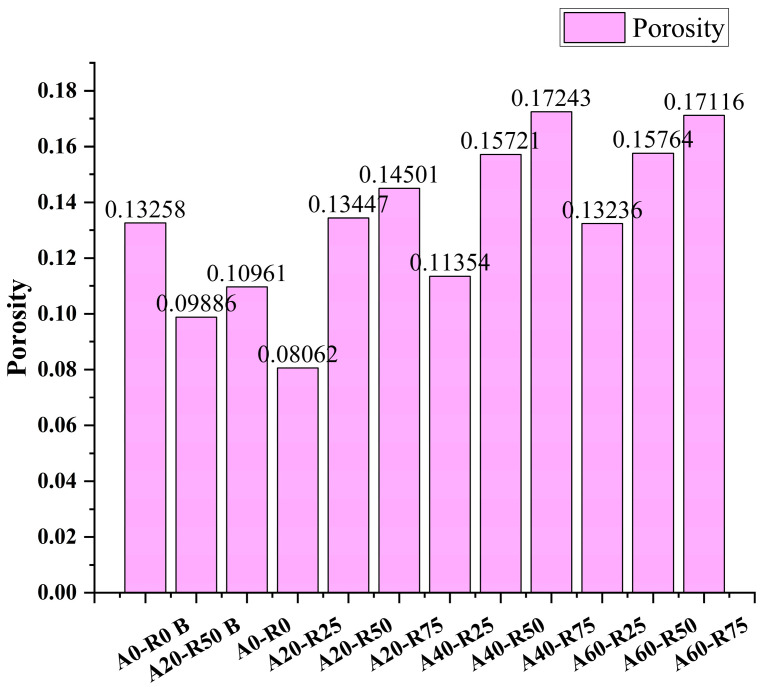
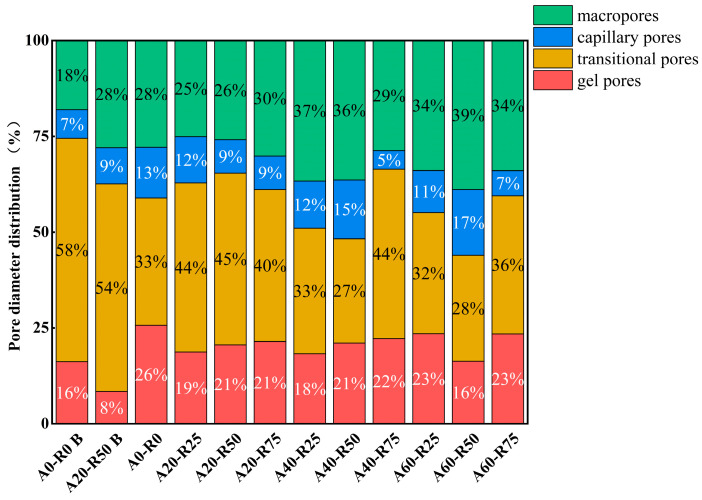
Self-compacting concrete has seen extensive application in both engineering and construction. In order to save building resources, aeolian sand—recycled coarse aggregate self-compacting concrete (ARSCC) is created by partially substituting recycled coarse aggregates (RCA) and aeolian sand (AS) for natural coarse aggregates. For ten groups with different mechanical and durable properties, this study examined the effects of sulfate erosion, chloride penetration resistance, and related impermeability, as well as AS replacement ratios of 20%, 40%, and 60% and RCA replacement ratios of 25%, 50%, and 75% in ARSCC and a control group (A0-R0). According to the study’s findings, after sulfate attack, the highest relative dynamic elastic modulus and corrosion resistance factor were obtained with the 20% AS replacement ratio and 50% RCA replacement ratio (A20-R50). The highest impermeability grade and lowest electric flux were obtained with the 20% AS replacement ratio and 25% RCA replacement ratio (A20-R25). X-ray diffraction (XRD) and mercury intrusion porosimetry (MIP) revealed that the addition of aeolian sand and recycled coarse aggregates improved the pore structure of the SCC and increased the densification of the self-compacting concrete, particularly following sulfate attack. This study highlights the importance of recycled aggregates and aeolian sand in engineering applications and the sustainable growth of the concrete industry, both of which support resource conservation and environmental protection.
Overview
CoChat Summary
TL;DR
This study evaluated self-compacting concrete made with aeolian sand (AS) and recycled coarse aggregate (RCA) for impermeability and sulfate durability. It found that 20% AS with 25% or 50% RCA generally gave the best impermeability and sulfate resistance, with A20-R50 showing the highest relative dynamic elastic modulus and corrosion resistance factor after sulfate attack.
Key findings
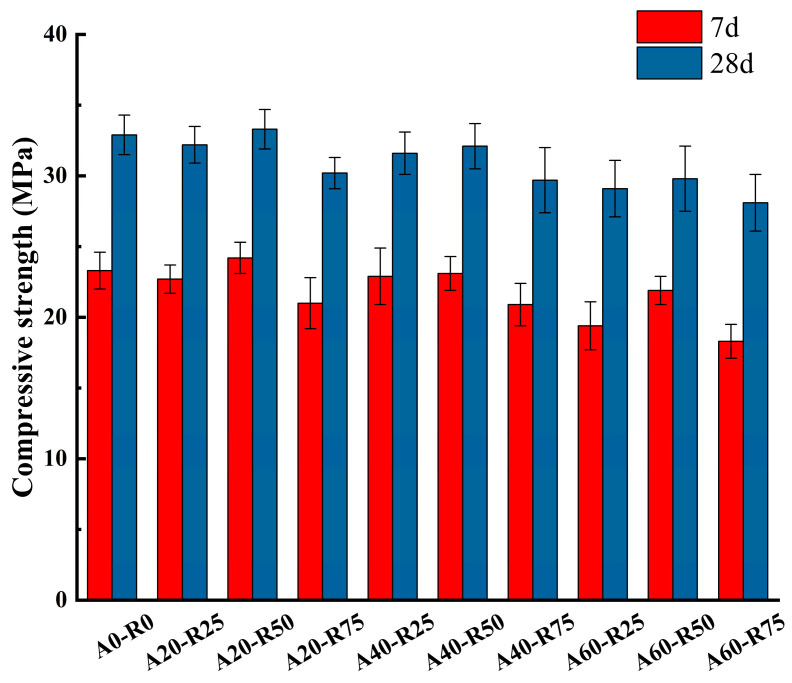
- Compressive strength at 7 and 28 days first increased then decreased as RCA replacement rose, peaking at 20% AS/50% RCA; versus the control, the maximum increase was 0.4 MPa and the minimum decrease was 4.8 MPa, with the highest value 33.3 MPa for A20-R50 and the lowest 28.1 MPa for A60-R75.
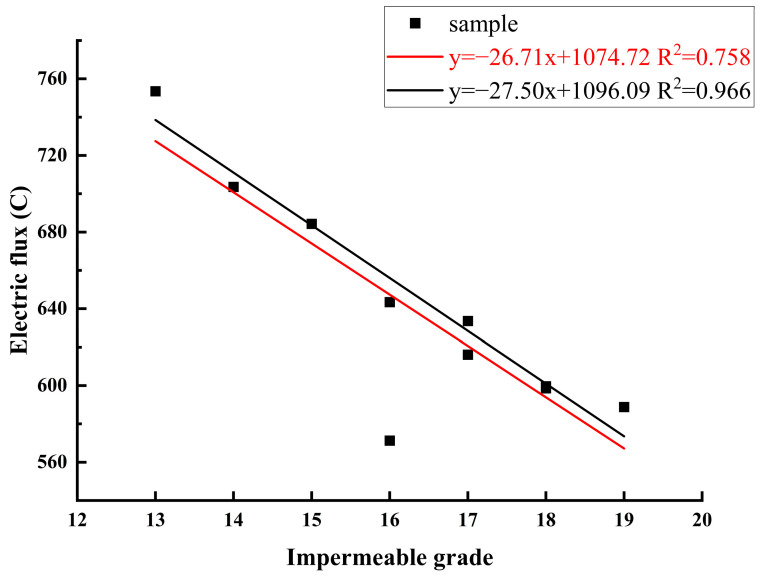
- A20-R25 and A20-R50 showed superior impermeability and chloride resistance; compared with the control, their impermeability grade increased by one grade and electric flux decreased by 9.83 C. Electric flux versus impermeability grade had a linear fit of R² = 0.758, or R² = 0.996 when A60-R25 was excluded.
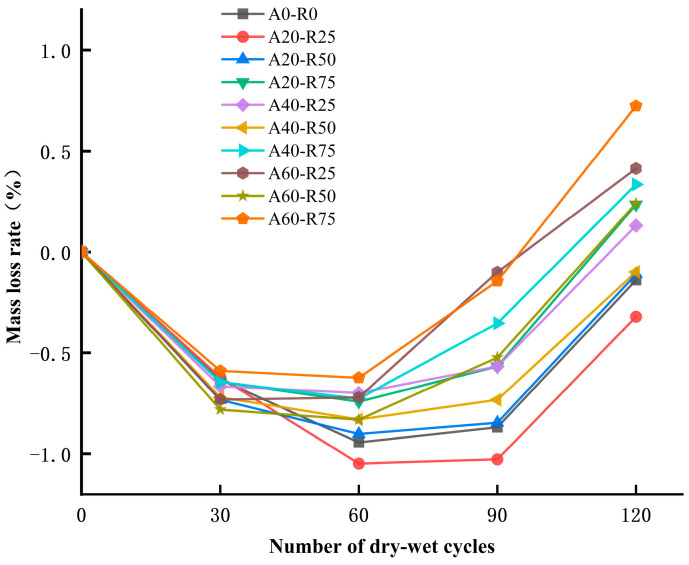
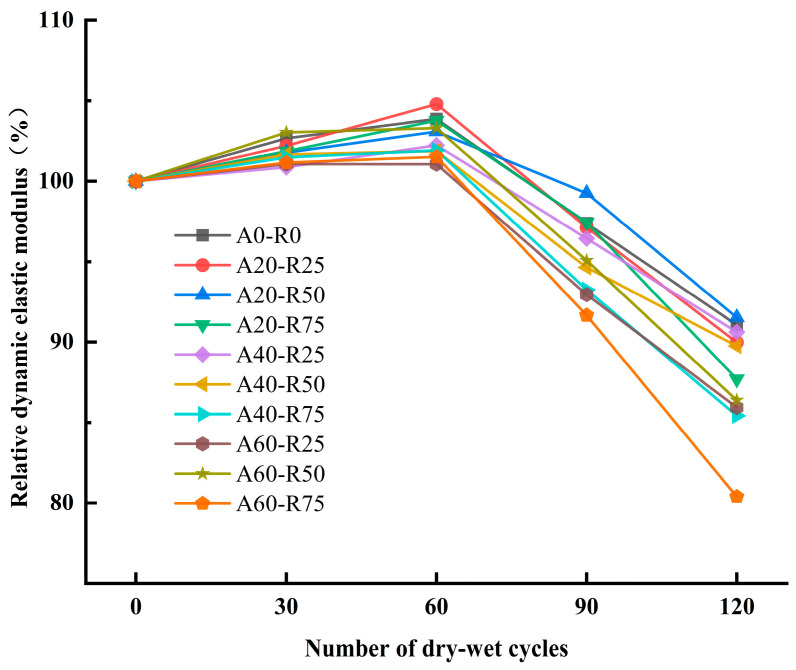
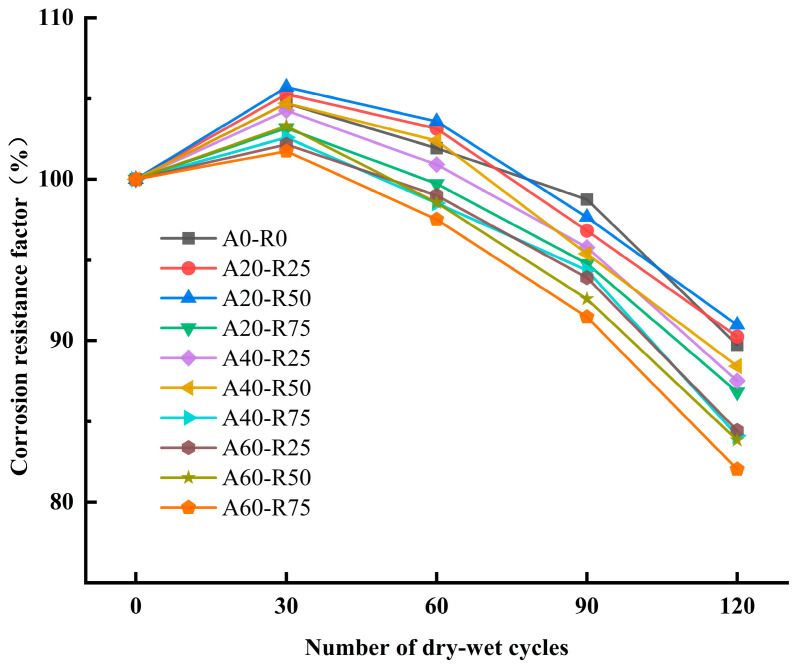
- Under sulfate dry–wet cycles, mass loss ranged from −1.048% to 0.724%; A20-R50 had the highest relative dynamic elastic modulus and corrosion resistance factor. After 60 cycles, relative dynamic elastic modulus decreased by 11.55% for A20-R50, 12.80% for A0-R0 (103.87% to 91.07%), and 14.80% for A20-R25 (104.79% to 89.99%).
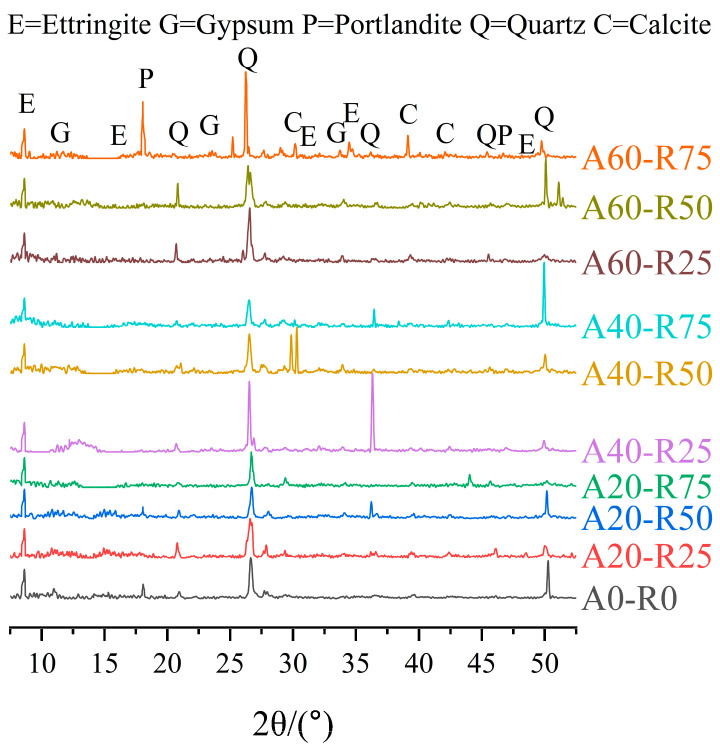
- XRD and MIP indicated sulfate erosion products including ettringite, AFt, and CaSO₄; A20-R50 showed superior compactness after sulfate attack, and AS/RCA addition improved pore structure and densification, particularly after sulfate exposure.
Methods
- Experimental study of ARSCC mixes with AS replacement ratios of 0%, 20%, 40%, and 60% by mass and RCA replacement ratios of 0%, 25%, 50%, and 75% by volume; water-to-binder ratio was 0.33, target strength C30, and specimens were cured 28 days at 20 °C and 95% relative humidity, with each test sample measured three times per group.
- Tests included workability (slump flow, segregation resistance, J-ring), compressive strength at 7 and 28 days, water penetration by gradual pressure loading, chloride penetration by 6 h electric flux, sulfate resistance by 5% Na₂SO₄ dry–wet cycles (15 h soaking + 6 h drying, 22 h cycle, 120 days), mass change, relative dynamic elastic modulus, corrosion resistance factor, XRD, and MIP.
- Main analysis used linear fitting between electric flux and impermeability grade and between durability indicators and impermeability grade, plus XRD and MIP for phase composition and pore structure.
Limitations
- The paper states that its narrow scope prevents a thorough evaluation of ARSCC performance and that it only serves as a guide for specific contexts; it calls for future research on more complicated conditions such as loaded sulfate coupling, loaded freeze–thaw coupling, and chloride salt freeze–thaw coupling.
- The paper notes possible device measurement error for the anomalous electric flux of A60-R25 and states that ARSCC is non-homogeneous, so specimen molding, curing, vibration, grinding, and other factors can affect linear fitting.
- Evident from the text: the study used a single water-to-binder ratio (0.33), single material sources (Xinjiang cement/fly ash, Gurbantungut Desert AS, Urumqi RCA), laboratory curing, and a 120-day sulfate exposure, with no field or longer-term validation reported.
Model-written summary. Check it against the paper before relying on it.
Integrity signals
Registry
Cites
Statistics
Figures
Verification
Claims the paper makes
0 Valid · 0 Not valid · 12 Not checked · 80 Own results and interpretations
A result the paper reports from its own data — it cites no other source for it, so there is none to check. The quote shows it is in the paper.
In the paper
“The highest impermeability grade and lowest electric flux were obtained with the 20% AS replacement ratio and 25% RCA replacement ratio (A20-R25).”
§ Impermeability and Durability of Self-Compacting Concrete Prepared with Aeolian Sand and Recycled Coarse Aggregate > Abstract
plainstates an association- Asserted: passes — The authors put it forward as true.
- Checkable: passes — It can be checked against evidence.
- Load-bearing: passes — The paper’s conclusions depend on it.
- Based: passes — The paper gives a reason why it holds.
A result the paper reports from its own data — it cites no other source for it, so there is none to check. The quote shows it is in the paper.
In the paper
“According to the study’s findings, after sulfate attack, the highest relative dynamic elastic modulus and corrosion resistance factor were obtained with the 20% AS replacement ratio and 50% RCA replacement ratio (A20-R50).”
§ Impermeability and Durability of Self-Compacting Concrete Prepared with Aeolian Sand and Recycled Coarse Aggregate > Abstract
plainstates an association- Asserted: passes — The authors put it forward as true.
- Checkable: passes — It can be checked against evidence.
- Load-bearing: passes — The paper’s conclusions depend on it.
- Based: passes — The paper gives a reason why it holds.
A result the paper reports from its own data — it cites no other source for it, so there is none to check. The quote shows it is in the paper.
In the paper
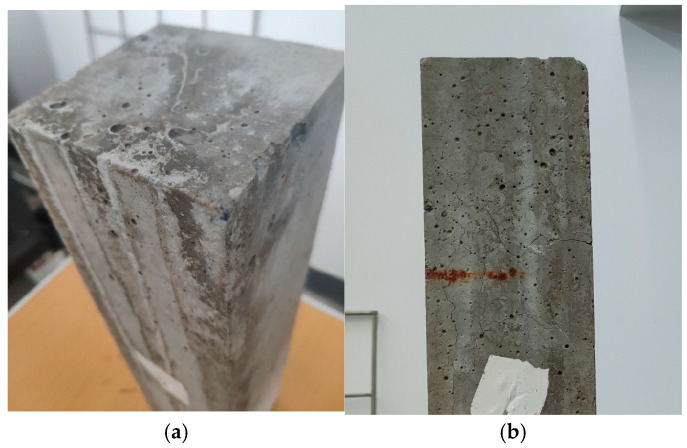
“Following 120 cycles, the specimen’s prism cracks on the outside became more severe.”
§ Impermeability and Durability of Self-Compacting Concrete Prepared with Aeolian Sand and Recycled Coarse Aggregate > 3. Results and Discussion > 3.3. Durability
plainstates a cause- Asserted: passes — The authors put it forward as true.
- Checkable: passes — It can be checked against evidence.
- Load-bearing: unclear — It is unclear whether the paper’s conclusions depend on it.
- Based: passes — The paper gives a reason why it holds.
A result the paper reports from its own data — it cites no other source for it, so there is none to check. The quote shows it is in the paper.
In the paper
“However, A20-R50 saw a gradual decline after 60 cycles in contrast to the other groups, including the control group A0-R0.”
§ Impermeability and Durability of Self-Compacting Concrete Prepared with Aeolian Sand and Recycled Coarse Aggregate > 3. Results and Discussion > 3.3. Durability
plainstates an association- Asserted: passes — The authors put it forward as true.
- Checkable: passes — It can be checked against evidence.
- Load-bearing: passes — The paper’s conclusions depend on it.
- Based: passes — The paper gives a reason why it holds.
A result the paper reports from its own data — it cites no other source for it, so there is none to check. The quote shows it is in the paper.
In the paper
“The ARSCCs exhibited negligible surface degradation overall.”
§ Impermeability and Durability of Self-Compacting Concrete Prepared with Aeolian Sand and Recycled Coarse Aggregate > 3. Results and Discussion > 3.3. Durability
plain- Asserted: passes — The authors put it forward as true.
- Checkable: passes — It can be checked against evidence.
- Load-bearing: unclear — It is unclear whether the paper’s conclusions depend on it.
- Based: passes — The paper gives a reason why it holds.
50 more claims
Create a free account to see all 92 claims and to verify the 25 references still open.
- It may state two separate claims as one. 26
- The quote only partly states this claim. 3
- Probably not a substantial claim. 12
Self-check
Percentages, sums and reported differences re-computed from the paper’s own numbers.
Each contradiction between two passages listed here was confirmed by an independent check.
Rated minor: it would not touch a result — a value no result rests on, a p-value that stays on the same side of the significance level, or a conflict that is clerical, resolved elsewhere in the paper, or outside its own findings.
In the paper
§ Impermeability and Durability of Self-Compacting Concrete Prepared with Aeolian Sand and Recycled Coarse Aggregate > 3. Results and Discussion > 3.4. Impermeability Grade and Durability
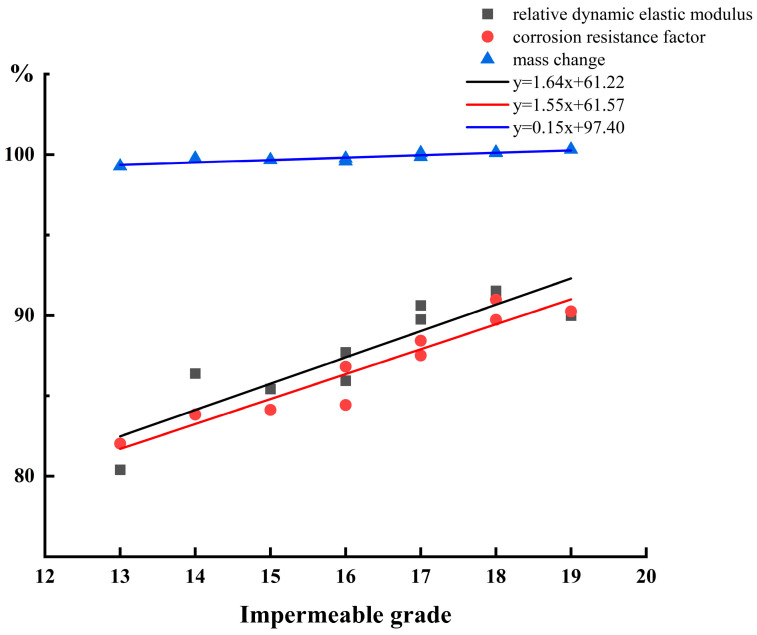
“R2 = 0.827 for mass change, R2 = 0.803 for relative dynamic elastic modulus, and R2 = 0.904 for corrosion resistance factor.”
§ Impermeability and Durability of Self-Compacting Concrete Prepared with Aeolian Sand and Recycled Coarse Aggregate > 3. Results and Discussion > 3.4. Impermeability Grade and Durability
“the fitted curve of the relative dynamic elastic modulus not only has the maximum R2, but also the maximum slope”
Citations
Cites
Okamura, H., & Ouchi, M. (2003) · Journal of Advanced Concrete Technology · doi:10.3151/jact.1.5 · Cited by 1,850
Etxeberria, M., Vázquez, E., Marí, A., & Barra, M. (2007) · Cement and Concrete Research · doi:10.1016/j.cemconres.2007.02.002 · Cited by 1,774
Study on the influence of attached mortar content on the properties of recycled concrete aggregate
de Juan, M. S., & Gutiérrez, P. A. (2009) · Construction and Building Materials · doi:10.1016/j.conbuildmat.2008.04.012 · Cited by 1,109
The use of coarse and fine crushed bricks as aggregate in concrete
Debieb, F., & Kenai, S. (2008) · Construction and Building Materials · doi:10.1016/j.conbuildmat.2006.12.013 · Cited by 607
Performance of recycled aggregate concrete monitored by durability indexes
Olorunsogo, F. T., & Padayachee, N. (2002) · Cement and Concrete Research · doi:10.1016/s0008-8846(01)00653-6 · Cited by 434
Persson, B. (2001) · Cement and Concrete Research · doi:10.1016/s0008-8846(00)00497-x · Cited by 408
Properties of HPC with recycled aggregates
Tu, T.-Y., Chen, Y.-Y., & Hwang, C. (2006) · Cement and Concrete Research · doi:10.1016/j.cemconres.2005.11.022 · Cited by 400
Mechanism of sulfate attack: a fresh look
Santhanam, M., Cohen, M. D., & Olek, J. (2003) · Cement and Concrete Research · doi:10.1016/s0008-8846(02)00958-4 · Cited by 365
Al-Bayati, H. K. A., Das, P. K., Tighe, S. L., & Baaj, H. (2016) · Construction and Building Materials · doi:10.1016/j.conbuildmat.2016.02.176 · Cited by 337
Assessment of the surface permeation properties of recycled aggregate concrete
Zaharieva, R., Buyle-Bodin, F., Skoczylas, F., & Wirquin, É. (2003) · Cement and Concrete Composites · doi:10.1016/s0958-9465(02)00010-0 · Cited by 269
Cited by
Luo, X., Xing, G., Tao, J., Hu, W., Wei, C., Chang, Z., & Qiao, L. (2025) · Construction and Building Materials · doi:10.1016/j.conbuildmat.2025.142335 · Cited by 19
Zheng, S., Liu, Q., Han, F., Liu, S., Han, T., & Yan, H. (2024) · Buildings · doi:10.3390/buildings14092949 · Cited by 14
Self-citationZhu, P., Zhou, X., Liu, X., Liang, N., Sun, W., Li, X., & Chen, X. (2025) · Construction and Building Materials · doi:10.1016/j.conbuildmat.2025.142991 · Cited by 11
Petrović, Ž., Milošević, B., Šurdilović, M. S., Zorić, A., & Turnić, D. (2026) · Materials · doi:10.3390/ma19020264 · Cited by 7
Durability of steel-fiber-reinforced self-compacted concrete with 100 % recycled mixed aggregates
Ortiz-Lozano, J. Á., de la Fuente, A., Sebastiá, F. M., Aguado, A., & Segura, I. (2025) · Case Studies in Construction Materials · doi:10.1016/j.cscm.2025.e05366 · Cited by 5
Metadata
- Authors
- Zheng, S., Liu, Q., Han, F., Liu, S., Zhang, G., & Zhu, J.
- Affiliations
- Xinjiang University (CN)
- Key Laboratory of Building Structure and Seismic Resistance of Xinjiang, Urumqi 830017, China
- Corresponding author
- Liu, Qing
- Venue
- Materials
- Publisher
- MDPI AG
- Published
- 2023-11-22
- Volume
- 16
- Issue
- 23
- Pages
- 7279
- ISSN
- 1996-1944 (ISSN-L)
- PMC
- PMC10707326
- OpenAlex
- W4388929163
- Cited by
- 9
- References
- 48
- Citations by year
- 2026: 3 · 2025: 5 · 2024: 1
- FWCI
- 0.87
- Type
- journal article
- Language
- en
- Open access
- gold
- doi.org
- Licence
- Locations
- Materials (publishedVersion, cc-by)
- PubMed Central (publishedVersion, cc-by)
- PubMed (publishedVersion)
- Funders
- Study on Deterioration Mechanism of Aeolian Sand Recycle Aggregate Self-Compacting Concrete in Cold and Saline Area (52168037)
- Topics
- Physical Sciences › Engineering › Building and Construction › Recycled Aggregate Concrete Performance
- Physical Sciences › Engineering › Civil and Structural Engineering › Concrete and Cement Materials Research
- Physical Sciences › Engineering › Civil and Structural Engineering › Innovative concrete reinforcement materials
- Keywords
- self-compacting concrete, wind-blown sand, recycled coarse aggregate, sulfate attack, chloride penetration, impermeability, durability, pore structure, elastic modulus, electric flux, partial replacement of natural aggregate, sustainable concrete
About these checks
Registry, retraction, Cites and statistics results are computed, not judged, with one exception: a printed reference that no index lists is read once by a model before it counts as a citation error. Claims are extracted by a model and kept only when their quote appears verbatim in the text; each cited source is then checked, with a model’s help, for whether it says what the claim relies on. Those verdicts can be wrong — read the claim’s quote and the cited source before relying on one.
A language model drew the claims from the paper on 2026-11-27, under version 3 of the claim definition (model deepseek-v4.1-flash, prompt extract-v3).
A second model labelled each claim on 2026-11-27 (model jev-1.13-20260917, definition revision gold-guideline-v0.2).
Statistics and arithmetic are recomputed, not judged.
Confidence bands are shown only for fields calibrated on our annotated test set. None is calibrated yet, so no band is shown.
What counts as a claim ›How we measure confidence ›How we check this ›
Are you an author, or do you see a problem with this page? Request a review
How to cite
Cite CoChat for the checks on this page, and the paper for its own findings.
- This page
- CoChat. (2026). Citation check: Impermeability and Durability of Self-Compacting Concrete Prepared with Aeolian Sand and Recycled Coarse Aggregate. https://app.cochat.ai/papers/10.3390/ma16237279
- The paper
- Zheng, S., Liu, Q., Han, F., Liu, S., Zhang, G., & Zhu, J. (2023). Impermeability and Durability of Self-Compacting Concrete Prepared with Aeolian Sand and Recycled Coarse Aggregate. Materials. https://doi.org/10.3390/ma16237279
Data sources
Bibliographic data: Semantic Scholar, OpenAlex, Crossref.
Contains information from the Semantic Scholar Academic Graph Datasets, made available under the ODC Attribution License (ODC-BY 1.0).
Semantic Scholar’s data is described in: Kinney, R., et al. (2023). The Semantic Scholar Open Data Platform. arXiv:2301.10140.
