

The DOI matches its Crossref record.
Mechanical Properties of a Sustainable Low-Carbon Geopolymer Concrete Using a Pumice-Derived Sodium Silicate Solution
Open accessAbstract
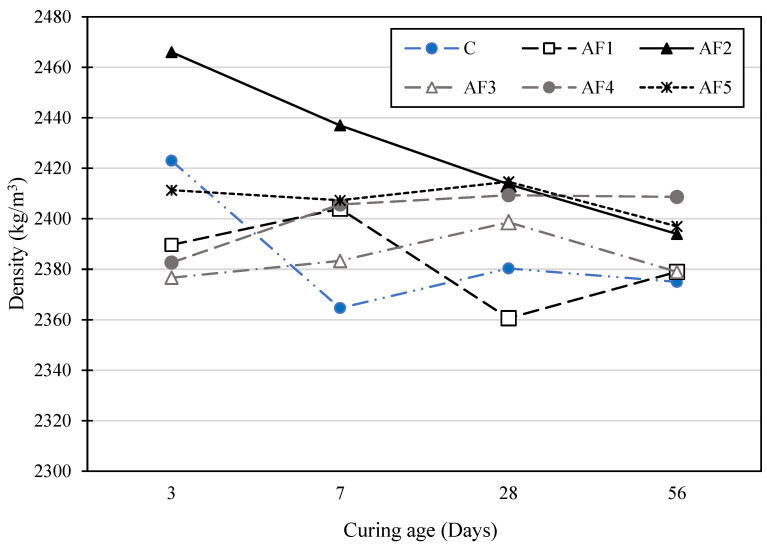
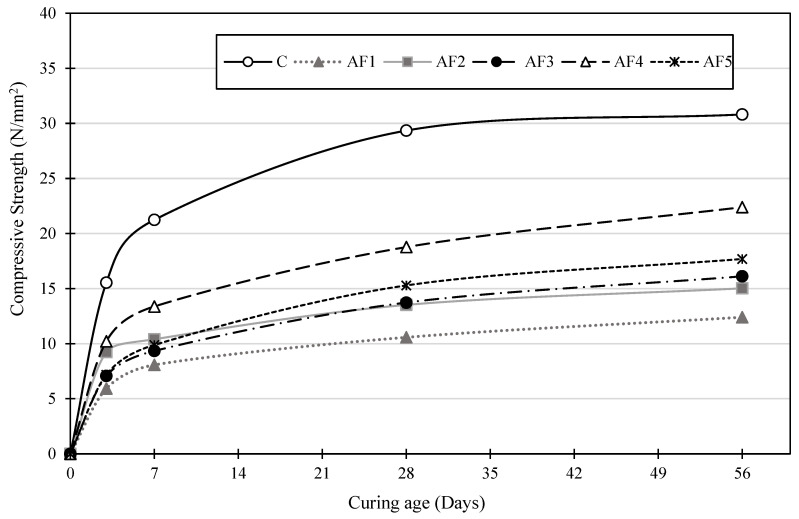
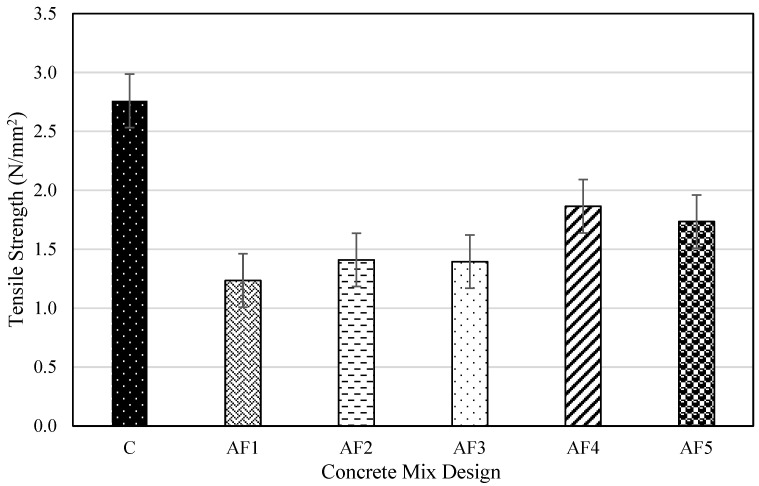
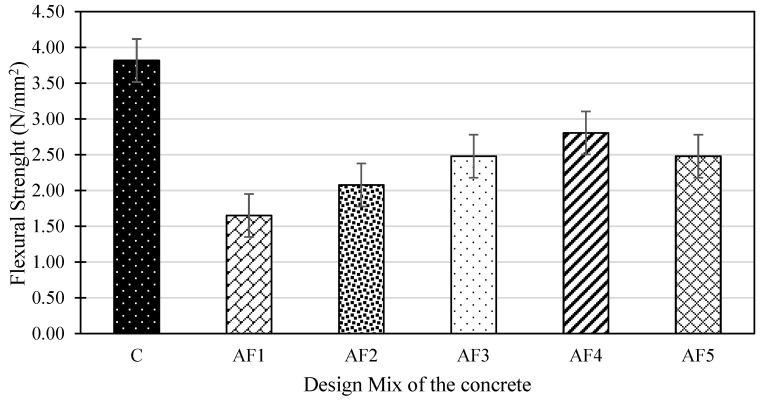
A geopolymer is an inorganic amorphous cementitious material, emerging as an alternative sustainable binder for greener concrete production over Ordinary Portland Cement (OPC). Geopolymer concrete production promotes waste reuse since the applicable precursor materials include agricultural and industrial waste that requires disposal, helping to reduce waste in landfills and ensuring sustainable environmental protection. This study investigates the development of an environmentally friendly sodium silicate alternative (SSA) derived from pumice powder (PP) in place of a commercial Na2SiO3 solution at a 10 M concentration. Six concrete batches were produced at alkaline/precursor (A/P) ratios of 0.1, 0.2, 0.3, 0.4, and 0.5. The geopolymer mix AF4, with an A/P ratio of 0.4, became the optimum geopolymer concrete design; however, it recorded lower compressive, tensile splitting, and flexural strengths, respectively, against the control OPC concrete. The geopolymer formulations, however, obtained 28-day-hardened concrete densities comparable to the control concrete. The 28-day compressive strength of the OPC concrete was 29.4 MPa, higher than the 18.8 MPa recorded for AF4. However, the 56-day strength of AF4 improved to 22.4 MPa, an around 19% increase compared to the 30.8 MPa achieved by the control mix on day 56, having experienced only a 5% strength increase. The low mechanical performances of the geopolymer formulation could be attributed to extra water added to the original geopolymer design to improve the workability of the geopolymer mix. Therefore, the SSA alkaline solution using PP showed some potential for developing geopolymer concrete for low-strength construction applications.
Overview
The claims and statistics of this paper haven’t been checked yet.
Run the check — free, no account needed. It reads the open-access text and checks the sources it cites.
Integrity signals
Registry
Cites
Statistics
Figures
Verification
Claims the paper makes
The claims and statistics of this paper haven’t been checked yet.
Run the check — free, no account needed. It reads the open-access text and checks the sources it cites.
Claims other papers make about this one
Each is checked against this paper’s own text: does it say what the citing paper says it does?
The cited source doesn’t support the claim as written.
In the citing paper
“Na 2 CO 3 and Na 2 SiO 3 are emerging as environmentally friendly alternatives, particularly under ambient curing circumstances, owing to their diminished ecological impact and safety benefits.”
From Experimental and Statistical Optimization of Low-carbon Binder Concrete under Varying Alkaline Activator Conditions (2026) · cites this paper as [12]
Checked by a reasoning model — may be wrong.
Experimental — accuracy not yet measuredThe check wasn’t confident either way, so it gives no verdict — never disputed.
In the citing paper
“Na 2 CO 3 frequently results in a reduced rate of strength development unless accompanied by enough silicate concentration [11, 12].”
From Experimental and Statistical Optimization of Low-carbon Binder Concrete under Varying Alkaline Activator Conditions (2026) · cites this paper as [12]
Experimental — accuracy not yet measured
Self-check
Percentages, sums and reported differences re-computed from the paper’s own numbers.
The self-check needs the paper’s full text.
Citations
Cites
No references could be resolved yet.
Research works printed but not linked: 67
- Oti, 2020, Durability of Concrete Containing PFA-GGBS By-Products, J. Civ. Eng. Constr., 9, 165, 10.32732/jcec.2020.9.3.165 · DOI
- UratanI, 2023, A Forward Looking Perspective on the Cement and Concrete Industry: Implications of Growth and Development in the Global South, Energy Res. Soc. Sci., 97, 102972, 10.1016/j.erss.2023.102972 · DOI
- Awoyera, 2019, A Critical Review on Application of Alkali Activated Slag as a Sustainable Composite Binder, Case Stud. Constr. Mater., 11, e00268
- Heath, 2013, The Potential for Using Geopolymer Concrete in the UK, Proc. Inst. Civ. Eng. Constr. Mater., 166, 195, 10.1680/coma.12.00030 · DOI
- Oti, 2018, Engineering Properties of Concrete made with Pulverised Fly Ash, Int. J. Mech. Prod. Eng., 6, 52
- Zhou, 2012, Effects of PFA and GGBS on Early-Ages Engineering Properties of Portland Cement Systems, J. Adv. Concr. Technol., 10, 74, 10.3151/jact.10.74 · DOI
- Dhir, 1998, Impact of BS EN 450 PFA on Concrete Construction in the UK, Constr. Build. Mater., 12, 59, 10.1016/S0950-0618(97)00029-9 · DOI
- Swamy, R.N. (1986). Cement Replacement Materials, Surrey University Press.
- Singh, 2015, Geopolymer Concrete: A review of some recent developments, Constr. Build. Mater., 85, 78, 10.1016/j.conbuildmat.2015.03.036 · DOI
- Krivenko, 2007, Directed Synthesis of Alkaline Aluminosilicate Minerals in a Geocement Matrix, Mater. Sci., 42, 53, 10.1007/s10853-006-0528-3 · DOI
- Pacheco-Torgal, F., Labrincha, J., Leonelli, C., Palomo, A., and Chindaprasit, P. (2015). Handbook of Akali-Activated Cements, Mortars and Concretes, Woodhead Publishing Ltd. · DOI
- Aldred, J., and Day, J. (2012, January 29–31). Is Geopolymer Concrete a Suitable Alternative to Traditional Concrete. Proceedings of the 37th Conference on Our World in Concrete and Structures, Singapore. Available online: https://earthfriendlyconcrete.com/wp-content/uploads/2022/01/jaldred_jday_geopolymer-concrete_singapore-2012.pdf.
- Chanh, N.V., Trung, B.D., and Tuan, D.V. (2008, January 11–13). Recent Research Geopolymer Concrete. Proceedings of the 3rd ACF International Conference-ACF/VCA, Ho Chi Minh City, Vietnam. Available online: https://www.researchgate.net/profile/Prem-Baboo/post/Is-Seawater-suitable-for-Geopolymer-concrete/attachment/59d636d679197b80779943c7/AS%3A390575271497729%401470131809520/download/A18.pdf.
- Duxson, 2007, Geopolymer technology: The current state of the art, J. Mater. Sci., 42, 2917, 10.1007/s10853-006-0637-z · DOI · Paper page
- Singh, 2020, Geopolymer cement and concrete: Properties, Mater. Today Proc., 29, 743, 10.1016/j.matpr.2020.04.513 · DOI
- Shobeiri, 2021, A Comprehensive Assessment of the Global Warming Potential of Geopolymer Concrete, J. Clean. Prod., 297, 126669, 10.1016/j.jclepro.2021.126669 · DOI
- Turner, 2013, Carbon Dioxide Equivalent (CO2-e) Emissions: A Comparison Between Geopolymer and OPC Cement Concrete, Constr. Build. Mater., 43, 125, 10.1016/j.conbuildmat.2013.01.023 · DOI
- Duxson, 2007, The Role of Inorganic Polymer Technology in the Development of ‘Green Concrete’, Cem. Concr. Res., 37, 1590, 10.1016/j.cemconres.2007.08.018 · DOI
- Davidovits, 1994, Properties of Geopolymer Concrete. First International Conference on Alkaline Cements and Concrete, Sci. Inst. Bind. Mater., 1, 131
- Provis, J.L., and Van Deventer, J.S. (2014). Alkali Activated Materials State-of-the-Art Report, RILEM TC 224-AAM, Springer. · DOI
- Zhang, 2021, Mechanical Properties and Reaction Mechanism of One-Part Geopolymer Mortars, Constr. Build. Mater., 273, 121973, 10.1016/j.conbuildmat.2020.121973 · DOI
- Alsalman, 2021, Energy and CO2 Emission Assessments of Alkali-Activated Concrete and Ordinary Portland Cement Concrete: A Comparative Analysis of Different Grades of Concrete, Clean. Environ. Syst., 3, 100047, 10.1016/j.cesys.2021.100047 · DOI
- Bajpai, 2020, Environmental Impact Assessment of Fly Ash and Silica Fume Based Geopolymer Concrete, J. Clean. Prod., 254, 120147, 10.1016/j.jclepro.2020.120147 · DOI
- Amran, 2021, Long-Term Durability Properties of Geopolymer Concrete: An In-depth Review, Case Stud. Constr. Mater., 15, e00661
- Jamieson, 2015, Comparison of Embodied Energies of Ordinary Portland Cement with Bayer-Derived Geopolymer Products, J. Clean. Prod., 99, 112, 10.1016/j.jclepro.2015.03.008 · DOI
- Billong, 2021, Using Silica Fume Based Activator in Sustainable Geopolymer Binder for Building Application, Constr. Build. Mater., 275, 122177, 10.1016/j.conbuildmat.2020.122177 · DOI
- Adeleke, B.O., Kinuthia, J.M., Oti, J., and Ebailila, M. (2023). Physico-Mechanical Evaluation of Geopolymer Concrete Activated by Sodium Hydroxide and Silica Fume-Synthesised Sodium Hydroxide Solution. Materials, 16. · DOI · Paper page
- Kamseu, 2017, Substitution of Sodium Silicate with Rice Husk Ash-NaOH Solution in Metakaolin Based Geopolymer Cement Concerning Reduction in Global Warming, J. Clean. Prod., 142, 3050, 10.1016/j.jclepro.2016.10.164 · DOI
- Rajan, 2021, Sustainable Development of Geopolymer Binder using Sodium Silicate Synthesized from Agricultural Waste, J. Clean. Prod., 286, 124959, 10.1016/j.jclepro.2020.124959 · DOI
- Figueiredo, 2021, Producing Sodium Silicate Powder from Iron Ore Tailings for use as an Activator in One-Part Geopolymer Binders, Mater. Lett., 288, 129333, 10.1016/j.matlet.2021.129333 · DOI
- Tong, 2018, Use of Vietnamese Rice Husk Ash for the Production of Sodium Silicate as the Activator for Alkali-Activated Binders, J. Clean. Prod., 201, 272, 10.1016/j.jclepro.2018.08.025 · DOI
- Rashad, 2021, An Overview of Pumice Stone as Cementitious Material-The Best Manual for Civil Engineer, Silicon, 13, 551, 10.1007/s12633-020-00469-3 · DOI
- Kabay, 2021, Pumice as Precursor in Geopolymer Paste and Mortar, J. Civ. Eng. Constr., 10, 225, 10.32732/jcec.2021.10.4.225 · DOI
- Safari, 2020, Mechanical Characteristics of Pumice-Based Geopolymer Paste, Resour. Conserv. Recycl., 162, 105055, 10.1016/j.resconrec.2020.105055 · DOI
- Nematollahi, 2015, Synthesis of Heat and Ambient Cured One-Part Geopolymer Mixes with Different Grades of Sodium Silicate, Ceram. Int., 41, 5696, 10.1016/j.ceramint.2014.12.154 · DOI
- Tuyan, 2021, Alkali-Activated and Geopolymer Materials Developed Using Innovative Manufacturing Techniques: A Critical Review, Constr. Build. Mater., 303, 124483, 10.1016/j.conbuildmat.2021.124483 · DOI
- Provis, J.L., and Van Deventer, J.S.J. (2013). Alkali Activated Materials: State-of-The-Art Report (RILEM TC 224-AAM), Springer. · DOI
- Law, 2012, Durability Assessment of Alkali Activated Slag (AAS) Concrete, Mater. Struct., 45, 1425, 10.1617/s11527-012-9842-1 · DOI
- Basheer, P.A.M. (2018). Durability of Concrete Structures, Proceedings of the ICDCS2018: 6th International Conference on Durability of Concrete Structures, Leeds, UK, 18–20 July 2018, Whittles Publishing.
- Yunsheng, 2007, Synthesis and Heavy Metal Immobilization Behaviors of Slag Based Geopolymer, J. Hazard. Mater., 143, 206, 10.1016/j.jhazmat.2006.09.033 · DOI
- Bellum, 2020, Exploration of Mechanical and Durability Characteristics of Fly Ash GGBFS Based Green Geopolymer Concrete, Appl. Sci., 2, 919
- Collins, 1999, Workability and Mechanical Properties of Alkali Activated Slag Concrete, Cem. Concr. Res., 29, 455, 10.1016/S0008-8846(98)00236-1 · DOI
- Nath, 2014, Effect of GGBFS on Setting, Workability and Early Strength Properties of Fly Ash Geopolymer Concrete Cured in Ambient Condition, Constr. Build. Mater., 66, 163, 10.1016/j.conbuildmat.2014.05.080 · DOI
- Yang, 2018, Effect of Fly Ash Microsphere on the Rheology and Microstructure of Alkali Activated Fly Ash/Slag Pastes, Cem. Concr. Res., 109, 198, 10.1016/j.cemconres.2018.04.008 · DOI
- Fang, 2018, Workability and Mechanical Properties of Alkali-Activated Fly Ash-Slag Concrete Cured at Ambient Temperature, Constr. Build. Mater., 172, 476, 10.1016/j.conbuildmat.2018.04.008 · DOI
- Jia, 2022, Understanding the Workability of Alkali-Activated Phosphorus Slag Pastes: Effects of Alkali Dose and Silicate Modulus on Early-Age Hydration Reactions, Cem. Concr. Compos., 133, 104649, 10.1016/j.cemconcomp.2022.104649 · DOI
- Nath, 2017, Flexural Strength and Elastic Modulus of Ambient-Cured Blended Low-Calcium Fly Ash Geopolymer Concrete, Constr. Build. Mater., 130, 22, 10.1016/j.conbuildmat.2016.11.034 · DOI
- Vijai, 2010, Effect of Types of Curing on Strength of Geopolymer Concrete, Int. J. Phys. Sci., 5, 1419
- Li, 2013, Influence of Curing on the Strength Development of Calcium-Containing Geopolymer Mortar, Materials, 6, 5069, 10.3390/ma6115069 · DOI
- Aziz, 2020, Strength Development of Solely Ground Granulated Blast Furnace Glag Geopolymers, Constr. Build. Mater., 250, 118720, 10.1016/j.conbuildmat.2020.118720 · DOI
- Haha, 2012, Influence of Slag Chemistry on the Hydration of Alkali-Activated Blast-Furnace Slag—Part II: Effect of Al2O3, Cem. Concr. Res., 42, 74, 10.1016/j.cemconres.2011.08.005 · DOI · Paper page
- Thunuguntla, 2018, Effect of Mix Design Parameters on Mechanical and Durability Properties of Alkali Activated Slag Concrete, Constr. Build. Mater., 193, 173, 10.1016/j.conbuildmat.2018.10.189 · DOI
- Zhu, 2020, Setting Behaviours and Early-Age Microstructures of Alkali-Activated Ground Granulated Blast Furnace Slag (GGBS) from Different Regions in China, Cem. Concr. Compos., 114, 103782, 10.1016/j.cemconcomp.2020.103782 · DOI
- Farhan, 2020, Assessment of Important Parameters Involved in the Synthesis of Geopolymer Composites: A Review, Constr. Build. Mater., 264, 120276, 10.1016/j.conbuildmat.2020.120276 · DOI
- Sithole, 2020, Geosynthesis of Building and Construction Materials through Alkaline Activation of Granulated Blast Furnace Slag, Constr. Build. Mater., 264, 120712, 10.1016/j.conbuildmat.2020.120712 · DOI
- 2021, Investigation of the Properties of Two Different Slag-Based Geopolymer Concretes Exposed to Freeze–Thaw Cycles, Struct. Concr. J., 22, E332
- Provis, 2007, Geopolymerisation Kinetics. 2. Reaction Kinetic Modelling, Chem. Eng. Sci., 62, 2318, 10.1016/j.ces.2007.01.028 · DOI
- Cui, 2019, Effects of the n(H2O: Na2Oeq) Ratio on the Geopolymerization Process and Microstructures of Fly Ash-Based Geopolymers, J. Non-Cryst. Solids, 511, 19, 10.1016/j.jnoncrysol.2018.12.033 · DOI
- Jeong, 2016, Influence of Four Additional Activators on Hydrated-Lime [Ca(OH)2] Activated Ground Granulated Blast-Furnace Slag, Cem. Concr. Compos., 65, 1, 10.1016/j.cemconcomp.2015.10.007 · DOI
- Shilar, 2022, Molarity activity effect on mechanical and microstructure properties of geopolymer concrete: A review, Case Stud. Constr. Mater., 16, e01014
- Mohamed, 2019, Factors Affecting Compressive Strength Development in Alkali-activated Slag Concrete, IOP Conf. Ser. Mater. Sci. Eng., 603, 042037, 10.1088/1757-899X/603/4/042037 · DOI
- Rangan, 2014, Geopolymer concrete for environmental protection, Indian Concr. J., 88, 41
- Asghar, 2023, Promoting the Green Construction: Scientometric Review on the Mechanical and Structural Performance of Geopolymer Concrete, Constr. Build. Mater., 368, 130502, 10.1016/j.conbuildmat.2023.130502 · DOI
- Thomas, 2015, Alkali-Activated Concrete: Engineering Properties and Stress–Strain Behavior, Constr. Build. Mater., 93, 49, 10.1016/j.conbuildmat.2015.04.039 · DOI
- Vora, 2013, Parametric Studies on Compressive Strength of Geopolymer Concrete, Procedia Eng., 51, 210, 10.1016/j.proeng.2013.01.030 · DOI
- Gaedicke, 2016, A Method to Correlate Splitting Tensile Strength and Compressive Strength of Pervious Concrete Cylinders and Cores, Constr. Build. Mater., 125, 271, 10.1016/j.conbuildmat.2016.08.031 · DOI
- Ansari, M.A., Shariq, M., and Mahdi, F. (2023). Structural behavior of reinforced geopolymer concrete beams—A review. Mater. Today Proc., in press. · DOI
Cited by
Sorted by citations
Performance of Sustainable Geopolymer Concrete Made of Different Alkaline Activators
Hamed, Y. R., Keshta, M. M., Elshikh, M. M. Y., Elshami, A. A., Matthana, M. H. S., & Youssf, O. (2025) · Infrastructures · doi:10.3390/infrastructures10020041 · Cited by 19
Ganesan, Y., & Panruti Thangaraj, R. (2026) · Periodica Polytechnica Civil Engineering · doi:10.3311/ppci.41876 · Cited by 2
“Na 2 CO 3 frequently results in a reduced rate of strength development unless accompanied by enough silicate concentration [11, 12].”
Metadata
- Authors
- Oti, J., Adeleke, B. O., Anowie, F. X., Kinuthia, J. M., & Ekwulo, E.
- Affiliations
- University of South Wales (GB)
- Rivers State University (NG)
- Corresponding author
- Adeleke, Blessing O.
- Venue
- Materials
- Publisher
- MDPI AG
- Published
- 2024-04-13
- Volume
- 17
- Issue
- 8
- Pages
- 1792
- ISSN
- 1996-1944 (ISSN-L)
- PMC
- PMC11051076
- OpenAlex
- W4394818430
- Cited by
- 19
- References
- 0
- Citations by year
- 2026: 5 · 2025: 10 · 2024: 4
- FWCI
- 3.17
- Type
- journal article
- Language
- en
- Open access
- gold
- doi.org
- Licence
- Locations
- Materials (publishedVersion, cc-by)
- PubMed Central (publishedVersion, cc-by)
- PubMed (publishedVersion)
- DOAJ (DOAJ: Directory of Open Access Journals) (submittedVersion)
- Funders
- Taith Funding
- Topics
- Physical Sciences › Engineering › Civil and Structural Engineering › Concrete and Cement Materials Research
- Physical Sciences › Environmental Science › Environmental Engineering › Microbial Applications in Construction Materials
- Physical Sciences › Engineering › Building and Construction › Recycled Aggregate Concrete Performance
- Keywords
- geopolymer concrete, sodium silicate solution, pumice powder, compressive strength, splitting tensile strength, flexural strength, low-carbon concrete, cement replacement, waste reuse, mechanical properties, concrete density
About these checks
Registry, retraction, Cites and statistics results are computed, not judged, with one exception: a printed reference that no index lists is read once by a model before it counts as a citation error. Claims are extracted by a model and kept only when their quote appears verbatim in the text; each cited source is then checked, with a model’s help, for whether it says what the claim relies on. Those verdicts can be wrong — read the claim’s quote and the cited source before relying on one.
Statistics and arithmetic are recomputed, not judged.
Confidence bands are shown only for fields calibrated on our annotated test set. None is calibrated yet, so no band is shown.
What counts as a claim ›How we measure confidence ›How we check this ›
Are you an author, or do you see a problem with this page? Request a review
How to cite
Cite CoChat for the checks on this page, and the paper for its own findings.
- This page
- CoChat. (2026). Citation check: Mechanical Properties of a Sustainable Low-Carbon Geopolymer Concrete Using a Pumice-Derived Sodium Silicate Solution. https://app.cochat.ai/papers/10.3390/ma17081792
- The paper
- Oti, J., Adeleke, B. O., Anowie, F. X., Kinuthia, J. M., & Ekwulo, E. (2024). Mechanical Properties of a Sustainable Low-Carbon Geopolymer Concrete Using a Pumice-Derived Sodium Silicate Solution. Materials. https://doi.org/10.3390/ma17081792
