

Multiscale Investigation of Modified Recycled Aggregate Concrete on Sulfate Attack Resistance
Open accessThe DOI matches its Crossref record; 43 of the 43 references it cites were found in a registry or an index; none of the 24 sources its claims cite is checked for support yet.
Abstract
This study investigated the sulfate resistance of modified recycled aggregate concrete (RAC) by applying carbonation and nano-silica soaking methodologies. Recycled concrete aggregates (RCA) derived from concretes of C30 and C60 strength grades were subjected to these modification techniques and subsequently utilized in the fabrication of RAC specimens. The results show notable porosity and crack density within the interfacial transition zone (ITZ) interfacing recycled aggregate and cement paste in recycled aggregate concrete (RAC). Specifically, the porosity within the ITZ of RAC is observed to be up to 30% higher than that of virgin aggregate concrete. These pathways facilitate the penetration of sulfate ions, subsequently inducing deterioration and resulting in a compression strength reduction of up to 40%. While carbonation treatment exhibits a moderate enhancement in sulfate resistance, decreasing the sulfate penetration depth by 15%, the incorporation of 2% nano-silica by weight of cement proves significantly more effective. This addition reduces the sulfate penetration depth by over 30% and lowers the sulfate concentration by 25%. Furthermore, the compressive strength of RAC modified with nano-silica increases by 15% following 28 days of sulfate exposure. Additionally, a 30% reduction in the sulfate ion mass equilibrium depth is observed in nano-silica-modified RAC, accompanied by a markedly lower sulfate concentration in the pore solution. After 56 days of sulfate attack, the compressive strength of nano-silica-modified RAC retains 85% of its initial value, whereas unmodified RAC decreases to 70%. Notably, the quality of recycled aggregate significantly impacts sulfate resistance, with high-strength RCA (exceeding 40 MPa) demonstrating superior resistance compared to low-strength RCA (below 20 MPa). Consequently, RAC produced with high-strength RCA experiences only a 20% loss in compressive strength under sulfate attack, whereas RAC containing low-strength RCA suffers a 40% loss. The novelty of this study is the effective use of nano-silica soaking and carbonation to enhance the sulfate resistance and compressive strength of recycled aggregate concrete originated from both normal and high-strength reference concrete.
Overview
CoChat Summary
TL;DR
This study modified recycled coarse aggregates (RCA) from C30 and C60 parent concretes by accelerated carbonation or 2% nano-silica soaking, then tested recycled aggregate concrete (RAC) under 5% Na₂SO₄ sulfate attack. Nano-silica soaking improved sulfate resistance and compressive strength more than carbonation, and RCA from high-strength concrete performed better than RCA from low-strength concrete.
Key findings
- The interfacial transition zone (ITZ) in RAC had porosity up to 30% higher than virgin aggregate concrete; sulfate ions penetrated these pathways, formed expansive ettringite, and caused compressive strength reductions of up to 40%.
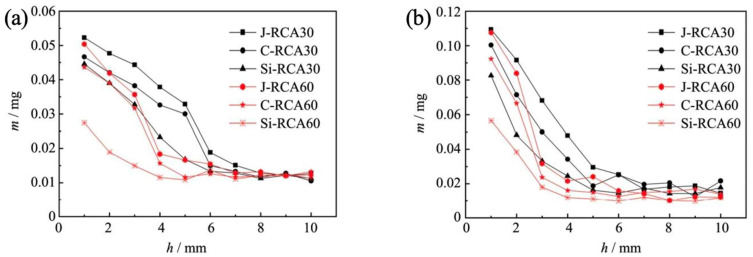
- Carbonation reduced sulfate penetration depth by about 15%. Nano-silica at 2% by weight of cement reduced sulfate penetration depth by over 30%, lowered sulfate concentration by 25%, increased compressive strength after 28 days of sulfate exposure by about 15%, and reduced the sulfate ion mass equilibrium depth by about 30%; after 56 days of sulfate attack, nano-silica-modified RAC retained 85% of initial compressive strength versus 70% for unmodified RAC.
- High-strength RCA (exceeding 40 MPa) showed superior sulfate resistance to low-strength RCA (below 20 MPa): RAC with high-strength RCA lost only 20% compressive strength under sulfate attack, while RAC with low-strength RCA lost 40%.
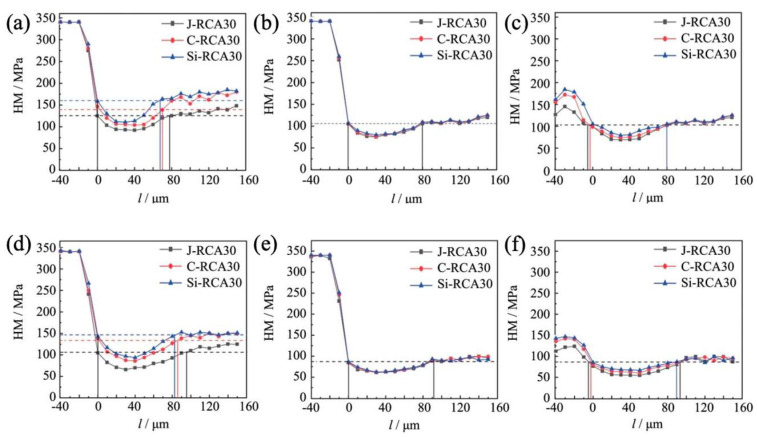
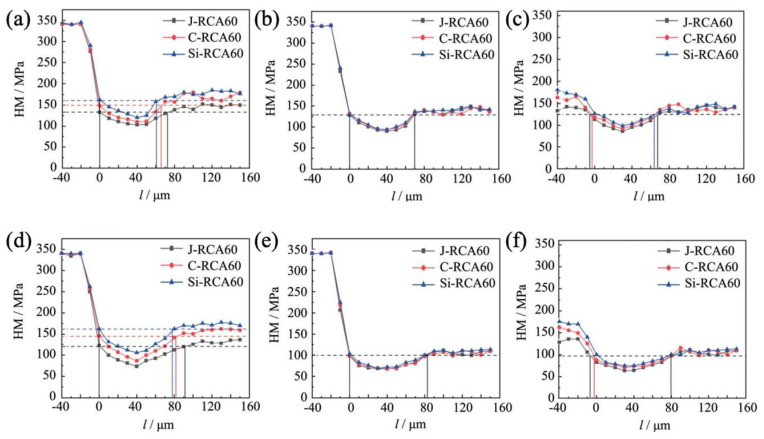
- Microhardness in the old aggregate–old mortar ITZ of J-RCA30 at 45 days ranged from 91.4 to 125.8 MPa with an interface width of about 76 μm; C-RCA30 and Si-RCA30 showed microhardness increases of 14.0%–9.5% and 21.7%–28.9%, with interface widths reduced by 10.8% and 13.5%, respectively. At 90 days, J-RCA30 microhardness decreased to 66.3–104.7 MPa, while C-RCA30 and Si-RCA30 showed increases of 29.6%–27.5% and 41.8%–35.9%, with widths reduced by 11.2% and 13.9%.
Methods
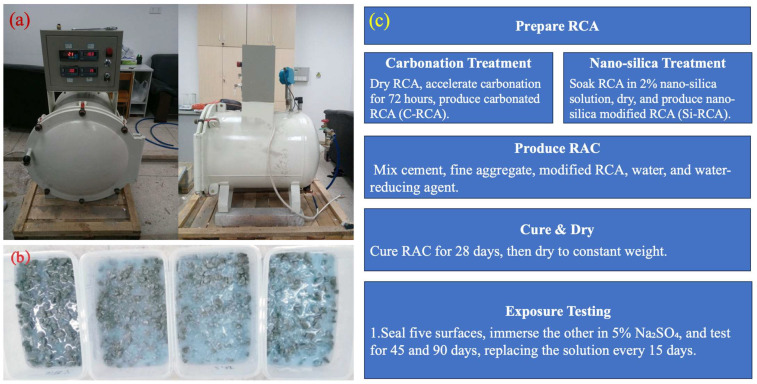
- RCA (5–10 mm, later described as screened to 5–27 mm) was sourced from parent concretes with designated compressive strengths of C30 and C60. RCA was modified by 72 h accelerated carbonation (C-RCA30, C-RCA60) or by full immersion in a 2% nano-SiO₂ solution followed by 12 h oven drying (Si-RCA30, Si-RCA60).
- RAC was produced with cement 340 kg/m³, fine aggregate 740 kg/m³, modified recycled coarse aggregate 970 kg/m³, water 163 kg/m³, and water-reducing agent 3.2 kg/m³. After 28 days standard curing and drying, five surfaces of each specimen were sealed with paraffin wax and one surface was immersed in 5% Na₂SO₄ solution for 45 and 90 days, with solution replaced every 15 days.
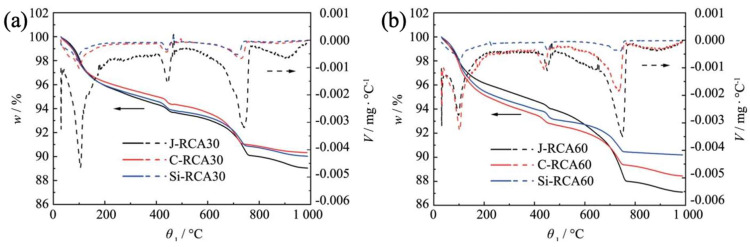
- Testing included SEM and XRD for RCA surface morphology/composition; compressive strength testing; spectrophotometry for sulfate ion concentration; microhardness testing of ITZs (old aggregate–old mortar, old aggregate–new mortar, old mortar–new mortar) using 100 mm × 50 mm × 10 mm specimens, nine lattices with a 4 × 5 grid, 50 g load, and 10 μm spacing; and TGA after 90 days of sulfate attack.
Limitations
- The paper does not have a dedicated limitations section. It states future research should optimize nano-silica dosage and explore other modifiers, but does not explicitly frame study limitations.
- Evident from the text: only two parent concrete strength grades (C30 and C60), one nano-silica concentration (2%), one carbonation duration (72 h), and sulfate exposure durations of 45 and 90 days in the experimental methods were tested; no field or longer-term exposure data are reported.
- Evident inconsistencies in the text: the methods describe 45- and 90-day sulfate immersion, while the abstract and conclusions also report 28- and 56-day results; the TGA section describes RCA60 as “recycled concrete aggregate incorporated at a 60% replacement level,” whereas elsewhere RCA60 denotes RCA from C60 parent concrete; and one ITZ width after 90 days for J-RCA30 is reported as 98 mm while other widths are in μm.
Model-written summary. Check it against the paper before relying on it.
Integrity signals
Registry
Cites
Statistics
Figures
Verification
Claims the paper makes
0 Valid · 1 Not valid · 12 Not checked · 110 Own results and interpretations
A result the paper reports from its own data — it cites no other source for it, so there is none to check. The quote shows it is in the paper.
In the paper
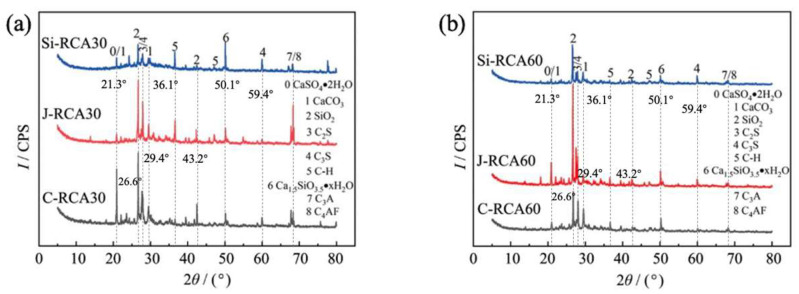
“Turning our attention to Figure 3, which presents the results of XRD analysis, it can be seen that the surface mortar of J-RCA30 is laden with incompletely hydrated cement clinker.”
§ Multiscale Investigation of Modified Recycled Aggregate Concrete on Sulfate Attack Resistance > 3. Results and Discussion > 3.1. Morphological Graph and Composition of RCA
plainSingle case- Asserted: passes — The authors put it forward as true.
- Checkable: passes — It can be checked against evidence.
- Load-bearing: passes — The paper’s conclusions depend on it.
- Based: passes — The paper gives a reason why it holds.
A result the paper reports from its own data — it cites no other source for it, so there is none to check. The quote shows it is in the paper.
In the paper
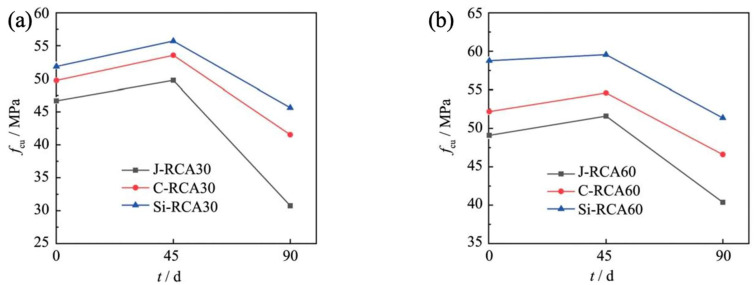
“Notably, the compressive strength values of modified RAC exceed those of unmodified RAC”
§ Multiscale Investigation of Modified Recycled Aggregate Concrete on Sulfate Attack Resistance > 3. Results and Discussion > 3.2. Compressive Strength and Sulfate Erosion Concentration Profiles in RAC
plainstates a cause- Asserted: passes — The authors put it forward as true.
- Checkable: passes — It can be checked against evidence.
- Load-bearing: passes — The paper’s conclusions depend on it.
- Based: passes — The paper gives a reason why it holds.
A result the paper reports from its own data — it cites no other source for it, so there is none to check. The quote shows it is in the paper.
In the paper
“with nano-SiO2 modification exhibiting a more pronounced enhancement compared to carbonation treatment.”
§ Multiscale Investigation of Modified Recycled Aggregate Concrete on Sulfate Attack Resistance > 3. Results and Discussion > 3.2. Compressive Strength and Sulfate Erosion Concentration Profiles in RAC
plainstates a cause- Asserted: passes — The authors put it forward as true.
- Checkable: passes — It can be checked against evidence.
- Load-bearing: unclear — It is unclear whether the paper’s conclusions depend on it.
- Based: passes — The paper gives a reason why it holds.
A result the paper reports from its own data — it cites no other source for it, so there is none to check. The quote shows it is in the paper.
In the paper
“The results show notable porosity and crack density within the interfacial transition zone (ITZ) interfacing recycled aggregate and cement paste in recycled aggregate concrete (RAC).”
§ Multiscale Investigation of Modified Recycled Aggregate Concrete on Sulfate Attack Resistance > Abstract
plain- Asserted: passes — The authors put it forward as true.
- Checkable: passes — It can be checked against evidence.
- Load-bearing: passes — The paper’s conclusions depend on it.
- Based: passes — The paper gives a reason why it holds.
A result the paper reports from its own data — it cites no other source for it, so there is none to check. The quote shows it is in the paper.
In the paper
“at any given depth, the sulfate mass in modified RAC is notably lower than that in unmodified RAC.”
§ Multiscale Investigation of Modified Recycled Aggregate Concrete on Sulfate Attack Resistance > 3. Results and Discussion > 3.2. Compressive Strength and Sulfate Erosion Concentration Profiles in RAC
plainstates an association- Asserted: passes — The authors put it forward as true.
- Checkable: passes — It can be checked against evidence.
- Load-bearing: passes — The paper’s conclusions depend on it.
- Based: passes — The paper gives a reason why it holds.
85 more claims
Create a free account to see all 123 claims and to verify the 24 references still open.
- The quote only partly states this claim. 1
- It may state two separate claims as one. 27
- Probably not a substantial claim. 5
Self-check
Percentages, sums and reported differences re-computed from the paper’s own numbers.
Each contradiction between two passages listed here was confirmed by an independent check.
Rated major: it would touch a result — a value a result rests on, reported and recomputed p-values on opposite sides of the significance level, two passages that conflict with no sign which is right, or a cited work retracted before this paper was published.
In the paper
§ Multiscale Investigation of Modified Recycled Aggregate Concrete on Sulfate Attack Resistance > 4. Conclusions
“After 56 days of sulfate attack, the compressive strength of nano-silica-modified RAC was maintained at 85% of its initial value, while that of unmodified RAC dropped to 70%.”
§ Multiscale Investigation of Modified Recycled Aggregate Concrete on Sulfate Attack Resistance > 2. Experimental Details > 2.2. Sample Preparation and the Sulfate Attack
“This immersion was conducted for durations of 45 and 90 days, respectively, to evaluate the long-term durability of the RAC specimens under sulfate attack.”
Rated major: it would touch a result — a value a result rests on, reported and recomputed p-values on opposite sides of the significance level, two passages that conflict with no sign which is right, or a cited work retracted before this paper was published.
In the paper
§ Multiscale Investigation of Modified Recycled Aggregate Concrete on Sulfate Attack Resistance > 2. Experimental Details > 2.1. Materials
“The RCAs (5–10 mm) were sourced from parent concretes with designated compressive strengths of C30 and C60, respectively.”
§ Multiscale Investigation of Modified Recycled Aggregate Concrete on Sulfate Attack Resistance > 2. Experimental Details > 2.1. Materials
“they were processed through a jaw crusher to achieve particle fragmentation and were then subjected to a meticulous screening process to attain a uniform particle size distribution within the specified range of 5 to 27 mm, henceforth designated as J-RCA.”
Rated major: it would touch a result — a value a result rests on, reported and recomputed p-values on opposite sides of the significance level, two passages that conflict with no sign which is right, or a cited work retracted before this paper was published.
In the paper
§ Multiscale Investigation of Modified Recycled Aggregate Concrete on Sulfate Attack Resistance > 3. Results and Discussion > 3.2. Compressive Strength and Sulfate Erosion Concentration Profiles in RAC
“C-RCA60 and Si-RCA60 reach equilibrium at depths of 5 mm and 6 mm, respectively.”
§ Multiscale Investigation of Modified Recycled Aggregate Concrete on Sulfate Attack Resistance > 4. Conclusions
“After carbonation, the sulfate penetration depth in RAC was reduced by approximately 15%. However, nano-silica incorporation demonstrated significantly greater efficacy. The incorporation of 2% nano-silica by weight of cement reduced the sulfate penetration depth by over 30%”
Rated major: it would touch a result — a value a result rests on, reported and recomputed p-values on opposite sides of the significance level, two passages that conflict with no sign which is right, or a cited work retracted before this paper was published.
In the paper
§ Multiscale Investigation of Modified Recycled Aggregate Concrete on Sulfate Attack Resistance > 4. Conclusions
“The compressive strength of nano-silica-modified RAC after 28 days of sulfate attack was increased by approximately 15% compared to the unmodified RAC.”
§ Multiscale Investigation of Modified Recycled Aggregate Concrete on Sulfate Attack Resistance > 2. Experimental Details > 2.2. Sample Preparation and the Sulfate Attack
“This immersion was conducted for durations of 45 and 90 days, respectively, to evaluate the long-term durability of the RAC specimens under sulfate attack.”
Rated minor: it would not touch a result — a value no result rests on, a p-value that stays on the same side of the significance level, or a conflict that is clerical, resolved elsewhere in the paper, or outside its own findings.
In the paper
§ Multiscale Investigation of Modified Recycled Aggregate Concrete on Sulfate Attack Resistance > 4. Conclusions
“The incorporation of 2% nano-silica by weight of cement reduced the sulfate penetration depth by over 30% and the sulfate concentration by 25% compared to unmodified RAC.”
§ Multiscale Investigation of Modified Recycled Aggregate Concrete on Sulfate Attack Resistance > 2. Experimental Details > 2.2. Sample Preparation and the Sulfate Attack
“The RCA was fully submerged in a nano-SiO2 solution with a concentration of 2%.”
1 more finding
Create a free account to see every finding of this check.
Citations
Cites
A Comprehensive Review on Recycled Aggregate and Recycled Aggregate Concrete
Wang, B., Yan, L., Fu, Q., & Kasal, B. (2021) · Resources, Conservation and Recycling · doi:10.1016/j.resconrec.2021.105565 · Cited by 999
Tang, Y., Xiao, J., Zhang, H., Duan, Z., & Xia, B. H. (2022) · Construction and Building Materials · doi:10.1016/j.conbuildmat.2022.126546 · Cited by 250
Development of nano-silica treatment methods to enhance recycled aggregate concrete
Li, L., Xuan, D., Sojobi, A. O., Liu, S., Chu, S. H., & Poon, C. S. (2021) · Cement and Concrete Composites · doi:10.1016/j.cemconcomp.2021.103963 · Cited by 175
Bio-mineralized self-healing recycled aggregate concrete for sustainable infrastructure
Khushnood, R. A., Qureshi, Z. A., Shaheen, N., & Ali, S. (2020) · Science of The Total Environment · doi:10.1016/j.scitotenv.2019.135007 · Cited by 168
Calcium carbonate nano- and microparticles: synthesis methods and biological applications
Fadia, P., Tyagi, S., Bhagat, S., Nair, A., Panchal, P., Dave, H., Dang, S., & Singh, S. (2021) · 3 Biotech · doi:10.1007/s13205-021-02995-2 · Cited by 148
Tejas, S., & Pasla, D. (2023) · Construction and Building Materials · doi:10.1016/j.conbuildmat.2023.131620 · Cited by 138
Deng, X., Gao, X., Wang, R., Gao, M., Yan, X., Cao, W., & Liu, J. (2020) · Construction and Building Materials · doi:10.1016/j.conbuildmat.2020.121219 · Cited by 103
Chen, X.-F., Kou, S.-C., & Xing, F. (2021) · Construction and Building Materials · doi:10.1016/j.conbuildmat.2021.123901 · Cited by 98
Self-citationGolewski, G. L. (2024) · Materials · doi:10.3390/ma17174230 · Cited by 88
Kalinowska-Wichrowska, K., Kosior‐Kazberuk, M., & Pawluczuk, E. (2019) · Materials · doi:10.3390/ma13010064 · Cited by 82
Cited by
Bakr, Z. M., & Jaf, D. K. I. (2025) · Results in Engineering · doi:10.1016/j.rineng.2025.108318 · Cited by 14
Beskopylny, A. N., Özkılıç, Y. O., Stel’makh, S. A., Shcherban’, E. M., El'shaeva, D. M., Chernil'nik, A. A., Madenci, E., & Aksoylu, C. (2025) · Civil Engineering Journal · doi:10.28991/cej-2025-011-12-08 · Cited by 7
Suarez-Riera, D., Lavagna, L., Falliano, D., Ferro, G. A., Pavese, M., Tulliani, J., & Restuccia, L. (2025) · Materials · doi:10.3390/ma18174208 · Cited by 6
Chen, X.-F., Xiu-cheng, Z., & Peng, Y. (2025) · Materials · doi:10.3390/ma18122838 · Cited by 6
Self-citationWang, M., Liu, S., Zhang, C., Wu, Y., Wang, L., & Guo, T. (2026) · Nanomaterials · doi:10.3390/nano16171051 · Cited by 1
Shahriar, M. F., & Kamal, T. (2026) · Discover Concrete and Cement · doi:10.1007/s44416-026-00128-7
Recycled Aggregate Concrete: Performance, Durability & Sustainability
Patwary, A. B. S., & Hasan, M. A. (2026) · American Journal of Civil Engineering and Constructions · doi:10.54536/ajcec.v2i2.8460
Wang, S., Zhu, X., Wang, Q., Wu, Z., & Xiang, Y. (2026) · Construction and Building Materials · doi:10.1016/j.conbuildmat.2026.147090
Experimental insights into high-performance recycled aggregate concrete: A critical review
AKINTUNDE, O. P., Snyman, J., Ackerman, C. E., & Kupolati, W. K. (2026) · Research on Engineering Structures and Materials · doi:10.17515/resm2025-1171ma0925rv
Liu, M., & V., T. A. (2025) · Vestnik of Brest State Technical University Civil Engineering and Architecture · doi:10.36773/1818-1112-2025-138-3-30-40
Reaction Sequence Coordination in Ternary Solid-Waste Systems for Low-Carbon Cementitious Materials
Ye, Y., Zhou, G., Zhang, Y. S., Wei, X., & Niu, B. (2026) · Applied Sciences · doi:10.3390/app16094205
Khan, M. A., Aziz, W., & Aslam, H. M. S. (2026) · Policy Research Journal · doi:10.5281/zenodo.21158141
Durability of alkali-activated recycled aggregate cement fly-ash gravel piles under salt attack
Zhang, S., Hu, M., Zhang, J., Iwai, H., Ma, L., Shi, C., & Tang, Y. (2026) · Case Studies in Construction Materials · doi:10.1016/j.cscm.2026.e06338
Zhang, W., Liu, D., Cao, K., & Tang, Y. (2026) · Structures · doi:10.1016/j.istruc.2026.112815
Ferdiansyah, T., & Dhaifullah, T. D. (2026) · The Open Civil Engineering Journal · doi:10.2174/01187414954275260810101556
Shahriar, M. F., & Kamal, T. (2026) · Progress in Engineering Science · doi:10.1016/j.pes.2026.100409
Metadata
- Authors
- Chen, X.-F., Zhang, X.-C., & Yan, G.-H.
- Affiliations
- Putian University (CN)
- School of Civil Engineering, Putian University, Putian 351100, China
- Jinxi Holding Group Co., Ltd., Putian 351100, China
- Corresponding author
- Chen, Xue-Fei
- ORCID
- Chen, Xue-Fei
- Venue
- Materials
- Publisher
- MDPI AG
- Published
- 2025-03-25
- Volume
- 18
- Issue
- 7
- Pages
- 1450
- ISSN
- 1996-1944 (ISSN-L)
- PMC
- PMC11989788
- OpenAlex
- W4408832906
- Semantic Scholar
- dae9e89e09efc65e510f1d1873b5dc61b56fa57c
- Cited by
- 16
- References
- 43
- Citations by year
- 2026: 11 · 2025: 5
- FWCI
- 4.52
- Type
- journal article
- Language
- en
- Open access
- gold
- doi.org
- Licence
- Locations
- Materials (publishedVersion, cc-by)
- PubMed Central (publishedVersion, cc-by)
- PubMed (publishedVersion)
- Funders
- Natural Science Foundation of Fujian (2023J01999, 2024174, JAS24117, 2024051, ZX2024-12)
- Putian University Zixiao Scholars-Young Top Talent Program-2024 (2023J01999, 2024174, JAS24117, 2024051, ZX2024-12)
- General Project of the Fujian Provincial Education and Scientific Research Program for Young and Middle-aged Teachers and Researchers (Social Sciences) (2023J01999, 2024174, JAS24117, 2024051, ZX2024-12)
- Startup Fund for Advanced Talents of Putian University (2023J01999, 2024174, JAS24117, 2024051, ZX2024-12)
- Mulan River Comprehensive Governance Research Institute of Putian University (2023J01999, 2024174, JAS24117, 2024051, ZX2024-12)
- Topics
- Physical Sciences › Engineering › Building and Construction › Recycled Aggregate Concrete Performance
- Physical Sciences › Engineering › Civil and Structural Engineering › Concrete and Cement Materials Research
- Physical Sciences › Engineering › Civil and Structural Engineering › Concrete Corrosion and Durability
- Keywords
- recycled aggregate concrete, recycled concrete aggregate, sulfate resistance, silica nanoparticles, carbonation treatment, interfacial transition zone, porosity, crack density, compressive strength
About these checks
Registry, retraction, Cites and statistics results are computed, not judged, with one exception: a printed reference that no index lists is read once by a model before it counts as a citation error. Claims are extracted by a model and kept only when their quote appears verbatim in the text; each cited source is then checked, with a model’s help, for whether it says what the claim relies on. Those verdicts can be wrong — read the claim’s quote and the cited source before relying on one.
A language model drew the claims from the paper on 2026-11-27, under version 3 of the claim definition (model deepseek-v4.1-flash, prompt extract-v3).
A second model labelled each claim on 2026-11-27 (model jev-1.13-20260917, definition revision gold-guideline-v0.2).
Statistics and arithmetic are recomputed, not judged.
Confidence bands are shown only for fields calibrated on our annotated test set. None is calibrated yet, so no band is shown.
What counts as a claim ›How we measure confidence ›How we check this ›
Are you an author, or do you see a problem with this page? Request a review
Data sources
Bibliographic data: Semantic Scholar, OpenAlex, Crossref.
Contains information from the Semantic Scholar Academic Graph Datasets, made available under the ODC Attribution License (ODC-BY 1.0).
Semantic Scholar’s data is described in: Kinney, R., et al. (2023). The Semantic Scholar Open Data Platform. arXiv:2301.10140.
