

Performance and Life Prediction of Recycled Concrete Against Sulfate Dry–Wet Cycle Corrosion
Open accessThe DOI matches its Crossref record; 32 of the 32 references it cites were found in a registry or an index; none of the 25 sources its claims cite is checked for support yet.
Abstract
To investigate the sulfate resistance of recycled concrete with composite admixtures under dry–wet cycling, a single-factor experimental design was first conducted to study the deterioration patterns of recycled concrete with single and composite admixtures (ground granulated blast furnace slag (GGBS) and fly ash) under sulfate attack. Based on the single-factor test results, orthogonal experiments were designed with composite admixtures as one influencing factor. Quantitative analysis was performed to determine the impact magnitude and significance of various factors on the sulfate resistance of recycled concrete at different corrosion ages. A damage model for recycled concrete under sulfate dry–wet cycling was established for preliminary service life prediction. The experimental results indicated that the sulfate resistance performance followed the sequence of composite admixtures > single slag admixture > single fly ash admixture. When uncycled (0 cycles), the influence ranking of factors was B (water–binder ratio) > A (recycled coarse aggregate replacement rate) > C (GGBS + fly ash content). After 60 and 120 cycles, the ranking became B > C > A. For the compressive strength regression model, the measured values deviated significantly from the calculated values (−6.88% to 16.66%), while the dynamic elastic modulus model showed good agreement between the measured and calculated values (−2.86% to 4.87%). A three-indicator lifespan prediction equation was established. Using practical engineering parameters (30% recycled aggregate replacement, 0.4 water–binder ratio, 20% fly ash and 20% slag content), the predicted service life of this recycled concrete project was T = 117 years. Therefore, incorporating fly ash and slag can effectively improve weak zones in recycled concrete and enhance its durability.
Overview
CoChat Summary
TL;DR
This study investigates sulfate dry–wet cycle corrosion of recycled concrete with GGBS and fly ash using single-factor and orthogonal experiments, then builds a three-indicator service-life prediction model. It finds composite admixtures give the best sulfate resistance, the water–binder ratio dominates, and predicts T = 117 years for a practical mix with 30% recycled aggregate, 0.4 water–binder ratio, 20% fly ash, and 20% slag.
Key findings
- Sulfate resistance followed composite admixtures > single slag admixture > single fly ash admixture; GGBS- and fly-ash-admixed recycled concrete outperformed non-admixed counterparts.
- Factor influence ranking was B (water–binder ratio) > A (recycled coarse aggregate replacement rate) > C (composite admixture content) at 0 cycles, shifting to B > C > A after 60 and 120 cycles; ANOVA likewise showed the water–binder ratio as the most significant factor throughout.
- Regression validation: compressive strength showed significant deviations, with Table 7 reporting relative errors of −14.87% to 22.77% at 0 cycles, −6.88% to 16.66% at 60 cycles, and −8.51% to 14.80% at 120 cycles; dynamic elastic modulus showed better agreement, with relative errors of −2.61% to 3.66% at 0 cycles, −1.72% to 2.06% at 60 cycles, and −2.86% to 4.87% at 120 cycles.
- Using practical engineering parameters (30% recycled aggregate replacement, 0.4 water–binder ratio, 20% fly ash, 20% slag), the predicted service life was T = 117 years.
Methods
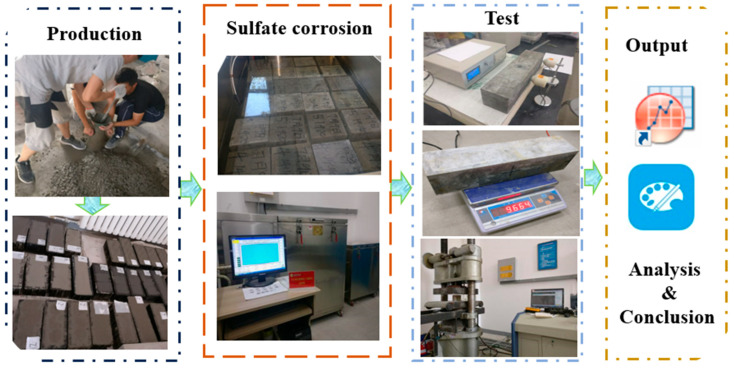
- Single-factor experiments first studied single and composite admixtures under sulfate attack; orthogonal experiments then used composite admixtures as one influencing factor. Specimens were 100 mm cubes and 100 mm × 100 mm × 400 mm prisms, standard-cured 28 days before testing.
- Sulfate wet–dry cycling used 5% Na₂SO₄ solution with a 24-h cycle: 14 h immersion, 1 h air-drying, 6 h baking at 80 °C, 2 h air-cooling, and 1 h baking at 35 °C; compressive strength, dynamic elastic modulus, and mass loss rate were measured at 0, 60, and 120 cycles.
- Analysis included range analysis, ANOVA in SPSS 29, multiple linear regression, relative-error validation, single-factor influence functions, and a material-decay-equation-based service-life prediction model using compressive corrosion resistance coefficient, relative dynamic elastic modulus, and mass loss rate.
Limitations
- Stated in the paper: the combined model assumes the three indicators are equally important and that sulfate penetration/corrosion is relatively stable and uniform, without significant local environmental differences or construction defects; it does not fully account for regional water-quality and soil-composition differences, and experimental conditions may differ from actual engineering. The paper also notes possible selection bias because material variability across regions and production batches may not have been fully captured.
- Evident from the text: the compressive strength regression fit showed significant deviations and low reliability, requiring further experimental refinement; testing was limited to 0, 60, and 120 cycles under specific laboratory materials and conditions.
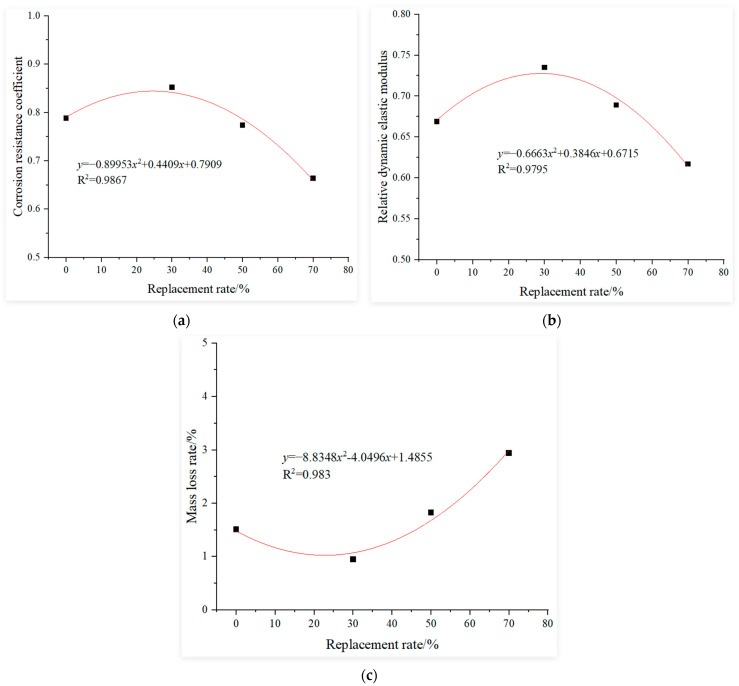
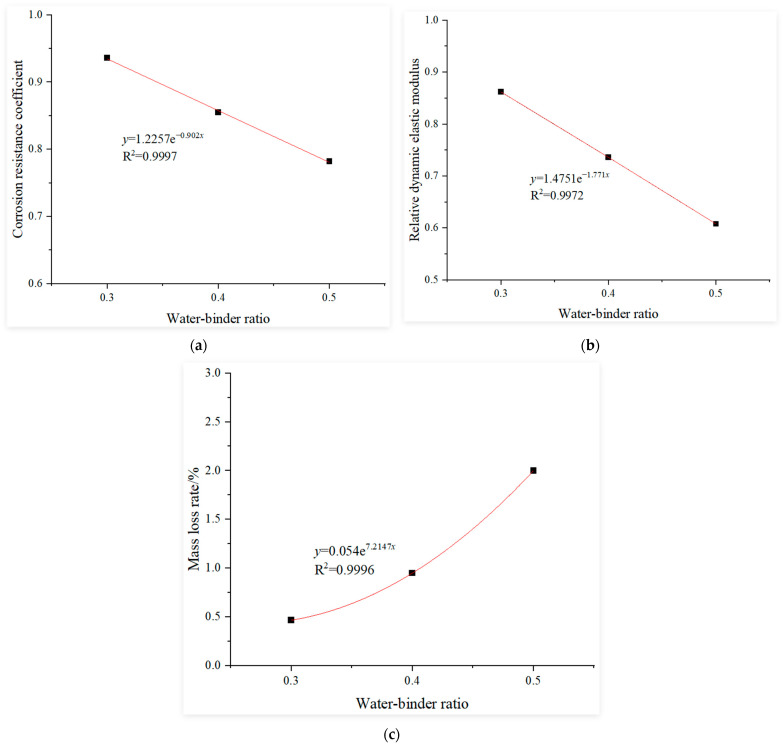
- Evident from the text: the influence functions and life prediction are based on limited single-factor parameter ranges (e.g., recycled aggregate replacement rates of 0%, 30%, 50%, 70%; water–binder ratios of 0.3, 0.4, 0.5; fly ash and slag contents of 0%, 20%, 40%), so extrapolation beyond these ranges is not directly supported.
Model-written summary. Check it against the paper before relying on it.
Integrity signals
Registry
Cites
Statistics
Figures
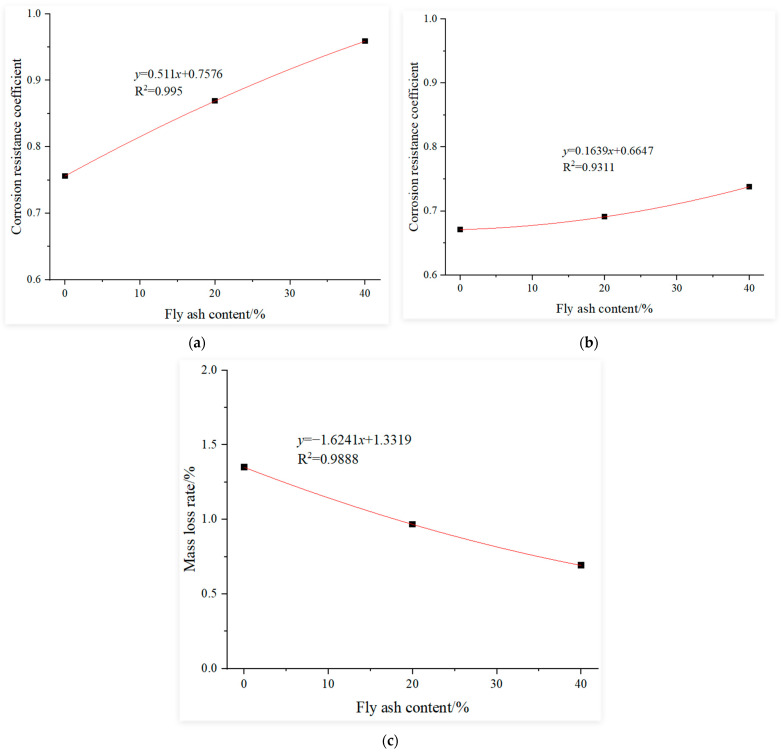
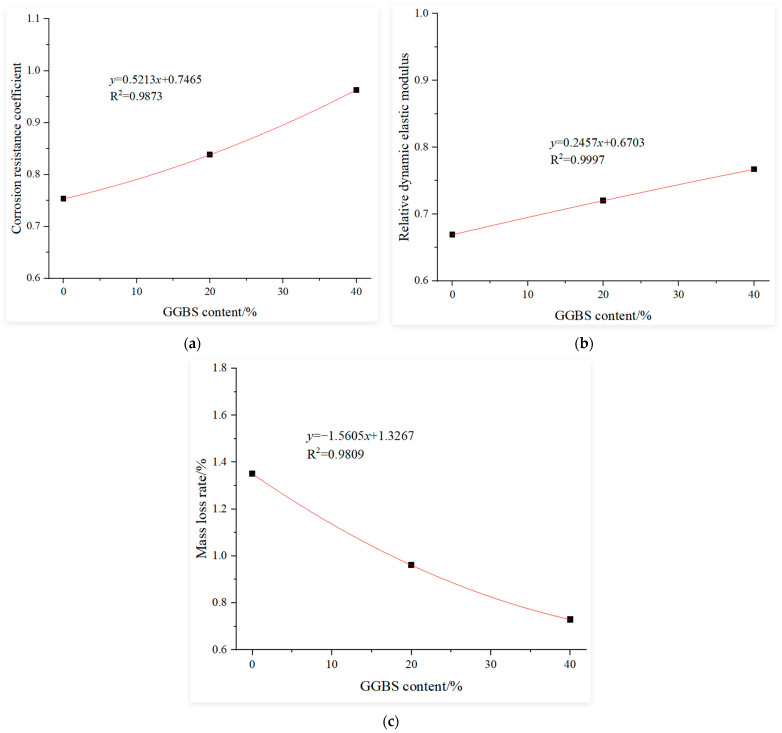
Verification
Claims the paper makes
0 Valid · 0 Not valid · 18 Not checked · 35 Own results and interpretations
A result the paper reports from its own data — it cites no other source for it, so there is none to check. The quote shows it is in the paper.
In the paper
“After 60 and 120 cycles, the ranking shifted to B > C > A.”
- Also stated in: § 4. Conclusions · plain
“After 60 and 120 cycles, the significance order became: water–binder ratio > composite admixture content > recycled coarse aggregate replacement rate.”
§ Performance and Life Prediction of Recycled Concrete Against Sulfate Dry–Wet Cycle Corrosion > 4. Conclusions
plainstates an association- Asserted: passes — The authors put it forward as true.
- Checkable: passes — It can be checked against evidence.
- Load-bearing: passes — The paper’s conclusions depend on it.
- Based: passes — The paper gives a reason why it holds.
- Also stated in: § 4. Conclusions · plain
A result the paper reports from its own data — it cites no other source for it, so there is none to check. The quote shows it is in the paper.
In the paper
“Analysis of the regression parameters reveals that, at 0 corrosion cycles: regression parameters a1, a2 and a3 for both compressive strength and the elastic modulus are negative (a1 < 0, a2 < 0 and a3 < 0), indicating these properties decrease with the increasing recycled aggregate replacement ratio, water-to-binder ratio and mineral admixture content.”
§ Performance and Life Prediction of Recycled Concrete Against Sulfate Dry–Wet Cycle Corrosion > 3. Results and Discussion > 3.2. Results Analysis of the Orthogonal Test
hedgedstates a cause- Asserted: passes — The authors put it forward as true.
- Checkable: passes — It can be checked against evidence.
- Load-bearing: passes — The paper’s conclusions depend on it.
- Based: passes — The paper gives a reason why it holds.
A result the paper states — it cites no source for it, so there is none to check. The quote shows it is in the paper.
In the paper
“Substituting the above parameters into the service life prediction in Equation (18), the predicted service life of the recycled concrete structure was T = 117 years.”
- Also stated in: § 4. Conclusions · plain
“Applied to practical engineering parameters, the service life of the recycled concrete project was predicted as T = 117 years.”
§ Performance and Life Prediction of Recycled Concrete Against Sulfate Dry–Wet Cycle Corrosion > 3. Results and Discussion > 3.5. Establishment of Life Prediction Equation Based on Three Indices
plainstates a causeSingle case- Asserted: passes — The authors put it forward as true.
- Checkable: passes — It can be checked against evidence.
- Load-bearing: passes — The paper’s conclusions depend on it.
- Based: passes — The paper gives a reason why it holds.
- Also stated in: § 4. Conclusions · plain
A result the paper reports from its own data — it cites no other source for it, so there is none to check. The quote shows it is in the paper.
In the paper
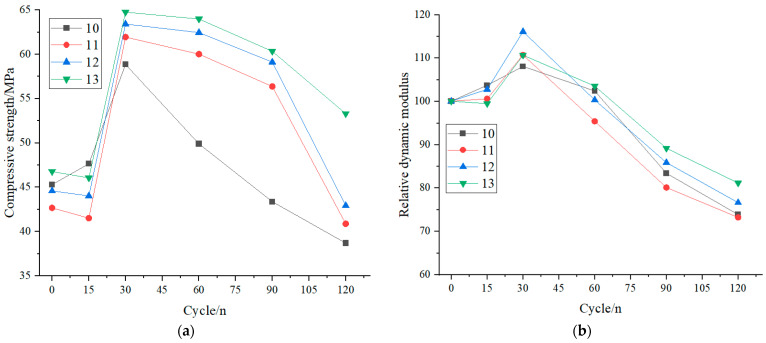
“Notably, GGBS and fly ash admixed recycled concrete exhibited superior corrosion resistance compared to the non-admixed counterparts, regardless of blending type.”
§ Performance and Life Prediction of Recycled Concrete Against Sulfate Dry–Wet Cycle Corrosion > 3. Results and Discussion > 3.1. The Influence Law of Single and Compound Doping
plainstates a cause- Asserted: passes — The authors put it forward as true.
- Checkable: passes — It can be checked against evidence.
- Load-bearing: passes — The paper’s conclusions depend on it.
- Based: passes — The paper gives a reason why it holds.
A result the paper reports from its own data — it cites no other source for it, so there is none to check. The quote shows it is in the paper.
In the paper
“When uncycled (0 cycles), the influence ranking of factors was B (water–binder ratio) > A (recycled coarse aggregate replacement rate) > C (GGBS + fly ash content).”
- Also stated in: § 3.2. Results Analysis of the Orthogonal Test · plain
“The analysis reveals the order of factor influence on compressive strength at 0 cycles: B > A > C, at 60 cycles: B > C > A and at 120 cycles: B > C > A.”
- Also stated in: § 3.2. Results Analysis of the Orthogonal Test · plain
“Order of factor influence on the dynamic elastic modulus is, at 0 cycles: B > A > C, at 60 cycles: B > C > A and at 120 cycles: B > C > A.”
§ Performance and Life Prediction of Recycled Concrete Against Sulfate Dry–Wet Cycle Corrosion > Abstract
plainstates an association- Asserted: passes — The authors put it forward as true.
- Checkable: passes — It can be checked against evidence.
- Load-bearing: passes — The paper’s conclusions depend on it.
- Based: passes — The paper gives a reason why it holds.
- Also stated in: § 3.2. Results Analysis of the Orthogonal Test · plain
21 more claims
Create a free account to see all 53 claims and to verify the 24 references still open.
- It may state two separate claims as one. 20
- Probably not a substantial claim. 11
- The quote only partly states this claim. 1
Self-check
Percentages, sums and reported differences re-computed from the paper’s own numbers.
Each contradiction between two passages listed here was confirmed by an independent check.
Rated major: it would touch a result — a value a result rests on, reported and recomputed p-values on opposite sides of the significance level, two passages that conflict with no sign which is right, or a cited work retracted before this paper was published.
In the paper
§ Performance and Life Prediction of Recycled Concrete Against Sulfate Dry–Wet Cycle Corrosion > 3. Results and Discussion > 3.5. Establishment of Life Prediction Equation Based on Three Indices
“(18) T=1/3(t+t^(′)+t^(″))”
§ Performance and Life Prediction of Recycled Concrete Against Sulfate Dry–Wet Cycle Corrosion > 3. Results and Discussion > 3.5. Establishment of Life Prediction Equation Based on Three Indices
“The service life of the recycled concrete structure was considered terminated when any of the following conditions were met: compressive corrosion resistance coefficient ≤ 75%, relative dynamic elastic modulus ≤ 60% and mass loss rate ≥ 4%.”
Rated minor: it would not touch a result — a value no result rests on, a p-value that stays on the same side of the significance level, or a conflict that is clerical, resolved elsewhere in the paper, or outside its own findings.
In the paper
§ Performance and Life Prediction of Recycled Concrete Against Sulfate Dry–Wet Cycle Corrosion > Abstract
“For the compressive strength regression model, the measured values deviated significantly from the calculated values (−6.88% to 16.66%)”
§ Performance and Life Prediction of Recycled Concrete Against Sulfate Dry–Wet Cycle Corrosion > 3. Results and Discussion > 3.2. Results Analysis of the Orthogonal Test
“Compressive Strength fit: 0 cycles: RE ranges from −14.87% to 22.77%, 60 cycles: RE ranges from −6.88% to 16.66% and 120 cycles: RE ranges from −8.51% to 14.80%.”
Rated minor: it would not touch a result — a value no result rests on, a p-value that stays on the same side of the significance level, or a conflict that is clerical, resolved elsewhere in the paper, or outside its own findings.
In the paper
§ Performance and Life Prediction of Recycled Concrete Against Sulfate Dry–Wet Cycle Corrosion > 3. Results and Discussion > 3.4. Establish Life Prediction Model Based on the Single-Factor Design
“(6) dXt/dt=−λ(Xt−X0)”
§ Performance and Life Prediction of Recycled Concrete Against Sulfate Dry–Wet Cycle Corrosion > 3. Results and Discussion > 3.4. Establish Life Prediction Model Based on the Single-Factor Design
“Integrating Equation (6) yields Equation (7):(7) f=Xt/Xo=αe^(−λt)”
Rated minor: it would not touch a result — a value no result rests on, a p-value that stays on the same side of the significance level, or a conflict that is clerical, resolved elsewhere in the paper, or outside its own findings.
In the paper
§ Performance and Life Prediction of Recycled Concrete Against Sulfate Dry–Wet Cycle Corrosion > 3. Results and Discussion > 3.5. Establishment of Life Prediction Equation Based on Three Indices
“For the relative dynamic elastic modulus, substituting into Equation (7) yields fR^(′)=1−αR^(′)e^(−λt), fW^(′)=αW^(′)e^(−λt), fF^(′)=αF^(′)e^(−λt) and fS^(′)=αS^(′)e^(−λt).”
§ Performance and Life Prediction of Recycled Concrete Against Sulfate Dry–Wet Cycle Corrosion > 3. Results and Discussion > 3.4. Establish Life Prediction Model Based on the Single-Factor Design
“Integrating Equation (6) yields Equation (7):(7) f=Xt/Xo=αe^(−λt)”
Rated minor: it would not touch a result — a value no result rests on, a p-value that stays on the same side of the significance level, or a conflict that is clerical, resolved elsewhere in the paper, or outside its own findings.
In the paper
§ Performance and Life Prediction of Recycled Concrete Against Sulfate Dry–Wet Cycle Corrosion > 3. Results and Discussion > 3.5. Establishment of Life Prediction Equation Based on Three Indices
“For the mass loss rate, substituting into Equation (8) yields fR^(″)=1−αRe^(−λt), fW^(″)=αWe^(−λt), fF^(″)=αFe^(−λt) and fS^(″)=αSe^(−λt).”
§ Performance and Life Prediction of Recycled Concrete Against Sulfate Dry–Wet Cycle Corrosion > 3. Results and Discussion > 3.4. Establish Life Prediction Model Based on the Single-Factor Design
“The mass loss rate can be calculated using Equation (8):(8) f′=(Xo−Xt)/Xo=1−Xt/Xo=1−αe^(−λt)”
Citations
Cites
A Comprehensive Review on Recycled Aggregate and Recycled Aggregate Concrete
Wang, B., Yan, L., Fu, Q., & Kasal, B. (2021) · Resources, Conservation and Recycling · doi:10.1016/j.resconrec.2021.105565 · Cited by 999 · cited 1×
“In this context, processing waste concrete into recycled concrete aggregate (RCA) through crushing and screening can achieve over 90% material recycling efficiency in construction [3].”
Properties of interfacial transition zones in recycled aggregate concrete tested by nanoindentation
Xiao, J., Li, W., Sun, Z., Lange, D. A., & Shah, S. P. (2013) · Cement and Concrete Composites · doi:10.1016/j.cemconcomp.2013.01.006 · Cited by 682 · cited 1×
“Research has demonstrated that the ITZ thickness in RAC can be 1.5 times greater than in conventional concrete, with the internal porosity increased by 25–40% [9,10], providing rapid transmission channels for corrosive media.”
InfluentialEfficient machine learning models for prediction of concrete strengths
Nguyen, H., Vu, T., Vo, T. P., & Thai, H.-T. (2021) · Construction and Building Materials · doi:10.1016/j.conbuildmat.2020.120950 · Cited by 524 · cited 1×
“In prediction models, conventional approaches include Fick’s law-based deterministic model [26], stochastic damage mechanics model [27] and machine learning prediction method [28].”
Alexander, M., & Beushausen, H. (2019) · Cement and Concrete Research · doi:10.1016/j.cemconres.2019.04.018 · Cited by 439 · cited 1×
“Substituting the above parameters into the service life prediction in Equation (18), the predicted service life of the recycled concrete structure was T = 117 years.”
Concrete with recycled concrete aggregate and crushed clay bricks
Yang, J., Du, Q., & Bao, Y. (2011) · Construction and Building Materials · doi:10.1016/j.conbuildmat.2010.11.063 · Cited by 427 · cited 1×
“In macroscale performance degradation, Yang et al. [22] observed 50% recycled clay brick aggregates, and 50% recycled concrete aggregates led to a reduction of 6% of the flexural strength compared to the corresponding natural aggregate concrete.”
Interfacial transition zones in recycled aggregate concrete with different mixing approaches
Li, W., Xiao, J., Sun, Z., Kawashima, S., & Shah, S. P. (2012) · Construction and Building Materials · doi:10.1016/j.conbuildmat.2012.06.022 · Cited by 410 · cited 1×
“…diffusion coefficients by 12–18% [12,13]; (2) electrical potential gradients from Ca 2+ concentration differences accelerate ion migration in interfacial transition zones (ITZ) [14,15]; (3) crystallization-induced expansion stress from Na 2 SO 4 solution during wet–dry cycles reaches 12 MPa [16].”
Sulfate attack research — whither now?
Santhanam, M., Cohen, M. D., & Olek, J. (2001) · Cement and Concrete Research · doi:10.1016/s0008-8846(01)00510-5 · Cited by 347 · cited 1×
“Substituting the above parameters into the service life prediction in Equation (18), the predicted service life of the recycled concrete structure was T = 117 years.”
Modification of recycled concrete aggregate by calcium carbonate biodeposition
Grabiec, A. M., Klama, J., Zawal, D., & Krupa-Palacz, D. (2012) · Construction and Building Materials · doi:10.1016/j.conbuildmat.2012.02.027 · Cited by 345 · cited 1×
“Grabiec et al. [24] observed that the recycled concrete aggregate water absorption had a reduction of around 13.5% to 21.2%.”
InfluentialStochastic damage model for concrete based on energy equivalent strain
Li, J., & Ren, X. (2009) · International Journal of Solids and Structures · doi:10.1016/j.ijsolstr.2009.01.024 · Cited by 228 · cited 1×
“In prediction models, conventional approaches include Fick’s law-based deterministic model [26], stochastic damage mechanics model [27] and machine learning prediction method [28].”
Roadmap to a net-zero carbon cement sector: Strategies, innovations and policy imperatives
Barbhuiya, S., Bhusan Das, B., & Adak, D. (2024) · Journal of Environmental Management · doi:10.1016/j.jenvman.2024.121052 · Cited by 171 · cited 1×
“This approach significantly reduces mountain destruction and river ecological imbalance caused by natural aggregate extraction, demonstrating notable resource conservation and carbon reduction benefits [4].”
Lu, C., Yu, Q., Wei, J., Niu, Y., Zhang, Y., Lin, C., Chen, P., Shi, C., & Yang, P. (2024) · Construction and Building Materials · doi:10.1016/j.conbuildmat.2024.139299 · Cited by 135 · cited 1×
“Research has demonstrated that the ITZ thickness in RAC can be 1.5 times greater than in conventional concrete, with the internal porosity increased by 25–40% [9,10], providing rapid transmission channels for corrosive media.”
InfluentialLi, Y., Fu, T., Wang, R., & Li, Y. (2020) · Construction and Building Materials · doi:10.1016/j.conbuildmat.2019.117543 · Cited by 118 · cited 1×
“X-ray microcomputed tomography studies indicate that the microcrack density within RCA reaches 2.3 times that of natural aggregates [7,8].”
InfluentialThéréné, F., Keita, E., Naël-Redolfi, J., Boustingorry, P., Bonafous, L., & Roussel, N. (2020) · Cement and Concrete Research · doi:10.1016/j.cemconres.2020.106196 · Cited by 115 · cited 1×
“Scanning electron microscopy analysis reveals that 30–60% of old mortar remains adhered to RCA surfaces [5], resulting in three-to five-times higher water absorption than natural aggregates [6].”
Zhang, H., Ji, T., & Liu, H. (2020) · Construction and Building Materials · doi:10.1016/j.conbuildmat.2020.118675 · Cited by 98 · cited 4×
“…machine (Beijing Shourui Co., Ltd., Beijing, China) in compliance with GB/T50082-2009 [29] Referring to a large amount of previous research literature [30,31], the instruments used in the experiment have been widely applied and recognized in the field of concrete material performance studies.”
InfluentialStudy of nucleation and growth processes of ettringite in diluted conditions
Poupelloz, E., Gauffinet, S., & Nonat, A. (2020) · Cement and Concrete Research · doi:10.1016/j.cemconres.2019.105915 · Cited by 90 · cited 1×
“…showing the gypsum content in RAC reaching 1.8 times that in natural concrete [17]; (2) needle-shaped ettringite crystal growth generates 220% volumetric expansion [18,19]; (3) degradation of C-S-H gel reduces concrete’s binding capacity, decreasing the compressive strength by up to 60% [20,21].”
InfluentialMechanical recycling of EOL concrete into high-grade aggregates
Lotfi, S., Deja, J., Rem, P., Mróz, R., van Roekel, E., & van der Stelt, H. (2014) · Resources, Conservation and Recycling · doi:10.1016/j.resconrec.2014.03.010 · Cited by 89 · cited 1×
“Lotfi et al. [23] showed that the reduction of compressive strength for RAC was 10.4%, which was much higher than that of natural aggregate concrete after exposure to freezing ( − 18 ± 2 ◦ C) and thawing (18 ± 2 ◦ C) with a rate of two to three cycles per day for 100 cycles.”
InfluentialPanghal, H., & Kumar, A. (2024) · Construction and Building Materials · doi:10.1016/j.conbuildmat.2023.134432 · Cited by 78 · cited 1×
“Scanning electron microscopy analysis reveals that 30–60% of old mortar remains adhered to RCA surfaces [5], resulting in three-to five-times higher water absorption than natural aggregates [6].”
Wei, H., Wan, H., Yuan, S., Liu, G., Teng, J., Shi, N., & Liu, Z. (2025) · Construction and Building Materials · doi:10.1016/j.conbuildmat.2025.140180 · Cited by 43 · cited 1×
“…diffusion coefficients by 12–18% [12,13]; (2) electrical potential gradients from Ca 2+ concentration differences accelerate ion migration in interfacial transition zones (ITZ) [14,15]; (3) crystallization-induced expansion stress from Na 2 SO 4 solution during wet–dry cycles reaches 12 MPa [16].”
Degradation of C–S–H(I) at different decalcification degrees
Jin, M., Ma, Y., Li, W., Huang, J., Zeng, H., Lü, C., Zhang, J., & Liu, J. (2022) · Journal of Materials Science · doi:10.1007/s10853-022-07857-7 · Cited by 31 · cited 1×
“…diffusion coefficients by 12–18% [12,13]; (2) electrical potential gradients from Ca 2+ concentration differences accelerate ion migration in interfacial transition zones (ITZ) [14,15]; (3) crystallization-induced expansion stress from Na 2 SO 4 solution during wet–dry cycles reaches 12 MPa [16].”
Du, T., Chen, J., Qu, F., Li, C., Zhao, H., Xie, B., Yuan, M., & Li, W. (2022) · Structures · doi:10.1016/j.istruc.2022.11.035 · Cited by 31 · cited 3×
“…machine (Beijing Shourui Co., Ltd., Beijing, China) in compliance with GB/T50082-2009 [29] Referring to a large amount of previous research literature [30,31], the instruments used in the experiment have been widely applied and recognized in the field of concrete material performance studies.”
Jiang, T., Cao, X., Duan, H., & Shu, K. (2025) · Construction and Building Materials · doi:10.1016/j.conbuildmat.2024.139663 · Cited by 28
Experimental and numerical study on the chloride ions penetration in recycled aggregate concrete
Du, T., Xiao, J., Li, C., Gan, Y., & Jiang, X. (2024) · Construction and Building Materials · doi:10.1016/j.conbuildmat.2024.138702 · Cited by 26 · cited 1×
“In microscale mass transport, (1) each 1% increase in RAC porosity elevates ion diffusion coefficients by 12–18% [12,13]; (2) electrical potential gradients from Ca 2+ concentration differences accelerate ion migration in interfacial transition zones (ITZ) [14,15]; (3) crystallization-induced…”
Effect mechanisms of prolonged dry-hot exposure on C-S-H gel properties in cementitious materials
Huang, L., An, M., Wang, Y., Xie, Y., Han, S., & Yu, Z. (2025) · Construction and Building Materials · doi:10.1016/j.conbuildmat.2025.140013 · Cited by 24 · cited 1×
“…showing the gypsum content in RAC reaching 1.8 times that in natural concrete [17]; (2) needle-shaped ettringite crystal growth generates 220% volumetric expansion [18,19]; (3) degradation of C-S-H gel reduces concrete’s binding capacity, decreasing the compressive strength by up to 60% [20,21].”
InfluentialInsights into the acting mechanism of ettringite in expansive Portland cement
Souza, M. T., Onghero, L., Sakata, R. D., Neto, F. C., de Campos, C. E. M., de Castro Pessôa, J. R., Repette, W. L., & de Oliveira, A. P. N. (2023) · Materials Letters · doi:10.1016/j.matlet.2023.134496 · Cited by 22 · cited 1×
“…showing the gypsum content in RAC reaching 1.8 times that in natural concrete [17]; (2) needle-shaped ettringite crystal growth generates 220% volumetric expansion [18,19]; (3) degradation of C-S-H gel reduces concrete’s binding capacity, decreasing the compressive strength by up to 60% [20,21].”
InfluentialYu, X., Hu, T., Khodadadi, N., Liu, Q., & Nanni, A. (2025) · Structures · doi:10.1016/j.istruc.2025.108372 · Cited by 20 · cited 1×
“In microscale mass transport, (1) each 1% increase in RAC porosity elevates ion diffusion coefficients by 12–18% [12,13]; (2) electrical potential gradients from Ca 2+ concentration differences accelerate ion migration in interfacial transition zones (ITZ) [14,15]; (3) crystallization-induced…”
Numerical prediction for life of damaged concrete under the action of fatigue loads
Wang, Y., Li, Y., Lu, L., Wang, F., Wang, L., Liu, Z., & Jiang, J. (2024) · Engineering Failure Analysis · doi:10.1016/j.engfailanal.2024.108368 · Cited by 18 · cited 1×
“Yuncheng Wang et al. [25] developed a fatigue-based damage evolution model for predicting the remaining life of cracked concrete components under cyclic loads.”
Analysis and Prediction of Sulfate Erosion Damage of Concrete in Service Tunnel Based on ARIMA Model
Liu, D., Chen, H., Tang, Y., Gong, C. M., Jian, Y., & Cao, K. (2021) · Materials · doi:10.3390/ma14195904 · Cited by 16 · cited 1×
“Substituting the above parameters into the service life prediction in Equation (18), the predicted service life of the recycled concrete structure was T = 117 years.”
Self-citationLi, Y., Long, J., & Chen, X. (2024) · Materials · doi:10.3390/ma17174194 · Cited by 16 · cited 1×
“…gypsum formation causes 120% volumetric expansion, with XRD analysis showing the gypsum content in RAC reaching 1.8 times that in natural concrete [17]; (2) needle-shaped ettringite crystal growth generates 220% volumetric expansion [18,19]; (3) degradation of C-S-H gel reduces concrete’s binding…”
InfluentialFeng, T., Miao, Y., Tan, Y., Yang, Z., Cao, T., Wang, F., & Jiang, J. (2026) · Engineering · doi:10.1016/j.eng.2025.03.010 · Cited by 13
An Improved Fick Model for Predicting Carbonation Depth of Concrete
Cao, H., Xu, Z., & Peng, X. (2024) · Coatings · doi:10.3390/coatings14111345 · Cited by 11 · cited 1×
“In prediction models, conventional approaches include Fick’s law-based deterministic model [26], stochastic damage mechanics model [27] and machine learning prediction method [28].”
The Deterioration of C-S-H Gel in a Severe Sulfate Environment
Liao, W., Lu, C., & Xu, Z. (2024) · Symmetry · doi:10.3390/sym16060703 · Cited by 10 · cited 1×
“…showing the gypsum content in RAC reaching 1.8 times that in natural concrete [17]; (2) needle-shaped ettringite crystal growth generates 220% volumetric expansion [18,19]; (3) degradation of C-S-H gel reduces concrete’s binding capacity, decreasing the compressive strength by up to 60% [20,21].”
InfluentialAnalysis and Prediction of Sulfate Erosion Damage of Concrete in Service Tunnel based on ARIMA Model
Liu, D., Chen, H., Tang, Y., Chun, G., Jian, Y., & Cao, K. (2021) · doi:10.21203/rs.3.rs-731283/v1 · Cited by 10
Self-citation
Research works printed but not linked: 1
- Huang B. Wang X. Kua H. Geng Y. Bleischwitz R. Ren J. Kim J. Lee S. Deep neural network-based durability prediction for marine concrete structures Cem. Concr. Res. 2021 143 106398
Cited by
Wang, D., Yang, K., Liu, C., Zhang, Y., Zhou, Y., Liu, Z., Tang, K., Ren, J., Li, X., & Guo, R. (2025) · Construction and Building Materials · doi:10.1016/j.conbuildmat.2025.143707 · Cited by 9
Asitimbay-Martínez, G., & Venegas-Vásconez, D. (2026) · Causalidad - Automatización e Ingeniería Informática en la Industria · doi:10.70929/caui3.v2i2.0024 · Cited by 1
Metadata
- Authors
- Chen, L., Wu, F., Liu, D., Huang, C., Pu, S., Wang, J., & Luo, P.
- Affiliations
- Huzhou Vocational and Technical College (CN)
- Guizhou Normal University (CN)
- Zhejiang Zhedong Jietong Road & Bridge Construction Co., Ltd., Ningbo 315000, China
- Zunyi Normal College (CN)
- Corresponding author
- Wu, Fufei
- Venue
- Materials
- Publisher
- MDPI AG
- Published
- 2025-05-10
- Volume
- 18
- Issue
- 10
- Pages
- 2201
- ISSN
- 1996-1944 (ISSN-L)
- PMC
- PMC12113050
- OpenAlex
- W4410285539
- Cited by
- 2
- References
- 31
- Citations by year
- 2026: 1 · 2025: 1
- FWCI
- 0.57
- Type
- journal article
- Language
- en
- Open access
- gold
- doi.org
- Licence
- Locations
- Materials (publishedVersion, cc-by)
- PubMed Central (publishedVersion, cc-by)
- PubMed (publishedVersion)
- Funders
- Guizhou Provincial Basic Research Program (Natural Science) (Qiankehe Foundation ZK [2023] 264, MS [2025] 250, Qian Jiao He KY Zi [2022] 011, Zun Shi Ke He HZ Zi [2022] 121)
- The Growth Project of Young Scientific and Technological Talents in Universities in Guizhou Province (Qiankehe Foundation ZK [2023] 264, MS [2025] 250, Qian Jiao He KY Zi [2022] 011, Zun Shi Ke He HZ Zi [2022] 121)
- Zunyi Science and Technology Plan Project (Qiankehe Foundation ZK [2023] 264, MS [2025] 250, Qian Jiao He KY Zi [2022] 011, Zun Shi Ke He HZ Zi [2022] 121)
- School of Materials and Architectural Engineering, Guizhou Normal University (Qiankehe Foundation ZK [2023] 264, MS [2025] 250, Qian Jiao He KY Zi [2022] 011, Zun Shi Ke He HZ Zi [2022] 121)
- Topics
- Physical Sciences › Engineering › Building and Construction › Recycled Aggregate Concrete Performance
- Physical Sciences › Engineering › Civil and Structural Engineering › Concrete and Cement Materials Research
- Physical Sciences › Engineering › Civil and Structural Engineering › Concrete Corrosion and Durability
- Keywords
- recycled aggregate concrete, sulfate attack, wetting-drying cycles, service life prediction, ground granulated blast furnace slag, fly ash, composite admixture, recycled aggregate, water-to-binder ratio, compressive strength, dynamic modulus of elasticity, durability, damage model
About these checks
Registry, retraction, Cites and statistics results are computed, not judged, with one exception: a printed reference that no index lists is read once by a model before it counts as a citation error. Claims are extracted by a model and kept only when their quote appears verbatim in the text; each cited source is then checked, with a model’s help, for whether it says what the claim relies on. Those verdicts can be wrong — read the claim’s quote and the cited source before relying on one.
A language model drew the claims from the paper on 2026-11-27, under version 3 of the claim definition (model deepseek-v4.1-flash, prompt extract-v3).
A second model labelled each claim on 2026-11-27 (model jev-1.13-20260917, definition revision gold-guideline-v0.2).
Statistics and arithmetic are recomputed, not judged.
Confidence bands are shown only for fields calibrated on our annotated test set. None is calibrated yet, so no band is shown.
What counts as a claim ›How we measure confidence ›How we check this ›
Are you an author, or do you see a problem with this page? Request a review
Data sources
Bibliographic data: Semantic Scholar, OpenAlex, Crossref.
Contains information from the Semantic Scholar Academic Graph Datasets, made available under the ODC Attribution License (ODC-BY 1.0).
Semantic Scholar’s data is described in: Kinney, R., et al. (2023). The Semantic Scholar Open Data Platform. arXiv:2301.10140.
