

Machine Learning in Disaster Management: Recent Developments in Methods and Applications
Open accessThe DOI matches its Crossref record; the references it cites are not checked yet.
Abstract
Recent years include the world’s hottest year, while they have been marked mainly, besides the COVID-19 pandemic, by climate-related disasters, based on data collected by the Emergency Events Database (EM-DAT). Besides the human losses, disasters cause significant and often catastrophic socioeconomic impacts, including economic losses. Recent developments in artificial intelligence (AI) and especially in machine learning (ML) and deep learning (DL) have been used to better cope with the severe and often catastrophic impacts of disasters. This paper aims to provide an overview of the research studies, presented since 2017, focusing on ML and DL developed methods for disaster management. In particular, focus has been given on studies in the areas of disaster and hazard prediction, risk and vulnerability assessment, disaster detection, early warning systems, disaster monitoring, damage assessment and post-disaster response as well as cases studies. Furthermore, some recently developed ML and DL applications for disaster management have been analyzed. A discussion of the findings is provided as well as directions for further research.
Overview
The claims and statistics of this paper haven’t been checked yet.
Free: it reads the open-access text and checks the first 5 claims that cite a source we can check. Create a free account to check every claim.
Integrity signals
Registry
Cites
Statistics
Figures
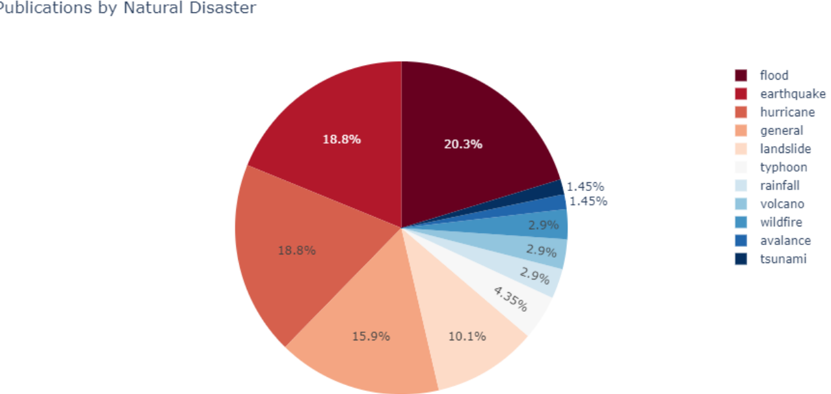
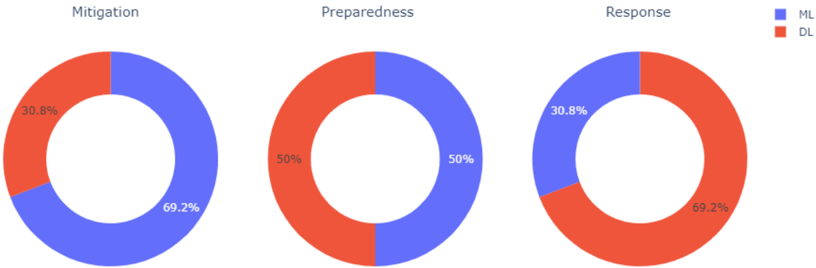
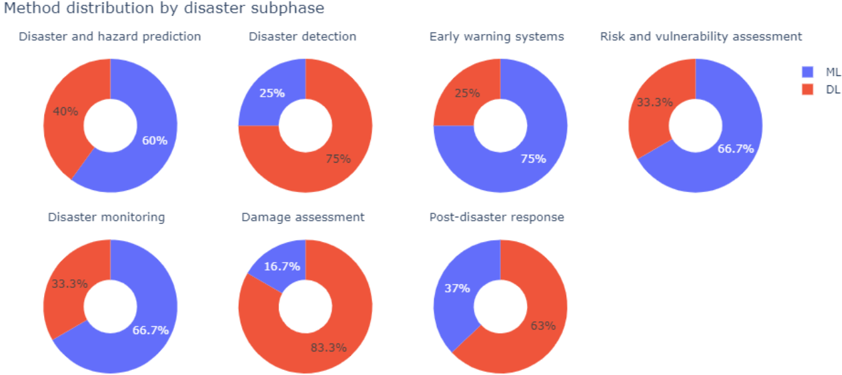
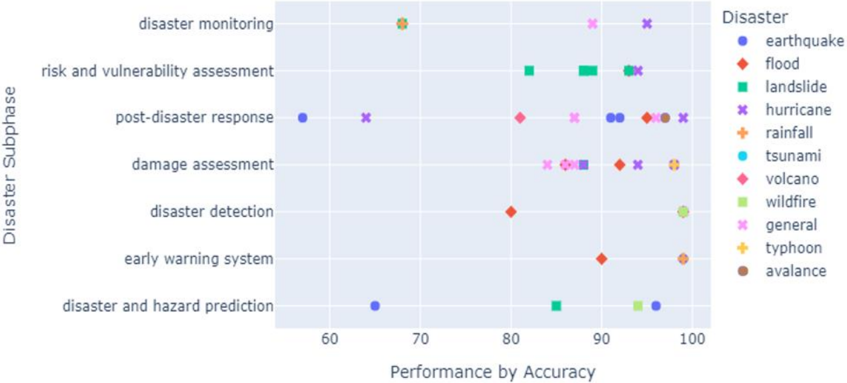
Verification
Claims the paper makes
The claims and statistics of this paper haven’t been checked yet.
Free: it reads the open-access text and checks the first 5 claims that cite a source we can check. Create a free account to check every claim.
Claims other papers make about this one
Each is checked against this paper’s own text: does it say what the citing paper says it does?
The source backs part of the claim, not all of it — or backs it for a different population, condition or comparison.
In the citing paper
“In AIDS, all-round AI techniques, in particular, modeling, simulation and deep learning methods, have been widely applied to all phases of the MPRR framework for disaster management [20, 21]”
From AI and data science for smart emergency, crisis and disaster resilience. (2023) · cites this paper as [21]
Experimental — accuracy not yet measured
Self-check
Percentages, sums and reported differences re-computed from the paper’s own numbers.
The self-check needs the paper’s full text.
Citations
The citation lists are queued
They are fetched later and appear here then.
References 71 · Cited by 319
Research works printed but not linked: 1
- Ben-Hur, A., Horn, D., Siegelmann, H.T., and Vapnik, V. (2000, January 3–7). A support vector clustering method. Proceedings of the 15th International Conference on Pattern Recognition. ICPR-2000, Barcelona, Spain.
Metadata
- Authors
- Linardos, V., Drakaki, M., Tzionas, P., & Karnavas, Y.
- Affiliations
- Athens Euroclinic (GR)
- International Hellenic University (GR)
- Democritus University of Thrace (GR)
- Corresponding author
- Drakaki, Maria
- Venue
- Machine Learning and Knowledge Extraction
- Publisher
- MDPI AG
- Published
- 2022-05-07
- Volume
- 4
- Issue
- 2
- Pages
- 446-473
- ISSN
- 2504-4990 (ISSN-L)
- OpenAlex
- W4229369233
- Cited by
- 319
- References
- 71
- Citations by year
- 2026: 55 · 2025: 129 · 2024: 80 · 2023: 47 · 2022: 8
- FWCI
- 46.12
- Type
- journal article
- Language
- en
- Open access
- gold
- doi.org
- Licence
- Locations
- Machine Learning and Knowledge Extraction (publishedVersion, cc-by)
- DOAJ (DOAJ: Directory of Open Access Journals) (submittedVersion)
- Topics
- Physical Sciences › Computer Science › Computer Networks and Communications › Energy and Environmental Systems
- Social Sciences › Sociology and Political Science › Disaster Management and Resilience
- Social Sciences › Communication › Public Relations and Crisis Communication
- Keywords
- disaster management, machine learning, deep learning, disaster prediction, hazard prediction, risk assessment, vulnerability assessment, disaster detection, early warning systems, disaster monitoring, damage assessment, disaster response, climate-related disasters
About these checks
Registry, retraction, Cites and statistics results are computed, not judged, with one exception: a printed reference that no index lists is read once by a model before it counts as a citation error. Claims are extracted by a model and kept only when their quote appears verbatim in the text; each cited source is then checked, with a model’s help, for whether it says what the claim relies on. Those verdicts can be wrong — read the claim’s quote and the cited source before relying on one.
Statistics and arithmetic are recomputed, not judged.
Confidence bands are shown only for fields calibrated on our annotated test set. None is calibrated yet, so no band is shown.
What counts as a claim ›How we measure confidence ›How we check this ›
Are you an author, or do you see a problem with this page? Request a review
How to cite
Cite CoChat for the checks on this page, and the paper for its own findings.
- This page
- CoChat. (2026). Citation check: Machine Learning in Disaster Management: Recent Developments in Methods and Applications. https://app.cochat.ai/papers/10.3390/make4020020
- The paper
- Linardos, V., Drakaki, M., Tzionas, P., & Karnavas, Y. (2022). Machine Learning in Disaster Management: Recent Developments in Methods and Applications. Machine Learning and Knowledge Extraction. https://doi.org/10.3390/make4020020
Data sources
Bibliographic data: Semantic Scholar, OpenAlex, Crossref.
Contains information from the Semantic Scholar Academic Graph Datasets, made available under the ODC Attribution License (ODC-BY 1.0).
Semantic Scholar’s data is described in: Kinney, R., et al. (2023). The Semantic Scholar Open Data Platform. arXiv:2301.10140.
