

The DOI matches its Crossref record; 1 of the 1 references it cites were found in a registry or an index.
Group Medical Visits for Addressing Weight and Blood Pressure in an Underserved Population
Open accessAbstract
The effect of group medical visits (GMV) compared to individual medical visits (IMV), on weight and blood pressure in a large primary care practice serving a predominantly underserved population, was assessed. The records of 304 patients attending a weight-loss program were analyzed using mixed-effects regression models. Patients in GMV lost an average of 11.63 lbs, whereas patients in IMV lost an average of 3.99 lbs (p < 0.001). A total of 55% of patients lost ≥7% in GMV compared to 11% of patients in IMV (p ≤ 0.001). Individuals who lost >5% of their baseline weight had a higher reduction in overall blood pressure. For systolic and diastolic blood pressure, the differences between baseline and three months for GMV and IMV were −7.4 vs. 4.1 mm of Hg (p = 0.002) and −4.6 vs. 4.2 mm of Hg (p = 0.003), respectively. Results from this study demonstrate that GMV may be a potentially useful modality for addressing weight and blood pressure in an underserved population.
Overview
The claims and statistics of this paper haven’t been checked yet.
Run the check — free, no account needed. It reads the open-access text and checks the sources it cites.
Integrity signals
Registry
Cites
Statistics
Figures
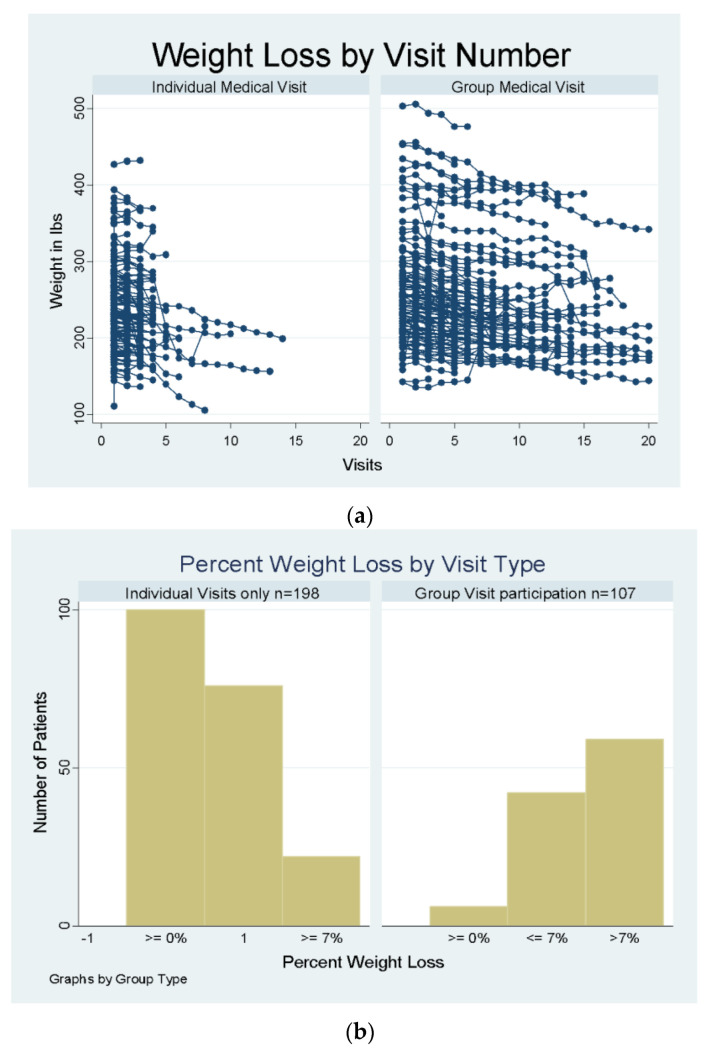
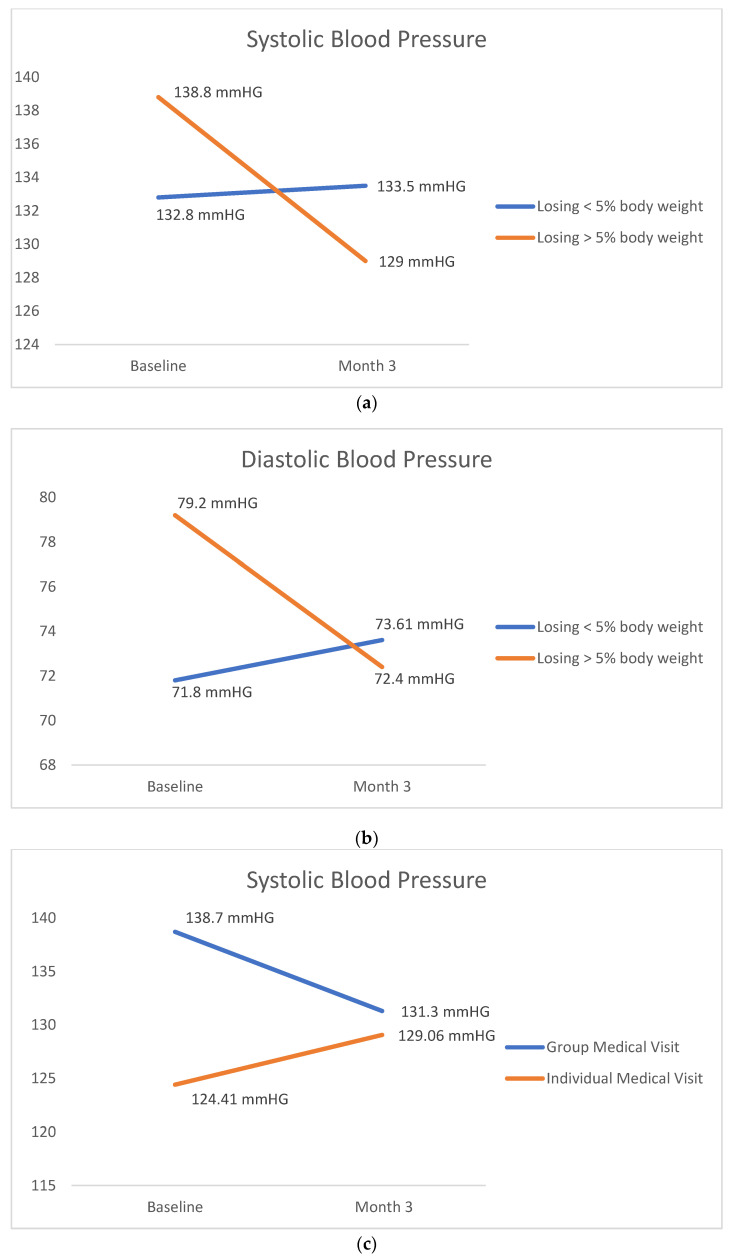
Verification
Claims the paper makes
The claims and statistics of this paper haven’t been checked yet.
Run the check — free, no account needed. It reads the open-access text and checks the sources it cites.
Claims other papers make about this one
Each is checked against this paper’s own text: does it say what the citing paper says it does?
The source backs part of the claim, not all of it — or backs it for a different population, condition or comparison.
In the citing paper
“a retrospective study among majority Latino and low‐income households in a federally designated underserved area found greater absolute weight reduction (12 vs. 4 pounds) and meaningful weight reduction (55% vs. 11% with 7% + weight reduction) with GMVs versus individual visits [212].”
From Nutritional priorities to support GLP ‐1 therapy for obesity: A joint Advisory from the American College of Lifestyle Medicine, the American Society for Nutrition, the Obesity Medicine Association, and The Obesity Society (2025) · cites this paper as [212]
Experimental — accuracy not yet measuredThe source backs part of the claim, not all of it — or backs it for a different population, condition or comparison.
In the citing paper
“a retrospective study among majority Latino and low‐income households in a federally designated underserved area found greater absolute weight reduction (12 vs. 4 pounds) and meaningful weight reduction (55% vs. 11% with 7% + weight reduction) with GMVs versus individual visits [212].”
From Nutritional priorities to support GLP ‐1 therapy for obesity: A joint Advisory from the American College of Lifestyle Medicine, the American Society for Nutrition, the Obesity Medicine Association, and The Obesity Society (2025) · cites this paper as [212]
Experimental — accuracy not yet measured
Self-check
Percentages, sums and reported differences re-computed from the paper’s own numbers.
The self-check needs the paper’s full text.
Citations
Cites
Ely, E. K., Gruss, S. M., Luman, E. T., Gregg, E. W., Ali, M. K., Nhim, K., Rolka, D. B., & Albright, A. L. (2017) · Diabetes Care · doi:10.2337/dc16-2099 · Cited by 386
Research works printed but not linked: 22
- Bentley, 2018, Recent origin and evolution of obesity-income correlation across the United States, Palgrave Commun., 4, 146, 10.1057/s41599-018-0201-x · DOI
- Calzada, 2009, The obesity epidemic: Are minority individuals equally affected?, Prim. Care, 36, 307, 10.1016/j.pop.2009.01.007 · DOI
- Carrillo, 2011, Defining and targeting health care access barriers, J. Health Care Poor Underserved., 22, 562, 10.1353/hpu.2011.0037 · DOI · Paper page
- Caballero, 2015, Shared medical appointments: An innovative approach to patient care, Nurse Pract., 40, 1, 10.1097/01.NPR.0000470357.85590.46 · DOI
- Reitz, 2012, The effects of a group visit program on outcomes of diabetes care in an urban family practice, J. Urban Health Bull. N. Y. Acad. Med., 89, 709
- Wing, 1999, Benefits of recruiting participants with friends and increasing social support for weight loss and maintenance, J. Consult. Clin. Psychol., 67, 132, 10.1037/0022-006X.67.1.132 · DOI · Paper page
- King, 1984, Low-Cost Strategies for Increasing Exercise Behavior: Relapse Preparation Training and Social Support, Behav. Modif., 8, 3, 10.1177/01454455840081001 · DOI
- Black, 1990, A meta-analytic evaluation of couples weight-loss programs, Health Psychol., 9, 330, 10.1037/0278-6133.9.3.330 · DOI
- Brumley, 2016, Gestational Weight Gain and Breastfeeding Outcomes in Group Prenatal Care, J. Midwifery Women’s Health, 61, 557, 10.1111/jmwh.12484 · DOI
- Taylor, 2018, The role of group cohesion in a group-based behavioral weight loss intervention, J. Behav. Med., 42, 162, 10.1007/s10865-018-9953-4 · DOI
- Guthrie, 2015, Impact of a Shared Medical Appointment Lifestyle Intervention on Weight and Lipid Parameters in Individuals with Type 2 Diabetes: A Clinical Pilot, J. Am. Coll. Nutr., 34, 300, 10.1080/07315724.2014.933454 · DOI
- Sorkin, 2014, Dyadic collaboration in shared health behavior change: The effects of a randomized trial to test a lifestyle intervention for high-risk Latinas, Health Psychol., 33, 566, 10.1037/hea0000063 · DOI
- Crowley, 2017, Jump starting shared medical appointments for diabetes with weight management: Rationale and design of a randomized controlled trial, Contemp. Clin. Trials, 58, 1, 10.1016/j.cct.2017.04.004 · DOI
- Papadakis, 2021, Shared Medical Appointments and Prediabetes: The Power of the Group, Ann. Fam. Med., 19, 258, 10.1370/afm.2647 · DOI
- Heisler, 2021, Evaluating the Effectiveness of Diabetes Shared Medical Appointments (SMAs) as Implemented in Five Veterans Affairs Health Systems: A Multi-site Cluster Randomized Pragmatic Trial, J. Gen. Intern. Med., 36, 1648, 10.1007/s11606-020-06570-y · DOI
- Lavoie, J.G., Wong, S.T., Chongo, M., Browne, A.J., MacLeod, M.L.P., and Ulrich, C. (2013). Group medical visits can deliver on patient-centred care objectives: Results from a qualitative study. BMC Health Serv. Res., 13. · DOI
- Geller, 2011, Impact of a group medical visit program on Latino health-related quality of life, Explore, 7, 94, 10.1016/j.explore.2010.12.005 · DOI
- McCuistion, 2013, Overcoming Challenges to Adoption of Shared Medical Appointments, Popul. Health Manag., 17, 100, 10.1089/pop.2013.0035 · DOI
- Greer, 2011, Implementing an evidence-based metabolic syndrome prevention and treatment program utilizing group visits, J. Am. Acad. Nurse Pract., 23, 76, 10.1111/j.1745-7599.2010.00585.x · DOI
- Patel, 2021, Successful Use of Virtual Shared Medical Appointments for a Lifestyle-Based Diabetes Reversal Program, Am. J. Lifestyle Med., 15, 506, 10.1177/15598276211008396 · DOI
- Hasegawa, 2019, Body Weight Reduction of 5% Improved Blood Pressure and Lipid Profiles in Obese Men and Blood Glucose in Obese Women: A Four-Year Follow-up Observational Study, Metab. Syndr. Relat. Disord., 17, 250, 10.1089/met.2018.0115 · DOI
- Trento, 2001, Group visits improve metabolic control in type 2 diabetes: A 2-year follow-up, Diabetes Care, 24, 995, 10.2337/diacare.24.6.995 · DOI
Cited by
Sorted by citations
Mozaffarian, D., Agarwal, M., Aggarwal, M., Alexander, L., Apovian, C. M., Bindlish, S., Bonnet, J., Butsch, W. S., Christensen, S., Gianos, E., et al. (2025) · The American Journal of Clinical Nutrition · doi:10.1016/j.ajcnut.2025.04.023 · Cited by 154
“…obesity care: a retrospective study among majority Latino and low-income households in a federally designated underserved area found greater absolute weight reduction (12 vs. 4 lbs) and meaningful weight reduction (55 % vs. 11 % with 7 % + weight reduction) with GMVs versus individual visits [203].”
Mozaffarian, D., Agarwal, M., Aggarwal, M., Alexander, L., Apovian, C. M., Bindlish, S., Bonnet, J., Butsch, W. S., Christensen, S., Gianos, E., et al. (2025) · Obesity · doi:10.1002/oby.24336 · Cited by 143
Mozaffarian, D., Agarwal, M., Aggarwal, M., Alexander, L., Apovian, C. M., Bindlish, S., Bonnet, J., Butsch, W. S., Christensen, S., Gianos, E., et al. (2025) · Obesity Pillars · doi:10.1016/j.obpill.2025.100181 · Cited by 28
Metadata
- Authors
- Algotar, A., Trofymenko, S., Muramoto, M., Howerter, A., & Kutob, R.
- Affiliations
- University of Arizona (US)
- Corresponding author
- Trofymenko, Stephanie
- Venue
- Medicines
- Publisher
- MDPI AG
- Published
- 2022-12-01
- Volume
- 9
- Issue
- 12
- Pages
- 60
- ISSN
- 2305-6320 (ISSN-L)
- PMC
- PMC9783786
- OpenAlex
- W4311185631
- Cited by
- 4
- References
- 1
- Citations by year
- 2025: 4
- FWCI
- 0.70
- Type
- journal article
- Language
- en
- Open access
- gold
- doi.org
- Licence
- Locations
- Medicines (publishedVersion, cc-by)
- PubMed Central (publishedVersion, cc-by)
- PubMed (publishedVersion)
- DOAJ (DOAJ: Directory of Open Access Journals) (submittedVersion, cc-by-sa)
- Funders
- University of Arizona
- Topics
- Health Sciences › Medicine › Cardiology and Cardiovascular Medicine › Blood Pressure and Hypertension Studies
- Health Sciences › Medicine › Public Health, Environmental and Occupational Health › Obesity and Health Practices
- Health Sciences › Medicine › Public Health, Environmental and Occupational Health › Health Promotion and Cardiovascular Prevention
- Keywords
- group medical visits, weight loss, blood pressure reduction, underserved populations, primary care, slimming program, obesity, hypertension
About these checks
Registry, retraction, Cites and statistics results are computed, not judged, with one exception: a printed reference that no index lists is read once by a model before it counts as a citation error. Claims are extracted by a model and kept only when their quote appears verbatim in the text; each cited source is then checked, with a model’s help, for whether it says what the claim relies on. Those verdicts can be wrong — read the claim’s quote and the cited source before relying on one.
Statistics and arithmetic are recomputed, not judged.
Confidence bands are shown only for fields calibrated on our annotated test set. None is calibrated yet, so no band is shown.
What counts as a claim ›How we measure confidence ›How we check this ›
Are you an author, or do you see a problem with this page? Request a review
