

Separation and Recycling for Rare Earth Elements by Homogeneous Liquid-Liquid Extraction (HoLLE) Using a pH-Responsive Fluorine-Based Surfactant
Open accessThe DOI matches its Crossref record; 24 of the 24 references it cites were found in a registry or an index.
Abstract
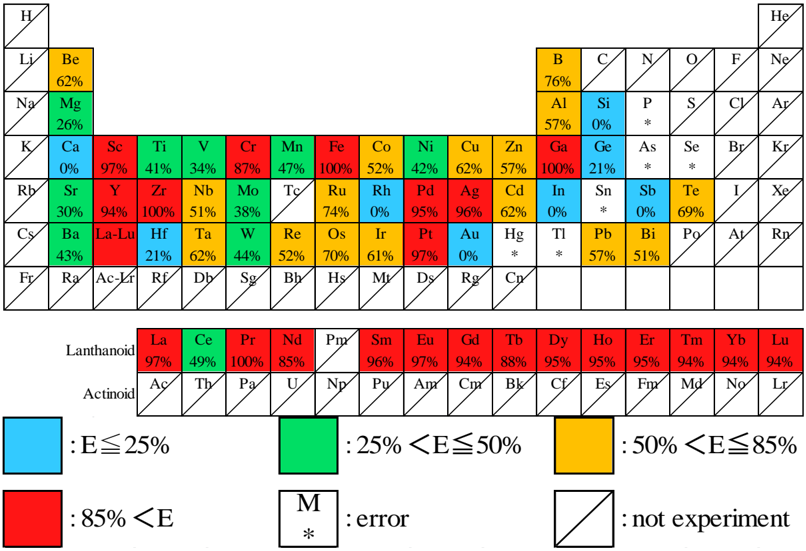
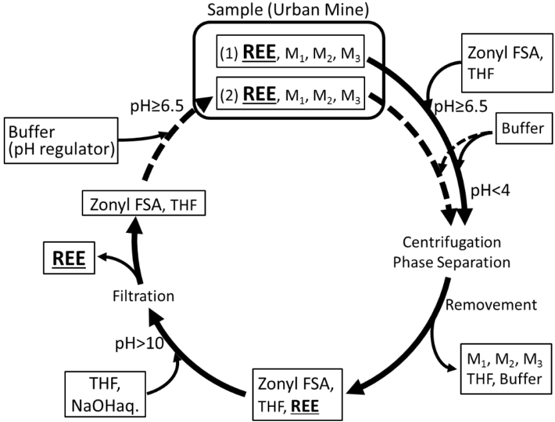
A selective separation and recycling system for metal ions was developed by homogeneous liquid-liquid extraction (HoLLE) using a fluorosurfactant. Sixty-two different elemental ions (e.g., Ag, Al, As, Au, B, Ba, Be, Bi, Ca, Cd, Ce, Co, Cr, Cu, Dy, Er, Eu, Fe, Ga, Gd, Ge, Hf, Hg, Ho, In, Ir, La, Lu, Mg, Mn, Mo, Nb, Nd, Ni, Os, P, Pb, Pd, Pr, Pt, Re, Rh, Ru, Sb, Sc, Se, Si, Sm, Sn, Sr, Ta, Tb, Te, Ti, Tl, Tm, V, W, Y, Yb, Zn, and Zr) were examined. By changing pH from a neutral or alkaline solution (pH ≥ 6.5) to that of an acidic solution (pH < 4.0), gallium, zirconium, palladium, silver, platinum, and rare earth elements were extracted at >90% efficiency into a sedimented Zonyl FSA® (CF3(CF2)n(CH2)2S(CH2)2COOH, n = 6–8) liquid phase. Moreover, all rare earth elements were obtained with superior extraction and stripping percentages. In the recycling of rare earth elements, the sedimented phase was maintained using a filter along with a mixed solution of THF and 1 M sodium hydroxide aqueous solution. The Zonyl FSA® was filtrated and the rare earth elements were recovered on the filter as a hydroxide. Furthermore, the filtrated Zonyl FSA was reusable by conditioning the subject pH.
Overview
The claims and statistics of this paper haven’t been checked yet.
Free: it reads the open-access text and checks the first 5 claims that cite a source we can check. Create a free account to check every claim.
Integrity signals
Registry
Cites
Statistics
Figures
Verification
Claims the paper makes
The claims and statistics of this paper haven’t been checked yet.
Free: it reads the open-access text and checks the first 5 claims that cite a source we can check. Create a free account to check every claim.
Self-check
Percentages, sums and reported differences re-computed from the paper’s own numbers.
The self-check needs the paper’s full text.
Citations
Cites
Air and water stable 1-ethyl-3-methylimidazolium based ionic liquids
Wilkes, J. S., & Zaworotko, M. J. (1992) · Journal of the Chemical Society, Chemical Communications · doi:10.1039/c39920000965 · Cited by 1,883
(1979) · Biochemical Education · doi:10.1016/0307-4412(79)90105-5 · Cited by 598
SINHA, S. P. (1966) · Complexes of the Rare Earths · doi:10.1016/b978-0-08-011616-7.50005-x · Cited by 317
Recovery of Au(III) by using low cost adsorbent prepared from persimmon tannin extract
Gurung, M., Adhikari, B. B., Kawakita, H., Ohto, K., Inoue, K., & Alam, S. (2011) · Chemical Engineering Journal · doi:10.1016/j.cej.2011.09.039 · Cited by 140
Hoogerstraete, T. V., Onghena, B., & Binnemans, K. (2013) · International Journal of Molecular Sciences · doi:10.3390/ijms141121353 · Cited by 114
Persimmon peel gel for the selective recovery of gold
Parajuli, D., Kawakita, H., Inoue, K., Ohto, K., & Kajiyama, K. (2007) · Hydrometallurgy · doi:10.1016/j.hydromet.2007.02.006 · Cited by 110
Igarashi, S., & Yotsuyanagi, T. (1992) · Microchimica Acta · doi:10.1007/bf01242697 · Cited by 100
Self-citationAltin, O., Ozbelge, O. H., & Dogu, T. (1999) · Journal of Chemical Technology & Biotechnology · doi:10.1002/(sici)1097-4660(199912)74:12<1131::aid-jctb158>3.0.co;2-0 · Cited by 79
Kato, T., Igarashi, S., Ishiwatari, Y., Furukawa, M., & Yamaguchi, H. (2013) · Hydrometallurgy · doi:10.1016/j.hydromet.2013.06.004 · Cited by 58
Self-citationHomogeneous liquid-liquid extraction method for spectrofluorimetric determination of chlorophyll a
SUDO, T., & Igarashi, S. (1996) · Talanta · doi:10.1016/0039-9140(95)01748-8 · Cited by 44
Self-citation
Research works printed but not linked: 7
- 10. Igarashi, S.; Yotsuyanagi, T. A novel homogeneous liquid-liquid Extraction by pH dependent phase separation with fluorocarbon ionic surfactant. In Proceedings of the Symposium on Solvent Extraction 1988, Tokyo, Japan, 5-7 December 1988; pp. 175-180.
- 11. Igarashi, S.; Yotsuyanagi, T. Temperature dependent phase transformation in the homogeneous liquid-liquid extraction with fluorocarbon surfactant. In Proceedings of the Symposium on Solvent Extraction 1989, Sendai, Japan, 9-11 November 1989; pp. 51-54.
- 12. Igarashi, S.; Yotsuyanagi, T. New homogeneous liquid-liquid extraction by phase separation and transformation with fluorocarbon surfactant and quaternary ammonium salt. In Solvent extraction 1990, Proceedings of the International Solvent Extraction Conference (ISEC '90), Kyoto, Japan, 16-21 July 1992;
- 13. Sekine, T., Ed.; Elsevier: New York, NY, USA, 1992; pp. 1725-1730.
- 15. Yamaguchi, H. Did the study of ionic liquids begin from analytical chemistry? Bunseki 2007, 11, 608-609.
- 21. Takagai, Y.; Igarashi, S. Homogeneous liquid-liquid extraction method as simple and powerful preconcentration for capillary gas chromatography and capillary electrophoresis. Am. Lab. 2002, 34, 29-30.
- 29. Suzuki, Y. Kidorui no Hanashi [The Story of Rare Earth Elements]; Shokabo Publishing Co., Ltd.: Chiyoda, Japan, 1998; pp. 66-72.
Cited by
Historical and current usage of per- and polyfluoroalkyl substances (PFAS): A literature review
Gaines, L. G. T. (2023) · American Journal of Industrial Medicine · doi:10.1002/ajim.23362 · Cited by 665
Recovery of rare earth elements with ionic liquids
Wang, K., Adidharma, H., Radosz, M., Wan, P., Xu, X., Russell, C. K., Tian, H., Fan, M., & Yu, J. (2017) · Green Chemistry · doi:10.1039/c7gc02141k · Cited by 203
Swain, B., Akçıl, A., & Lee, J.-C. (2020) · Critical Reviews in Environmental Science and Technology · doi:10.1080/10643389.2020.1829898 · Cited by 111
“Though the reported process is silent about Y and La separation/recovery, based on literature it can reasonably be concluded that both these metals can be recovered by solvent extraction (Saito et al., 2015; Swain & Otu, 2011; Swain & Tanaka, 2018).”
BackgroundSwain, B. (2023) · Reviews in Environmental Science and Bio/Technology · doi:10.1007/s11157-023-09647-2 · Cited by 36
Masry, B. A., Aly, M. I., & Daoud, J. A. (2020) · Colloids and Surfaces A Physicochemical and Engineering Aspects · doi:10.1016/j.colsurfa.2020.125713 · Cited by 30
Industrial Applications, Environmental Fate, Human Exposure, and Health Effects of PFAS
Hasan, M., Habib, A., Alam, M., Islam, S., & Halim, E. (2025) · Pollutants · doi:10.3390/pollutants5040043 · Cited by 21
“Studies have demonstrated that PFASs can achieve nearly 100% recovery in just two extraction steps, with the solvent being reusable [30].”
Bhargava, S. K., Pownceby, M. I., & Ram, R. (2016) · Metals · doi:10.3390/met6050122 · Cited by 21
REE Geochemistry of Euphrates River, Turkey
Kalender, L., & Aytimur, G. (2016) · Journal of Chemistry · doi:10.1155/2016/1012021 · Cited by 18
“[42] was used to obtain the maximum REE concentration at 9.”
MethodZhao, S., Hu, R., Nie, Y., Sheng, L., He, W., Zhu, N., Li, Y., Ji, D., & Guo, K. (2022) · Chemical Engineering and Processing - Process Intensification · doi:10.1016/j.cep.2022.109034 · Cited by 16
HYDROMETALLURGICAL METHODS OF INDIUM RECOVERY FROM OBSOLETE LCD AND LED PANELS
Krištofová, P., Rudnik, E., & Miškufová, A. (2016) · Metallurgy and Foundry Engineering · doi:10.7494/mafe.2016.42.3.157 · Cited by 15
Kato, T., Nagashima, Y., Manaka, A., Nakamura, C., Oshite, S., & Igarashi, S. (2019) · Analytical Sciences · doi:10.2116/analsci.19n001 · Cited by 9
Self-citationSeparation Factor of Y/Dy Emulsion on Membrane Process Using Nitric Acid and D2EHPA Solvent
Basuki, K. T., & Pamungkas, N. S. (2019) · Indonesian Journal of Chemistry · doi:10.22146/ijc.35783 · Cited by 4
Study on mixing characteristics of multichamber static mixer
Shi, H., & Liu, Z. (2023) · Engineering Reports · doi:10.1002/eng2.12712 · Cited by 3
Kato, T., Saito, S., Oshite, S., & Igarashi, S. (2017) · Environment and Natural Resources Research · doi:10.5539/enrr.v7n4p44 · Cited by 3
Self-citationBhargava, S. K., Ram, R., & Pownceby, M. I. (2017) · MDPI eBooks · doi:10.3390/books978-3-03842-465-9
Metadata
- Authors
- Saito, S., Ohno, O., Igarashi, S., Kato, T., & Yamaguchi, H.
- Affiliations
- Ibaraki University (JP)
- Industrial Technology Institute of Ibaraki Prefecture, 3781-1 Nagaoka, Ibaraki-machi, Ibaraki-gun, Ibaraki 311-3195, Japan
- National Institute for Materials Science (JP)
- Corresponding author
- Igarashi, Shukuro
- ORCID
- Kato, Takeshi
- Venue
- Metals
- Publisher
- MDPI AG
- Published
- 2015-08-27
- Volume
- 5
- Issue
- 3
- Pages
- 1543-1552
- ISSN
- 2075-4701 (ISSN-L)
- OpenAlex
- W2168415422
- Cited by
- 14
- References
- 24
- Citations by year
- 2025: 1 · 2023: 2 · 2022: 2 · 2020: 2 · 2019: 2 · 2017: 2 · 2016: 3
- FWCI
- 1.63
- Type
- journal article
- Language
- en
- Open access
- gold
- dx.doi.org
- Licence
- Locations
- Metals (publishedVersion, cc-by)
- DOAJ (DOAJ: Directory of Open Access Journals) (submittedVersion, cc-by-sa)
- Funders
- Japan Society for the Promotion of Science (15H02847)
- Topics
- Physical Sciences › Materials Science › Metals and Alloys › Extraction and Separation Processes
- Physical Sciences › Chemistry › Inorganic Chemistry › Radioactive element chemistry and processing
- Physical Sciences › Chemical Engineering › Filtration and Separation › Chemical and Physical Properties in Aqueous Solutions
- Keywords
- rare earth elements, homogeneous liquid-liquid extraction, rare earth recycling, fluorosurfactants, metal ion separation
About these checks
Registry, retraction, Cites and statistics results are computed, not judged, with one exception: a printed reference that no index lists is read once by a model before it counts as a citation error. Claims are extracted by a model and kept only when their quote appears verbatim in the text; each cited source is then checked, with a model’s help, for whether it says what the claim relies on. Those verdicts can be wrong — read the claim’s quote and the cited source before relying on one.
Statistics and arithmetic are recomputed, not judged.
Confidence bands are shown only for fields calibrated on our annotated test set. None is calibrated yet, so no band is shown.
What counts as a claim ›How we measure confidence ›How we check this ›
Are you an author, or do you see a problem with this page? Request a review
Data sources
Bibliographic data: Semantic Scholar, OpenAlex, Crossref.
Contains information from the Semantic Scholar Academic Graph Datasets, made available under the ODC Attribution License (ODC-BY 1.0).
Semantic Scholar’s data is described in: Kinney, R., et al. (2023). The Semantic Scholar Open Data Platform. arXiv:2301.10140.
