

Mineralogy of Miocene Petrified Wood from Central Washington State, USA
Open accessThe DOI matches its Crossref record; 58 of the 58 references it cites were found in a registry or an index; none of the 48 sources its claims cite is checked for support yet.
Abstract
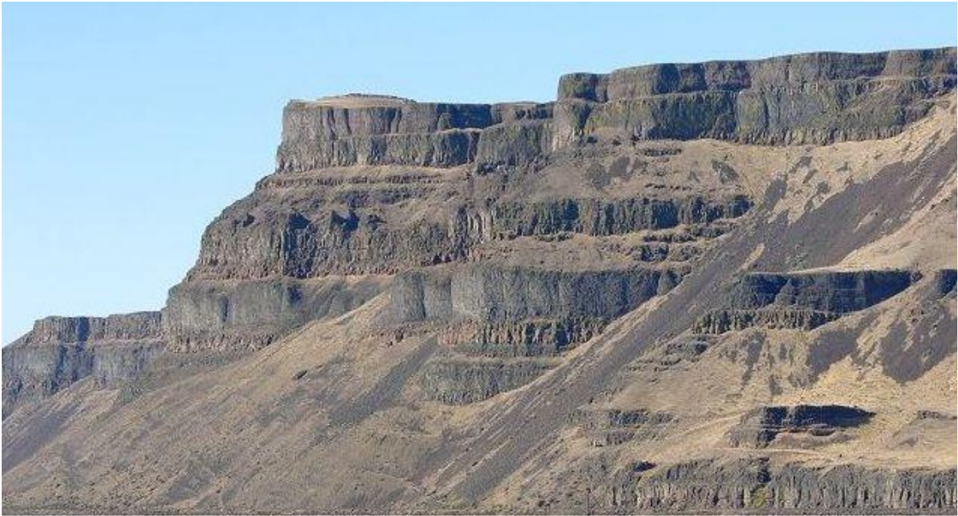
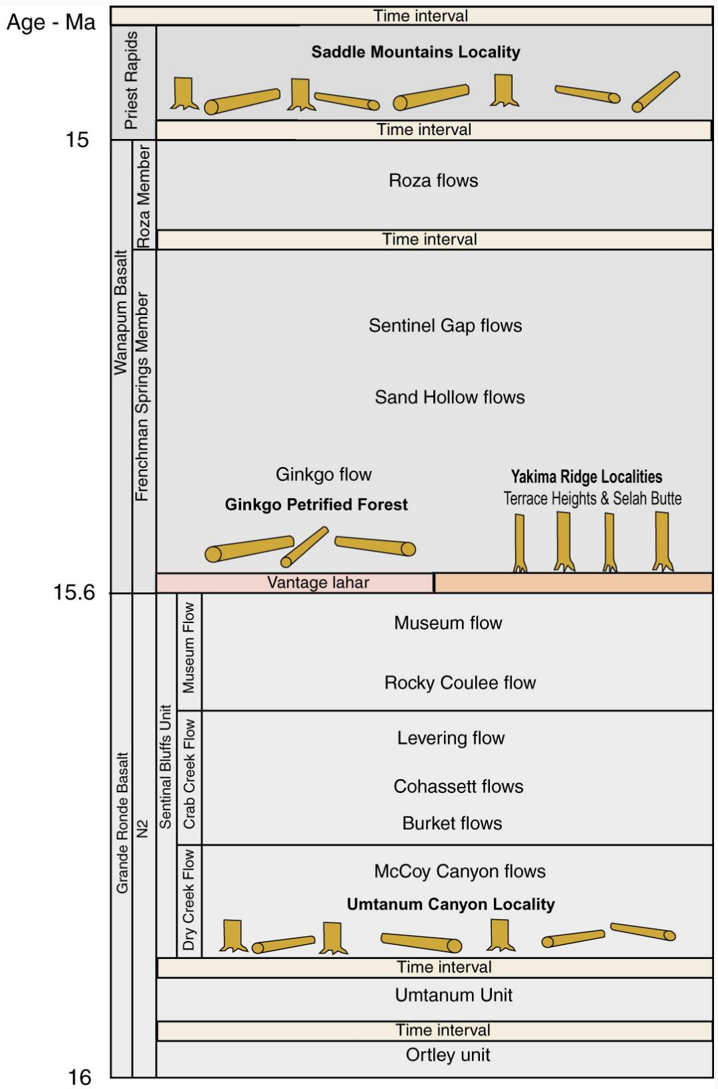
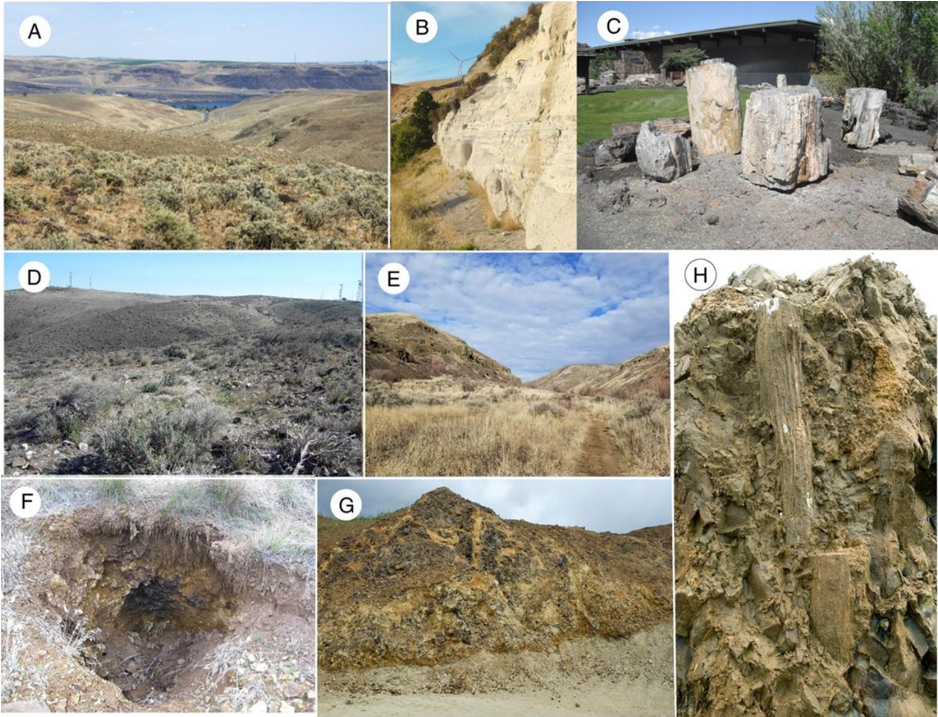
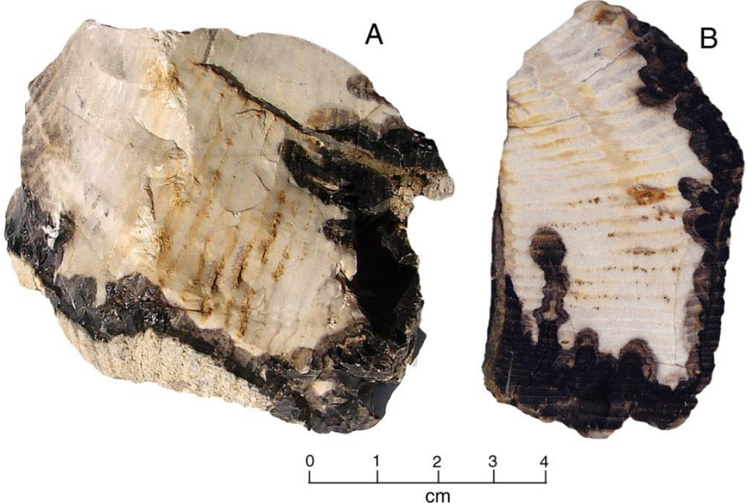
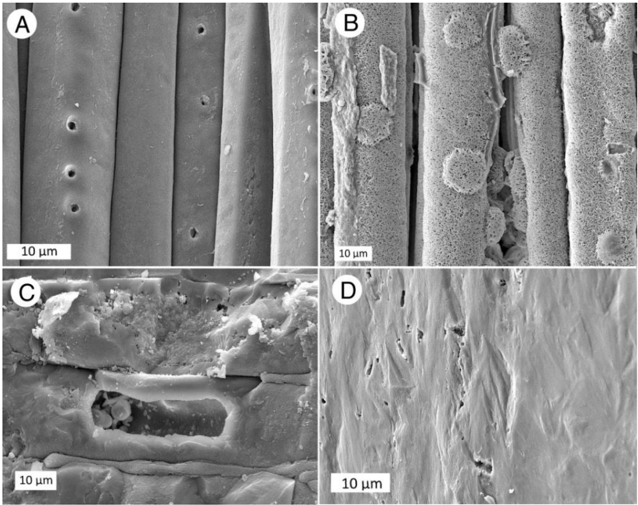
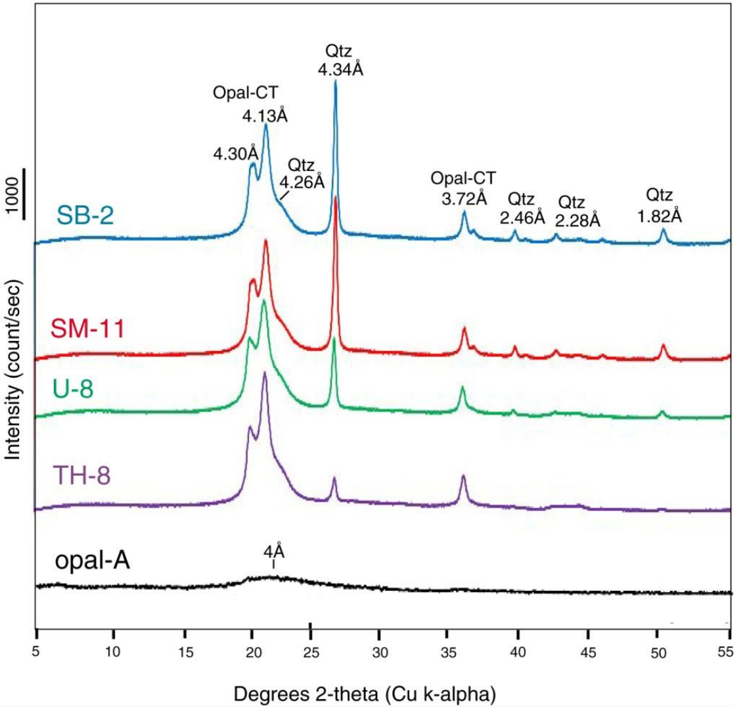
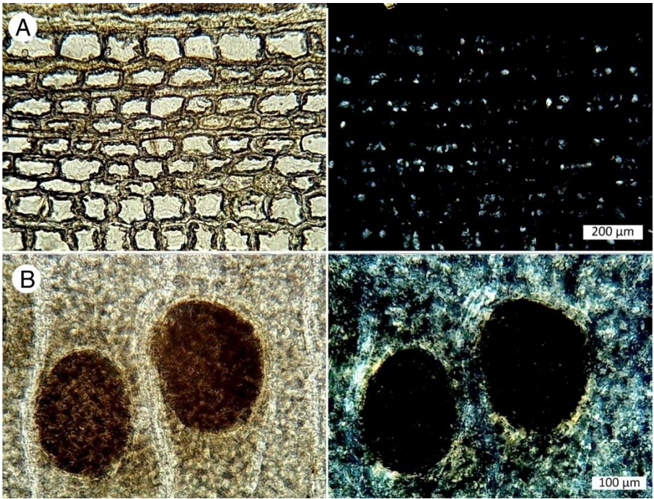
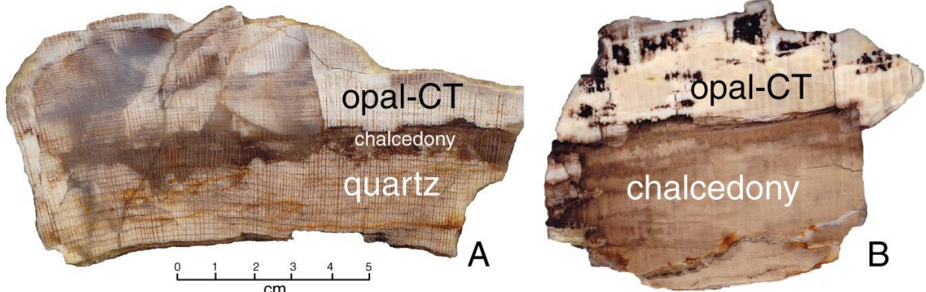
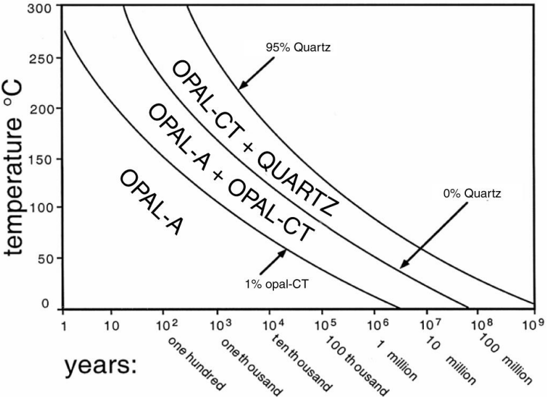
Silicified wood occurs abundantly in Middle Miocene flows and sedimentary interbeds of the Columbia River Basalt Group (CRBG) in central Washington State, USA. These fossil localities are well-dated based on radiometric ages determined for the host lava. Paleoenvironments include wood transported by lahars (Ginkgo Petrified Forest State Park), fluvial and palludal environments (Saddle Mountain and Yakima Canyon fossil localities), and standing forests engulfed by advancing lava (Yakima Ridge fossil forest). At all of these localities, the mineralogy of fossil wood is diverse, with silica minerals that include opal-A, opal-CT, chalcedony, and macrocrystalline quartz. Some specimens are composed of only a single form of silica; more commonly, specimens contain multiple phases. Opal-A and Opal-CT often coexist. Some woods are mineralized only with chalcedony; however, chalcedony and macrocrystalline quartz are common as minor constituents in opal wood. In these specimens, crystalline silica filling fractures, rot pockets, and cell lumen may occur. These occurrences are evidence that silicification occurred as a sequential process, where changes in the geochemical environment or anatomical structures affected the precipitation of silica. Fossilization typically began with precipitation of amorphous silica within cell walls, leaving cell lumen and conductive vessels open. Diagenetic transformation of opal-A to opal-CT in fossil wood has long been a widely accepted hypothesis; however, in opaline CRBG specimens, the two silica polymorphs usually appear to have formed independently, e.g., woods in which cell walls are mineralized with opal-A but in which lumen contain opal-CT. Similarly, opal-CT has been inferred to sometimes transform to chalcedony; however, in CRBG, these mixed assemblages commonly resulted from multiple mineralization episodes.
Overview
CoChat Summary
TL;DR
Silicified Middle Miocene woods from four Columbia River Basalt Group localities in central Washington contain opal-A, opal-CT, chalcedony, and macrocrystalline quartz, often mixed within single specimens. Textures indicate silicification typically began with opal in cell walls and later filled fractures and lumen with crystalline silica, so mixed assemblages mostly reflect multiple mineralization episodes rather than simple diagenetic transformation.
Key findings
- Four silica forms were found in CRBG fossil wood: opal-A, opal-CT, chalcedony, and macrocrystalline quartz. No locality has a distinctive mineralogy, but trends include: Ginkgo Petrified Forest woods range from nearly pure opal to pure chalcedony; at Umtanum Canyon, seven of eight specimens studied are opaline with opal-A as a major constituent; Saddle Mountain opal woods contain only opal-CT, with chalcedony and quartz common; Yakima Ridge fossil forest has abundant opal, including both opal-A and opal-CT.
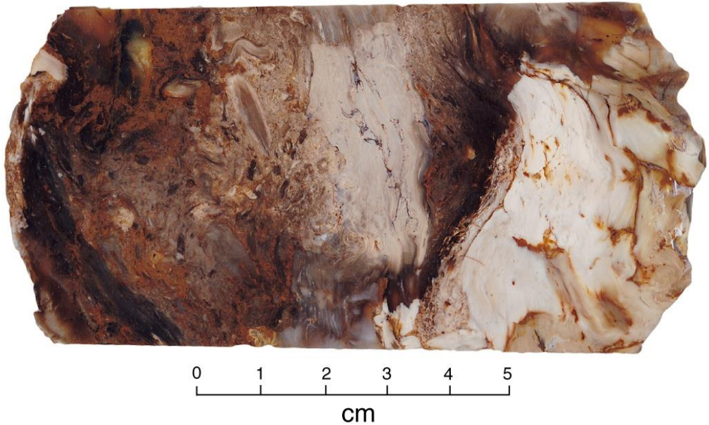
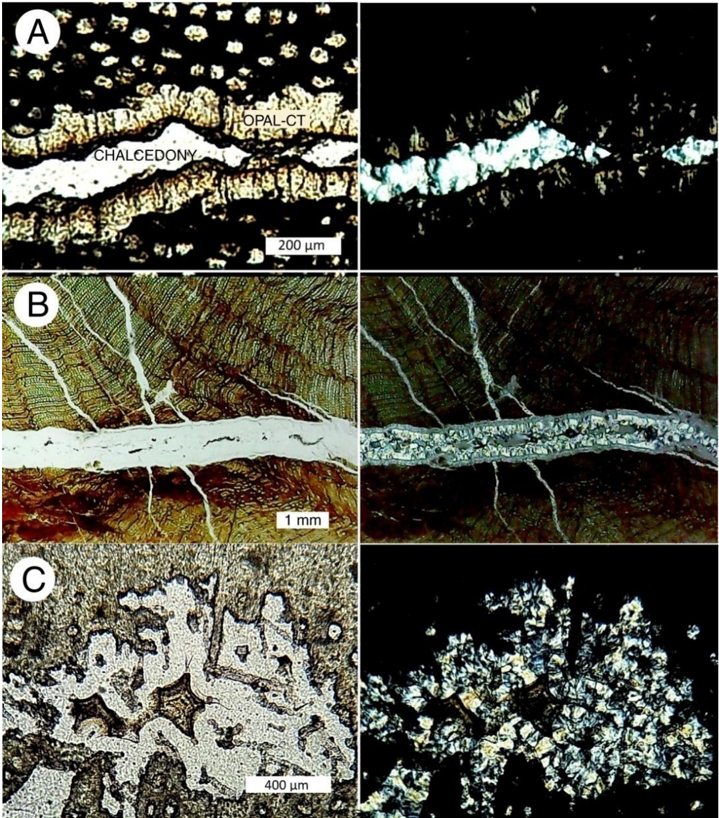
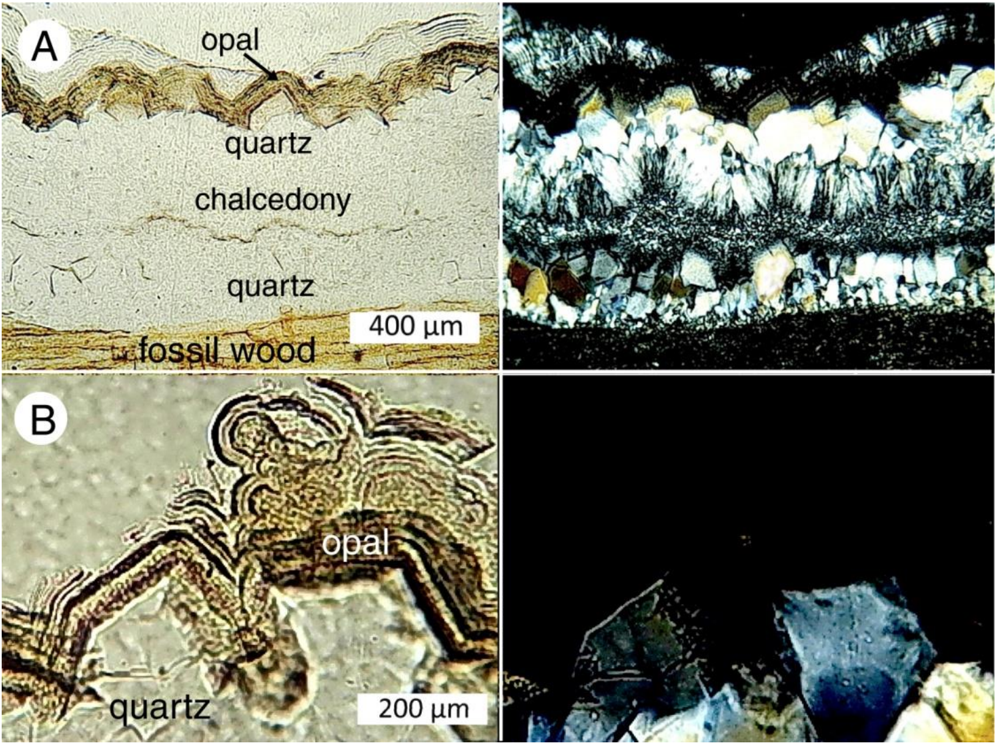
- Fossilization typically began with precipitation of amorphous silica within cell walls, leaving cell lumen and conductive vessels open. Later episodes filled fractures, rot pockets, and vessels with chalcedony or quartz; a Saddle Mountain fracture less than 2 mm wide shows a depositional succession of chalcedony → quartz → opal-A → chalcedony.
- The long-accepted diagenetic transformation hypothesis is not strongly supported by these specimens: opal-A and opal-CT often coexist independently, e.g., cell walls mineralized with opal-A but lumen containing opal-CT, and mixed assemblages commonly resulted from multiple mineralization episodes. Possible transformation candidates include Saddle Mountain SM-3 and SM-12, which have quartz-only XRD patterns and densities of 2.55 g/cm³ with relict microsphere shapes, and Selah Butte SB-8, which has quartz-only XRD but a density of only 2.15 g/cm³ and opal-A microspheres.
- Density ranges reported: opal-mineralized woods 1.9–2.1 g/cm³; fully chalcedony/quartz-mineralized woods 2.5–2.6 g/cm³. Appendix A lists 62 specimens.
Methods
- Specimens came from the authors’ research collections, supplemented by loans from the University of Washington Burke Museum and donations by other collectors; 62 specimens are listed in Appendix A from Ginkgo/Vantage, Umtanum Canyon/Yakima Canyon outliers, Saddle Mountain, and Yakima Ridge (Terrace Heights and Selah Butte).
- Petrographic thin sections were prepared at 30 µm; optical photomicrographs used a Zeiss Pol petrographic microscope with a 5 MP CMOS camera. SEM used a Tescan Vega III on fractured wood fragments mounted on aluminum stubs, some etched for 60 s in 40% HF, and sputter coated with Pd.
- XRD used a Rigaku MiniFlex diffractometer with Ni-filtered CuKα radiation over 5–55° 2θ, step scan 0.02° at 2°/min. Density was measured by hydrostatic weighing. Silica classification followed Jones and Segnit.
Limitations
- Stated in the paper: at Saddle Mountain, stratigraphic relationships are difficult to ascertain and no scientific studies had been done there; at Terrace Heights, the property owner excavated all fossil trees, limiting opportunities for scientific study, and the only scientific examination occurred after most trunks had been excavated. Esthetic concerns preclude destructive chemical analysis of museum display specimens.
- Stated analytical limitations: XRD has limited value for fossilization details; opal-A identification is less reliable because it yields only a weak diffuse 4 Å peak; quartz peaks cannot distinguish chalcedony from microcrystalline quartz; conditions were not optimized for moganite or the weak opal-A peak. Direct evidence of diagenetic silica transformations in fossil wood remains sparse and sometimes questionable, and the search for mineralogic “missing links” remains a goal for future research.
- Evident from the text: sampling relied on available collections, loans, and donations rather than systematic field sampling, and some localities or outlier occurrences are understudied or not directly correlative with the main strata.
Model-written summary. Check it against the paper before relying on it.
Integrity signals
Registry
Cites
Statistics
Figures
![Figure 1 Fossil wood localities studied in this report. (1) Saddle Mountain. (2) Umtanum Canyo (3) Gingko Petrified Forest State Park; (4) Yakima Ridge Fossil Forest. Base map modified from [26 Figure 1. Fossil wood localities studied in this report. (1) Saddle Mountain. (2) Umtanum Canyon; (3) Gingko Petrified Forest State Park; (4) Yakima Ridge Fossil Forest. Base map modified from [26]. Figure 1. Fossil wood localities studied in this report. (1) Saddle Mountain. (2) Umtanum Canyon; (3) Gingko Petrified Forest State Park; (4) Yakima Ridge Fossil Forest. Base map modified from [26].](https://figures.cochat.ai/paper-figures/b0f8ed45e0524473a2b3a5ca8f7d4209/mineralogy-of-miocene-petrified-wood-from-central-washington-state-usa-figure-1.png)
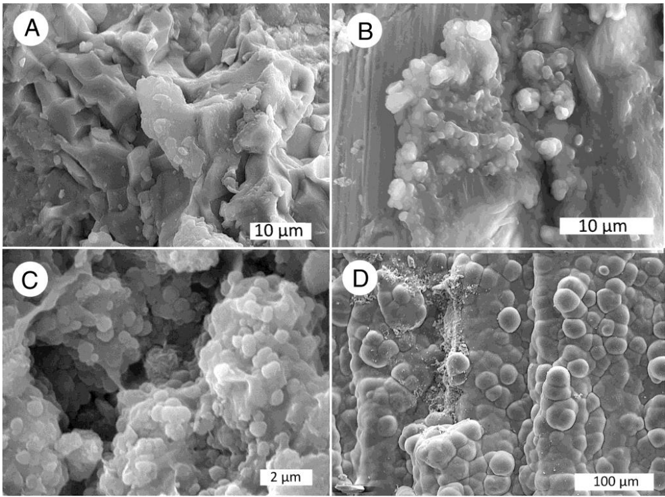
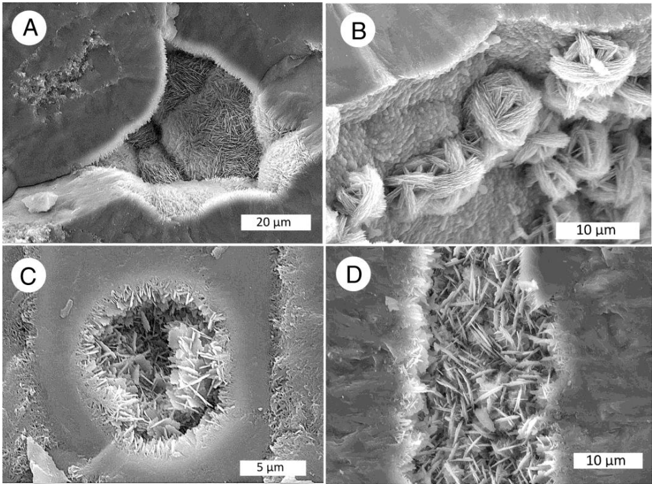
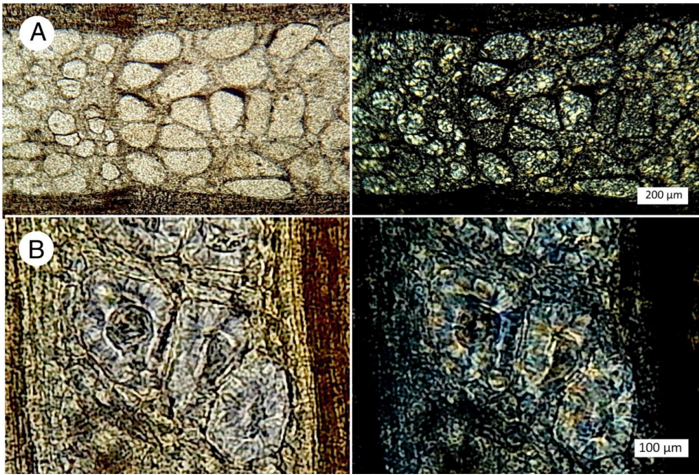
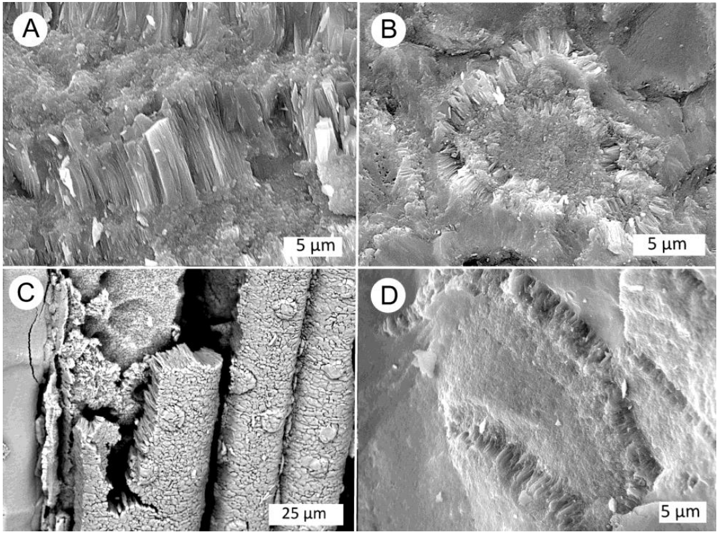
Verification
Claims the paper makes
0 Valid · 10 Not valid · 28 Not checked · 171 Own results and interpretations
A result the paper states — it cites no source for it, so there is none to check. The quote shows it is in the paper.
In the paper
“Selah Butte specimens commonly show charred exteriors that resulted fromstanding trees becoming engulfed in magma”
§ Mineralogy of Miocene Petrified Wood from Central Washington State, USA > 3.1. Ginkgo Petrified Forest
plainstates a cause- Asserted: passes — The authors put it forward as true.
- Checkable: passes — It can be checked against evidence.
- Load-bearing: unclear — It is unclear whether the paper’s conclusions depend on it.
- Based: passes — The paper gives a reason why it holds.
A result the paper reports from its own data — it cites no other source for it, so there is none to check. The quote shows it is in the paper.
In the paper
“Four forms of silica have been found in CRBG fossil wood specimens: opal-A, opal-CT, chalcedony, and macrocrystalline quartz.”
§ Mineralogy of Miocene Petrified Wood from Central Washington State, USA > 5.1. Silica Mineralogy
plain- Asserted: passes — The authors put it forward as true.
- Checkable: passes — It can be checked against evidence.
- Load-bearing: passes — The paper’s conclusions depend on it.
- Based: passes — The paper gives a reason why it holds.
A result the paper states — it cites no source for it, so there is none to check. The quote shows it is in the paper.
In the paper
“Opal-A and Opal-CT often coexist.”
§ Mineralogy of Miocene Petrified Wood from Central Washington State, USA > Abstract
plainstates an association- Asserted: passes — The authors put it forward as true.
- Checkable: passes — It can be checked against evidence.
- Load-bearing: unclear — It is unclear whether the paper’s conclusions depend on it.
- Based: passes — The paper gives a reason why it holds.
In the paper
“Geochemical analysis of the basalt places the flow within the Frenchman Spring Member of the Wanapum Basalt Formations, with an approximate age of 15 Ma [51].”
§ Mineralogy of Miocene Petrified Wood from Central Washington State, USA > 3.4. Yakima Ridge Fossil Forest
What the sources say
- Not checked yetcites [51] Dillhoff, T.A. A Miocene Forest Assemblage from the Columbia River Basalts of Washington State, USA, Botanical Society of America Botany 2006 Conference, California State University, Chico, CA, USA, Abstract 444. Available online: http://www.2006 .botanyconference.org/engine/search/index.php?func=detail&aid=444/ (accessed on 16 October 2021).
plain- Asserted: passes — The authors put it forward as true.
- Checkable: passes — It can be checked against evidence.
- Load-bearing: unclear — It is unclear whether the paper’s conclusions depend on it.
- Based: passes — The paper gives a reason why it holds.
A result the paper reports from its own data — it cites no other source for it, so there is none to check. The quote shows it is in the paper.
In the paper
“At all of these localities, the mineralogy of fossil wood is diverse, with silica minerals that include opal-A, opal-CT, chalcedony, and macrocrystalline quartz.”
§ Mineralogy of Miocene Petrified Wood from Central Washington State, USA > Abstract
plain- Asserted: passes — The authors put it forward as true.
- Checkable: passes — It can be checked against evidence.
- Load-bearing: passes — The paper’s conclusions depend on it.
- Based: passes — The paper gives a reason why it holds.
102 more claims
Create a free account to see all 209 claims and to verify the 46 references still open.
- It may state two separate claims as one. 62
- Probably not a substantial claim. 60
- The quote only partly states this claim. 1
Self-check
Percentages, sums and reported differences re-computed from the paper’s own numbers.
Each contradiction between two passages listed here was confirmed by an independent check.
Rated major: it would touch a result — a value a result rests on, reported and recomputed p-values on opposite sides of the significance level, two passages that conflict with no sign which is right, or a cited work retracted before this paper was published.
In the paper
§ Mineralogy of Miocene Petrified Wood from Central Washington State, USA > 6. Discussion
“In contrast, opal wood specimens collected from Saddle Mountain contain only opal-CT, with chalcedony and quartz being common constituents.”
§ Mineralogy of Miocene Petrified Wood from Central Washington State, USA > 6.2. Why Is the Mineralogy So Complicated?
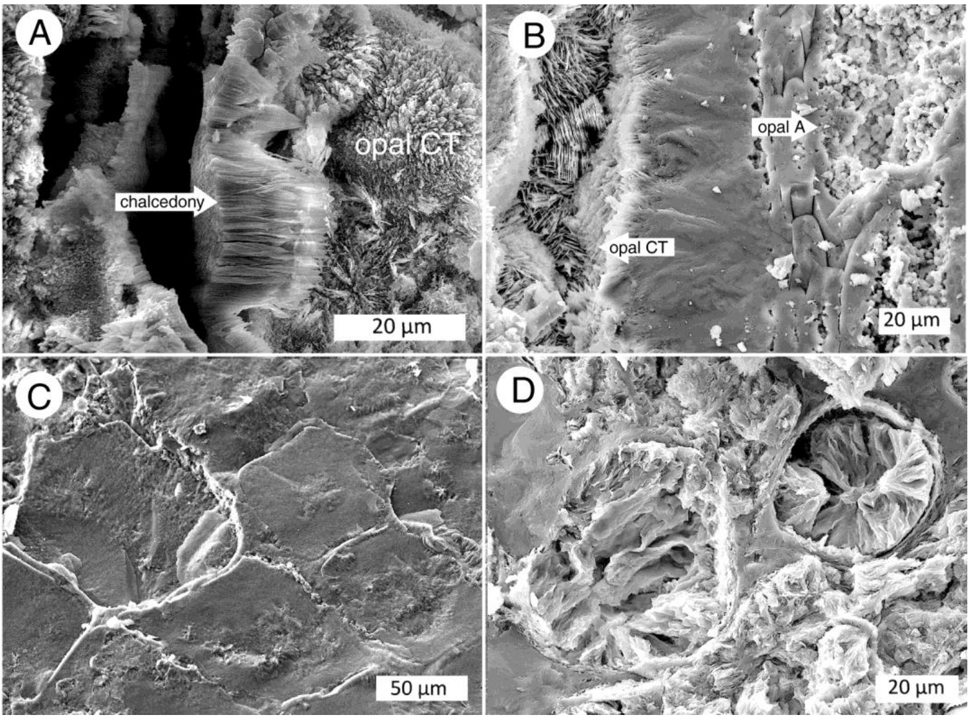
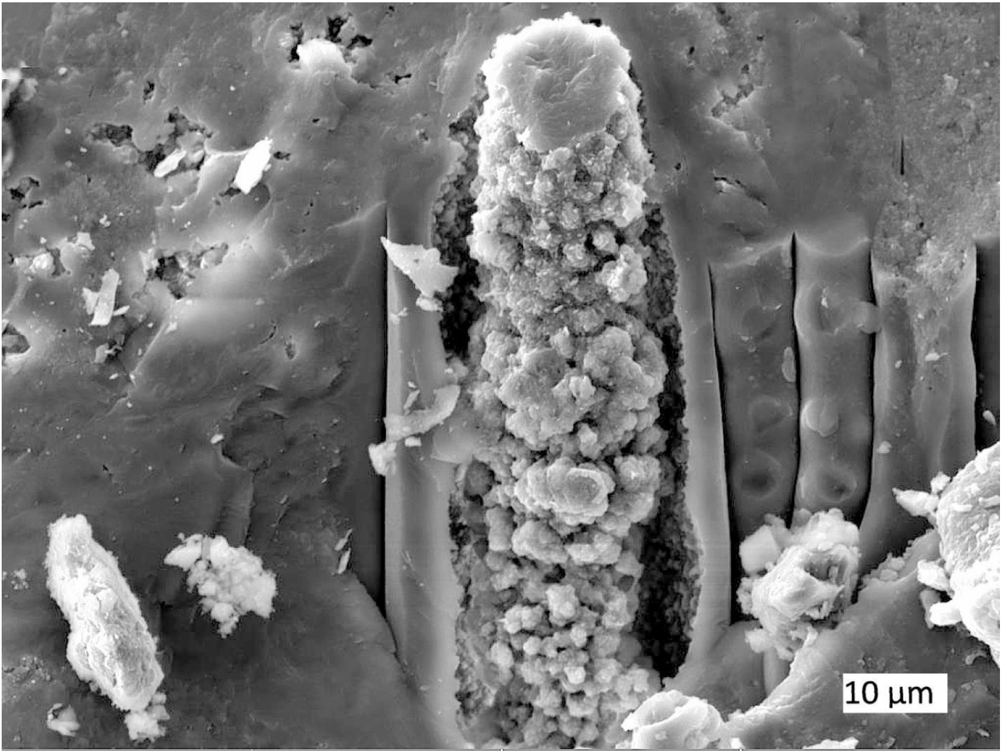
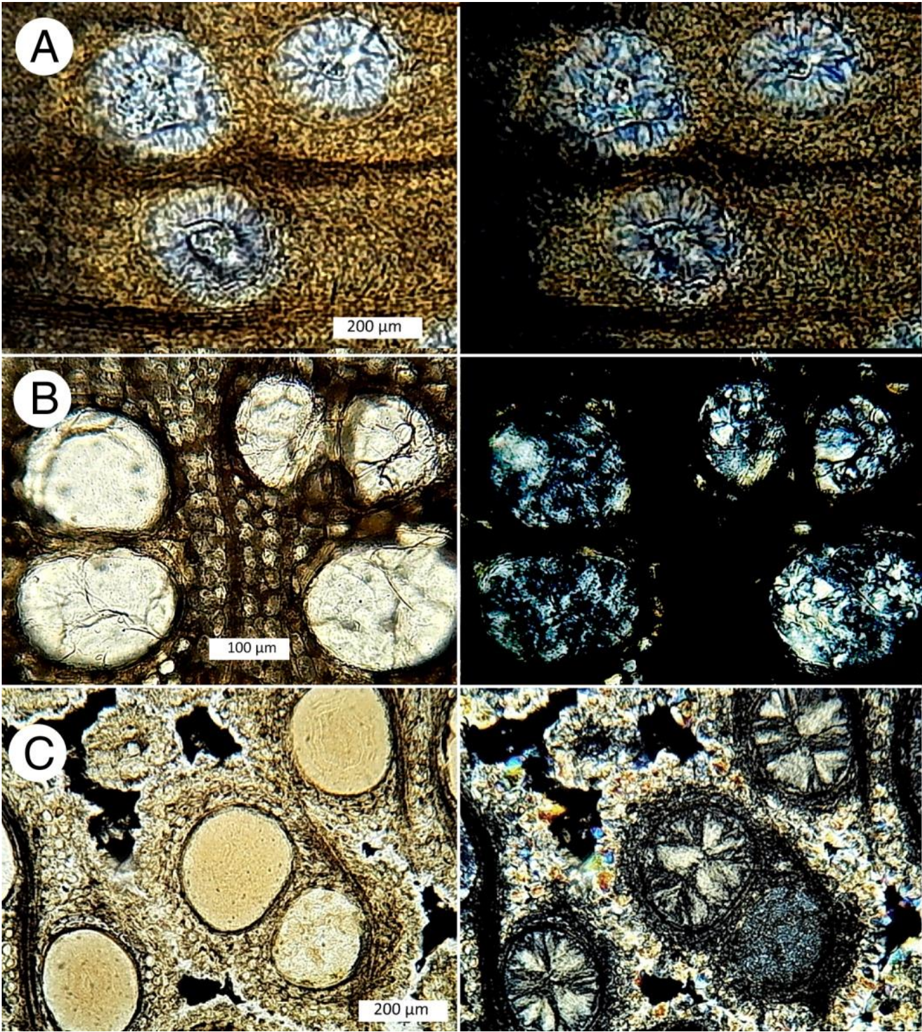
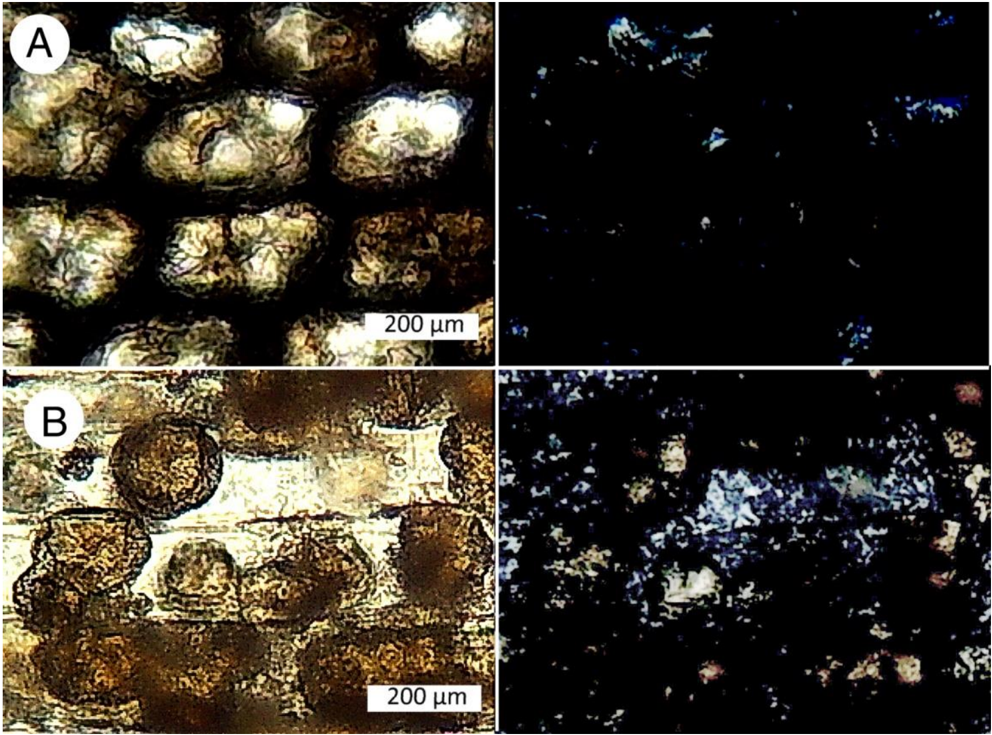
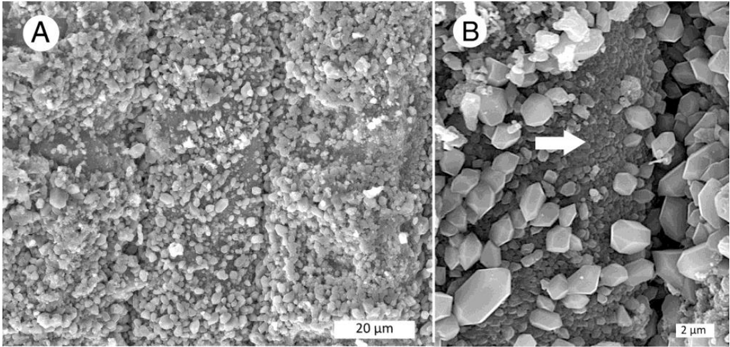
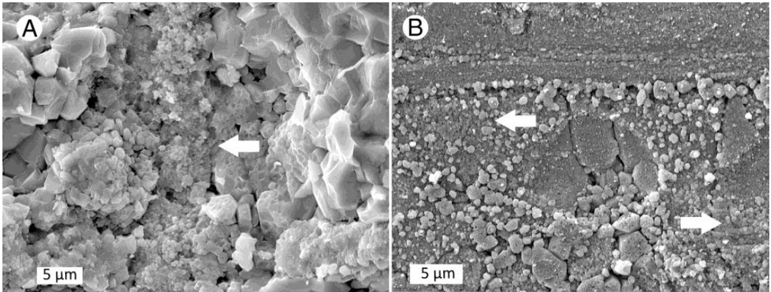
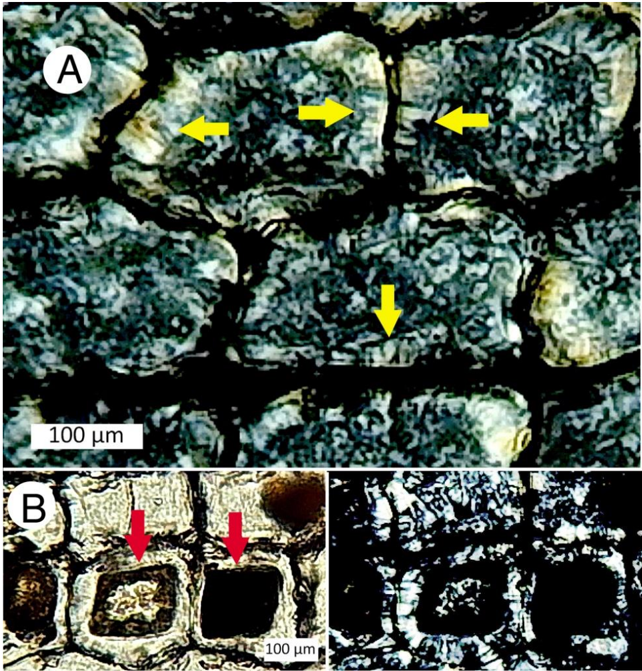
“Figure 25.Saddle Mountain sample SM-1 contains cells that contain semi-spherical masses of opal-A surrounded by opal-CT.(A) Opal-A cell walls, with lumen that contain spheroidal masses of opal-A with lesser amounts of opal-CT.”
Rated minor: it would not touch a result — a value no result rests on, a p-value that stays on the same side of the significance level, or a conflict that is clerical, resolved elsewhere in the paper, or outside its own findings.
In the paper
§ Mineralogy of Miocene Petrified Wood from Central Washington State, USA > 5.2. Compositional Heterogeneity
“The overall depositional succession indicated by the wall architecture was chalcedony → quartz → opal-A → chalcedony.”
§ Mineralogy of Miocene Petrified Wood from Central Washington State, USA > 6.2. Why Is the Mineralogy So Complicated?
“The quartz overlies a chalcedony zone, which is positioned above a basal quartz layer.”
Rated minor: it would not touch a result — a value no result rests on, a p-value that stays on the same side of the significance level, or a conflict that is clerical, resolved elsewhere in the paper, or outside its own findings.
In the paper
§ Mineralogy of Miocene Petrified Wood from Central Washington State, USA > 4. Methods and Materials
“Opal-C has an incipient crystallinity of α-cristobalite with interlayered tridyite stacking.”
§ Mineralogy of Miocene Petrified Wood from Central Washington State, USA > 4. Methods and Materials
“Opal-C has the structure of well-ordered α-cristobalite.”
Rated minor: it would not touch a result — a value no result rests on, a p-value that stays on the same side of the significance level, or a conflict that is clerical, resolved elsewhere in the paper, or outside its own findings.
In the paper
§ Mineralogy of Miocene Petrified Wood from Central Washington State, USA > 4. Methods and Materials
“A few specimens were etched for 60 s in 40% HF; most were left in their natural state.”
§ Mineralogy of Miocene Petrified Wood from Central Washington State, USA > 6.2. Why Is the Mineralogy So Complicated?
“Yakima Canyon Sample YC-1, after etching 10 s with 40% HF.”
Citations
Cites
Kastner, M., Keene, J. B., & Gieskes, J. M. (1977) · Geochimica et Cosmochimica Acta · doi:10.1016/0016-7037(77)90099-0 · Cited by 492
The nature of opal I. nomenclature and constituent phases
Jones, J. B., & Segnit, E. R. (1971) · Journal of the Geological Society of Australia · doi:10.1080/00167617108728743 · Cited by 414
Silica Diagenesis, I. Solubility Controls
Loretta Ann Williams (2), G. A. (1985) · SEPM Journal of Sedimentary Research · doi:10.1306/212f86ac-2b24-11d7-8648000102c1865d · Cited by 397
Silica Diagenesis, II. General Mechanisms
Loretta Ann Williams (2), D. A. (1985) · SEPM Journal of Sedimentary Research · doi:10.1306/212f86b1-2b24-11d7-8648000102c1865d · Cited by 377
SILICA MINERALS IN THE EARLY STAGE OF DIAGENESIS
Mizutani, S. (1970) · Sedimentology · doi:10.1111/j.1365-3091.1970.tb02193.x · Cited by 111
The Saddle Mountains; the evolution of an anticline in the Yakima fold belt
Reidel, S. P. (1984) · American Journal of Science · doi:10.2475/ajs.284.8.942 · Cited by 111
Petrifaction of wood by silica minerals
Scurfield, G., & Segnit, E. R. (1984) · Sedimentary Geology · doi:10.1016/0037-0738(84)90048-4 · Cited by 110
A plume-triggered delamination origin for the Columbia River Basalt Group
Camp, V. E., & Hanan, B. B. (2008) · Geosphere · doi:10.1130/ges00175.1 · Cited by 96
Tracking crystallinity in siliceous hot-spring deposits
Lynne, B. Y., Campbell, K. A., James, B. J., Browne, P. R. L., & Moore, J. (2007) · American Journal of Science · doi:10.2475/03.2007.03 · Cited by 93
Buurman, P. (1972) · The Digital Academic Repository of Naturalis Biodiversity Center (Naturalis Biodiversity Center) · Cited by 92
Research works printed but not linked: 17
- Iannuzzi, R., Röβler, R., Kunzann, L., Eds.; Springer Nature: London, UK, 2020; pp. 1-45.
- Furuno, T.; Watanabe, T.; Suzuki, N.; Goto, T.; Yokoyama, K. Microstrucure and silica mineralization in the formation of silicified woods. I, Species identification of silicified wood and observations with a scanning electron microscope. MokuzaiGakkaishi 1986, 32, 387-400.
- Mustoe, G.E. Washington's fossil forests. Wash. Geol. 2001, 29, 10-21.
- Reidel, S.P., Camp, V.E., Ross, M.E., Wolff, J.A., Martin, B.S., Tolan, T., Wells, R.E.W., Eds.; Geological Society of America: Boulder, CO, USA, 2013; pp. 1-44.
- Orsen, M.J. Biostratigraphy of Columbia River Basalt Group petrified forests, Paper 226-13, Geological Society of America Seattle Annual Meeting, 2-5 November 2003. Geol. Soc. Am. Abstr. Programs 2003, 35, 55.
- Beck, G.F. Fossil wood of the far West, Part 5. Northwest Miner. News 1956, 3, 19-22.
- Tolan, T.L.; Reidel, S.P.; Fecht, K.R. The unusual occurrence of fossil logs within a middle Miocene flood basalt pillow lava complex-An examination of geologic events and processes that created the "Vantage Forest" of central Washington (abstract). EOS Am. Geophys. Union Trans. 1991, 72, 602.
- Beck, G.F. Fossil bearing basalts. Northwest Sci. 1935, 9, 4-7.
- Beck, G.F. Squaw Creek petrified forest of central Washington. In Fossil Woods of the Far West; Informal Publication of Central Washington State University: Ellensburg, WA, USA, 1942; Volume 2, pp. 1-10.
- Prakash, U. Miocene fossil woods from the Columbia Basalts of Central Washington, III. Palaeoontographica Suppl. B 1968, 122, 181-200.
- Dillhoff, T.A. A Miocene Forest Assemblage from the Columbia River Basalts of Washington State, USA, Botanical Society of America Botany 2006 Conference, California State University, Chico, CA, USA, Abstract 444. Available online: http://www.2006 .botanyconference.org/engine/search/index.php?func=detail&aid=444/ (accessed on 16 October 2021).
- Flörke, O.W.; Graetsch, H.; Röller, M.B.; Wirth, R. Nomenclature and micro-and non-crystalline silica minerals, based on structure and microstructure. NeuesJahrb. Mineral. Abh. 1991, 163, 19-42.
- Flörke, O.W.; Flörke, U.; Giese, U. Moganite: A new crystalline silica mineral. N. Jb. Mineral. Abh. 1976, 149, 325-326.
- Leo, R.F.; Barghoorn, E.S. Silicificiation of wood. Harv. Bot. Mus. Leafl. 1973, 25, 1-47.
- Gee, C.T.; Liesegang, M. Chapter 6. Experimental silicification of wood in lab and field: Pivitol studies and open questions. In Fossilization: Understanding the Material Nature of Ancient Plants and Animals in the Paleontological Record;
- Gee, C.T., McCoy, V.E., Sander, P.M., Eds.; Johns Hopkins University: Baltimore, MD, USA, 2021; pp. 139-158.
- Gee, C.T., McCoy, V.E., Sander, P.M., Eds.; Johns Hopkins University: Baltimore, MD, USA, 2021; pp. 159-186.
Cited by
Silicification of Wood: An Overview
Mustoe, G. (2023) · Minerals · doi:10.3390/min13020206 · Cited by 51
Self-citationdos Santos, Â. C. S., Guerra-Sommer, M., Barboza, E. G., Degani-Schmidt, I., Siegloch, A. M., Vieira, C. E. L., Vieira, D. T., Bardola, T. P., & Schultz, C. L. (2023) · Journal of South American Earth Sciences · doi:10.1016/j.jsames.2023.104415 · Cited by 9
Martínez, L. C. A., Pujana, R. R., MONFERRAN, M. D., Cajade, R., Hernando, A. B., Zaracho, V. H., & Gallego, O. F. (2023) · Ameghiniana · doi:10.5710/amgh.09.01.2023.3543 · Cited by 8
Harbowo, D. G., Aswan, A., Zaim, Y., Chaerun, S. K., Chaerun, R. I., Astuti, W., & Sato, T. (2024) · Scientific Reports · doi:10.1038/s41598-024-69681-0 · Cited by 5
Menezes, M. N., Bó, P. F. D., Smith, J. J., Mattos, N. H., Ribeiro, C. D. S., Arena, M., dos Santos, H. N., Pires, G. L. C., Watahe, P., & Borghi, L. (2025) · Marine and Petroleum Geology · doi:10.1016/j.marpetgeo.2025.107427 · Cited by 4
Salama, A., & Mustoe, G. (2023) · Lethaia · doi:10.18261/let.56.3.6 · Cited by 4
Self-citationBáez, E. M., Crisafulli, A. M. C., Kanbour, A. E., & Figueredo, E. I. (2025) · Journal of South American Earth Sciences · doi:10.1016/j.jsames.2025.105679 · Cited by 4
Greppi, C. D., Pujana, R. R., & Scasso, R. A. (2026) · Geodiversitas · doi:10.5252/geodiversitas2026v48a15 · Cited by 3
Mineralization of Fossil Wood with Macrocrystalline Quartz: A Microscopic Investigation
Mustoe, G. (2025) · Minerals · doi:10.3390/min15030225 · Cited by 3
Self-citationLiu, W., Shi, G., Zhou, Z., Qin, L., Li, X., Quan, X., Yuan, Y., Häger, T., Jantschke, A., & Botcharnikov, R. (2025) · Scientific Reports · doi:10.1038/s41598-025-27072-z · Cited by 2
Báez, E. M., Crisafulli, A. M. C., Kanbour, A. E., Germanier, A. G., & Gadea, M. (2026) · Geological Journal · doi:10.1002/gj.70273 · Cited by 2
Liu, W., Shi, G., Li, X., Quan, X., Li, Y., & Yuan, Y. (2025) · Plants · doi:10.3390/plants14223468 · Cited by 1
Mineralogy of Fossil Wood from the Miocene Goderdzi Formation, Republic of Georgia
Makadze, M., & Mustoe, G. (2026) · Geosciences · doi:10.3390/geosciences16030127 · Cited by 1
Self-citationA UNIQUE GEOSITE OF A LAVA SUBFOSSIL FOREST IN THE GALÁPAGOS
Toulkeridis, T., Páez-Barrera, G. T., Muñoz, J. L., & ALVARADO, G. E. (2026) · GeoJournal of Tourism and Geosites · doi:10.30892/gtg.68417-1898
Tuzyak, Y. M. (2023) · THEORETICAL AND EMPIRICAL SCIENTIFIC RESEARCH: CONCEPT AND TRENDS VOLUME1 · doi:10.36074/logos-23.06.2023.85
Tuzyak, Y. M., Борняк, У. І., & Рагуліна, М. (2023) · Visnyk of the Lviv University Geology Series · doi:10.30970/vgl.37.11
Kazancı, N., Boyraz-Aslan, S., Suludere, Y., Yücel, T. O., Yedek, Ö., & Mülazımoğlu, N. S. (2026) · Mediterranean Geoscience Reviews · doi:10.1007/s42990-026-00248-z
Metadata
- Authors
- Mustoe, G. E., & Dillhoff, T. A.
- Affiliations
- Western Washington University (US)
- Evolving Earth Foundation (US)
- Corresponding author
- Mustoe, George E.
- ORCID
- Mustoe, George E.
- Venue
- Minerals
- Publisher
- MDPI AG
- Published
- 2022-01-23
- Volume
- 12
- Issue
- 2
- Pages
- 131
- ISSN
- 2075-163X (ISSN-L)
- OpenAlex
- W4206922792
- Semantic Scholar
- f2b17e1caa88335a6165720c98bc2e9f8ee196fb
- Cited by
- 18
- References
- 58
- Citations by year
- 2026: 5 · 2025: 5 · 2024: 1 · 2023: 7
- FWCI
- 1.56
- Type
- journal article
- Language
- en
- Open access
- gold
- doi.org
- Licence
- Locations
- Minerals (publishedVersion, cc-by)
- Funders
- University of Washington
- Western Washington University
- Burke Museum, University of Washington
- Topics
- Physical Sciences › Earth and Planetary Sciences › Geochemistry and Petrology › Mineralogy and Gemology Studies
- Physical Sciences › Earth and Planetary Sciences › Paleontology › Paleontology and Stratigraphy of Fossils
- Physical Sciences › Earth and Planetary Sciences › Geochemistry and Petrology › Geological and Geochemical Analysis
- Keywords
- petrified wood, silicification, Miocene, Columbia River Basalt Group, opal-A, opal-CT, chalcedony, silica polymorphs, diagenesis, fossil forest, lahars
About these checks
Registry, retraction, Cites and statistics results are computed, not judged, with one exception: a printed reference that no index lists is read once by a model before it counts as a citation error. Claims are extracted by a model and kept only when their quote appears verbatim in the text; each cited source is then checked, with a model’s help, for whether it says what the claim relies on. Those verdicts can be wrong — read the claim’s quote and the cited source before relying on one.
A language model drew the claims from the paper on 2026-11-24, under version 3 of the claim definition (model deepseek-v4.1-flash, prompt extract-v3).
A second model labelled each claim on 2026-11-24 (model jev-1.13-20260917, definition revision gold-guideline-v0.2).
Statistics and arithmetic are recomputed, not judged.
Confidence bands are shown only for fields calibrated on our annotated test set. None is calibrated yet, so no band is shown.
What counts as a claim ›How we measure confidence ›How we check this ›
Are you an author, or do you see a problem with this page? Request a review
Data sources
Bibliographic data: Semantic Scholar, OpenAlex, Crossref.
Contains information from the Semantic Scholar Academic Graph Datasets, made available under the ODC Attribution License (ODC-BY 1.0).
Semantic Scholar’s data is described in: Kinney, R., et al. (2023). The Semantic Scholar Open Data Platform. arXiv:2301.10140.
