

The DOI matches its Crossref record; 1 of the 1 references it cites were found in a registry or an index.
Laurus nobilis, Zingiber officinale and Anethum graveolens Essential Oils: Composition, Antioxidant and Antibacterial Activities against Bacteria Isolated from Fish and Shellfish
Abstract
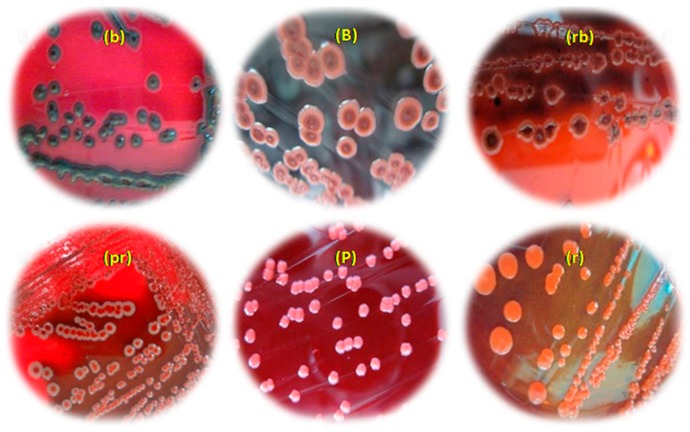
Several bacterial strains were isolated from wild and reared fish and shellfish. The identification of these strains showed the dominance of the Aeromonas hydrophila species in all seafood samples, followed by Staphylococcus spp., Vibrio alginolyticus, Enterobacter cloacae, Klebsiella ornithinolytica, Klebsiella oxytoca and Serratia odorifera. The isolates were studied for their ability to produce exoenzymes and biofilms. The chemical composition of the essential oils from Laurus nobilis leaves, Zingiber officinale rhizomes and Anethum graveolens aerial parts was studied by GC and GC/MS. The essential oils’ antioxidant and antibacterial activities against the isolated microorganisms were studied. Low concentrations of the three essential oils were needed to inhibit the growth of the selected bacteria and the lowest MBCs values were obtained for the laurel essential oil. The selected essential oils can be used as a good natural preservative in fish food due to their antioxidant and antibacterial activities.
Overview
The claims and statistics of this paper haven’t been checked yet.
Run the check — free, no account needed. It reads the open-access text and checks the sources it cites.
Integrity signals
Registry
Cites
Statistics
Figures
Verification
Claims the paper makes
The claims and statistics of this paper haven’t been checked yet.
Run the check — free, no account needed. It reads the open-access text and checks the sources it cites.
Claims other papers make about this one
Each is checked against this paper’s own text: does it say what the citing paper says it does?
In the citing paper
“Several studies support the efficacy of DEO in preserving the sensory qualities of fish meat during storage [21,97].”
From Preservative Potential of Anethum graveolens Essential Oil on Fish Fillet Quality and Shelf Life During Refrigerated Storage (2025) · cites this paper as [97]
Self-check
Percentages, sums and reported differences re-computed from the paper’s own numbers.
The self-check needs the paper’s full text.
Citations
Cites
Anethum graveolens: An Indian traditional medicinal herb and spice
Shekhawat, G., & Jana, S. (2010) · Pharmacognosy Reviews · doi:10.4103/0973-7847.70915 · Cited by 269
Research works printed but not linked: 82
- Jiang, 2008, Evaluation of textural properties of channel catfish (Ictalurus punctatus Rafinesque) fillet with the natural contour method, LWT-Food Sci. Technol., 41, 1548, 10.1016/j.lwt.2007.11.022 · DOI
- Mejri, 2011, Study of the microbial ecology of wild and aquacultured Tunisian fresh fish, J. Food Prot., 74, 1762, 10.4315/0362-028X.JFP-11-057 · DOI
- Rashid, 2014, Food Additives and their use in Destruction of Some Seafood Poisoning Bacteria, EAR, 2, 8749
- Alzoreky, 2014, Destruction of some food poisoning bacteria and shelf-life extension of seafood, JAIR, 3, 10
- Poli, 2001, Quality outline of European sea bass (Dicentrarchus labrax) reared in Italy: Shelf life, edible yield, nutritional and dietetic traits, Aquaculture, 202, 303, 10.1016/S0044-8486(01)00780-3 · DOI
- Gram, 2002, Fish spoilage bacteria—Problems and solutions, Curr. Opin. Biotechnol., 13, 262, 10.1016/S0958-1669(02)00309-9 · DOI
- Huss, 2000, Prevention and control of hazards in seafood, Food Control, 11, 149, 10.1016/S0956-7135(99)00087-0 · DOI
- Carraro, 2015, Hygiene and health risks associated with the consumption of edible lamellibranch molluscs, Int. J. Food Microbiol., 201, 52, 10.1016/j.ijfoodmicro.2015.02.014 · DOI
- Muli, 2004, Some epidemiologic characteristics of foodborne intoxications in Croatia during the 1992–2001 period, Acta Med. Croat., 58, 421
- Boulares, 2013, Characterisation and identification of spoilage psychotrophic Gram-negative bacteria originating from Tunisian fresh fish, Ann. Microbiol., 63, 733, 10.1007/s13213-012-0527-3 · DOI
- Serio, 2014, A survey on bacteria isolated as hydrogen sulfide-producers from marine fish, Food Control, 39, 111, 10.1016/j.foodcont.2013.11.003 · DOI
- Burt, 2004, Essential oils: Their antibacterial properties and potential applications in foods—A review, Int. J. Food. Microbiol., 4, 223, 10.1016/j.ijfoodmicro.2004.03.022 · DOI · Paper page
- Dorman, 2000, Antimicrobial agents from plants: Antibacterial activity of plant volatile oils, J. App. Microbiol., 88, 308, 10.1046/j.1365-2672.2000.00969.x · DOI · Paper page
- Snoussi, 2015, Mentha spicata essential oil: Chemical composition, antioxidant and antibacterial activities against planktonic and biofilm cultures of Vibrio spp. strains, Molecules, 20, 14402, 10.3390/molecules200814402 · DOI
- Seden, 2009, Effect of Origanum vulgare as a feed additive on growth performance, feed utilization and whole body composition of Nile tilapia (Oreochromis niloticus) fingerlings challenged with pathogenic Aeromonas hydrophila, J. Agric. Sci. Mansoura Univ., 34, 1683
- Shehata, 2013, Antibacterial Activity of Essential Oils and their Effects on Nile Tilapia Fingerlings Performance, J. Med. Sci., 13, 367, 10.3923/jms.2013.367.372 · DOI
- Hassaan, 2016, Evaluation of Essential Oil of Fennel and Garlic Separately or Combined with Bacillus licheniformis on the Growth, Feeding Behaviour, Hemato-biochemical Indices of Oreochromis niloticus (L.) Fry, J. Aquac. Res. Dev., 7, 422, 10.4172/2155-9546.1000422 · DOI
- Sharopov, 2013, Composition and bioactivity of the essential oil of Anethum graveolens L. from Tajikistan, Int. J. Med. Arom. Plants, 3, 125
- Baytop, T. (1999). Therapy with Medicinal Plants in Turkey (Past and Present), Nobel Tıp Press. [2nd ed.].
- Merghni, 2016, Antibacterial and antibiofilm activities of Laurus nobilis L. essential oil against Staphylococcus aureus strains associated with oral infections, Pathol. Biol., 64, 29
- Chmit, 2014, Antibacterial and antibiofilm activities of polysaccharides, essential oil, and fatty oil extracted from Laurus nobilis growing in Lebanon, Asian Pac. J. Trop. Med., 7, 546, 10.1016/S1995-7645(14)60288-1 · DOI
- Chen, 2014, Dill (Anethum graveolens L.) seed essential oil induces Candida albicans apoptosis in a metacaspase-dependent manner, Fungal Biol., 118, 394, 10.1016/j.funbio.2014.02.004 · DOI
- Kazemi, 2015, Phenolic profile, antioxidant capacity and anti-inflammatory activity of Anethum graveolens L. essential oil, Nat. Prod. Res., 29, 551, 10.1080/14786419.2014.951934 · DOI
- Singh, 2008, Chemistry, antioxidant and antimicrobial investigations on essential oil and oleoresins of Zingiber officinale, Food. Chem. Toxicol., 46, 3295, 10.1016/j.fct.2008.07.017 · DOI
- Kumar, 2011, A Review on Pharmacological and Phytochemical Properties of Zingiber officinale Roscoe (Zingiberaceae), I. Pharm. Res., 4, 2963
- Croci, 2001, Detection of Vibrionaceae in mussels and in their seawater growing area, Lett. Appl. Microbiol., 32, 57, 10.1046/j.1472-765x.2001.00855.x · DOI
- Saidi, 2011, Adhesive properties of Aeromonas hydrophila strains isolated from Tunisian aquatic biotopes, Afr. J. Microbiol. Res., 5, 5644
- Khouadja, 2013, Phenotypic characterization and RAPD fingerprinting of Vibrio parahaemolyticus and Vibrio alginolyticus isolated during Tunisian fish farm outbreaks, Folia Microbiol., 58, 17, 10.1007/s12223-012-0174-x · DOI
- 2014, Isolation and identification of Staphylococcus bacteria from fish of fresh water and its antibiotics sensitivity in Mosul city, Bas. J. Vet. Res., 1, 33
- Snoussi, 2009, High potential of adhesion to abiotic and biotic materials in fish aquaculture facility by Vibrio alginolyticus strains, J. Appl. Microbiol., 106, 1591, 10.1111/j.1365-2672.2008.04126.x · DOI
- Snoussi, 2008, Adhesive properties of environmental Vibrio alginolyticus strains to biotic and abiotic surfaces, New Microbiol., 31, 489
- Sechi, 2002, Distribution of virulence genes in Aeromonas spp. Isolated from Sardinian waters and from patients with diarrhoea, J. Appl. Microbiol., 92, 221, 10.1046/j.1365-2672.2002.01522.x · DOI
- Thenmozhi, 2015, Virulence and molecular characterization of Aeromonas spp. from fish samples using ARDRA technique, Int. J. Pharm. Biol. Sci., 6, 593
- Chaieb, 2009, Adherence assays and Slime production of Vibrio alginolyticus and Vibrio parahaemolyticus, Braz. J. Microbiol., 40, 394, 10.1590/S1517-83822009000200033 · DOI
- Habimanab, 2013, Impact of food-related environmental factors on the adherence and biofilm formation of natural Staphylococcus aureus isolates, Curr. Microbiol., 66, 110, 10.1007/s00284-012-0247-8 · DOI
- Tersim, 2012, Insecticidal activities of essential oils from leaves of Laurus nobilis L. from Tunisia, Algeria and Morocco, and comparative chemical composition, J. Stored Prod. Res., 48, 97, 10.1016/j.jspr.2011.10.003 · DOI
- Marzouki, H., Khaldi, A., Elaisse, A., Bouzid, S., Piras, A., Porcedda, S., Tuveri, E., and Marongiu, B. (2002, January 16–19). Isolation of the oils from Laurus nobilis of Tunisia and Algeria by supercritical carbon dioxide extraction. Proceedings of the 1st International Congress on the Chemistry of Natural Products (ICNP-2002), Trabzon, Turkey.
- Bakkali, 2008, Biological effects of essential oils—A review, Food Chem. Toxicol., 46, 446, 10.1016/j.fct.2007.09.106 · DOI · Paper page
- Peerakam, 2014, Chemical Profiling of Essential Oil Composition and Biological Evaluation of Anethum graveolens L. (Seed) Grown in Thailand, J. Nat. Sci. Res., 4, 34
- Radulescu, 2010, Chemical composition of the volatile oil from different plant parts of Anethum graveolens L. (Umbelliferae) cultivated in Romania, Farmacia, 58, 594
- Jirovetz, 2003, Composition, quality control, and antimicrobial activity of the essential oil of long-time stored dill (Anethum graveolens L.) seeds from Bulgaria, J. Agric. Food Chem., 51, 3854, 10.1021/jf030004y · DOI · Paper page
- Bailer, 2001, Essential oil content and composition in commercially available dill cultivars in comparison to caraway, Ind. Crop. Prod., 14, 229, 10.1016/S0926-6690(01)00088-7 · DOI
- Sintim, 2015, Hydrodistillation time affects dill seed essential oil yield, composition, and bioactivity, Ind. Crop. Prod., 63, 190, 10.1016/j.indcrop.2014.09.058 · DOI
- Agrawal, 2001, Insect growth inhibition, antifeedant and antifungal activity of compounds isolated/derived from Zingiber officinale Roscoe (ginger) rhizomes, Pest. Manag. Sci., 57, 289, 10.1002/ps.263 · DOI
- Menut, 1994, Aromatic Plants of Tropical Central Africa. XIII. Rhizomes Volatile Components of Two Zingiberales from the Central African Republic, J. Essent. Oil. Res., 6, 101, 10.1080/10412905.1994.9698347 · DOI
- Singh, 2014, Composition, In Vitro Antioxidant and Antimicrobial Activities of Essential Oil and Oleoresins Obtained from Black Cumin Seeds (Nigella sativa L.), Bio. Med. Res. Int., 2014, 1
- Singh, 2005, Studies on essential oils, Part 42: Chemical, antifungal, antimicrobial and sprout suppressant studies on ginger essential oil and its oleoresin, Flavour. Frag. J., 20, 1, 10.1002/ffj.1373 · DOI
- Sivasothy, 2011, Essential oils of Zingiber officinale var rubrum Theilade and their antibacterial activities, Food Chem., 124, 514, 10.1016/j.foodchem.2010.06.062 · DOI
- Yeh, 2014, Bioactive components analysis of two various gengers (Zingiber officinale Roscoe) and antioxidant effect of ginger extracts, LWT-Food Sci. Technol., 55, 329, 10.1016/j.lwt.2013.08.003 · DOI
- Cherrat, 2014, Chemical composition and antioxidant properties of Laurus nobilis L. and Myrtus communis L. essential oils from Morocco and evaluation of their antimicrobial activity acting alone or in combined processes for food preservation, J. Sci. Food. Agric., 94, 1197, 10.1002/jsfa.6397 · DOI
- Basak, 2013, Effect of Laurus nobilis L. Essential Oil and its Main Components on a-glucosidase and Reactive Oxygen Species Scavenging Activity, Iran J. Pharm. Res., 12, 367
- Cao, 2009, Essential oil composition, antimicrobial and antioxidant properties of Mosla chinensis Maxim, Food Chem., 115, 801, 10.1016/j.foodchem.2008.12.064 · DOI
- Ramadan, 2014, Aroma Volatiles, Antibacterial, Antifungal and Antioxidant Properties of Essential Oils Obtained from Some Spices Widely Consumed in Egypt, American-Eurasian. J. Agric. Environ. Sci., 14, 486
- Przygodzka, 2013, Comparison of methods for evaluation of the antioxidant capacity and phenolic compounds in common spices, LWT-Food Sci. Technol., 33, 1
- Bellik, 2013, Antioxidant activity of the essential oil and oleoresin of Zingiber officinale Roscoe as affected by chemical environment, Int. J. Food Prop., 16, 1304, 10.1080/10942912.2011.584257 · DOI
- Rehman, 2003, Antioxidant activity of ginger extract in sunflower oil, J. Sci. Agric., 83, 624, 10.1002/jsfa.1318 · DOI
- Embuscado, 2015, Spices and herbs: Natural sources of antioxidants—A mini review, J. Funct. Foods, 18, 811, 10.1016/j.jff.2015.03.005 · DOI
- Sharififar, 2007, In vitro evaluation of antibacterial and antioxidant activities of the essential oil and methanol extract of endemic Zataria multiflora Boiss, Food Control, 18, 800, 10.1016/j.foodcont.2006.04.002 · DOI
- Dadalioglu, 2004, Chemical compositions and antibacterial effects of essential oils of Turkish oregano (Origanum minutiflorum), bay laurel (Laurus nobilis), Spanish lavender (Lavandula stoechas L.), and fennel (Foeniculum vulgare) on common foodborne pathogens, J. Agric. Food. Chem., 52, 8255, 10.1021/jf049033e · DOI
- Lopez, 2005, Solid- and vapor-phase antimicrobial activities of six essential oils: susceptibility of selected foodborne bacterial and fungal strains, J. Agric. Food. Chem., 53, 6939, 10.1021/jf050709v · DOI
- Singh, 2006, Chemical constituents, antimicrobial investigations, and antioxidative potentials of Anethum graveolens L. essential oil and acetone extract: Part 52, J. Food. Sci., 70, 208, 10.1111/j.1365-2621.2005.tb07190.x · DOI
- Karuppiah, 2012, Antibacterial effect of Allium sativum cloves and Zingiber officinale rhizomes against multiple-drug resistant clinical pathogens, Asian Pac. J. Trop. Biomed., 2, 597, 10.1016/S2221-1691(12)60104-X · DOI
- AnbuJebaSunilson, 2009, In vitro antibacterial evaluation of Zingiber officinale, Curcuma longa and Alpinia galangal extracts as natural foods preservatives, Am. J. Food. Technol., 4, 192, 10.3923/ajft.2009.192.200 · DOI
- Mesomo, 2013, Supercritical CO2 extracts and essential oil of ginger (Zingiber officinale R). Chemical composition and antibacterial activity, J. Supercrit. Fluids, 80, 44, 10.1016/j.supflu.2013.03.031 · DOI
- Silveira, 2012, Chemical composition and antimicrobial activity of essential oils from selected herbs cultivated in the South of Brazil against food spoilage and foodborne pathogens, Ciênc. Rural, 42, 1300, 10.1590/S0103-84782012000700026 · DOI
- Erkmen, 2008, Antimicrobial effects of Turkish propolis, pollen, and laurel on spoilage and pathogenic food-related microorganisms, J. Med. Food, 11, 587, 10.1089/jmf.2007.0038 · DOI
- Bouzouita, 2003, Antimicrobial activity of essential oils from Tunisian aromatic plants, Flavour Fragr. J., 18, 380, 10.1002/ffj.1200 · DOI
- Hamad, 2016, Chemical constituents and antibacterial activities of crude extract and essential oils of Alpinia galanga and Zingiber officinale, IFRJ, 23, 837
- Aligiannis, 2001, Composition and antimicrobial activity of the essential oil of two Origanum species, J. Agric. Food Chem., 40, 4168, 10.1021/jf001494m · DOI
- Ruangamnart, 2015, Chemical compositions and antibacterial activity of essential oil from dill fruits (Anethum graveolens L.) cultivated in Thailand, Mahidol. Univ. J. Pharm. Sci., 42, 135
- Snoussi, 2006, Quantitative study, identification and antibiotics sensitivity of some Vibrionaceae associated to a marine fish hatchery, Ann. Microbiol., 5, 289, 10.1007/BF03175020 · DOI
- Valle, 2001, The enterococcal surface protein, Esp, is involved in Enterococcus faecalis biofilm formation, Appl. Environ. Microbiol., 67, 4538, 10.1128/AEM.67.10.4538-4545.2001 · DOI
- Jennings, W., and Shibamoto, T. (1980). Qualitative Analysis of Flavour and Fragrance Volatiles by Glass capillary Gas Chromatography, Academic Press.
- Davies, 1990, Gas chromatographic retention indices of monoterpenes and sesquiterpenes on methyl silicone and Carbowax 20M phases, J. Chromatogr., 503, 1, 10.1016/S0021-9673(01)81487-4 · DOI
- Goodner, 2008, Practical retention index models of OV-101, DB-1, DB-5, and DB-Wax for flavor and fragrance compounds, LWT-Food Sci. Technol., 41, 951, 10.1016/j.lwt.2007.07.007 · DOI
- (1998). Wiley Registry of Mass Spectral Data, with NIST Spectral Data CD Rom, John Wiley & Sons. [7th ed.].
- Hatano, 1988, Two new flavonoids and other constituents in licore root: Their relative astringency and radical scavenging affects, Chem. Pharm. Bull., 36, 1090, 10.1248/cpb.36.2090 · DOI
- Duh, 1999, Antioxidant activity of water extract of HarngJyur (Chrysanthemum morifolium Ramat), LWT-Food Sci. Technol., 32, 269, 10.1006/fstl.1999.0548 · DOI
- Oyaizu, 1986, Studies on product of browning reaction prepared from glucose amine, Jpn. J. Nutr., 44, 307, 10.5264/eiyogakuzashi.44.307 · DOI
- Hajlaoui, 2010, Chemical composition and biological activities of Tunisian Cuminum cyminum L. essential oil: A high effectiveness against Vibrio spp. strains, Food Chem. Toxicol., 48, 2186, 10.1016/j.fct.2010.05.044 · DOI
- Snoussi, 2008, In vitro anti-Vibrio spp. activity and chemical composition of some Tunisian aromatic plants, World J. Microbiol. Biotechnol., 24, 3071, 10.1007/s11274-008-9811-6 · DOI
- Bauer, 1966, Antibiotic susceptibility testing by a standardized single disk method, Am. J. Clin. Pathol., 45, 493, 10.1093/ajcp/45.4_ts.493 · DOI · Paper page
Cited by
Hadi, N., Drioiche, A., Bouchra, E. M., Baammi, S., Abdelaziz Shahat, A., Tagnaout, I., Radi, M., Remok, F., Bouzoubaa, A., & Zair, T. (2024) · Pharmaceuticals · doi:10.3390/ph17070862 · Cited by 30
Tayel, A., Hassanin, F. S., Edris, S. N., Hamad, A., & Sabeq, I. I. (2025) · Foods · doi:10.3390/foods14091591 · Cited by 7
Metadata
- Authors
- Snuossi, M., Trabelsi, N., Ben Taleb, S., Dehmeni, A., Flamini, G., & De Feo, V.
- Venue
- Molecules
- Publisher
- MDPI AG
- Published
- 2016-10-22
- Volume
- 21
- Issue
- 10
- Pages
- 1414
- ISSN
- 1420-3049
- PMC
- PMC6273486
- Cited by
- 71
- References
- 1
- Language
- en
About these checks
Registry, retraction, Cites and statistics results are computed, not judged, with one exception: a printed reference that no index lists is read once by a model before it counts as a citation error. Claims are extracted by a model and kept only when their quote appears verbatim in the text; each cited source is then checked, with a model’s help, for whether it says what the claim relies on. Those verdicts can be wrong — read the claim’s quote and the cited source before relying on one.
Statistics and arithmetic are recomputed, not judged.
Confidence bands are shown only for fields calibrated on our annotated test set. None is calibrated yet, so no band is shown.
What counts as a claim ›How we measure confidence ›How we check this ›
Are you an author, or do you see a problem with this page? Request a review
Data sources
Bibliographic data: Semantic Scholar, OpenAlex, Crossref.
Contains information from the Semantic Scholar Academic Graph Datasets, made available under the ODC Attribution License (ODC-BY 1.0).
Semantic Scholar’s data is described in: Kinney, R., et al. (2023). The Semantic Scholar Open Data Platform. arXiv:2301.10140.
