

New Method for Obtaining a Bioactive Essence Extracted from Iberian Ham Fat Rich in MUFA and Antioxidants
Open accessThe DOI matches its Crossref record; 49 of the 49 references it cites were found in a registry or an index.
Abstract
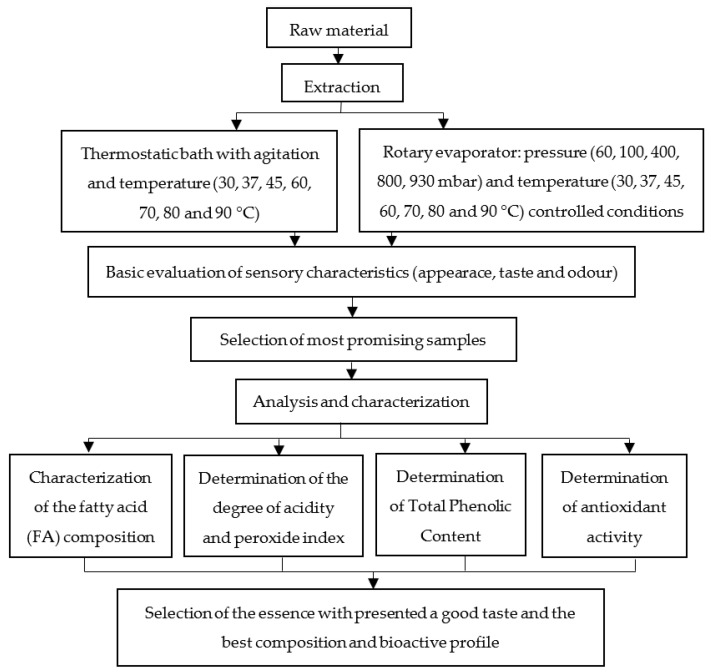
Iberian ham is one of the most representative Spanish products and presents an excellent nutritional and sensory quality. Iberian ham trimming fat is considered a by-product and to give a new use to this remaining part could represent a healthy and innovative option for obtaining sustainable foods. The purpose of this work was to obtain a new bioactive ingredient from Iberian ham trimming fat with the highest amount of antioxidants and monounsaturated fatty acids (MUFA), using a new non-invasive solvent-free method. To obtain the essence, two different extraction procedures were carried out. After fatty acid characterization, degree of acidity, peroxide index and a basic sensory analysis were performed. Antioxidant in vitro activity and total phenolic compounds (TPC) were also determined. This new ingredient showed a better sensory profile than raw ham fat, a lower degree of acidity, a higher content of MUFAs, and also showed a higher antioxidant capacity and an increase in phenolic compounds compared to the raw material. This bioactive essence could be used as a food, a cosmetic or a nutraceutical ingredient to prevent certain diseases related to oxidative stress and could also contribute to the maintenance of the circular economy.
Overview
The claims and statistics of this paper haven’t been checked yet.
Free: it reads the open-access text and checks the first 5 claims that cite a source we can check. Create a free account to check every claim.
Integrity signals
Registry
Cites
Statistics
Figures
Verification
Claims the paper makes
The claims and statistics of this paper haven’t been checked yet.
Free: it reads the open-access text and checks the first 5 claims that cite a source we can check. Create a free account to check every claim.
Claims other papers make about this one
Each is checked against this paper’s own text: does it say what the citing paper says it does?
The source backs part of the claim, not all of it — or backs it for a different population, condition or comparison.
In the citing paper
“Iberian ham is a traditional food in Spain. Its fat is usually discarded. Recent studies have suggested a potential use in the cosmetic industry focused on the composition rich in monounsaturated fatty acids, such as ellagic, gallic, and oleic acids. Those have antioxidant potential and can act as protectors against UV radiation damage. Interestingly, the extraction method is independent of”
From Innovative Approaches to an Eco-Friendly Cosmetic Industry: A Review of Sustainable Ingredients (2024) · cites this paper as [115]
Experimental — accuracy not yet measured
Self-check
Percentages, sums and reported differences re-computed from the paper’s own numbers.
The self-check needs the paper’s full text.
Citations
Cites
Singleton, V. L., Orthofer, R., & Lamuela-Raventós, R. M. (1999) · Methods in Enzymology · doi:10.1016/s0076-6879(99)99017-1 · Cited by 19,125 · cited 2×
“Their identification provides useful information on the preservation of the oil and its rancidity [20].”
BackgroundAinsworth, E. A., & Gillespie, K. M. (2007) · Nature Protocols · doi:10.1038/nprot.2007.102 · Cited by 3,342 · cited 2×
“, 1999 and updated by Ainsworth and Gillespie, 2007, [20,21] with some modifications for lipophilic samples according to Capannesi et al.”
BackgroundMethodPérez-Jiménez, J., Arranz, S., Tabernero, M., Díaz- Rubio, M. E., Serrano, J., Goñi, I., & Saura-Calixto, F. (2008) · Food Research International · doi:10.1016/j.foodres.2007.12.004 · Cited by 718 · cited 1×
“…Capacity (ORAC) method, described by Garcés-Rimón et al., 2016 by using fluorescein as a fluorescent substance (ORAC-FL) [16], with some modifications according to Pérez-Jimenez et al., 2008, Zullo and Ciafardini, 2008 and Bataglion et al., 2014, for its application in a lipophilic sample [17–19].”
MethodToldrá, F., & Flores, M. (1998) · Critical Reviews in Food Science and Nutrition · doi:10.1080/10408699891274237 · Cited by 465 · cited 1×
“Lipolysis occurs throughout the ripening process and extraction conditions of the essence [27] and is presumably for PUFA decrease.”
BackgroundDietary linoleic acid and human health: Focus on cardiovascular and cardiometabolic effects
Marangoni, F., Agostoni, C., Borghi, C., Catapano, A. L., Cena, H., Ghiselli, A., La Vecchia, C., Lercker, G., Manzato, E., Pirillo, A., et al. (2020) · Atherosclerosis · doi:10.1016/j.atherosclerosis.2019.11.018 · Cited by 416 · cited 1×
“The dietary intake of PUFA, and especially linoleic acid, is associated with a reduced incidence of cardiovascular disease (mainly coronary artery disease) and metabolic syndrome or type 2 diabetes [32,34].”
BackgroundChemical properties of virgin coconut oil
Marina, A. M., Che Man, Y. B., Nazimah, S. A. H., & Amin, I. (2009) · Journal of the American Oil Chemists' Society · doi:10.1007/s11746-009-1351-1 · Cited by 397 · cited 1×
“18 mg GAE/100 g) [54], but lower than those of oil extracted from nectarine seeds (334.”
BackgroundTang, Y., & Tsao, R. (2017) · Molecular Nutrition & Food Research · doi:10.1002/mnfr.201600767 · Cited by 325 · cited 3×
“Antioxidant activity is a measure that evaluates the ability of a compound to reduce the impact of ROS [39].”
BackgroundElectrochemical sensor and biosensor for polyphenols detection in olive oils
Capannesi, C., Palchetti, I., Mascini, M., & Parenti, A. (2000) · Food Chemistry · doi:10.1016/s0308-8146(00)00211-9 · Cited by 288 · cited 1×
“TPC were determined by the Folin–Ciocalteu method, proposed by Singleton et al., 1999 and updated by Ainsworth and Gillespie, 2007, [20,21] with some modifications for lipophilic samples according to Capannesi et al., 2000 and Seneviratne et al., 2008 [22,23].”
MethodVolatile compounds of dry-cured Iberian ham as affected by the length of the curing process
Ruiz, J., Ventanas, J., Cava, R., Andrés, A., & Garcı́a, C. (1999) · Meat Science · doi:10.1016/s0309-1740(98)00144-2 · Cited by 250 · cited 1×
“The studies carried out so far in acorn-fed Iberian pigs have focused, for the most part, on evaluating how acorn intake affects the increase in the amount and proportion of monounsaturated fatty acids in the ham [4] and in its relationship between acorn and the aromatic profile of ham [26].”
BackgroundPrior, R. L. (2015) · Journal of Functional Foods · doi:10.1016/j.jff.2014.12.018 · Cited by 244 · cited 1×
“The ORAC method is a relevant method because it uses a source of biologically free radicals (peroxyl radical) that is the most prevalent free radical in human biology [38], and is comparable to biologically generated reactive oxygen species (ROS) in the body.”
MethodCantos, E., Espín, J. C., López-Bote, C., de la Hoz, L., Ordóñez, J. A., & Tomás-Barberán, F. A. (2003) · Journal of Agricultural and Food Chemistry · doi:10.1021/jf030216v · Cited by 206 · cited 2×
“Moreover, in this complex matrix, there are many compounds interacting with antioxidants that are in the cell membrane microsomes, and it has been postulated that the animals fed in “montanera” show a low oxidation and stabilization of the lipids of the microsomal membrane [49].”
BackgroundNutritional composition of dry-cured ham and its role in a healthy diet
Jiménez-Colmenero, F., Ventanas, J., & Toldrá, F. (2009) · Meat Science · doi:10.1016/j.meatsci.2009.10.029 · Cited by 186 · cited 1×
“However, in the case of ham fat there is the presence of sea salt used for curing hams, which is known to be a pro-oxidant agent [50], along with the hemo iron and oxygen [51].”
BackgroundGuidelines for Sensory Analysis in Food Product Development and Quality Control
(1992) · Springer eBooks · doi:10.1007/978-1-4615-1999-7 · Cited by 177
Ventanas, S., Ventanas, J., Tovar, J. J., García, C., & Estévez, M. (2007) · Meat Science · doi:10.1016/j.meatsci.2007.03.010 · Cited by 141 · cited 2×
“To obtain these products, a diet based on grass and acorns is essential [4] and so is a curing time of more than 36 months, which produces the accumulation of high levels of bioactive compounds in its tissues and provides an excellent quality of meat [3,5,6].”
BackgroundVariation of phenolic content in coconut oil extracted by two conventional methods
Seneviratne, K. N., & Sudarshana Dissanayake, D. M. (2008) · International Journal of Food Science & Technology · doi:10.1111/j.1365-2621.2006.01493.x · Cited by 124
Dietary fat intake and metabolic syndrome in adults: A systematic review
Julibert, A., Bibiloni, M. D. M., & Tur, J. A. (2019) · Nutrition, Metabolism and Cardiovascular Diseases · doi:10.1016/j.numecd.2019.05.055 · Cited by 118 · cited 2×
“82%), and these compounds are related to an antihypertensive effect and prevention of cardiovascular diseases [10,32,33].”
BackgroundGarcés‐Rimón, M., González, C., Uranga, J. A., López‐Miranda, V., López‐Fandiño, R., & Miguel, M. (2016) · PLoS ONE · doi:10.1371/journal.pone.0151193 · Cited by 89 · cited 3×
“Antioxidant activity was determined by the Oxygen Radical Absorbance Capacity (ORAC) method, described by Garcés-Rimón et al., 2016 by using fluorescein as a fluorescent substance (ORAC-FL) [16], with some modifications according to Pérez-Jimenez et al., 2008, Zullo and Ciafardini, 2008 and Bataglion et al., 2014, for…”
MethodInfluentialAcorn Flour as a Source of Bioactive Compounds in Gluten-Free Bread
Martins, R. B., Gouvinhas, I., Nunes, M. C., Peres, J. A., Raymundo, A., & Barros, A. (2020) · Molecules · doi:10.3390/molecules25163568 · Cited by 85
Differentiation of Lard, Chicken Fat, Beef Fat and Mutton Fat by GCMS and EA-IRMS Techniques
Nizar, N. N. A., Marikkar, J. M. N., & Hashim, D. M. (2013) · Journal of Oleo Science · doi:10.5650/jos.62.459 · Cited by 83
Mahgoub, O., Khan, A. J., Al‐Maqbaly, R. S., Al-Sabahi, J. N., Annamalai, K., & Al-Sakry, N. M. (2002) · Meat Science · doi:10.1016/s0309-1740(01)00208-x · Cited by 82
Phenolic Profile and Antioxidant Activity of Italian Monovarietal Extra Virgin Olive Oils
Negro, C., Aprile, A., Luvisi, A., Nicolì, F., Nutricati, E., Vergine, M., Miceli, A., Blando, F., Sabella, E., & Bellis, L. D. (2019) · Antioxidants · doi:10.3390/antiox8060161 · Cited by 82
Antioxidant capacity of extra‐virgin olive oils
Ninfali, P., Aluigi, G., Bacchiocca, M., & Magnani, M. (2001) · Journal of the American Oil Chemists Society · doi:10.1007/s11746-001-0252-9 · Cited by 78
Effects of storage and cooking on the antioxidant capacity of laying hen eggs
Nimalaratne, C., Schieber, A., & Wu, J. (2015) · Food Chemistry · doi:10.1016/j.foodchem.2015.07.116 · Cited by 76 · cited 1×
“Different studies have shown that if a food is subjected to high temperatures (for example, frying an egg or roasting coffee in the air), there is a decrease in ORAC values [40,41].”
BackgroundUetake, Y., Ikeda, H., Irie, R., Tejima, K., Matsui, H., Ogura, S., Wang, H., Mu, S., Hirohama, D., Ando, K., et al. (2015) · Lipids in Health and Disease · doi:10.1186/s12944-015-0002-9 · Cited by 64 · cited 1×
“However, in the case of ham fat there is the presence of sea salt used for curing hams, which is known to be a pro-oxidant agent [50], along with the hemo iron and oxygen [51].”
BackgroundIberian pigs for the development of high-quality cured products.
Ventanas, S., Ventanas, J., Ruiz, J. A. Z., Estévez, M., & Pandalai, S. G. (2005) · Cited by 62
Bataglion, G. A., da Silva, F. M. A., Santos, J. M., dos Santos, F. N., Barcia, M. T., de Lourenço, C. C., Salvador, M. J., Godoy, H. T., Eberlin, M. N., & Koolen, H. H. F. (2014) · Food Research International · doi:10.1016/j.foodres.2014.07.011 · Cited by 58 · cited 1×
“…Capacity (ORAC) method, described by Garcés-Rimón et al., 2016 by using fluorescein as a fluorescent substance (ORAC-FL) [16], with some modifications according to Pérez-Jimenez et al., 2008, Zullo and Ciafardini, 2008 and Bataglion et al., 2014, for its application in a lipophilic sample [17–19].”
MethodZhang, Y., Ma, X., & Dai, Z. (2019) · Journal of Food Processing and Preservation · doi:10.1111/jfpp.14111 · Cited by 55 · cited 1×
“Moreover, the decrease observed in oleic acid, as a consequence of its degradation, could release aromatic compounds, such as el octanal y nonanal, responsible of the fruity flavor [28].”
BackgroundGiuffrè, A. M., Caracciolo, M., Zappia, C., Capocasale, M., & Poiana, M. (2018) · Italian Journal of Food Science · doi:10.14674/ijfs-1269 · Cited by 53
Michielsen, C. C. J. R., Hangelbroek, R., Feskens, E. J. M., & Afman, L. A. (2019) · Molecular Nutrition & Food Research · doi:10.1002/mnfr.201801095 · Cited by 52 · cited 3×
“82%), and these compounds are related to an antihypertensive effect and prevention of cardiovascular diseases [10,32,33].”
BackgroundThe effect of air flow in coffee roasting for antioxidant activity and total polyphenol content
Kwak, H. S., Ji, S., & Jeong, Y. (2016) · Food Control · doi:10.1016/j.foodcont.2016.06.047 · Cited by 47 · cited 1×
“Different studies have shown that if a food is subjected to high temperatures (for example, frying an egg or roasting coffee in the air), there is a decrease in ORAC values [40,41].”
BackgroundDíaz, I., Regueiro, J. A. G., Casillas, M., & Sanz, E. J. D. P. (1996) · Food Chemistry · doi:10.1016/0308-8146(95)00140-9 · Cited by 43 · cited 1×
“In this context, Iberian ham fat has been described as having a high content of monounsaturated fatty acids (MUFA) and polyunsaturated fatty acids (PUFA), mainly highlighting the levels of oleic acid and linoleic acid [3,7,8] and the lower concentrations of saturated fatty acids (SFA) than those found in hams from whi…”
BackgroundAvocado oil characteristics of Mexican creole genotypes
Espinosa‐Alonso, L. G., Paredes‐López, O., Valdez‐Morales, M., & Oomah, B. D. (2017) · European Journal of Lipid Science and Technology · doi:10.1002/ejlt.201600406 · Cited by 40
Characterization of Virgin Avocado Oil Obtained via Advanced Green Techniques
Tan, C. X., Chong, G. H., Hamzah, H. B., & Ghazali, H. M. (2018) · European Journal of Lipid Science and Technology · doi:10.1002/ejlt.201800170 · Cited by 40 · cited 2×
“04 mg GAE/100 g) [56], but the sample extracted at 60 ◦C presents a significantly higher result (139.”
BackgroundLópez-Bote, C. J., Isabel, B., Ruiz, J., & Daza, A. (2003) · Archives of Animal Nutrition · doi:10.1080/0003942031000086653 · Cited by 36 · cited 2×
“FA analysis was carried out according to the methodology described by Lopez-Bote et al., 2003, based on the extraction and acid methylation of the fatty acid methyl esters for their subsequent injection and determination by gas chromatography.”
BackgroundMethodThe olive oil oxygen radical absorbance capacity (DPPH assay) as a quality indicator
Zullo, B. A., & Ciafardini, G. (2008) · European Journal of Lipid Science and Technology · doi:10.1002/ejlt.200700136 · Cited by 28 · cited 1×
“…Capacity (ORAC) method, described by Garcés-Rimón et al., 2016 by using fluorescein as a fluorescent substance (ORAC-FL) [16], with some modifications according to Pérez-Jimenez et al., 2008, Zullo and Ciafardini, 2008 and Bataglion et al., 2014, for its application in a lipophilic sample [17–19].”
MethodEnzymes in Minimally Processed Fruits and Vegetables
Temiz, A., & Ayhan, D. K. (2017) · Food engineering series · doi:10.1007/978-1-4939-7018-6_4 · Cited by 24 · cited 1×
“The activity of these lipolytic and oxidative enzymes can lead to the formation of strange tastes and odors [35].”
BackgroundCaracterización y extracción lipídica de las semillas del cacao amazónico [Theobroma grandiflorum].
Alviárez-Gutierrez, E., Walter Murillo, A., Perea, E. M., Rojano, B. A., & Arteaga, J. J. M. (2016) · CIENCIA EN DESARROLLO · doi:10.19053/01217488.4237 · Cited by 19 · cited 2×
“3 meq O2/kg of sample, respectively [37].”
BackgroundMediterranean diet and all-cause mortality: A cohort of Italian men
Trevisan, M., Krogh, V., Grioni, S., & Farinaro, E. (2020) · Nutrition Metabolism and Cardiovascular Diseases · doi:10.1016/j.numecd.2020.05.034 · Cited by 16 · cited 1×
“82%), and these compounds are related to an antihypertensive effect and prevention of cardiovascular diseases [10,32,33].”
BackgroundSodeifian, G., & Sajadian, S. A. (2020) · Journal of Food Processing and Preservation · doi:10.1111/jfpp.15198 · Cited by 16 · cited 1×
“Since the phenolic compounds are subject to deterioration when exposed to high temperatures [55], it seems that with an increase in the extraction temperature to 80 ◦C, there is a decrease in TPC, so that the extraction at 60 ◦C would be the most suitable for the preservation and release of TPC and also showed better…”
BackgroundYılmaz, M. T., & Karakaya, M. (2009) · Journal of the American Oil Chemists Society · doi:10.1007/s11746-009-1420-5 · Cited by 15
Makhlouf, F. Z., Squeo, G., Barkat, M., Pasqualone, A., & Caponio, F. (2019) · The North African Journal of Food and Nutrition Research · doi:10.51745/najfnr.3.5.148-155 · Cited by 14
Effect of ham protein substitution on oxidative stress in older adults.
Mayoral, P., Martinez-Salgado, C. S., Santiago, J. M., Rodriguez-Hernandez, M. V., García-Gomez, M. L., Morales, A., López-Novoa, J. M., & Núñez, J. F. M. (2003) · PubMed · Cited by 12
Caballero, D., Asensio, M., Fernández, C., Martín, N., & Silva, A. (2018) · Journal of Food Science and Technology · doi:10.1007/s13197-018-3396-3 · Cited by 10 · cited 1×
“To obtain these products, a diet based on grass and acorns is essential [4] and so is a curing time of more than 36 months, which produces the accumulation of high levels of bioactive compounds in its tissues and provides an excellent quality of meat [3,5,6].”
BackgroundGenomic differentiation among varieties of Iberian pig
Alonso, I., Ibáñez‐Escriche, N., Noguera, J. L., Casellas, J., de Hijas-Villalba, M. M., Gracia-Santana, M. J., & Varona, L. (2020) · Spanish Journal of Agricultural Research · doi:10.5424/sjar/2020181-15411 · Cited by 10 · cited 1×
“To obtain these products, a diet based on grass and acorns is essential [4] and so is a curing time of more than 36 months, which produces the accumulation of high levels of bioactive compounds in its tissues and provides an excellent quality of meat [3,5,6].”
BackgroundMoreno, I., Ladero, L., & Cava, R. (2020) · Livestock Science · doi:10.1016/j.livsci.2020.104006 · Cited by 10 · cited 2×
“This feeding strategy affects the chemical composition and oxidative stability of pork tissues, increasing the amount of tocopherols and phenolic compounds [57].”
BackgroundArrizabalaga-Larrañaga, A., Rodríguez, P., Sala, M. M., Santos, F. J., & Moyano, E. (2020) · Food Additives & Contaminants Part A · doi:10.1080/19440049.2020.1753891 · Cited by 9
Çoruh, N., Nebigil, C., & Özgökçe, F. (2014) · Journal of Liquid Chromatography & Related Technologies · doi:10.1080/10826076.2012.759126 · Cited by 7 · cited 1×
“Previous studies have identified up to 32 phenolic compounds present in the acorns on which the Iberian pig feeds, such as gallic acid or ellagic acid [49,53].”
BackgroundInteracción de los compuestos aromáticos del jamón curado con la matriz proteica
Juan, M. P. (2006) · RiuNet (Universitat Politècnica de València) · doi:10.4995/thesis/10251/1887 · Cited by 2
Influencia del consumo de jamón ibérico de bellota sobre el perfil lipídico aterogénico.
Rebollo, A. J. G., Cansado, A. O., Botejara, E. A. M., & Blanco, P. M. (1999) · Dialnet (Universidad de la Rioja) · Cited by 1
Research works printed but not linked: 4
- Vicente-Vicente L. Prieto M. Morales A.I. Efficacy and Safety of Quercetin as Dietary Supplement Toxicología 2013 30 171 181
- Gallego-Ibáñez M. Péptidos Generados En El Jamón Curado Como Marcadores de Calidad Ph.D. Thesis Universidad Politécnica de Valencia Valencia, Spain 2015
- Ariza-Ortega A. López Valdez F. Coyotl Huerta J. Ramos Cassellis M. Díaz Reyes J. Martínez-Zavala A. Effect of Different Extraction Methods on the Fatty Acid Profile in the Avocado Rev. Venez. Cienc. Tecnol. Aliment. 2011 2 263 276
- Ngampeerapong C. Chavasit V. Durst R.W. Bioactive and Nutritional Compounds in Virgin Coconut Oils Malays. J. Nutr. 2018 24 257 267
Cited by
Innovative Approaches to an Eco-Friendly Cosmetic Industry: A Review of Sustainable Ingredients
Sasounian, R., Martinez, R. M., Lopes, A. M., Giarolla, J., Rosado, C., Magalhães, W. V., Velasco, M. V. R., & Baby, A. R. (2024) · Clean Technologies · doi:10.3390/cleantechnol6010011 · Cited by 96
“Interestingly, the extraction method is independent of organic solvents [115].”
MethodBruna-García, E., Redondo, B. I., Sabater‐Muñoz, B., & Miguel, M. (2023) · LWT · doi:10.1016/j.lwt.2023.115235 · Cited by 6
Self-citationBruna-García, E., Miguel, M., & Redondo, B. I. (2024) · Foods · doi:10.3390/foods13223596 · Cited by 2
Self-citationEFSA Panel on Nutrition, N. F. A. F. A. (., Turck, D., Bohn, T., Castenmiller, J. J. M., Henauw, S. D., Hirsch‐Ernst, K. I., Knutsen, H. K., Maciuk, A., Mangelsdorf, I., McArdle, H. J., et al. (2024) · EFSA Journal · doi:10.2903/j.efsa.2024.8862
Metadata
- Authors
- Bruna-García, E., Isabel Redondo, B., & Miguel Castro, M.
- Affiliations
- Instituto de Investigación en Ciencias de la Alimentación (ES)
- Animal Production Department, Faculty of Veterinary, Complutense University of Madrid, 28040 Madrid, Spain
- Department of Bioactivity and Food Analysis, Institute of Food Science Research (CIAL, CSIC-UAM), 28049 Madrid, Spain
- Venue
- Molecules
- Publisher
- MDPI AG
- Published
- 2022-01-10
- Volume
- 27
- Issue
- 2
- Pages
- 428
- ISSN
- 1420-3049 (ISSN-L)
- PMC
- PMC8781370
- OpenAlex
- W4205966353
- Cited by
- 4
- References
- 49
- Citations by year
- 2024: 3 · 2023: 1
- FWCI
- 0.38
- Type
- journal article
- Language
- en
- Open access
- gold
- doi.org
- Licence
- Locations
- Molecules (publishedVersion, cc-by)
- PubMed Central (publishedVersion, cc-by)
- PubMed (publishedVersion)
- DIGITAL.CSIC (Spanish National Research Council (CSIC)) (submittedVersion, cc-by)
- DOAJ (DOAJ: Directory of Open Access Journals) (submittedVersion, cc-by-sa)
- Topics
- Physical Sciences › Chemistry › Organic Chemistry › Edible Oils Quality and Analysis
- Life Sciences › Agricultural and Biological Sciences › Animal Science and Zoology › Meat and Animal Product Quality
- Health Sciences › Medicine › Biochemistry (medical) › Phytochemicals and Antioxidant Activities
- Keywords
- Iberian ham, monounsaturated fatty acids, antioxidants, total phenolic compounds, solvent-free extraction, food by-product valorization, oxidative stress, nutraceutical ingredients, circular economy
- MeSH terms
- Pork Meat, Adult, Antioxidants, Fatty Acids, Monounsaturated, Female, Food Technology, Humans, Male, Middle Aged, Phenols, Taste
About these checks
Registry, retraction, Cites and statistics results are computed, not judged, with one exception: a printed reference that no index lists is read once by a model before it counts as a citation error. Claims are extracted by a model and kept only when their quote appears verbatim in the text; each cited source is then checked, with a model’s help, for whether it says what the claim relies on. Those verdicts can be wrong — read the claim’s quote and the cited source before relying on one.
Statistics and arithmetic are recomputed, not judged.
Confidence bands are shown only for fields calibrated on our annotated test set. None is calibrated yet, so no band is shown.
What counts as a claim ›How we measure confidence ›How we check this ›
Are you an author, or do you see a problem with this page? Request a review
Data sources
Bibliographic data: Semantic Scholar, OpenAlex, Crossref.
Contains information from the Semantic Scholar Academic Graph Datasets, made available under the ODC Attribution License (ODC-BY 1.0).
Semantic Scholar’s data is described in: Kinney, R., et al. (2023). The Semantic Scholar Open Data Platform. arXiv:2301.10140.
