

Optimization of a Natural-Deep-Eutectic-Solvent-Based Dispersive Liquid–Liquid Microextraction Method for the Multi-Target Determination of Emerging Contaminants in Wastewater
Open accessThe DOI matches its Crossref record; 50 of the 50 references it cites were found in a registry or an index; 11 of the 38 sources its claims cite were checked for support.
Abstract
The widespread discharge of industrial and urban waste has led to significant increases in the environmental concentrations of numerous chemical substances. This work presents the development of a simple and environmentally friendly dispersive liquid–liquid microextraction (DLLME) method based on a hydrophobic natural deep eutectic solvent (NADES) for the determination of selected compounds from benzotriazole, benzothiazole, paraben, and UV filter families in wastewater samples. Of the twelve NADES formulations evaluated, those composed of a 4:1 molar ratio of thymol and menthol presented the highest extraction efficiencies. The influence of key experimental variables such as the pH of the aqueous sample, the ratio of NADES phase to sample volume, and the extraction time on the extraction efficiency was investigated using a multivariate optimization. Under optimal conditions, relative standard deviations below 15% and recoveries for spiked wastewater samples ranged between 82 and 108%, demonstrating the suitability of the method for routine water-quality monitoring. The sustainability and practicality of the developed method was evaluated using the assessment tools ChlorTox, AGREEprep, AGRRE, and BAGI, obtaining scores of 0.005 g in the NADES-DLLME method, 0.70, 0.52, and 72.5, respectively, demonstrating that the method is green and reliable.
Overview
CoChat Summary
TL;DR
This paper optimizes a hydrophobic natural deep eutectic solvent (NADES)-based dispersive liquid–liquid microextraction (DLLME) method for nine emerging contaminants from benzotriazole, benzothiazole, paraben, and UV filter families in wastewater. The selected 4:1 thymol–menthol NADES, coupled to UHPLC-QTOF-MS, gave recoveries of 82–108%, RSDs below 15%, and favorable greenness/practicality scores.
Key findings
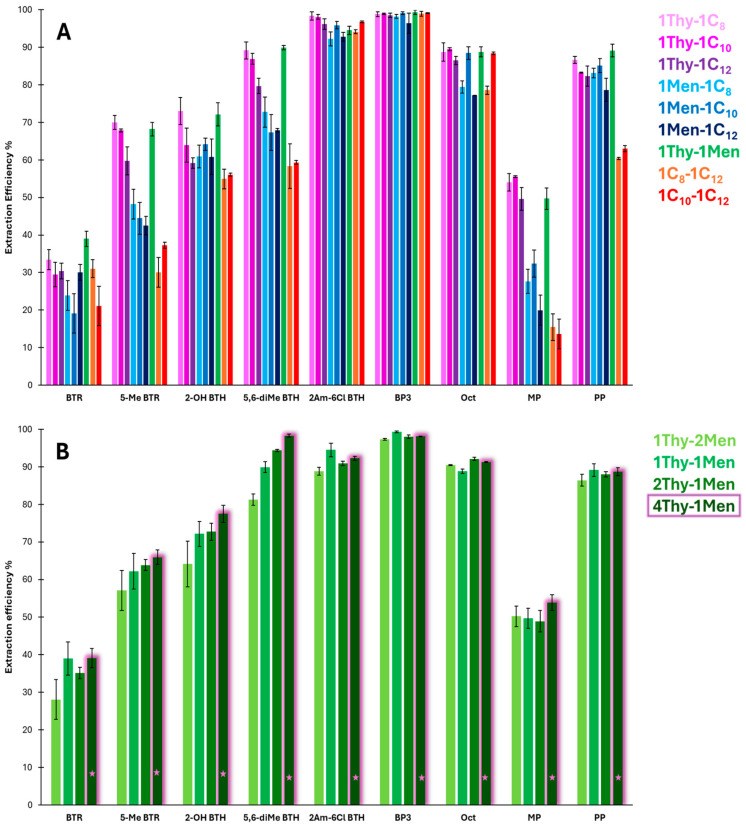
- Of twelve NADES formulations tested, the 4:1 molar ratio thymol–menthol NADES gave the highest overall extraction efficiency, with EE% ranging from 40 to 100% depending on analyte hydrophobicity.
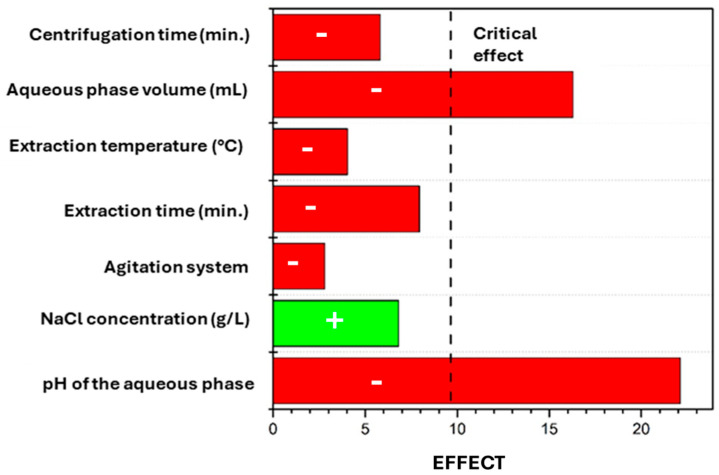
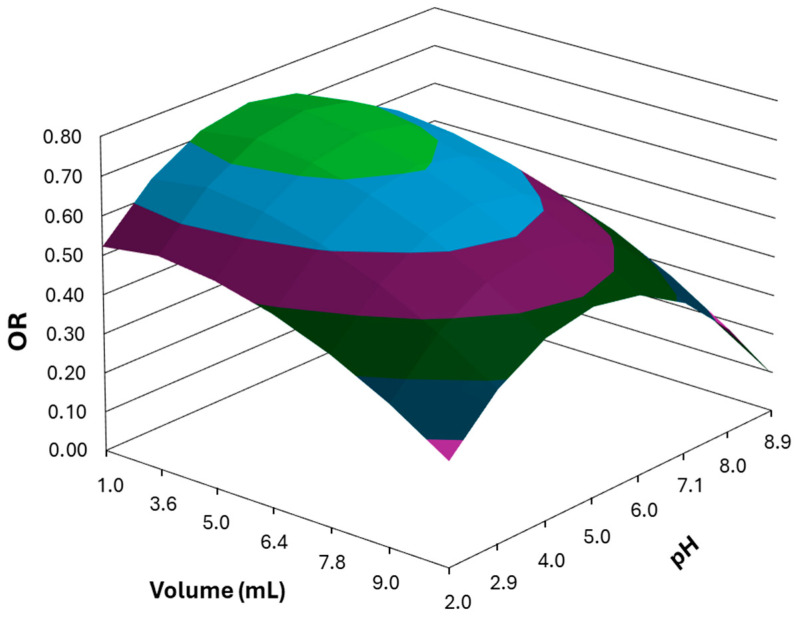
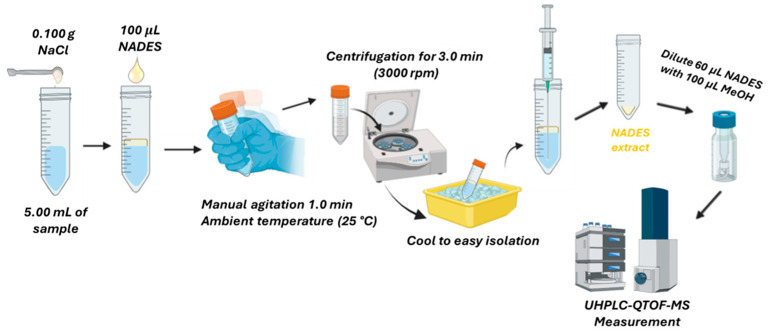
- Multivariate optimization selected pH 4.0–6.0 and 5.00 mL aqueous phase as optimal; fixed conditions included manual agitation for 1.0 min, 20.0 g L−1 NaCl, and centrifugation for 3.0 min at 3000 rpm.
- Analytical performance showed calibration r² > 0.996, RSDs of 5.1–13.5% at 1.00 ng mL−1 and <7.3% at 4.00 ng mL−1, and spiked wastewater recoveries of 82–108%.
- Sustainability/practicality scores were ChlorTox 0.005 g for NADES-DLLME (6 g for the full analytical method), AGREEprep 0.70, AGREE 0.52, and BAGI 72.5; in four Greek influent wastewater samples, BTR was detected at 0.32–0.84 ng mL−1 and OCT at 0.51–0.91 ng mL−1.
Methods
- The method used a two-step multivariate optimization: a two-level Plackett–Burman design to screen seven extraction variables, followed by a five-level central composite design and response surface model to optimize aqueous phase pH and volume.
- NADESs were prepared from monoterpenes (menthol and/or thymol) and fatty acids (octanoic, decanoic, and/or dodecanoic acid); DLLME was performed on 5.00 mL aqueous standards or wastewater with 100 µL NADES, then extracts were diluted in MeOH with diuron-d6 and measured by UHPLC-QTOF-MS.
- Validation used NADES-matched calibration curves from 2.00 to 100 ng mL−1, triplicate extractions, and four influent wastewater samples from Greek WWTPs; sample WW-1 was spiked at 0.200 ng mL−1 for recovery assessment.
Limitations
- The paper states that method LODs/LOQs are approximately ten times higher than those of conventional SPE methods before LC-MS, though those SPE methods use larger sample volumes and longer extraction/preconcentration times.
- The paper notes that AGREEprep and AGREE criteria related to off-line laboratory location, energy consumption, and waste generation did not achieve green ratings; it also states that not all prepared mixtures were at their deep eutectic molar ratios or showed ideal behavior.
- Evident from the text: validation and application were limited to four influent wastewater samples from two Greek cities, with recovery testing on only one spiked sample, so broader matrix and geographic applicability are not demonstrated.
Model-written summary. Check it against the paper before relying on it.
Integrity signals
Registry
Cites
Statistics
Figures
Verification
Claims the paper makes
6 Valid · 1 Not valid · 6 Not checked · 49 Own results and interpretations
The cited sources support only part of this claim — read each source’s verdict below.
In the paper
“In addition, the higher viscosity of menthol- and fatty-acid-based NADESs, particularly those containing longer chain lengths such as dodecanoic acid, could hinder phase dispersion and analyte diffusion [28,36,37,38], reducing the EE% in comparison to NADESs with shorter chain lengths.”
§ Optimization of a Natural-Deep-Eutectic-Solvent-Based Dispersive Liquid–Liquid Microextraction Method for the Multi-Target Determination of Emerging Contaminants in Wastewater > 2. Results > 2.1. Evaluation and Selection of the NADES Extractant Phase
What the sources say
- Not checked — no full text of the sourcecites [28] Martins, 2018, Tunable Hydrophobic Eutectic Solvents Based on Terpenes and Monocarboxylic Acids, ACS Sustain. Chem. Eng. source
- Not checked — no full text of the sourcecites [36] Deepika, 2022, Water Miscibility, Surface Tension, Density, and Dynamic Viscosity of Hydrophobic Deep Eutectic Solvents Composed of Capric Acid, Menthol, and Thymol, J. Chem. Eng. Data source
- Partly supportedcites [37] Florindo, 2018, From Phase Change Materials to Green Solvents: Hydrophobic Low Viscous Fatty Acid–Based Deep Eutectic Solvents, ACS Sustain. Chem. Eng. sourceExperimental — accuracy not yet measured
The Results and Discussion (p. 5) report that viscosity rises as the fatty-acid alkyl chain length increases, and the Conclusions (p. 7) link low viscosity to efficient mass transfer. But the paper studies fatty-acid-only solvents, not menthol–fatty-acid mixtures, and does not establish that greater viscosity hinders phase dispersion or analyte diffusion. Its extraction results (p. 6) also do not show a consistent efficiency advantage for shorter chains: C8:C12 extracted less bisphenol A than C10:C12. (LLM, conf=0.88)
- Partly supportedcites [38] Cherniakova, 2024, Menthol-Based (Deep) Eutectic Solvents: A Review on Properties and Application in Extraction, Chem. Rec. sourceExperimental — accuracy not yet measured
Section 3.3.2 (page unavailable) says that high extraction-solvent viscosity impedes transfer of the extracted compound, supporting the proposed diffusion-related mechanism. It does not establish that menthol–dodecanoic-acid solvents are more viscous than shorter-chain alternatives, that they hinder phase dispersion, or that they consequently have lower extraction efficiency. (LLM, conf=0.86)
hedgedstates a possible cause- Asserted: passes — The authors put it forward as true.
- Checkable: passes — It can be checked against evidence.
- Load-bearing: passes — The paper’s conclusions depend on it.
- Based: passes — The paper gives a reason why it holds.
The cited sources that could be checked couldn’t confirm or dispute this claim.
In the paper
“In contrast, these values are approximately ten times higher than those achieved with conventional SPE methods before LS-MS analysis [13,16].”
§ Optimization of a Natural-Deep-Eutectic-Solvent-Based Dispersive Liquid–Liquid Microextraction Method for the Multi-Target Determination of Emerging Contaminants in Wastewater > 2. Results > 2.3. Calibration and Analytical Figures of Merit
What the sources say
- Could not verifycites [13] Bletsou, 2020, Wide-Scope Target Screening of >2000 Emerging Contaminants in Wastewater Samples with UPLC-Q-ToF-HRMS/MS and Smart Evaluation of Its Performance through the Validation of 195 Selected Representative Analytes, J. Hazard. Mater. sourceExperimental — accuracy not yet measured
Section 2.5.3 defines screening detection limits (SDL) and limits of identification (LOI), and Section 3.3.1 reports decision-limit and detection-capability values. Section 2.3 describes the paper’s own SPE preparation, but the passages found do not compare LOD or LOQ values with conventional SPE–LC-MS methods or report an approximately tenfold difference (searched for those terms and an order-of-magnitude comparison). (LLM, conf=0.72)
- Could not verifycites [16] Arvaniti, O.S., Gkotsis, G., Nika, M.-C., Gyparakis, S., Manios, T., Thomaidis, N.S., Fountoulakis, M.S., and Stasinakis, A.S. (2023). Study on the Occurrence of Artificial Sweeteners, Parabens, and Other Emerging Contaminants in Hospital Wastewater Using LC-QToF-MS Target Screening Approach. Water, 15. sourceExperimental — accuracy not yet measured
Section 2.5 says the method’s detection and quantification limits are provided in Table S5, and section 2.4 describes its extraction and LC–QToF-MS analysis. No passage found compares those limits with conventional SPE methods or says they are approximately ten times higher (searched: ten-fold limits, conventional SPE comparison, order of magnitude). (LLM, conf=0.75)
plain- Asserted: passes — The authors put it forward as true.
- Checkable: passes — It can be checked against evidence.
- Load-bearing: unclear — It is unclear whether the paper’s conclusions depend on it.
- Based: passes — The paper gives a reason why it holds.
- Could not verify
A result the paper reports from its own data — it cites no other source for it, so there is none to check. The quote shows it is in the paper.
In the paper
“while for the standard containing 4.00 ng mL−1 (level 2), RSD values lower than 7.3% were achieved”
§ Optimization of a Natural-Deep-Eutectic-Solvent-Based Dispersive Liquid–Liquid Microextraction Method for the Multi-Target Determination of Emerging Contaminants in Wastewater > 2. Results > 2.3. Calibration and Analytical Figures of Merit
plain- Asserted: passes — The authors put it forward as true.
- Checkable: passes — It can be checked against evidence.
- Load-bearing: passes — The paper’s conclusions depend on it.
- Based: passes — The paper gives a reason why it holds.
A result the paper states — it cites no source for it, so there is none to check. The quote shows it is in the paper.
In the paper
“In contrast, the NADESs composed solely of long-chain fatty acids (NADESs 1C8–1C12 and 1C10–1C12) showed the lowest overall EE%.”
§ Optimization of a Natural-Deep-Eutectic-Solvent-Based Dispersive Liquid–Liquid Microextraction Method for the Multi-Target Determination of Emerging Contaminants in Wastewater > 2. Results > 2.1. Evaluation and Selection of the NADES Extractant Phase
plainstates an association- Asserted: passes — The authors put it forward as true.
- Checkable: passes — It can be checked against evidence.
- Load-bearing: passes — The paper’s conclusions depend on it.
- Based: passes — The paper gives a reason why it holds.
A result the paper reports from its own data — it cites no other source for it, so there is none to check. The quote shows it is in the paper.
In the paper
“The OR of the system was found to be maximal and stable within the range of aqueous phase volumes of 1.00 to 5.00 mL and pH values of 4.0 to 6.0.”
§ Optimization of a Natural-Deep-Eutectic-Solvent-Based Dispersive Liquid–Liquid Microextraction Method for the Multi-Target Determination of Emerging Contaminants in Wastewater > 2. Results > 2.2. Multivariate Optimization of the NADES-DLLME Conditions
plain- Asserted: passes — The authors put it forward as true.
- Checkable: passes — It can be checked against evidence.
- Load-bearing: passes — The paper’s conclusions depend on it.
- Based: passes — The paper gives a reason why it holds.
32 more claims
Create a free account to see all 62 claims and every source verdict.
- It may state two separate claims as one. 20
- Probably not a substantial claim. 6
- The quote only partly states this claim. 1
Citations
Cites
AGREE—Analytical GREEnness Metric Approach and Software
Pena-Pereira, F., Wojnowski, W., & Tobiszewski, M. (2020) · Analytical Chemistry · doi:10.1021/acs.analchem.0c01887 · Cited by 3,983 · cited 1×
“The environmental impact of the developed method was assessed using three complementary sustainability metrics: the Chloroform Toxicity Estimation Scale (ChlorTox), the Analytical GREEnness Preparation (AGREEprep) metric, and the Analytical GREEnness (AGREE) metric [43–46].”
Gałuszka, A., Migaszewski, Z., & Namieśnik, J. (2013) · TrAC Trends in Analytical Chemistry · doi:10.1016/j.trac.2013.04.010 · Cited by 2,461 · cited 1×
“To simplify these procedures and align them with the principles of green analytical chemistry (GAC) [17] and green sample preparation (GSP) [18], miniaturized versions of these techniques such as solid-phase microextraction (SPME) and dispersive liquid–liquid microextraction (DLLME) have gained…”
Water Analysis: Emerging Contaminants and Current Issues
Richardson, S. D., & Ternes, T. A. (2014) · Analytical Chemistry · doi:10.1021/ac500508t · Cited by 2,144
Manousi, N., Wojnowski, W., Płotka-Wasylka, J., & Samanidou, V. (2023) · Green Chemistry · doi:10.1039/d3gc02347h · Cited by 1,685 · cited 2×
“In addition, the Blue Applicability Grade Index (BAGI) was used to identify the weak and strong points of the method in terms of practicality and applicability [47].”
The ten principles of green sample preparation
López-Lorente, Á. I., Pena-Pereira, F., Pedersen-Bjergaard, S., Zuin, V. G., Ozkan, S. A., & Psillakis, E. (2022) · TrAC Trends in Analytical Chemistry · doi:10.1016/j.trac.2022.116530 · Cited by 721 · cited 1×
“To simplify these procedures and align them with the principles of green analytical chemistry (GAC) [17] and green sample preparation (GSP) [18], miniaturized versions of these techniques such as solid-phase microextraction (SPME) and dispersive liquid–liquid microextraction (DLLME) have gained…”
A Search for Natural Hydrophobic Deep Eutectic Solvents Based on Natural Components
van Osch, D. J. G. P., Dietz, C. H. J. T., van Spronsen, J., Kroon, M. C., Gallucci, F., van Sint Annaland, M., & Tuinier, R. (2019) · ACS Sustainable Chemistry & Engineering · doi:10.1021/acssuschemeng.8b03520 · Cited by 580 · cited 3×
“It is important to note that although these solvents are referred to as NADESs throughout this work, not all mixtures were prepared at their deep eutectic molar ratios or showed an ideal behavior [26,28,36,37,41,42].”
InfluentialAbranches, D. O., Martins, M. A. R., Silva, L. P., Schaeffer, N., Pinho, S. P., & Coutinho, J. A. P. (2019) · Chemical Communications · doi:10.1039/c9cc04846d · Cited by 550 · cited 3×
“It is important to note that although these solvents are referred to as NADESs throughout this work, not all mixtures were prepared at their deep eutectic molar ratios or showed an ideal behavior [26,28,36,37,41,42].”
Li, X., Shen, X., Jiang, W., Xi, Y., & Li, S. (2024) · Ecotoxicology and Environmental Safety · doi:10.1016/j.ecoenv.2024.116420 · Cited by 536 · cited 1×
“Among them, solid-phase extraction (SPE) and liquid–liquid extraction (LLE) are the most widely reported in the literature [3,12–16].”
Badawy, M. E. I., El-Nouby, M. A. M., Kimani, P. K., Lim, L. W., & Rabea, E. I. (2022) · Analytical Sciences · doi:10.1007/s44211-022-00190-8 · Cited by 484 · cited 1×
“…techniques such as solid-phase microextraction (SPME) and dispersive liquid–liquid microextraction (DLLME) have gained significant attention in the past decade due to their high extraction efficiency in a relatively short time and their reduced use of adsorbents and/or organic solvents [14,19–22].”
Tijani, J. O., Fatoba, O. O., Babajide, O. O., & Petrik, L. F. (2016) · Environmental Chemistry Letters · doi:10.1007/s10311-015-0537-z · Cited by 473
Cited by
Vitorino, G. B. D. L., Silva, J. R. D. S., carvalho, V. A., de Almeida, J. P., Suarez, W. T., Oliveira, S. C. B., & dos Santos, V. B. (2026) · Analytical Methods · doi:10.1039/d6ay00456c · Cited by 6
Alahmadi, S. M., & Abu-Dief, A. M. (2026) · Sustainable Chemistry · doi:10.3390/suschem7030033 · Cited by 1
One Health water-based epidemiology: The chemical perspective
Byrnes, N. A., Beaney, J., Ceolotto, N., Elabbadi, D., Elliss, H., Faill, B., Hawkins, E., Ranathunge, B., & Kasprzyk‐Hordern, B. (2026) · TrAC Trends in Analytical Chemistry · doi:10.1016/j.trac.2026.119051
Baig, J. A., Arain, M. B., Kazi, T. G., & Soylak, M. (2026) · Journal of Separation Science · doi:10.1002/jssc.70468
Metadata
- Authors
- Gómez-Nieto, B., Konomi, A., Gkotsis, G., Nika, M.-C., & Thomaidis, N. S.
- Affiliations
- National and Kapodistrian University of Athens (GR)
- Laboratory of Analytical Chemistry, Department of Chemistry, National and Kapodistrian University of Athens, Panepistimiopolis Zografou, 15771 Athens, Greece
- ORCID
- Venue
- Molecules
- Publisher
- MDPI AG
- Published
- 2025-07-16
- Volume
- 30
- Issue
- 14
- Pages
- 2988
- ISSN
- 1420-3049 (ISSN-L)
- PMC
- PMC12298753
- OpenAlex
- W4412786056
- Cited by
- 5
- References
- 50
- Citations by year
- 2026: 5
- FWCI
- 1.88
- Type
- journal article
- Language
- en
- Open access
- gold
- doi.org
- Licence
- Locations
- Molecules (publishedVersion, cc-by)
- PubMed Central (publishedVersion, cc-by)
- PubMed (publishedVersion)
- DOAJ (DOAJ: Directory of Open Access Journals) (submittedVersion, cc-by-sa)
- Topics
- Physical Sciences › Chemistry › Analytical Chemistry › Analytical chemistry methods development
- Physical Sciences › Chemistry › Physical and Theoretical Chemistry › Ionic liquids properties and applications
- Physical Sciences › Environmental Science › Water Science and Technology › Environmental and Analytical Chemistry Studies
- Keywords
- dispersive liquid-liquid microextraction, natural deep eutectic solvents, emerging contaminants, wastewater, benzotriazole, benzothiazole, parabens, UV filters, green analytical chemistry, method optimization, water quality monitoring
About these checks
Registry, retraction, Cites and statistics results are computed, not judged, with one exception: a printed reference that no index lists is read once by a model before it counts as a citation error. Claims are extracted by a model and kept only when their quote appears verbatim in the text; each cited source is then checked, with a model’s help, for whether it says what the claim relies on. Those verdicts can be wrong — read the claim’s quote and the cited source before relying on one.
The claim verdicts this report counts are experimental: their accuracy is not yet measured.
A language model drew the claims from the paper on 2026-09-30, under version 3 of the claim definition (model deepseek-v4.1-flash, prompt extract-v3).
A second model labelled each claim on 2026-09-30 (model jev-1.13-20260917, definition revision gold-guideline-v0.2).
Cited sources are checked with a language model’s help (gpt-6-sol).
Statistics and arithmetic are recomputed, not judged.
Confidence bands are shown only for fields calibrated on our annotated test set. None is calibrated yet, so no band is shown.
What counts as a claim ›How we measure confidence ›How we check this ›
Are you an author, or do you see a problem with this page? Request a review
Data sources
Bibliographic data: Semantic Scholar, OpenAlex, Crossref.
Contains information from the Semantic Scholar Academic Graph Datasets, made available under the ODC Attribution License (ODC-BY 1.0).
Semantic Scholar’s data is described in: Kinney, R., et al. (2023). The Semantic Scholar Open Data Platform. arXiv:2301.10140.
