

The DOI matches its Crossref record; the references it cites are not checked yet.
Understanding the Gut–Brain Axis and Its Therapeutic Implications for Neurodegenerative Disorders
Open accessAbstract
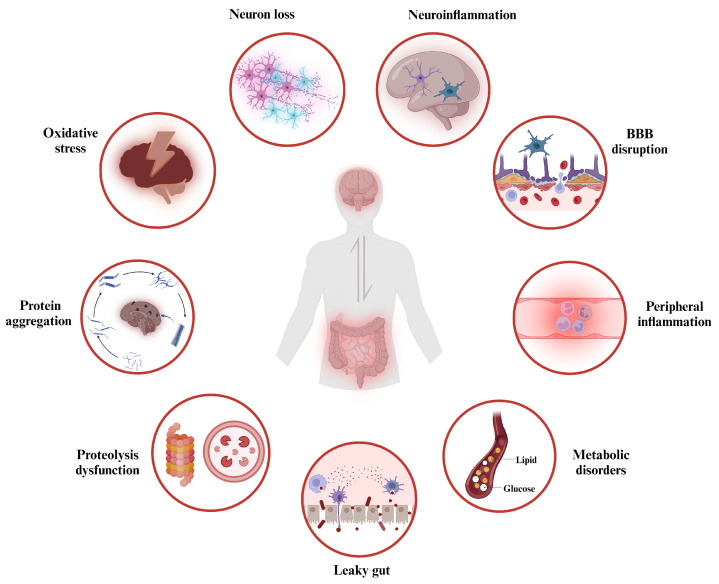
The gut–brain axis (GBA) is a complex bidirectional communication network connecting the gut and brain. It involves neural, immune, and endocrine communication pathways between the gastrointestinal (GI) tract and the central nervous system (CNS). Perturbations of the GBA have been reported in many neurodegenerative disorders (NDDs), such as Alzheimer’s disease (AD), Parkinson’s disease (PD), and amyotrophic lateral sclerosis (ALS), among others, suggesting a possible role in disease pathogenesis. The gut microbiota is a pivotal component of the GBA, and alterations in its composition, known as gut dysbiosis, have been associated with GBA dysfunction and neurodegeneration. The gut microbiota might influence the homeostasis of the CNS by modulating the immune system and, more directly, regulating the production of molecules and metabolites that influence the nervous and endocrine systems, making it a potential therapeutic target. Preclinical trials manipulating microbial composition through dietary intervention, probiotic and prebiotic supplementation, and fecal microbial transplantation (FMT) have provided promising outcomes. However, its clear mechanism is not well understood, and the results are not always consistent. Here, we provide an overview of the major components and communication pathways of the GBA, as well as therapeutic approaches targeting the GBA to ameliorate NDDs.
Overview
The claims and statistics of this paper haven’t been checked yet.
Free: it reads the open-access text and checks the first 5 claims that cite a source we can check. Create a free account to check every claim.
Integrity signals
Registry
Cites
Statistics
Figures


Verification
Claims the paper makes
The claims and statistics of this paper haven’t been checked yet.
Free: it reads the open-access text and checks the first 5 claims that cite a source we can check. Create a free account to check every claim.
Claims other papers make about this one
Each is checked against this paper’s own text: does it say what the citing paper says it does?
The source backs part of the claim, not all of it — or backs it for a different population, condition or comparison.
In the citing paper
“Dysregulation of the GBA has been implicated in a wide range of conditions, including neuropsychiatric disorders such as depression and anxiety[2], as well as gastrointestinal diseases such as irritable bowel syndrome (IBS) and gastroesophageal reflux disease (GERD) [3].”
From The hidden genetic and microbial networks connecting neuropsychiatric and digestive disorders (2025) · cites this paper as [2]
Experimental — accuracy not yet measured
Self-check
Percentages, sums and reported differences re-computed from the paper’s own numbers.
The self-check needs the paper’s full text.
Citations
The citation lists are queued
They are fetched later and appear here then.
References 164 · Cited by 175
Research works printed but not linked: 1
- Sudo, N. (2016). The Gut-Brain Axis Dietary, Probiotic, and Prebiotic Interventions on the Microbiota, Elsevier Inc.
Metadata
- Authors
- Zheng, Y., Bonfili, L., Wei, T., & Eleuteri, A. M.
- Affiliations
- Università di Camerino (IT)
- Zhengzhou University of Light Industry (CN)
- Corresponding author
- Wei, Tao
- Eleuteri, Anna Maria
- Venue
- Nutrients
- Publisher
- MDPI AG
- Published
- 2023-10-31
- Volume
- 15
- Issue
- 21
- Pages
- 4631
- ISSN
- 2072-6643 (ISSN-L)
- PMC
- PMC10648099
- OpenAlex
- W4388041827
- Cited by
- 175
- References
- 164
- Citations by year
- 2026: 62 · 2025: 73 · 2024: 39 · 2023: 1
- FWCI
- 4.61
- Type
- journal article
- Language
- en
- Open access
- gold
- doi.org
- Licence
- Locations
- Nutrients (publishedVersion, cc-by)
- PubMed Central (publishedVersion, cc-by)
- PubMed (publishedVersion)
- Unicam Scientific Publications (University of Camerino) (submittedVersion, cc-by)
- Funders
- University of Camerino and the Zhongyuan Science and Technology Innovation Leading Talent Project (224200510017)
- Topics
- Life Sciences › Biochemistry, Genetics and Molecular Biology › Molecular Biology › Gut microbiota and health
- Health Sciences › Medicine › Gastroenterology › Gastrointestinal motility and disorders
- Health Sciences › Medicine › Clinical Neurology › Parkinson's Disease Mechanisms and Treatments
- Keywords
- gut-brain axis, neurodegenerative diseases, gut microbiota, gut dysbiosis, Alzheimer's disease, Parkinson's disease, amyotrophic lateral sclerosis, neuroinflammation, dietary intervention, probiotics, prebiotics, fecal microbiota transplantation, microbial metabolites
- MeSH terms
- Gastrointestinal Microbiome, Brain-Gut Axis, Alzheimer Disease, Brain, Humans, Parkinson Disease, Neurodegenerative Diseases, Dysbiosis
About these checks
Registry, retraction, Cites and statistics results are computed, not judged, with one exception: a printed reference that no index lists is read once by a model before it counts as a citation error. Claims are extracted by a model and kept only when their quote appears verbatim in the text; each cited source is then checked, with a model’s help, for whether it says what the claim relies on. Those verdicts can be wrong — read the claim’s quote and the cited source before relying on one.
Statistics and arithmetic are recomputed, not judged.
Confidence bands are shown only for fields calibrated on our annotated test set. None is calibrated yet, so no band is shown.
What counts as a claim ›How we measure confidence ›How we check this ›
Are you an author, or do you see a problem with this page? Request a review
How to cite
Cite CoChat for the checks on this page, and the paper for its own findings.
- This page
- CoChat. (2026). Citation check: Understanding the Gut–Brain Axis and Its Therapeutic Implications for Neurodegenerative Disorders. https://app.cochat.ai/papers/10.3390/nu15214631
- The paper
- Zheng, Y., Bonfili, L., Wei, T., & Eleuteri, A. M. (2023). Understanding the Gut–Brain Axis and Its Therapeutic Implications for Neurodegenerative Disorders. Nutrients. https://doi.org/10.3390/nu15214631
Data sources
Bibliographic data: Semantic Scholar, OpenAlex, Crossref.
Contains information from the Semantic Scholar Academic Graph Datasets, made available under the ODC Attribution License (ODC-BY 1.0).
Semantic Scholar’s data is described in: Kinney, R., et al. (2023). The Semantic Scholar Open Data Platform. arXiv:2301.10140.
