

The DOI matches its Crossref record; 52 of the 52 references it cites were found in a registry or an index.
Applications of Artificial Intelligence, Machine Learning, and Deep Learning in Nutrition: A Systematic Review
Open accessAbstract
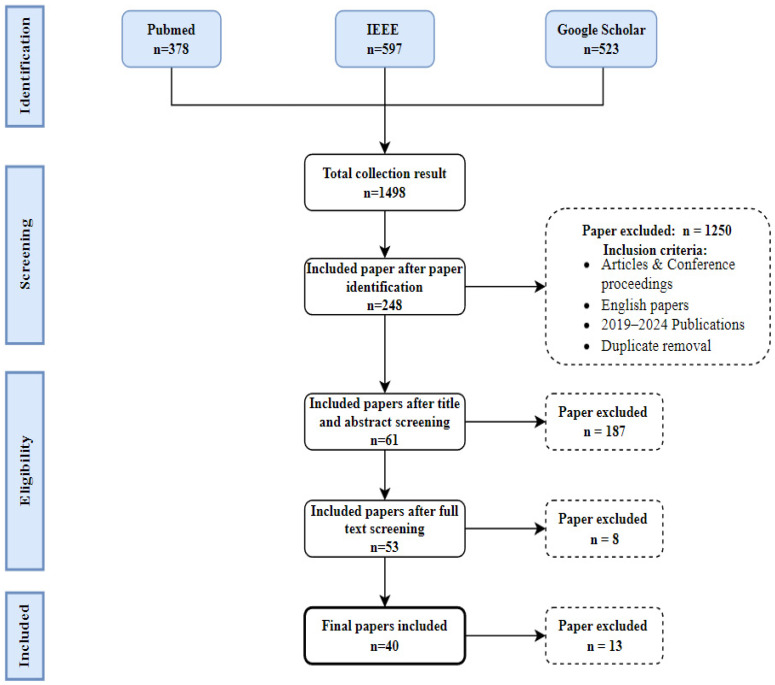
In industry 4.0, where the automation and digitalization of entities and processes are fundamental, artificial intelligence (AI) is increasingly becoming a pivotal tool offering innovative solutions in various domains. In this context, nutrition, a critical aspect of public health, is no exception to the fields influenced by the integration of AI technology. This study aims to comprehensively investigate the current landscape of AI in nutrition, providing a deep understanding of the potential of AI, machine learning (ML), and deep learning (DL) in nutrition sciences and highlighting eventual challenges and futuristic directions. A hybrid approach from the systematic literature review (SLR) guidelines and the preferred reporting items for systematic reviews and meta-analyses (PRISMA) guidelines was adopted to systematically analyze the scientific literature from a search of major databases on artificial intelligence in nutrition sciences. A rigorous study selection was conducted using the most appropriate eligibility criteria, followed by a methodological quality assessment ensuring the robustness of the included studies. This review identifies several AI applications in nutrition, spanning smart and personalized nutrition, dietary assessment, food recognition and tracking, predictive modeling for disease prevention, and disease diagnosis and monitoring. The selected studies demonstrated the versatility of machine learning and deep learning techniques in handling complex relationships within nutritional datasets. This study provides a comprehensive overview of the current state of AI applications in nutrition sciences and identifies challenges and opportunities. With the rapid advancement in AI, its integration into nutrition holds significant promise to enhance individual nutritional outcomes and optimize dietary recommendations. Researchers, policymakers, and healthcare professionals can utilize this research to design future projects and support evidence-based decision-making in AI for nutrition and dietary guidance.
Overview
The claims and statistics of this paper haven’t been checked yet.
Run the check — free, no account needed. It reads the open-access text and checks the sources it cites.
Integrity signals
Registry
Cites
Statistics
Figures
Verification
Claims the paper makes
The claims and statistics of this paper haven’t been checked yet.
Run the check — free, no account needed. It reads the open-access text and checks the sources it cites.
Claims other papers make about this one
Each is checked against this paper’s own text: does it say what the citing paper says it does?
In the citing paper
“These tools enhance adherence by tracking biometrics and offering actionable insights to users, making weight management dynamic and adaptive to individual needs [96,97,98,99,100,101,102].”
From Beyond Calories: Individual Metabolic and Hormonal Adaptations Driving Variability in Weight Management—A State-of-the-Art Narrative Review (2024) · cites this paper as [100]
Self-check
Percentages, sums and reported differences re-computed from the paper’s own numbers.
The self-check needs the paper’s full text.
Citations
Cites
PRISMA-P Group, Moher, D., Shamseer, L., Clarke, M., Ghersi, D., Liberati, A., Petticrew, M., Shekelle, P., & Stewart, L. A. (2015) · Systematic Reviews · doi:10.1186/2046-4053-4-1 · Cited by 26,223
Global nutrition transition and the pandemic of obesity in developing countries
Popkin, B. M., Adair, L. S., & Ng, S. W. (2012) · Nutrition Reviews · doi:10.1111/j.1753-4887.2011.00456.x · Cited by 4,313
Mozaffarian, D. (2016) · Circulation · doi:10.1161/circulationaha.115.018585 · Cited by 2,216
Taye, M. M. (2023) · Computers · doi:10.3390/computers12050091 · Cited by 1,275
Woschank, M., Rauch, E., & Zsifkovits, H. (2020) · Sustainability · doi:10.3390/su12093760 · Cited by 338
Iwendi, C., Khan, S. A., Anajemba, J. H., Bashir, A. K., & Noor, F. (2020) · IEEE Access · doi:10.1109/access.2020.2968537 · Cited by 232
Machine Learning in Nutrition Research
Kirk, D., Kok, E. J., Tufano, M., Teki̇nerdoğan, B., Feskens, E. J. M., & Camps, G. (2022) · Advances in Nutrition · doi:10.1093/advances/nmac103 · Cited by 206
Wearable Food Intake Monitoring Technologies: A Comprehensive Review
Vu, T., Lin, F., Alshurafa, N. I., & Xu, W. (2017) · Computers · doi:10.3390/computers6010004 · Cited by 175
Challenges in Personalized Nutrition and Health
Verma, M., Hontecillas, R., Tubau‐Juni, N., Abedi, V., & Bassaganya-Riera, J. (2018) · Frontiers in Nutrition · doi:10.3389/fnut.2018.00117 · Cited by 153
The Age of Artificial Intelligence: Use of Digital Technology in Clinical Nutrition
Limketkai, B. N., Mauldin, K., Manitius, N., Jalilian, L., & Salonen, B. R. (2021) · Current Surgery Reports · doi:10.1007/s40137-021-00297-3 · Cited by 128
Research works printed but not linked: 1
- Chopra, M., and Purwar, A. (2022). Applications of Artificial Intelligence, Big Data and Internet of Things in Sustainable Development, CRC Press.
Cited by
Sorted by citations
Personalized Nutrition: Tailoring Dietary Recommendations through Genetic Insights
Singar, S., Nagpal, R., Arjmandi, B. H., & Akhavan, N. S. (2024) · Nutrients · doi:10.3390/nu16162673 · Cited by 178
The future of pharmaceuticals: Artificial intelligence in drug discovery and development
Fu, C., & Chen, Q. (2025) · Journal of Pharmaceutical Analysis · doi:10.1016/j.jpha.2025.101248 · Cited by 151
Investigation and Assessment of AI’s Role in Nutrition—An Updated Narrative Review of the Evidence
Kassem, H., Beevi, A., Basheer, S., Elkabat, G., Ismail, L. C., & Papandreou, D. (2025) · Nutrients · doi:10.3390/nu17010190 · Cited by 121
Kalogerakou, T., & Αντωνιάδου, Μ. (2024) · Antioxidants · doi:10.3390/antiox13121508 · Cited by 105
Phalle, A., & Gokhale, D. (2025) · Frontiers in Nutrition · doi:10.3389/fnut.2025.1518466 · Cited by 75
Metadata
- Authors
- Theodore Armand, T. P., Nfor, K. A., Kim, J.-I., & Kim, H.-C.
- Affiliations
- Institute of Digital Anti-Aging Healthcare, Inje University, Gimhae 50834, Republic of Korea
- Inje University (KR)
- Corresponding author
- Kim, Hee-Cheol
- Venue
- Nutrients
- Publisher
- MDPI AG
- Published
- 2024-04-06
- Volume
- 16
- Issue
- 7
- Pages
- 1073
- ISSN
- 2072-6643 (ISSN-L)
- PMC
- PMC11013624
- OpenAlex
- W4394576240
- Cited by
- 253
- References
- 52
- Citations by year
- 2026: 101 · 2025: 128 · 2024: 24
- FWCI
- 5.71
- Type
- journal article
- Language
- en
- Open access
- gold
- doi.org
- Licence
- Locations
- Nutrients (publishedVersion, cc-by)
- PubMed Central (publishedVersion, cc-by)
- PubMed (publishedVersion)
- Funders
- Ministry of Science ICT (2022-0-01091, 1711175863)
- Institute of Information and Communications Technology Planning and Evaluation (2022-0-01091, 1711175863)
- Topics
- Health Sciences › Medicine › Health Informatics › Artificial Intelligence in Healthcare and Education
- Life Sciences › Biochemistry, Genetics and Molecular Biology › Genetics › Nutrition, Genetics, and Disease
- Health Sciences › Health Professions › Health Information Management › Artificial Intelligence in Healthcare
- Keywords
- artificial intelligence in nutrition, machine learning, deep learning, personalized nutrition, dietary assessment, food recognition, dietary monitoring, predictive modeling, disease prevention, disease diagnosis, disease surveillance, dietary recommendations, Industry 4.0
- MeSH terms
- Machine Learning, Deep Learning, Artificial Intelligence, Humans, Nutritional Status, Nutritional Sciences
About these checks
Registry, retraction, Cites and statistics results are computed, not judged, with one exception: a printed reference that no index lists is read once by a model before it counts as a citation error. Claims are extracted by a model and kept only when their quote appears verbatim in the text; each cited source is then checked, with a model’s help, for whether it says what the claim relies on. Those verdicts can be wrong — read the claim’s quote and the cited source before relying on one.
Statistics and arithmetic are recomputed, not judged.
Confidence bands are shown only for fields calibrated on our annotated test set. None is calibrated yet, so no band is shown.
What counts as a claim ›How we measure confidence ›How we check this ›
Are you an author, or do you see a problem with this page? Request a review
