

The DOI matches its Crossref record; 63 of the 64 references it cites were found in a registry or an index.
The Role of Artificial Intelligence in Nutrition Research: A Scoping Review
Open accessAbstract
Artificial intelligence (AI) refers to computer systems doing tasks that usually need human intelligence. AI is constantly changing and is revolutionizing the healthcare field, including nutrition. This review’s purpose is four-fold: (i) to investigate AI’s role in nutrition research; (ii) to identify areas in nutrition using AI; (iii) to understand AI’s future potential impact; (iv) to investigate possible concerns about AI’s use in nutrition research. Eight databases were searched: PubMed, Web of Science, EBSCO, Agricola, Scopus, IEEE Explore, Google Scholar and Cochrane. A total of 1737 articles were retrieved, of which 22 were included in the review. Article screening phases included duplicates elimination, title-abstract selection, full-text review, and quality assessment. The key findings indicated AI’s role in nutrition is at a developmental stage, focusing mainly on dietary assessment and less on malnutrition prediction, lifestyle interventions, and diet-related diseases comprehension. Clinical research is needed to determine AI’s intervention efficacy. The ethics of AI use, a main concern, remains unresolved and needs to be considered for collateral damage prevention to certain populations. The studies’ heterogeneity in this review limited the focus on specific nutritional areas. Future research should prioritize specialized reviews in nutrition and dieting for a deeper understanding of AI’s potential in human nutrition.
Overview
The claims and statistics of this paper haven’t been checked yet.
Run the check — free, no account needed. It reads the open-access text and checks the sources it cites.
Integrity signals
Registry
Cites
Statistics
Figures
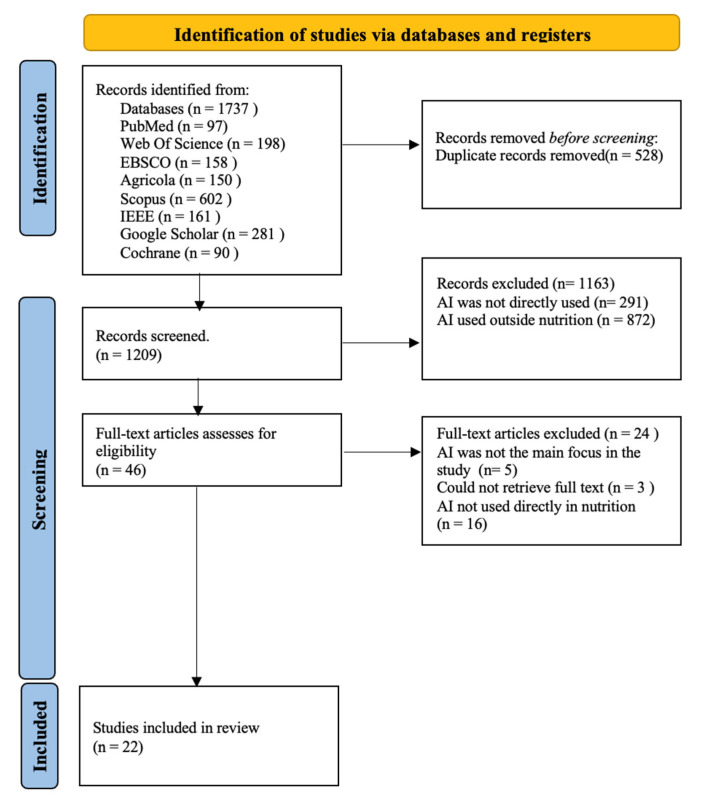
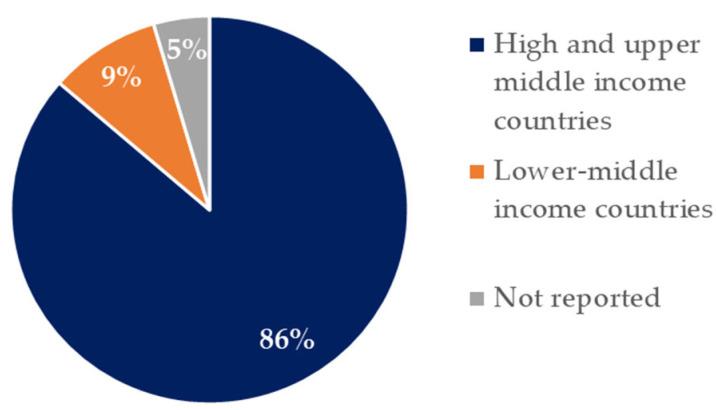
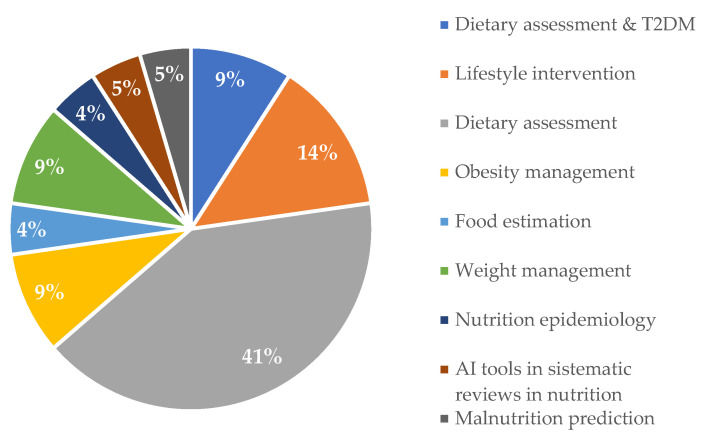
Verification
Claims the paper makes
The claims and statistics of this paper haven’t been checked yet.
Run the check — free, no account needed. It reads the open-access text and checks the sources it cites.
Claims other papers make about this one
Each is checked against this paper’s own text: does it say what the citing paper says it does?
In the citing paper
“These tools enhance adherence by tracking biometrics and offering actionable insights to users, making weight management dynamic and adaptive to individual needs [96,97,98,99,100,101,102].”
From Beyond Calories: Individual Metabolic and Hormonal Adaptations Driving Variability in Weight Management—A State-of-the-Art Narrative Review (2024) · cites this paper as [101]
Self-check
Percentages, sums and reported differences re-computed from the paper’s own numbers.
The self-check needs the paper’s full text.
Citations
Cites
1 retracted
Chatelan, A., Clerc, A., & Fonta, P.-A. (2023) · Journal of the Academy of Nutrition and Dietetics · doi:10.1016/j.jand.2023.08.001 · Cited by 105
RetractedSystematic Literature Reviews in Software Engineering—A Systematic Literature Review
Kitchenham, B., Pearl Brereton, O., Budgen, D., Turner, M., Bailey, J., & Linkman, S. (2009) · Information and Software Technology · doi:10.1016/j.infsof.2008.09.009 · Cited by 4,537
Haenlein, M., & Kaplan, A. (2019) · California Management Review · doi:10.1177/0008125619864925 · Cited by 2,655
Wahl, B., Cossy-Gantner, A., Germann, S., & Schwalbe, N. R. (2018) · BMJ Global Health · doi:10.1136/bmjgh-2018-000798 · Cited by 796
On Defining Artificial Intelligence
Wang, P. (2019) · Journal of Artificial General Intelligence · doi:10.2478/jagi-2019-0002 · Cited by 740
Artificial intelligence: a survey on evolution, models, applications and future trends
Lu, Y. (2019) · Journal of Management Analytics · doi:10.1080/23270012.2019.1570365 · Cited by 641
Human- versus Artificial Intelligence
Korteling, J. E. (., van de Boer-Visschedijk, G. C., Blankendaal, R. A. M., Boonekamp, R. C., & Eikelboom, A. R. (2021) · Frontiers in Artificial Intelligence · doi:10.3389/frai.2021.622364 · Cited by 619 · cited 2×
“However, the distinctions and similarities between humans and AI are being widely debated [20].”
BackgroundReal-world data: A brief review of the methods, applications, challenges and opportunities
Liu, F., & Panagiotakos, D. (2022) · BMC Medical Research Methodology · doi:10.1186/s12874-022-01768-6 · Cited by 496
Brief History of Artificial Intelligence
Muthukrishnan, N., Maleki, F., Ovens, K. L., Reinhold, C., Forghani, B., & Forghani, R. (2020) · Neuroimaging Clinics of North America · doi:10.1016/j.nic.2020.07.004 · Cited by 283
Oh, Y. J., Zhang, J., Fang, M.-L., & Fukuoka, Y. (2021) · International Journal of Behavioral Nutrition and Physical Activity · doi:10.1186/s12966-021-01224-6 · Cited by 278
Research works printed but not linked: 2
- Nunes-Galbes, N.M. (2022). Systematic Reviews in Nutrition Using Artificial Intelligence Tools: A Brief Review, Faculty of Public Health, University of São Paulo.
- Narkhede, 2018, Understanding auc-roc curve, Towards Data Sci., 26, 220
Cited by
Sorted by citations
Investigation and Assessment of AI’s Role in Nutrition—An Updated Narrative Review of the Evidence
Kassem, H., Beevi, A., Basheer, S., Elkabat, G., Ismail, L. C., & Papandreou, D. (2025) · Nutrients · doi:10.3390/nu17010190 · Cited by 121
A Scoping Review of Artificial Intelligence for Precision Nutrition
Wu, X., Oniani, D., Shao, Z., Arciero, P. J., Sivarajkumar, S., Hilsman, J., Mohr, A. E., Ibe, S., Moharir, M., Li, L.-J., et al. (2025) · Advances in Nutrition · doi:10.1016/j.advnut.2025.100398 · Cited by 89
Artificial Intelligence in Nutrition and Dietetics: A Comprehensive Review of Current Research
Panayotova, G. G. (2025) · Healthcare · doi:10.3390/healthcare13202579 · Cited by 65
Healthy Food Recommendations for User Communities through Trust and Popularity-Aware Aggregation
Raghunathareddy, M., V, Basavaraja, P. H., Babu, J. A., Ramesh, G. P., & Prakash, R. (2025) · ITM Web of Conferences · doi:10.1051/itmconf/20257901044 · Cited by 56
Rouskas, K., Guela, M., Pantoura, M., Pagkalos, I. G., Hassapidou, M. N., Lalama, E., Pfeiffer, A. F. H., Decorte, E., Cornelissen, V., Wilson-Barnes, S., et al. (2025) · Nutrients · doi:10.3390/nu17071260 · Cited by 53
Metadata
- Authors
- Sosa-Holwerda, A., Park, O.-H., Albracht-Schulte, K., Niraula, S., Thompson, L., & Oldewage-Theron, W.
- Affiliations
- Texas Tech University (US)
- Department of Kinesiology & Sport Management, Texas Tech University, Lubbock, TX 79409, USA
- Corresponding author
- Oldewage-Theron, Wilna
- Venue
- Nutrients
- Publisher
- MDPI AG
- Published
- 2024-06-28
- Volume
- 16
- Issue
- 13
- Pages
- 2066
- ISSN
- 2072-6643 (ISSN-L)
- PMC
- PMC11243505
- OpenAlex
- W4400119754
- Cited by
- 114
- References
- 64
- Citations by year
- 2026: 50 · 2025: 58 · 2024: 6
- FWCI
- 2.60
- Type
- journal article
- Language
- en
- Open access
- gold
- doi.org
- Licence
- Locations
- Nutrients (publishedVersion, cc-by)
- PubMed Central (publishedVersion, cc-by)
- PubMed (publishedVersion)
- Topics
- Health Sciences › Medicine › Health Informatics › Artificial Intelligence in Healthcare and Education
- Life Sciences › Biochemistry, Genetics and Molecular Biology › Genetics › Nutrition, Genetics, and Disease
- Physical Sciences › Computer Science › Artificial Intelligence › Artificial Intelligence Applications
- Keywords
- artificial intelligence, nutrition research, dietary assessment, lifestyle intervention, diet-related diseases, AI ethics, artificial intelligence in healthcare
- MeSH terms
- Artificial Intelligence, Humans, Biomedical Research, Nutritional Sciences
About these checks
Registry, retraction, Cites and statistics results are computed, not judged, with one exception: a printed reference that no index lists is read once by a model before it counts as a citation error. Claims are extracted by a model and kept only when their quote appears verbatim in the text; each cited source is then checked, with a model’s help, for whether it says what the claim relies on. Those verdicts can be wrong — read the claim’s quote and the cited source before relying on one.
Statistics and arithmetic are recomputed, not judged.
Confidence bands are shown only for fields calibrated on our annotated test set. None is calibrated yet, so no band is shown.
What counts as a claim ›How we measure confidence ›How we check this ›
Are you an author, or do you see a problem with this page? Request a review
