

The DOI matches its Crossref record; 104 of the 105 references it cites were found in a registry or an index, and 1 are not checked yet; none of the 123 sources its claims cite is checked for support yet.
Use of Nutritional Strategies, Bioactive Compounds, and Dietary Supplements in Young Athletes: From Evidence to Potential Risks—A Narrative Review
Open accessAbstract
Young athletes face unique nutritional challenges due to their simultaneous engagement in intensive physical training and ongoing growth and development. Standard adult-based dietary recommendations often fail to meet the specific needs of this population. While the role of macronutrients and micronutrients is well recognized, increasing attention is being paid to bioactive compounds—non-essential food-derived elements with potential health benefits. This review aims to summarize current evidence regarding the efficacy, safety, and potential benefits of bioactive compounds in the nutritional management of young athletes. Methods: A narrative review of the literature published over the last 30 years was conducted across PubMed/Medline, Embase, and Scopus databases to identify relevant studies published in English. The inclusion criteria covered original research articles, clinical trials, cohort and case-control studies, and meta-analyses focusing on individuals aged 8–20 years. Studies addressing supplementation strategies, physiological effects, and safety concerns of bioactive compounds in young athletes were selected. Preclinical data and adult-based studies were also included to contextualize molecular mechanisms and support clinical findings. Results: The review highlights that bioactive compounds such as omega-3 fatty acids, curcumin, caffeine, and creatine as well as antioxidant vitamins may play a beneficial role in improving recovery, immune function, and performance in young athletes. Of these 21 studies, 8 focused on recovery and muscle soreness, 6 addressed immune function or antioxidant/anti-inflammatory effects, and 7 investigated direct performance enhancement. However, most of the available evidence derives from adult populations, and pediatric-specific data remain limited. Concerns remain about the misuse of supplements, lack of professional guidance, and potential contamination with banned substances. Conclusions: While some bioactive compounds show promising potential to support the health and performance of young athletes, current evidence is insufficient to support routine use in this population. More pediatric-specific research is necessary to establish safety, efficacy, and appropriate supplementation protocols tailored to young athletes’ unique physiological needs.
Checked 2026-11-14 · 1 reference not checked yet
Overview
CoChat Summary
TL;DR
This narrative review summarizes evidence on nutritional strategies, bioactive compounds, and dietary supplements in young athletes aged 8–20, finding some compounds promising for recovery, immune function, or performance but with limited pediatric-specific data. It concludes that current evidence is insufficient to support routine supplementation and emphasizes professional guidance, a balanced diet, and more youth-specific research.
Key findings
- The final synthesis included 21 studies: 6 clinical trials, 12 randomized controlled trials, and 3 systematic reviews/meta-analyses; 8 focused on recovery and muscle soreness, 6 on immune function or antioxidant/anti-inflammatory effects, and 7 on direct performance enhancement.
- Caffeine showed acute ergogenic effects in adolescents: 3–6 mg/kg improved anaerobic performance markers in elite adolescent athletes, low doses (1–3 mg/kg) had task-dependent effects, and 6 mg/kg improved anaerobic performance in highly trained male futsal players (15.9 ± 1.2 years); no side effects were reported in adolescent studies, though sample sizes were limited.
- Creatine studies in young athletes (ages 14.3–20), mostly swimmers and soccer players, generally used loading (20–30 g/day for 4–9 days) followed by maintenance (5 g/day) and showed improvements in sprint ability, muscular strength, power output, sport-specific skills, and repeated high-intensity efforts, with no reported side effects; long-term safety data remain limited.
- Other findings: a single 200,000 IU vitamin D3 mega-dose improved jumping, agility, and running speed in vitamin D-deficient young soccer players, while 2000 IU/day for 12 weeks in swimmers showed no significant difference; beetroot juice showed no significant VO2 max benefit in adolescent soccer players (mean ΔVO2 max 3.13 ± 2.76 vs 4.43 ± 3.47 mL/kg/min, p = 0.42); β-alanine 4.8 g/day for 5–6 weeks improved high-intensity performance in water polo athletes but muscle carnosine was not measured; curcumin 1200 mg/day for 12 weeks reduced muscle pain and fatigue in adolescent athletes, though methodological limitations prevented definitive conclusions.
Methods
- Narrative review of literature published from 1994 to 2024 in PubMed/Medline, Embase, and Scopus; inclusion criteria covered original research, randomized or non-randomized clinical trials, cohort or case-control studies, and meta-analyses involving pediatric/adolescent athletic populations aged 8–20 years and interventions using bioactive compounds or dietary supplements; preclinical and adult studies were included only for mechanistic or contextual purposes.
- Two independent reviewers screened titles and abstracts, reference lists were examined, and data were synthesized narratively around potential benefit, athlete age, and dosage/duration.
- The search initially retrieved 423 articles; after removing 76 duplicates, 347 were screened, 285 excluded, 62 full texts assessed, 41 excluded, leaving 21 studies in the final narrative synthesis.
Limitations
- The paper states that most available evidence derives from adult populations and pediatric-specific data remain limited; current evidence is insufficient to support routine use of bioactive compounds in young athletes, and concerns remain about supplement misuse, lack of professional guidance, and contamination with banned substances.
- The paper notes compound-specific limitations: creatine long-term safety in adolescents is limited, most safety data are self-reported, and studies often lack comprehensive laboratory assessments; β-alanine studies did not measure post-supplementation muscle carnosine; beetroot findings in adolescents are inconclusive; caffeine research is limited and mostly focused on males; curcumin evidence has methodological limitations; and the iron meta-analysis had poor methodological quality in most included interventions.
- Evident from the text: this is a narrative review without quantitative pooling, and the final 21 studies are few and heterogeneous, with many conclusions extrapolated from adult or preclinical data rather than directly demonstrated in young athletes.
Model-written summary. Check it against the paper before relying on it.
Integrity signals
Registry
Cites
Statistics
Figures
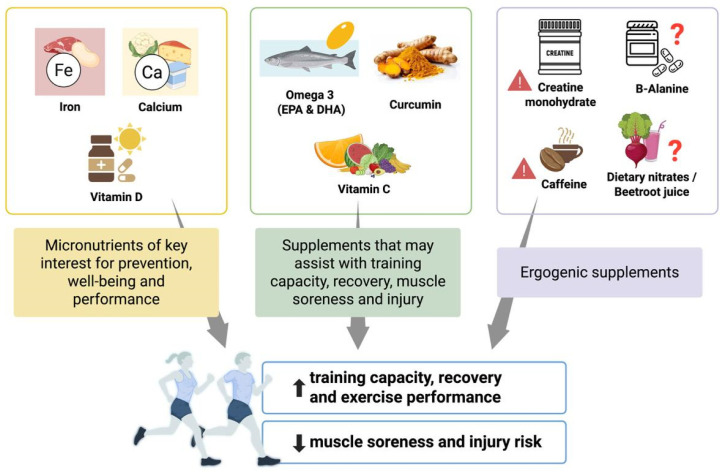
Verification
Claims the paper makes
0 Valid · 0 Not valid · 85 Not checked · 18 Own results and interpretations
A result the paper states — it cites no source for it, so there is none to check. The quote shows it is in the paper.
In the paper
“fatty acids, curcumin, caffeine, and creatine as well as antioxidant vitamins may play a beneficial role in improving recovery, immune function, and performance in young athletes.”
§ Use of Nutritional Strategies, Bioactive Compounds, and Dietary Supplements in Young Athletes: From Evidence to Potential Risks—A Narrative Review > Abstract
hedgedstates a possible cause- Asserted: passes — The authors put it forward as true.
- Checkable: passes — It can be checked against evidence.
- Load-bearing: passes — The paper’s conclusions depend on it.
- Based: passes — The paper gives a reason why it holds.
A result the paper states — it cites no source for it, so there is none to check. The quote shows it is in the paper.
In the paper
“However, no studies have examined these effects on adolescent athletes.”
§ Use of Nutritional Strategies, Bioactive Compounds, and Dietary Supplements in Young Athletes: From Evidence to Potential Risks—A Narrative Review > 3. Results > 3.3. Supplements That May Assist with Training Capacity, Recovery, Muscle Soreness, and Injury
plain- Asserted: passes — The authors put it forward as true.
- Checkable: passes — It can be checked against evidence.
- Load-bearing: unclear — It is unclear whether the paper’s conclusions depend on it.
- Based: passes — The paper gives a reason why it holds.
A check of a cited source is scheduled, or we don’t hold its full text yet; the claim is checked once it runs.
In the paper
“Young athletes exhibit higher energy requirements compared to non-athlete peers due to simultaneous energy expenditure for growth and sport performance [19,20].”
§ Use of Nutritional Strategies, Bioactive Compounds, and Dietary Supplements in Young Athletes: From Evidence to Potential Risks—A Narrative Review > 3. Results > 3.1. Targeted Nutritional Requirements in Young Athletes
What the sources say
- Not checked yetcites [19] Amawi, A., Khataybeh, B., Al Aqaili, R., Ababneh, N., Alnimer, L., Qoqazeh, A., Oukal, F., Jahrami, H., Mousa Ay, K., and Al Saoud, H. (2024). Junior Athletes’ Nutritional Demands: A Narrative Review of Consumption and Prevalence of Eating Disorders. Front. Nutr., 11. source
A check is scheduled.
- Not checked yetcites [20] Petrie, 2004, Nutritional Concerns for the Child and Adolescent Competitor, Nutrition source
A check is scheduled.
plainstates a cause- Asserted: passes — The authors put it forward as true.
- Checkable: passes — It can be checked against evidence.
- Load-bearing: passes — The paper’s conclusions depend on it.
- Based: passes — The paper gives a reason why it holds.
- Not checked yet
A conclusion the paper draws from its own results — it cites no other source for it, so there is none to check. The quote shows it is in the paper.
In the paper
“While some bioactive compounds show promising potential to support the health and performance of young athletes, current evidence is insufficient to support routine use in this population.”
§ Use of Nutritional Strategies, Bioactive Compounds, and Dietary Supplements in Young Athletes: From Evidence to Potential Risks—A Narrative Review > Abstract
plain- Asserted: passes — The authors put it forward as true.
- Checkable: passes — It can be checked against evidence.
- Load-bearing: passes — The paper’s conclusions depend on it.
- Based: passes — The paper gives a reason why it holds.
In the paper
“In contrast, evaluating the effect of 2000 UI/day (50 µg/day) of vitamin D3 supplementation for 12 weeks on physical performance in adolescent swimmers with insufficiency did not reveal a significant difference between those who became sufficient and those who did not [25].”
§ Use of Nutritional Strategies, Bioactive Compounds, and Dietary Supplements in Young Athletes: From Evidence to Potential Risks—A Narrative Review > 3. Results > 3.2. Bioactive Compounds in Young Athletes
What the sources say
- Not checked yetcites [25] Livne, 2015, Vitamin D Supplementation and Physical Performance in Adolescent Swimmers, Int. J. Sport Nutr. Exerc. Metab. source
plain- Asserted: passes — The authors put it forward as true.
- Checkable: passes — It can be checked against evidence.
- Load-bearing: passes — The paper’s conclusions depend on it.
- Based: passes — The paper gives a reason why it holds.
50 more claims
Create a free account to see all 103 claims and to verify the 123 references still open.
- It may state two separate claims as one. 42
- Probably not a substantial claim. 9
- The quote only partly states this claim. 1
Self-check
Percentages, sums and reported differences re-computed from the paper’s own numbers.
Each contradiction between two passages listed here was confirmed by an independent check.
Rated minor: it would not touch a result — a value no result rests on, a p-value that stays on the same side of the significance level, or a conflict that is clerical, resolved elsewhere in the paper, or outside its own findings.
In the paper
§ Use of Nutritional Strategies, Bioactive Compounds, and Dietary Supplements in Young Athletes: From Evidence to Potential Risks—A Narrative Review > 4. Discussion
“Acute supplementation with caffeine (3–6 mg/kg) has shown improvements in anaerobic performance markers such as reaction time, agility, and sprint speed in elite adolescent athletes [52,53,54].”
§ Use of Nutritional Strategies, Bioactive Compounds, and Dietary Supplements in Young Athletes: From Evidence to Potential Risks—A Narrative Review > References
“52. Theodorou A.S. Cooke C.B. King R.F. Hood C. Denison T. Wainwright B.G. Havenetidis K. The Effect of Longer-Term Creatine Supplementation on Elite Swimming Performance after an Acute Creatine Loading”
Rated minor: it would not touch a result — a value no result rests on, a p-value that stays on the same side of the significance level, or a conflict that is clerical, resolved elsewhere in the paper, or outside its own findings.
In the paper
§ Use of Nutritional Strategies, Bioactive Compounds, and Dietary Supplements in Young Athletes: From Evidence to Potential Risks—A Narrative Review > 3. Results > 3.2. Bioactive Compounds in Young Athletes
“Supplementation with vitamin D, calcium, and iron is therefore considered essential in young athletes, not primarily for performance enhancement but to ensure the maintenance of optimal micronutrient status”
§ Use of Nutritional Strategies, Bioactive Compounds, and Dietary Supplements in Young Athletes: From Evidence to Potential Risks—A Narrative Review > 3. Results > 3.2. Bioactive Compounds in Young Athletes
“iron supplementation should be considered only if medically indicated [6].”
Citations
Cites
Antioxidants prevent health-promoting effects of physical exercise in humans
Ristow, M., Zarse, K., Oberbach, A., Klöting, N., Birringer, M., Kiehntopf, M., Stumvoll, M., Kahn, C. R., & Blüher, M. (2009) · Proceedings of the National Academy of Sciences · doi:10.1073/pnas.0903485106 · Cited by 1,582
Exercise and Fluid Replacement
(2007) · Medicine & Science in Sports & Exercise · doi:10.1249/mss.0b013e31802ca597 · Cited by 1,497
Mountjoy, M., Sundgot-Borgen, J., Burke, L., Carter, S., Constantini, N., Lebrun, C., Meyer, N., Sherman, R., Steffen, K., Budgett, R., et al. (2014) · British Journal of Sports Medicine · doi:10.1136/bjsports-2014-093502 · Cited by 1,469 · cited 1×
“For this reason, the IOC Consensus group introduced a more comprehensive term, Relative Energy Deficiency in Sport (RED-S) [64].”
Vitamin C pharmacokinetics in healthy volunteers: evidence for a recommended dietary allowance
Levine, M., Conry-Cantilena, C., Wang, Y., Welch, R. W., Washko, P. W., Dhariwal, K. R., Park, J. B., Lazarev, A., Graumlich, J. F., King, J., et al. (1996) · Proceedings of the National Academy of Sciences · doi:10.1073/pnas.93.8.3704 · Cited by 1,325
Nutrition and Athletic Performance
(2016) · Medicine & Science in Sports & Exercise · doi:10.1249/mss.0000000000000852 · Cited by 1,305 · cited 7×
“Vitamin and mineral supplements are unnecessary for the athlete who consumes a diet providing high-energy availability from a variety of nutrient-dense foods [18].”
InfluentialEffects of caffeine on human health
Nawrot, P., Jordan, S., Eastwood, J., Rotstein, J., Hugenholtz, A., & Feeley, M. (2003) · Food Additives and Contaminants · doi:10.1080/0265203021000007840 · Cited by 1,199
Kreider, R. B., Kalman, D. S., Antonio, J., Ziegenfuss, T. N., Wildman, R., Collins, R., Candow, D. G., Kleiner, S. M., Almada, A. L., & Lopez, H. L. (2017) · Journal of the International Society of Sports Nutrition · doi:10.1186/s12970-017-0173-z · Cited by 1,057 · cited 2×
“…of creatine monohydrate (e.g., 0.3 g/kg/day for 5–7 days or 20 g/day for 5 days) is indeed the most effective strategy to rapidly increase intramuscular creatine levels, as recommended by the International Society of Sports Nutrition (ISSN) [87] and the International Olympic Committee (IOC) [7].”
InfluentialIOC Consensus Statement: Dietary Supplements and the High-performance Athlete
Maughan, R. J., Burke, L. M., Dvorak, J., Larson-Meyer, D. E., Peeling, P., Phillips, S. M., Rawson, E. S., Walsh, N. P., Garthe, I., Geyer, H., et al. (2018) · British Journal of Sports Medicine · doi:10.1136/bjsports-2018-099027 · Cited by 1,004
Sharifi-Rad, J., Rayess, Y. E., Rizk, A. A., Sadaka, C., Zgheib, R., Zam, W., Sestito, S., Rapposelli, S., Neffe-Skocińska, K., Zielińska, D., et al. (2020) · Frontiers in Pharmacology · doi:10.3389/fphar.2020.01021 · Cited by 937
IOC consensus statement on relative energy deficiency in sport (RED-S): 2018 update
Mountjoy, M., Sundgot-Borgen, J. K., Burke, L. M., Ackerman, K. E., Blauwet, C., Constantini, N., Lebrun, C., Lundy, B., Melin, A. K., Meyer, N. L., et al. (2018) · British Journal of Sports Medicine · doi:10.1136/bjsports-2018-099193 · Cited by 883
Cited by
Vitamin Supplementation in Sports: A Decade of Evidence-Based Insights
Wiącek, M., Nowak, E., Lipka, P., Denda, R., & Zubrzycki, I. Z. (2026) · Nutrients · doi:10.3390/nu18020213 · Cited by 4
Farfán-Díaz, Á., Fuentes-Hinojosa, C., Andrade-Oyarzun, M., Garcia-Carrillo, E., Molina-Márquez, I., Yáñez-Sepúlveda, R., Castillo-Paredes, A., Barrera-González, D., & Montalva-Valenzuela, F. (2026) · Adolescents · doi:10.3390/adolescents6040059 · Cited by 1
“Recent reviews of nutritional strategies in young athletes emphasize that promising effects do not constitute sufficient evidence for routine pediatric use and that individualization and qualified supervision remain central [21].”
Papadakis, Z., Ribeiro, V. L., Egret, C., & Amasay, T. (2026) · Sport Sciences for Health · doi:10.1007/s11332-026-01928-x
Biliński, K., Wiśniewski, K., Rafner, L., Witko, P., & Gaweł-Dąbrowska, D. (2026) · Nutrients · doi:10.3390/nu18101523
The role of biotics and bioactive compounds in sports injuries: a narrative review
Şahin, K., Dal, N., Gönen, B., Akman, O., Raposa, B. L., & Ağagündüz, D. (2026) · Frontiers in Nutrition · doi:10.3389/fnut.2026.1813030
Hai, L. (2026) · SSRN Electronic Journal · doi:10.2139/ssrn.7087567
Potential Health Risks Associated with Sports Supplementation Use in Athletes
Cai, J., Wang, T., & Li, S. (2026) · Nutrients · doi:10.3390/nu18152490
Investigating the Efficacy of Polyphenolic Bioactives on Athletic Performance in Endurance Athletes
Sutherland, E. (2026) · Otago University Research Archive (University of Otago) · doi:10.82348/our-archive.00321
Oufkir, I., Rhalem, N., Bellimam, M. A., Asraoui, A., Haddouchi, A. E., Marrouh, A., Eljaoudi, R., & Abouali, F. (2026) · Scientific Reports · doi:10.1038/s41598-026-69912-6
Alhumaid, M. M., Alobaid, M. A., & Said, M. A. (2026) · Frontiers in Nutrition · doi:10.3389/fnut.2026.1955972
Kowalczuk, M., Strzępek, S. F., Tołkacz, M. K., Dytkowski, M., Wołyniak, P., Majewski, W. F., Strzalińska, D., Pazio, K., Piskor, M., & Kaczmarczyk, K. (2026) · African Journal of Biomedical Research · doi:10.65327/ze6z7579
Metadata
- Authors
- De Zan, D., Eletti, F., Fiore, G., Di Girolamo, E., Bozzini, G. G. M., Perico, V., Tosi, M., Norsa, L., Zuccotti, G., & Verduci, E.
- Affiliations
- Department of Pediatrics, Vittore Buzzi Children’s Hospital, 20154 Milan, Italy
- University of Milan (IT)
- Ospedale dei Bambini Vittore Buzzi (IT)
- Corresponding author
- Eletti, Francesca
- ORCID
- Venue
- Nutrients
- Publisher
- MDPI AG
- Published
- 2025-06-30
- Volume
- 17
- Issue
- 13
- Pages
- 2194
- ISSN
- 2072-6643 (ISSN-L)
- PMC
- PMC12251387
- OpenAlex
- W4411802899
- Cited by
- 11
- References
- 105
- Citations by year
- 2026: 11
- FWCI
- 1.15
- Type
- journal article
- Language
- en
- Open access
- gold
- doi.org
- Licence
- Locations
- Nutrients (publishedVersion, cc-by)
- PubMed (publishedVersion)
- PubMed Central (publishedVersion, cc-by)
- Archivio Istituzionale della Ricerca (Universita Degli Studi Di Milano) (submittedVersion, other-oa)
- Funders
- European Union—NextGenerationEU (PE00000003, CUP D93C22000890001)
- Italian Ministry of University and Research (PE00000003, CUP D93C22000890001)
- Topics
- Health Sciences › Medicine › Physiology (medical) › Exercise and Physiological Responses
- Health Sciences › Medicine › Orthopedics and Sports Medicine › Sports Performance and Training
- Health Sciences › Medicine › Public Health, Environmental and Occupational Health › Nutrition and Health Studies
- Keywords
- youth athletes, bioactive compounds, dietary supplements, omega-3 fatty acids, curcumin, caffeine, creatine, antioxidant vitamins, post-exercise recovery, muscle soreness, immune function, anti-inflammatory activity, athletic performance, supplement safety, child nutrition
- MeSH terms
- Adolescent, Child, Humans, Male, Dietary Supplements, Athletic Performance, Young Adult, Athletes, Sports Nutritional Physiological Phenomena, Phytochemicals
About these checks
Registry, retraction, Cites and statistics results are computed, not judged, with one exception: a printed reference that no index lists is read once by a model before it counts as a citation error. Claims are extracted by a model and kept only when their quote appears verbatim in the text; each cited source is then checked, with a model’s help, for whether it says what the claim relies on. Those verdicts can be wrong — read the claim’s quote and the cited source before relying on one.
A language model drew the claims from the paper on 2026-11-14, under version 3 of the claim definition (model deepseek-v4.1-flash, prompt extract-v3).
A second model labelled each claim on 2026-11-14 (model jev-1.13-20260917, definition revision gold-guideline-v0.2).
Statistics and arithmetic are recomputed, not judged.
Confidence bands are shown only for fields calibrated on our annotated test set. None is calibrated yet, so no band is shown.
What counts as a claim ›How we measure confidence ›How we check this ›
Are you an author, or do you see a problem with this page? Request a review
Data sources
Bibliographic data: Semantic Scholar, OpenAlex, Crossref.
Contains information from the Semantic Scholar Academic Graph Datasets, made available under the ODC Attribution License (ODC-BY 1.0).
Semantic Scholar’s data is described in: Kinney, R., et al. (2023). The Semantic Scholar Open Data Platform. arXiv:2301.10140.
