

The DOI matches its Crossref record; the references it cites are not checked yet.
Simultaneous Determination of Chlorogenic Acid Isomers and Metabolites in Rat Plasma Using LC-MS/MS and Its Application to A Pharmacokinetic Study Following Oral Administration of Stauntonia Hexaphylla Leaf Extract (YRA-1909) to Rats
Open accessAbstract
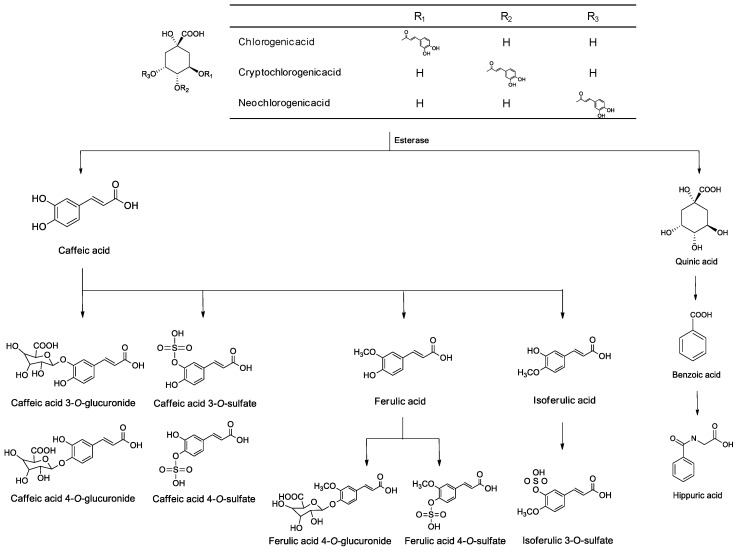
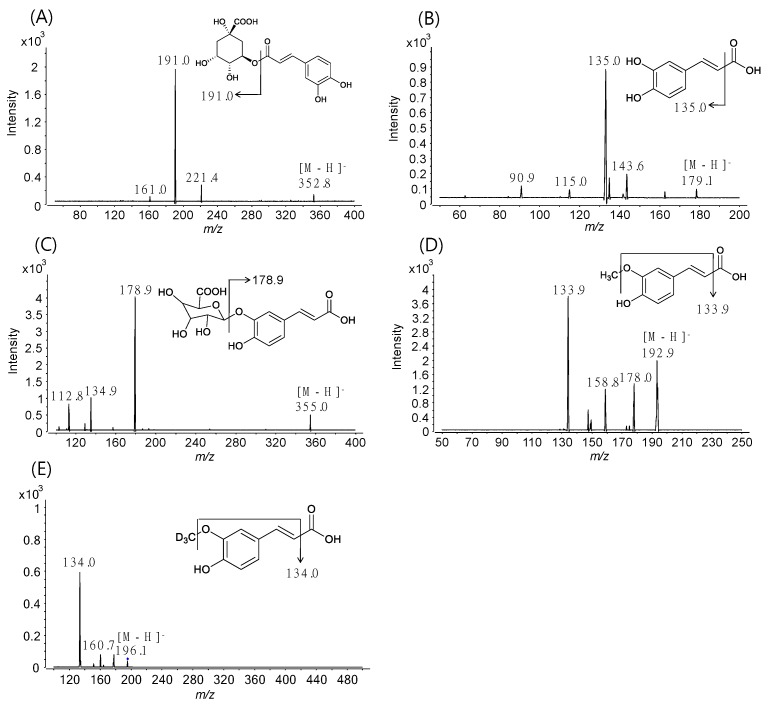
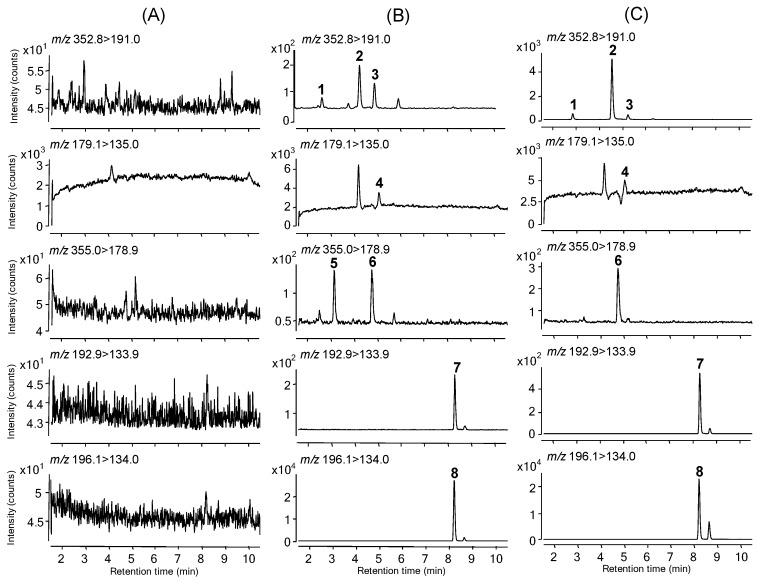
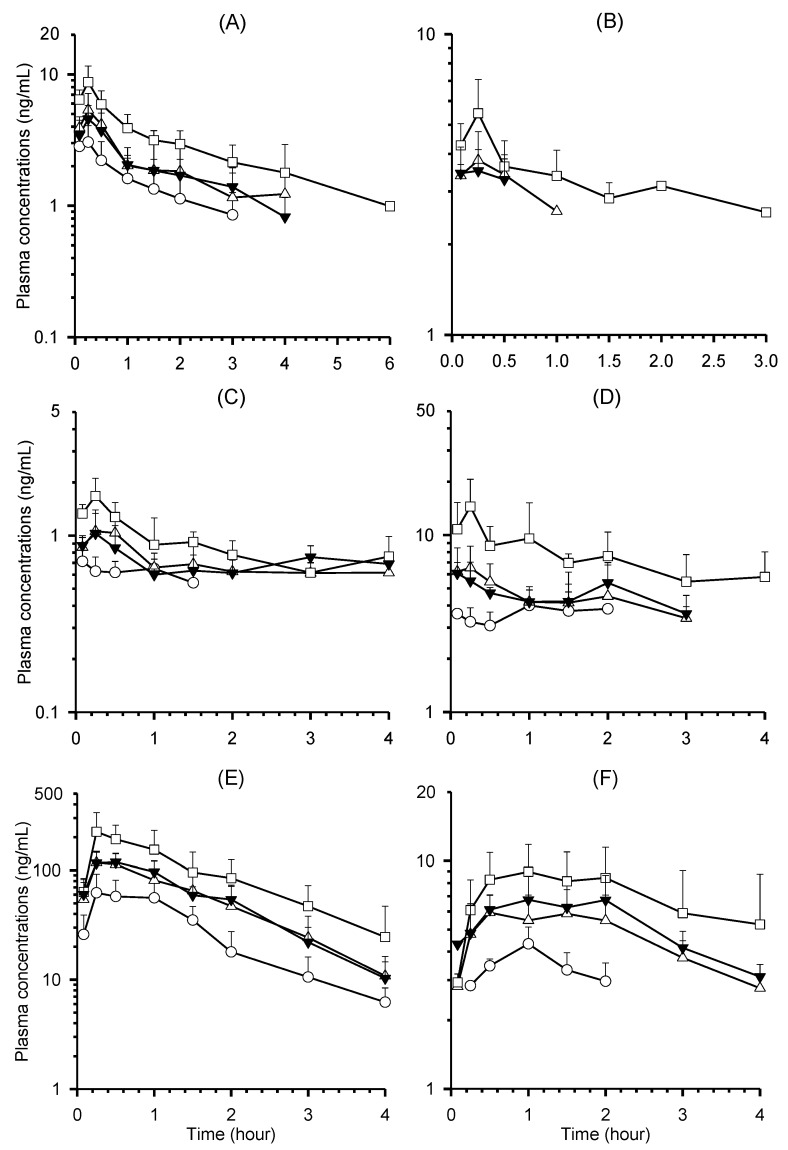
Stauntonia hexaphylla leaf extract (YRA-1909), which is widely used for the antirheumatic properties, has been under phase 2 clinical trials in patients with rheumatoid arthritis since April 2017. Liquid chromatography-tandem mass spectrometric method while using liquid–liquid extraction with ethyl acetate was validated for the simultaneous determination of the major active components of YRA-1909, including chlorogenic acid (CGA), neochlorogenic acid (NCGA), cryptochlorogenic acid (CCGA), and their metabolites (i.e., caffeic acid (CA), caffeic acid 3-O-glucuronide (CA-3-G), caffeic acid 4-O-glucuronide (CA-4-G), and ferulic acid (FA)) in rat plasma and applied to a pharmacokinetic study of YRA-1909 in rats. Seven analytes were separated on Halo C18 while using gradient elution of formic acid and methanol, and then quantified in selected reaction monitoring mode whle using negative electrospray ionization. Following oral administration of YRA-1909 at doses of 25, 50, and 100 mg/kg to male Sprague-Dawley rats, CGA, NCGA, and CCGA were rapidly absorbed and metabolized to CA, CA-3-G, and CA-4-G. The area under the plasma concentration-time curve (AUClast) of CGA, NCGA, CCGA, and three metabolites linearly increased as the YRA-1909 dose increased. Other pharmacokinetic parameters were comparable among three doses studied. AUClast values for CA, CA-3-G, and CA-4-G exceeded those for CGA, NCGA, and CCGA.
Overview
The claims and statistics of this paper haven’t been checked yet.
Run the check — free, no account needed. It reads the open-access text and checks the sources it cites.
Integrity signals
Registry
Cites
Statistics
Figures
Verification
Claims the paper makes
The claims and statistics of this paper haven’t been checked yet.
Run the check — free, no account needed. It reads the open-access text and checks the sources it cites.
Self-check
Percentages, sums and reported differences re-computed from the paper’s own numbers.
The self-check needs the paper’s full text.
Citations
The citation lists are queued
They are fetched later and appear here then.
References 30 · Cited by 25
Research works printed but not linked: 31
- Wang, 1998, A phenolic glycoside and triterpenoids from Stauntonia hexaphylla, Phytochemistry, 47, 467, 10.1016/S0031-9422(97)00588-8 · DOI
- Park, 2009, Chemical components and biological activity of Stauntonia hexaphylla, Korean J. Plant. Resour., 22, 403
- Cheon, Y.H., Baek, J.M., Park, S.H., Ahn, S.J., Lee, M.S., Oh, J., and Kim, J.Y. (2015). Stauntonia hexaphylla (Lardizabalaceae) leaf methanol extract inhibits osteoclastogenesis and bone resorption activity via proteasome-mediated degradation of c-Fos protein and suppression of NFATc1 expression. BMC Complement. Altern. Med., 15. · DOI
- Hwang, 2017, Inhibitory activities of Stauntonia hexaphylla leaf constituents on rat lens aldose reductase and formation of advanced glycation end products and antioxidant, Biomed. Res. Int., 2017, 4273257, 10.1155/2017/4273257 · DOI
- Kim, J., Kim, H., Choi, H., Jo, A., Kang, H., Yun, H., Im, S., and Choi, C. (2018). Anti-inflammatory effects of a Stauntonia hexaphylla Fruit Extract in lipopolysaccharide-activated RAW-264.7 macrophages and rats by carrageenan-induced hind paw swelling. Nutrients, 10. · DOI
- Yoo, H.J., Kim, J.Y., Kang, S.E., Yoo, J.S., Lee, Y., Lee, D.G., Park, J.S., Lee, E.B., Lee, E.Y., and Song, Y.W. (2017, January 6). YRA-1909 suppresses production of pro-inflammatory mediators and MMPs through downregulating Akt, p38, JNK and NF-κb activation in rheumatoid arthritis fibroblast-like synoviocytes. Proceedings of the 81st American College of Rheumatology and the 52nd Association of Rheumatology Health Professionals Annual Scientific Meeting, San Diego, CA, USA. Abstract Number, 1412.
- Sato, 2011, In vitro and in vivo antioxidant properties of chlorogenic acid and caffeic acid, Int. J. Pharm., 403, 136, 10.1016/j.ijpharm.2010.09.035 · DOI · Paper page
- Kurata, 2007, Growth suppression of human cancer cells by polyphenolics from sweetpotato (Ipomoea batatas L.) leaves, J. Agric. Food Chem., 55, 185, 10.1021/jf0620259 · DOI
- Ooi, 2006, Antiviral activities of purified compounds from Youngia japonica (L.) DC (Asteraceae, Compositae), J. Ethnopharmacol., 106, 187, 10.1016/j.jep.2005.12.028 · DOI
- Choi, 2017, Investigation of the anticoagulant and antithrombotic effects of chlorogenic acid, J. Biochem. Mol. Toxicol., 31, e21865, 10.1002/jbt.21865 · DOI
- Stalmach, 2010, Bioavailability of coffee chlorogenic acids and green tea flavan-3-ols, Nutrients, 2, 820, 10.3390/nu2080820 · DOI
- Farrell, 2011, Absorption and metabolism of chlorogenic acids in cultured gastric epithelial monolayers, Drug Metab. Dispos., 39, 2338, 10.1124/dmd.111.040147 · DOI
- Omar, 2012, Absorption, disposition, metabolism, and excretion of [3-(14)C] caffeic acid in rats, J. Agric. Food Chem., 60, 5205, 10.1021/jf3001185 · DOI
- Azuma, 2000, Absorption of chlorogenic acid and caffeic acid in rats after oral administration, J. Agric. Food Chem., 48, 5496, 10.1021/jf000483q · DOI
- Wong, 2010, In vitro and in vivo conjugation of dietary hydroxycinnamic acids by UDP-glucuronosyltransferases and sulfotransferases in humans, J. Nutr. Biochem., 21, 1060, 10.1016/j.jnutbio.2009.09.001 · DOI
- Piazzon, 2012, Antioxidant activity of phenolic acids and their metabolites: synthesis and antioxidant properties of the sulfate derivatives of ferulic and caffeic acids and of the acyl glucuronide of ferulic acid, J. Agric. Food Chem., 60, 12312, 10.1021/jf304076z · DOI
- Yamada, 1996, Antimutagenic activity of caffeic acid and related compounds, Biosci. Biotech. Biochem., 60, 328, 10.1271/bbb.60.328 · DOI
- Guo, 2015, A caffeic acid mediated facile synthesis of silver nanoparticles with powerful anti-cancer activity, Colloids Surf. B Biointerfaces, 134, 229, 10.1016/j.colsurfb.2015.06.070 · DOI
- Yang, 2015, Ferulic acid exerts anti-angiogenic and anti-tumor activity by targeting fibroblast growth factor receptor 1-mediated angiogenesis, Int. J. Mol. Sci., 16, 24011, 10.3390/ijms161024011 · DOI
- Shi, 2018, A comprehensive review of recent studies on pharmacokinetics of traditional Chinese medicines (2014–2017) and perspectives, Drug Metab. Rev., 50, 161, 10.1080/03602532.2017.1417424 · DOI
- Li, 2015, Challenges and solutions of pharmacokinetics for efficacy and safety of traditional chinese medicine, Curr. Drug Metab., 16, 765, 10.2174/138920021609151201114223 · DOI
- Jeong, 2011, Liquid chromatography-atmospheric pressure chemical ionization tandem mass spectrometry for the simultaneous determination of dimethoxyaschantin, dimethylliroresinol, dimethylpinoresinol, epimagnolin A, fargesin and magnolin in rat plasma, Biomed. Chromatogr., 25, 879, 10.1002/bmc.1538 · DOI
- Wang, 2013, Simultaneous determination of five phenolic components and paeoniflorin in rat plasma by liquid chromatography-tandem mass spectrometry and pharmacokinetic study after oral administration of Cerebralcare granule, J. Pharm. Biomed. Anal., 86, 82, 10.1016/j.jpba.2013.07.042 · DOI
- Zhou, 2013, Simultaneous determination of phenolic acids by UPLC-MS/MS in rat plasma and its application in pharmacokinetic study after oral administration of Flos Lonicerae preparations, J. Pharm. Biomed. Anal., 86, 189, 10.1016/j.jpba.2013.08.010 · DOI
- Pinto, 2013, Development and validation of methods for the extraction of phenolic acids from plasma, urine, and liver and analysis by UPLC-MS, J. Agric. Food Chem., 61, 6113, 10.1021/jf401534d · DOI
- Zhou, 2014, Simultaneous determination of caffeic acid derivatives by UPLC-MS/MS in rat plasma and its application in pharmacokinetic study after oral administration of Flos Lonicerae-Fructus Forsythiae herb combination, J. Chromatogr. B, 949–950, 7, 10.1016/j.jchromb.2013.12.035 · DOI
- Zeng, 2014, Simultaneous multi-component quantitation of Chinese herbal injection Yin-zhi-huang in rat plasma by using a single-tube extraction procedure for mass spectrometry-based pharmacokinetic measurement, J. Chromatogr B, 967, 245, 10.1016/j.jchromb.2014.07.037 · DOI
- Marmet, 2014, Quantification of phenolic acids and their methylates, glucuronides, sulfates and lactones metabolites in human plasma by LC-MS/MS after oral ingestion of soluble coffee, J. Pharm. Biomed. Anal., 88, 617, 10.1016/j.jpba.2013.10.009 · DOI
- Wang, 2015, Simultaneous determination of caffeic acid and its major pharmacologically active metabolites in rat plasma by LC-MS/MS and its application in pharmacokinetic study, Biomed. Chromatogr., 29, 552, 10.1002/bmc.3313 · DOI
- Chang, 2016, Simultaneous determination of four phenolic acids and seven alkaloids in rat plasma after oral administration of traditional Chinese medicinal preparation Jinqi Jiangtang Tablet by LC-ESI-MS/MS, J. Pharm. Biomed. Anal., 117, 1, 10.1016/j.jpba.2015.08.030 · DOI
- Jung, 2014, Pharmacokinetics of chlorogenic acid and corydaline in DA-9701, a new botanical gastroprokinetic agent, in rats, Xenobiotica, 44, 635, 10.3109/00498254.2013.874610 · DOI
Metadata
- Authors
- Choi, W.-G., Kim, J.-H., Kim, D. K., Lee, Y., Yoo, J. S., Shin, D. H., & Lee, H. S.
- Affiliations
- Catholic University of Korea (KR)
- Yeungnam University (KR)
- Central R&D Institute, YUNGJIN PHARM. CO., LTD., Suwon 16229, Korea
- Corresponding author
- Lee, Hye Suk
- Venue
- Pharmaceutics
- Publisher
- MDPI AG
- Published
- 2018-09-02
- Volume
- 10
- Issue
- 3
- Pages
- 143
- ISSN
- 1999-4923 (ISSN-L)
- PMC
- PMC6161084
- OpenAlex
- W2889429701
- Cited by
- 25
- References
- 30
- Citations by year
- 2026: 3 · 2025: 2 · 2024: 2 · 2023: 5 · 2022: 2 · 2021: 3 · 2020: 4 · 2019: 3
- FWCI
- 3.43
- Type
- journal article
- Language
- en
- Open access
- gold
- dx.doi.org
- Licence
- Locations
- Pharmaceutics (publishedVersion, cc-by)
- Europe PMC (PubMed Central) (publishedVersion, other-oa)
- PubMed Central (publishedVersion, cc-by)
- PubMed (publishedVersion)
- DOAJ (DOAJ: Directory of Open Access Journals) (submittedVersion, cc-by-sa)
- Funders
- Ministry of Trade, Industry and Energy (Technology Innovation Program (10051145))
- Topics
- Health Sciences › Medicine › Complementary and alternative medicine › Traditional Chinese Medicine Analysis
- Physical Sciences › Chemistry › Analytical Chemistry › Analytical Methods in Pharmaceuticals
- Life Sciences › Agricultural and Biological Sciences › Plant Science › Phytochemistry and Biological Activities
- Keywords
- chlorogenic acid, neochlorogenic acid, cryptochlorogenic acid, caffeic acid, ferulic acid, pharmacokinetics, oral administration, rat plasma, rheumatoid arthritis, herbal medicine
About these checks
Registry, retraction, Cites and statistics results are computed, not judged, with one exception: a printed reference that no index lists is read once by a model before it counts as a citation error. Claims are extracted by a model and kept only when their quote appears verbatim in the text; each cited source is then checked, with a model’s help, for whether it says what the claim relies on. Those verdicts can be wrong — read the claim’s quote and the cited source before relying on one.
Statistics and arithmetic are recomputed, not judged.
Confidence bands are shown only for fields calibrated on our annotated test set. None is calibrated yet, so no band is shown.
What counts as a claim ›How we measure confidence ›How we check this ›
Are you an author, or do you see a problem with this page? Request a review
How to cite
Cite CoChat for the checks on this page, and the paper for its own findings.
- This page
- CoChat. (2026). Citation check: Simultaneous Determination of Chlorogenic Acid Isomers and Metabolites in Rat Plasma Using LC-MS/MS and Its Application to A Pharmacokinetic Study Following Oral Administration of Stauntonia Hexaphylla Leaf Extract (YRA-1909) to Rats. https://app.cochat.ai/papers/10.3390/pharmaceutics10030143
- The paper
- Choi, W.-G., Kim, J.-H., Kim, D. K., Lee, Y., Yoo, J. S., Shin, D. H., & Lee, H. S. (2018). Simultaneous Determination of Chlorogenic Acid Isomers and Metabolites in Rat Plasma Using LC-MS/MS and Its Application to A Pharmacokinetic Study Following Oral Administration of Stauntonia Hexaphylla Leaf Extract (YRA-1909) to Rats. Pharmaceutics. https://doi.org/10.3390/pharmaceutics10030143
Data sources
Bibliographic data: Semantic Scholar, OpenAlex, Crossref.
Contains information from the Semantic Scholar Academic Graph Datasets, made available under the ODC Attribution License (ODC-BY 1.0).
Semantic Scholar’s data is described in: Kinney, R., et al. (2023). The Semantic Scholar Open Data Platform. arXiv:2301.10140.
