

The DOI matches its Crossref record.
Chemical Composition and Bioactivity of Dill Seed (Anethum graveolens L.) Essential Oil from Plants Grown under Shading
Abstract
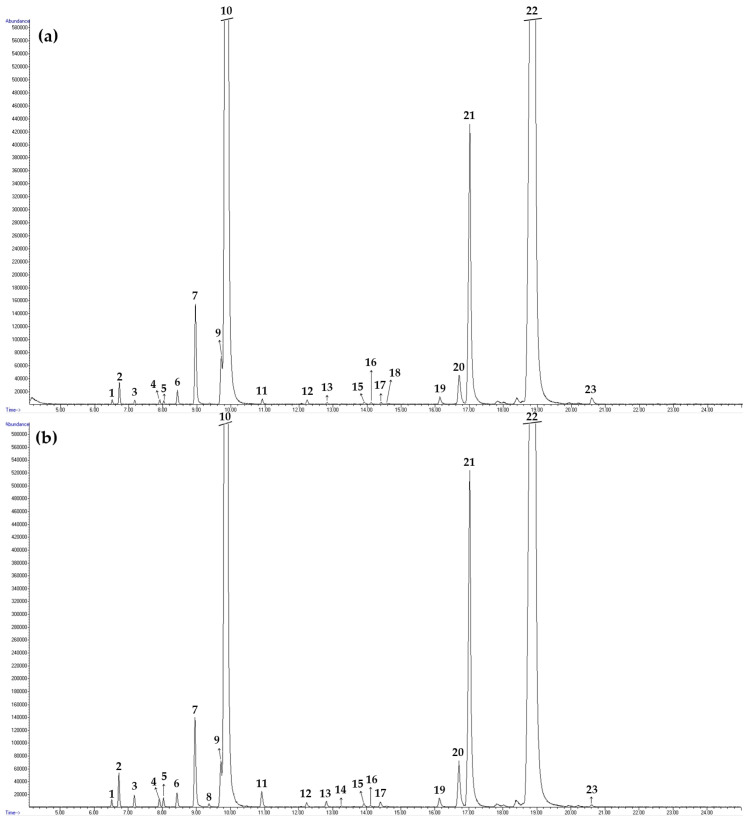
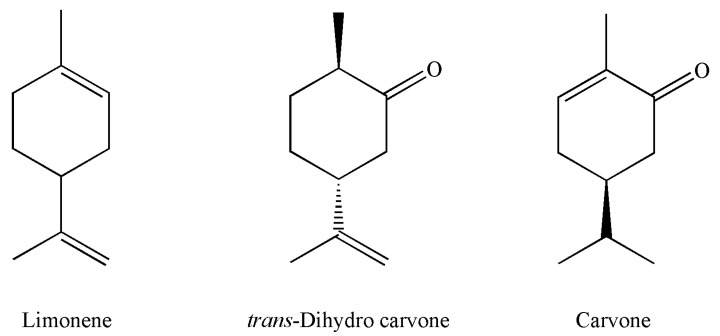
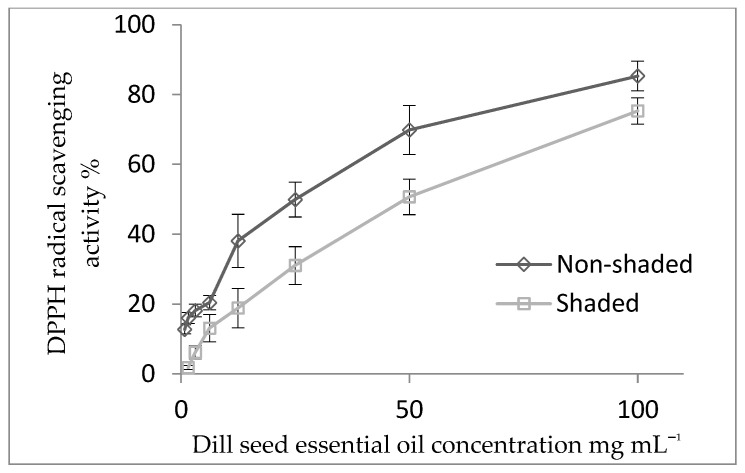
This study determined the content and composition of dill seed (Anethum graveolens L.) essential oil under varying light conditions: non-shaded plants in open fields and plants covered with pearl shade nets (40% shade index). Essential oil was extracted using Clevenger hydrodistillation. The essential oil content was 4.63% for non-shaded plants and 4.81% for shaded plants. GC/MS analysis revealed twenty-one and twenty-two components in dill seed from non-shaded and shaded plants, respectively. The terpenic fraction of essential oil from non-shaded plants consisted mainly of oxygen-containing monoterpene derivatives (53.6%), with carvone (46.1%) as the primary component, followed by monoterpene hydrocarbons (46.4%), predominantly limonene (43.8%). Essential oil from shaded plants contained a higher content of carvone (49.8%) and a lower content of limonene (37.8%) compared to essential oil from non-shaded plants. Non-shaded plant essential oil exhibited stronger antioxidant activity (EC50 value: 26.04 mg mL−1) than shaded plant essential oil (54.23 mg mL−1). Dill seed essential oil showed the most potent antimicrobial activity (disc diffusion method) against Escherichia coli (inhibition zone: 15–18 mm). Shaded plants demonstrated a positive influence of essential oil against Klebsiella pneumoniae. Carvone and its derivatives, as the main components, hold significant potential in the food industry and alternative medicines. A practical implication of this study could be higher plant densities or intercropping of dill, as it thrives with minimal light.
Overview
The claims and statistics of this paper haven’t been checked yet.
Run the check — free, no account needed. It reads the open-access text and checks the sources it cites.
Integrity signals
Registry
Cites
Statistics
Figures
Verification
Claims the paper makes
The claims and statistics of this paper haven’t been checked yet.
Run the check — free, no account needed. It reads the open-access text and checks the sources it cites.
Claims other papers make about this one
Each is checked against this paper’s own text: does it say what the citing paper says it does?
In the citing paper
“The higher carvotanacetone percentage reported in the current study may therefore indicate a specific chemotype of the plant.”
From Maceration, Soxhlet Extraction, and Steam Hydrodistillation of Anethum graveolens Seeds: Phytochemical Profiles and Cytotoxic Effects (2026) · cites this paper as [15]
Self-check
Percentages, sums and reported differences re-computed from the paper’s own numbers.
The self-check needs the paper’s full text.
Citations
Cites
No references could be resolved yet.
Research works printed but not linked: 58
- Mohebodini, 2021, Comparative chemical composition of essential oils in dill (Anethum graveolens L.) ecotypes: Focus on Univariate and Factor Analysis, Int. J. Hortic. Sci. Technol., 8, 81
- Olaoluwa, 2022, Ethnopharmacology, phytochemistry and biological activities of selected African species of the genus Ficus L., Trends Phytochem. Res., 6, 46
- Sarhan, 2015, Essential oils of Anethum graveolens L.: Chemical composition and their antimicrobial activities at vegetative, flowering and fruiting stages of development, Int. J. Plant Sci. Ecol., 1, 98
- AguiarCampolina, 2023, Essential oil and plant extracts as preservatives and natural antioxidants applied to meat and meat products: A Review, Food Technol. Biotechnol., 61, 212, 10.17113/ftb.61.02.23.7883 · DOI
- 2015, The yield, composition and hydrodistillation kinetics of the essential oil of dill seeds (Anethi fructus) obtained by different hydrodistillation techniques, Ind. Crops Prod., 65, 429, 10.1016/j.indcrop.2014.10.067 · DOI
- Ozliman, S., Yaldiz, G., Camlica, M., and Ozsoy, N. (2021). Chemical components ofessential oils and biological activities of the aqueous extract of Anethum graveolens L. grown under inorganic and organic conditions. Chem. Biol. Technol. Agric., 8. · DOI · Paper page
- Li, 2018, The antioxidation of different fractions of dill (Anethum graveolens) and their influences on cytokines in macrophages RAW264.7, J. Oleo Sci., 67, 1535, 10.5650/jos.ess18134 · DOI
- Ulus, 2023, Dill seed oil as a possible contraceptive agent: Antiangiogenic effects on endothelial cells, Braz. J. Pharm. Sci., 59, e20060
- Youssef, 2013, Medicinal and non-medicinal uses of some plants found in the middle region of Saudi Arabia, J. Med. Plants Res., 7, 2501
- Aati, 2022, Headspace solid-phase microextraction method for extracting volatile constituents from the different parts of Saudi Anethum graveolens L. and their antimicrobial activity, Heliyon, 8, e09051, 10.1016/j.heliyon.2022.e09051 · DOI
- Gomaa, 2021, Phenolic content of dill seed extracts as antifungal agent against Aspergillus spp. Middle East, J. Agric. Res., 10, 1310
- 2016, Dill (Anethum graveolens L.) seeds essential oil as a potential natural antioxidant and antimicrobial agent, Biol. Nyssana, 7, 31
- Chaubey, 2021, Insecticidal activities of Anethum graveolens L. and Illicium verum Hook. f. essential oıls against Sitophilus zeamais Motschulsky, Rev. Cienc. Agrícolas, 38, 38, 10.22267/rcia.213801.143 · DOI
- Karanisa, 2015, Effect of postharvest application of carvone on potato tubers grown from true potato seed (TPS), Proced. Environ. Sci., 29, 166, 10.1016/j.proenv.2015.07.242 · DOI
- Sarhan, 2015, Volatile oil composition of Anethum graveolens affected by harvest stage, Int. J. Plant Sci. Ecol., 1, 93
- Omer, 2016, Impact of cultivar and harvest time on growth, production and essential oil of Anethum graveolens cultivated in Egypt, Int. J. Pharm. Pharm. Sci., 8, 54
- Tabanca, 2018, Headspace-SPME/GC-MS analysis of the Anethum graveolens L. volatiles from Saudi Arabia with different fibers coatings, Nat. Volatiles Essent. Oils, 5, 29
- Jirovetz, 2003, Composition, quality control, and antimicrobial activity of the essential oil of long-time stored dill (Anethum graveolens L.) seeds from Bulgaria, J. Agric. Food Chem., 51, 3854, 10.1021/jf030004y · DOI · Paper page
- Wasowicz, 2002, Estimation of the main dill seeds odorant carvone by solid-phase micro-extraction and gas chromatography, Nahrung, 46, 357, 10.1002/1521-3803(20020901)46:5<357::AID-FOOD357>3.0.CO;2-W · DOI
- Wall, 1986, The effect of herbicides and weeds on the yields and composition of dill (Anethum graveolens L.) oil, Crop Prot., 5, 137, 10.1016/0261-2194(86)90095-5 · DOI
- Fallik, 2017, Light quality manipulation improves vegetables quality at harvest and postharvest: A review, Environ. Exp. Bot., 139, 79, 10.1016/j.envexpbot.2017.04.006 · DOI
- Lalevic, D., Ilic, Z.S., Stanojevic, L., Milenkovic, L., Šunic, L., Kovac, R., Kovacevic, D., Danilovic, B., Milenkovic, A., and Stanojevic, J. (2023). Shade-induced effects on essential oil yield, chemical profiling, and biological activity in some Lamiaceae plants cultivated in Serbia. Horticulturae, 9. · DOI
- 2022, Essential oils content, composition and antioxidant activity of lemon balm, mint and sweet basil from Serbia, LWT—Food Sci. Technol., 153, 112210, 10.1016/j.lwt.2021.112210 · DOI
- Buthelezi, M.N.D. (2015). Effect of Photo-Selective Netting on Postharvest Quality and Bioactive Compounds in Three Selected Summer Herbs (Coriander, Marjoram and Oregano). [Master’s Thesis, Department of Crop Sciences, Faculty of Science, Tshwane University of Technology].
- 2021, Modification of light intensity influence essential oils content, composition and antioxidant activity of thyme, marjoram and oregano, Saudi J. Biol. Sci., 28, 6532, 10.1016/j.sjbs.2021.07.018 · DOI
- Ilić, Z., Stanojević, L., Milenković, L., Šunić, L., Milenković, A., Stanojević, J., and Cvetković, D. (2022). The yield, chemical composition, and antioxidant activities of essential oils from different plant parts of the wild and cultivated oregano (Origanum vulgare L.). Horticulturae, 8. · DOI
- 2022, Aroma profile and antioxidant activity of sweet basil aqueous extracts affect by light modification, J. Essent. Oil Bear. Plants, 25, 1131, 10.1080/0972060X.2022.2124888 · DOI
- Ilić, S.Z., Milenković, L., Šunić, L., Tmušić, N., Mastilović, J., Kevrešan, Ž., Stanojević, L., Danilović, B., and Stanojević, J. (2021). Efficiency of basil essential oil antimicrobial agents under different shading treatments and harvest times. Agronomy, 11. · DOI
- Kazemini, 2022, Chemical composition, biological activities, and nutritional application of Asteraceae family herbs: A systematic review, Trends Phytochem. Res., 6, 187
- Kiehlbauch, 2000, Use of the national committee for clinical laboratory standards guidelines for disk diffusion susceptibility testing in New York State Laboratories, J. Clin. Microbiol., 38, 3341, 10.1128/JCM.38.9.3341-3348.2000 · DOI
- Stagnari, 2018, Light quantity and quality supplies sharply affect growth, morphological, physiological and quality traits of basil, Ind. Crops Prod., 122, 277, 10.1016/j.indcrop.2018.05.073 · DOI
- 2023, Phytochemical composition and antimicrobial activities of the essential oils from summer savory (Satureja hortensis L.) growing in shading condition, J. Essent. Oil Bear. Plants, 26, 6
- Sikora, 2019, Yield of biomass and essential oil of dill (Anethum graveolens L.) grown under irrigation, Ratar. Povrt., 56, 49, 10.5937/ratpov56-19792 · DOI
- Bowes, 2004, Influence of seeding date and harvest stage on yields and essential oil composition of three cultivars of dill (Anethum graveolens L.) grown in Nova Scotia, Can. J. Plant Sci., 84, 1155, 10.4141/P03-202 · DOI
- Wander, 1998, Effects of nitrogen fertilization on dill (Anethum graveolens L.) seed and carvone production, Ind. Crops Prod., 7, 211, 10.1016/S0926-6690(97)00050-2 · DOI
- Bailer, 2001, Essential oil content and composition in commercially available dill cultivars in comparison to caraway, Ind. Crops Prod., 14, 229, 10.1016/S0926-6690(01)00088-7 · DOI
- Popescu, 2010, Chemical composition of the volatile oil from different plant parts of Anethum graveolens L. (Umbelliferae) cultivated in Romania, Farmacia, 58, 594
- Yili, 2009, Chemical composition and antimicrobial activity of essential oil from seeds of Anethum graveolens growing in Uzbekistan, Chem. Nat. Compd., 45, 280, 10.1007/s10600-009-9275-4 · DOI
- Popescu, V., Ciocarlan, A., Dragalin, I., Lungu, L., and Arîcu, A. (2021, January 21). Chemical composition of essential oil of dill (Anethum graveolens L.) growing in Republic of Moldova. Scientific seminar. Proceedings of the New Frontiers in Natural Product Chemistry. Book of Abstract, Chișinău, Moldova. · DOI
- Khaldi, 2015, Chemical composition and antifungal activity of essential oil of Anethum graveolens L. from Southwestern Algeria (Bechar), J. Chem. Pharm. Res., 7, 615
- Salehiarjmand, 2014, Essential oils main constituents and antibacterial activity of seeds from Iranian local landraces of dill (Anethum graveolens L.), J. Hortic. For. Biotechnol., 18, 1
- Biesiada, 2019, Nutritional value of garden dill (Anethum graveolens L.), depending on genotype, Not. Bot. Horti Agrobot. Cluj-Napoca, 47, 784
- El-Zaeddi, H., Martínez-Tomé, J., Calín-Sánchez, A., Burló, F., and Carbonell-Barrachina, A. (2016). Volatile composition of essential oils from different aromatic herbs grown in Mediterranean regions of Spain. Foods, 5. · DOI
- Sharopov, 2013, Composition and bioactivity of the essential oil of Anethum graveolens L. from Tajikistan, Int. J. Med. Aromat. Plants, 3, 125
- Sefidkon, 2001, Essential oil composition of Anethum graveolens L., Iran. J. Med. Aromat. Plants Res., 8, 45
- Kruger, 1996, A new chemotype of Anethum graveolens L., J. Essent. Oil Res., 8, 205, 10.1080/10412905.1996.9700596 · DOI
- Benlembarek, 2022, Chemical composition and biological activities of Anethum graveolens L. essential oil from Algeria, J. Essent. Oil Bear. Plants, 25, 5, 10.1080/0972060X.2022.2113149 · DOI · Paper page
- Chahal, 2016, Antifungal potential of dill seed essential oil and its constituents, Indian J. Ecol., 43, 903
- Alsahli, 2019, Light effects on growth and essential oil quantity and constituents in some Apiaceae plants, Afr. J. Agric. Res., 14, 1262, 10.5897/AJAR2019.14051 · DOI
- Burlo, 2017, Irrigation dose and plant density affect the volatile composition and sensory quality of dill (Anethum graveolens L.), J. Sci. Food Agric., 97, 427, 10.1002/jsfa.7890 · DOI
- Jianu, C., Mişcă, C., Stoin, D., Bujancă, G., and Lukinich-Gruia, T.A. (2018, January 2–8). Chemical composition and antioxidant properties of dill essential oil. Proceedings of the International Multidisciplinary Scientific GeoConference: SGEM, Sofia, Bulgaria. · DOI
- Kazemi, 2015, Phenolic profile, antioxidant capacity and anti-inflammatory activity of Anethum graveolens L. essential oil, Nat. Prod. Res., 29, 551, 10.1080/14786419.2014.951934 · DOI
- Nanasombat, 2011, Antimicrobial and antioxidant activity of spice essential oils, Food Sci. Biotechnol., 20, 45, 10.1007/s10068-011-0007-8 · DOI
- Kaur, 2020, A review on dill essential oil and its chief compounds as natural biocide, Flavour Fragr. J., 36, 412, 10.1002/ffj.3633 · DOI
- Dahiya, 2012, Phytochemical analysis and antibacterial efficacy of dill seed oil against multi-drug resistant clinical isolates, Asian J. Pharm. Clin. Res., 5, 62
- Kavaz, 2019, Physiochemical characterization, antioxidative, anticancer cells proliferation and food pathogens antibacterial activity of chitosan nanoparticles loaded with Cyperus articulatus rhizome essential oils, Int. J. Biol. Macromol., 123, 837, 10.1016/j.ijbiomac.2018.11.177 · DOI
- Delshadi, 2020, Micro and nanoencapsulation of vegetable and essential oils to develop functional food products with improved nutritional profiles, Trends Food Sci. Technol., 104, 72, 10.1016/j.tifs.2020.07.004 · DOI
- Hasheminejad, 2019, Improving the antifungal activity of clove essential oil encapsulated by chitosan nanoparticles, Food Chem., 275, 113, 10.1016/j.foodchem.2018.09.085 · DOI
Cited by
Farmanpour Kalalagh, K., Mohebodini, M., Sabaghnia, N., Beyraghdar Kashkooli, A., & Esmaeili, H. (2025) · PLOS One · doi:10.1371/journal.pone.0327018 · Cited by 4
Goldiș, C., Racoviceanu, R., Negrea-Ghiulai, R., Mioc, A., Prodea, A., Atyim, E., Maksimovic, T., Lukinich-Gruia, A. T., Pricop, M.-A., & Șoica, C. (2026) · Molecules · doi:10.3390/molecules31183337
Metadata
- Authors
- Milenković, L., Ilić, Z. S., Stanojević, L., Danilović, B., Šunić, L., Kevrešan, Ž., Stanojević, J., & Cvetković, D.
- Venue
- Plants
- Publisher
- MDPI AG
- Published
- 2024-03-19
- Volume
- 13
- Issue
- 6
- Pages
- 886
- ISSN
- 2223-7747
- PMC
- PMC10974297
- Cited by
- 31
- References
- 0
- Language
- en
- Funders
- Ministry of Education Science and Technological Development (451-03-47/2023-01/200133, 451-422 03-47/2023-01/200189)
About these checks
Registry, retraction, Cites and statistics results are computed, not judged, with one exception: a printed reference that no index lists is read once by a model before it counts as a citation error. Claims are extracted by a model and kept only when their quote appears verbatim in the text; each cited source is then checked, with a model’s help, for whether it says what the claim relies on. Those verdicts can be wrong — read the claim’s quote and the cited source before relying on one.
Statistics and arithmetic are recomputed, not judged.
Confidence bands are shown only for fields calibrated on our annotated test set. None is calibrated yet, so no band is shown.
What counts as a claim ›How we measure confidence ›How we check this ›
Are you an author, or do you see a problem with this page? Request a review
