

The DOI matches its Crossref record.
Chitosan: Gels and Interfacial Properties
Abstract
Chitosan is a unique biopolymer in the respect that it is abundant, cationic, low-toxic, non-immunogenic and biodegradable. The relative occurrence of the two monomeric building units (N-acetyl-glucosamine and d-glucosamine) is crucial to whether chitosan is predominantly an ampholyte or predominantly a polyelectrolyte at acidic pH-values. The chemical composition is not only crucial to its surface activity properties, but also to whether and why chitosan can undergo a sol–gel transition. This review gives an overview of chitosan hydrogels and their biomedical applications, e.g., in tissue engineering and drug delivery, as well as the chitosan’s surface activity and its role in emulsion formation, stabilization and destabilization. Previously unpublished original data where chitosan acts as an emulsifier and flocculant are presented and discussed, showing that highly-acetylated chitosans can act both as an emulsifier and as a flocculant.
Overview
The claims and statistics of this paper haven’t been checked yet.
Run the check — free, no account needed. It reads the open-access text and checks the sources it cites.
Integrity signals
Registry
Cites
Statistics
Figures
Verification
Claims the paper makes
The claims and statistics of this paper haven’t been checked yet.
Run the check — free, no account needed. It reads the open-access text and checks the sources it cites.
Claims other papers make about this one
Each is checked against this paper’s own text: does it say what the citing paper says it does?
In the citing paper
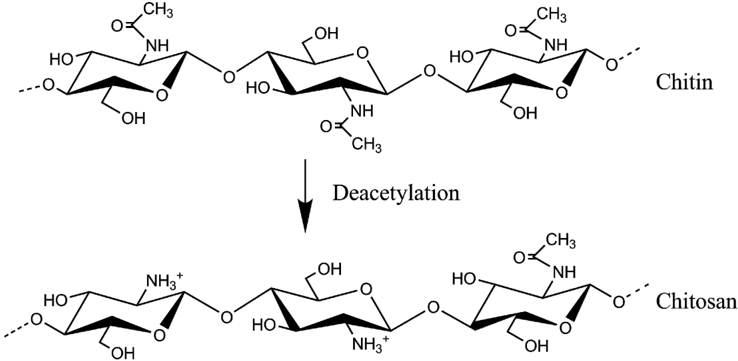
“Chitosan, the partially deacetylated form of chitin, can be obtained by chitin deacetylase enzyme or chemical alkaline treatment using concentrating NaOH as shown in (Figure 2).124,125”
From Current Advances in Chitosan Nanoparticles Based Oral Drug Delivery for Colorectal Cancer Treatment (2022) · cites this paper as [125]
Self-check
Percentages, sums and reported differences re-computed from the paper’s own numbers.
The self-check needs the paper’s full text.
Citations
Cites
No references could be resolved yet.
Research works printed but not linked: 115
- Steinbüchel, A., and Rhee, S.K. (2005). Polysaccharides and Polyamides in the Food Industry, Wiley-VCH Verlag GmbH.
- Dimitriu, S. (2005). Polysaccharides: Structural Diversity and Functional Versatility, Marcel Decker. · DOI
- Strand, 2001, Electrophoretic light scattering studies of chitosans with different degrees of N-acetylation, Biomacromolecules, 2, 1310, 10.1021/bm015598x · DOI
- Kim, 2015, Chitosan to connect biology to electronics: Fabricating the bio-device interface and communicating across this interface, Polymers, 7, 1, 10.3390/polym7010001 · DOI
- Holme, 1996, Determination of enzymatic hydrolysis specificity of partially N-acetylated chitosans, Biochim. Biophys. Acta, 1291, 5, 10.1016/0304-4165(96)00038-4 · DOI
- Nordtveit, 1996, Degradation of partially N-acetylated chitosans with hen egg white and human lysozyme, Carbohydr. Polym., 29, 163, 10.1016/0144-8617(96)00003-3 · DOI
- Strand, 2010, Molecular design of chitosan gene delivery systems with an optimized balance between polyplex stability and polyplex unpacking, Biomaterials, 31, 975, 10.1016/j.biomaterials.2009.09.102 · DOI
- Mumper, 1995, Novel polymeric condensing carriers for gene delivery, Proc. Int. Symp. Control Release Bioact. Mater., 22, 178
- Croisier, 2013, Chitosan-based biomaterials for tissue engineering, Eur. Polym. J., 49, 780, 10.1016/j.eurpolymj.2012.12.009 · DOI
- Berger, 2004, Structure and interactions in covalently and ionically crosslinked chitosan hydrogels for biomedical applications, Eur. J. Pharm. Biopharm., 57, 19, 10.1016/S0939-6411(03)00161-9 · DOI
- Yao, K.D., Yao, F.L., Li, J.J., Yin, Y.J., Jarry, C., and Shive, M.S. (2008). Smart Materials, CRC Press.
- Ta, 2008, Injectable chitosan hydrogels for localised cancer therapy, J. Control. Release, 126, 205, 10.1016/j.jconrel.2007.11.018 · DOI
- Kaur, 2014, The versatile biopolymer chitosan: Potential sources, evaluation of extraction methods and applications, Crit. Rev. Microbiol., 40, 155, 10.3109/1040841X.2013.770385 · DOI
- Bhattarai, 2010, Chitosan-based hydrogels for controlled, localized drug delivery, Adv. Drug. Deliv. Rev., 62, 83, 10.1016/j.addr.2009.07.019 · DOI
- 1994, Water-solubility of partially N-acetylated chitosans as a function of pH: Effect of chemical composition and depolymerisation, Carbohydr. Polym., 25, 65, 10.1016/0144-8617(94)90140-6 · DOI
- Vachoud, 2000, Physicochemical behaviour of chitin gels, Carbohydr. Res., 326, 295, 10.1016/S0008-6215(00)00038-0 · DOI
- Chenite, 2001, Rheological characterisation of thermogelling chitosan/glycerol-phosphate solutions, Carbohydr. Polym., 46, 39, 10.1016/S0144-8617(00)00281-2 · DOI
- Lavertu, 2008, Heat-induced transfer of protons from chitosan to glycerol phosphate produces chitosan precipitation and gelation, Biomacromolecules, 9, 640, 10.1021/bm700745d · DOI
- Montembault, 2005, Rheometric study of the gelation of chitosan in aqueous solution without cross-linking agent, Biomacromolecules, 6, 653, 10.1021/bm049593m · DOI
- Ladet, 2008, Multi-membrane hydrogels, Nature, 452, 76, 10.1038/nature06619 · DOI
- Rami, 2014, Physicochemical modulation of chitosan-based hydrogels induces different biological responses: Interest for tissue engineering, J. Biomed. Mater. Res. A, 102, 3666, 10.1002/jbm.a.35035 · DOI
- Shu, 2002, Controlled drug release properties of ionically cross-linked chitosan beads: The influence of anion structure, Int. J. Pharm., 233, 217, 10.1016/S0378-5173(01)00943-7 · DOI
- Draget, 1992, Chitosan cross-linked with Mo (VI) polyoxyanions: A new gelling system, Biomaterials, 13, 635, 10.1016/0142-9612(92)90032-J · DOI
- Dambies, 2001, Preparation of chitosan gel beads by ionotropic molybdate gelation, Biomacromolecules, 2, 1198, 10.1021/bm010083r · DOI
- Luo, 2014, Recent development of chitosan-based polyelectrolyte complexes with natural polysaccharides for drug delivery, Int. J. Biol. Macromol., 64, 353, 10.1016/j.ijbiomac.2013.12.017 · DOI
- Tsuchida, 1982, Interactions between macromolecules in solution and intermolecular complexes, Adv. Polym. Sci., 45, 1, 10.1007/BFb0017549 · DOI
- Holme, 2008, Polyelectrolyte complex formation using alginate and chitosan, Carbohydr. Polym., 74, 813, 10.1016/j.carbpol.2008.04.048 · DOI
- Khong, 2013, Gelling concept combining chitosan and alginate—Proof of principle, Biomacromolecules, 14, 2765, 10.1021/bm400610b · DOI
- Draget, 1996, Associating phenomena in highly acetylated chitosan gels, Polym. Gels Netw., 4, 143, 10.1016/0966-7822(96)00006-8 · DOI
- Strand, 2011, Preparation and characterization of branched chitosans, Carbohydr. Polym., 83, 1558, 10.1016/j.carbpol.2010.10.008 · DOI
- Goycoolea, 1998, Rheological study of the chitosan/glutaraldehyde chemical gel system, Polym. Gels Netw., 6, 429, 10.1016/S0966-7822(98)00032-X · DOI
- Andersson, 2011, Improved immune responses in mice using the novel chitosan adjuvant ViscoGel, with a Haemophilus influenzae type b glycoconjugate vaccine, Vaccine, 29, 8965, 10.1016/j.vaccine.2011.09.041 · DOI
- Rinaudo, 2010, New way to crosslink chitosan in aqueous solution, Eur. Polym. J., 46, 1537, 10.1016/j.eurpolymj.2010.04.012 · DOI
- Simi, 2010, Transparent xyloglucan–chitosan complex hydrogels for different applications, Food Hydrocoll., 24, 72, 10.1016/j.foodhyd.2009.08.007 · DOI
- Guo, 1998, Gelation kinetics of scleraldehyde–chitosan co-gels, Polym. Gels Netw., 6, 113, 10.1016/S0966-7822(98)00005-7 · DOI
- Christensen, 2001, Gelation of periodate oxidised scleroglucan (scleraldehyde), Carbohydr. Polym., 46, 241, 10.1016/S0144-8617(00)00327-1 · DOI
- Hennink, 2012, Novel crosslinking methods to design hydrogels, Adv. Drug. Deliv. Rev., 64, 223, 10.1016/j.addr.2012.09.009 · DOI
- Kim, 2008, Chitosan and its derivatives for tissue engineering applications, Biotech. Adv., 26, 1, 10.1016/j.biotechadv.2007.07.009 · DOI
- Anitha, 2014, Chitin and chitosan in selected biomedical applications, Prog. Polym. Sci., 39, 1644, 10.1016/j.progpolymsci.2014.02.008 · DOI
- Chenite, 2000, Novel injectable neutral solutions of chitosan form biodegradable gels in situ, Biomaterials, 21, 2155, 10.1016/S0142-9612(00)00116-2 · DOI
- Dunnhaupt, 2012, Chitosan-based drug delivery systems, Eur. J. Pharm. Biopharm., 81, 463, 10.1016/j.ejpb.2012.04.007 · DOI
- Agarwal, 2013, Injectable implants for the sustained release of protein and peptide drugs, Drug Discov. Today, 18, 337, 10.1016/j.drudis.2013.01.013 · DOI
- Luppi, 2010, Chitosan-based hydrogels for nasal drug delivery: From inserts to nanoparticles, Exp. Opin. Drug Deliv., 7, 811, 10.1517/17425247.2010.495981 · DOI
- Bhise, 2008, Effect of drying methods on swelling, erosion and drug release from chitosan-naproxen sodium complexes, AAPS PharmSciTech, 9, 1, 10.1208/s12249-007-9001-0 · DOI
- Dutta, 2009, Perspectives for chitosan based antimicrobial films in food applications, Food Chem., 114, 1173, 10.1016/j.foodchem.2008.11.047 · DOI
- Xia, 2011, Biological activities of chitosan and chitooligosaccharides, Food Hydrocoll., 25, 170, 10.1016/j.foodhyd.2010.03.003 · DOI
- Norowski, 2009, Biomaterial and antibiotic strategies for peri-implantitis, J. Biomed. Mater. Res., 88B, 530, 10.1002/jbm.b.31152 · DOI
- Ong, 2008, Development of a chitosan-based wound dressing with improved hemostatic and antimicrobial properties, Biomaterials, 29, 4323, 10.1016/j.biomaterials.2008.07.034 · DOI
- Jayakumar, 2011, Biomaterials based on chitin and chitosan in wound dressing applications, Biotech. Adv., 29, 322, 10.1016/j.biotechadv.2011.01.005 · DOI
- Walstra, P. (2003). Physical Chemistry of Foods, Marcel Dekker. · DOI
- Dickinson, 2003, Hydrocolloids at interfaces and the influence on the properties of dispersed systems, Food Hydrocoll., 17, 25, 10.1016/S0268-005X(01)00120-5 · DOI
- McClements, D.J. (2005). Food Emulsions: Principles, Practices and Techniques, CRC Press. · DOI
- Norde, W. (2003). Colloids and Interfaces in Life Sciences, Marcel Dekker. · DOI
- Rodriguez, 1999, Influence of the deacetylation degree on chitosan emulsification properties, Colloid Polym. Sci., 277, 1087, 10.1007/s003960050495 · DOI
- Schulz, 1998, Emulsification properties of chitosan, Colloid Polym. Sci., 276, 1159, 10.1007/s003960050359 · DOI
- Albertengo, 2002, Emulsification capacity of chitosan, Carbohydr. Polym., 48, 271, 10.1016/S0144-8617(01)00258-2 · DOI
- Li, 2011, Effects of concentration, degree of deacetylation and molecular weight on emulsifying properties of chitosan, Int. J. Biol. Macromol., 48, 768, 10.1016/j.ijbiomac.2011.02.016 · DOI
- Liu, 2012, Simple, reversible emulsion system switched by pH on the basis of chitosan without any hydrophobic modification, Langmuir, 28, 11017, 10.1021/la3021113 · DOI
- Payet, 2008, Emulsification and stabilization mechanisms of O/W emulsions in the presence of chitosan, Langmuir, 24, 12247, 10.1021/la8019217 · DOI
- Pepic, 2008, Interactions in a nonionic surfactant and chitosan mixtures, Colloid Surface A, 327, 95, 10.1016/j.colsurfa.2008.06.009 · DOI
- 2006, Comblike poly(ethylene oxide)/hydrophobic C6 branched chitosan surfactant polymers as anti-infection surface modifying agents, Colloid Surface B, 49, 117, 10.1016/j.colsurfb.2006.03.007 · DOI
- Qun, 2006, Effects of molecular weight, degree of acetylation and ionic strength on surface tension of chitosan in dilute solution, Carbohydr. Polym., 64, 29, 10.1016/j.carbpol.2005.10.026 · DOI
- Babak, 1999, Interfacial properties of dynamic association between chitin derivatives and surfactants, Colloid Surface A, 147, 139, 10.1016/S0927-7757(98)00752-3 · DOI
- Geng, 2005, Electrospinning of chitosan dissolved in concentrated acetic acid solution, Biomaterials, 26, 5427, 10.1016/j.biomaterials.2005.01.066 · DOI
- Calero, 2010, Flow behaviour, linear viscoelasticity and surface properties of chitosan aqueous solutions, Food Hydrocoll., 24, 659, 10.1016/j.foodhyd.2010.03.009 · DOI
- Sletmoen, 2014, Stability and interaction forces of oil-in-water emulsions as observed by optical tweezers—A proof-of-concept study, RSC Adv., 4, 52220, 10.1039/C4RA07140A · DOI
- Klinkesorn, 2013, The role of chitosan in emulsion formation and stabilization, Food Rev. Int., 29, 371, 10.1080/87559129.2013.818013 · DOI
- Guzey, 2006, Formation, stability and properties of multilayer emulsions for application in the food industry, Adv. Colloid Interface Sci., 128–130, 227, 10.1016/j.cis.2006.11.021 · DOI
- Guzey, 2006, Influence of environmental stresses on O/W emulsions stabilized by β-lactoglobulin-pectin and β-lactoglobulin-pectin-chitosan membranes produced by the electrostatic layer-by-layer deposition technique, Food Biophys., 1, 30, 10.1007/s11483-005-9002-z · DOI
- Gudipati, 2010, Oxidative stability and in vitro digestibility of fish oil-in-water emulsions containing multilayered membranes, J. Agric. Food Chem., 58, 8093, 10.1021/jf101348c · DOI
- Klinkesorn, 2005, Encapsulation of emulsified tuna oil in two-layered interfacial membranes prepared using electrostatic layer-by-layer deposition, Food Hydrocoll., 19, 1044, 10.1016/j.foodhyd.2005.01.006 · DOI
- Klinkesorn, 2006, Characterization of spray-dried tuna oil emulsified in two-layered interfacial membranes prepared using electrostatic layer-by-layer deposition, Food Res. Int., 39, 449, 10.1016/j.foodres.2005.09.008 · DOI
- Calvo, 1997, Development of positively charged colloidal drug carriers: Chitosan coated polyester nanocapsules and submicron-emulsions, Colloid Polym. Sci., 275, 46, 10.1007/s003960050050 · DOI
- Mun, 2005, Influence of droplet characteristics on the formation of oil-in-water emulsions stabilized by surfactant-chitosan layers, Langmuir, 21, 6228, 10.1021/la050502w · DOI
- Mun, 2006, Effect of molecular weight and degree of deacetylation of chitosan on the formation of oil-in-water emulsions stabilized by surfactant-chitosan membranes, J. Colloid Interface Sci., 296, 581, 10.1016/j.jcis.2005.09.023 · DOI
- Svensson, 2006, Layer-by-layer assembly of mucin and chitosan—Influence of surface properties, concentration and type of mucin, J. Colloid Interface Sci., 299, 608, 10.1016/j.jcis.2006.02.027 · DOI
- Ogawa, 2003, Production and characterization of O/W emulsions containing cationic droplets stabilized by lecithin-chitosan membranes, J. Agric. Food Chem., 51, 2806, 10.1021/jf020590f · DOI
- Ogawa, 2003, Influence of environmental conditions on the stability of oil in water emulsions containing droplets stabilized by lecithin-chitosan membranes, J. Agric. Food Chem., 51, 5522, 10.1021/jf026103d · DOI
- Ogawa, 2004, Production and characterization of O/W emulsions containing droplets stabilized by lecithin-chitosan-pectin mutilayered membranes, J. Agric. Food Chem., 52, 3595, 10.1021/jf034436k · DOI
- Zinoviadou, 2011, Impact of emulsifier–polysaccharide interactions on the stability and rheology of stabilised oil-in-water emulsions, Proced. Food Sci., 1, 57, 10.1016/j.profoo.2011.09.010 · DOI
- Klinkesorn, 2009, Influence of chitosan on stability and lipase digestibility of lecithin-stabilized tuna oil-in-water emulsions, Food Chem., 114, 1308, 10.1016/j.foodchem.2008.11.012 · DOI
- Speiciene, 2007, The effect of chitosan on the properties of emulsions stabilized by whey proteins, Food Chem., 102, 1048, 10.1016/j.foodchem.2006.06.041 · DOI
- Laplante, 2005, Emulsion stabilizing properties of various chitosans in the presence of whey protein isolate, Carbohydr. Polym., 59, 425, 10.1016/j.carbpol.2004.08.031 · DOI
- Laplante, 2005, Effect of pH, ionic strength, and composition on emulsion stabilising properties of chitosan in a model system containing whey protein isolate, Food Hydrocoll., 19, 721, 10.1016/j.foodhyd.2004.08.001 · DOI
- Laplante, 2006, Emulsion-stabilizing properties of chitosan in the presence of whey protein isolate: Effect of the mixture ratio, ionic strength and pH, Carbohydr. Polym., 65, 479, 10.1016/j.carbpol.2006.02.024 · DOI
- Zinoviadou, 2012, Properties of emulsions stabilised by sodium caseinate–chitosan complexes, Int. Dairy. J., 26, 94, 10.1016/j.idairyj.2012.01.007 · DOI
- Aoki, 2005, Influence of environmental stresses on stability of O/W emulsions containing droplets stabilized by multilayered membranes produced by a layer-by-layer electrostatic deposition technique, Food Hydrocoll., 19, 209, 10.1016/j.foodhyd.2004.05.006 · DOI
- Strand, 2002, Efficiency of chitosans applied for flocculation of different bacteria, Water Res., 36, 4745, 10.1016/S0043-1354(02)00173-2 · DOI
- Strand, 2001, Screening of chitosans and conditions for bacterial flocculation, Biomacromolecules, 2, 126, 10.1021/bm005601x · DOI
- Hughes, 1990, The flocculation of bacteria using cationic synthetic flocculatants and chitosan, Biotechnol. Tech., 4, 55, 10.1007/BF00156611 · DOI
- Divakaran, 2002, Flocculation of algae using chitosan, J. Appl. Phycol., 14, 419, 10.1023/A:1022137023257 · DOI
- Ashmore, 2000, Flocculation of model latex particles by chitosans of varying degrees of acetylation, Langmuir, 16, 4906, 10.1021/la991648w · DOI
- Pinotti, 1997, Optimization of the flocculation stage in a model system of a food emulsion waste using chitosan as polyelectrolyte, J. Food Eng., 32, 69, 10.1016/S0260-8774(97)00003-4 · DOI
- Bratskaya, 2006, Enhanced flocculation of oil-in-water emulsions by hydrophobically modified chitosan derivatives, Colloid Surface A, 275, 168, 10.1016/j.colsurfa.2005.09.036 · DOI
- Axberg, 1980, Flocculation of waste emulsion using polyelectrolytes, Progr. Water Tech., 12, 371
- Israelachvili, J.N. (2011). Intermolecular and Surface Forces, Academic Press. [3rd ed.].
- Klaypradit, 2008, Fish oil encapsulation with chitosan using ultrasonic atomizer, LWT-Food Sci. Technol., 41, 1133, 10.1016/j.lwt.2007.06.014 · DOI
- Hosseini, 2013, Two-step method for encapsulation of oregano essential oil in chitosan nanoparticles: Preparation, characterization and in vitro release study, Carbohydr. Polym., 95, 50, 10.1016/j.carbpol.2013.02.031 · DOI
- Abreu, 2012, Chitosan/cashew gum nanogels for essential oil encapsulation, Carbohydr. Polym., 89, 1277, 10.1016/j.carbpol.2012.04.048 · DOI
- Yoksan, 2010, Encapsulation of ascorbyl palmitate in chitosan nanoparticles by oil-in-water emulsion and ionic gelation processes, Colloid Surface B, 76, 292, 10.1016/j.colsurfb.2009.11.007 · DOI
- Helgason, 2009, Influence of molecular character of chitosan on the adsorption of chitosan to oil droplet interfaces in an in vitro digestion model, Food Hydrocoll., 23, 2243, 10.1016/j.foodhyd.2009.05.014 · DOI
- Beysseriat, 2006, Preliminary study of the influence of dietary fiber on the properties of oil-in-water emulsions passing through an in vitro human digestion model, Food Hydrocoll., 20, 800, 10.1016/j.foodhyd.2005.08.001 · DOI
- Claesson, 1993, Stabilization by chitosan of soybean oil emulsions coated with phospholipid and glycocholic acid, Colloid Surface A, 71, 187, 10.1016/0927-7757(93)80343-D · DOI
- Yao, 2008, A comparative study on hypoglycemic and hypocholesterolemic effects of high and low molecular weight chitosan in streptozotocin-induced diabetic rats, Food Chem. Toxicol., 46, 1525, 10.1016/j.fct.2007.12.012 · DOI
- Zhang, 2008, Dietary chitosan improves hypercholesterolemia in rats fed high-fat diets, Nutr. Res., 28, 383, 10.1016/j.nutres.2007.12.013 · DOI
- Han, 1999, Reduction in fat storage during chitin-chitosan treatment in mice fed a high-fat diet, Int. J. Obes., 23, 174, 10.1038/sj.ijo.0800806 · DOI
- Renault, 2009, Chitosan for coagulation/flocculation processes—An eco-friendly approach, Eur. Polym. J., 45, 1337, 10.1016/j.eurpolymj.2008.12.027 · DOI
- Guibal, 2007, Coagulation and flocculation of dye-containing solutions using a biopolymer (chitosan), React. Funct. Polym., 67, 33, 10.1016/j.reactfunctpolym.2006.08.008 · DOI
- Venkataraman, 2013, Attachment of a hydrophobically modified biopolymer at the oil-water interface in the treatment of oil spills, ACS Appl. Mater. Inter., 5, 3572, 10.1021/am303000v · DOI
- Ahmad, 2006, Coagulation of residue oil and suspended solid in palm oil mill effluent by chitosan, alum and PAC, Chem. Eng. J., 118, 99, 10.1016/j.cej.2006.02.001 · DOI
- Ahmad, 2005, Residual oil and suspended solid removal using natural adsorbents chitosan, bentonite and activated carbon: A comparative study, Chem. Eng. J., 108, 179, 10.1016/j.cej.2005.01.016 · DOI
- Khachatoorian, 2003, Biopolymer plugging effect: Laboratory-pressurized pumping flow studies, J. Pet. Sci. Eng., 38, 13, 10.1016/S0920-4105(03)00019-6 · DOI
- Sarmento, B., and das Neves, J. (2012). Chitosan-Based Systems for Biopharmaceuticals: Delivery, Targeting and Polymer Therapeutics, John Wiley and Sons, Ltd. · DOI
- Antohonsen, 1991, Determination of the degree of N-acetylation and the distribution of N-acetyl groups in partially N-deacetylated chitins (chitosans) by high-field NMR spectroscopy, Carbohyd. Res., 211, 17, 10.1016/0008-6215(91)84142-2 · DOI
- Berth, 2002, The degree of acetylation of chitosans and its effect on the chain conformation in aqueous solution, Carbohydr. Polym., 47, 39, 10.1016/S0144-8617(00)00343-X · DOI
Cited by
Sorted by citations
Current Advances in Chitosan Nanoparticles Based Oral Drug Delivery for Colorectal Cancer Treatment
Choukaife, H., Seyam, S., Alallam, B., Doolaanea, A. A., & Alfatama, M. (2022) · International Journal of Nanomedicine · doi:10.2147/ijn.s375229 · Cited by 127
Metadata
- Authors
- Nilsen-Nygaard, J., Strand, S., Vårum, K., Draget, K., & Nordgård, C.
- Venue
- Polymers
- Publisher
- MDPI AG
- Published
- 2015-03-13
- Volume
- 7
- Issue
- 3
- Pages
- 552-579
- ISSN
- 2073-4360
- Cited by
- 306
- References
- 0
- Language
- en
About these checks
Registry, retraction, Cites and statistics results are computed, not judged, with one exception: a printed reference that no index lists is read once by a model before it counts as a citation error. Claims are extracted by a model and kept only when their quote appears verbatim in the text; each cited source is then checked, with a model’s help, for whether it says what the claim relies on. Those verdicts can be wrong — read the claim’s quote and the cited source before relying on one.
Statistics and arithmetic are recomputed, not judged.
Confidence bands are shown only for fields calibrated on our annotated test set. None is calibrated yet, so no band is shown.
What counts as a claim ›How we measure confidence ›How we check this ›
Are you an author, or do you see a problem with this page? Request a review
