

The DOI matches its Crossref record; 1 of the 3 references it cites were found in a registry or an index; none of the 35 sources its claims cite is checked for support yet.
On the Ālayavijñāna in the Awakening of Faith: Comparing and Contrasting Wŏnhyo and Fazang’s Views on Tathāgatagarbha and Ālayavijñāna
Open accessAbstract
The Awakening of Faith, one of the most seminal treatises in East Asian Buddhism, is well-known for its synthesis of the two Mahāyāna concepts of tathāgatagarbha and ālayavijñāna. Unlike early Yogācāra texts, such as the Yogācārabhūmi, in which ālayavijñāna is described as a defiled consciousness, the Awakening of Faith explains it as a “synthetic” consciousness, in which tathāgatagarbha and the defiled mind are unified in a neither-identical-nor-different condition. East Asian Buddhist exegetes noted the innovative explanation of the Awakening of Faith and compiled the commentaries, among which Huayan master Fazang’s (643–712) commentary had a profound effect on the process of the establishment of the treatise as one of the most representative tathāgatagarbha texts in East Asia. However, as scholarly perceptions that the commentators’ interpretations do not always represent the Awakening of Faith’s tenets themselves have grown, the propriety of relying on Fazang’s commentary for understanding the treatise has also been questioned. What attracts our attention in this regard is that the Silla scholar-monk Wŏnhyo’s (617–686) commentaries, which are known to have significantly influenced Fazang’s, present very different views. This article demonstrates that two distinct interpretations existed in Wŏnhyo’s days for tathāgatagarbha and ālayavijñāna of the Awakening of Faith, by comparing Wŏnhyo and Fazang’s commentaries, and further considers the possibility that the Awakening of Faith’s doctrine of ālayavijñāna is not doctrinally incompatible with that of early Yogācāra on the basis of Wŏnhyo’s view on ālayavijñāna.
Overview
CoChat Summary
Written by AI from the paper’s full text.
TL;DR
Comparing Wŏnhyo's and Fazang's commentaries on the *Awakening of Faith*, this article argues that two distinct interpretations of tathāgatagarbha and ālayavijñāna existed in Wŏnhyo's day, and that Wŏnhyo's twofold reading of tathāgatagarbha opens the possibility that the treatise's doctrine of ālayavijñāna is not doctrinally incompatible with early Yogācāra.
Key findings
- Wŏnhyo holds that the mind-essence (i.e., tathāgatagarbha) of ālayavijñāna has a twofold nature — both arising-and-ceasing and neither-arising-nor-ceasing — as set out in the third of three views he presents in the *Kisillon so* (T1844:44.216c28–217a21), where the first view is attributed to the *Yogācārabhūmi* and the second to the *Awakening of Faith*.
- Fazang, by contrast, describes tathāgatagarbha as having only the single nature of neither-arising-nor-ceasing (Yiji T1846:44.255a29–b03), and identifies the two types of original enlightenment (pure-in-nature and conforming-to-impurity) with the "nature of realization," treating them as two names for one-natured tathāgatagarbha rather than a genuine distinction.
- Consequently, Wŏnhyo explains the neither-identical-nor-different unification in ālayavijñāna as twofold (non-identical and non-different, each grounded in one aspect of tathāgatagarbha's twofold nature), whereas Fazang treats it as a single interfused state, "the unification of truth and delusion" (C. *zhenwang hehe*).
- The article suggests that on Wŏnhyo's reading, the *Awakening of Faith*'s ālayavijñāna need not conflict with early Yogācāra, whereas Fazang's "synthetic" consciousness — with neither-arising-nor-ceasing tathāgatagarbha directly interacting with the arising-and-ceasing mind — is what has made the treatise appear doctrinally incompatible with early Yogācāra.
Methods
- Comparative textual/exegetical study of two East Asian commentaries on the *Awakening of Faith*: Wŏnhyo's (617–686) *Kisillon so* (T1844) and *Taesŭng kisillon pyŏlgi* (T1845), against Fazang's (643–712) *Dasheng qixinlun yiji* (T1846), with reference also to Wŏnhyo's *Yŏlban chongyo* (T1769) and Fazang's *Huayan wujiao zhang* (T1866).
- Primary sources are cited from the Taishō shinshū daizōkyō; the *Laṅkāvatāra Sūtra* recensions (Gunabhadra's four-fascicle T670 and Bodhiruci's ten-fascicle T671) supply the shared doctrinal reference point for both commentators.
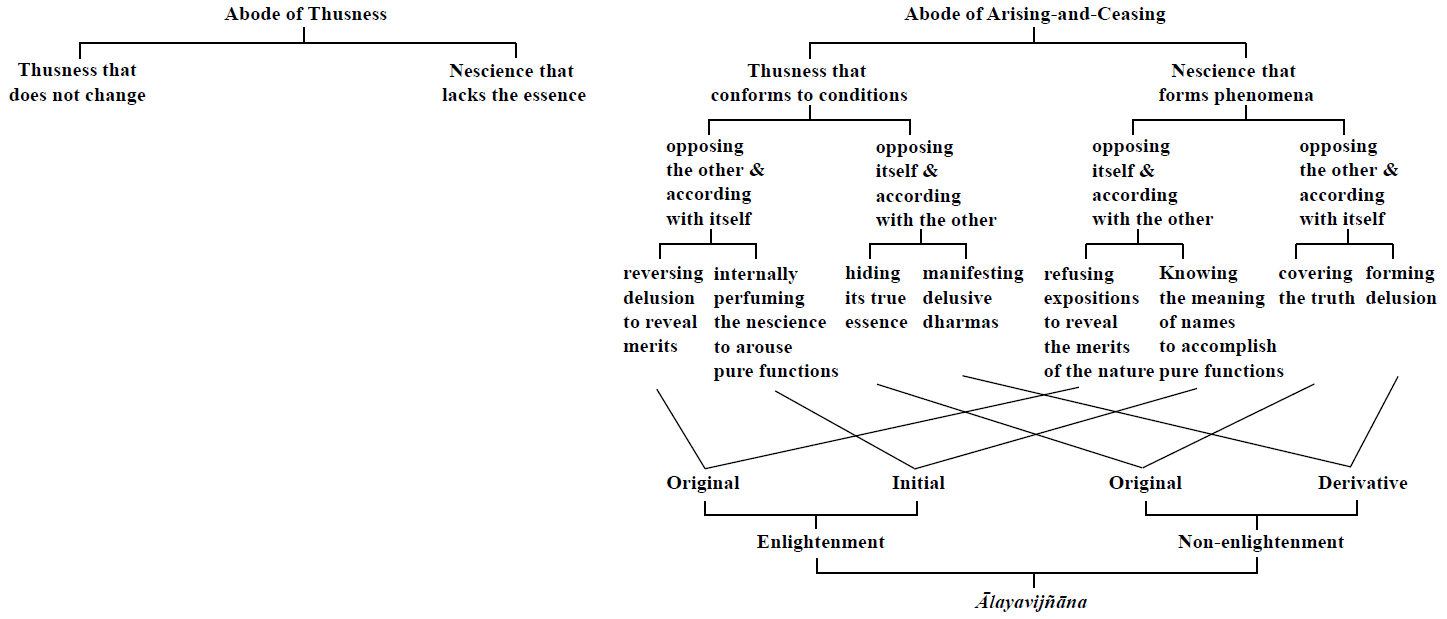
- Analysis proceeds by close reading of key passages on tathāgatagarbha, original enlightenment, and the twofold unification in ālayavijñāna, including a figure adapted from Whalen Lai (1980, p. 252) to represent Fazang's mutual interfusion of Thusness and nescience.
Limitations
- The paper states no explicit limitations section.
- Evident from the text: the argument is confined to two commentaries and their doctrinal sources, so claims about "two distinct interpretations" rest on this comparison rather than a survey of the wider commentary tradition (the paper itself notes other early commentaries, e.g., Tanyan's and the Dunhuang *Dasheng qixinlun shu*, took significantly different perspectives).
- The attribution of Wŏnhyo's third view to Wŏnhyo himself is inferential: the paper acknowledges it "is not directly stated" in the *Kisillon so*, though it argues the *Pyŏlgi*'s "評曰" makes his advocacy clear.
Model-written summary. Check it against the paper before relying on it.
Integrity signals
Registry
Cites
Statistics
Figures
Verification
Claims the paper makes
35 Own interpretation · 26 Sources not found · 11 Own result · 9 Not checked yet · 3 No basis given · 1 No full text of the sources
A result the paper states — it cites no source for it, so there is none to check. The quote shows it is in the paper.
In the paper
“However, there was another view on tathāgatagarbha, the third view that tathāgatagarbha has the twofold nature of not only neither-arising-nor-ceasing but also arising-and-ceasing, and this view was advocated by W ȏnhyo.”
§ On the Ālayavijñ āna in the Awakening of Faith: Comparing and Contrasting W ȏnhyo and Fazang's Views on > 6
plain- Asserted: passes — The authors put it forward as true.
- Checkable: passes — It can be checked against evidence.
- Load-bearing: passes — The paper’s conclusions depend on it.
- Based: passes — The paper gives a reason why it holds.
In the paper
“The view that they are identical would end up with nihilism because the mind-essence, or tathāgatagarbha, should also disappear when the arising-and-ceasing mind is eradicated”
§ On the Ālayavijñ āna in the Awakening of Faith: Comparing and Contrasting W ȏnhyo and Fazang's Views on > 3. Ālayavijñ āna
What the sources say
- Not matchedcites T1844:44.208b22-26
Couldn’t be matched to a paper in Crossref, so it can’t be checked.
hedgedstates a cause- Asserted: passes — The authors put it forward as true.
- Checkable: passes — It can be checked against evidence.
- Load-bearing: passes — The paper’s conclusions depend on it.
- Based: passes — The paper gives a reason why it holds.
- Not matched
In the paper
“W ȏnhyo's twofold view on tathāgatagarbha is also evident in his interpretation of the concept of [original] enlightenment (C.[ben]jue, K. [pon]gak [本]覺), one of the two aspects of ālayavijñāna presented in the Awakening of Faith, along with non-enlightenment”
§ On the Ālayavijñ āna in the Awakening of Faith: Comparing and Contrasting W ȏnhyo and Fazang's Views on > 6
What the sources say
- Not matchedcites [15]
Couldn’t be matched to a paper in Crossref, so it can’t be checked.
plainstates an association- Asserted: passes — The authors put it forward as true.
- Checkable: passes — It can be checked against evidence.
- Load-bearing: passes — The paper’s conclusions depend on it.
- Based: passes — The paper gives a reason why it holds.
- Not matched
In the paper
“Fazang says that the tathāgatagarbha has only the one nature of neither-arising-nor-ceasing.”
§ On the Ālayavijñ āna in the Awakening of Faith: Comparing and Contrasting W ȏnhyo and Fazang's Views on > 6
What the sources say
- Not matchedcites [24]
Couldn’t be matched to a paper in Crossref, so it can’t be checked.
plain- Asserted: passes — The authors put it forward as true.
- Checkable: passes — It can be checked against evidence.
- Load-bearing: passes — The paper’s conclusions depend on it.
- Based: passes — The paper gives a reason why it holds.
- Not matched
A result the paper states — it cites no source for it, so there is none to check. The quote shows it is in the paper.
In the paper
“W ȏnhyo also gives a warning, in this regard, of nihilism and eternalism in a similar way to how he does in discussing the twofold nature of tathāgatagarbha”
§ On the Ālayavijñ āna in the Awakening of Faith: Comparing and Contrasting W ȏnhyo and Fazang's Views on > 3. Ālayavijñ āna
plainstates an association- Asserted: passes — The authors put it forward as true.
- Checkable: passes — It can be checked against evidence.
- Load-bearing: unclear — It is unclear whether the paper’s conclusions depend on it.
- Based: passes — The paper gives a reason why it holds.
- Probably not a substantial claim. 34
- It may state two separate claims as one. 20
Create a free account to see these claims.
Create a free account to see these assumptions.
34 more claims
Create a free account to see all 85 claims and to verify the 7 references still open.
Self-check
Percentages, sums and reported differences re-computed from the paper’s own numbers.
Each contradiction between two passages listed here was confirmed by an independent check.
Rated minor: it would not touch a result — a value no result rests on, a p-value that stays on the same side of the significance level, or a conflict that is clerical, resolved elsewhere in the paper, or outside its own findings.
In the paper
§ On the Ālayavijñ āna in the Awakening of Faith: Comparing and Contrasting W ȏnhyo and Fazang's Views on > 3. Ālayavijñ āna
“the La ṅkāvatāra S ūtra's passage in which tathāgatagarbha consciousness does not reside in ālayavijñāna (the Ru lengqie jing T671:16.556b29-c01;see footnote 28 above)”
§ On the Ālayavijñ āna in the Awakening of Faith: Comparing and Contrasting W ȏnhyo and Fazang's Views on > 3. Ālayavijñ āna
“Soon after this passage, it states, "Mahāmati!Tathāgatagarbha consciousness does not reside in ālayavijñāna; therefore, the seven kinds of consciousness arise and cease and tathāgatagarbha neither arise nor cease."See the Ru lengqie jing T671:16.556c11-13”
Rated minor: it would not touch a result — a value no result rests on, a p-value that stays on the same side of the significance level, or a conflict that is clerical, resolved elsewhere in the paper, or outside its own findings.
In the paper
§ On the Ālayavijñ āna in the Awakening of Faith: Comparing and Contrasting W ȏnhyo and Fazang's Views on > 3
“Yogācāra exegete Śīlabhadra (529-645; C. Jiexian 戒賢), Bhāvaviveka and Dharmapāla's successors, respectively”
§ On the Ālayavijñ āna in the Awakening of Faith: Comparing and Contrasting W ȏnhyo and Fazang's Views on > 3
“Śīlabhadra, the teacher of Dharmapāla.”
Citations
Cites
THE I-CHING AND THE FORMATION OF THE HUA-YEN PHILOSOPHY
LAI, W. (1980) · Journal of Chinese Philosophy · doi:10.1111/j.1540-6253.1980.tb00239.x · Cited by 6
Research works printed but not linked: 6
- Fuji, 1964, Ryōga kyō ni okeru ichini no mondai: Nyoraizō Yuishiki setsu no kōshō 『楞伽経』における一・二の問題: 如来蔵唯識説の考証 [One or two problems in the Laṅkāvatāra Sūtra: Historical investigation of theories on tathāgatagarbha and Yogācāra], Ryūkoku Daigaku Bukkyō Bunka enkyūjo kiyō 龍谷大学佛敎文化硏究所紀要, 3, 153
- Ikeda, 2012, Kyō’u shōoku shōzou tonkō bunken the Dashengqixinlun shu (gidai, 羽333V) ni tsuite 杏雨書屋所藏敦煌文獻 『大乘起信論疏』 (擬題, 羽333V) について [On the Dunhuang Manuscript Dasheng qixin lun shu 大乘起信論疏 (provisional title; hane 羽 333 verso) belonging to the Kyō’u 杏雨 Library], Pulgyŏhak Review 불교학리뷰, 12, 45
- Muller, 2004, The Yogācāra Two Hindrances and their Reinterpretations in East Asia, Journal of the International Association of Buddhist Studies, 27, 207
- Muller, 2006, Wonhyo’s Reliance on Huiyuan in his Exposition of the Two Hindrances, Bulletin of Tōyō Gakuen University, 14, 1
- Yoshizu, 1983, Shōsō yūe ni tsuite 性相融会について [On the interfusion of nature and characteristics], Komazawa Daigaku Bukkyōgakubu kenkyū kiyō 駒澤大學佛教學部研究紀要, 41, 300
- Yoshizu, 2005, Kishinron to Kishinron shisō: Jōyōji Eon no jirei o chūshin ni shite 起信論と起信論思想: 淨影寺慧遠の事例を中心にして [The Awakening of Faith and the ideas of the Awakening of Faith: Centering on a Case Study of Jingying Huiyuan], Komazawa Daigaku Bukkyōgakubu kenkyū kiyō 駒沢大学仏教学部研究紀要, 63, 1
Cited by
The East Asian Mahāyāna Teaching of the One Mind and Its Implications in a Polarized World
Kang, B. (2023) · Religions · doi:10.3390/rel14091154 · Cited by 3
Kim, T., & Kim, D. (2024) · Religions · doi:10.3390/rel15070857 · Cited by 1
Mentor, P. F. (2026) · Kalagatos · doi:10.52521/kg.v23i1.16586
Metadata
- Authors
- Lee, S.
- Affiliations
- Dongguk University (KR)
- Corresponding author
- Lee, Sumi
- ORCID
- Lee, Sumi
- Venue
- Religions
- Publisher
- MDPI AG
- Published
- 2019-09-19
- Volume
- 10
- Issue
- 9
- Pages
- 536
- ISSN
- 2077-1444 (ISSN-L)
- OpenAlex
- W2973790088
- Semantic Scholar
- dae6a46689f5d0b60bcb03630786ec7cc4d2f997
- Cited by
- 3
- References
- 3
- Citations by year
- 2026: 1 · 2024: 1 · 2023: 1
- FWCI
- 0.00
- Type
- journal article
- Language
- en
- Open access
- gold
- dx.doi.org
- Licence
- Locations
- Religions (publishedVersion, cc-by)
- DOAJ (DOAJ: Directory of Open Access Journals) (submittedVersion, cc-by-sa)
- Funders
- the Academy of Korean Studies (KSPS) Grant funded by the Korean Government (MOE) (AKS-2012-AAZ-2102)
- Topics
- Social Sciences › Arts and Humanities › Religious studies › Indian and Buddhist Studies
- Social Sciences › Arts and Humanities › Philosophy › Study and Philosophy of Religion
- Health Sciences › Medicine › Complementary and alternative medicine › Traditional Chinese Medicine Studies
- Keywords
- Awakening of Faith, Wonhyo, Fazang, Buddha-nature, Yogācāra, Silla Buddhism, Huayan Buddhism, Buddhist commentaries, artificial consciousness, East Asian Buddhism
About these checks
Registry, retraction, Cites and statistics results are computed, not judged, with one exception: a printed reference that no index lists is read once by a model before it counts as a citation error. Claims are extracted by a model and kept only when their quote appears verbatim in the text; each cited source is then checked, with a model’s help, for whether it says what the claim relies on. Those verdicts can be wrong — read the claim’s quote and the cited source before relying on one.
A language model drew the claims from the paper on 2026-11-06, under version 3 of the claim definition (model deepseek-v4.1-flash, prompt extract-v3).
A second model labelled each claim on 2026-11-06 (model jev-1.13-20260917, definition revision gold-guideline-v0.2).
Statistics and arithmetic are recomputed, not judged.
Confidence bands are shown only for fields calibrated on our annotated test set. None is calibrated yet, so no band is shown.
What counts as a claim ›How we measure confidence ›How we check this ›
Are you an author, or do you see a problem with this page? Request a review
