

Complex Human Activity Recognition Using Smartphone and Wrist-Worn Motion Sensors
Open accessThe DOI matches its Crossref record; 40 of the 41 references it cites were found in a registry or an index.
Abstract
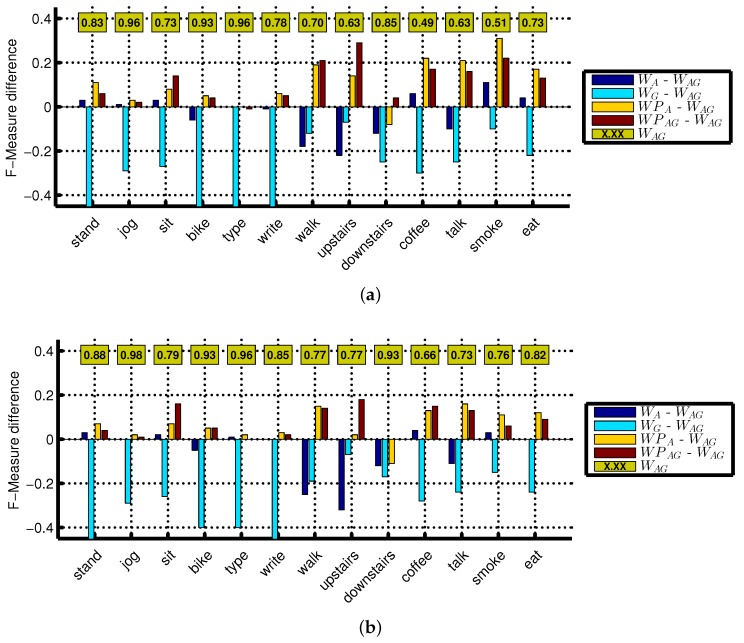
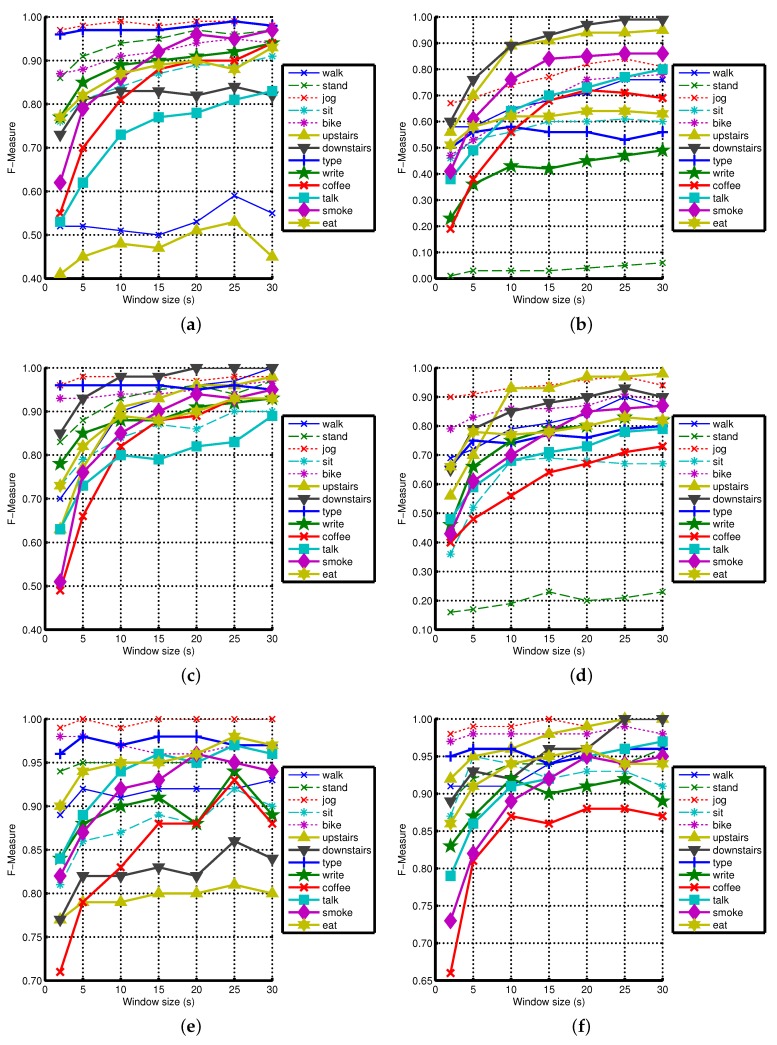
The position of on-body motion sensors plays an important role in human activity recognition. Most often, mobile phone sensors at the trouser pocket or an equivalent position are used for this purpose. However, this position is not suitable for recognizing activities that involve hand gestures, such as smoking, eating, drinking coffee and giving a talk. To recognize such activities, wrist-worn motion sensors are used. However, these two positions are mainly used in isolation. To use richer context information, we evaluate three motion sensors (accelerometer, gyroscope and linear acceleration sensor) at both wrist and pocket positions. Using three classifiers, we show that the combination of these two positions outperforms the wrist position alone, mainly at smaller segmentation windows. Another problem is that less-repetitive activities, such as smoking, eating, giving a talk and drinking coffee, cannot be recognized easily at smaller segmentation windows unlike repetitive activities, like walking, jogging and biking. For this purpose, we evaluate the effect of seven window sizes (2-30 s) on thirteen activities and show how increasing window size affects these various activities in different ways. We also propose various optimizations to further improve the recognition of these activities. For reproducibility, we make our dataset publicly available.
Overview
The claims and statistics of this paper haven’t been checked yet.
Free: it reads the open-access text and checks the first 5 claims that cite a source we can check. Create a free account to check every claim.
Integrity signals
Registry
Cites
Statistics
Figures





Verification
Claims the paper makes
The claims and statistics of this paper haven’t been checked yet.
Free: it reads the open-access text and checks the first 5 claims that cite a source we can check. Create a free account to check every claim.
Claims other papers make about this one
Each is checked against this paper’s own text: does it say what the citing paper says it does?
The source backs part of the claim, not all of it — or backs it for a different population, condition or comparison.
In the citing paper
“Basic activities demonstrate consistent and repeated patterns, facilitating their detection, whereas complex activities entail non-repetitive and context-sensitive motions that depend on extended temporal sequences, presenting considerable challenges for detection [7, 8].”
From Adaptive temporal attention mechanism and hybrid deep CNN model for wearable sensor-based human activity recognition (2025) · cites this paper as [8]
Experimental — accuracy not yet measuredIn the citing paper
“The UTwente dataset consists of 13 activities gathered from 10 people utilizing two smartphones (one in the right trouser pocket and the other on the wrist), equipped with accelerometer, gyroscope, linear acceleration, and magnetometer sensors at a frequency of 50 Hz.”
From Adaptive temporal attention mechanism and hybrid deep CNN model for wearable sensor-based human activity recognition (2025) · cites this paper as [8]
In the citing paper
“The UTwente dataset was chosen as a suitable benchmark for evaluation because of its diverse range of activities (13 in total, comprising 7 simple and 6 complicated activities), superior data quality, and the application of wearable sensors in real-world contexts (trouser pockets and wrists) [8].”
From Adaptive temporal attention mechanism and hybrid deep CNN model for wearable sensor-based human activity recognition (2025) · cites this paper as [8]
Self-check
Percentages, sums and reported differences re-computed from the paper’s own numbers.
The self-check needs the paper’s full text.
Citations
Cites
Scikit-learn: Machine Learning in Python
Pedregosa, F., Varoquaux, G., Gramfort, A., Michel, V., Thirion, B., Grisel, O., Blondel, M., Müller, A., Nothman, J., Louppe, G., et al. (2012) · arXiv · doi:10.48550/arxiv.1201.0490 · Cited by 71,016
The WEKA data mining software: an update
Hall, M., Frank, E., Holmes, G., Pfahringer, B., Reutemann, P., & Witten, I. H. (2009) · ACM SIGKDD Explorations Newsletter · doi:10.1145/1656274.1656278 · Cited by 17,750 · cited 1×
“As data are randomized before stratified cross-validation in the WEKA (Waikato Environment for Knowledge Analysis) tool [25], overlap in the data can cause using some data in both training and testing, which can lead to higher recognition performance.”
MethodA survey of mobile phone sensing
Lane, N., Miluzzo, E., Lu, H., Peebles, D., Choudhury, T., & Campbell, A. (2010) · IEEE Communications Magazine · doi:10.1109/mcom.2010.5560598 · Cited by 2,292
A tutorial on human activity recognition using body-worn inertial sensors
Bulling, A., Blanke, U., & Schiele, B. (2014) · ACM Computing Surveys · doi:10.1145/2499621 · Cited by 1,668 · cited 1×
“Activity recognition using body-worn motion sensors in general [19] and especially using smartphone sensors has been studied in recent years [1,2], and it is still being studied extensively [1,2,19–21].”
BackgroundMiluzzo, E., Lane, N. D., Fodor, K., Peterson, R., Lu, H., Musolesi, M., Eisenman, S. B., Zheng, X., & Campbell, A. T. (2008) · Proceedings of the 6th ACM conference on Embedded network sensor systems · doi:10.1145/1460412.1460445 · Cited by 1,032 · cited 1×
“They are implemented on mobile phones in various studies; i.e. , Naive Bayes in [37–39], decision tree in [40–42] and KNN in [31,32,39,43].”
MethodPreprocessing techniques for context recognition from accelerometer data
Figo, D., Diniz, P. C., Ferreira, D. R., & Cardoso, J. M. P. (2010) · Personal and Ubiquitous Computing · doi:10.1007/s00779-010-0293-9 · Cited by 578
The Jigsaw continuous sensing engine for mobile phone applications
Lu, H., Yang, J., Liu, Z., Lane, N. D., Choudhury, T., & Campbell, A. T. (2010) · Proceedings of the 8th ACM Conference on Embedded Networked Sensor Systems · doi:10.1145/1869983.1869992 · Cited by 560
Mobile Phone Sensing Systems: A Survey
Khan, W. Z., Xiang, Y., Aalsalem, M. Y., & Arshad, Q. (2013) · IEEE Communications Surveys & Tutorials · doi:10.1109/surv.2012.031412.00077 · Cited by 557 · cited 2×
“Activity recognition using body-worn motion sensors in general [19] and especially using smartphone sensors has been studied in recent years [1,2], and it is still being studied extensively [1,2,19–21].”
BackgroundFusion of Smartphone Motion Sensors for Physical Activity Recognition
Shoaib, M., Bosch, S., Incel, O., Scholten, H., & Havinga, P. (2014) · Sensors · doi:10.3390/s140610146 · Cited by 552 · cited 6×
“We had shown previously that the accelerometer performs poorly at recognizing walking upstairs and downstairs and needs additional gyroscope data for better recognition of these two activities [12].”
BackgroundMethodInfluentialSelf-citationA Survey of Online Activity Recognition Using Mobile Phones
Shoaib, M., Bosch, S., Incel, O., Scholten, H., & Havinga, P. (2015) · Sensors · doi:10.3390/s150102059 · Cited by 489 · cited 2×
“We selected three classifiers, which are commonly used for practical activity recognition: Naive Bayes, k-nearest neighbor (KNN) and decision tree [35,36].”
BackgroundMethodSelf-citation
Research works printed but not linked: 1
- Kose Mustafa. Incel O.D. Ersoy C. Online human activity recognition on smart phones Proceedings of the Workshop on Mobile Sensing: From Smartphones and Wearables to Big Data Beijing, China 16 April 2012 11 15
Cited by
Items 301–400 of 424
HUMAN ACTIVITY RECOGNITION BASED ON SMARTPHONE SENSOR DATA USING CNN
İsmail, K., & Özacar, K. (2020) · The international archives of the photogrammetry, remote sensing and spatial information sciences/International archives of the photogrammetry, remote sensing and spatial information sciences · doi:10.5194/isprs-archives-xliv-4-w3-2020-263-2020 · Cited by 4
Jaschinski, C. (2018) · doi:10.3990/1.9789036546348 · Cited by 12
Pushing the limits of intertial motion sensing
Bosch, S. (2022) · doi:10.3990/1.9789036554350 · Cited by 4
Self-citationSeMoM, a semantic middleware for IoT healthcare applications
Zgheib, R. (2017) · theses.fr (ABES) · doi:10.70675/80992e30ze695z46cfzaa20z3651343aa3f2 · Cited by 6
“in [42] propose to process human activity recognition using smartphone inertial sensors and wrist sensors.”
BackgroundWonderwall: A Virtual-to-Real Foundation Model for IMU-based HAR
Miao, S., & Chen, L. (2026) · Proceedings of the ACM on Interactive Mobile Wearable and Ubiquitous Technologies · doi:10.1145/3789688 · Cited by 9
“For downstream evaluation, we select ten datasets: UTD-MHAD [8], MMAct [20], Mhealth [4], UT-Complex [48], WISDM [53], Wharf [6], DSADS [2], PAMAP [42], W-HAR [5], and Shoaib [47].”
Studying the Simultaneous Visual Representation of Microgestures
Lambert, V., Goguey, A., Malacria, S., & Nigay, L. (2024) · Proceedings of the ACM on Human-Computer Interaction · doi:10.1145/3676523 · Cited by 4
Smartphone-Based Drivers Context Recognition
Hossen, M. I., Goh, M. K. O., Connie, T., Lau, S. H., & Bari, A. (2019) · Smart innovation, systems and technologies · doi:10.1007/978-981-13-8311-3_21 · Cited by 3
An FPGA-Based Embedded System for Terrain Recognition Using Inertial Measurement Units
Madaoui, L., Kedir-Talha, M., & Kerdjidj, O. (2024) · International Conference on Image and Signal Processing and their Applications (ISPA) · doi:10.1109/ispa59904.2024.10536850 · Cited by 3
“These particular characteristics have been chosen for their simplicity and demonstrated capacity to produce accurate recognition outcomes across different terrains environment [12].”
BackgroundTian, Y., Gu, Y., Lu, Q., & Kamijo, S. (2025) · Sensors · doi:10.3390/s25030649 · Cited by 8
An activity history based approach for recognizing the mode of transportation
Jahn, A., Kroll, D., Lau, S. L., & David, K. (2017) · IEEE Conference on Open Systems · doi:10.1109/icos.2017.8280268 · Cited by 3
“These systems have been shown to accurately recognize activities such as sitting, standing, walking, or taking stairs on realworld data [1].”
BackgroundReal-Time Recognition of Human Daily Motion with Smartphone Sensor
Xia, Q. (2018) · International Journal of Performability Engineering · doi:10.23940/ijpe.18.04.p1.593602 · Cited by 5
“Literature [21] used wrist motion sensor and built-in sensors in mobile phones to collect the experimenters’ movement data, identified two sets of a total of 13 kinds of complex movements, but as the system added additional sensors, the user costs have been largely increased.”
MethodActivity recognition using smartphones and wearable devices: Traditional approaches, New solutions
Iskanderov, J., & Guvensan, M. A. (2019) · Pamukkale University Journal of Engineering Sciences · doi:10.5505/pajes.2018.84758 · Cited by 4
Fall classification based on sensor data from smartphone and smartwatch
Suresh, S., Jain, M., & Radha, R. (2019) · AIP conference proceedings · doi:10.1063/1.5112260 · Cited by 3
Sensor-Based Activity Recognition Inside Smart Building Energy and Comfort Management Systems
Marcello, F. C., & Pilloni, V. (2019) · IEEE World Forum on Internet of Things (WF-IoT) · doi:10.1109/wf-iot.2019.8767233 · Cited by 6
“A comparison of classification approaches for activity recognition is provided in [10] and [11].”
BackgroundOctave Mix: Data Augmentation Using Frequency Decomposition for Activity Recognition
Hasegawa, T. (2021) · IEEE Access · doi:10.1109/access.2021.3070778 · Cited by 5
“Most of the research in HAR is based on extracting human-designed features (HCF: Hand-Crafted Features) from sensor values, and classifying the activity using machine learning algorithms such as SVM and Random Forest [7, 8, 9, 10, 11, 12, 13, 14, 15, 16, 17, 18, 19, 20].”
MethodLong Short Term Memory Networks for Stroke Activity Recognition base on Smartphone
Siagian, P., & Fernando, E. (2021) · International Conference on Information Technology, Information Systems and Electrical Engineering (ICITISEE) · doi:10.1109/icitisee53823.2021.9655817 · Cited by 3
Improving Activity Recognition while Reducing Misclassification of Unknown Activities
Fasciglione, A., Leotta, M., & Verri, A. (2021) · IEEE International Conference on Enabling Technologies: Infrastructure for Collaborative Enterprises (WETICE) · doi:10.1109/wetice53228.2021.00039 · Cited by 8
Ambika, K., & R, R. K. (2022) · Indian Journal of Computer Science and Engineering · doi:10.21817/indjcse/2022/v13i4/221304045 · Cited by 3
Physique- Based Human Activity Recognition Using Deep Learning Approaches and Smartphone Sensors
Pravesjit, S., Jantawong, P., Jitpattanakul, A., & Mekruksavanich, S. (2023) · Joint International Conference on Digital Arts, Media and Technology with ECTI Northern Section Conference on Electrical, Electronics, Computer and Telecommunications Engineering (ECTI DAMT & NCON) · doi:10.1109/ectidamtncon57770.2023.10139396 · Cited by 3
“Classifying different kinds of human behavior has been made easier by standard techniques for machine learning, including Naive Bayes, decision trees, and support vector machines [10].”
MethodDeep Learning Networks for Complex Activity Recognition Based on Wrist-Worn Sensor
Mekruksavanich, S., & Jitpattanakul, A. (2023) · IEEE Region 10 Conference (TENCON) · doi:10.1109/tencon58879.2023.10322430 · Cited by 3
“Conventional machine learning techniques like Na¨ıve Bayes, decision trees, and support vector machines have proven effective in accurately categorizing various human actions [12].”
BackgroundProfiling Instructor Activities Using Smartwatch Sensors in a Classroom
Chowdhury, Z. U., De, P., & Allen, A. A. (2020) · ACM Southeast Regional Conference (ACMSE) · doi:10.1145/3374135.3385290 · Cited by 4
“In [22] 3 motion sensors (accelerometer, gyroscope and linear acceleration sensor) were evaluated at both wrist and pocket positions in order to recognize human activities.”
MethodYour Day in Your Pocket: Complex Activity Recognition from Smartphone Accelerometers
Bouton--Bessac, E., Meegahapola, L., & Gática-Pérez, D. (2023) · Lecture notes of the Institute for Computer Sciences, Social Informatics and Telecommunications Engineering · doi:10.1007/978-3-031-34586-9_17 · Cited by 10
User-centric Activity Recognition and Prediction Model using Machine Learning Algorithms
Roy, N., Ahmed, R., Huq, M. R., & Shahriar, M. M. (2021) · International Journal of Advanced Computer Science and Applications · doi:10.14569/ijacsa.2021.0121265 · Cited by 2
A Survey of Motion Data Processing and Classification Techniques Based on Wearable Sensors
Xiaoqiong, X., Xuemei, 熊. X., Keda, Z., & Chao, L. (2023) · IgMin Research · doi:10.61927/igmin123 · Cited by 2
A Novel Human Activity Recognition Using Spiking Neural Network
Nguyen, H. H., Nghiem, T. K., Hoang, M. P., & Nguyen, D. M. (2024) · IEEE International Conference on Contemporary Computing and Communications (InC4) · doi:10.1109/inc460750.2024.10649246 · Cited by 4
“Combining hand-crafted features with machine learning-based classifiers has historically yielded satisfactory performance [10,11].”
BackgroundHuan, R., Bo, A., Cao, M., Chen, P., & Liang, R. (2025) · IEEE Transactions on Instrumentation and Measurement · doi:10.1109/tim.2025.3558226 · Cited by 2
“The UT-Data-gar dataset is a GAR dataset derived from the UT-Data [39] individual action dataset.”
TCP-HAR: On-Device Transferable and Copyright-Preserving Human Activity Recognition
Sacco, A., Palermo, B., Figliolino, G., Contoli, C., Marchetto, G., & Esposito, F. (2026) · Pervasive and Mobile Computing · doi:10.1016/j.pmcj.2026.102163 · Cited by 2
“The sampling frequency of sensors needs to be carefully selected, not only because of its impact on capturing activity patterns, but also due to its impact on battery duration [28–30].”
Human activity recognition (HAR): techniques, applications, and future directions
Rani, M., & Kumar, M. (2026) · International Journal of Data Science and Analytics · doi:10.1007/s41060-026-01042-8 · Cited by 3
“…CASAS: Tokyo [28], CASAS: Aruba [28], Opportunity [66], CASAS: Kyoto Multires-ident [75], PAMAP2 [64], USC-HAD [94], CASAS: Cairo [29], UCI-HAR [7], UTD-MHAD [21], UCI-SBHAR [58], UT_complex [71], UniMiB [54], SisFall [76], ExtraSensory [83], WISDM [90], UP-Fall [52], LARa [57] and MARBLE [10].”
Tanigaki, K., Maekawa, T., & Hara, T. (2026) · IEEE International Conference on Pervasive Computing and Communications · doi:10.1109/percom67906.2026.11524533 · Cited by 3
Enhancing mobile brain and body imaging: Open-source solutions for real-world research applications
Haupt, T., Maanen, P., Daeglau, M., Contreras-Altamirano, Strizke, A. S., Kiene, F., Welzel, J., Blum, S., Roheger, M., & Debener, S. (2026) · iScience · doi:10.1016/j.isci.2026.116647 · Cited by 2
“56 Therefore, integration of movement sensors into the data recording framework is crucial, as the position of body-worn sensors can be tailored to a specific biomechanical measurement.”
Luo, B., Qiu, Q., Zhu, T., & Liu, Z. (2024) · IFIP advances in information and communication technology · doi:10.1007/978-3-031-57919-6_7 · Cited by 2
Mekruksavanich, S., & Jitpattanakul, A. (2025) · Joint International Conference on Digital Arts, Media and Technology with ECTI Northern Section Conference on Electrical, Electronics, Computer and Telecommunications Engineering (ECTI DAMT & NCON) · doi:10.1109/ectidamtncon64748.2025.10962017 · Cited by 2
“This research utilizes the UTwente dataset, titled Complex Human Activities using Smartphones and Smartwatch Sensors [34], which serves as a well-established benchmark in the HAR domain.”
Multi-Sensor Activity Monitoring: Combination of Models with Class-Specific Voting
Mo, L., Zeng, L., Liu, S., & Gao, R. X. (2019) · Information · doi:10.3390/info10060197 · Cited by 3
“placed multiple sensors (accelerometer, gyroscope, and linear acceleration sensor) on different parts of the body for human activity recognition [5].”
Sensor-Based Benchmark Datasets: Comparison and Analysis
Ahad, M. A. R., Antar, A. D., & Ahmed, M. (2020) · Intelligent systems reference library · doi:10.1007/978-3-030-51379-5_6 · Cited by 2
Studi Literatur Human Activity Recognition (HAR) Menggunakan Sensor Inersia
Pradani, H. N., & Mahananto, F. (2021) · Jurnal RESTI (Rekayasa Sistem dan Teknologi Informasi) · doi:10.29207/resti.v5i6.3665 · Cited by 2
“WISDM 6 26 SP A [26] UT-Complex 13 10 SP, SS A,G,M [27] SMT 12 9 SP, SS A,G [28] DU-MD 10 34 SS A [29] PAMAP2 18 9 SS A,G,M [30] USC-HAD 12 14 SS A [31] WHARF 14 16 SS A [32] Sussex-Huawei LocomotionTransportation (SHL) 8 3 SP A,G,M, dll.”
Comparative performance of machine learning models for the classification of human gait
Thakur, D., & Lalwani, P. (2023) · Biomedical Physics & Engineering Express · doi:10.1088/2057-1976/ad17f9 · Cited by 1
Activity Recognition Method Based on Kernel Supervised Laplacian Eigenmaps
Tu, P., Cheng, T., Du, D., Li, J., & Wang, H. (2024) · IEEE International Conference on Acoustics Speech and Signal Processing · doi:10.1109/icassp48485.2024.10446979 · Cited by 2
“Shoaib et al. [2] extracted the two time-domain features, i.e., mean and standard deviation, and utilized three classification models to identify the different movements.”
BackgroundMethodClasificación de actividad física mediante señales de acelerometría
Cavita-Huerta, E., & Reyes‐Reyes, J. (2024) · PÄDI Boletín Científico de Ciencias Básicas e Ingenierías del ICBI · doi:10.29057/icbi.v12iespecial.12163 · Cited by 2
Mamiya, H., & Fuller, D. (2025) · Physical Activity and Nutrition · doi:10.20463/pan.2025.0020 · Cited by 2
“This is a common evaluation approach when the generalizability of algorithms to new participants is of interest 24 .”
On Recognizing Abnormal Human Behaviours by Data Stream Mining with Misclassified Recalls
Fong, S. J., Hu, S., Song, W., Cho, K., Wong, R. K., & Mohammed, S. (2017) · International World Wide Web Conference (WWW) · doi:10.1145/3041021.3054929 · Cited by 3
“the effects of window size are investigated in [19]) and incremental outlier detection and removal [20].”
BackgroundZhang, W., & Zhou, S. (2017) · Sensors · doi:10.3390/s17061214 · Cited by 2
Jiang, M., Liu, X.-H., Zhang, Z., Zhao, Y., Zhang, R., Qiu, S., & Wu, D. (2017) · International Conference on Information, Cybernetics, and Computational Social Systems (ICCSS) · doi:10.1109/iccss.2017.8091449 · Cited by 2
“So far, online data segmentation can be mainly divided into manual methods [5-7] and automatic methods [810].”
MethodA Deep Ensemble model to Recognize Human Activities using inertial sensors on smartphones
Imanzadeh, S., Tanha, J., Razzaghi-Asl, N., Mostafaei, S. H., Samadi, N., & Tarhib, S. (2024) · CSI International Symposium on Artificial Intelligence and Signal Processing · doi:10.1109/aisp61396.2024.10475271 · Cited by 2
“Additionally, in most datasets, users follow predetermined path [10], [12], [13], [15], [17], [18], [19].”
BackgroundMicro Activity Recognition of Mobile Phone Users Using Inbuilt Sensors
Bansal, A., Shukla, A., Rastogi, S., & Mittal, S. (2018) · International Conference on Cloud Computing, Data Science & Engineering (Confluence) · doi:10.1109/confluence.2018.8442663 · Cited by 2
A Hybrid Solution for Human Activity Recognition: Application to Wrist-Worn Accelerometry
Abbas, M., Saleh, M., & Jeannès, R. L. B. (2019) · International Conference on Advances in Biomedical Engineering (ICABME) · doi:10.1109/icabme47164.2019.8940233 · Cited by 3
Human Activities Analysis Using Machine Learning Approaches
Gaur, D., & Dubey, S. K. (2021) · Algorithms for intelligent systems · doi:10.1007/978-981-16-5747-4_39 · Cited by 2
UniMTS: Unified Pre-training for Motion Time Series
Zhang, X., Teng, D., Chowdhury, R. R., Li, S., Hong, D., Gupta, R. K., & Shang, J. (2024) · arXiv · Cited by 9
“Following the same Wilcoxon-signed rank test as in the zero-shot setting, we observe p-values far below 0.05 (e.g., p-value = 2 × 10 − 25 for the best-performing baseline ImageBind), indicating the statistical significance of our improvement.”
InfluentialChen, C. (2023) · IEEE International Conference on Advances in Electrical Engineering and Computer Applications (AEECA) · doi:10.1109/aeeca59734.2023.00089 · Cited by 1
“Currently, the interaction mode between humans and motion sensing technology is an active research field in the "human action recognition" domain, involving multiple disciplines such as artificial intelligence, machine learning, computer vision, cognitive psychology, and exercise physiology [2].”
BackgroundMahmood, A., Sridevi, P., Rabbani, M., Meikandan, P. V., Syam, M., Shefa, S. T., Chu, W. C., & Ahamed, S. I. (2024) · IEEE Annual International Computer Software and Applications Conference (COMPSAC) · doi:10.1109/compsac61105.2024.00115 · Cited by 1
“Shoaib et al. used a combination of two smartphones at two body positions, pocket and wrist, and got better results than using a single device [11].”
MethodZhang, M., Liu, H., Ye, Z., Liu, L., & Zhang, X. (2026) · Applied Bionics and Biomechanics · doi:10.1155/abb/7560773 · Cited by 1
Turdalyuly, M., Zholdassova, A., Turdalykyzy, T., & Doshybekov, A. (2026) · Information · doi:10.3390/info17040368 · Cited by 1
Dolai, U., Paul, B., & Nandi, U. (2026) · Smart Health · doi:10.1016/j.smhl.2026.100679 · Cited by 1
Open-ended Human Activity Understanding via LLM-assisted Motion Decomposition and Semantic Fusion
Wei, Q., Hu, K., Huang, J., Guo, C. C., Gao, Y., & Dong, W. (2026) · Proceedings of the ACM on Interactive Mobile Wearable and Ubiquitous Technologies · doi:10.1145/3831643 · Cited by 2
“The 18 datasets used in our evaluation are: Opportunity [42], UCI-HAR [3], MotionSense [35], w-HAR [5], Shoaib [45], HAR70+ [54], RealWorld [51], TNDA-HAR [67], PAMAP2 [41], USC-HAD [71], Mhealth [4], Harth [34], UT-Complex [46], Wharf [7], WISDM [59], DSADS [2], UTD-MHAD [10], MMAct [28].”
Characterization of human motion by the use of an accelerometer-based detection system
Wang, H., & Liu, L. (2020) · Instrumentation Science & Technology · doi:10.1080/10739149.2020.1779083 · Cited by 1
Research on Position Layout Strategy of Posture Sensors in Alpine Skiing Movement Analysis
Zhang, H., Yao, X., Fei, Q., Zhang, Y., & Li, P. (2022) · Chinese Control Conference (CCC) · doi:10.23919/ccc55666.2022.9902426 · Cited by 1
Kalita, D., & Mirza, K. B. (2022) · IEEE India Conference · doi:10.1109/indicon56171.2022.10039967 · Cited by 1
SkinSense: Efficient vibration-based communications over human body using motion sensors
Wijewickrama, R., Dohadwalla, S. A., Maiti, A., Jadliwala, M. S., & Narain, S. (2023) · Internet of Things · doi:10.1016/j.iot.2023.100835 · Cited by 2
Human Activity Recognition Model Capable of Handling Various Input Waveforms
Hasegawa, T. (2025) · Lecture notes in computer science · doi:10.1007/978-981-96-6606-5_1 · Cited by 2
Detecting Transitions in Manual Tasks from Wearables: An Unsupervised Labeling Approach
Böttcher, S., Scholl, P., & Laerhoven, K. V. (2018) · Informatics · doi:10.3390/informatics5020016 · Cited by 2
Analysing Human Activity Patterns by Chest-Mounted Wearable Devices
Shafi, J., Waheed, A., & Krishna, P. V. (2020) · Advances in intelligent systems and computing · doi:10.1007/978-981-15-0135-7_37 · Cited by 1
Human Activity Recognition Algorithm Based on One-Dimensional Convolutional Neural Network
Tang, D., Jin, M., Wang, Q., Wei, Z., & Zhang, J. (2020) · Revue d intelligence artificielle · doi:10.18280/ria.340110 · Cited by 1
“Previous work tried to extract effective body movement features from the signals of tri-axis accelerometers and gyroscopes [4].”
BackgroundMethodInfluentialA Survey on Hand-based Behavioral Activity Recognition
Monday, H. N., Li, J., Nneji, G. U., Raji, M. F., Ukwuoma, C. C., Khan, J., Ejiyi, C. J., Ulhaq, A., Nahar, S., Abubakar, H. S., et al. (2019) · International Computer Conference on Wavelet Active Media Technology and Information Processing (ICCWAMTIP) · doi:10.1109/iccwamtip47768.2019.9067524 · Cited by 1
“For example, [14] presents an activity recognition system to recognize nine different gestures usually performed in daily activities by means of ring and bracelets IMUs placed on the fingers and on the wrist, respectively.”
BackgroundSmartphones as Chemometric applications
Arora, T., Chauhan, R., Sharma, V., & Kumar, R. (2021) · Elsevier eBooks · doi:10.1016/b978-0-12-823696-3.00014-3 · Cited by 1
Breatheasy - An Android Application To Quit The Smoking
Anjaneyalu, M. B., Sreenivasa, N., Satish, E. G., Fernandes, R., Sarojadevi, H., & Rodrigues, A. P. (2021) · IEEE International Conference on Distributed Computing, VLSI, Electrical Circuits and Robotics (DISCOVER) · doi:10.1109/discover52564.2021.9663588 · Cited by 1
Suarez, J. J. P., Orillaza, N. S., & Naval, P. C. (2022) · Lecture notes in computer science · doi:10.1007/978-3-031-21967-2_38 · Cited by 1
The Deep Learning-based Human Activity Recognition Using Smart Wearable Sensors : A Tutorial
Mekruksavanich, S., & Jitpattanakul, A. (2022) · Research Briefs on Information and Communication Technology Evolution · doi:10.56801/rebicte.v8i.133 · Cited by 1
Digitalization Capacity for Knowledge Acquisition: Learning from Health Monitoring
Sun, S. (2020) · UPM Digital Archive (Technical University of Madrid) · doi:10.20868/upm.thesis.63094 · Cited by 1
Harnessing the Power of Generative Models for Mobile Continuous and Implicit Authentication
Tahoun, E. (2021) · UWSpace (University of Waterloo) · Cited by 2
Contributions to Human Motion Modeling and Recognition using Non-intrusive Wearable Sensors
Martín, M. (2022) · UPM Digital Archive (Technical University of Madrid) · doi:10.20868/upm.thesis.70493 · Cited by 2
Human Activity Recognition Dataset for Pedestrians with Mobility Disabilities
Woo, Y., Hwang, S., Oh, S., Kang, M., Lee, S., Kim, J., Cha, J., & Kim, K. K. (2026) · Scientific Data · doi:10.1038/s41597-025-06527-y · Cited by 3
“HAR researchers measure the performance of the model for new users by splitting the training and testing data into different users, as the performance of models tends to decline when applied to users not seen during training 6,32,37,39 .”
Abdelkawy, H. (2021) · theses.fr (ABES) · doi:10.70675/3ae0f056z1a4az4407z8309zd6153c0e83d7 · Cited by 1
Estimation of Walking rate in Complex activity recognition
Kashanian, H., Sharif, S., & Akildyz, R. (2016) · International Journal of Computer Applications Technology and Research · doi:10.7753/ijcatr0509.1003
“Despite the use of wearable technology and particularly inertial measurement units (IMUs) gaining popularity within the research environment, clinical uptake remains poor [16], [17].”
BackgroundA Framework for Inferring Combination Lock Codes using Smartwatches.
Maiti, A., Heard, R., Sabra, M., & Jadliwala, M. S. (2017)
Guede-Fernández, F. (2018) · UPCommons institutional repository (Universitat Politècnica de Catalunya) · doi:10.5821/dissertation-2117-121196
“Los datos de las actividades están recogidas durante sólo 5 minutos en un entorno controlado [66].”
BackgroundZheng, X. (2019) · UPM Digital Archive (Technical University of Madrid) · doi:10.20868/upm.thesis.55328
Web-based Elderly Monitoring System with GIS
Sriwichian, A., Boonjing, V., Nillaor, P., & Muangprathub, J. (2019) · International Joint Conference on Computer Science and Software Engineering · doi:10.1109/jcsse.2019.8864174
LEARNING EMBEDDINGS FOR WEARABLE-BASED HUMAN ACTIVITY ANALYSIS
Sheng, T. (2020) · Cited by 1
Nonlinear methods to quantify Movement Variability in Human-Humanoid Interaction ActivitiesPreprint
Xochicale, M. P., & Baber, C. (2021) · Research Square · doi:10.21203/rs.3.rs-352130/v1
“With regards to the window size, Shoaib et al. in 201643 investigated effects of seven window lengths (2, 5, 10, 15, 20, 25, 30 seconds) and combination of inertial sensors (accelerometer, gyroscope and linear acceleration sensor) to improve the activity recognition performance for repetitive activities (walking, jogg…”
BackgroundInfluentialAn Integrated & Robust User Authentication Framework Based on Gait Smart Devices
Vardhan, V. H., Kumar, V., Nagarajan, G., Jacob, T. P., & Pravin, A. (2021) · Lecture notes in electrical engineering · doi:10.1007/978-981-15-7511-2_67
Chehab, M. (2019) · doi:10.26756/th.2020.168
Human activity recognition by wearable sensors in the smart home control problem
Nebogatikov, I. Y., & Павлович, С. И. (2021) · Journal of Physics Conference Series · doi:10.1088/1742-6596/1864/1/012112
Smartphone and Smartwatch for Human Activity Recognition
Amer, M. M. B. (2021) · Annals of Advanced Biomedical Sciences · doi:10.23880/aabsc-16000159
Gait Processing and Performance using Angular Velocity and Leaping Angle Parameters
(2019) · International Journal of Recent Technology and Engineering (IJRTE) · doi:10.35940/ijrte.b1031.0782s219
Smart Sensors for Activity Recognition
Rayan, R. Α., Zafar, I., Rafique, A., & Tsagkaris, C. (2022) · Wiley eBooks · doi:10.1002/9781119785651.ch4
Fischer, T., & Riedl, R. (2018) · SpringerBriefs in information systems · doi:10.1007/978-3-319-98711-8_2
Nonlinear Methods to Quantify Movement Variability in Human-Humanoid Interaction ActivitiesPreprint
Xochicale, M. P., & Baber, C. (2021) · Research Square · doi:10.21203/rs.3.rs-352130/v2
Detection of Change Points in Time Series for Devices Maintenance
Zhou, Q., Liu, L., Zhang, J., & Zheng, Y. (2022) · IEEE Joint International Information Technology and Artificial Intelligence Conference (ITAIC) · doi:10.1109/itaic54216.2022.9836900
Sandhu, M. M., Khalifa, S., Portmann, M., & Jurdak, R. (2023) · Green energy and technology · doi:10.1007/978-3-031-27685-9_2
Mobile Sensing Based Classification System For Human Fall Detection
Rana, R. S., Bora, N., Chaudhary, S., & Kumar, T. (2023) · International Conference on Contemporary Computing and Informatics (IC3I) · doi:10.1109/ic3i59117.2023.10397709
“A new method for recognizing human activities utilizing motion sensors in smartphones and wrist-worn devices was proposed by Shoaib et al. [13].”
MethodSurvey on Objective Measurement and Sensor-Based Detection of Physical and Social Activities
Mahmood, A., Sridevi, P., Meikandan, P. V., & Ahamed, S. I. (2024) · IEEE Annual International Computer Software and Applications Conference (COMPSAC) · doi:10.1109/compsac61105.2024.00083
“In [76], the authors incorporated a linear acceleration sensor, gyroscope, and accelerometer.”
BackgroundReddy, G. M., & Kumar, P. (2024) · AIP conference proceedings · doi:10.1063/5.0237628
Smartwatch-Based Prediction of Transdermal Alcohol Levels Using Hyperdimensional Computing
Vergés, P., Segura, M. E., Arangott, R., Garcia, A. K., Reynoso, L. G., Nicolau, A. E., Givargis, T., & Gago–Masague, S. (2024) · IEEE World Forum on Internet of Things (WF-IoT) · doi:10.1109/wf-iot62078.2024.10811151
Ensemble filter based feature selection technique for classification of human activity recognition
Yusup, N., & Zain, A. M. (2025) · AIP conference proceedings · doi:10.1063/5.0208886
Adversarial Perturbation for Sensor Data Anonymization: Balancing Privacy and Utility
Hasegawa, T., & Fujino, K. (2025) · Computers, materials & continua/Computers, materials & continua (Print) · doi:10.32604/cmc.2025.066270
MHCAGE:Multi-Head Attention-based Combined Accelerometer and Gyroscope Embedding Network
Yan, J., Zhou, W., Zhang, W., Lu, Y., & Huang, L. (2025) · International Conference on Advanced Electronic Materials, Computers and Software Engineering (AEMCSE) · doi:10.1109/aemcse65292.2025.11042562
“…recognition techniques typically employ machine learning algorithms like kernel-based support vector machines[11], state-space hidden Markov models[12], as well as other classification models including Gaussian naive Bayes, distance - weighted K-nearest neighbors, and ensemble decision trees[13].”
On the Utilization of Sensor-Based Machine Learning Approaches for Human Activity Recognition
Hamid, S., Javed, T., Khan, A., & Iqbal, S. (2025) · Journal of Engineering and Applied Sciences , University of Engineering and Technology, Peshawar · doi:10.17582/journal.jeas/44.13.26
Inertial Signal Forecasting With Foundation Model Techniques
Wieland, C., & Pankratius, V. (2025) · IEEE Sensors Journal · doi:10.1109/jsen.2025.3603456 · Cited by 3
“…cross-dataset task is complex because different datasets use different sensors (accelerometer and gyroscope) with different characteristics (sampling rate and units), and sensor placements (wrist, chest, and ankle), and various unique activities [16], [17], [18], [19], [20], [21], [22], [23], [24].”
MULFE: A Sensor-Based Multilevel Feature Enhancement Method for Group Activity Recognition
Huan, R., Wang, K., Dong, J., Zhang, J., Chen, P., Sun, G., & Liang, R. (2025) · IEEE Sensors Journal · doi:10.1109/jsen.2025.3613557
“The UT-Data-gar dataset is a group activity simulation dataset modified from the publicly available UT-Data [32] individual action dataset.”
Díaz, C., Sanchez, M., Arce, R., & Sánchez, R. (2025) · IEEE International Geoscience and Remote Sensing Symposium (IGARSS) · doi:10.1109/igarss55030.2025.11243045
“Insights from previous studies on sensor-based HAR [6, 17] and transporta-3325 tion mode detection [5] suggest that well-designed algorithms can achieve robust classification even with noisy data sources.”
Metadata
- Authors
- Shoaib, M., Bosch, S., Incel, O., Scholten, H., & Havinga, P.
- Affiliations
- University of Twente (NL)
- Department of Computer Engineering, Galatasaray University, Ortakoy, 34349 Istanbul, Turkey
- Corresponding author
- Shoaib, Muhammad
- Venue
- Sensors
- Publisher
- MDPI AG
- Published
- 2016-03-24
- Volume
- 16
- Issue
- 4
- Pages
- 426
- ISSN
- 1424-8220 (ISSN-L)
- PMC
- PMC4850940
- OpenAlex
- W2304267454
- Cited by
- 423
- References
- 41
- Citations by year
- 2026: 28 · 2025: 24 · 2024: 34 · 2023: 42 · 2022: 48 · 2021: 62 · 2020: 58 · 2019: 52 · 2018: 37 · 2017: 29 · 2016: 9
- FWCI
- 28.79
- Type
- journal article
- Language
- en
- Open access
- gold
- doi.org
- Licence
- Locations
- Sensors (publishedVersion, cc-by)
- PubMed Central (publishedVersion, cc-by)
- PubMed (publishedVersion)
- University of Twente Research Information (publishedVersion, cc-by)
- University of Twente Research Information (submittedVersion, cc-by)
- Funders
- Galatasaray Üniversitesi (13.401.002)
- Topics
- Physical Sciences › Computer Science › Computer Vision and Pattern Recognition › Context-Aware Activity Recognition Systems
- Social Sciences › Transportation › Human Mobility and Location-Based Analysis
- Physical Sciences › Computer Science › Computer Vision and Pattern Recognition › Human Pose and Action Recognition
- Keywords
- human activity recognition, smartphone sensors, accelerometer, gyroscope, sensor placement, hand gestures, smoking detection, multimodal sensor fusion, activity recognition dataset
- MeSH terms
- Smartphone, Activities of Daily Living, Humans, Movement, Pattern Recognition, Automated, Smoking, Wrist, Walking, Accelerometry
About these checks
Registry, retraction, Cites and statistics results are computed, not judged, with one exception: a printed reference that no index lists is read once by a model before it counts as a citation error. Claims are extracted by a model and kept only when their quote appears verbatim in the text; each cited source is then checked, with a model’s help, for whether it says what the claim relies on. Those verdicts can be wrong — read the claim’s quote and the cited source before relying on one.
Statistics and arithmetic are recomputed, not judged.
Confidence bands are shown only for fields calibrated on our annotated test set. None is calibrated yet, so no band is shown.
What counts as a claim ›How we measure confidence ›How we check this ›
Are you an author, or do you see a problem with this page? Request a review
Data sources
Bibliographic data: Semantic Scholar, OpenAlex, Crossref.
Contains information from the Semantic Scholar Academic Graph Datasets, made available under the ODC Attribution License (ODC-BY 1.0).
Semantic Scholar’s data is described in: Kinney, R., et al. (2023). The Semantic Scholar Open Data Platform. arXiv:2301.10140.
