

The DOI matches its Crossref record; 234 of the 234 references it cites were found in a registry or an index.
Data-Driven Structural Health Monitoring and Damage Detection through Deep Learning: State-of-the-Art Review
Open accessAbstract
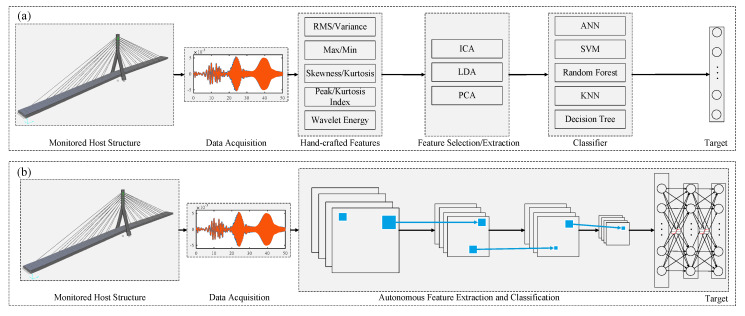
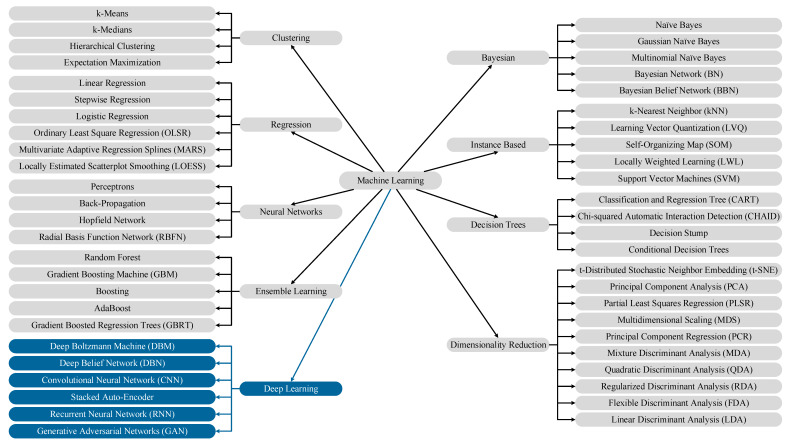
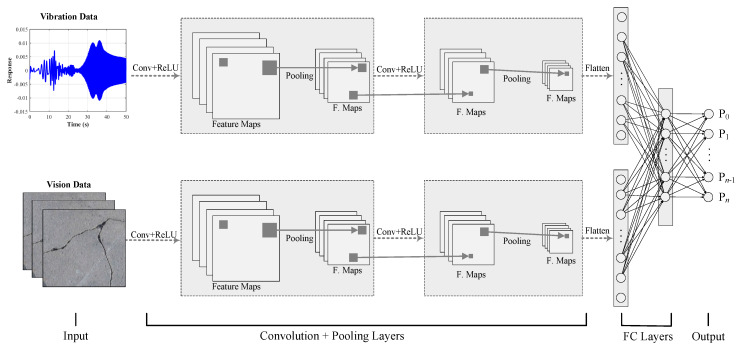
Data-driven methods in structural health monitoring (SHM) is gaining popularity due to recent technological advancements in sensors, as well as high-speed internet and cloud-based computation. Since the introduction of deep learning (DL) in civil engineering, particularly in SHM, this emerging and promising tool has attracted significant attention among researchers. The main goal of this paper is to review the latest publications in SHM using emerging DL-based methods and provide readers with an overall understanding of various SHM applications. After a brief introduction, an overview of various DL methods (e.g., deep neural networks, transfer learning, etc.) is presented. The procedure and application of vibration-based, vision-based monitoring, along with some of the recent technologies used for SHM, such as sensors, unmanned aerial vehicles (UAVs), etc. are discussed. The review concludes with prospects and potential limitations of DL-based methods in SHM applications.
Overview
The claims and statistics of this paper haven’t been checked yet.
Run the check — free, no account needed. It reads the open-access text and checks the sources it cites.
Integrity signals
Registry
Cites
Statistics
Figures
Verification
Claims the paper makes
The claims and statistics of this paper haven’t been checked yet.
Run the check — free, no account needed. It reads the open-access text and checks the sources it cites.
Claims other papers make about this one
Each is checked against this paper’s own text: does it say what the citing paper says it does?
The source backs part of the claim, not all of it — or backs it for a different population, condition or comparison.
In the citing paper
“In particular, the choice of this specific size is based on the fact that the AlexNet 34 (and also similar CNN architectures) has been shown to offer satisfactory performances with an input matrix of that size or very similar, albeit for different types of problems with respect to the one presented in this work (e.g., image classification).”
From Vibration-based structural health monitoring exploiting a combination of convolutional neural networks and autoencoders for temperature effects neutralization (2022) · cites this paper as [48]
Experimental — accuracy not yet measured
Self-check
Percentages, sums and reported differences re-computed from the paper’s own numbers.
The self-check needs the paper’s full text.
Citations
Cites
Deep Residual Learning for Image Recognition
He, K., Zhang, X., Ren, S., & Sun, J. (2016) · 2016 IEEE Conference on Computer Vision and Pattern Recognition (CVPR) · doi:10.1109/cvpr.2016.90 · Cited by 235,474
Very Deep Convolutional Networks for Large-Scale Image Recognition
Simonyan, K., & Zisserman, A. (2014) · arXiv · doi:10.48550/arxiv.1409.1556 · Cited by 114,148
ImageNet classification with deep convolutional neural networks
Krizhevsky, A., Sutskever, I., & Hinton, G. E. (2017) · Communications of the ACM · doi:10.1145/3065386 · Cited by 112,155
LeCun, Y., Bengio, Y., & Hinton, G. (2015) · Nature · doi:10.1038/nature14539 · Cited by 84,126
Faster R-CNN: Towards Real-Time Object Detection with Region Proposal Networks
Ren, S., He, K., Girshick, R., & Sun, J. (2017) · IEEE Transactions on Pattern Analysis and Machine Intelligence · doi:10.1109/tpami.2016.2577031 · Cited by 73,472
Faster R-CNN: Towards Real-Time Object Detection with Region Proposal Networks
Ren, S., He, K., Girshick, R., & Sun, J. (2015) · arXiv · doi:10.48550/arxiv.1506.01497 · Cited by 70,812
ImageNet: A large-scale hierarchical image database
Deng, J., Dong, W., Socher, R., Li, L.-J., Li, K., & Fei-Fei, L. (2009) · 2009 IEEE Conference on Computer Vision and Pattern Recognition · doi:10.1109/cvpr.2009.5206848 · Cited by 65,333
Going deeper with convolutions
Szegedy, C., Liu, W., Jia, Y., Sermanet, P., Reed, S., Anguelov, D., Erhan, D., Vanhoucke, V., & Rabinovich, A. (2015) · 2015 IEEE Conference on Computer Vision and Pattern Recognition (CVPR) · doi:10.1109/cvpr.2015.7298594 · Cited by 48,562
A Threshold Selection Method from Gray-Level Histograms
Otsu, N. (1979) · IEEE Transactions on Systems, Man and Cybernetics · doi:10.1109/tsmc.1979.4310076 · Cited by 44,708
Fully convolutional networks for semantic segmentation
Long, J., Shelhamer, E., & Darrell, T. (2015) · 2015 IEEE Conference on Computer Vision and Pattern Recognition (CVPR) · doi:10.1109/cvpr.2015.7298965 · Cited by 38,834
Research works printed but not linked: 9
- Goodfellow, I., Pouget-Abadie, J., Mirza, M., Xu, B., Warde-Farley, D., Ozair, S., Courville, A., and Bengio, Y. (2014, January 8–13). Generative adversarial nets. Proceedings of the Advances in neural information processing systems, Montréal, QC, Canada.
- Zink, 2015, Unmanned Aer, Veh. Bridge Insp. Demonstr. Proj., 32, 76
- Wells, 2017, Unmanned Aircr, Syst. Bridge Insp. Demonstr. Proj. Phase II Final. Rep., 13, 45
- Gopalakrishnan, K. (2018). Symposium on Automation and Robotics. Deep Learn. Pavement Image Anal. Autom. Distress Detect. Rev., 9.
- Nahata, 2019, Post-Earthquake. Assessment. Buildlings Using Deep Learning, J. Comput. Civ. Eng., 8, 330
- Gao, Y., Li, K., Mosalam, K., and Günay, S. (2018, January 16–25). Deep Residual Network with Transfer Learning for Imagebased Structural Damage Recognition. Proceedings of the Eleventh US National Conference on Earthquake Engineering, Integrating Science, Engineering Policy, San Francisco, CA, USA.
- Sharma, M., Anotaipaiboon, W., and Chaiyasarn, K. (2018, January 20–25). Crack Detection in Masonry Structures using Convolutional Neural Networks and Support Vector Machines. Proceedings of the 35th International Symposium on Automation and Robotics in Construction (ISARC 2018), Berlin, Germany.
- Aono, K., Kondapalli, S.H., Lajnef, N., Pekcan, G., Faridazar, F., and Chakrabartty, S. (2017, January 22–23). Self-powered Sensors to Facilitate Infrastructural Internet-of-Things for Smart Structures. Proceedings of the 13th International Workshop on Advanced Smart Materials and Smart Structures Technology, Tokyo, Japan.
- Brockman, G., Cheung, V., Pettersson, L., Schneider, J., Schulman, J., Tang, J., and Zaremba, W. (2020, May 09). Openai Gym. Available online: https://arxiv.org/abs/1606.01540. · arXiv
Cited by
Sorted by citations
Malekloo, A., Ozer, E., AlHamaydeh, M., & Girolami, M. (2022) · Structural Health Monitoring · doi:10.1177/14759217211036880 · Cited by 607
Zhang, C., Mousavi, A. A., Masri, S. F., Gholipour, G., Yan, K., & Li, X. (2022) · Mechanical Systems and Signal Processing · doi:10.1016/j.ymssp.2022.109175 · Cited by 411
3D vision technologies for a self-developed structural external crack damage recognition robot
Hu, K., Chen, Z., Kang, H., & Tang, Y. (2024) · Automation in Construction · doi:10.1016/j.autcon.2023.105262 · Cited by 324
Roy, A. M., & Bhaduri, J. (2023) · Advanced Engineering Informatics · doi:10.1016/j.aei.2023.102007 · Cited by 316
Three decades of statistical pattern recognition paradigm for SHM of bridges
Figueiredo, E., & Brownjohn, J. (2022) · Structural Health Monitoring · doi:10.1177/14759217221075241 · Cited by 251
Metadata
- Authors
- Azimi, M., Eslamlou, A., & Pekcan, G.
- Affiliations
- University of Nevada, Reno (US)
- Iran University of Science and Technology (IR)
- Department of Civil and Environmental Engineering, University of Nevada, Reno, NV 89557, USA
- Corresponding author
- Azimi, Mohsen
- Venue
- Sensors
- Publisher
- MDPI AG
- Published
- 2020-05-13
- Volume
- 20
- Issue
- 10
- Pages
- 2778
- ISSN
- 1424-8220 (ISSN-L)
- PMC
- PMC7294417
- OpenAlex
- W3024912007
- Cited by
- 769
- References
- 232
- Citations by year
- 2026: 151 · 2025: 181 · 2024: 133 · 2023: 138 · 2022: 96 · 2021: 56 · 2020: 14
- FWCI
- 44.44
- Type
- journal article
- Language
- en
- Open access
- gold
- dx.doi.org
- Licence
- Locations
- Sensors (publishedVersion, cc-by)
- PubMed Central (publishedVersion, cc-by)
- PubMed (publishedVersion)
- DOAJ (DOAJ: Directory of Open Access Journals) (submittedVersion, cc-by-sa)
- Funders
- National Science Foundation (1646420)
- Topics
- Physical Sciences › Engineering › Civil and Structural Engineering › Structural Health Monitoring Techniques
- Physical Sciences › Engineering › Civil and Structural Engineering › Infrastructure Maintenance and Monitoring
- Physical Sciences › Engineering › Civil and Structural Engineering › Structural Engineering and Materials Analysis
- Keywords
- structural health monitoring, damage detection, deep learning, vibration-based condition monitoring, vision-based monitoring, transfer learning, deep neural network, unmanned aerial vehicles, structural sensors, civil infrastructure
About these checks
Registry, retraction, Cites and statistics results are computed, not judged, with one exception: a printed reference that no index lists is read once by a model before it counts as a citation error. Claims are extracted by a model and kept only when their quote appears verbatim in the text; each cited source is then checked, with a model’s help, for whether it says what the claim relies on. Those verdicts can be wrong — read the claim’s quote and the cited source before relying on one.
Statistics and arithmetic are recomputed, not judged.
Confidence bands are shown only for fields calibrated on our annotated test set. None is calibrated yet, so no band is shown.
What counts as a claim ›How we measure confidence ›How we check this ›
Are you an author, or do you see a problem with this page? Request a review
