

The DOI matches its Crossref record; the references it cites are not checked yet.
Lightweight and Resource-Constrained Learning Network for Face Recognition with Performance Optimization
Open accessAbstract
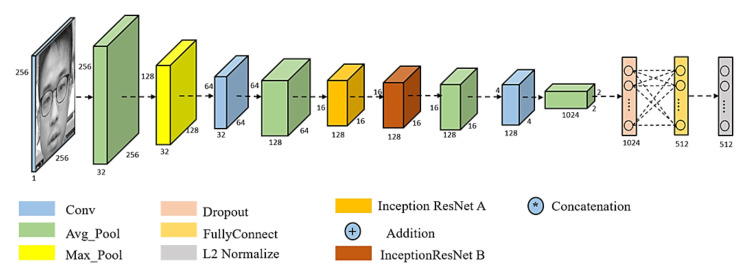
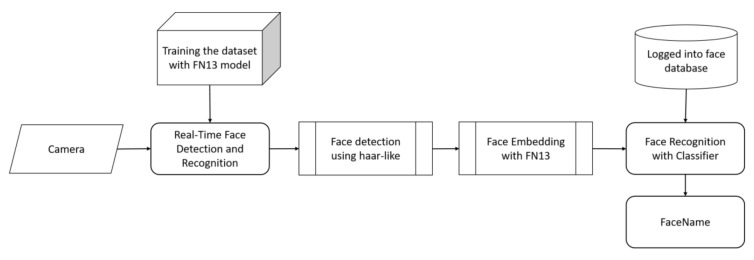
Despite considerable progress in face recognition technology in recent years, deep learning (DL) and convolutional neural networks (CNN) have revealed commendable recognition effects with the advent of artificial intelligence and big data. FaceNet was presented in 2015 and is able to significantly improve the accuracy of face recognition, while also being powerfully built to counteract several common issues, such as occlusion, blur, illumination change, and different angles of head pose. However, not all hardware can sustain the heavy computing load in the execution of the FaceNet model. In applications in the security industry, lightweight and efficient face recognition are two key points for facilitating the deployment of DL and CNN models directly in field devices, due to their limited edge computing capability and low equipment cost. To this end, this paper provides a lightweight learning network improved from FaceNet, which is called FN13, to break through the hardware limitation of constrained computational resources. The proposed FN13 takes the advantage of center loss to reduce the variations of the between-class features and enlarge the difference of the within-class features, instead of the triplet loss by using FaceNet. The resulting model reduces the number of parameters and maintains a high degree of accuracy, only requiring few grayscale reference images per subject. The validity of FN13 is demonstrated by conducting experiments on the Labeled Faces in the Wild (LFW) dataset, as well as an analytical discussion regarding specific disguise problems.
Overview
The claims and statistics of this paper haven’t been checked yet.
Free: it reads the open-access text and checks the first 5 claims that cite a source we can check. Create a free account to check every claim.
Integrity signals
Registry
Cites
Statistics
Figures









Verification
Claims the paper makes
The claims and statistics of this paper haven’t been checked yet.
Free: it reads the open-access text and checks the first 5 claims that cite a source we can check. Create a free account to check every claim.
Claims other papers make about this one
Each is checked against this paper’s own text: does it say what the citing paper says it does?
The cited source says what the claim attributes to it.
In the citing paper
“CNNs have been extensively applied in a range of different fields, including computer vision [77], speech processing [78], Face Recognition [79], etc.”
From Review of deep learning: concepts, CNN architectures, challenges, applications, future directions (2021) · cites this paper as [79]
Self-check
Percentages, sums and reported differences re-computed from the paper’s own numbers.
The self-check needs the paper’s full text.
Citations
The citation lists are queued
They are fetched later and appear here then.
References 37 · Cited by 54
Metadata
- Authors
- Li, H.-C., Deng, Z.-Y., & Chiang, H.-H.
- Affiliations
- Fu Jen Catholic University (TW)
- National Taiwan Normal University (TW)
- Corresponding author
- Chiang, Hsin-Han
- Venue
- Sensors
- Publisher
- MDPI AG
- Published
- 2020-10-27
- Volume
- 20
- Issue
- 21
- Pages
- 6114
- ISSN
- 1424-8220 (ISSN-L)
- PMC
- PMC7662273
- OpenAlex
- W3097781980
- Cited by
- 54
- References
- 37
- Citations by year
- 2026: 5 · 2025: 11 · 2024: 17 · 2023: 14 · 2022: 5 · 2021: 2
- FWCI
- 2.04
- Type
- journal article
- Language
- en
- Open access
- gold
- doi.org
- Licence
- Locations
- Sensors (publishedVersion, cc-by)
- PubMed Central (publishedVersion, cc-by)
- PubMed (publishedVersion)
- DOAJ (DOAJ: Directory of Open Access Journals) (submittedVersion, cc-by-sa)
- Funders
- Holtek Semiconductor (Taiwan) Inc. (108K0007)
- Ministry of Science and Technology, Taiwan, R.O.C. (MOST 107-2221-E-003-024-MY3 and MOST 109-2634-F-003-006)
- Topics
- Physical Sciences › Computer Science › Computer Vision and Pattern Recognition › Face recognition and analysis
- Physical Sciences › Computer Science › Computer Vision and Pattern Recognition › Face and Expression Recognition
- Physical Sciences › Computer Science › Computer Vision and Pattern Recognition › Advanced Neural Network Applications
- Keywords
- face recognition, lightweight neural networks, FaceNet, center loss, triplet loss, edge computing, resource-constrained devices, parameter reduction, LFW dataset
- MeSH terms
- Deep Learning, Automated Facial Recognition, Algorithms, Artificial Intelligence, Head, Humans, Neural Networks, Computer
About these checks
Registry, retraction, Cites and statistics results are computed, not judged, with one exception: a printed reference that no index lists is read once by a model before it counts as a citation error. Claims are extracted by a model and kept only when their quote appears verbatim in the text; each cited source is then checked, with a model’s help, for whether it says what the claim relies on. Those verdicts can be wrong — read the claim’s quote and the cited source before relying on one.
Statistics and arithmetic are recomputed, not judged.
Confidence bands are shown only for fields calibrated on our annotated test set. None is calibrated yet, so no band is shown.
What counts as a claim ›How we measure confidence ›How we check this ›
Are you an author, or do you see a problem with this page? Request a review
How to cite
Cite CoChat for the checks on this page, and the paper for its own findings.
- This page
- CoChat. (2026). Citation check: Lightweight and Resource-Constrained Learning Network for Face Recognition with Performance Optimization. https://app.cochat.ai/papers/10.3390/s20216114
- The paper
- Li, H.-C., Deng, Z.-Y., & Chiang, H.-H. (2020). Lightweight and Resource-Constrained Learning Network for Face Recognition with Performance Optimization. Sensors. https://doi.org/10.3390/s20216114
Data sources
Bibliographic data: Semantic Scholar, OpenAlex, Crossref.
Contains information from the Semantic Scholar Academic Graph Datasets, made available under the ODC Attribution License (ODC-BY 1.0).
Semantic Scholar’s data is described in: Kinney, R., et al. (2023). The Semantic Scholar Open Data Platform. arXiv:2301.10140.
