

An Evolving TinyML Compression Algorithm for IoT Environments Based on Data Eccentricity
Open accessThe DOI matches its Crossref record; 65 of the 66 references it cites were found in a registry or an index.
Abstract
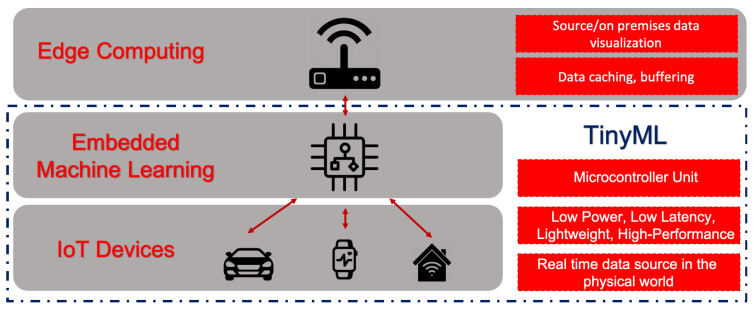
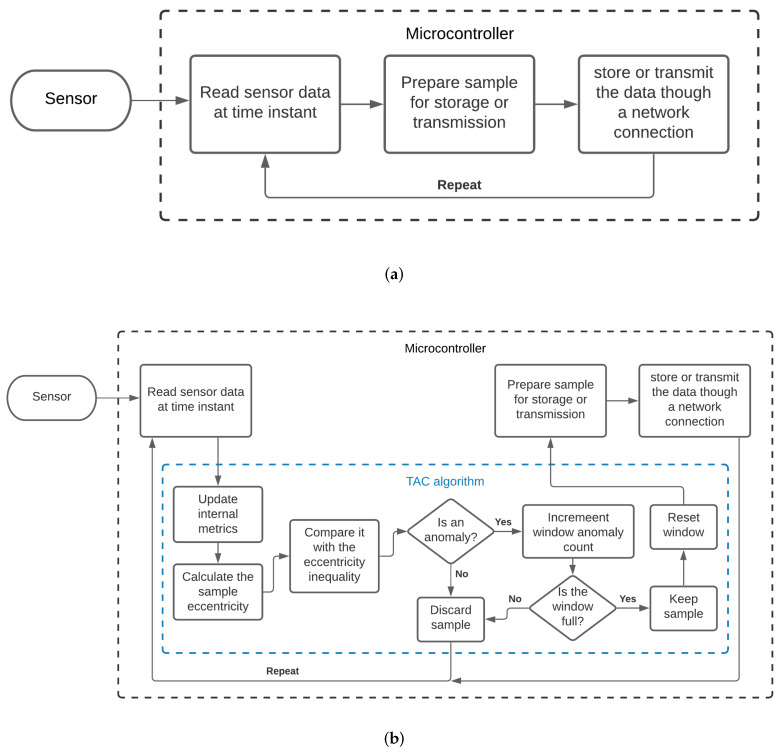
Currently, the applications of the Internet of Things (IoT) generate a large amount of sensor data at a very high pace, making it a challenge to collect and store the data. This scenario brings about the need for effective data compression algorithms to make the data manageable among tiny and battery-powered devices and, more importantly, shareable across the network. Additionally, considering that, very often, wireless communications (e.g., low-power wide-area networks) are adopted to connect field devices, user payload compression can also provide benefits derived from better spectrum usage, which in turn can result in advantages for high-density application scenarios. As a result of this increase in the number of connected devices, a new concept has emerged, called TinyML. It enables the use of machine learning on tiny, computationally restrained devices. This allows intelligent devices to analyze and interpret data locally and in real time. Therefore, this work presents a new data compression solution (algorithm) for the IoT that leverages the TinyML perspective. The new approach is called the Tiny Anomaly Compressor (TAC) and is based on data eccentricity. TAC does not require previously established mathematical models or any assumptions about the underlying data distribution. In order to test the effectiveness of the proposed solution and validate it, a comparative analysis was performed on two real-world datasets with two other algorithms from the literature (namely Swing Door Trending (SDT) and the Discrete Cosine Transform (DCT)). It was found that the TAC algorithm showed promising results, achieving a maximum compression rate of 98.33%. Additionally, it also surpassed the two other models regarding the compression error and peak signal-to-noise ratio in all cases.
Overview
The claims and statistics of this paper haven’t been checked yet.
Free: it reads the open-access text and checks the first 5 claims that cite a source we can check. Create a free account to check every claim.
Integrity signals
Registry
Cites
Statistics
Figures
Verification
Claims the paper makes
The claims and statistics of this paper haven’t been checked yet.
Free: it reads the open-access text and checks the first 5 claims that cite a source we can check. Create a free account to check every claim.
Claims other papers make about this one
Each is checked against this paper’s own text: does it say what the citing paper says it does?
The source backs part of the claim, not all of it — or backs it for a different population, condition or comparison.
In the citing paper
“However, inference of DL in edge devices is not yet prepared enough to be fully executed [3,4,6].”
From TinyML: Enabling of Inference Deep Learning Models on Ultra-Low-Power IoT Edge Devices for AI Applications (2022) · cites this paper as [3]
Experimental — accuracy not yet measuredThe cited source says what the claim attributes to it.
In the citing paper
“In (Signoretti et al., 2021), a tiny anomaly compressor (TAC) model is proposed on top of the typicality and eccentricity data analytics (TEDA) mathematical framework (also known as the empirical data analysis -EDA).”
From A review on TinyML: State-of-the-art and prospects (2022) · cites this paper as Signoretti et al., 2021
The cited source says what the claim attributes to it.
In the citing paper
“The TAC aims to compress user data without prior knowledge about any established mathematical models.”
From A review on TinyML: State-of-the-art and prospects (2022) · cites this paper as Signoretti et al., 2021
Self-check
Percentages, sums and reported differences re-computed from the paper’s own numbers.
The self-check needs the paper’s full text.
Citations
Cites
Representation Learning: A Review and New Perspectives
Bengio, Y., Courville, A., & Vincent, P. (2013) · IEEE Transactions on Pattern Analysis and Machine Intelligence · doi:10.1109/tpami.2013.50 · Cited by 13,001 · cited 1×
“These are a class of models that are not explicitly instructed to predict something specific; rather, the patterns in the data are identified by the algorithm itself, and it is left to the user to interpret the output and reach a conclusion [34,35].”
BackgroundInternet of Things for Smart Cities
Zanella, A., Bui, N., Castellani, A., Vangelista, L., & Zorzi, M. (2014) · IEEE Internet of Things Journal · doi:10.1109/jiot.2014.2306328 · Cited by 6,292 · cited 1×
“The Internet of Things (IoT) allows the continuous monitoring of environments and machines using small and inexpensive sensors [1,2].”
BackgroundA Survey on Mobile Edge Computing: The Communication Perspective
Mao, Y., You, C., Zhang, J., Huang, K., & Letaief, K. B. (2017) · IEEE Communications Surveys & Tutorials · doi:10.1109/comst.2017.2745201 · Cited by 5,607 · cited 1×
“For all these reasons, decreasing the time-on-air of each transmission can reduce collisions, save bandwidth, and allow a higher number of coexisting nodes (for high-density applications [25]) Therefore, it is clear that the new trend is to add “intelligence” to IoT devices so that they process data and make decisions…”
BackgroundFast Normalized Cross-Correlation
Yoo, J.-C., & Han, T. H. (2009) · Circuits, Systems and Signal Processing · doi:10.1007/s00034-009-9130-7 · Cited by 1,115
Machine Learning for Internet of Things Data Analysis: A Survey
Mahdavinejad, M. S., Rezvan, M., Barekatain, M., Adibi, P., Barnaghi, P. M., & Sheth, A. (2017) · Surrey Research Insight Open Access (The University of Surrey) · Cited by 1,008
Machine learning for internet of things data analysis: a survey
Mahdavinejad, M. S., Rezvan, M., Barekatain, M., Adibi, P., Barnaghi, P., & Sheth, A. P. (2018) · Digital Communications and Networks · doi:10.1016/j.dcan.2017.10.002 · Cited by 921 · cited 1×
“However, in those proposals, the algorithms were not structured with Machine Learning (ML) techniques, which is the conjunction of methods for data analysis that automates the construction of analytical models [31].”
MethodSurvey on Multi-Access Edge Computing for Internet of Things Realization
Porambage, P., Okwuibe, J., Liyanage, M., Ylianttila, M., & Taleb, T. (2018) · IEEE Communications Surveys & Tutorials · doi:10.1109/comst.2018.2849509 · Cited by 795 · cited 1×
“Often, IoT devices work with low-frequency processors and have limited local data storage capacity, severe memory restrictions [23,24], simple protocols, and inefficient medium access strategies (e.”
BackgroundLow Power Wide Area Network Analysis: Can LoRa Scale?
Georgiou, O., & Raza, U. (2017) · IEEE Wireless Communications Letters · doi:10.1109/lwc.2016.2647247 · Cited by 729 · cited 1×
“In this manner, some challenges regarding the amount of data generated per second are encountered, especially when using low-power transmission protocols as LoRaWAN [18–20].”
Edge Computing for the Internet of Things: A Case Study
Premsankar, G., Di Francesco, M., & Taleb, T. (2018) · IEEE Internet of Things Journal · doi:10.1109/jiot.2018.2805263 · Cited by 697
Balanda, K. P., & Macgillivray, H. L. (1988) · The American Statistician · doi:10.1080/00031305.1988.10475539 · Cited by 482 · cited 1×
“It is a scaled version of the distribution’s forth moment [57].”
Background
Research works printed but not linked: 1
- Neto, E.J.M., Augusto, L., Souza, D.C., and Guedes, L.A. (2014, January 20–24). Adaptive Swinging Door Trending: Um Algoritmo Adaptativo para Compressão de Dados em Tempo Real. Proceedings of the Anais do XX Congresso Brasileiro de Automática, Belo Horizonte, Brazil.
Cited by
A review on TinyML: State-of-the-art and prospects
Ray, P. P. (2022) · Journal of King Saud University - Computer and Information Sciences · doi:10.1016/j.jksuci.2021.11.019 · Cited by 460
“In (Signoretti et al., 2021), a tiny anomaly compressor (TAC) model is proposed on top of the typicality and eccentricity data analytics (TEDA) mathematical framework (also known as the empirical data analysis - EDA).”
TinyML for Ultra-Low Power AI and Large Scale IoT Deployments: A Systematic Review
Schizas, N., Karras, A., Karras, C., & Sioutas, S. (2022) · Future Internet · doi:10.3390/fi14120363 · Cited by 215
Alajlan, N. N., & Ibrahim, D. M. (2022) · Micromachines · doi:10.3390/mi13060851 · Cited by 224
“However, inference of DL in edge devices is not yet prepared enough to be fully executed [3,4,6].”
BackgroundIslam, M. M., Nooruddin, S., Karray, F., & Muhammad, G. (2023) · IEEE Internet of Things Journal · doi:10.1109/jiot.2022.3228795 · Cited by 183
“Lossless compression models can also be researched to transmit huge volumes of data over IoT networks [189].”
BackgroundDeep Reinforcement Learning-Based Energy-Efficient Edge Computing for Internet of Vehicles
Kong, X., Duan, G., Hou, M., Shen, G., Wang, H., Yan, X., & Collotta, M. (2022) · IEEE Transactions on Industrial Informatics · doi:10.1109/tii.2022.3155162 · Cited by 166
TinyML: Tools, applications, challenges, and future research directions
Kallimani, R., Pai, K., Raghuwanshi, P., Iyer, S., & López, O. L. A. (2023) · Multimedia Tools and Applications · doi:10.1007/s11042-023-16740-9 · Cited by 185
“Authors conducted a detailed study on data compression in [88], emphasising that data compression algorithms must manage extensive collected data in a portable device.”
TinyML: A Systematic Review and Synthesis of Existing Research
Han, H., & Siebert, J. (2022) · International Conference on Artificial Intelligence in Information and Communication (ICAIIC) · doi:10.1109/icaiic54071.2022.9722636 · Cited by 155
Unlocking Edge Intelligence Through Tiny Machine Learning (TinyML)
Zaidi, S. A. R., Hayajneh, A. M., Hafeez, M., & Ahmed, Q. Z. (2022) · IEEE Access · doi:10.1109/access.2022.3207200 · Cited by 129
“In [17] authors present a new data compres-216 sion solution called the Tiny Anomaly Compressor (TAC) to leverage the TinyML perspective.”
BackgroundNassra, I., & Capella, J. V. (2023) · Internet of Things · doi:10.1016/j.iot.2023.100806 · Cited by 101
Artificial intelligence and edge computing for machine maintenance-review
Bala, A., Rashid, R. Z. J. A., Ismail, I. B., Oliva, D. A., Muhammad, N., Sait, S. M., Al-Utaibi, K. A., Amosa, T. I., & Memon, K. A. (2024) · Artificial Intelligence Review · doi:10.1007/s10462-024-10748-9 · Cited by 121
“…models, such as just another network (JANET) Van Der Westhuizen and Lasenby (2018) which is a light version of LSTM, lightweight recurrent neural network (LLRNN) Liu et al. (2019) and other tiny machine learning tinyML methods (Dutta and Bharali 2021; Signoretti et al. 2021; Asutkar et al. 2022).”
Asutkar, S., Chalke, C., Shivgan, K., & Tallur, S. G. (2022) · Expert Systems with Applications · doi:10.1016/j.eswa.2022.119016 · Cited by 76
A TinyML Soft-Sensor Approach for Low-Cost Detection and Monitoring of Vehicular Emissions
Andrade, P., Silva, I., Silva, M., Flores, T., Cassiano, J., & Costa, D. G. (2022) · Sensors · doi:10.3390/s22103838 · Cited by 66
Self-citationHayajneh, A. M., Aldalahmeh, S. A., Alasali, F., Al-Obiedollah, H. M., Zaidi, S. A., & McLernon, D. (2023) · IET Smart Cities · doi:10.1049/smc2.12072 · Cited by 83
TinyML Algorithms for Big Data Management in Large-Scale IoT Systems
Karras, A., Γιάνναρος, Α., Karras, C., Theodorakopoulos, L., Mammassis, C. S., Krimpas, G. A., & Sioutas, S. (2024) · Future Internet · doi:10.3390/fi16020042 · Cited by 81
“Additionally, we assess our proposed method named Com-pressEdgeML with a similar method presented in [72] named TAC.”
From Tiny Machine Learning to Tiny Deep Learning: A Survey
Somvanshi, S., Islam, M. M., Chhetri, G., Chakraborty, R., Mimi, M. S., Shuvo, S. A., Islam, K. S., Javed, S. A., Rafat, S. A., Dutta, A. K., et al. (2025) · ACM Computing Surveys · doi:10.1145/3776588 · Cited by 128
“In addition to these, Ray [9] analyzed specific model compression techniques, including the Tiny Anomaly Compressor [45], Doped Kronecker Product [46], and Starfish [47], particularly in the context of image compression.”
Advancing TinyML in IoT: A Holistic System-Level Perspective for Resource-Constrained AI
Ortiz, L. A. P., Soliz, I. F. M., & Balarezo, V. K. G. (2025) · Future Internet · doi:10.3390/fi17060257 · Cited by 43
“Federated learning has demonstrated the feasibility of distributed AI, yet scaling to millions or billions of edge devices can introduce performance bottlenecks, fairness concerns, and vulnerability to malicious updates [83].”
Ntabeni, U., Basutli, B., Alves, H., & Chuma, J. (2024) · IEEE Open Journal of the Communications Society · doi:10.1109/ojcoms.2024.3443920 · Cited by 41
“Additionally, advancements in memory devices and data compression techniques, such as hybrid storage architectures [183], [184] and TinyML-based compression, are optimizing energy consumption and data management in resource-constrained environments [185].”
BackgroundLi, T., Luo, J., Liang, K., Yi, C., & Ma, L. (2023) · Sustainability · doi:10.3390/su151813779 · Cited by 24
Hybrid computing framework security in dynamic offloading for IoT-enabled smart home system
Khan, S., Zheng, J., Ullah, F., Akhter, M. P., Khan, S., Awwad, F. A. A., & Ismail, E. A. A. (2024) · PeerJ Computer Science · doi:10.7717/peerj-cs.2211 · Cited by 29
Developing a TinyML Image Classifier in an Hour
Berta, R., Dabbous, A., Lazzaroni, L., Pau, D. P., & Bellotti, F. (2024) · IEEE Open Journal of the Industrial Electronics Society · doi:10.1109/ojies.2024.3451959 · Cited by 21
“Some of such techniques are TinyML specific, such as hyperdimen-sional computing [36], swapping [37], attention condensers [38], once-for-all modeling [39], parallelization [40], in-place computation [32], model pruning [41], online learning [42], and data compression [43].”
MethodTerziyska, M., Ilieva, I., Terziyski, Z., & Komitov, N. G. (2026) · Sci · doi:10.3390/sci8010010 · Cited by 24
“TinyML is no longer merely a tool for local computation but an integrated strategy for green cognitive autonomy, where every device continuously balances accuracy, resource usage, and environmental impact [8,33,51,53,72].”
A TinyML Soft-Sensor for the Internet of Intelligent Vehicles
Flores, T. K. S., da Silva, M. L., de Andrade, P. H. M., Silva, J., da Silva, I. M. D., Sisinni, E., Ferrari, P., & Rinaldi, S. (2022) · IEEE International Workshop on Metrology for Automotive (MetroAutomotive) · doi:10.1109/metroautomotive54295.2022.9855110 · Cited by 21
Self-citationSmart Agriculture: A Comprehensive Overview
Mitra, A., Vangipuram, S. L. T., Bapatla, A. K., Bathalapalli, V. K. V. V., Mohanty, S. P., Kougianos, E., & Ray, C. (2024) · SN Computer Science · doi:10.1007/s42979-024-03319-w · Cited by 101
“According to [251], adding intelligence to IoT devices is the new trend.”
Andrade, M., Medeiros, M. D. A., Medeiros, T., Azevedo, M., Silva, M., Costa, D. G., & da Silva, I. M. D. (2024) · Sustainability · doi:10.3390/su16020708 · Cited by 21
“Based on these variables, some conversions are performed, as expressed in Table 1, according to previous analyses [30,33].”
MethodSelf-citationSisinni, E., Carvalho, D. F., Depari, A., Bellagente, P., Flammini, A., Pasetti, M., Rinaldi, S., & Ferrari, P. (2023) · Sensors · doi:10.3390/s23052407 · Cited by 14
“Better performance is obtained following the strategy in the RFC5795 or in RFC6282 [33], both implementing a stateful approach, that, in turn, results in wasting power and Better performance is obtained following the strategy in the RFC5795 or in the RFC6282 [33], both implementing a stateful…”
Self-citationOliveira, F., Costa, D. G., de Lima, L. C., & da Silva, I. M. D. (2021) · Smart Cities · doi:10.3390/smartcities4030056 · Cited by 14
“Actually, this research line is focused on analyzing the infrastructure of cycle paths (or roads) through sensors, bringing some important contributions [2,13].”
BackgroundSelf-citationTiny Machine Learning (TinyML): Research trends and future application opportunities
Han, H., Trimi, S., & Lee, S. M. (2026) · Array · doi:10.1016/j.array.2025.100674 · Cited by 24
“7 These 20 influential articles span diverse applications, including embedded devices [28 – 30], IoT [19,31,32], autonomous vehicles [33], agriculture [34], environmental monitoring [35], and healthcare [36].”
An Adaptive TinyML Unsupervised Online Learning Algorithm for Driver Behavior Analysis
da Silva, M. L., Medeiros, T., Azevedo, M., Medeiros, M. D. A., Themoteo, M., Gois, T., da Silva, I. M. D., & Costa, D. G. (2023) · IEEE International Workshop on Metrology for Automotive (MetroAutomotive) · doi:10.1109/metroautomotive57488.2023.10219125 · Cited by 17
“In situations with limited internet connectivity, on-device inference becomes crucial, making Tiny Machine Learning (TinyML) a viable alternative to Edge Computing [13], [14].”
MethodSelf-citationTEDA-RLS: A TinyML Incremental Learning Approach for Outlier Detection and Correction
de Andrade, P. H. M., Silva, M., Medeiros, M. D. A., Costa, D. G., & da Silva, I. M. D. (2024) · IEEE Sensors Journal · doi:10.1109/jsen.2024.3458917 · Cited by 14
“By leveraging lightweight algorithms and model optimization techniques, TinyML allows for efficient inference and data processing directly on low-power microcontrollers and other edge devices [12].”
MethodSelf-citationOnline Processing of Vehicular Data on the Edge Through an Unsupervised TinyML Regression Technique
de Andrade, P. H. M., da Silva, I. M. D., Diniz, M., Flores, T. K. S., Costa, D. G., & Soares, E. A. (2023) · ACM Transactions on Embedded Computing Systems · doi:10.1145/3591356 · Cited by 16
“However, their main constraints are the reduced memory (KB or MB) and their low-frequency processors [4, 71].”
BackgroundInfluentialSelf-citationDesign an efficient internet of things data compression for healthcare applications
Kadhim, A. N., & Manaa, M. E. (2022) · Bulletin of Electrical Engineering and Informatics · doi:10.11591/eei.v11i3.3758 · Cited by 12
Machine Learning and Fuzzy Logic in Electronics: Applying Intelligence in Practice
Ivanova, M., Petkova, P., & Petkov, N. (2021) · Electronics · doi:10.3390/electronics10222878 · Cited by 11
“Signoretti et al. present a new algorithm called Tiny Anomaly Compressor for data compression in the infrastructure of Internet of Things [26].”
MethodAn Evolving Multivariate Time Series Compression Algorithm for IoT Applications
Costa, H., Silva, M., Sánchez-Gendriz, I., Viegas, C. M. D., & da Silva, I. M. D. (2024) · Sensors · doi:10.3390/s24227273 · Cited by 10
Self-citationTinyML Custom AI Algorithms for Low-Power IoT Data Compression: A Bridge Monitoring Case Study
Medeiros, T., Amaral, M., Targino, M., Silva, M., da Silva, I. M. D., Sisinni, E., & Ferrari, P. (2023) · IEEE International Workshop on Metrology for Industry 4.0 & IoT (MetroInd4.0&IoT) · doi:10.1109/metroind4.0iot57462.2023.10180152 · Cited by 9
“In [4], the Tiny Anomaly Compressor (TAC) algorithm is introduced, which leverages the perspective of TinyML and is based on data eccentricity, eliminating the need for established mathematical models or data distribution assumptions.”
BackgroundMethodInfluentialSelf-citationGao, X., Wang, X., & Qian, Z. (2024) · IEEE Internet of Things Journal · doi:10.1109/jiot.2024.3360444 · Cited by 9
“In addition, TinyML model for predicting air quality and IoT data compression algorithm are also proposed [2], [5].”
MethodZheng, T., Qiu, Y., Zheng, Y., Wang, Q., & Chen, X. (2024) · IEEE Internet of Things Journal · doi:10.1109/jiot.2024.3361452 · Cited by 8
“1, the emergence of tiny machine learning (TinyML) in recent years has provided edge devices with a lightweight and low-power local approach for model inference and training [17], making it widely applicable to various real-time tasks [18], [19], [20], [21].”
BackgroundMethodAn Online Unsupervised Machine Learning Approach to Detect Driving Related Events
da Silva, M. L., Flores, T. K. S., Andrade, P., Silva, J., da Silva, I. M. D., & Costa, D. G. (2022) · Annual Conference of the IEEE Industrial Electronics Society (IECON) · doi:10.1109/iecon49645.2022.9968381 · Cited by 10
“However, in this very promising scenario, a considerable group of IoT devices will have processing, memory, and power constraints [4], which would impose many challenges when such applications rely on Cloud-based services to operate [5].”
BackgroundSelf-citationPiątkowski, D., Puślecki, T., & Walkowiak, K. M. (2023) · Sensors · doi:10.3390/s24010224 · Cited by 14
“An example can be found in [7], where a new data compression algorithm tailored for TinyML is proposed.”
MethodRahmani, A. M., Alsubai, S., Alanazi, A., Alqahtani, A., Zaidi, M. M., & Hosseinzadeh, M. (2024) · Computers & Electrical Engineering · doi:10.1016/j.compeleceng.2024.109812 · Cited by 9
Towards a customized vehicular maintenance based on 2-layers data-stream application
Silva, M., Signoretti, G., de Andrade, P. H. M., da Silva, I. M. D., & Ferrari, P. (2021) · IEEE International Workshop on Metrology for Automotive (MetroAutomotive) · doi:10.1109/metroautomotive50197.2021.9502892 · Cited by 7
Self-citationTang, D., Peng, X., Zheng, T., Li, X., & Yang, C. (2024) · Wireless Networks · doi:10.1007/s11276-024-03833-y · Cited by 9
“This enables quick adaptation of the models to various scenarios like the Internet of Vehicles (IoV) [19–21], IoT [22, 23], and other similar contexts [24, 25].”
A data-stream TinyML compression algorithm for vehicular applications: a case study
Silva, M., Signoretti, G., Flores, T. K. S., de Andrade, P. H. M., Silva, J., da Silva, I. M. D., Sisinni, E., & Ferrari, P. (2022) · IEEE International Workshop on Metrology for Industry 4.0 & IoT (MetroInd4.0&IoT) · doi:10.1109/metroind4.0iot54413.2022.9831606 · Cited by 6
Self-citationCough Recognition Using Tiny ML
Shankar, R., Mythireyan, K. M. G., Nalla, N. R., & Venkateshkumar, M. (2022) · IEEE Industrial Electronics and Applications Conference (IEACon) · doi:10.1109/ieacon55029.2022.9951763 · Cited by 6
Malicious Traffic Compression and Classification Technique for Secure Internet of Things
Lee, Y. R., Park, N.-E., Kim, S.-Y., & Lee, I.-G. (2023) · Computers, materials & continua/Computers, materials & continua (Print) · doi:10.32604/cmc.2023.041196 · Cited by 6
Kiran, A., Ramesh, J. V. N., Quraishi, A., Patni, J. C., Keshta, I. M., Byeon, H., Raparthi, M., Sandhu, M., & Soni, M. (2024) · IEEE Transactions on Intelligent Transportation Systems · doi:10.1109/tits.2024.3495332 · Cited by 5
“Reference [27] presents another application of TinyML for IoT based on data eccentricity.”
Zhang, S. (2022) · Computational Intelligence and Neuroscience · doi:10.1155/2022/4670523 · Cited by 5
RetractedMa, L., Wang, F., Ma, X., Xiao, Y., Deng, Q., Li, X., & Song, X. (2023) · International Journal of Structural Stability and Dynamics · doi:10.1142/s0219455424501463 · Cited by 5
A Cloud-Aware Scalable Architecture for Distributed Edge-Enabled BCI Biosensor System
Ghosh, S., Bhuvanakantham, R., Sindhujaa, P., Bhuvana, H. P., Mohan, A., Gulyás, B. Z., Máthé, D., & Padmanabhan, P. (2026) · Biosensors · doi:10.3390/bios16030157 · Cited by 6
“TinyML models were trained in Python using scikit-learn and TensorFlow Lite [70], converted to .tflite format, and compiled into .h header files for integration into the RP2040 firmware [71,72].”
Tinyml Applications in Wearable Devices: A Systematic Review and Research Directions
Nguyen, T.-D., Nguyen, T.-P., Nguyen, T.-P., & Thương, P. T. (2026) · Lecture notes in networks and systems · doi:10.1007/978-3-032-18316-3_22 · Cited by 3
A Metrological Fuel Surveillance Application Based on Internet of Intelligent Vehicles
de Andrade, P. H. M., da Silva, I. M. D., Signoretti, G., Silva, M., Dias, J., Marques, L., Melo, W. S., & Galhardo, C. E. C. (2021) · IEEE International Workshop on Metrology for Automotive (MetroAutomotive) · doi:10.1109/metroautomotive50197.2021.9502890 · Cited by 3
Self-citationHabiyaremye, J., Zennaro, M., Mikeka, C., & Masabo, E. (2022) · International Conference on Machine Learning and Computing (ICMLC) · doi:10.1145/3529836.3529932 · Cited by 4
TinyML based Deep Learning Model for Activity Detection
Kayarvizhy, N., Gera, B. M., Sharma, B., & Dakshinamurthy, S. (2023) · International Journal on Recent and Innovation Trends in Computing and Communication · doi:10.17762/ijritcc.v11i11s.8081 · Cited by 4
Exploring Sustainable Practices for Energy Conservation in IoT Systems- An Extensive Overview
Agrawal, K., & Ahmad, S. (2024) · International Conference on Networking, Embedded and Wireless Systems (ICNEWS) · doi:10.1109/icnews60873.2024.10731068 · Cited by 3
“sleep / wakeup cycles In these papers [8], [2], [16] machine learning algorithms are used for data reduction and thus saving power.”
BackgroundMethodZhang, J., Chen, C., Peng, J., & Liang, J. (2022) · International Conference on Information Technology and Intelligent Control (CITIC) · doi:10.1117/12.2653382 · Cited by 3
“The data storage module is used for storing data[6][7].”
MethodTinyML: principles and algorithms
Ghorpade, S. N., Chougule, S., Chaudhari, B. S., & Zennaro, M. (2024) · Elsevier eBooks · doi:10.1016/b978-0-44-322202-3.00009-9 · Cited by 3
Perspectives of TinyML-Based Self-management in IoT-Based Systems
Maoui, M., & Benaboud, R. (2024) · Lecture notes in networks and systems · doi:10.1007/978-3-031-60594-9_1 · Cited by 3
Predictive Machine Maintenance Using Tiny ML
Bhide, A., Ghodake, D., Jamle, A., Shaikh, S., & Bhujbal, S. R. (2023) · International Journal for Research in Applied Science and Engineering Technology · doi:10.22214/ijraset.2023.51254 · Cited by 5
TAC: A Python package for IoT-focused Tiny Anomaly Compression
Amaral, M., Signoretti, G., Silva, M., & da Silva, I. M. D. (2024) · SoftwareX · doi:10.1016/j.softx.2024.101747 · Cited by 2
Self-citationETL-FEXIC Model For Secured Heart Rate Abnormality Healthcare Framework
Arthi, R. (2024) · Journal of Electrical Systems · doi:10.52783/jes.3995 · Cited by 2
de Andrade, P. H. M., Medeiros, M. D. A., Silva, M., Costa, D. G., & da Silva, I. M. D. (2025) · Computing · doi:10.1007/s00607-025-01490-3 · Cited by 1
“Despite advances in machine learning and anomaly detection, there is a lack of lightweight and efficient algorithms suitable for microcontroller-based devices, such as the ESP32, commonly used in OBD-II Edge systems [37].”
Self-citationEvolving online clustering for real-time driver behavior analysis in IoT-enabled vehicles
Medeiros, M. D. A., Silva, M., & da Silva, I. M. D. (2025) · Evolving Systems · doi:10.1007/s12530-025-09745-2 · Cited by 2
“This approach meets the demand for more intelligent and more connected systems in the automotive sector while addressing concerns about energy efficiency and sustainability (Signoretti et al. 2021; Silva et al. 2023).”
Self-citationA Human Activity Determination Predicting Abnormality for Mining Field Workers
Tephillah, S., Jana, K., & Saran Krishna, P. (2024) · International Conference on Advances in Data Engineering and Intelligent Computing Systems (ADICS) · doi:10.1109/adics58448.2024.10533538 · Cited by 1
Demand-Driven Data Acquisition for Large Scale Fleets
Matesanz, P., Graen, T., Fiege, A., Nolting, M., & Nejdl, W. (2021) · Sensors · doi:10.3390/s21217190 · Cited by 2
“In contrast, the authors of [54] propose to detect anomalies locally on the vehicle and restrict data transmission to them.”
BackgroundETL-FEXIC Model for Secured Heart Rate Abnormality Healthcare Framework
Arthi, R. (2024) · Journal of Electrical Systems · doi:10.52783/jes.3861
“TinyML[4][10] focuses on being efficient and using little power.”
BackgroundChronological Archery Algorithm for Image Compression Using Compressive Sensing in IoT–LTE System
Rao, A. S. V., Amgoth, T., & Bhattacharya, A. (2024) · IEEE Transactions on Consumer Electronics · doi:10.1109/tce.2024.3477628
“Restrictions apply. space [6], [12], [13].”
Ultralow power communication: Challenges and machine learning solutions
Sharma, R., Singh, B., Prashar, D., & Jha, S. (2025) · Elsevier eBooks · doi:10.1016/b978-0-443-29927-8.00012-6
Quantization of MobileNetV2 for Resource-Constrained Microcontrollers
Lazzaroni, L., Bellotti, F., Dabbous, A., Pighetti, A., & Berta, R. (2025) · Lecture notes in electrical engineering · doi:10.1007/978-3-031-84100-2_59
Medeiros, M. D. A., Costa, H., Silva, M., & da Silva, I. M. D. (2025) · Anais do Workshop de Computação Urbana (CoUrb) · doi:10.5753/courb.2025.8828
Self-citationHayatunnufus, H., Bangun, A. E. P., Nainggolan, P. I., Nababan, E. B., Fikri, A., & Mustiawani, V. (2025) · International Conference on Electrical, Telecommunication and Computer Engineering (ELTICOM) · doi:10.1109/elticom67568.2025.11335770
“Signoretti and Silva in research on time series data compression for IoT, it was also stated that transformation techniques such as DCT remain very efficient and effective because they have low complexity and good performance in reducing data size [4].”
It's a Big Tiny(ML) World in Industry 4.0 and 5.0
Torres-Medina, K., Sanchez-Orozco, D., & Collantes, M. I. M. (2025) · International Conference on Algorithms, Computing and Systems (ICACS) · doi:10.1145/3789418.3789452
“This process typically involves training a Machine Learning (ML) model on a Resource-Rich Device (RRD), optimizing it to reduce its computational and memory footprint [11], [12], [13] and finally deploying it on a Low-Resource Device (LRD) [14].”
Temporal Recurrence Matrix Representation for Anomaly Detection in Industrial Network Traffic
Medeiros, M. D. A., Brandao, D., Silva, M., Ferrari, P., & da Silva, I. M. D. (2026) · IEEE International Workshop on Metrology for Industry 4.0 & IoT (MetroInd4.0&IoT) · doi:10.1109/metroind4.0iot69397.2026.11653137
“Furthermore, approaches based on complex feature engineering or computationally intensive models may be unsuitable for deployment on resource-constrained edge devices [3], [7], [10].”
Self-citationDarabkh, K. A., & Kassab, W. K. (2026) · Array · doi:10.1016/j.array.2026.101205 · Cited by 2
An overview of machine learning methods on microcontrollers and IoT devices in the TinyML paradigm
Achkasov, A. V., Yagodkin, A., & Lemza, S. (2026) · Modeling of systems and processes · doi:10.12737/2219-0767-2026-19-2-39-58
Metadata
- Authors
- Signoretti, G., Silva, M., Andrade, P., Silva, I., Sisinni, E., & Ferrari, P.
- Affiliations
- Universidade Federal do Rio Grande do Norte (BR)
- University of Brescia (IT)
- Corresponding author
- Silva, Marianne
- Silva, Ivanovitch
- ORCID
- Venue
- Sensors
- Publisher
- MDPI AG
- Published
- 2021-06-17
- Volume
- 21
- Issue
- 12
- Pages
- 4153
- ISSN
- 1424-8220 (ISSN-L)
- PMC
- PMC8235329
- OpenAlex
- W3177140588
- Cited by
- 73
- References
- 66
- Citations by year
- 2026: 7 · 2025: 9 · 2024: 22 · 2023: 13 · 2022: 16 · 2021: 6
- FWCI
- 5.12
- Type
- journal article
- Language
- en
- Open access
- gold
- doi.org
- Licence
- Locations
- Sensors (publishedVersion, cc-by)
- PubMed Central (publishedVersion, cc-by)
- PubMed (publishedVersion)
- DOAJ (DOAJ: Directory of Open Access Journals) (submittedVersion, cc-by-sa)
- Institutional Research Information System (Università degli Studi di Brescia) (submittedVersion)
- Funders
- Coordenação de Aperfeiçoamento de Pessoal de Nível Superior (001)
- Conselho Nacional de Desenvolvimento Científico e Tecnológico (435683/2018-7)
- Topics
- Physical Sciences › Computer Science › Computer Vision and Pattern Recognition › Advanced Data Compression Techniques
- Physical Sciences › Engineering › Electrical and Electronic Engineering › IoT Networks and Protocols
- Physical Sciences › Computer Science › Computer Networks and Communications › IoT and Edge/Fog Computing
- Keywords
- TinyML, data compression, Internet of Things, sensor data, battery-powered devices, low-power wide-area networks, anomaly detection, compression rate, PSNR
About these checks
Registry, retraction, Cites and statistics results are computed, not judged, with one exception: a printed reference that no index lists is read once by a model before it counts as a citation error. Claims are extracted by a model and kept only when their quote appears verbatim in the text; each cited source is then checked, with a model’s help, for whether it says what the claim relies on. Those verdicts can be wrong — read the claim’s quote and the cited source before relying on one.
Statistics and arithmetic are recomputed, not judged.
Confidence bands are shown only for fields calibrated on our annotated test set. None is calibrated yet, so no band is shown.
What counts as a claim ›How we measure confidence ›How we check this ›
Are you an author, or do you see a problem with this page? Request a review
Data sources
Bibliographic data: Semantic Scholar, OpenAlex, Crossref.
Contains information from the Semantic Scholar Academic Graph Datasets, made available under the ODC Attribution License (ODC-BY 1.0).
Semantic Scholar’s data is described in: Kinney, R., et al. (2023). The Semantic Scholar Open Data Platform. arXiv:2301.10140.
