

The DOI matches its Crossref record; 43 of the 43 references it cites were found in a registry or an index.
Combining the YOLOv4 Deep Learning Model with UAV Imagery Processing Technology in the Extraction and Quantization of Cracks in Bridges
Open accessAbstract
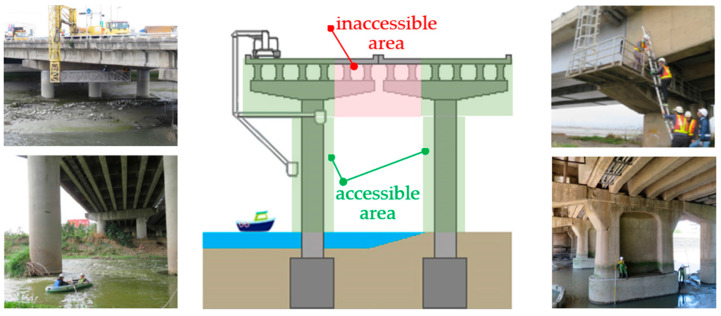
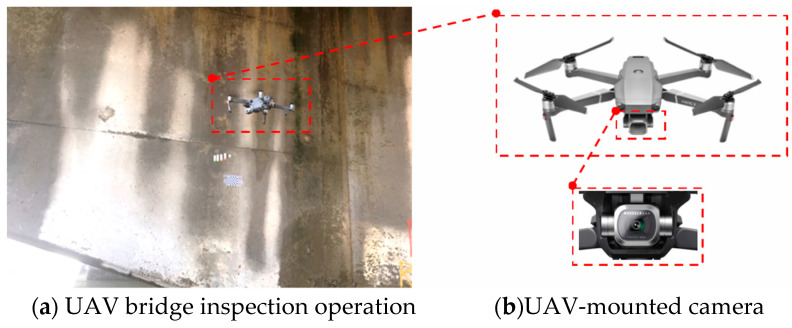
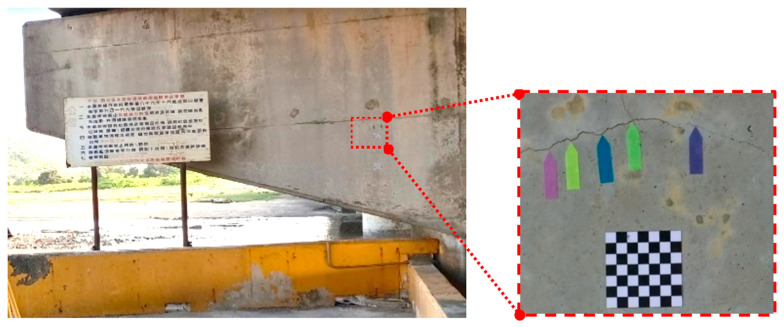
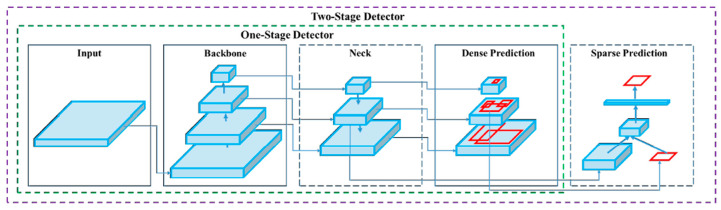
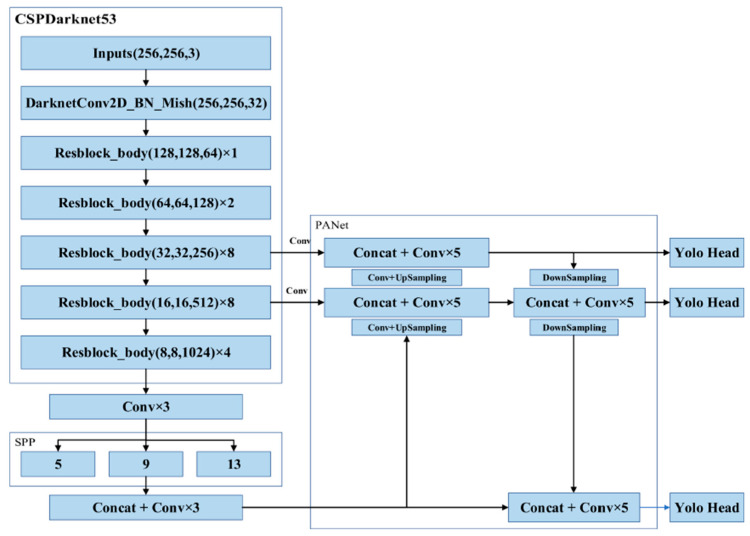
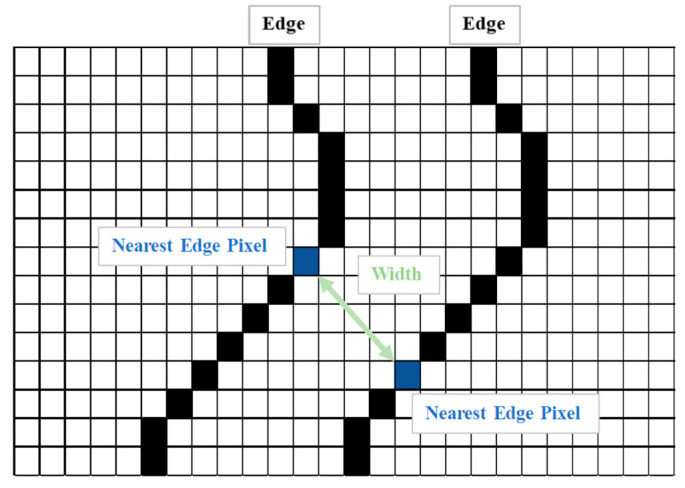
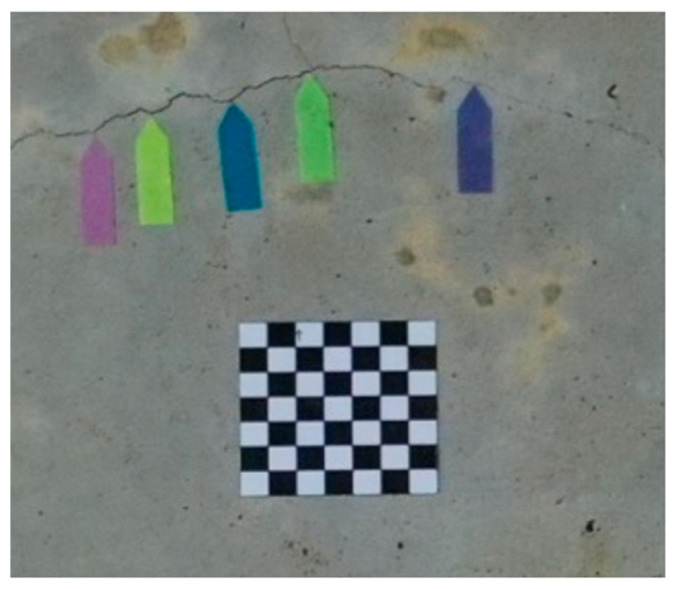
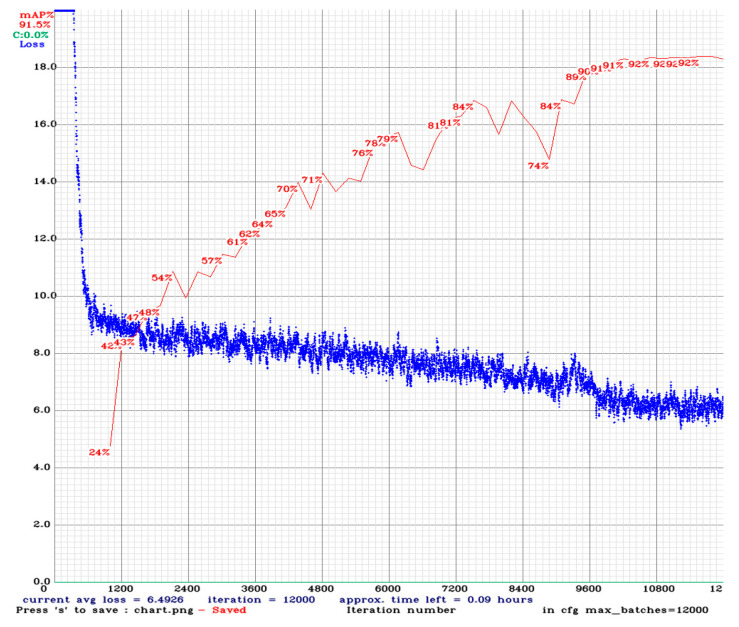
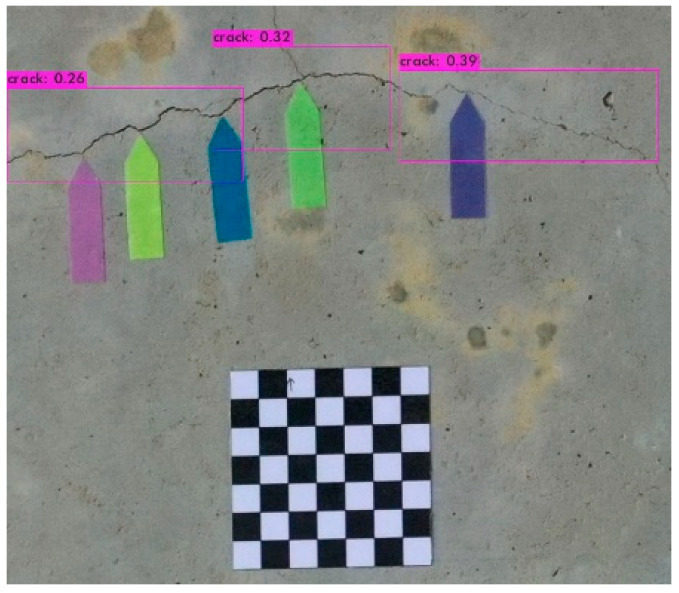
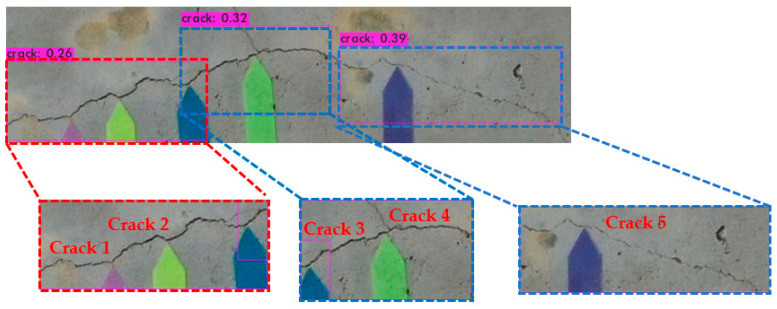
Bridges are often at risk due to the effects of natural disasters, such as earthquakes and typhoons. Bridge inspection assessments normally focus on cracks. However, numerous concrete structures with cracked surfaces are highly elevated or over water, and is not easily accessible to a bridge inspector. Furthermore, poor lighting under bridges and a complex visual background can hinder inspectors in their identification and measurement of cracks. In this study, cracks on bridge surfaces were photographed using a UAV-mounted camera. A YOLOv4 deep learning model was used to train a model for identifying cracks; the model was then employed in object detection. To perform the quantitative crack test, the images with identified cracks were first converted to grayscale images and then to binary images the using local thresholding method. Next, the two edge detection methods, Canny and morphological edge detectors were applied to the binary images to extract the edges of the cracks and obtain two types of crack edge images. Then, two scale methods, the planar marker method, and the total station measurement method, were used to calculate the actual size of the crack edge image. The results indicated that the model had an accuracy of 92%, with width measurements as precise as 0.22 mm. The proposed approach can thus enable bridge inspections and obtain objective and quantitative data.
Overview
The claims and statistics of this paper haven’t been checked yet.
Run the check — free, no account needed. It reads the open-access text and checks the sources it cites.
Integrity signals
Registry
Cites
Statistics
Figures







Verification
Claims the paper makes
The claims and statistics of this paper haven’t been checked yet.
Run the check — free, no account needed. It reads the open-access text and checks the sources it cites.
Claims other papers make about this one
Each is checked against this paper’s own text: does it say what the citing paper says it does?
The source backs part of the claim, not all of it — or backs it for a different population, condition or comparison.
In the citing paper
“In addition, DL has also been applied to SHM to identify, locate, and evaluate various damages by extracting advanced damage features from data such as pictures and vibration signals [15,35,36].”
From Deep Learning for Structural Health Monitoring: Data, Algorithms, Applications, Challenges, and Trends (2023) · cites this paper as [36]
Experimental — accuracy not yet measuredThe cited source says what the claim attributes to it.
In the citing paper
“Generally, the training set’s ratio to the test set is 8:2 [27,36,182,198] or 7:3 [15,58,187].”
From Deep Learning for Structural Health Monitoring: Data, Algorithms, Applications, Challenges, and Trends (2023) · cites this paper as [36]
Self-check
Percentages, sums and reported differences re-computed from the paper’s own numbers.
The self-check needs the paper’s full text.
Citations
Cites
Faster R-CNN: Towards Real-Time Object Detection with Region Proposal Networks
Ren, S., He, K., Girshick, R., & Sun, J. (2017) · IEEE Transactions on Pattern Analysis and Machine Intelligence · doi:10.1109/tpami.2016.2577031 · Cited by 73,472
Faster R-CNN: Towards Real-Time Object Detection with Region Proposal Networks
Ren, S., He, K., Girshick, R., & Sun, J. (2015) · arXiv · doi:10.48550/arxiv.1506.01497 · Cited by 70,812
You Only Look Once: Unified, Real-Time Object Detection
Redmon, J., Divvala, S., Girshick, R., & Farhadi, A. (2016) · 2016 IEEE Conference on Computer Vision and Pattern Recognition (CVPR) · doi:10.1109/cvpr.2016.91 · Cited by 53,803
A Threshold Selection Method from Gray-Level Histograms
Otsu, N. (1979) · IEEE Transactions on Systems, Man, and Cybernetics · doi:10.1109/tsmc.1979.4310076 · Cited by 43,398
(2016) · Cited by 31,590
Girshick, R. (2015) · 2015 IEEE International Conference on Computer Vision (ICCV) · doi:10.1109/iccv.2015.169 · Cited by 28,105
SSD: Single Shot MultiBox Detector
Liu, W., Anguelov, D., Erhan, D., Szegedy, C., Reed, S., Fu, C.-Y., & Berg, A. C. (2016) · Lecture Notes in Computer Science · doi:10.1007/978-3-319-46448-0_2 · Cited by 22,128
Spatial Pyramid Pooling in Deep Convolutional Networks for Visual Recognition
He, K., Zhang, X., Ren, S., & Sun, J. (2015) · IEEE Transactions on Pattern Analysis and Machine Intelligence · doi:10.1109/tpami.2015.2389824 · Cited by 11,971
Deep Learning‐Based Crack Damage Detection Using Convolutional Neural Networks
Cha, Y., Choi, W., & Büyüköztürk, O. (2017) · Computer-Aided Civil and Infrastructure Engineering · doi:10.1111/mice.12263 · Cited by 3,295
Region-based convolutional networks for accurate object detection and segmentation
Girshick, R., Donahue, J., Darrell, T., & Malik, J. (2016) · IEEE Transactions on Pattern Analysis and Machine Intelligence · doi:10.1109/tpami.2015.2437384 · Cited by 2,912
Research works printed but not linked: 2
- Yang, L., Li, B., Li, W., Liu, Z., Yang, G., and Xiao, J. (2017, January 24–28). Deep Concrete Inspection Using Unmanned Aerial Vehicle Towards CSSC Database. Proceedings of the 2017 IEEE/RSJ International Conference on Intelligent Robots and Systems, Vancouver, BC, Canada.
- Bochkovskiy, A., Wang, C., and Liao, H.M. (2020). YOLOv4: Optimal Speed and Accuracy of Object Detection. arXiv.
Cited by
Computer Vision-Based Bridge Inspection and Monitoring: A Review
Luo, K., Kong, X., Zhang, J., Hu, J., Li, J., & Tang, H. J. (2023) · Sensors · doi:10.3390/s23187863 · Cited by 182
Jia, J., & Li, Y. (2023) · Sensors · doi:10.3390/s23218824 · Cited by 182
“Generally, the training set’s ratio to the test set is 8:2 [27,36,182,198] or 7:3 [15,58,187].”
BackgroundYuan, Q., Shi, Y., & Li, M. (2024) · Remote Sensing · doi:10.3390/rs16162910 · Cited by 143
Recent advances in crack detection technologies for structures: a survey of 2022-2023 literature
Kaveh, H., & Alhajj, R. (2024) · Frontiers in Built Environment · doi:10.3389/fbuil.2024.1321634 · Cited by 58
A scientometric analysis of drone-based structural health monitoring and new technologies
Fayyad, T. M., Taylor, S. E., Feng, K., & Hui, F. K. P. (2024) · Advances in Structural Engineering · doi:10.1177/13694332241255734 · Cited by 43
Metadata
- Authors
- Kao, S.-P., Chang, Y.-C., & Wang, F.-L.
- Affiliations
- National Chung Hsing University (TW)
- Corresponding author
- Wang, Feng-Liang
- Venue
- Sensors
- Publisher
- MDPI AG
- Published
- 2023-02-25
- Volume
- 23
- Issue
- 5
- Pages
- 2572
- ISSN
- 1424-8220 (ISSN-L)
- PMC
- PMC10007411
- OpenAlex
- W4322502428
- Cited by
- 40
- References
- 42
- Citations by year
- 2026: 6 · 2025: 9 · 2024: 14 · 2023: 11
- FWCI
- 4.67
- Type
- journal article
- Language
- en
- Open access
- gold
- doi.org
- Licence
- Locations
- Sensors (publishedVersion, cc-by)
- PubMed Central (publishedVersion, cc-by)
- PubMed (publishedVersion)
- DOAJ (DOAJ: Directory of Open Access Journals) (submittedVersion, cc-by-sa)
- Funders
- National Science and Technology Council (NSTC) of Taiwan (NSTC 111-2622-M-005-001)
- Topics
- Physical Sciences › Engineering › Civil and Structural Engineering › Infrastructure Maintenance and Monitoring
- Physical Sciences › Engineering › Civil and Structural Engineering › Structural Health Monitoring Techniques
- Physical Sciences › Engineering › Industrial and Manufacturing Engineering › Industrial Vision Systems and Defect Detection
- Keywords
- bridge crack detection, crack width measurement, UAV imagery, YOLOv4, object detection, bridge inspection, edge detection, Canny edge detection, morphological edge detection, total station measurements, concrete structures, automated structural inspection
About these checks
Registry, retraction, Cites and statistics results are computed, not judged, with one exception: a printed reference that no index lists is read once by a model before it counts as a citation error. Claims are extracted by a model and kept only when their quote appears verbatim in the text; each cited source is then checked, with a model’s help, for whether it says what the claim relies on. Those verdicts can be wrong — read the claim’s quote and the cited source before relying on one.
Statistics and arithmetic are recomputed, not judged.
Confidence bands are shown only for fields calibrated on our annotated test set. None is calibrated yet, so no band is shown.
What counts as a claim ›How we measure confidence ›How we check this ›
Are you an author, or do you see a problem with this page? Request a review
How to cite
Cite CoChat for the checks on this page, and the paper for its own findings.
- This page
- CoChat. (2026). Citation check: Combining the YOLOv4 Deep Learning Model with UAV Imagery Processing Technology in the Extraction and Quantization of Cracks in Bridges. https://app.cochat.ai/papers/10.3390/s23052572
- The paper
- Kao, S.-P., Chang, Y.-C., & Wang, F.-L. (2023). Combining the YOLOv4 Deep Learning Model with UAV Imagery Processing Technology in the Extraction and Quantization of Cracks in Bridges. Sensors. https://doi.org/10.3390/s23052572
Data sources
Bibliographic data: Semantic Scholar, OpenAlex, Crossref.
Contains information from the Semantic Scholar Academic Graph Datasets, made available under the ODC Attribution License (ODC-BY 1.0).
Semantic Scholar’s data is described in: Kinney, R., et al. (2023). The Semantic Scholar Open Data Platform. arXiv:2301.10140.
