

The DOI matches its Crossref record; 58 of the 60 references it cites were found in a registry or an index, and 2 are not checked yet.
A Deep Learning-Driven Self-Conscious Distributed Cyber-Physical System for Renewable Energy Communities
Open accessAbstract
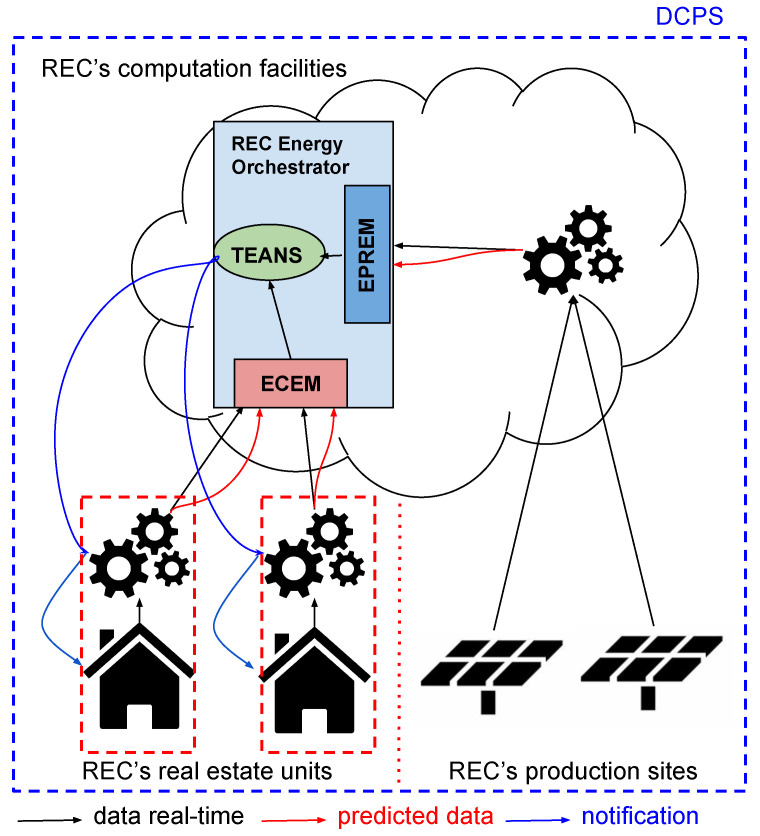
The Internet of Things (IoT) is transforming various domains, including smart energy management, by enabling the integration of complex digital and physical components in distributed cyber-physical systems (DCPSs). The design of DCPSs has so far been focused on performance-related, non-functional requirements. However, with the growing power consumption and computation expenses, sustainability is becoming an important aspect to consider. This has led to the concept of energy-aware DCPSs, which integrate conventional non-functional requirements with additional attributes for sustainability, such as energy consumption. This research activity aimed to investigate and develop energy-aware architectural models and edge/cloud computing technologies to design next-generation, AI-enabled (and, specifically, deep-learning-enhanced), self-conscious IoT-extended DCPSs. Our key contributions include energy-aware edge-to-cloud architectural models and technologies, the orchestration of a (possibly federated) edge-to-cloud infrastructure, abstractions and unified models for distributed heterogeneous virtualized resources, innovative machine learning algorithms for the dynamic reallocation and reconfiguration of energy resources, and the management of energy communities. The proposed solution was validated through case studies on optimizing renewable energy communities (RECs), or energy-aware DCPSs, which are particularly challenging due to their unique requirements and constraints; in more detail, in this work, we aim to define the optimal implementation of an energy-aware DCPS. Moreover, smart grids play a crucial role in developing energy-aware DCPSs, providing a flexible and efficient power system integrating renewable energy sources, microgrids, and other distributed energy resources. The proposed energy-aware DCPSs contribute to the development of smart grids by providing a sustainable, self-consistent, and efficient way to manage energy distribution and consumption. The performance demonstrates our approach's effectiveness for consumption and production (based on RMSE and MAE metrics). Our research supports the transition towards a more sustainable future, where communities adopting REC principles become key players in the energy landscape.
Overview
The claims and statistics of this paper haven’t been checked yet.
Run the check — free, no account needed. It reads the open-access text and checks the sources it cites.
Integrity signals
Registry
Cites
Statistics
Figures
Verification
Claims the paper makes
The claims and statistics of this paper haven’t been checked yet.
Run the check — free, no account needed. It reads the open-access text and checks the sources it cites.
Claims other papers make about this one
Each is checked against this paper’s own text: does it say what the citing paper says it does?
The check wasn’t confident either way, so it gives no verdict — never disputed.
In the citing paper
“Carbon-intensity reduction per unit of energy consumed offers a normalized measure, comparable across different facility sizes and fuel types [25].”
From Explainable AI and Multi-Agent Systems for Energy Management in IoT-Edge Environments: A State of the Art Review (2026) · cites this paper as [25]
Experimental — accuracy not yet measured
Self-check
Percentages, sums and reported differences re-computed from the paper’s own numbers.
The self-check needs the paper’s full text.
Citations
Cites
Hochreiter, S., & Schmidhuber, J. (1997) · Neural Computation · doi:10.1162/neco.1997.9.8.1735 · Cited by 102,318
Buyya, R., Yeo, C. S., Venugopal, S., Broberg, J., & Brandić, I. (2008) · Future Generation Computer Systems · doi:10.1016/j.future.2008.12.001 · Cited by 5,946
Short-Term Residential Load Forecasting Based on LSTM Recurrent Neural Network
Kong, W., Dong, Z. Y., Jia, Y., Hill, D. J., Xu, Y. H., & Zhang, Y. (2017) · IEEE Transactions on Smart Grid · doi:10.1109/tsg.2017.2753802 · Cited by 2,826
Smart Grid Technologies: Communication Technologies and Standards
Güngör, V. Ç., Sahin, D., Koçak, T., Ergüt, S., Buccella, C., Cecati, C., & Hancke, G. P. (2011) · IEEE Transactions on Industrial Informatics · doi:10.1109/tii.2011.2166794 · Cited by 2,694
Neural networks for short-term load forecasting: a review and evaluation
Hippert, H. S., Pedreira, C. E., & Souza, R. C. (2001) · IEEE Transactions on Power Systems · doi:10.1109/59.910780 · Cited by 2,280
Internet of Things and Big Data Analytics for Smart and Connected Communities
Sun, Y., Song, H. H., Jara, A. J., & Bie, R. (2016) · IEEE Access · doi:10.1109/access.2016.2529723 · Cited by 890
Advanced Demand Side Management for the Future Smart Grid Using Mechanism Design
Samadi, P., Mohsenian‐Rad, H., Schober, R., & Wong, V. W. S. (2012) · IEEE Transactions on Smart Grid · doi:10.1109/tsg.2012.2203341 · Cited by 814
Using peer-to-peer energy-trading platforms to incentivize prosumers to form federated power plants
Morstyn, T., Farrell, N., Darby, S. J., & Mcculloch, M. (2018) · Nature Energy · doi:10.1038/s41560-017-0075-y · Cited by 764
Analysis and evaluation of five short-term load forecasting techniques
Moghram, I. S., & Rahman, S. (1989) · IEEE Transactions on Power Systems · doi:10.1109/59.41700 · Cited by 709
Estimation of energy consumption in machine learning
García-Martín, E., Rodrigues, C. F., Riley, G. D., & Grahn, H. (2019) · Journal of Parallel and Distributed Computing · doi:10.1016/j.jpdc.2019.07.007 · Cited by 619
Machine Learning at the Network Edge: A Survey
Murshed, M. G. S., Murphy, C., Hou, D., Khan, N., Ananthanarayanan, G., & Hussain, F. (2021) · ACM Computing Surveys · doi:10.1145/3469029 · Cited by 586
The Time Series Approach to Short Term Load Forecasting
Hagan, M., & Behr, S. M. (1987) · IEEE Transactions on Power Systems · doi:10.1109/tpwrs.1987.4335210 · Cited by 548
Distributed Optimal Energy Management in Microgrids
Shi, W., Xie, X., Chu, C., & Gadh, R. (2014) · IEEE Transactions on Smart Grid · doi:10.1109/tsg.2014.2373150 · Cited by 492
A Bidirectional LSTM Prognostics Method Under Multiple Operational Conditions
Huang, C., Huang, H., & Li, Y. (2019) · IEEE Transactions on Industrial Electronics · doi:10.1109/tie.2019.2891463 · Cited by 483
Electric load forecasting in smart grids using Long-Short-Term-Memory based Recurrent Neural Network
Zheng, J., Xu, C., Zhang, Z., & Li, X. (2017) · Conference on Information Sciences and Systems · doi:10.1109/ciss.2017.7926112 · Cited by 385
Wang, S., Wang, X., Wang, S., & Wang, D. (2019) · International Journal of Electrical Power & Energy Systems · doi:10.1016/j.ijepes.2019.02.022 · Cited by 363
Peer-to-peer energy trading in a community microgrid
Long, C., Wu, J., Zhang, C., Thomas, L., Cheng, M., & Jenkins, N. (2017) · IEEE Power Engineering Society General Meeting · doi:10.1109/pesgm.2017.8274546 · Cited by 348
A Survey on Edge and Edge-Cloud Computing Assisted Cyber-Physical Systems
Cao, K., Hu, S., Shi, Y., Colombo, A. W., Karnouskos, S., & Li, X. (2021) · IEEE Transactions on Industrial Informatics · doi:10.1109/tii.2021.3073066 · Cited by 307
Neural network based short term load forecasting
Lu, C., Wu, H.-T., & Vemuri, S. (1993) · IEEE Transactions on Power Systems · doi:10.1109/59.221223 · Cited by 286
An energy efficient IoT data compression approach for edge machine learning
Azar, J., Makhoul, A., Barhamgi, M., & Couturier, R. (2019) · Future Generation Computer Systems · doi:10.1016/j.future.2019.02.005 · Cited by 272
Home Energy Management Systems: A Review of Modelling and Complexity
Beaudin, M., & Zareipour, H. (2016) · Lecture notes in energy · doi:10.1007/978-3-319-26950-4_35 · Cited by 254
Dai, Y., & Zhao, P. (2020) · Applied Energy · doi:10.1016/j.apenergy.2020.115332 · Cited by 202
Renewable Energy Communities business models under the 2020 Italian regulation
Cielo, A., Margiaria, P., Lazzeroni, P., Mariuzzo, I., & Repetto, M. (2021) · Journal of Cleaner Production · doi:10.1016/j.jclepro.2021.128217 · Cited by 187
Deep sequence to sequence Bi-LSTM neural networks for day-ahead peak load forecasting
Mughees, N., Mohsin, S. A., Mughees, A., & Mughees, A. (2021) · Expert Systems with Applications · doi:10.1016/j.eswa.2021.114844 · Cited by 185
Wu, K., Wu, J. F., Feng, L., Yang, B., Liang, R., Yang, S., & Zhao, R. (2020) · International Transactions on Electrical Energy Systems · doi:10.1002/2050-7038.12637 · Cited by 169
Multi-objective optimization of ethanol fuelled HCCI engine performance using hybrid GRNN–PSO
Bendu, H., Deepak, B. B. V. L., & Murugan, S. (2016) · Applied Energy · doi:10.1016/j.apenergy.2016.11.072 · Cited by 130
A comprehensive layered approach for implementing internet of things-enabled smart grid: A survey
Alavikia, Z., & Shabro, M. (2022) · Digital Communications and Networks · doi:10.1016/j.dcan.2022.01.002 · Cited by 122
Energy-Efficient and Delay-Guaranteed Workload Allocation in IoT-Edge-Cloud Computing Systems
Guo, M., Li, L., & Guan, Q. (2019) · IEEE Access · doi:10.1109/access.2019.2922992 · Cited by 119
A Bidirectional LSTM Language Model for Code Evaluation and Repair
Rahman, M. M., Watanobe, Y., & Nakamura, K. (2021) · Symmetry · doi:10.3390/sym13020247 · Cited by 110
An improved office building cooling load prediction model based on multivariable linear regression
Qiang, G., Zhe, T., Yan, D., & Neng, Z. (2015) · Energy and Buildings · doi:10.1016/j.enbuild.2015.08.041 · Cited by 108
A systematic review of machine learning techniques related to local energy communities
Hernandez-Matheus, A., Löschenbrand, M., Berg, K., Fuchs, I., Aragüés‐Peñalba, M., Bullich‐Massagué, E., & Sumper, A. (2022) · Renewable and Sustainable Energy Reviews · doi:10.1016/j.rser.2022.112651 · Cited by 104
A deep gated recurrent neural network for petroleum production forecasting
Al-Shabandar, R., Jaddoa, A., Liatsis, P., & Hussain, A. J. (2020) · Machine Learning with Applications · doi:10.1016/j.mlwa.2020.100013 · Cited by 98
Optimal Battery Energy Storage System Scheduling within Renewable Energy Communities
Talluri, G., Lozito, G. M., Grasso, F., Garcia, C. I., & Luchetta, A. (2021) · Energies · doi:10.3390/en14248480 · Cited by 95
Marchetti, D. J., & Parigi, G. (2000) · Journal of Forecasting · doi:10.1002/1099-131x(200009)19:5 · Cited by 84
Power Load Forecasting Using BiLSTM-Attention
Du, J., Cheng, Y., Zhou, Q., Zhang, J., Zhang, X., & Li, G. (2020) · IOP Conference Series Earth and Environmental Science · doi:10.1088/1755-1315/440/3/032115 · Cited by 79
Architecture of the Internet of Energy Network: An Application to Smart Grid Communications
Rana, M. (2017) · IEEE Access · doi:10.1109/access.2017.2683503 · Cited by 72
Towards energy efficient service composition in green energy powered Cyber–Physical Fog Systems
Zeng, D., Gu, L., & Yao, H. L. (2018) · Future Generation Computer Systems · doi:10.1016/j.future.2018.01.060 · Cited by 70
On hourly home peak load prediction
Singh, R. P., Gao, P. X., & Lizotte, D. J. (2012) · IEEE International Conference on Smart Grid Communications (SmartGridComm) · doi:10.1109/smartgridcomm.2012.6485977 · Cited by 62
Sudharsan, B., Breslin, J. G., & Ali, M. I. (2020) · International Conference on the Internet of Things (IoT) · doi:10.1145/3410992.3411014 · Cited by 55
Distributed Dispatch of Integrated Electricity-Heat Systems With Variable Mass Flow
Zheng, W., Zhu, J., & Luo, Q. (2022) · IEEE Transactions on Smart Grid · doi:10.1109/tsg.2022.3210014 · Cited by 55
The potential of smart home sensors in forecasting household electricity demand
Ziekow, H., Goebel, C., Strüker, J., & Jacobsen, H. (2013) · IEEE International Conference on Smart Grid Communications (SmartGridComm) · doi:10.1109/smartgridcomm.2013.6687962 · Cited by 53
An LSTM model for power grid loss prediction
Tulensalo, J., Seppänen, J., & Ilin, A. (2020) · Electric Power Systems Research · doi:10.1016/j.epsr.2020.106823 · Cited by 51
Machine Learning Techniques for Improving Self-Consumption in Renewable Energy Communities
Grève, Z. D., Bottieau, J., Vangulick, D., Wautier, A., Dapoz, P.-D., Arrigo, A., Toubeau, J., & Vallée, F. (2020) · Energies · doi:10.3390/en13184892 · Cited by 50
Privacy-Preserving Probabilistic Voltage Forecasting in Local Energy Communities
Toubeau, J., Teng, F., Morstyn, T., Krannichfeldt, L. V., & Wang, Y. (2022) · IEEE Transactions on Smart Grid · doi:10.1109/tsg.2022.3187557 · Cited by 41
Stack4Things: An OpenStack-Based Framework for IoT
Longo, F., Bruneo, D., Distefano, S., Merlino, G., & Puliafito, A. (2015) · International Conference on Future Internet of Things and Cloud (FiCloud) · doi:10.1109/ficloud.2015.97 · Cited by 41
Self-citationA survey on cloud computing in energy management of the smart grids
Allahvirdizadeh, Y., Moghaddam, M. P., & Shayanfar, H. (2019) · International Transactions on Electrical Energy Systems · doi:10.1002/2050-7038.12094 · Cited by 39
Cooperative Relaying Strategies for Smart Grid Communications: Bargaining Models and Solutions
Ma, K., Liu, X., Liu, Z., Chen, C., Liang, H., & Guan, X. (2017) · IEEE Internet of Things Journal · doi:10.1109/jiot.2017.2764941 · Cited by 38
Device-Centric Sensing: An Alternative to Data-Centric Approaches
Distefano, S., Merlino, G., & Puliafito, A. (2015) · IEEE Systems Journal · doi:10.1109/jsyst.2015.2448533 · Cited by 29
Self-citationSharmila, P., Baskaran, J., Nayanatara, C., & Maheswari, R. U. (2019) · Procedia Computer Science · doi:10.1016/j.procs.2020.01.076 · Cited by 28
Optimization Model for IoT-Aware Energy Exchange in Energy Communities for Residential Users
Giordano, A., Mastroianni, C., & Scarcello, L. (2020) · Electronics · doi:10.3390/electronics9061003 · Cited by 24
Roy, S., Debnath, A., Tariq, M., Behnamfar, M., & Sarwat, A. I. (2023) · Sustainability · doi:10.3390/su15021214 · Cited by 23
A Resilient Fire Protection System for Software-Defined Factories
Tricomi, G., Scaffidi, C., Merlino, G., Longo, F., Puliafito, A., & Distefano, S. (2021) · IEEE Internet of Things Journal · doi:10.1109/jiot.2021.3127387 · Cited by 18
Self-citationDecentralized Federated Learning for Nonintrusive Load Monitoring in Smart Energy Communities
Giuseppi, A., Manfredi, S., Menegatti, D., Pietrabissa, A., & Poli, C. (2022) · Mediterranean Conference on Control and Automation (MED) · doi:10.1109/med54222.2022.9837291 · Cited by 17
Tayyab, M., Sarwar, A., Murshid, S., Tariq, M., Urooj, S., & Khan, B. (2022) · IET Renewable Power Generation · doi:10.1049/rpg2.12581 · Cited by 16
Software-Defined City Infrastructure: A Control Plane for Rewireable Smart Cities
Tricomi, G., Merlino, G., Longo, F., Distefano, S., & Puliafito, A. (2019) · IEEE International Conference on Smart Computing · doi:10.1109/smartcomp.2019.00050 · Cited by 16
Self-citationPower Grid Stability Prediction Model Based on BiLSTM with Attention
Zhang, Y., Zhang, H., Zhang, J., Li, L., & Zheng, Z. (2021) · International Symposium on Electrical, Electronics and Information Engineering (ISEEIE) · doi:10.1145/3459104.3459160 · Cited by 13
A Deep Learning Approach for Indoor User Localization in Smart Environments
Vita, F. D., & Bruneo, D. (2018) · IEEE International Conference on Smart Computing · doi:10.1109/smartcomp.2018.00078 · Cited by 9
From Vertical to Horizontal Buildings Through IoT and Software Defined Approaches
Tricomi, G., Scaffidi, C., Merlino, G., Longo, F., Distefano, S., & Puliafito, A. (2021) · IEEE International Conference on Smart Computing · doi:10.1109/smartcomp52413.2021.00074 · Cited by 9
Self-citationEnergy-Aware Workload Allocation for Distributed Deep Neural Networks in Edge-Cloud Continuum
Jin, Y., Xu, J., Huan, Y., Yan, Y., Zheng, L., & Zou, Z. (2019) · IEEE International System-on-Chip Conference (SOCC) · doi:10.1109/socc46988.2019.1570554761 · Cited by 8
Ding, Y., Borges, J. D. M., Neumann, M. A., & Beigl, M. (2015) · IEEE International Smart Cities Conference (ISC2) · doi:10.1109/isc2.2015.7366169 · Cited by 8
Research works printed but not linked: 2
- Faustine, A. (2020, January 6–12). Leveraging Machine Learning for Sustainable and Self-sufficient Energy Communities. Proceedings of the NeurIPS 2020, Online.
- Beaudin, M., and Zareipour, H. (2017). Energy Solutions to Combat Global Warming, Springer. Lecture Notes in Energy.
Cited by
From Sensors to Data Intelligence: Leveraging IoT, Cloud, and Edge Computing with AI
Ficili, I., Giacobbe, M., Tricomi, G., & Puliafito, A. (2025) · Sensors · doi:10.3390/s25061763 · Cited by 254
Self-citationArévalo-Cordero, P., & Jurado, F. (2024) · Energies · doi:10.3390/en17174501 · Cited by 161
Chui, K. T., Gupta, B. B., Liu, J., Arya, V., Nedjah, N., Almomani, A., & Chaurasia, P. (2023) · Information · doi:10.3390/info14070388 · Cited by 74
Umar, H. G. A., Yasmeen, I., Aoun, M., Mazhar, T., Khan, M. A., Jaghdam, I. H., & Hamam, H. (2025) · Journal of Cloud Computing Advances Systems and Applications · doi:10.1186/s13677-025-00762-9 · Cited by 47
Comparative Analysis of Machine Learning Models for Predictive Maintenance of Ball Bearing Systems
Farooq, U., Ademola, M., & Shaalan, A. (2024) · Electronics · doi:10.3390/electronics13020438 · Cited by 48
Metadata
- Authors
- Cicceri, G., Tricomi, G., D’Agati, L., Longo, F., Merlino, G., & Puliafito, A.
- Affiliations
- University of Messina (IT)
- Corresponding author
- Tricomi, Giuseppe
- Puliafito, Antonio
- ORCID
- Venue
- Sensors
- Publisher
- MDPI AG
- Published
- 2023-05-07
- Volume
- 23
- Issue
- 9
- Pages
- 4549
- ISSN
- 1424-8220 (ISSN-L)
- PMC
- PMC10181772
- OpenAlex
- W4376630019
- Cited by
- 58
- References
- 58
- Citations by year
- 2026: 17 · 2025: 26 · 2024: 14 · 2023: 1
- FWCI
- 6.44
- Type
- journal article
- Language
- en
- Open access
- gold
- doi.org
- Licence
- Locations
- Sensors (publishedVersion, cc-by)
- PubMed Central (publishedVersion, cc-by)
- PubMed (publishedVersion)
- IRIS UniPA (University of Palermo) (submittedVersion, cc-by)
- DOAJ (DOAJ: Directory of Open Access Journals) (submittedVersion, cc-by-sa)
- Funders
- HORIZON EUROPE Framework Programme (101079774)
- Topics
- Physical Sciences › Computer Science › Computer Networks and Communications › IoT and Edge/Fog Computing
- Physical Sciences › Engineering › Electrical and Electronic Engineering › Smart Grid Energy Management
- Physical Sciences › Computer Science › Hardware and Architecture › Energy Efficiency in Computing
- Keywords
- distributed cyber-physical systems, energy-aware systems, renewable energy communities, smart grid, microgrids, Internet of Things, sustainability, energy optimization, resource reconfiguration
About these checks
Registry, retraction, Cites and statistics results are computed, not judged, with one exception: a printed reference that no index lists is read once by a model before it counts as a citation error. Claims are extracted by a model and kept only when their quote appears verbatim in the text; each cited source is then checked, with a model’s help, for whether it says what the claim relies on. Those verdicts can be wrong — read the claim’s quote and the cited source before relying on one.
Statistics and arithmetic are recomputed, not judged.
Confidence bands are shown only for fields calibrated on our annotated test set. None is calibrated yet, so no band is shown.
What counts as a claim ›How we measure confidence ›How we check this ›
Are you an author, or do you see a problem with this page? Request a review
Data sources
Bibliographic data: Semantic Scholar, OpenAlex, Crossref.
Contains information from the Semantic Scholar Academic Graph Datasets, made available under the ODC Attribution License (ODC-BY 1.0).
Semantic Scholar’s data is described in: Kinney, R., et al. (2023). The Semantic Scholar Open Data Platform. arXiv:2301.10140.
