

The DOI matches its Crossref record; 2 of the 2 references it cites were found in a registry or an index.
Agroforestry: Challenges and Opportunities in Rhino Camp and Imvepi Refugee Settlements of Arua District, Northern Uganda
Open accessAbstract
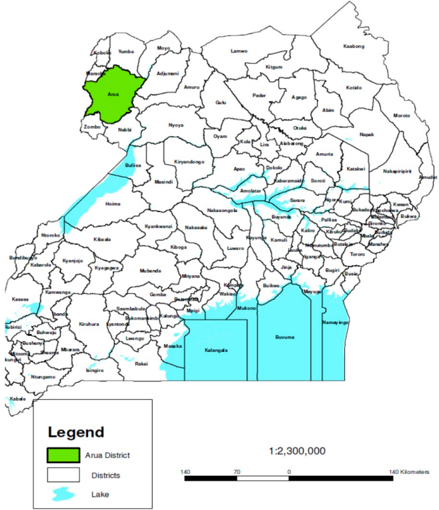
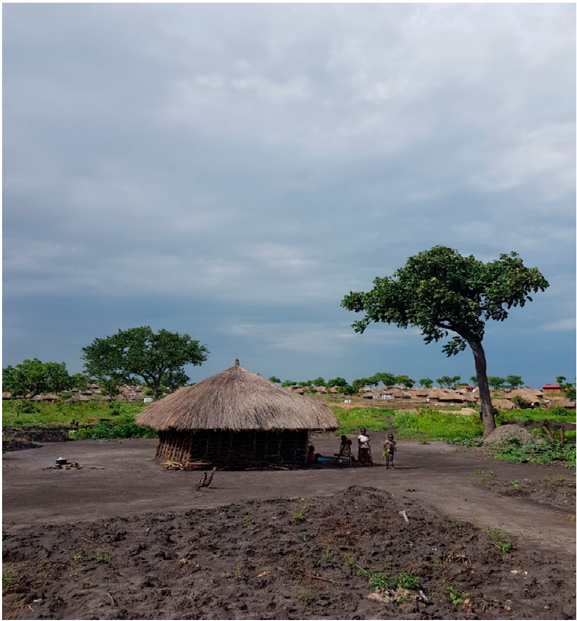
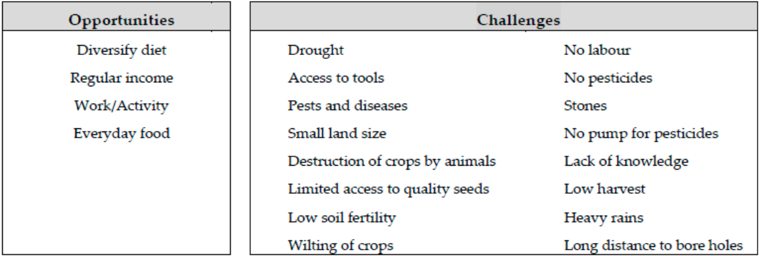
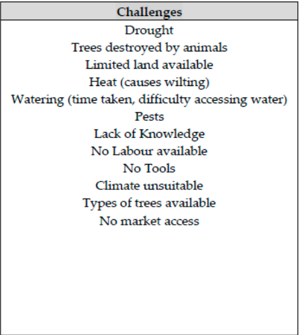
In the past, the environment has been a low priority in humanitarian operations for refugee agencies and implementing partners because of the emergency context. However, actions to safeguard the environment can be undertaken concurrently with emergency interventions and organisations should take responsibility for conserving the environment in refugee settlements in the same way that they are responsible for the welfare of refugees. Tree-based interventions, such as agroforestry, have been demonstrated as a viable option for resilience and sustainability in landscapes with increasing human pressure. Refugee settlements are subject to intense human pressure and suffer environmental degradation as a consequence. The potential benefits of agroforestry in refugee settlements though are not well researched. This study explores the implementation of agroforestry schemes in refugee settlements in the Arua district of Uganda. Using semi-structured interviews with the beneficiaries of the International Centre for Research on Agroforestry (ICRAF) agroforestry projects in Imvepi and Rhino camps, the study identifies key benefits for participants and the environment. These include improved livelihoods and nutrition. However, there are challenges to overcome before agroforestry can be made more widely available in refugee camps. Key barriers include insufficient land, limited water availability and lack of local knowledge, which limits productivity. This research shows how relief, rehabilitation and development can work hand in hand to reduce social and environmental pressure in the targeted refugee settlements and host communities and improve the well-being of beneficiary households by creating opportunities for income generation, improving nutrition and contributing to social cohesion.
Overview
The claims and statistics of this paper haven’t been checked yet.
Run the check — free, no account needed. It reads the open-access text and checks the sources it cites.
Integrity signals
Registry
Cites
Statistics
Figures
Verification
Claims the paper makes
The claims and statistics of this paper haven’t been checked yet.
Run the check — free, no account needed. It reads the open-access text and checks the sources it cites.
Claims other papers make about this one
Each is checked against this paper’s own text: does it say what the citing paper says it does?
The check wasn’t confident either way, so it gives no verdict — never disputed.
In the citing paper
“Nakivale is located in a part of the country that is more developed and has more fertile land than the settlements in northern Uganda (Berke & Larsen, 2022;Grosrenaud et al., 2021).”
From Sexual and gender-based violence against South Sudanese refugees in Uganda: a mixed-methods study (2025) · cites this paper as Grosrenaud et al., 2021
Experimental — accuracy not yet measured
Self-check
Percentages, sums and reported differences re-computed from the paper’s own numbers.
The self-check needs the paper’s full text.
Citations
Cites
Biodiversity loss and its impact on humanity
Cardinale, B. J., Duffy, J. E., Gonzalez, A., Hooper, D. U., Perrings, C., Venail, P., Narwani, A., Mace, G. M., Tilman, D., Wardle, D. A., et al. (2012) · Nature · doi:10.1038/nature11148 · Cited by 7,457 · cited 1×
“People depend on trees for various reasons; in African regions some of the most important services provided by trees are wood, shade and soil fertility [19,22].”
BackgroundAn Introduction to Agroforestry
Nair, P. K. R. (1993) · doi:10.1007/978-94-011-1608-4 · Cited by 1,438
Research works printed but not linked: 26
- Minang, 2014, REDD+ Readiness progress across countries: Time for reconsideration, Clim. Policy, 14, 685, 10.1080/14693062.2014.905822 · DOI
- Young, A. (1997). Agroforestry for Soil Management, CAB International. [2nd ed.]. · DOI
- Jose, S., and Gordon, A.M. (2008). Ecological Knowledge and Agroforestry Design: An Introduction. Toward Agroforestry Design an Ecological Approach, Springer. · DOI
- Coe, 2014, Scaling up agroforestry requires research ‘in’ rather than ‘for’ development, Curr. Opin. Environ. Sustain., 6, 73, 10.1016/j.cosust.2013.10.013 · DOI
- Luedeling, 2014, Agroforestry systems in a changing climate—Challenges in projecting future performance, Curr. Opin. Environ. Sustain., 6, 1, 10.1016/j.cosust.2013.07.013 · DOI
- Sinclair, 1999, A general classification of agroforestry practice, Agrofor. Syst., 46, 161, 10.1023/A:1006278928088 · DOI
- Torquebiau, E.F. (2000). A Renewed Perspective on Agroforestry Concepts and Classification, Editions Scientifiques et Medicales Elsevier SAS. · DOI
- Ahuja, M.R., and Mohan Jain, S. (2017). Native Trees and Shrubs for Ecosystems Services and the Redesign of Resilient Livestock Production Systems in the Mexican Neotropics. Biodiversity and Conservation of Woody Plants, Springer. · DOI
- Thrupp, 2000, Linking agricultural biodiversity and food security: The valuable role of agrobiodiversity for sustainable agriculture, Int. Aff., 76, 265, 10.1111/1468-2346.00133 · DOI
- Johansson, 2013, Mapping the relationship of inter-village variation in agroforestry tree survival with social and ecological characteristics: The case of the Vi agroforestry project, Mara Region, Tanzania, Sustainability, 5, 5171, 10.3390/su5125171 · DOI
- Tumwebaze, 2016, Soil organic carbon stocks under coffee agroforestry systems and coffee monoculture in Uganda, Agric. Ecosyst. Environ., 216, 188, 10.1016/j.agee.2015.09.037 · DOI
- Udeinya, 2006, Fractions of an antimalarial neem-leaf extract have activities superior to chloroquine, and are gametocytocidal, Ann. Trop. Med. Parasitol., 100, 17, 10.1179/136485906X78508 · DOI
- Gianotti, 2008, Efficacy of local neem extracts for sustainable malaria vector control in an African village, Malar. J., 7, 138, 10.1186/1475-2875-7-138 · DOI
- Özerdem, A., and Roberts, R. (2012). Challenging Post-Conflict Environments, Routledge. [1st ed.].
- Tumwebaze, 2012, Soil organic carbon under a linear simultaneous agroforestry system in Uganda, Agrofor. Syst., 84, 11, 10.1007/s10457-011-9448-6 · DOI
- Mbow, 2014, Achieving mitigation and adaptation to climate change through sustainable agroforestry practices in Africa, Curr. Opin. Environ. Sustain., 6, 8, 10.1016/j.cosust.2013.09.002 · DOI
- Jacobsen, 2002, Livelihoods in conflict: The pursuit of livelihoods by refugees and the impact on the human security of host communities, Int. Migr., 40, 95, 10.1111/1468-2435.00213 · DOI
- Mukadasi, 2007, Gender mainstreaming and community participation in plant resource conservation in Buzaya county, Kamuli district, Uganda, Afr. J. Ecol., 45, 7, 10.1111/j.1365-2028.2007.00730.x · DOI
- Oduol, 1990, The banana (Musa spp.)—Coffee robusta: Traditional agroforestry system of Uganda, Agrofor. Syst., 11, 213, 10.1007/BF00045900 · DOI
- Akwango, 2017, Efect of drought early warning system on household food security in Karamoja subregion, Uganda, Agric. Food Secur., 6, 1, 10.1186/s40066-017-0120-x · DOI
- Bakewell, 2002, Refugee aid and protection in rural Africa: Working in parallel or cross-purposes?, Refug. Surv. Q., 21, 228, 10.1093/rsq/21.1_and_2.228 · DOI
- Devereux, 2001, Livelihood insecurity and social protection: A re-emerging issue in rural development, Dev. Policy Rev., 19, 507, 10.1111/1467-7679.00148 · DOI
- Tidball, K.G., and Krasny, M.E. (2014). Reforestation activities at the Chadian refugee camp in Northern Cameron. Greening in the Red Zone: Disaster, Resilience and Community Greening, Springer. · DOI
- Frank, 2014, The Self Reliance Strategy and Refugee Livelihoods: Evidence from Oruchinga Refugee Settlement, South Western Uganda, Int. J. Res. Soc. Sci., 4, 59
- Nduwamungu, 2012, Agroforestry practice in villages surrounding Nyamure former refugee camp, Nyanza District: Tree species and purpose, Rwanda J., 74, 64
- Kidd, C.V., and Pimentel, D. (1992). Integrated resource management systems—definition and assessment. Integrated Resource Management: Agroforestry for Development, Academic Press.
Cited by
Sorted by citations
Using land to promote Refugee Self-Reliance in Uganda
Berke, T., & Larsen, L. (2022) · Land · doi:10.3390/land11030410 · Cited by 17
Sexual and gender-based violence against South Sudanese refugees in Uganda: a mixed-methods study
Michaelsen, S. (2025) · Université de Montréal · doi:10.71781/1596
Metadata
- Authors
- Grosrenaud, E., Okia, C. A., Adam-Bradford, A., & Trenchard, L.
- Affiliations
- Coventry University (GB)
- World Agroforestry Centre (KE)
- Centre for Agroecology, Water and Resilience, Coventry University, Coventry CV8 3LG, UK
- Corresponding author
- Grosrenaud, Evangeline
- ORCID
- Trenchard, Liz
- Venue
- Sustainability
- Publisher
- MDPI AG
- Published
- 2021-02-17
- Volume
- 13
- Issue
- 4
- Pages
- 2134
- ISSN
- 2071-1050 (ISSN-L)
- OpenAlex
- W3130308955
- Cited by
- 13
- References
- 2
- Citations by year
- 2026: 3 · 2025: 4 · 2024: 4 · 2022: 1 · 2021: 1
- FWCI
- 2.10
- Type
- journal article
- Language
- en
- Open access
- gold
- doi.org
- Licence
- Locations
- Sustainability (publishedVersion, cc-by)
- RePEc: Research Papers in Economics (submittedVersion)
- DOAJ (DOAJ: Directory of Open Access Journals) (submittedVersion)
- Pure (Coventry University) (submittedVersion, cc-by)
- Funders
- Coventry University
- Department for International Development
- Deutsche Gesellschaft für Internationale Zusammenarbeit
- World Agroforestry Centre
- FP7 International Cooperation
- Topics
- Life Sciences › Agricultural and Biological Sciences › Forestry › African Botany and Ecology Studies
- Life Sciences › Agricultural and Biological Sciences › Forestry › Forest Ecology and Conservation
- Life Sciences › Agricultural and Biological Sciences › General Agricultural and Biological Sciences › Food Security and Socioeconomic Dynamics
- Keywords
- agroforestry, refugee settlement, Arua District, livelihoods, nutrition, land scarcity, water availability, local knowledge, social cohesion, income generation, environmental degradation, ICRAF
About these checks
Registry, retraction, Cites and statistics results are computed, not judged, with one exception: a printed reference that no index lists is read once by a model before it counts as a citation error. Claims are extracted by a model and kept only when their quote appears verbatim in the text; each cited source is then checked, with a model’s help, for whether it says what the claim relies on. Those verdicts can be wrong — read the claim’s quote and the cited source before relying on one.
Statistics and arithmetic are recomputed, not judged.
Confidence bands are shown only for fields calibrated on our annotated test set. None is calibrated yet, so no band is shown.
What counts as a claim ›How we measure confidence ›How we check this ›
Are you an author, or do you see a problem with this page? Request a review
