

How to Measure Inclusion in Higher Education: An Inclusive Rating
Open accessThe DOI matches its Crossref record; 31 of the 31 references it cites were found in a registry or an index.
Abstract
Nowadays, inclusion is a main concern whoever and wherever. Higher education and business schools have been criticized for their non-inclusion for many years. In this context, higher education has a model role to play concerning inclusion. However, there is a lack of tools to measure the inclusivity levels of institutions. Thus, it is difficult to really know if higher education is inclusive or not and in case it is needed, where they must be more inclusive. This paper proposes a new tool. This paper created an inclusivity index that provides an operational answer to assess inclusivity. This tool does not rank institutions as ranking was highly criticized. It rates the levels of inclusivity of all the stakeholders of higher education for different dimensions.
Overview
The claims and statistics of this paper haven’t been checked yet.
Free: it reads the open-access text and checks the first 5 claims that cite a source we can check. Create a free account to check every claim.
Integrity signals
Registry
Cites
Statistics
Figures
Verification
Claims the paper makes
The claims and statistics of this paper haven’t been checked yet.
Free: it reads the open-access text and checks the first 5 claims that cite a source we can check. Create a free account to check every claim.
Claims other papers make about this one
Each is checked against this paper’s own text: does it say what the citing paper says it does?
The source backs part of the claim, not all of it — or backs it for a different population, condition or comparison.
In the citing paper
“International and higher education indicator frameworks support tracking participation, attainment and accessibility-related indicators rather than relying on statements of commitment [9,14,20,57,58].”
From Inclusive Higher Education and Disability: Policy–Implementation Gaps Across Universities in Mexico and Colombia (2026) · cites this paper as [57]
Experimental — accuracy not yet measured
Self-check
Percentages, sums and reported differences re-computed from the paper’s own numbers.
The self-check needs the paper’s full text.
Citations
Cites
Multidimensional Poverty Measurement and Analysis
Alkire, S., Foster, J., Seth, S., Santos, M. E., Roche, J. M., & Ballon, P. (2015) · Oxford University Press eBooks · doi:10.1093/acprof:oso/9780199689491.001.0001 · Cited by 924 · cited 1×
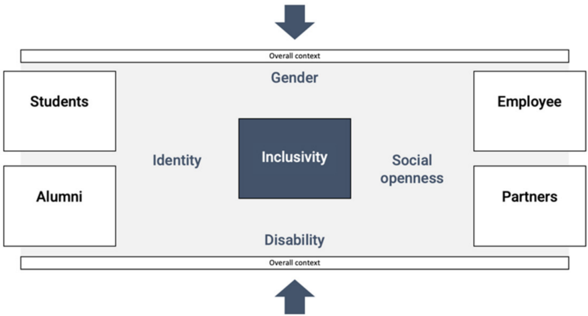
“[33]: • Defining the set of indicators that will be considered in the multidimensional measure (social openness, gender, identity, disability).”
BackgroundMor Barak, M. E., Cherin, D. A., & Berkman, S. (1998) · The Journal of Applied Behavioral Science · doi:10.1177/0021886398341006 · Cited by 662 · cited 1×
“Wieczorek-Szyman [25] focuses on gender but gender and ethnic/racial discussions can be associated [26,27].”
BackgroundChang, M. J. (1999) · Journal of college student development · Cited by 383
Measuring the use of inclusive practices among pre-service educators: A multi-national study
Sharma, U., Sokal, L. J., Wang, M., & Loreman, T. (2021) · Teaching and Teacher Education · doi:10.1016/j.tate.2021.103506 · Cited by 177 · cited 1×
“Moreover, the impacts of inclusive education are examined [15,16].”
BackgroundThe Diversity Scorecard: A Learning Approach to Institutional Change
Bensimon, E. M. (2004) · Change: The Magazine of Higher Learning · doi:10.1080/00091380409605083 · Cited by 165 · cited 1×
“Based on existing work ([3]’s dashboard; [4] questionnaire), the goal is to develop an index to measure inclusivity.”
BackgroundAssessing the social and affective outcomes of inclusion
Frederickson, N. L., Simmonds, E., Evans, L., & Soulsby, C. (2007) · British Journal of Special Education · doi:10.1111/j.1467-8578.2007.00463.x · Cited by 145
Perceived diversity and employee well-being: mediating role of inclusion
Jaiswal, A., & Dyaram, L. (2019) · Personnel Review · doi:10.1108/pr-12-2018-0511 · Cited by 124 · cited 1×
“[11] study the link between inclusivity perception and well-being; Lubiano [17] studies inclusivity perception and performance increasing.”
BackgroundDeVries, J. M., Voß, S., & Gebhardt, M. (2018) · Research in Developmental Disabilities · doi:10.1016/j.ridd.2018.07.007 · Cited by 117
Mohammadi, A., Broström, A., & Franzoni, C. (2017) · Journal of Product Innovation Management · doi:10.1111/jpim.12388 · Cited by 112
A proposal for measuring sustainability in universities: a case study of Spain
Larrán Jorge, M., Herrera Madueño, J., Calzado, Y., & Andrades, J. (2016) · International Journal of Sustainability in Higher Education · doi:10.1108/ijshe-03-2015-0055 · Cited by 80
Cited by
Khoir, T., Maarif, S., Elizabeth, M. Z., & Permata, K. I. (2025) · Higher Education · doi:10.1007/s10734-024-01370-3 · Cited by 24
“…as research universities (Arifin, 2021); (2) collaborating internationally (de Wit & Altbach, 2021; Wedlin, 2020); (3) focusing on sustainability (Jaegler, 2021); (4) improving rankings through reaccreditation and webometric efforts (Gupta et al., 2023; Hidayat & Azwar, 2021); (5) being aware of…”
Fairness in Higher Education Research and Innovation Funding in the UK
Liyanage, C., Villalba-Romero, F., & Carmichael, A. (2024) · Trends in Higher Education · doi:10.3390/higheredu3040060 · Cited by 8
“More recently, Jaegler [38] has proposed a new tool, which generates a rating that measures the level of inclusion of all stakeholders in higher education.”
Inclusion for Equality Practices in Higher Education Institutions in Cameroon
Etomes, S. E., & George, F. E. (2023) · Springer eBooks · doi:10.1007/978-3-031-33878-6_6 · Cited by 4
Educative performance transitions in engineering students through the COVID-19 pandemic
Vázquez-Sánchez, A., & Delgado, F. (2023) · Frontiers in Education · doi:10.3389/feduc.2023.1156724 · Cited by 4
Pratama, A., Afiah, N. N., Ismail, R. F., & Muhammad, K. (2024) · Journal of Lifestyle and SDGs Review · doi:10.47172/2965-730x.sdgsreview.v5.n01.pe02976 · Cited by 2
“However, the subjectivity of accounting students' perceptions can be controlled by the condition that they have experienced a sustainable university governance environment for at least two years (Aginako, et al., 2021; Jaegler, 2022).”
SOCIAL INCLUSION IN HIGHER EDUCATION: ASSESSMENT METHODOLOGY
Tsymbaliuk, S. (2024) · Education Modern Discourses · doi:10.37472/2617-3107-2024-7-08 · Cited by 1
Carrillo-Sierra, S.-M., Munda Magill, F., & Rivera-Porras, D. (2026) · Societies · doi:10.3390/soc16070222
“International and higher education indicator frameworks support tracking participation, attainment and accessibility-related indicators rather than relying on statements of commitment [9,14,20,57,58].”
Inclusive Education in India and Bangladesh – Preliminary Results
Daniela, L., Rūdolfa, A., Rūdolfa, A., Brown, D. J., Isacker, K. V., & PhoenixKM (2022) · Human, Technologies and Quality of Education · doi:10.22364/htqe.2022.68
Indicadores de inclusión y políticas institucionales en una Universidad Pública brasileña
Louzada, J. C. D. A., & Martins, S. E. S. D. O. (2024) · Debates em educação · doi:10.28998/2175-6600.2024v16n38pe16880
Rúbrica per a l’avaluació de guies docents en educació superior
Giralt, E. G. (2025) · Observar Revista Electrònica de Didàctica de les Arts · doi:10.1344/observar.2025.19.4
Tsymbaliuk, S. (2026) · Educological discourse · doi:10.28925/2312-5829/2025.4.10 · Cited by 1
Karmilasari, V., Apriliani, F., Meiliyana, M., & Prihantika, I. (2025) · Jurnal Manajemen dan Ilmu Administrasi Publik (JMIAP) · doi:10.24036/jmiap.v7i3.1278
Global University Rankings and the Politics of Excellence
Salendab, F. A., Lumangco, R. A., Asis, R. A., & Cogo, D. A. (2026) · IGI Global eBooks · doi:10.4018/979-8-3373-6856-6.ch010
Serna, L. R., Black, H. K., & Gane, J. (2026) · Higher Education Research & Development · doi:10.1080/07294360.2026.2713501
Institutional practices and inclusion experience in wartime Ukrainian higher education
Tsymbaliuk, S. (2026) · International Journal of Inclusive Education · doi:10.1080/13603116.2026.2732199
Perceptions of Social Inclusion in Ukrainian Higher Education: Demographic Differences
Tsymbaliuk, S. (2026) · Journal of University Teaching and Learning Practice · doi:10.53761/95b2yg23
An inclusiveness rating for higher education: An international case study
Jaegler, A., Kokkinaki, A. I., Sen, K., Burgi-Tian, J., & Salignac, F. (2026) · Innovations in Education and Teaching International · doi:10.1080/14703297.2026.2757730
Self-citation
Metadata
- Authors
- Jaegler, A.
- Affiliations
- Kedge Business School (FR)
- Corresponding author
- Jaegler, Anicia
- ORCID
- Jaegler, Anicia
- Venue
- Sustainability
- Publisher
- MDPI AG
- Published
- 2022-07-06
- Volume
- 14
- Issue
- 14
- Pages
- 8278
- ISSN
- 2071-1050 (ISSN-L)
- OpenAlex
- W4284887840
- Cited by
- 19
- References
- 31
- Citations by year
- 2026: 7 · 2025: 3 · 2024: 6 · 2023: 2 · 2022: 1
- FWCI
- 4.55
- Type
- journal article
- Language
- en
- Open access
- gold
- doi.org
- Licence
- Locations
- Sustainability (publishedVersion, cc-by)
- HAL (submittedVersion)
- RePEc: Research Papers in Economics (submittedVersion)
- DOAJ (DOAJ: Directory of Open Access Journals) (submittedVersion, cc-by-sa)
- Topics
- Social Sciences › Education › Inclusive Education and Diversity
- Social Sciences › Education › Sustainability in Higher Education
- Social Sciences › Education › Higher Education Research Studies
- Keywords
- inclusive higher education, business schools, institutional evaluation, stakeholder inclusion, higher education institutions
About these checks
Registry, retraction, Cites and statistics results are computed, not judged, with one exception: a printed reference that no index lists is read once by a model before it counts as a citation error. Claims are extracted by a model and kept only when their quote appears verbatim in the text; each cited source is then checked, with a model’s help, for whether it says what the claim relies on. Those verdicts can be wrong — read the claim’s quote and the cited source before relying on one.
Statistics and arithmetic are recomputed, not judged.
Confidence bands are shown only for fields calibrated on our annotated test set. None is calibrated yet, so no band is shown.
What counts as a claim ›How we measure confidence ›How we check this ›
Are you an author, or do you see a problem with this page? Request a review
Data sources
Bibliographic data: Semantic Scholar, OpenAlex, Crossref.
Contains information from the Semantic Scholar Academic Graph Datasets, made available under the ODC Attribution License (ODC-BY 1.0).
Semantic Scholar’s data is described in: Kinney, R., et al. (2023). The Semantic Scholar Open Data Platform. arXiv:2301.10140.
