

The DOI matches its Crossref record; 1 of the 1 references it cites were found in a registry or an index.
Associations between Urinary, Dietary, and Water Fluoride Concentrations among Children in Mexico and Canada
Abstract
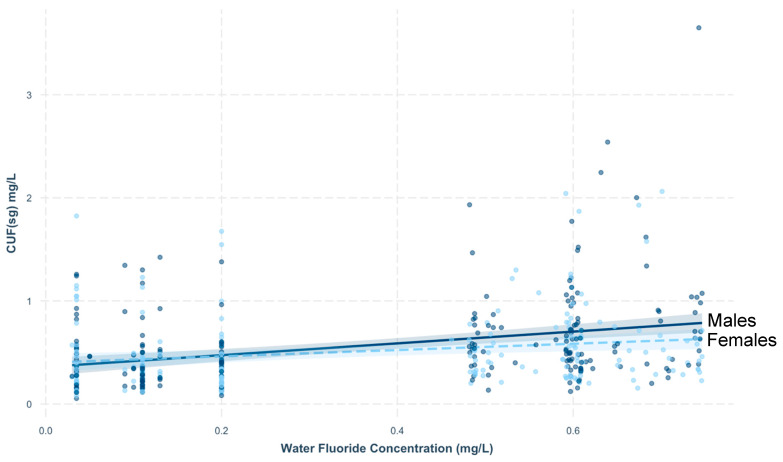
Fluoride, which may be toxic to the developing brain, is added to salt in Mexico and drinking water in Canada to prevent dental caries. We compared childhood urinary fluoride (CUF) concentrations in Mexico City and Canada to characterize patterns of fluoride exposure in these two populations. We also examined associations of CUF with dietary and water fluoride levels in Mexico City and Canada respectively. We included 561 children (ages 4–6; mean age 4.8 years) from the Programming Research in Obesity, Growth, Environment, and Social Stress (PROGRESS) cohort in Mexico City, and 645 children (ages 2–6; mean age 3.7 years) from the Maternal–Infant Research on Environmental Chemicals (MIREC) cohort in Canada. We applied Spearman correlations, T-tests, ANOVA or covariate-adjusted linear regression to examine associations of CUF (mg/L; adjusted for specific gravity) with demographics and dietary or water fluoride concentrations. We used Welch equivalence testing to compare means across cohorts. Mean (SD) CUF was equivalent (t = 4.26, p < 0.001) in PROGRESS: 0.74 (0.42) and fluoridated Canadian communities: 0.66 (0.47), but lower in non-fluoridated Canadian communities: 0.42 (0.31) (t = −6.37, p < 0.001). Water fluoride concentrations were significantly associated with CUF after covariate adjustment for age and sex in MIREC (B = 0.44, 95% CI: 0.30, 0.59, p < 0.001). In contrast, daily food and beverage fluoride intake was not associated with CUF in PROGRESS (p = 0.82). We found that CUF levels are comparable among children in Mexico City and fluoridated Canadian communities, despite distinct sources of exposure. Community water fluoridation is a major source of fluoride exposure for Canadian children.
Overview
The claims and statistics of this paper haven’t been checked yet.
Run the check — free, no account needed. It reads the open-access text and checks the sources it cites.
Integrity signals
Registry
Cites
Statistics
Figures
Verification
Claims the paper makes
The claims and statistics of this paper haven’t been checked yet.
Run the check — free, no account needed. It reads the open-access text and checks the sources it cites.
Claims other papers make about this one
Each is checked against this paper’s own text: does it say what the citing paper says it does?
In the citing paper
“However, excessive fluoride intake through food, beverages, dental materials or supplements [3], particularly during the critical period of dental development [4,5], can lead to the formation of dental fluorosis, which poses a significant threat to oral health [6].”
From Severity-dependent alterations in oral microbiota and antibiotic resistance in children with dental fluorosis (2026) · cites this paper as [6]
Self-check
Percentages, sums and reported differences re-computed from the paper’s own numbers.
The self-check needs the paper’s full text.
Citations
Cites
Lakens, D. (2017) · Social Psychological and Personality Science · doi:10.1177/1948550617697177 · Cited by 2,161 · cited 1×
“We applied two one-sided tests (TOST) Welch equivalence testing [41] to compare CUFSG means between PROGRESS and MIREC, which allows for skewed outcome data and does not assume equal variances between groups [42].”
Method
Research works printed but not linked: 35
- Marinho, 2009, Cochrane reviews of randomized trials of fluoride therapies for preventing dental caries, Eur. Arch. Paediatr. Dent., 10, 183, 10.1007/BF03262681 · DOI
- Zohoori, 2013, Total fluoride intake and excretion in children up to 4 years of age living in fluoridated and non-fluoridated areas, Eur. J. Oral Sci., 121, 457, 10.1111/eos.12070 · DOI
- Das, 2016, Dental fluorosis and urinary fluoride concentration as a reflection of fluoride exposure and its impact on IQ level and BMI of children of Laxmisagar, Simlapal Block of Bankura District, W.B., India, Environ. Monit. Assess., 188, 218, 10.1007/s10661-016-5219-1 · DOI
- Till, 2018, Community water fluoridation and urinary fluoride concentrations in a national sample of pregnant women in Canada, Environ. Health Perspect., 126, 107001, 10.1289/EHP3546 · DOI
- Rango, 2014, Fluoride exposure from groundwater as reflected by urinary fluoride and children’s dental fluorosis in the main ethiopian rift valley, Sci. Total Environ., 496, 188, 10.1016/j.scitotenv.2014.07.048 · DOI
- Ahmed, 2012, Correlation of fluoride in drinking water with urine, blood plasma, and serum fluoride levels of people consuming high and low fluoride drinking water in Pakistan, Fluoride, 45, 384
- Jain, 2017, Concentrations of fluoride in water and plasma for US children and adolescents: Data from NHANES 2013–2014, Environ. Toxicol. Pharmacol., 50, 20, 10.1016/j.etap.2017.01.006 · DOI
- McLaren, 2016, Fluoridation exposure status based on location of data collection in the Canadian health measures survey: Is it valid?, J. Can. Dent. Assoc., 82, 1
- Singh, 2007, Fluoride in drinking water and human urine in Southern Haryana, India, J. Hazard. Mater., 144, 147, 10.1016/j.jhazmat.2006.10.010 · DOI
- Barberio, 2017, Fluoride exposure and reported learning disability diagnosis among Canadian children: Implications for community water fluoridation, Can. J. Public Health, 108, e229, 10.17269/CJPH.108.5951 · DOI
- Kumar, 2017, Relationship between water, urine and serum fluoride and fluorosis in school children of Jhajjar District, Haryana, India, Appl. Water Sci., 7, 3377, 10.1007/s13201-016-0492-2 · DOI
- Cantoral, 2019, Fluoride content in foods and beverages from Mexico City markets and supermarkets, Food Nutr. Bull., 40, 514, 10.1177/0379572119858486 · DOI
- Riddell, 2019, Association of water fluoride and urinary fluoride concentrations with attention deficit hyperactivity disorder in Canadian youth, Environ. Int., 133, 105190, 10.1016/j.envint.2019.105190 · DOI
- Till, 2020, Association between maternal fluoride exposure and child IQ—Reply, JAMA Pediatr., 174, 216, 10.1001/jamapediatrics.2019.5251 · DOI
- Green, 2019, Fluoride exposure during fetal development and intellectual abilities in a Canadian birth cohort, JAMA Pediatr., 173, 940, 10.1001/jamapediatrics.2019.1729 · DOI
- Bashash, 2018, Prenatal fluoride exposure and attention deficit hyperactivity disorder (ADHD) symptoms in children at 6–12 years of age in Mexico City, Environ. Int., 121, 658, 10.1016/j.envint.2018.09.017 · DOI
- Bashash, 2017, Prenatal fluoride exposure and cognitive outcomes in children at 4 and 6–12 years of age in Mexico, Environ. Health Perspect., 125, 097017, 10.1289/EHP655 · DOI
- National Toxicology Program (NTP) (2019). Draft NTP Monograph on the Systematic Review of Fluoride Exposure and Neurodevelopmental and Cognitive Health Effects.
- Farmus, L., Till, C., Green, R., Hornung, R., Martinez-Mier, E.A., Ayotte, P., Muckle, G., Lanphear, B., and Flora, D. (2020). Critical windows of fluoride neurotoxicity in Canadian children. Environment, in revision. · DOI
- Broadbent, 2015, Community water fluoridation and intelligence: Prospective study in New Zealand, Am. J. Public Health, 105, 72, 10.2105/AJPH.2013.301857 · DOI
- Buzalaf, 2011, Fluoride intake, metabolism and toxicity, Fluoride and the Oral Environment, Volume 22, 20, 10.1159/000325107 · DOI
- Villa, 2010, Relationships between fluoride intake, urinary fluoride excretion and fluoride retention in children and adults: An analysis of available data, Caries Res., 44, 60, 10.1159/000279325 · DOI
- Junger, 2019, Use of toothpaste and toothbrushing patterns among children and adolescents—United States, 2013–2016, Morb. Mortal. Wkly. Rep., 68, 87, 10.15585/mmwr.mm6804a3 · DOI
- Goin, 2020, Maternal and fetal exposures to fluoride during mid-gestation among pregnant women in Northern California, Environ. Health, 19, 38, 10.1186/s12940-020-00581-2 · DOI
- Ketley, 2004, Urinary fluoride excretion by preschool children in six European countries, Community Dent. Oral Epidemiol., 32, 62, 10.1111/j.1600-0528.2004.00141.x · DOI
- Arbuckle, 2013, Cohort profile: The maternal-infant research on environmental chemicals research platform, Paediatr. Perinat. Epidemiol., 27, 415, 10.1111/ppe.12061 · DOI
- Braun, 2014, Relationships between lead biomarkers and diurnal salivary cortisol indices in pregnant women from Mexico City: A cross-sectional study, Environ. Health, 13, 50, 10.1186/1476-069X-13-50 · DOI
- Burris, 2013, Association between birth weight and DNA methylation of IGF2, glucocorticoid receptor and repetitive elements LINE-1 and Alu, Epigenomics, 5, 271, 10.2217/epi.13.24 · DOI
- Cury, 2011, Development of gold standard ion-selective electrode-based methods for fluoride analysis, Caries Res., 45, 3, 10.1159/000321657 · DOI
- Buckley, 2009, Evaluation of the direct and diffusion methods for the determination of fluoride content in table salt, Community Dent. Health, 26, 204
- Hauser, 2004, Temporal variability of urinary phthalate metabolite levels in men of reproductive age, Environ. Health Perspect., 112, 1734, 10.1289/ehp.7212 · DOI
- 2009, Methodology for the analysis of dietary data from the Mexican National Health and Nutrition Survey 2006, Salud Publ. Mex., 51, S523
- Aylward, 2015, Biomonitoring equivalents for interpretation of urinary fluoride, Regul. Toxicol. Pharmacol., 72, 158, 10.1016/j.yrtph.2015.04.005 · DOI
- Forte, 2008, Urinary fluoride excretion in children exposed to fluoride toothpaste and to different water fluoride levels in a tropical area of Brazil, Braz. Dent. J., 19, 214, 10.1590/S0103-64402008000300007 · DOI
- Marthaler, 2013, Salt fluoridation and oral health, Acta Med. Acad., 42, 140, 10.5644/ama2006-124.82 · DOI
Cited by
Sorted by citations
Xia, Y., Peng, S., Yu, J., Wang, Y., Ye, Y., Liu, M., Shang, L., Cui, X., Wang, P., & Ding, Z. (2026) · Journal of Oral Microbiology · doi:10.1080/20002297.2026.2714622
Metadata
- Authors
- Green, R., Till, C., Cantoral, A., Lanphear, B., Martinez-Mier, E., Ayotte, P., Wright, R., Tellez-Rojo, M., & Malin, A.
- Affiliations
- Department of Psychology, York University, Toronto, ON M3J 1P3, Canada
- Departamento de Salud, Universidad Iberoamericana, Ciudad de México 01219, Mexico
- Faculty of Health Sciences, Simon Fraser University, Vancouver, BC V5A 1S6, Canada
- School of Dentistry, Indiana University, Indianapolis, IN 46202, USA
- Department of Social and Preventive Medicine, Laval University, Quebec City, QC G1V 0A6, Canada
- Environmental Medicine and Public Health, Icahn School of Medicine at Mount Sinai, New York, NY 10029, USA
- School of Public Health, Instituto Nacional de Salud Pública, Cuernavaca 62100, Mexico
- Venue
- Toxics
- Publisher
- MDPI AG
- Published
- 2020-11-20
- Volume
- 8
- Issue
- 4
- Pages
- 110
- ISSN
- 2305-6304
- PMC
- PMC7711675
- Cited by
- 27
- References
- 1
- Language
- en
- Funders
- Canadian Institutes of Health Research (MOP-81285)
- National Institute of Environmental Health Sciences (P30ES023515, R01ES013744, R01ES014930, R01ES021357, R01ES020268, R01ES026333, R01ES028927, R21ES027044)
About these checks
Registry, retraction, Cites and statistics results are computed, not judged, with one exception: a printed reference that no index lists is read once by a model before it counts as a citation error. Claims are extracted by a model and kept only when their quote appears verbatim in the text; each cited source is then checked, with a model’s help, for whether it says what the claim relies on. Those verdicts can be wrong — read the claim’s quote and the cited source before relying on one.
Statistics and arithmetic are recomputed, not judged.
Confidence bands are shown only for fields calibrated on our annotated test set. None is calibrated yet, so no band is shown.
What counts as a claim ›How we measure confidence ›How we check this ›
Are you an author, or do you see a problem with this page? Request a review
