

The Interplay between HIV-1 Gag Binding to the Plasma Membrane and Env Incorporation
Open accessThe DOI matches its Crossref record; 186 of the 189 references it cites were found in a registry or an index.
Abstract
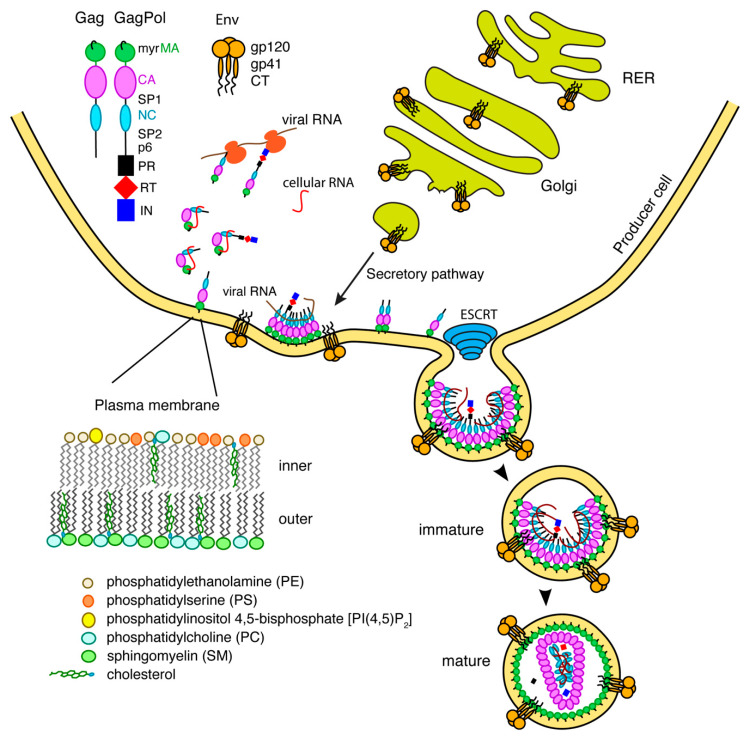
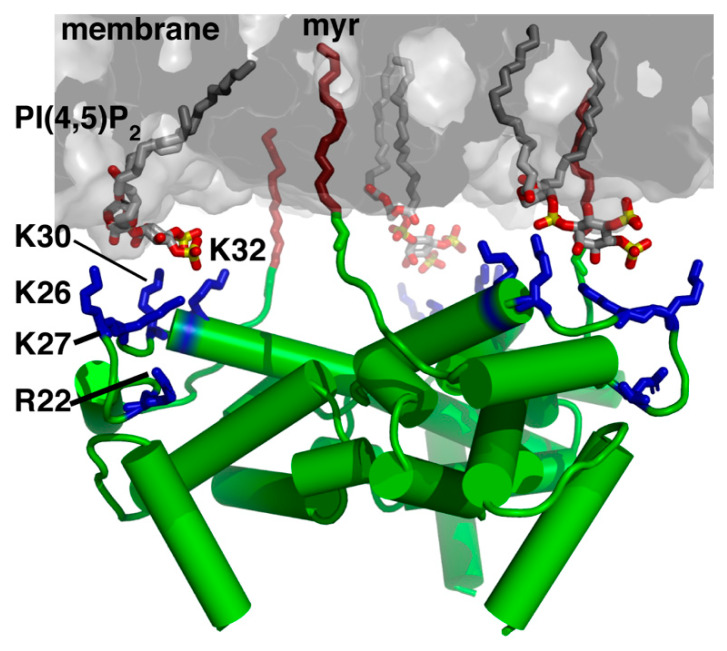
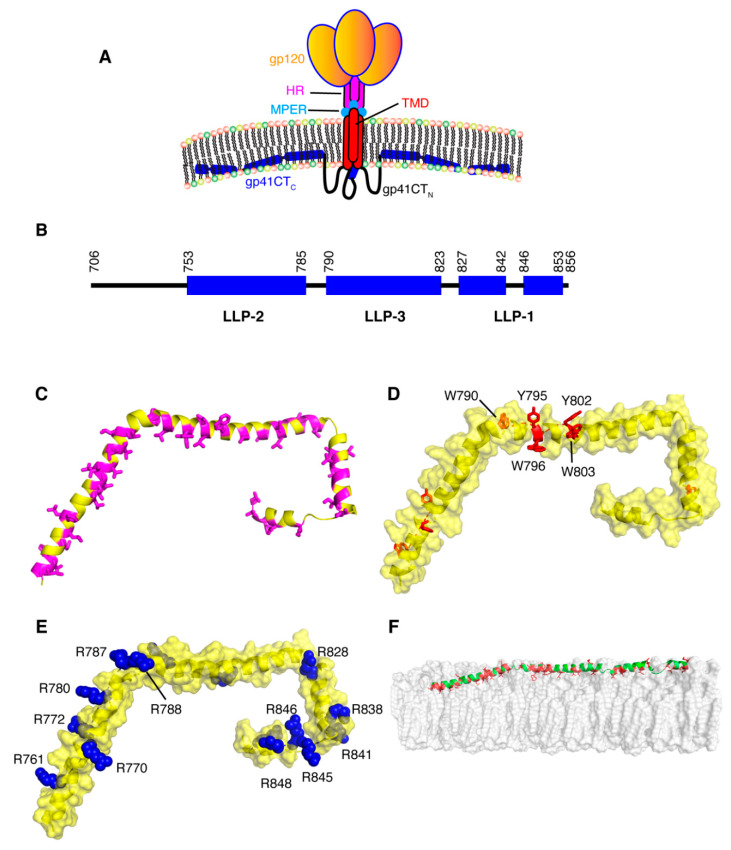
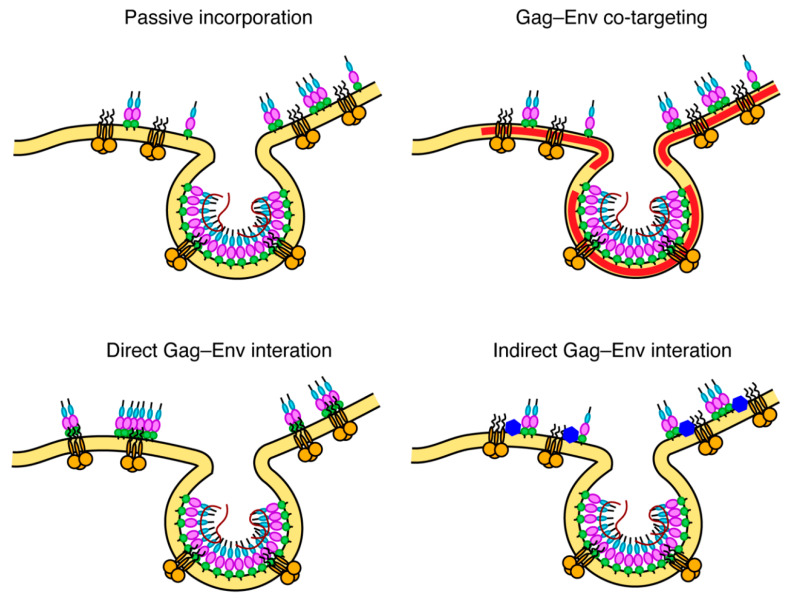
Advancement in drug therapies and patient care have drastically improved the mortality rates of HIV-1 infected individuals. Many of these therapies were developed or improved upon by using structure-based techniques, which underscore the importance of understanding essential mechanisms in the replication cycle of HIV-1 at the structural level. One such process which remains poorly understood is the incorporation of the envelope glycoprotein (Env) into budding virus particles. Assembly of HIV particles is initiated by targeting of the Gag polyproteins to the inner leaflet of the plasma membrane (PM), a process mediated by the N-terminally myristoylated matrix (MA) domain and phosphatidylinositol 4,5-bisphosphate (PI(4,5)P2). There is strong evidence that formation of the Gag lattice on the PM is a prerequisite for the incorporation of Env into budding particles. It is also suggested that Env incorporation is mediated by an interaction between its cytoplasmic tail (gp41CT) and the MA domain of Gag. In this review, we highlight the latest developments and current efforts to understand the interplay between gp41CT, MA, and the membrane during assembly. Elucidation of the molecular determinants of Gag–Env–membrane interactions may help in the development of new antiviral therapeutic agents that inhibit particle assembly, Env incorporation and ultimately virus production.
Overview
The claims and statistics of this paper haven’t been checked yet.
Free: it reads the open-access text and checks the first 5 claims that cite a source we can check. Create a free account to check every claim.
Integrity signals
Registry
Cites
Statistics
Figures
Verification
Claims the paper makes
The claims and statistics of this paper haven’t been checked yet.
Free: it reads the open-access text and checks the first 5 claims that cite a source we can check. Create a free account to check every claim.
Claims other papers make about this one
Each is checked against this paper’s own text: does it say what the citing paper says it does?
The cited source says what the claim attributes to it.
In the citing paper
“This process is governed by two key chemical signals: myristoylation and interaction with the plasma membrane-specific phospholipid phosphatidylinositol-4,5-bisphosphate (PIP2) (5).”
From Research progress on HIV-1 structural proteins and antiviral therapies (2026) · cites this paper as [5]
Self-check
Percentages, sums and reported differences re-computed from the paper’s own numbers.
The self-check needs the paper’s full text.
Citations
Cites
VMD: visual molecular dynamics
Humphrey, W., Dalke, A., & Schulten, K. (1996) · Journal of Molecular Graphics · doi:10.1016/0263-7855(96)00018-5 · Cited by 66,952 · cited 4×
“Membrane bilayer was generated in VMD membrane builder plug‐in [53].”
MethodInfluentialAvogadro: an advanced semantic chemical editor, visualization, and analysis platform
Hanwell, M. D., Curtis, D. E., Lonie, D. C., Vandermeersch, T., Zurek, E., & Hutchison, G. R. (2012) · Journal of Cheminformatics · doi:10.1186/1758-2946-4-17 · Cited by 10,553 · cited 2×
“PI(4, )P2 was generated i Avogadro [54].”
MethodAntiretroviral therapy for the prevention of HIV-1 transmission.
Cohen, M. S., Chen, Y. Q., McCauley, M., Gamble, T., Hosseinipour, M. C., Kumarasamy, N., Hakim, J. G., Kumwenda, J., Grinsztejn, B., Pilotto, J. H. S., et al. (2016) · New England Journal of Medicine · doi:10.1056/nejmoa1600693 · Cited by 1,700 · cited 1×
“Even though advances in treatment, particularly in antiretroviral therapies (ARTs) and patient care, have drastically reduced the morbidity and mortality of infected individuals worldwide [1,2], there are still ~36 million adults and 1.”
BackgroundAbsence of Intact nef Sequences in a Long-Term Survivor with Nonprogressive HIV-1 Infection
Kirchhoff, F., Greenough, T. C., Brettler, D. B., Sullivan, J. L., & Desrosiers, R. C. (1995) · New England Journal of Medicine · doi:10.1056/nejm199501263320405 · Cited by 1,003
Characterization of ribosomal frameshifting in HIV-1 gag-pol expression
Jacks, T., Power, M. D., Masiarz, F. R., Luciw, P. A., Barr, P. J., & Varmus, H. E. (1988) · Nature · doi:10.1038/331280a0 · Cited by 966 · cited 1×
“GagPol, which contains the elements of Gag as well as the viral enzymes protease (PR), reverse transcriptase (RT) and integrase (IN), is produced and incorporated at lower levels relative to Gag (~5%) due to an infrequent ribosomal frameshift event [8,9].”
BackgroundReconstitution of Membrane Proteins in Phospholipid Bilayer Nanodiscs
Ritchie, T. K., Grinkova, Y. V., Bayburt, T. H., Denisov, I. G., Zolnerciks, J. K., Atkins, W. M., & Sligar, S. G. (2009) · Methods in Enzymology · doi:10.1016/s0076-6879(09)64011-8 · Cited by 872
Plasma membrane phosphoinositide organization by protein electrostatics
McLaughlin, S., & Murray, D. (2005) · Nature · doi:10.1038/nature04398 · Cited by 868
HIV-1 Antiretroviral Drug Therapy
Arts, E. J., & Hazuda, D. J. (2012) · Cold Spring Harbor Perspectives in Medicine · doi:10.1101/cshperspect.a007161 · Cited by 851 · cited 1×
“While ARTs have been effective in combating the AIDS epidemic, they are not capable of eradicating the virus from the body entirely, requiring patients to undergo indefinite treatments [3] which can lead to adverse effects including drug toxicity and drug resistant mutations in the viral genome ([4–6] and references t…”
BackgroundPIP2and Proteins: Interactions, Organization, and Information Flow
McLaughlin, S., Wang, J., Gambhir, A., & Murray, D. (2002) · Annual Review of Biophysics and Biomolecular Structure · doi:10.1146/annurev.biophys.31.082901.134259 · Cited by 837
HIV-1 assembly, budding, and maturation
Sundquist, W. I., & Krausslich, H.-G. (2012) · Cold Spring Harbor Perspectives in Medicine · doi:10.1101/cshperspect.a006924 · Cited by 814
Cited by
van Heuvel, Y., Schatz, S., Rosengarten, J. F., & Stitz, J. (2022) · Toxins · doi:10.3390/toxins14020138 · Cited by 170
“The assembly of Gag at the plasma membrane also induces the retention of Env trimers at assembly sites mediated by an interaction between the Gag MA domain and the C-tail of the Env protein gp41TM [78].”
BackgroundMaturation of the matrix and viral membrane of HIV-1
Qu, K., Ke, Z., Zila, V., Anders-Össwein, M., Glass, B., Mücksch, F., Müller, R., Schultz, C., Müller, B., Kräusslich, H.-G., et al. (2021) · Science · doi:10.1126/science.abe6821 · Cited by 106
“This mode of PI(4,5)P2 binding, in which the 2 ́ acyl chain of the lipid would have to be pulled out of the bilayer, is no longer widely considered relevant to MA-membrane interactions during virus assembly, which instead are likely to be between the PI(4,5)P2 headgroup and the membrane-facing basic MA residues (13-15…”
BackgroundSever, B., Otsuka, M., Fujita, M., & Ciftci, H. I. (2024) · International Journal of Molecular Sciences · doi:10.3390/ijms25073659 · Cited by 78
Broadly neutralizing anti-HIV-1 antibodies tether viral particles at the surface of infected cells
Dufloo, J., Planchais, C., Frémont, S., Lorin, V., Guivel‐Benhassine, F., Stéfic, K., Casartelli, N., Échard, A., Roingeard, P., Mouquet, H., et al. (2022) · Nature Communications · doi:10.1038/s41467-022-28307-7 · Cited by 37
Marie, V., & Gordon, M. L. (2022) · International Journal of Molecular Sciences · doi:10.3390/ijms23147569 · Cited by 29
“Upon translation from the 9 kb transcript in the cytoplasm [5], Gag is trafficked to the plasma membrane where the membrane-bound polyprotein recruits and packages two copies of viral RNA per virion [6].”
BackgroundMethodInfluentialDevelopment of Anti-HIV Therapeutics: From Conventional Drug Discovery to Cutting-Edge Technology
Sun, Y., & Wang, L. (2024) · Pharmaceuticals · doi:10.3390/ph17070887 · Cited by 30
“The viral envelop glycoprotein (Env) and the precursor of the Gag protein, Gag-pol polyprotein, are synthesized in the endoplasmic reticulum (ER) and transported to the plasma membrane, where viral particle assembly takes place [35].”
BackgroundAtomic view of the HIV-1 matrix lattice; implications on virus assembly and envelope incorporation
Samal, A. B., Green, T. J., & Saad, J. S. (2022) · Proceedings of the National Academy of Sciences · doi:10.1073/pnas.2200794119 · Cited by 24
“A few models of the HIV-1 myrMA trimer bound to membranes have been proposed based on structural, biochemical, biophysical, and functional studies (2, 22, 39).”
MethodSelf-citationLaomeephol, C., Tawinwung, S., Suppipat, K., Arunmanee, W., Wang, Q., & Luckanagul, J. A. (2024) · International Journal of Pharmaceutics · doi:10.1016/j.ijpharm.2024.124332 · Cited by 20
Full scale structural, mechanical and dynamical properties of HIV-1 liposomes
Bryer, A. J., Reddy, T. J., Lyman, E. R., & Perilla, J. R. (2022) · PLoS Computational Biology · doi:10.1371/journal.pcbi.1009781 · Cited by 20
Tian, S., Nguyen, H. V., Ye, Z., Rouskin, S., Thirumalai, D., & Trcek, T. (2025) · Nature Communications · doi:10.1038/s41467-025-62973-7 · Cited by 16
“In addition to stabilizing intermolecular base pairing between HIV genomic RNAs, Gag multimerizes to encapsulate the genome into virions, protecting the HIV genomes from host degradation and enhancing viral infectivity 94 .”
Fernandez, M. V., Hoffman, H. K., Pezeshkian, N., Tedbury, P. R., van Engelenburg, S. B., & Freed, E. O. (2020) · Journal of Virology · doi:10.1128/jvi.01334-20 · Cited by 16
Interplay between Host tRNAs and HIV-1: A Structural Perspective
Zhang, J. (2021) · Viruses · doi:10.3390/v13091819 · Cited by 15
Structural characterization of HIV-1 matrix mutants implicated in envelope incorporation
Eastep, G. N., Ghanam, R. H., Green, T. J., & Saad, J. S. (2021) · Journal of Biological Chemistry · doi:10.1016/j.jbc.2021.100321 · Cited by 16
Self-citationFernandez, M. V., Hoffman, H. K., Carter, H. M., Simons, L. M., Naing, L., Ablan, S. D., Scheiblin, D. A., Hultquist, J. F., van Engelenburg, S. B., & Freed, E. O. (2022) · Journal of Virology · doi:10.1128/jvi.00876-22 · Cited by 9
Structural maturation of the matrix lattice is not required for HIV-1 particle infectivity
Chen, L., Hikichi, Y., Rey, J. S., Akıl, C., Zhu, Y., Veler, H., Shen, Y., Perilla, J. R., Freed, E. O., & Zhang, P. (2025) · Science Advances · doi:10.1126/sciadv.adv4356 · Cited by 9
“…which includes residues Arg 21 , Lys 25 , Lys 26 , Lys 29 , and Lys 31 , creates a positively charged area on the MA globular domain’s surface that facilitates membrane binding via electrostatic interactions with the acidic headgroups of phospholipids including PI(4,5) P 2 and PS ( 26 , 49 , 50 ).”
InfluentialHelp or Hinder: Protein Host Factors That Impact HIV-1 Replication
Moezpoor, M. R., & Stevenson, M. (2024) · Viruses · doi:10.3390/v16081281 · Cited by 7
“Interactions between the gp41 CT and MA also contribute to the proper incorporation of Env into budding virions, as mutations in MA or the CT lead to inefficient incorporation of Env into the viral particles [498,512,513].”
BackgroundA Conserved Tryptophan in the Envelope Cytoplasmic Tail Regulates HIV-1 Assembly and Spread
Snetkov, X., Haider, T., Mesner, D., Groves, N. S., van Engelenburg, S. B., & Jolly, C. L. (2022) · Viruses · doi:10.3390/v14010129 · Cited by 8
“Whether the EnvCT interacts with Gag MA, how exactly Env gets incorporated into virions and whether Env plays any role in regulating virus assembly remain unclear [1,9].”
BackgroundDick, A., & Cocklin, S. (2021) · Biomolecules · doi:10.3390/biom11091294 · Cited by 6
“The MA core contains the highly positive PI[4,5]P2/nucleic acid binding site made up of helix α2, helix α5, and helix α6.”
BackgroundInfluentialThe Assembly of HTLV-1—How Does It Differ from HIV-1?
Herrmann, D., Meng, S., Yang, H., Mansky, L. M., & Saad, J. S. (2024) · Viruses · doi:10.3390/v16101528 · Cited by 5
“The HBR is a conserved feature in MA proteins across multiple genera within the Retroviridae family [121,126,127].”
BackgroundSelf-citationDevelopment of HIV-1 vectors pseudotyped with envelope proteins of other retroviruses
Stitz, J. (2024) · Virology · doi:10.1016/j.virol.2024.110300 · Cited by 5
Gag-Gag Interactions Are Insufficient to Fully Stabilize and Order the Immature HIV Gag Lattice
Saha, I., Preece, B., Peterson, A., Durden, H., MacArthur, B., Lowe, J., Belnap, D. M., Vershinin, M. D., & Saffarian, S. (2021) · Viruses · doi:10.3390/v13101946 · Cited by 4
“The cytosolic domain of HIV ENV interacts with the immature HIV Gag lattice and play a role in recruitment of ENV into budding HIV virions [32,41,42].”
BackgroundBarría, M. I., Alvarez, R. A., Law, K., Wolfson, D. L., Huser, T. R., & Chen, B. K. (2021) · Viruses · doi:10.3390/v13091729 · Cited by 3
Research progress on HIV-1 structural proteins and antiviral therapies
Wang, H., Yuan, J., & Wang, H. (2026) · Frontiers in Immunology · doi:10.3389/fimmu.2026.1805597 · Cited by 2
“The second signal involves electrostatic interactions between basic residues (HBR) in MA and negatively charged PIP2 in the plasma membrane (5).”
Mechanisms of APOBEC3 Packaging into HIV-1
Nzivo, M. M., Gertzen, C. G. W., Luedde, T., Gohlke, H., & Münk, C. (2026) · Viruses · doi:10.3390/v18030389 · Cited by 1
“Residues in loop 1 and loop 7 or α -helix 6 residues together with duplex RNA are responsible for retaining A3H in the cytoplasm, while select residues in https://doi.org/10.3390/v18030389 loop 1 and loop 3 retain A3H in the nucleolus [98,99].”
InfluentialThe role of the TRPV1-CGRP axis in the mucosal pathophysiology of HSV-2/HIV-1 co-infection
Mariotton, J. (2024) · theses.fr (ABES) · doi:10.70675/43d0e3cdz7290z4c79z9beaz351fcaf83c4a
Optimization of retroviral packaging cells for scale-up of vector production
van Heuvel, Y. (2023) · Institutional Repository of Leibniz Universität Hannover (Leibniz Universität Hannover) · doi:10.15488/14856
MATTEUCCI, M. (2024) · Electronic Theses and Dissertations Repository (University of Pisa)
Characterizing Human and Viral Proteins in the HIV-1 Envelope Using Novel Methods in Flow Virometry
Burnie, J. (2023) · TSpace (University of Toronto)
Pillai, V. N. (2025) · Pécsi Egyetemi Archívum (University of Pécs)
Caractérisation des activités antivirales des anticorps anti-VIH-1 et anti-SARS-CoV-2
Dufloo, J. (2021) · theses.fr (ABES) · doi:10.70675/215798eaz7f82z4e57za8eazf4453d37b8c8
Nandi, T., Wong, M., Waheed, A. A., Freed, E. O., Schiffer, C. A., & Munro, J. B. (2026) · bioRxiv (Cold Spring Harbor Laboratory) · doi:10.64898/2026.09.11.751012
Le, B. Q., Tran, K. Q., Doi, N., Koma, T., Kondo, T., Kotani, O., Sato, H., Adachi, S., Adachi, A., Yokoyama, M., et al. (2026) · Frontiers in Microbiology · doi:10.3389/fmicb.2026.1877899
“Consistent with prior work showing that gp41-CT alterations can influence Env incorporation and trimer conformation (Checkley et al., 2011; Chen, 2019; Murphy and Saad, 2020; Chen et al., 2015), this insertion modestly increased Env incorporation (Supplementary Figure 4).”
Metadata
- Authors
- Murphy, R. E., & Saad, J. S.
- Affiliations
- University of Alabama at Birmingham (US)
- Corresponding author
- Saad, Jamil S.
- Venue
- Viruses
- Publisher
- MDPI AG
- Published
- 2020-05-16
- Volume
- 12
- Issue
- 5
- Pages
- 548
- ISSN
- 1999-4915 (ISSN-L)
- PMC
- PMC7291237
- OpenAlex
- W3024961866
- Semantic Scholar
- fb12fe23d5797aecc38505c9190ad469227f09eb
- Cited by
- 30
- References
- 189
- Citations by year
- 2026: 3 · 2025: 2 · 2024: 7 · 2022: 8 · 2021: 9 · 2020: 1
- FWCI
- 0.73
- Type
- journal article
- Language
- en
- Open access
- gold
- dx.doi.org
- Licence
- Locations
- Viruses (publishedVersion, cc-by)
- PubMed Central (publishedVersion, cc-by)
- PubMed (publishedVersion)
- DOAJ (DOAJ: Directory of Open Access Journals) (submittedVersion, cc-by-sa)
- Funders
- National Institutes of Health (9R01AI150901)
- Topics
- Life Sciences › Immunology and Microbiology › Virology › HIV Research and Treatment
- Life Sciences › Immunology and Microbiology › Immunology › T-cell and Retrovirus Studies
- Health Sciences › Medicine › Infectious Diseases › HIV/AIDS drug development and treatment
- Keywords
- HIV-1, Gag protein, viral budding, plasma membrane, phosphatidylinositol 4,5-bisphosphate, antiviral drug targets
- MeSH terms
- Cell Membrane, Protein Binding, Protein Conformation, HIV Antigens, HIV-1, HIV Envelope Protein gp41, Virus Assembly, Phosphatidylinositol 4,5-Diphosphate, env Gene Products, Human Immunodeficiency Virus, gag Gene Products, Human Immunodeficiency Virus
About these checks
Registry, retraction, Cites and statistics results are computed, not judged, with one exception: a printed reference that no index lists is read once by a model before it counts as a citation error. Claims are extracted by a model and kept only when their quote appears verbatim in the text; each cited source is then checked, with a model’s help, for whether it says what the claim relies on. Those verdicts can be wrong — read the claim’s quote and the cited source before relying on one.
Statistics and arithmetic are recomputed, not judged.
Confidence bands are shown only for fields calibrated on our annotated test set. None is calibrated yet, so no band is shown.
What counts as a claim ›How we measure confidence ›How we check this ›
Are you an author, or do you see a problem with this page? Request a review
Data sources
Bibliographic data: Semantic Scholar, OpenAlex, Crossref.
Contains information from the Semantic Scholar Academic Graph Datasets, made available under the ODC Attribution License (ODC-BY 1.0).
Semantic Scholar’s data is described in: Kinney, R., et al. (2023). The Semantic Scholar Open Data Platform. arXiv:2301.10140.
