

The DOI matches its Crossref record; 1 of the 1 references it cites were found in a registry or an index.
Foamy Virus Assembly with Emphasis on Pol Encapsidation
Open accessAbstract
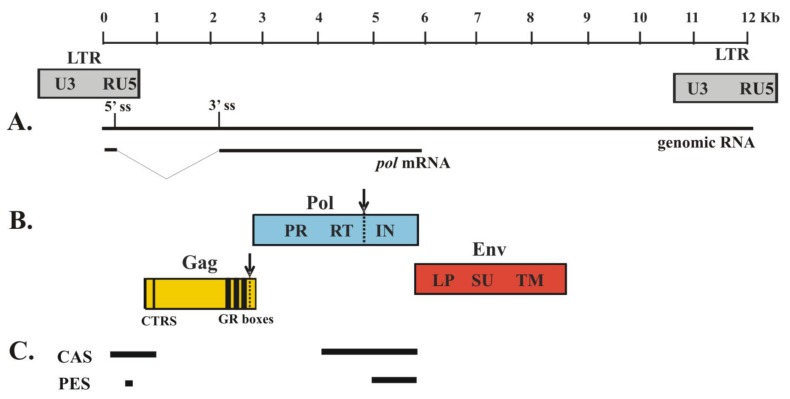
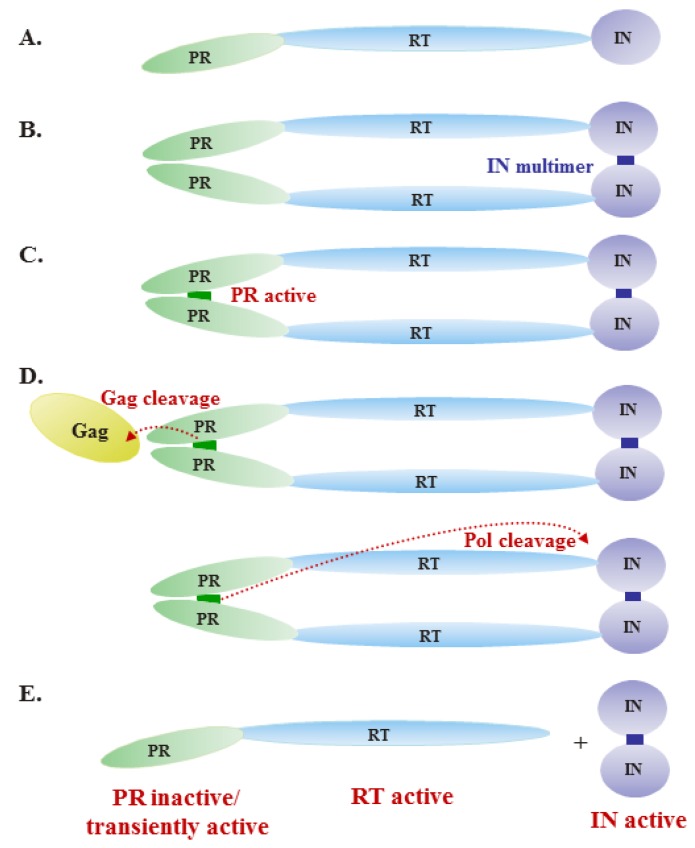
Foamy viruses (FVs) differ from all other genera of retroviruses (orthoretroviruses) in many aspects of viral replication. In this review, we discuss FV assembly, with special emphasis on Pol incorporation. FV assembly takes place intracellularly, near the pericentriolar region, at a site similar to that used by betaretroviruses. The regions of Gag, Pol and genomic RNA required for viral assembly are described. In contrast to orthoretroviral Pol, which is synthesized as a Gag-Pol fusion protein and packaged through Gag-Gag interactions, FV Pol is synthesized from a spliced mRNA lacking all Gag sequences. Thus, encapsidation of FV Pol requires a different mechanism. We detail how WT Pol lacking Gag sequences is incorporated into virus particles. In addition, a mutant in which Pol is expressed as an orthoretroviral-like Gag-Pol fusion protein is discussed. We also discuss temporal regulation of the protease, reverse transcriptase and integrase activities of WT FV Pol.
Overview
The claims and statistics of this paper haven’t been checked yet.
Run the check — free, no account needed. It reads the open-access text and checks the sources it cites.
Integrity signals
Registry
Cites
Statistics
Figures
Verification
Claims the paper makes
The claims and statistics of this paper haven’t been checked yet.
Run the check — free, no account needed. It reads the open-access text and checks the sources it cites.
Claims other papers make about this one
Each is checked against this paper’s own text: does it say what the citing paper says it does?
The source backs part of the claim, not all of it — or backs it for a different population, condition or comparison.
In the citing paper
“Some of the unique features of this subfamily include: (1) initiation of reverse transcription of the viral genome during the late stage of virus assembly, leading to the presence of fully or partially dsDNA in the released virions similar to that observed in Hepadnaviruses”
From Beyond reverse transcription: molecular mechanisms and emerging paradigms in retroviral replication (2026) · cites this paper as Lee et al. 2013
Experimental — accuracy not yet measuredThe source backs part of the claim, not all of it — or backs it for a different population, condition or comparison.
In the citing paper
“(2) synthesis of Pro/Pol proteins from a separate spliced subgenomic mRNA, leading to their recruitment into virions via Gag C-terminal interactions rather than the classical Gag–Pro/Pol (or Gag/Pol) fusion”
From Beyond reverse transcription: molecular mechanisms and emerging paradigms in retroviral replication (2026) · cites this paper as Lee et al. 2013
Experimental — accuracy not yet measuredThe source backs part of the claim, not all of it — or backs it for a different population, condition or comparison.
In the citing paper
“Absence of the membrane-targeting domain results in intracellular budding of foamy viruses into the endoplasmic/Golgi secretory pathway where they acquire Env, rather than the plasma membrane.”
From Beyond reverse transcription: molecular mechanisms and emerging paradigms in retroviral replication (2026) · cites this paper as Lee et al. 2013
Experimental — accuracy not yet measuredThe source backs part of the claim, not all of it — or backs it for a different population, condition or comparison.
In the citing paper
“Interestingly, this signal is found in one of the three glycine–arginine-rich rich sequences (GR motifs) observed in foamy virus Gag that compensate for the lack of zinc fingers important for encapsidation of genomic RNA (gRNA) in Orthoretrovirinae as well as Pol incorporation into the assembling virions (Calcraft et al. 2024, Lee et al. 2013, Müllers 2013, Lindemann and Rethwilm 2011, Linial 1999”
From Beyond reverse transcription: molecular mechanisms and emerging paradigms in retroviral replication (2026) · cites this paper as Lee et al. 2013
Experimental — accuracy not yet measuredThe source backs part of the claim, not all of it — or backs it for a different population, condition or comparison.
In the citing paper
“(4) a unique Gag protein that lacks the classical domains observed in Orthoretrovirinae, such as the zinc finger motifs (cysteine–histidine boxes) and the plasma membrane-targeting signal.”
From Beyond reverse transcription: molecular mechanisms and emerging paradigms in retroviral replication (2026) · cites this paper as Lee et al. 2013
Experimental — accuracy not yet measured
The cited source says what the claim attributes to it.
In the citing paper
“In fact, they are considered the “most ancient” among retroviruses and display features in between those of Orthoretrovirinae and Hepadnaviruses (Lee et al. 2013).”
From Beyond reverse transcription: molecular mechanisms and emerging paradigms in retroviral replication (2026) · cites this paper as Lee et al. 2013
The check wasn’t confident either way, so it gives no verdict — never disputed.
In the citing paper
“(3) an unusual requirement of Env for budding where Gag alone is not sufficient for release of virus particles”
From Beyond reverse transcription: molecular mechanisms and emerging paradigms in retroviral replication (2026) · cites this paper as Lee et al. 2013
Experimental — accuracy not yet measured
Self-check
Percentages, sums and reported differences re-computed from the paper’s own numbers.
The self-check needs the paper’s full text.
Citations
Cites
Retroviral intasome assembly and inhibition of DNA strand transfer
Hare, S., Gupta, S. S., Valkov, E., Engelman, A., & Cherepanov, P. (2010) · Nature · doi:10.1038/nature08784 · Cited by 678 · cited 4×
“The solution structure of the PFV IN tetramer has been solved [53,54].”
BackgroundInfluential
Research works printed but not linked: 81
- Katzourakis, 2009, Macroevolution of Complex Retroviruses, Science, 325, 1512, 10.1126/science.1174149 · DOI
- Han, 2012, An Endogenous Foamy Virus in the Aye-Aye (Daubentonia madagascariensis), J. Virol., 86, 7696, 10.1128/JVI.00650-12 · DOI
- Han, 2012, An endogenous foamy-like viral element in the coelacanth genome, PLoS Pathog, 8, e1002790, 10.1371/journal.ppat.1002790 · DOI
- Meiering, 2001, Historical perspective of foamy virus epidemiology and infection, Clin. Microbiol. Rev., 14, 165, 10.1128/CMR.14.1.165-176.2001 · DOI
- May, 2008, Diverse Contexts of Zoonotic Transmission of Simian Foamy Viruses in Asia, Emerg. Infect. Dis., 14, 1200, 10.3201/eid1408.071430 · DOI
- Caron, 2012, Cross-Species Transmission of Simian Foamy Virus to Humans in Rural Gabon, Central Africa, J. Virol., 86, 1255, 10.1128/JVI.06016-11 · DOI
- Linial, 1999, Foamy viruses are unconventional retroviruses, J. Virol., 73, 1747, 10.1128/JVI.73.3.1747-1755.1999 · DOI
- Leceilier, 2000, Foamy viruses: between retroviruses and pararetroviruses, Virology, 271, 1, 10.1006/viro.2000.0216 · DOI
- Peters, 2005, RNA and protein requirements for incorporation of the Pol protein into foamy virus particles, J. Virol., 79, 7005, 10.1128/JVI.79.11.7005-7013.2005 · DOI
- Yu, 1996, The carboxyl terminus of the human foamy virus gag protein contains separable nucleic acid binding and nuclear transport domains, J. Virol., 70, 8255, 10.1128/jvi.70.12.8255-8262.1996 · DOI
- Schliephake, 1994, Nuclear localization of foamy virus Gag precursor protein, J. Virol., 68, 4946, 10.1128/jvi.68.8.4946-4954.1994 · DOI
- Stenbak, 2004, Role of the C terminus of foamy virus Gag in RNA packaging and Pol expression, J. Virol., 78, 9423, 10.1128/JVI.78.17.9423-9430.2004 · DOI
- Lee, 2008, The C terminus of foamy retrovirus Gag contains determinants for encapsidation of Pol protein into virions, J. Virol., 82, 10803, 10.1128/JVI.00812-08 · DOI
- Uhlig, 2011, Novel Functions of Prototype Foamy Virus Gag Glycine- Arginine-Rich Boxes in Reverse Transcription and Particle Morphogenesis, J. Virol., 85, 1452, 10.1128/JVI.01731-10 · DOI
- Yu, 2006, Foamy virus capsid assembly occurs at a pericentriolar region through a cytoplasmic targeting/retention signal in Gag, Traffic, 7, 966, 10.1111/j.1600-0854.2006.00448.x · DOI
- Beckham, 2008, P bodies, stress granules, and viral life cycles, Cell. Host Microbe., 3, 206, 10.1016/j.chom.2008.03.004 · DOI
- Furtak, 2010, Perturbation of the P-Body Component Mov10 Inhibits HIV-1 Infectivity, PLoS ONE, 5, e9081, 10.1371/journal.pone.0009081 · DOI
- Burdick, 2010, Delviks-Frankenberry KA, Hu WS, Pathak VK P Body-Associated Protein Mov10 Inhibits HIV-1 Replication at Multiple Stages, J. Virol., 84, 10241, 10.1128/JVI.00585-10 · DOI
- Jangra, 2010, DDX6 (Rck/p54) Is Required for Efficient Hepatitis C Virus Replication but Not for Internal Ribosome Entry Site-Directed Translation, J. Virol., 84, 6810, 10.1128/JVI.00397-10 · DOI
- Ariumi, 2007, DDX3 DEAD-Box RNA Helicase Is Required for Hepatitis C Virus RNA Replication, J. Virol., 81, 13922, 10.1128/JVI.01517-07 · DOI
- Yu, 2011, The DEAD-box RNA Helicase DDX6 is Required for Efficient Encapsidation of a Retroviral Genome, PLoS Pathog, 7, e1002303, 10.1371/journal.ppat.1002303 · DOI
- Yu, 1996, Human foamy virus replication - a pathway distinct from that of retroviruses and hepadnaviruses, Science, 271, 1579, 10.1126/science.271.5255.1579 · DOI
- Jordan, 1996, Expression of human foamy virus reverse transcriptase involves a spliced pol mRNA, Virology, 224, 314, 10.1006/viro.1996.0534 · DOI
- 1996, The human foamy virus pol gene is expressed as a Pro-Pol polyprotein and not as a Gag-Pol fusion protein, J. Virol., 70, 1033, 10.1128/jvi.70.2.1033-1040.1996 · DOI
- Bodem, 1996, Characterization of the spliced pol transcript of feline foamy virus - the splice acceptor site of the pol transcript is located in gag of foamy viruses, J. Virol., 70, 9024, 10.1128/jvi.70.12.9024-9027.1996 · DOI
- Holzschu, 1998, The nucleotide sequence and spliced pol mRNA levels of the nonprimate spumavirus bovine foamy virus, J. Virol., 72, 2177, 10.1128/JVI.72.3.2177-2182.1998 · DOI
- Lee, 2008, A Premature Termination Codon Mutation at the C Terminus of Foamy Virus Gag Downregulates the Levels of Spliced pol mRNA, J. Virol., 82, 1656, 10.1128/JVI.00990-07 · DOI
- Baldwin, 1998, The roles of Pol and Env in the assembly pathway of human foamy virus, J. Virol., 72, 3658, 10.1128/JVI.72.5.3658-3665.1998 · DOI
- Heinkelein, 2002, Pregenomic RNA is required for efficient incorporation of Pol polyprotein into foamy virus capsids, J. Virol., 76, 10069, 10.1128/JVI.76.19.10069-10073.2002 · DOI
- Heinkelein, 1998, Characterization of a cis-acting sequence in the pol region required to transfer human foamy virus vectors, J. Virol., 72, 6307, 10.1128/JVI.72.8.6307-6314.1998 · DOI
- Erlwein, 1998, Sequences in pol are required for transfer of human foamy virus- based vectors, J. Virol., 72, 5510, 10.1128/JVI.72.7.5510-5516.1998 · DOI
- Trobridge, 2002, Improved foamy virus vectors with minimal viral sequences, J. Am. Soc. Gene Ther., 6, 321, 10.1006/mthe.2002.0672 · DOI
- Heinkelein, 2002, Improved primate foamy virus vectors and packaging constructs, J. Virol., 76, 3774, 10.1128/JVI.76.8.3774-3783.2002 · DOI
- Lee, 2012, Foamy Virus Pol Protein Expressed as a Gag-Pol Fusion Retains Enzymatic Activities, Allowing for Infectious Virus Production, J. Virol., 86, 5992, 10.1128/JVI.06979-11 · DOI
- Stirnnagel, 2011, Prototype Foamy Virus Gag Nuclear Localization: a Novel Pathway among Retroviruses, J. Virol., 85, 9276, 10.1128/JVI.00663-11 · DOI
- Cartellieri, 2005, Determination of the relative amounts of Gag and Pol proteins in foamy virus particles, Retrovirol., 2, 44, 10.1186/1742-4690-2-44 · DOI
- Roy, 2007, Role of the foamy virus Pol cleavage site in viral replication, J. Virol., 81, 4956, 10.1128/JVI.00104-07 · DOI
- Lee, 2011, Foamy Retrovirus Integrase Contains a Pol Dimerization Domain Required for Protease Activation, J. Virol., 85, 1655, 10.1128/JVI.01873-09 · DOI
- Konvalinka, 1995, Active spumavirus proteinase is essential for virus infectivity but not for formation of the Pol polyprotein, J. Virol., 69, 7264, 10.1128/jvi.69.11.7264-7268.1995 · DOI
- Enssle, 1997, Carboxy-terminal cleavage of the human foamy virus gag precursor molecule is an essential step in the viral life cycle, J. Virol., 71, 7312, 10.1128/jvi.71.10.7312-7317.1997 · DOI
- Zemba, 1998, The carboxy-terminal p3(Gag) Domain of the human foamy virus gag precursor is required for efficient virus infectivity, Virology, 247, 7, 10.1006/viro.1998.9234 · DOI
- Pearl, 1987, A structural model for the retroviral proteases, Nature, 329, 351, 10.1038/329351a0 · DOI
- Wlodawer, 1989, Conserved folding in retroviral proteases: crystal structure of a synthetic HIV-1 protease, Science, 245, 616, 10.1126/science.2548279 · DOI
- Miller, 1989, Crystal structure of a retroviral protease proves relationship to aspartic protease family, Nature, 337, 576, 10.1038/337576a0 · DOI
- Boross, 2006, Improved purification protocol for wild-type and mutant human foamy virus proteases, Prot. Exp. Purific., 46, 343, 10.1016/j.pep.2005.09.004 · DOI
- Pfrepper, 1998, Molecular characterization of proteolytic processing of the Pol proteins of human foamy virus reveals novel features of the viral protease, J. Virol., 72, 7648, 10.1128/JVI.72.9.7648-7652.1998 · DOI
- Hartl, 2008, The Solution Structure of the Simian Foamy Virus Protease Reveals a Monomeric Protein, J. Mol. Biol., 381, 141, 10.1016/j.jmb.2008.05.064 · DOI
- Hartl, 2010, Biophysical and enzymatic properties of the simian and prototype foamy virus reverse transcriptases, Retrovirol., 7, 5, 10.1186/1742-4690-7-5 · DOI
- Hartl, 2010, Formation of transient dimers by a retroviral protease, Biochem. J., 427, 197, 10.1042/BJ20091451 · DOI
- Li, 2006, Retroviral DNA integration: reaction pathway and critical intermediates, EMBO J., 25, 1295, 10.1038/sj.emboj.7601005 · DOI
- Gupta, 2012, Solution Conformations of Prototype Foamy Virus Integrase and Its Stable Synaptic Complex with U5 Viral DNA, Structure, 20, 1918, 10.1016/j.str.2012.08.023 · DOI
- Hartl, 2011, Regulation of Foamy Virus Protease Activity by Viral RNA: a Novel and Unique Mechanism among Retroviruses, J. Virol., 85, 4462, 10.1128/JVI.02211-10 · DOI
- Spannaus, 2012, The prototype foamy virus protease is active independently of the integrase domain, Retrovirol., 9, 41, 10.1186/1742-4690-9-41 · DOI
- Hütter, S., Müllers, E., Stanke, N., Reh, J., and Lindemann, D. (2013). Prototype Foamy Virus protease activity is essential for intra-particle reverse transcription initiation but not absolutely required for uncoating upon host cell entry. J. Virol., in press. · DOI
- Rinke, 2002, Mutation of the catalytic domain of the foamy virus reverse transcriptase leads to loss of processivity and infectivity, J. Virol., 76, 7560, 10.1128/JVI.76.15.7560-7570.2002 · DOI
- Boyer, 2004, Characterization of the polymerase and RNase H activities of human foamy virus reverse transcriptase, J. Virol., 78, 6112, 10.1128/JVI.78.12.6112-6121.2004 · DOI
- Kim, 2008, Deoxynucleoside triphosphate incorporation mechanism of foamy virus (FV) reverse transcriptase: implications for cell tropism of FV, J. Virol., 82, 8235, 10.1128/JVI.00088-08 · DOI
- Swiersy, 2011, Orthoretroviral-like Prototype Foamy Virus Gag-Pol expression is compatible with viral replication, Retrovirol., 8, 66, 10.1186/1742-4690-8-66 · DOI
- Nassal, 2008, Hepatitis B viruses: reverse transcription a different way, Virus. Res., 134, 235, 10.1016/j.virusres.2007.12.024 · DOI
- Wang, 1993, Novel mechanism for reverse transcription in hepatitis B viruses, J. Virol., 67, 6507, 10.1128/jvi.67.11.6507-6512.1993 · DOI
- Delelis, 2003, Biphasic DNA Synthesis in Spumaviruses, J. Virol., 77, 8141, 10.1128/JVI.77.14.8141-8146.2003 · DOI
- Zamborlini, 2010, Early Reverse Transcription Is Essential for Productive Foamy Virus Infection, PLoS ONE, 5, e11023, 10.1371/journal.pone.0011023 · DOI
- Yu, 1999, Evidence that the human foamy virus genome is DNA, J. Virol., 73, 1565, 10.1128/JVI.73.2.1565-1572.1999 · DOI
- Moebes, 1997, Human foamy virus reverse transcription that occurs late in the viral replication cycle, J. Virol., 71, 7305, 10.1128/jvi.71.10.7305-7311.1997 · DOI
- Jackson, 2013, Expression of Prototype Foamy Virus Pol as a Gag-Pol Fusion Protein Does Not Change the Timing of Reverse Transcription, J. Virol., 87, 1252, 10.1128/JVI.02153-12 · DOI
- Pahl, 1995, Characterization of the human spumaretrovirus integrase by site- directed mutagenesis, by complementation analysis, and by swapping the zinc finger domain of HIV-1, J. Biol. Chem., 270, 2957, 10.1074/jbc.270.7.2957 · DOI
- Lee, 2005, Characterization of the functional domains of human foamy virus integrase using chimeric integrases, Mol. & Cells, 19, 246, 10.1016/S1016-8478(23)13164-5 · DOI
- Imrich, 2000, Primate foamy virus Pol proteins are imported into the nucleus, J. Gen. Virol., 81, 2941, 10.1099/0022-1317-81-12-2941 · DOI
- An, 2008, Characterization of nuclear localization signals of the prototype foamy virus integrase, J. Gen. Virol., 89, 7, 10.1099/vir.0.83689-0 · DOI
- Fouchier, 1999, Nuclear import of human immunodeficiency virus type-1 preintegration complexes, Adv. Vir. Res., 52, 275, 10.1016/S0065-3527(08)60302-4 · DOI
- Lo, 2010, The foamy virus genome remains unintegrated in the nuclei of G1/S phase-arrested cells, and integrase is critical for preintegration comlex transport into the nucleus, J. Virol., 84, 2832, 10.1128/JVI.02435-09 · DOI
- Maertens, 2010, The mechanism of retroviral integration from X-ray structures of its key intermediates, Nature, 468, 326, 10.1038/nature09517 · DOI · Paper page
- Delelis, 2008, Insight into the Integrase-DNA Recognition Mechanism: A specific DNA-binding mode revealed by an enzymatically labeled integrase, J. Biol. Chem., 283, 27838, 10.1074/jbc.M803257200 · DOI
- Valkov, 2009, Functional and structural characterization of the integrase from the prototype foamy virus, Nucleic Acids Res., 37, 243, 10.1093/nar/gkn938 · DOI · Paper page
- Poeschla, 2008, Integrase, LEDGF/p75 and HIV replication, Cell Mol. Life Sci., 65, 1403, 10.1007/s00018-008-7540-5 · DOI
- Tang, 2008, Visualizing transient events in amino-terminal autoprocessing of HIV-1 protease, Nature, 455, 693, 10.1038/nature07342 · DOI
- Ishima, 2003, Solution Structure of the Mature HIV-1 Protease Monomer: Insight into the tertiary fold and stability of a precursor, J. Biol. Chem., 278, 43311, 10.1074/jbc.M307549200 · DOI
- Wondrak, 1996, A Transient Precursor of the HIV-1 Protease, J. Biol. Chem., 271, 4477, 10.1074/jbc.271.8.4477 · DOI
- Life, 2008, Mutations in the amino-terminus of foamy virus Gag disrupt morphology and infectivity, but not targeting of assembly, J. Virol., 82, 6109, 10.1128/JVI.00503-08 · DOI
- Eastman, 2001, Identification of a conserved residue of foamy virus Gag required for intracellular capsid assembly, J. Virol., 75, 6857, 10.1128/JVI.75.15.6857-6864.2001 · DOI
- Giron, 2005, Protease-dependent uncoating of a complex retrovirus, J. Virol., 79, 9244, 10.1128/JVI.79.14.9244-9253.2005 · DOI
Cited by
Sorted by citations
Menéndez-Arias, L., Sebastián-Martín, A., & Álvarez, M. (2017) · Virus Research · doi:10.1016/j.virusres.2016.12.019 · Cited by 123
Beyond reverse transcription: molecular mechanisms and emerging paradigms in retroviral replication
Jehad, M. A., Ali, L. M., Pillai, V. N., Prabhu, S. G., Mustafa, F., & Rizvi, T. A. (2026) · FEMS Microbiology Reviews · doi:10.1093/femsre/fuaf066 · Cited by 5
“In fact, they are considered the “most an-cient” among retroviruses and display features in between those of Orthoretrovirinae and Hepadnaviruses (Lee et al. 2013 ).”
Metadata
- Authors
- Lee, E.-G., Stenbak, C., & Linial, M.
- Affiliations
- Fred Hutch Cancer Center (US)
- Seattle University (US)
- Corresponding author
- Linial, Maxine
- Venue
- Viruses
- Publisher
- MDPI AG
- Published
- 2013-03-20
- Volume
- 5
- Issue
- 3
- Pages
- 886-900
- ISSN
- 1999-4915 (ISSN-L)
- PMC
- PMC3705302
- OpenAlex
- W1983893496
- Cited by
- 15
- References
- 1
- Citations by year
- 2025: 1 · 2023: 1 · 2022: 1 · 2021: 3 · 2019: 2 · 2017: 1 · 2016: 2 · 2014: 1 · 2013: 3
- FWCI
- 0.17
- Type
- journal article
- Language
- en
- Open access
- gold
- doi.org
- Licence
- Locations
- Viruses (publishedVersion, cc-by)
- Europe PMC (PubMed Central) (publishedVersion, cc-by)
- PubMed Central (publishedVersion, cc-by)
- PubMed (publishedVersion)
- DOAJ (DOAJ: Directory of Open Access Journals) (submittedVersion)
- Funders
- Pfizer
- National Institutes of Health
- National Cancer Institute (R01 CA18282, R01CA018282)
- Topics
- Life Sciences › Immunology and Microbiology › Immunology › T-cell and Retrovirus Studies
- Life Sciences › Immunology and Microbiology › Virology › HIV Research and Treatment
- Health Sciences › Medicine › Infectious Diseases › Infectious Diseases and Mycology
- Keywords
- foamy virus, viral assembly, spliced mRNA, proteolytic activity, reverse transcriptase activity, retroviral replication
- MeSH terms
- Animals, Capsid, Humans, Retroviridae Infections, Gene Products, pol, Gene Expression Regulation, Viral, Spumavirus, Virus Assembly
About these checks
Registry, retraction, Cites and statistics results are computed, not judged, with one exception: a printed reference that no index lists is read once by a model before it counts as a citation error. Claims are extracted by a model and kept only when their quote appears verbatim in the text; each cited source is then checked, with a model’s help, for whether it says what the claim relies on. Those verdicts can be wrong — read the claim’s quote and the cited source before relying on one.
Statistics and arithmetic are recomputed, not judged.
Confidence bands are shown only for fields calibrated on our annotated test set. None is calibrated yet, so no band is shown.
What counts as a claim ›How we measure confidence ›How we check this ›
Are you an author, or do you see a problem with this page? Request a review
