

A Century of Riverbank Protection and River Training in Bangladesh
Open accessThe DOI matches its Crossref record; 16 of the 18 references it cites were found in a registry or an index.
Abstract
Protecting against riverbank erosion along the world’s largest rivers is challenging. The Bangladesh Delta, bisected by the Brahmaputra River (also called the Jamuna River), is rife with complexity. Here, an emerging middle-income country with the world’s highest population density coexists with the world’s most unpredictable and largest braided, sand-bed river. Bangladesh has struggled over decades to protect against the onslaught of a continuously widening river corridor. Many of the principles implemented successfully in other parts of the world failed in Bangladesh. To this end, Bangladesh embarked on intensive knowledge-based developments and piloted new technologies. After two decades, successful, sustainable, low-cost riverbank protection technology was developed, suitable for the challenging river conditions. It was necessary to accept that no construction is permanent in this morphologically dynamic environment. What was initially born out of fund shortages became a cost-effective, systematic and adaptive approach to riverbank protection using improved knowledge, new materials, and new techniques, in the form of geobag revetments. This article provides an overview of the challenges faced when attempting to stabilize the riverbanks of the mighty rivers of Bangladesh. An overview of the construction of the major bridge crossings as well as riverbank protection schemes is detailed. Finally, a summary of lessons learned concludes the impressive progress made.
Overview
The claims and statistics of this paper haven’t been checked yet.
Free: it reads the open-access text and checks the first 5 claims that cite a source we can check. Create a free account to check every claim.
Integrity signals
Registry
Cites
Statistics
Figures
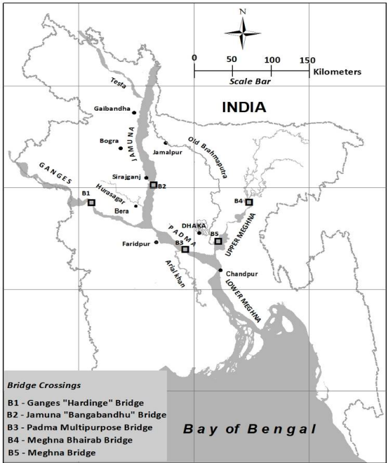
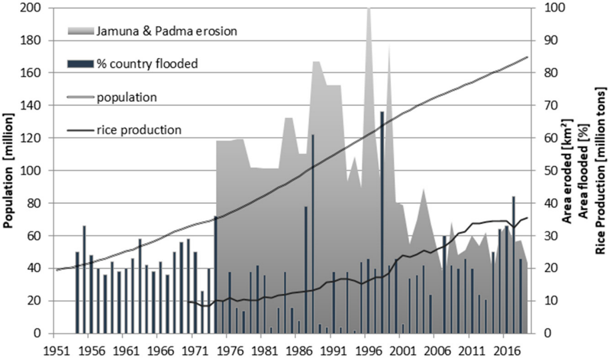
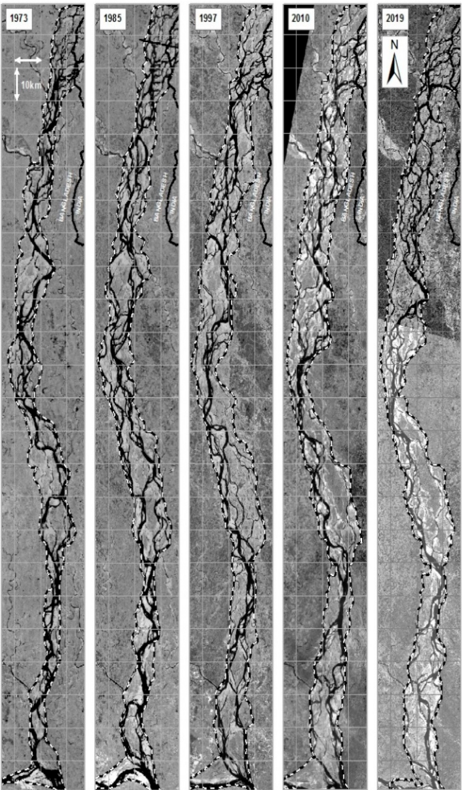
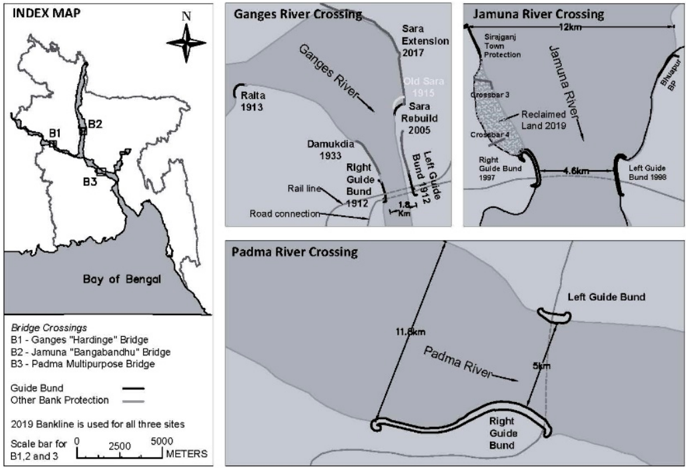
Verification
Claims the paper makes
The claims and statistics of this paper haven’t been checked yet.
Free: it reads the open-access text and checks the first 5 claims that cite a source we can check. Create a free account to check every claim.
Claims other papers make about this one
Each is checked against this paper’s own text: does it say what the citing paper says it does?
The source backs part of the claim, not all of it — or backs it for a different population, condition or comparison.
In the citing paper
“These characteristics vary not only in space, but also in time, given that the Jamuna River is among the most quickly widening and changing river systems in the world (Oberhagemann et al., 2020).”
From Environmental shocks and migration among a climate-vulnerable population in Bangladesh (2025) · cites this paper as Oberhagemann et al., 2020
Experimental — accuracy not yet measured
Self-check
Percentages, sums and reported differences re-computed from the paper’s own numbers.
The self-check needs the paper’s full text.
Citations
Cites
Recent sediment flux to the Ganges-Brahmaputra-Meghna delta system
Rahman, M., Dustegir, M., Karim, R., Haque, A., Nicholls, R. J., Darby, S. E., Nakagawa, H., Hossain, M., Dunn, F., & Akter, M. (2018) · The Science of The Total Environment · doi:10.1016/j.scitotenv.2018.06.147 · Cited by 157
Self-citationBraided Rivers: Process, Deposits, Ecology and Management
Smith, G. H. S., Best, J. L., Petts, G. E., & Bristow, C. S. (2006) · Wiley eBooks · doi:10.1002/9781444304374 · Cited by 116
Sarker, M. H., & Thorne, C. R. (2006) · Braided Rivers · doi:10.1002/9781444304374.ch14 · Cited by 105 · cited 5×
“Parts of the town eroded as a consequence of the widening of the Brahmaputra after the Great Assam Earthquake in 1950.”
BackgroundInfluentialThe Variability of Large Alluvial Rivers
Schumm, S. A., & Winkley, B. R. (1994) · Cited by 86
Geotextile bag revetments for large rivers in Bangladesh
Oberhagemann, K., & Hossain, M. M. (2011) · Geotextiles and Geomembranes · doi:10.1016/j.geotexmem.2010.12.003 · Cited by 49 · cited 5×
“The authors contributed to the analysis of existing work in 2000 [11], the development of sand-filled geotextile bag (geobag) revetments from 2001 until 2008 [12,13], the design of the river training works for Padma Bridge from 2009 until 2011 [3], the implementation of the Flood and Riverbank Erosion Risk Management…”
BackgroundMethodInfluentialSelf-citationMathematical modelling of morphological processes in rivers with erodible cohesive banks
Mosselman, E. (1992) · Research Repository (Delft University of Technology) · Cited by 48
Geobag stability for riverbank erosion protection structures: Physical model study
Thompson, A., Oberhagemann, K., & She, Y. (2019) · Geotextiles and Geomembranes · doi:10.1016/j.geotexmem.2019.103526 · Cited by 24
Self-citationTHE DESIGN AND CONSTRUCTION OF JAMUNA BRIDGE, BANGLADESH.
TAPPIN, R. G. R., DUIVEDIJK, J. V., & HAQUE, M. (1998) · Proceedings of the Institution of Civil Engineers - Civil Engineering · doi:10.1680/icien.1998.30822 · Cited by 10 · cited 2×
“It was constructed between 1996 and 1998 [19], with an upstream railway bridge now being planned some 20 years after the bridge inauguration.”
BackgroundMethodder Hoeven, M. A. V. (2002) · Cited by 5
Model Tests on Geobags for Erosion Protection
Neill, C. R., Mannerström, M., & Azad, A. K. (2008) · Hydraulic Engineering Repository (HENRY) (Bundesanstalt für Wasserbau) · Cited by 5
Research works printed but not linked: 11
- Thompson, A.; Oberhagemann, K.; She, Y.; Haque, A.M.A. The behavior of self-launching geotextile bag aprons-latest investigations from the Lower Brahmaputra in Bangladesh. In Proceedings of the 9th International Conference on Scour and Erosion, Taipei, Taiwan, 5-8 November 2018.
- Neill, C.; Oberhagemann, K.; McLean, D.; Ferdous, Q.M. River Training Works for Padma Multipurpose Bridge, Bangladesh. In Proceedings of the IABSE JSCE Joint Conference on Advances in Bridge Engineering II, Dhaka, Bangladesh, 8-10 August 2010.
- Sarker, M.H.; Klaassen, G.J.; Noor, F.; Islam, M.S. Impact of the Bangabandhu Bridge on the Morphology of the Jamuna River, Bangladesh. In Proceedings of the 3rd International Conference on Water & Flood Management (ICWFM-2011), Dhaka, Bangladesh, 8-11 January 2011.
- Oostinga, H.; Daemen, I. Construction of the River Training Works for the Jamuna Bridge Project in Bangladesh; International Association of Dredging Companies: Voorburg, The Netherlands, 1997; pp. 3-13.
- Thorne, C.R., Abt, S.R., Barends, F.B.J., Maynard, S.T., Pilarczyk, K.W., Eds.; John Wiley & Sons: Hoboken, NJ, USA, 1995.
- Khan, H.; Oberhagemann, K.; Choubey, R.I.; Hawkswood, M.; Habib, A. Case studies of erosion protection pilots in Bangladesh: Embankments, bioengineering and using jute where it "mattress". In Proceedings of the Tenth International Conference on Scour and Erosion, Arlington, VA, USA, 17-20 October 2021.
- Aitken, T. River Training in Bangladesh. Proc. Inst. Civ. Eng. 1992, 34, 313-321. Water 2020, 12, 3018
- Oberhagemann, K.; Al-Kamal, S. Geobag Protection in Bangladesh. In Proceedings of the 4th International Conference on Filters and Drainage in Geotechnical and Environmental Engineering, Geofilters, Stellenbosch, South Africa, 19-21 October 2004.
- Heibaum, M.; Oberhagemann, K.; Faisal, M.A.; Haque, S. Geotextile Bags for sole permanent Bank Protection. In Proceedings of the 4th European Geosynthetics Conference, Edinburgh, Scotland, 7-10 September 2008.
- Diggelmann, P. Experiences with Falling Aprons in Bangladesh. Diploma Thesis, Swiss Federal Institute of Technology, Zürich, Switzerland, February 2007.
- Klaassen, G.J.; Mosselman, E.; Brühl, H. On the Prediction of Planform Changes in Braided Sand-Bed Rivers; Delft Hydraulics: Delft, The Netherlands, 1993; pp. 134-146.
Cited by
Freihardt, J., & Frey, O. (2023) · Natural Hazards and Earth System Sciences · doi:10.5194/nhess-23-751-2023 · Cited by 45
“Computing power is necessary since fluvial systems are highly complex due to the large number of processes, scales and dimensions involved Applying a numerical model to a river system as complicated as a braided river, however, would be extremely difficult, if not impossible.”
BackgroundAhmad, D., Kanwal, M., & Afzal, M. (2022) · Environment Development and Sustainability · doi:10.1007/s10668-022-02440-1 · Cited by 49
Thapa, S., Sinclair, H. D., Creed, M., Borthwick, A. G. L., Watson, C. S., & Muthusamy, M. (2024) · Water Resources Research · doi:10.1029/2024wr037742 · Cited by 40
“For example, the Brahmaputra Right Embankment in Bangladeshhas undergone erosion with reconstruction activities repeated nearly 10 times in the past 50 years (Oberhagemann et al., 2020).”
Abbas, S., Dastgeer, G., Yaseen, M. W., & Latif, Y. (2022) · Land Degradation and Development · doi:10.1002/ldr.4252 · Cited by 22
“(Kanevskiy et al., 2016; Oberhagemann et al., 2020; Recking et al., 2019).”
Islam, M. S., Hasan, M. R., & Islam, Z. (2022) · Environmental Science and Pollution Research · doi:10.1007/s11356-022-23596-3 · Cited by 25
Metadata
- Authors
- Oberhagemann, K., Haque, A. M. A., & Thompson, A.
- Affiliations
- Northwest Hydraulic Consultants, Edmonton, AB T6X 0E3, Canada
- Bangladesh Water Development Board, Dhaka 1205, Bangladesh
- Corresponding author
- Oberhagemann, Knut
- ORCID
- Haque, A. M. Aminul
- Venue
- Water
- Publisher
- MDPI AG
- Published
- 2020-10-27
- Volume
- 12
- Issue
- 11
- Pages
- 3018
- ISSN
- 2073-4441 (ISSN-L)
- OpenAlex
- W3095469562
- Cited by
- 39
- References
- 18
- Citations by year
- 2026: 6 · 2025: 11 · 2024: 6 · 2023: 3 · 2022: 12 · 2020: 1
- FWCI
- 2.13
- Type
- journal article
- Language
- en
- Open access
- gold
- doi.org
- Licence
- Locations
- Water (publishedVersion, cc-by)
- DOAJ (DOAJ: Directory of Open Access Journals) (submittedVersion, cc-by-sa)
- Topics
- Physical Sciences › Earth and Planetary Sciences › Earth-Surface Processes › Hydrology and Sediment Transport Processes
- Physical Sciences › Engineering › Civil and Structural Engineering › Hydraulic flow and structures
- Physical Sciences › Earth and Planetary Sciences › Earth-Surface Processes › Coastal and Marine Dynamics
- Keywords
- bank erosion, riverbank protection, river training, Brahmaputra River, Jamuna River, Bangladesh delta, braided rivers, riverbank stabilization, bridge crossing
About these checks
Registry, retraction, Cites and statistics results are computed, not judged, with one exception: a printed reference that no index lists is read once by a model before it counts as a citation error. Claims are extracted by a model and kept only when their quote appears verbatim in the text; each cited source is then checked, with a model’s help, for whether it says what the claim relies on. Those verdicts can be wrong — read the claim’s quote and the cited source before relying on one.
Statistics and arithmetic are recomputed, not judged.
Confidence bands are shown only for fields calibrated on our annotated test set. None is calibrated yet, so no band is shown.
What counts as a claim ›How we measure confidence ›How we check this ›
Are you an author, or do you see a problem with this page? Request a review
Data sources
Bibliographic data: Semantic Scholar, OpenAlex, Crossref.
Contains information from the Semantic Scholar Academic Graph Datasets, made available under the ODC Attribution License (ODC-BY 1.0).
Semantic Scholar’s data is described in: Kinney, R., et al. (2023). The Semantic Scholar Open Data Platform. arXiv:2301.10140.
