

The DOI matches its Crossref record; 34 of the 34 references it cites were found in a registry or an index.
Beyond Water Surface Profiles: A New Iterative Methodology for 2D Model Calibration in Rivers Using Velocity Data from Multiple Cross-Sections
Abstract
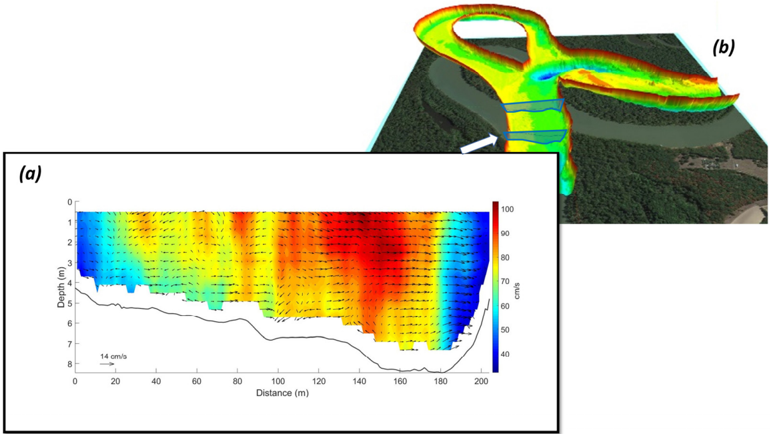
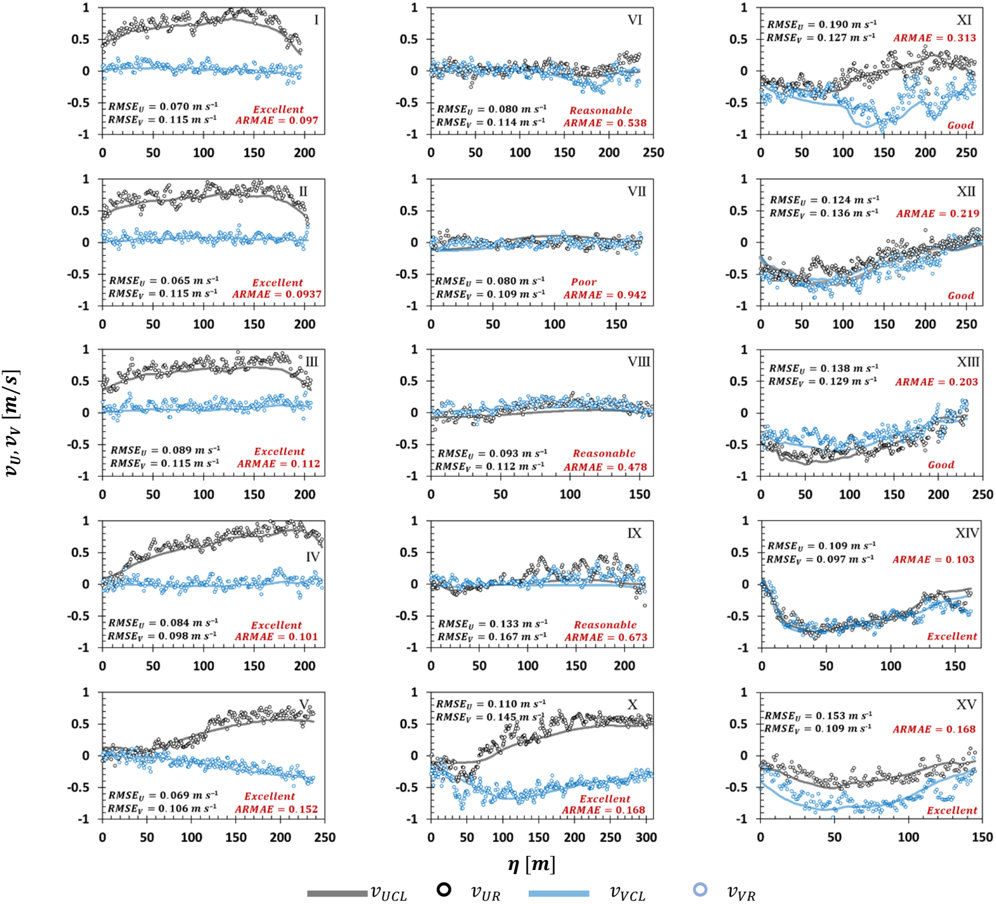
Observed longitudinal water-surface profiles are commonly used to calibrate river hydrodynamic models, relying on assumptions of lateral uniformity in water surface elevation and velocity distribution. While suitable for 1D models, this approach has limitations in regard to 2D model calibration. When 2D flow measurements are available, a more robust quantitative evaluation is necessary to assess model accuracy. This study introduces a novel methodology to improve 2D model calibration and evaluate performance. High-resolution bathymetric and hydrodynamic data collected with a multibeam echosounder (MBES) and acoustic Doppler current profiler (ADCP) were aligned to compare observed and simulated flow velocities at matching spatial locations. Statistical metrics, including relative mean absolute error and root-mean-square error, were employed to assess hydrodynamic modeling. The methodology was tested using MBES and ADCP measurements alongside TELEMAC-2D simulations of a dynamic neck cutoff on the White River, Arkansas, USA. This approach provides a 2D calibration process, enhancing model accuracy and informing parameter selection, such as channel boundary roughness and downstream boundary water surface elevation.
Overview
The claims and statistics of this paper haven’t been checked yet.
Free: it reads the open-access text and checks the first 5 claims that cite a source we can check. Create a free account to check every claim.
Integrity signals
Registry
Cites
Statistics
Figures



Verification
Claims the paper makes
The claims and statistics of this paper haven’t been checked yet.
Free: it reads the open-access text and checks the first 5 claims that cite a source we can check. Create a free account to check every claim.
Claims other papers make about this one
Each is checked against this paper’s own text: does it say what the citing paper says it does?
The check wasn’t confident either way, so it gives no verdict — never disputed.
In the citing paper
“Channel geometry (yielding an optimized bottom width of 2.09 m, top width of 3.09 m, bank height of 2.0 m, and longitudinal bed slope of 0.00095) and flow parameters were calibrated against the October 2025 record, while holding Manning's n fixed at a baseline of 0.042 (representing a gravel bed with scattered vegetation) 30 .”
From AI-driven digital twinning quantifies the trade-off between flood conveyance and riparian stability under climate extremes (2026) · cites this paper as [30]
Experimental — accuracy not yet measuredThe check wasn’t confident either way, so it gives no verdict — never disputed.
In the citing paper
“Channel geometry (yielding an optimized bottom width of 2.09 m, top width of 3.09 m, bank height of 2.0 m, and longitudinal bed slope of 0.00095) and flow parameters were calibrated against the October 2025 record, while holding Manning's n fixed at a baseline of 0.042 (representing a gravel bed with scattered vegetation) 30 .”
From AI-driven digital twinning quantifies the trade-off between flood conveyance and riparian stability under climate extremes (2026) · cites this paper as [30]
Experimental — accuracy not yet measuredIn the citing paper
“Channel geometry (yielding an optimized bottom width of 2.09 m, top width of 3.09 m, bank height of 2.0 m, and longitudinal bed slope of 0.00095) and flow parameters were calibrated against the October 2025 record, while holding Manning's n fixed at a baseline of 0.042 (representing a gravel bed with scattered vegetation) 30 .”
From AI-driven digital twinning quantifies the trade-off between flood conveyance and riparian stability under climate extremes (2026) · cites this paper as [30]
Self-check
Percentages, sums and reported differences re-computed from the paper’s own numbers.
The self-check needs the paper’s full text.
Citations
Cites
Evaluating the performance of morphological models
Sutherland, J., Peet, A. H., & Soulsby, R. L. (2004) · Coastal Engineering · doi:10.1016/j.coastaleng.2004.07.015 · Cited by 318
Sediment Transport Modeling Review—Current and Future Developments
Papanicolaou, A. (. N., Elhakeem, M., Krallis, G., Prakash, S., & Edinger, J. (2008) · Journal of Hydraulic Engineering · doi:10.1061/(asce)0733-9429(2008)134:1(1 · Cited by 273
Parsons, D. R., Jackson, P. R., Czuba, J. A., Engel, F. L., Rhoads, B. L., Oberg, K. A., Best, J. L., Mueller, D. S., Johnson, K. K., & Riley, J. D. (2013) · Earth Surface Processes and Landforms · doi:10.1002/esp.3367 · Cited by 237
Bedform transport rates for the lowermost Mississippi River
Nittrouer, J. A., Allison, M. A., & Campanella, R. (2008) · Journal of Geophysical Research: Earth Surface · doi:10.1029/2007jf000795 · Cited by 201
Morphology, flow structure, and suspended bed sediment transport at two large braid‐bar confluences
Szupiany, R. N., Amsler, M. L., Parsons, D. R., & Best, J. L. (2009) · Water Resources Research · doi:10.1029/2008wr007428 · Cited by 179
Parsons, D. R., Best, J. L., Lane, S. N., Orfeo, O., Hardy, R. J., & Kostaschuk, R. (2007) · Earth Surface Processes and Landforms · doi:10.1002/esp.1457 · Cited by 177
TELEMAC modelling system: an overview
Hervouet, J. (2000) · Hydrological Processes · doi:10.1002/1099-1085(200009)14:13<2209::aid-hyp23>3.0.co;2-6 · Cited by 152
Comparison of Fixed- and Moving-Vessel Flow Measurements with an aDp in a Large River
Szupiany, R. N., Amsler, M. L., Best, J., & Parsons, D. R. (2007) · Journal of Hydraulic Engineering · doi:10.1061/(asce)0733-9429(2007)133:12(1299 · Cited by 121
Dinehart, R. L., & Burau, J. R. (2005) · Water Resources Research · doi:10.1029/2005wr004050 · Cited by 111
Williams, R. D., Brasington, J., Hicks, D. M., Measures, R. J., Rennie, C. D., & Vericat, D. (2013) · Water Resources Research · doi:10.1002/wrcr.20391 · Cited by 109
Williams, J. J., & Esteves, L. S. (2017) · Advances in Civil Engineering · doi:10.1155/2017/5251902 · Cited by 109
Evaluation of coastal area modelling systems at an estuary mouth
Sutherland, J., Walstra, D. J. R., Chesher, T. J., van Rijn, L. C., & Southgate, H. N. (2004) · Coastal Engineering · doi:10.1016/j.coastaleng.2003.12.003 · Cited by 108
High-resolution Numerical Simulation of Flow Through a Highly Sinuous River Reach
Rodriguez, J. F., Bombardelli, F. A., Garcia, M. H., Frothingham, K. M., Rhoads, B. L., & Abad, J. D. (2004) · Water Resources Management · doi:10.1023/b:warm.0000043137.52125.a0 · Cited by 105
Errors in Acoustic Doppler Profiler Velocity Measurements Caused by Flow Disturbance
Mueller, D. S., Abad, J. D., García, C. M., Gartner, J. W., Garcia, M. H., & Oberg, K. A. (2007) · Journal of Hydraulic Engineering · doi:10.1061/(asce)0733-9429(2007)133:12(1411 · Cited by 75
Field Assessment of Alternative Bed-Load Transport Estimators
Gaeuman, D. A., & Jacobson, R. B. (2007) · Journal of Hydraulic Engineering · doi:10.1061/(asce)0733-9429(2007)133:12(1319 · Cited by 62
Bedform response to flow variability
Nelson, J. M., Logan, B. L., Kinzel, P. J., SHIMIZU, Y., Giri, S., Shreve, R. L., & McLean, S. R. (2011) · Earth Surface Processes and Landforms · doi:10.1002/esp.2212 · Cited by 52
Assessment of TELEMAC system performances, a hydrodynamic case study of Anglet, France
Brière, C., Abadie, S., Bretel, P., & Lang, P. (2006) · Coastal Engineering · doi:10.1016/j.coastaleng.2006.10.006 · Cited by 52
Matte, P., Secretan, Y., & Morin, J. (2017) · Journal of Waterway Port Coastal and Ocean Engineering · doi:10.1061/(asce)ww.1943-5460.0000397 · Cited by 50
Papanicolaou, A. N., Elhakeem, M., & Wardman, B. (2010) · Journal of Hydraulic Engineering · doi:10.1061/(asce)hy.1943-7900.0000280 · Cited by 47
Improved flow velocity estimates from moving-boat ADCP measurements
Vermeulen, B., Sassi, M. G., & Hoitink, A. J. F. (2014) · Water Resources Research · doi:10.1002/2013wr015152 · Cited by 47
Effect of transect location, transect spacing and interpolation methods on river bathymetry accuracy
Glenn, J., Tonina, D., Morehead, M. D., Fiedler, F., & Benjankar, R. M. (2015) · Earth Surface Processes and Landforms · doi:10.1002/esp.3891 · Cited by 43
Parsapour‐Moghaddam, P., & Rennie, C. D. (2018) · Journal of Hydraulic Engineering · doi:10.1061/(asce)hy.1943-7900.0001424 · Cited by 40
Leary, K., & Buscombe, D. (2020) · Earth Surface Dynamics · doi:10.5194/esurf-8-161-2020 · Cited by 40
Alho, P., & Mäkinen, J. (2010) · Hydrological Processes · doi:10.1002/hyp.7671 · Cited by 34
Morphologic adjustments of actively evolving highly curved neck cutoffs
Richards, D., & Konsoer, K. (2019) · Earth Surface Processes and Landforms · doi:10.1002/esp.4763 · Cited by 30
Self-citationProgress in hydrodynamic modeling, review of U.S. contributions, 1979‐1982
Lynch, D. R. (1983) · Reviews of Geophysics · doi:10.1029/rg021i003p00741 · Cited by 27
Evaluation of aDcp processing options for secondary flow identification at river junctions
Moradi, G., Vermeulen, B., Rennie, C. D., Cardot, R., & Lane, S. N. (2019) · Earth Surface Processes and Landforms · doi:10.1002/esp.4719 · Cited by 25
Kasvi, E., Alho, P., Vaaja, M. T., Hannu, H., & Hyyppa, J. M. (2013) · Hydrology research · doi:10.2166/nh.2013.091 · Cited by 24
Clifford, N. J., Wright, N., Harvey, G. L., Gurnell, A. M., Harmar, O. P., & Soar, P. J. (2009) · Journal of Hydraulic Engineering · doi:10.1061/(asce)hy.1943-7900.0000057 · Cited by 21
Turnipseed, C., Konsoer, K., Richards, D., & Willson, C. S. (2020) · Water Resources Research · doi:10.1029/2020wr027329 · Cited by 19
Self-citationCharacterising three‐dimensional flow through neck cutoffs with complex planform geometry
Richards, D., Konsoer, K., Turnipseed, C., & Willson, C. S. (2018) · doi:10.1002/9781119424437.ch11 · Cited by 16
Self-citationRichards, D., Konsoer, K., Langendoen, E. J., Ursic, M., & Constantine, J. A. (2021) · Sedimentology · doi:10.1111/sed.12915 · Cited by 11
Self-citationSecondary currents: Measurement and analysis
Priego-Hernández, G., & Rivera-Trejo, F. (2016) · Atmósfera · doi:10.20937/atm.2016.29.01.03 · Cited by 9
Self-citationPlancke, Y. M. G., Stark, J., Meire, D., & Schrijver, M. C. (2020) · Journal of Hydraulic Engineering · doi:10.1061/(asce)hy.1943-7900.0001737 · Cited by 7
Cited by
Shin, J. H., Go, S. H., & Park, J. H. (2026) · Scientific Reports · doi:10.1038/s41598-026-63704-8
Metadata
- Authors
- Rivera-Trejo, F., Soto-Cortes, G., Konsoer, K. M., Langendoen, E. J., & Priego-Hernandez, G.
- Affiliations
- Division of Engineering and Architecture, Juarez Autonomous University of Tabasco, Tabasco 86040, Mexico
- Department of Earth Resources, Autonomous Metropolitan University, Lerma 52005, Mexico
- Department of Geography and Anthropology, Louisiana State University, Baton Rouge, LA 70802, USA
- National Sedimentation Laboratory, US Department of Agriculture, Oxford, MS 38655, USA
- Division of Basic Sciences, Juarez Autonomous University of Tabasco, Tabasco 86690, Mexico
- Venue
- Water
- Publisher
- MDPI AG
- Published
- 2025-01-30
- Volume
- 17
- Issue
- 3
- Pages
- 377
- ISSN
- 2073-4441
- Cited by
- 5
- References
- 34
- Language
- en
- Funders
- Ministry of Public Education (PRODEP-IDCA 30509, PRODEP 511-6/18-9789)
About these checks
Registry, retraction, Cites and statistics results are computed, not judged, with one exception: a printed reference that no index lists is read once by a model before it counts as a citation error. Claims are extracted by a model and kept only when their quote appears verbatim in the text; each cited source is then checked, with a model’s help, for whether it says what the claim relies on. Those verdicts can be wrong — read the claim’s quote and the cited source before relying on one.
Statistics and arithmetic are recomputed, not judged.
Confidence bands are shown only for fields calibrated on our annotated test set. None is calibrated yet, so no band is shown.
What counts as a claim ›How we measure confidence ›How we check this ›
Are you an author, or do you see a problem with this page? Request a review
Data sources
Bibliographic data: Semantic Scholar, OpenAlex, Crossref.
Contains information from the Semantic Scholar Academic Graph Datasets, made available under the ODC Attribution License (ODC-BY 1.0).
Semantic Scholar’s data is described in: Kinney, R., et al. (2023). The Semantic Scholar Open Data Platform. arXiv:2301.10140.
