

The DOI matches its Crossref record.
Spatiotemporal Analysis and Automated Identification of Manning’s Roughness Coefficient in Lined Canals
Abstract
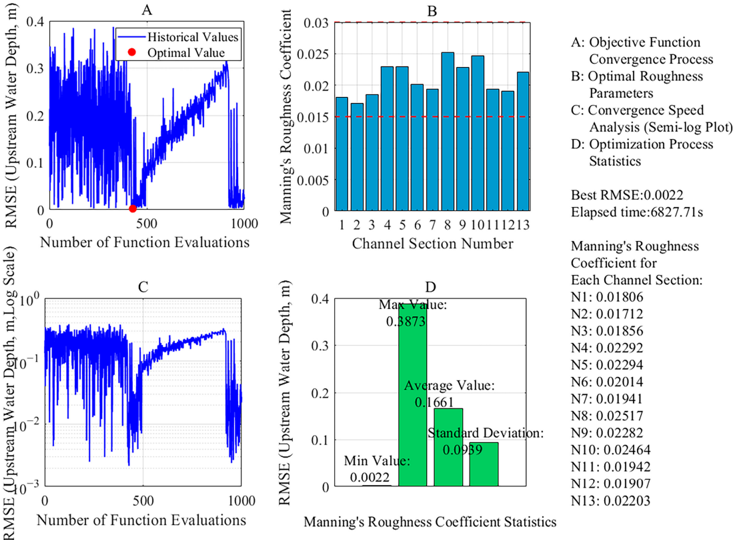
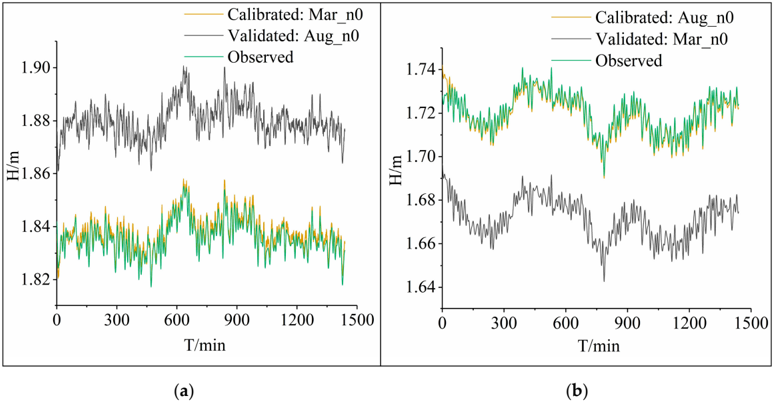
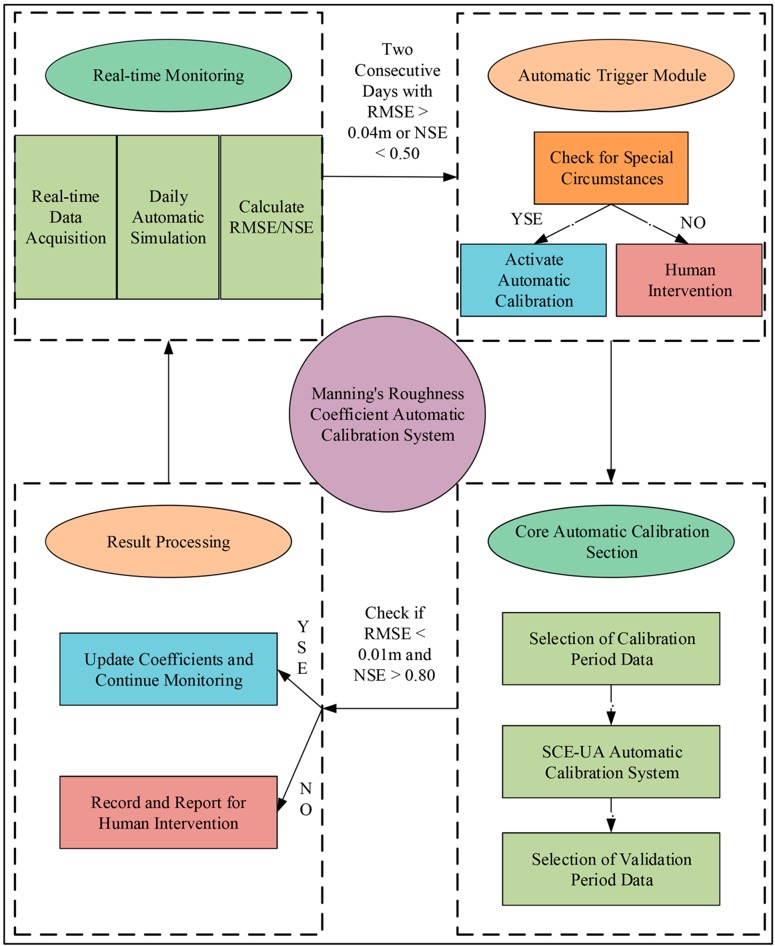
This study addresses the problem of inaccurate channel flow simulation and uneven irrigation water distribution caused by the spatiotemporal variability of Manning’s roughness coefficient. The SCE-UA optimization algorithm was applied to calibrate Manning’s roughness coefficients and quantify their spatiotemporal variation patterns using 1728 sets of measured water level–discharge data collected in the Yellow River Irrigation District. Results show that accounting for spatiotemporal variability reduces the mean absolute percentage error (MAPE) for water level simulation by nearly 8%. Based on these findings, an automatic roughness update system specifically designed for grassroots water distribution stations has been developed, which can integrate water demand and gate control to achieve efficient water allocation in canals in the future.
Overview
The claims and statistics of this paper haven’t been checked yet.
Run the check — free, no account needed. It reads the open-access text and checks the sources it cites.
Integrity signals
Registry
Cites
Statistics
Figures
Verification
Claims the paper makes
The claims and statistics of this paper haven’t been checked yet.
Run the check — free, no account needed. It reads the open-access text and checks the sources it cites.
Claims other papers make about this one
Each is checked against this paper’s own text: does it say what the citing paper says it does?
In the citing paper
“One-at-a-time sensitivity analysis confirmed that these scenario rankings remain robust against variations in the drag coefficient ( 𝐶𝐷 ) and bed roughness ( 𝑛𝑏 ) (Table 3), underscoring the reliability of the cognitive twin framework for supporting reach-scale decision-making 43,44 .”
From AI-driven digital twinning quantifies the trade-off between flood conveyance and riparian stability under climate extremes (2026) · cites this paper as [44]
Self-check
Percentages, sums and reported differences re-computed from the paper’s own numbers.
The self-check needs the paper’s full text.
Citations
Cites
No references could be resolved yet.
Research works printed but not linked: 40
- Ayvaz, 2013, A linked simulation–optimization model for simultaneously estimating the Manning’s surface roughness values and their parameter structures in shallow water flows, J. Hydrol., 500, 183, 10.1016/j.jhydrol.2013.07.019 · DOI
- Butler, 2015, Definition and solution of a stochastic inverse problem for the Manning’s n parameter field in hydrodynamic models, Adv. Water Resour., 78, 60, 10.1016/j.advwatres.2015.01.011 · DOI
- Moravejalahkami, 2009, Furrow infiltration and roughness prediction for different furrow inflow hydrographs using a zero-inertia model with a multilevel calibration approach, Biosyst. Eng., 103, 374, 10.1016/j.biosystemseng.2009.04.005 · DOI
- Mazarei, 2021, Temporal variability of infiltration and roughness coefficients and furrow irrigation performance under different inflow rates, Agric. Water Manag., 245, 106465, 10.1016/j.agwat.2020.106465 · DOI
- Belaud, 2025, A path towards precision border irrigation combining hydrodynamic modelling and in-field sensor-based support, Agric. Water Manag., 316, 109518, 10.1016/j.agwat.2025.109518 · DOI
- Bonet, E., Russo, B., González, R., Yubero, M.T., Gómez, M., and Sánchez-Juny, M. (2023). The FC Algorithm to Estimate the Manning’s Roughness Coefficients of Irrigation Canals. Agriculture, 13. · DOI
- Zhou, L., Yan, P., Han, Z., Zhang, Z., Lei, X., and Wang, H. (2023). Roughness Inversion of Water Transfer Channels from a Data-Driven Perspective. Water, 15. · DOI
- Aronica, 1998, Uncertainty and equifinality in calibrating distributed roughness coefficients in a flood propagation model with limited data, Adv. Water Resour., 22, 349, 10.1016/S0309-1708(98)00017-7 · DOI
- Bao, 2011, Hydraulic model with roughness coefficient updating method based on Kalman filter for channel flood forecast, Water Sci. Eng., 4, 13
- Wang, 2022, Partition of one-dimensional river flood routing uncertainty due to boundary conditions and riverbed roughness, J. Hydrol., 608, 127660, 10.1016/j.jhydrol.2022.127660 · DOI
- Shen, 2023, Estimating Manning’s coefficient n for sheet flow during rainstorms, Catena, 226, 107093, 10.1016/j.catena.2023.107093 · DOI
- Isidoro, 2023, Design and characterisation of customised-roughness beds for open-channel flow experiments, Flow Meas. Instrum., 94, 102472, 10.1016/j.flowmeasinst.2023.102472 · DOI
- Amsie, 2024, Acclimatize experimental approach to adjudicate hydraulic coefficients under different bed material configurations and slopes with and without weir, Heliyon, 10, e32162, 10.1016/j.heliyon.2024.e32162 · DOI
- Burshtynska, K., Zayats, I., Halochkin, M., Bakuła, K., and Babiy, L. (2023). The Influence of the Main Factors on the Accuracy of Hydrological Modelling of Flooded Lands. Water, 15. · DOI
- Jiang, 2010, An improved two-point velocity method for estimating the roughness coefficient of natural channels, Phys. Chem. Earth Parts A/B/C, 35, 182, 10.1016/j.pce.2010.03.036 · DOI
- Sedaghatdoost, 2015, Calibration of infiltration, roughness and longitudinal dispersivity coefficients in furrow fertigation using inverse modelling with a genetic algorithm, Biosyst. Eng., 136, 129, 10.1016/j.biosystemseng.2015.05.011 · DOI
- Jia, 2023, Physically based numerical model for the landscape evolution of soil-mantled watersheds driven by rainfall and overland flow, J. Hydrol., 620, 129419, 10.1016/j.jhydrol.2023.129419 · DOI
- Isma, 2025, Spatiotemporal variations of Manning’s roughness coefficient in the estuary of Langsa River based on field measurements and hydraulic modeling, J. Hydrol. Reg. Stud., 61, 102632, 10.1016/j.ejrh.2025.102632 · DOI
- Attari, 2019, A Simple Innovative Method for Calibration of Manning’s Roughness Coefficient in Rivers using a Similarity Concept, J. Hydrol., 575, 810, 10.1016/j.jhydrol.2019.05.083 · DOI
- Attari, 2021, A simple and robust method for identifying the distribution functions of Manning’s roughness coefficient along a natural river, J. Hydrol., 595, 125680, 10.1016/j.jhydrol.2020.125680 · DOI
- Li, 2025, Physics-informed neural network for hydraulic prediction in open-channel water transfer projects with sparse monitoring data, Water Res., 287, 124507, 10.1016/j.watres.2025.124507 · DOI
- Zevallos, 2025, Bayesian calibration of a 2D hydraulic model using a convolutional neural network emulator, Environ. Model. Softw., 193, 106621, 10.1016/j.envsoft.2025.106621 · DOI
- Bessar, M.A., Matte, P., and Anctil, F. (2020). Uncertainty Analysis of a 1D River Hydraulic Model with Adaptive Calibration. Water, 12. · DOI
- Mohammadian, 2022, Calibration of a 3D hydrodynamic model for a hypertidal estuary with complex irregular bathymetry using adaptive parametrization of bottom roughness and eddy viscosity, Estuar. Coast. Shelf Sci., 265, 107655, 10.1016/j.ecss.2021.107655 · DOI
- Ara, 2021, Application, adoption and opportunities for improving decision support systems in irrigated agriculture: A review, Agric. Water Manag., 257, 107161, 10.1016/j.agwat.2021.107161 · DOI
- Yu, 2025, Deep learning for intelligent irrigation decision-making: A review, Agric. Water Manag., 320, 109836, 10.1016/j.agwat.2025.109836 · DOI
- Zhang, 2016, Multi-metric calibration of hydrological model to capture overall flow regimes, J. Hydrol., 539, 525, 10.1016/j.jhydrol.2016.05.053 · DOI
- Venezia, 2025, From weather data to water fluxes simulation in Mediterranean greenhouses through a combined climate and hydrological modelling approach, Agric. Water Manag., 311, 109386, 10.1016/j.agwat.2025.109386 · DOI
- Zeitfogel, 2025, Regional-scale assessment of groundwater recharge and the water balance for Austria, J. Hydrol. Reg. Stud., 59, 102297, 10.1016/j.ejrh.2025.102297 · DOI
- Duan, 1993, Shuffled complex evolution approach for effective and efficient global minimization, J. Optim. Theory Appl., 76, 501, 10.1007/BF00939380 · DOI
- Almahawis, 2024, Investigating the impact of irrigation practices on hydrologic fluxes in a highly managed river basin, Agric. Water Manag., 301, 108954, 10.1016/j.agwat.2024.108954 · DOI
- Abbas, 2025, Modeling agro-hydrological surface-subsurface processes in a semi-arid, intensively irrigated river basin, J. Hydrol. Reg. Stud., 57, 102188, 10.1016/j.ejrh.2025.102188 · DOI
- Mu, 2025, Ditch rotation irrigation coupled with multi-scale ecological reservoir operation, Agric. Water Manag., 307, 109271, 10.1016/j.agwat.2024.109271 · DOI
- Barkhordari, 2021, Developing a smart operating system for fairly distribution of irrigation water, based on social, economic, and environmental considerations, Agric. Water Manag., 250, 106833, 10.1016/j.agwat.2021.106833 · DOI
- Fan, 2023, Water distribution and scheduling model of an irrigation canal system, Comput. Electron. Agric., 209, 107866, 10.1016/j.compag.2023.107866 · DOI
- Morchid, 2025, Fuzzy logic-based IoT system for optimizing irrigation with cloud computing: Enhancing water sustainability in smart agriculture, Smart Agric. Technol., 11, 100979, 10.1016/j.atech.2025.100979 · DOI
- Offermans, 2023, Error-driven adaptive mesh refinement for unsteady turbulent flows in spectral-element simulations, Comput. Fluids, 251, 105736, 10.1016/j.compfluid.2022.105736 · DOI
- Xu, 2024, Real-time calculation of ship to ship hydrodynamic interaction in shallow waters with adaptive mesh refinement, Ocean Eng., 295, 116943, 10.1016/j.oceaneng.2024.116943 · DOI
- Xu, 2019, Evaluation and optimization of border irrigation in different irrigation seasons based on temporal variation of infiltration and roughness, Agric. Water Manag., 214, 64, 10.1016/j.agwat.2019.01.003 · DOI
- Patel, 2017, Flow and bedform dynamics in an alluvial channel with downward seepage, Catena, 158, 219, 10.1016/j.catena.2017.07.009 · DOI
Cited by
Shin, J. H., Go, S. H., & Park, J. H. (2026) · Scientific Reports · doi:10.1038/s41598-026-63704-8
Metadata
- Authors
- Li, L., Bai, D., Bai, X., & Zhou, W.
- Affiliations
- State Key Laboratory of Eco-Hydraulics in Northwest Arid Region, Xi’an University of Technology, Xi’an 710048, China
- Venue
- Water
- Publisher
- MDPI AG
- Published
- 2025-12-04
- Volume
- 17
- Issue
- 23
- Pages
- 3446
- ISSN
- 2073-4441
- Cited by
- 3
- References
- 0
- Language
- en
- Funders
- National Natural Science Foundation of China (41571222, 51909208)
About these checks
Registry, retraction, Cites and statistics results are computed, not judged, with one exception: a printed reference that no index lists is read once by a model before it counts as a citation error. Claims are extracted by a model and kept only when their quote appears verbatim in the text; each cited source is then checked, with a model’s help, for whether it says what the claim relies on. Those verdicts can be wrong — read the claim’s quote and the cited source before relying on one.
Statistics and arithmetic are recomputed, not judged.
Confidence bands are shown only for fields calibrated on our annotated test set. None is calibrated yet, so no band is shown.
What counts as a claim ›How we measure confidence ›How we check this ›
Are you an author, or do you see a problem with this page? Request a review
