

The DOI matches its Crossref record; 26 of the 27 references it cites were found in a registry or an index.
Distinguishing PTSD, Complex PTSD, and Borderline Personality Disorder: A latent class analysis
Open accessAbstract
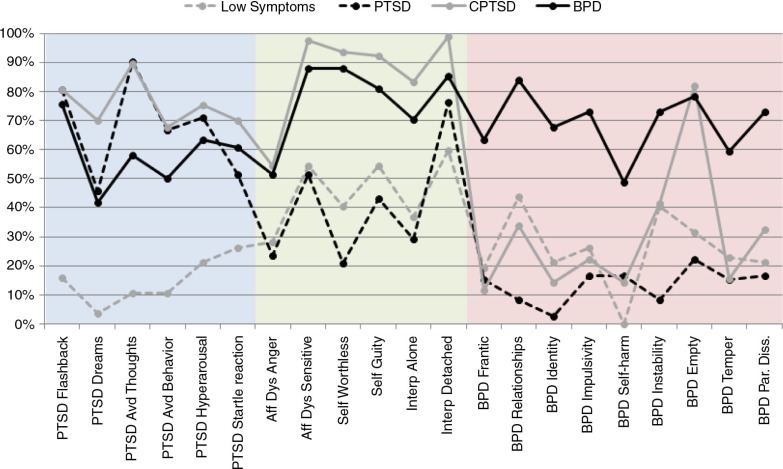
BACKGROUND: There has been debate regarding whether Complex Posttraumatic Stress Disorder (Complex PTSD) is distinct from Borderline Personality Disorder (BPD) when the latter is comorbid with PTSD. OBJECTIVE: To determine whether the patterns of symptoms endorsed by women seeking treatment for childhood abuse form classes that are consistent with diagnostic criteria for PTSD, Complex PTSD, and BPD. METHOD: A latent class analysis (LCA) was conducted on an archival dataset of 280 women with histories of childhood abuse assessed for enrollment in a clinical trial for PTSD. RESULTS: THE LCA REVEALED FOUR DISTINCT CLASSES OF INDIVIDUALS: a Low Symptom class characterized by low endorsements on all symptoms; a PTSD class characterized by elevated symptoms of PTSD but low endorsement of symptoms that define the Complex PTSD and BPD diagnoses; a Complex PTSD class characterized by elevated symptoms of PTSD and self-organization symptoms that defined the Complex PTSD diagnosis but low on the symptoms of BPD; and a BPD class characterized by symptoms of BPD. Four BPD symptoms were found to greatly increase the odds of being in the BPD compared to the Complex PTSD class: frantic efforts to avoid abandonment, unstable sense of self, unstable and intense interpersonal relationships, and impulsiveness. CONCLUSIONS: Findings supported the construct validity of Complex PTSD as distinguishable from BPD. Key symptoms that distinguished between the disorders were identified, which may aid in differential diagnosis and treatment planning.
Overview
The claims and statistics of this paper haven’t been checked yet.
Run the check — free, no account needed. It reads the open-access text and checks the sources it cites.
Integrity signals
Registry
Cites
Statistics
Figures
Verification
Claims the paper makes
The claims and statistics of this paper haven’t been checked yet.
Run the check — free, no account needed. It reads the open-access text and checks the sources it cites.
Claims other papers make about this one
Each is checked against this paper’s own text: does it say what the citing paper says it does?
The cited source doesn’t support the claim as written.
In the citing paper
“However, when BPD symptoms were endorsed they were consistently accompanied by PTSD and cPTSD/DSO symptoms.”
From Complex PTSD and borderline personality disorder (2021) · cites this paper as [19]
Checked by a reasoning model — may be wrong.
Experimental — accuracy not yet measuredThe cited source doesn’t support the claim as written.
In the citing paper
“in an outpatient treatment-seeking sample of women with histories of childhood abuse, ICD-11 cPTSD was comorbid with approximately half of cases diagnosed with BPD, while BPD was comorbid with only approximately 8% of cases diagnosed with cPTSD [19].”
From Complex PTSD and borderline personality disorder (2021) · cites this paper as [19]
Checked by a reasoning model — may be wrong.
Experimental — accuracy not yet measuredThe cited source doesn’t support the claim as written.
In the citing paper
“there are higher rates of childhood abuse in people with complex PTSD than in those with PTSD 13,14,17 .”
From Post‐traumatic stress disorder: a state‐of‐the‐art review of evidence and challenges (2019) · cites this paper as [14]
Checked by a reasoning model — may be wrong.
Experimental — accuracy not yet measuredThe source backs part of the claim, not all of it — or backs it for a different population, condition or comparison.
In the citing paper
“In a sample of outpatient treatment-seeking women with childhood abuse histories [19], three sub-groups were identified that were characterized by: (1) PTSD with minimal DSO and BPD symptoms except for interpersonal detachment; (2) cPTSD with both PTSD and DSO symptoms and minimal BPD symptoms except emotional emptiness; and (3) BPD plus all PTSD and DSO symptoms except for avoidance.”
From Complex PTSD and borderline personality disorder (2021) · cites this paper as [19]
Experimental — accuracy not yet measuredThe source backs part of the claim, not all of it — or backs it for a different population, condition or comparison.
In the citing paper
“although dissociation, temper outbursts, self-harm, and mood instability also were twice as likely to occur in the BPD class as in the cPTSD class.”
From Complex PTSD and borderline personality disorder (2021) · cites this paper as [19]
Experimental — accuracy not yet measured
The cited source says what the claim attributes to it.
In the citing paper
“Terror of abandonment, unstable sense of self and relationships, and impulsiveness best distinguished the “BPD” versus cPTSD sub-groups”
From Complex PTSD and borderline personality disorder (2021) · cites this paper as [19]
In the citing paper
“latent class analyses have consistently documented that there is a class of individuals with high PTSD symptoms and high disturbances in self-organization, and another class with high PTSD symptoms and low disturbances in self-organization 12-16 .”
From Post‐traumatic stress disorder: a state‐of‐the‐art review of evidence and challenges (2019) · cites this paper as [14]
In the citing paper
“there is also evidence that complex PTSD identifies a distinct class from borderline personality disorder 14 .”
From Post‐traumatic stress disorder: a state‐of‐the‐art review of evidence and challenges (2019) · cites this paper as [14]
Self-check
Percentages, sums and reported differences re-computed from the paper’s own numbers.
The self-check needs the paper’s full text.
Citations
Cites
Diagnostic and Statistical Manual of Mental Disorders
American Psychiatric Association (2013) · doi:10.1176/appi.books.9780890425596 · Cited by 116,369
Diagnostic and Statistical Manual of Mental Disorders, 5th ed.
Carter, M. J. (2014) · Therapeutic Recreation Journal · Cited by 15,154
Nylund, K. L., Asparouhov, T., & Muthén, B. O. (2007) · Structural Equation Modeling: A Multidisciplinary Journal · doi:10.1080/10705510701575396 · Cited by 11,415
(1993) · Cited by 7,136
The brief symptom inventory: an introductory report.
Derogatis, L. R., & Melisaratos, N. (1983) · Psychological Medicine · doi:10.1017/s0033291700048017 · Cited by 6,650
Cognitive-Behavioral Treatment of Borderline Personality Disorder
Cary, G. L. (1994) · American Journal of Psychotherapy · doi:10.1176/appi.psychotherapy.1994.48.1.155 · Cited by 6,299
Clinician-administered PTSD scale: A review of the first ten years of research
Weathers, F. W., Keane, T. M., & Davidson, J. R. T. (2001) · Depression and Anxiety · doi:10.1002/da.1029 · Cited by 1,903
Assessment of social adjustment by patient self report.
Weissman, M. M. (1976) · Archives of General Psychiatry · doi:10.1001/archpsyc.1976.01770090101010 · Cited by 1,782
Grant, B. F., Chou, S. P., Goldstein, R. B., Huang, B., Stinson, F. S., Saha, T. D., Smith, S. M., Dawson, D. S., Pulay, A. J., Pickering, R. P., et al. (2008) · The Journal of Clinical Psychiatry · doi:10.4088/jcp.v69n0404 · Cited by 1,618
Axis I Comorbidity of Borderline Personality Disorder
Zanarini, M. C., Frankenburg, F. R., Dubo, E., Sickel, A. E., Trikha, A., Levin, A., & Reynolds, V. (1998) · American Journal of Psychiatry · doi:10.1176/ajp.155.12.1733 · Cited by 978
Research works printed but not linked: 2
- Cloitre M, 2006, Treating survivors of childhood abuse: psychotherapy for the interrupted life
- 10.1002/jts.2490100103 · DOI
Cited by
Sorted by citations
A review of current evidence regarding the ICD-11 proposals for diagnosing PTSD and complex PTSD
Brewin, C. R., Cloitre, M., Hyland, P., Shevlin, M., Maercker, A., Bryant, R. A., Humayun, A., Jones, L. M., Kagee, A., Rousseau, C., et al. (2017) · Clinical Psychology Review · doi:10.1016/j.cpr.2017.09.001 · Cited by 678
Self-citationPost‐traumatic stress disorder: a state‐of‐the‐art review of evidence and challenges
Bryant, R. A. (2019) · World Psychiatry · doi:10.1002/wps.20656 · Cited by 528
Self-citationComplex post-traumatic stress disorder
Maercker, A., Cloître, M., Bachem, R., Schlumpf, Y. R., Khoury, B. A., Hitchcock, C., & Bohus, M. (2022) · The Lancet · doi:10.1016/s0140-6736(22)00821-2 · Cited by 517
Karatzias, T., Shevlin, M. E., Fyvie, C., Hyland, P., Efthymiadou, E., Wilson, D., Roberts, N. P., Bisson, J. I., Brewin, C. R., & Cloître, M. (2016) · Journal of Affective Disorders · doi:10.1016/j.jad.2016.09.032 · Cited by 365
Leichsenring, F., Fonagy, P., Heim, N., Kernberg, O. F., Leweke, F., Luyten, P., Salzer, S., Spitzer, C., & Steinert, C. (2024) · World Psychiatry · doi:10.1002/wps.21156 · Cited by 399
Metadata
- Authors
- Cloitre, M., Garvert, D. W., Weiss, B., Carlson, E. B., & Bryant, R. A.
- Affiliations
- National Center for PTSD, Veterans Affairs Palo Alto Health Care System, Palo Alto, CA, USA
- VA Palo Alto Health Care System (US)
- UNSW Sydney (AU)
- Venue
- European Journal of Psychotraumatology
- Publisher
- Informa UK Limited
- Published
- 2014-09-15
- Volume
- 5
- Issue
- 1
- ISSN
- 2000-8066 (ISSN-L)
- PMC
- PMC4165723
- OpenAlex
- W2059428488
- Cited by
- 468
- References
- 27
- Citations by year
- 2026: 32 · 2025: 51 · 2024: 53 · 2023: 40 · 2022: 46 · 2021: 70 · 2020: 53 · 2019: 40 · 2018: 27 · 2017: 25 · 2016: 15 · 2015: 15
- FWCI
- 21.70
- Type
- journal article
- Language
- en
- Open access
- gold
- doi.org
- Licence
- Locations
- European Journal of Psychotraumatology (publishedVersion, cc-by)
- PubMed Central (publishedVersion, cc-by)
- PubMed (publishedVersion)
- DOAJ (DOAJ: Directory of Open Access Journals) (submittedVersion, cc-by-sa)
- Figshare (submittedVersion, cc-by)
- Minerva Access (University of Melbourne) (submittedVersion, cc-by)
- Figshare (cc-by)
- Topics
- Social Sciences › Psychology › Clinical Psychology › Posttraumatic Stress Disorder Research
- Social Sciences › Psychology › Clinical Psychology › Personality Disorders and Psychopathology
- Social Sciences › Psychology › Clinical Psychology › Child Abuse and Trauma
- Keywords
- complex PTSD, borderline personality disorder, post-traumatic stress disorder, childhood abuse, differential diagnosis, construct validity, symptom profiles, women, interpersonal relationships, impulsivity
About these checks
Registry, retraction, Cites and statistics results are computed, not judged, with one exception: a printed reference that no index lists is read once by a model before it counts as a citation error. Claims are extracted by a model and kept only when their quote appears verbatim in the text; each cited source is then checked, with a model’s help, for whether it says what the claim relies on. Those verdicts can be wrong — read the claim’s quote and the cited source before relying on one.
Statistics and arithmetic are recomputed, not judged.
Confidence bands are shown only for fields calibrated on our annotated test set. None is calibrated yet, so no band is shown.
What counts as a claim ›How we measure confidence ›How we check this ›
Are you an author, or do you see a problem with this page? Request a review
