

The DOI matches its Crossref record; 7 of the 7 references it cites were found in a registry or an index; none of the 14 sources its claims cite is checked for support yet.
Tobacco use prevalence – disentangling associations between Alaska Native race, low socio-economic status and rural disparities
Open accessAbstract
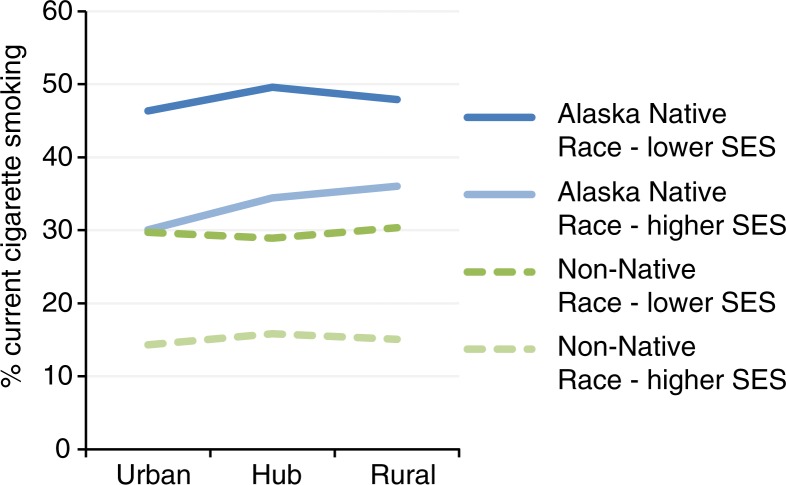
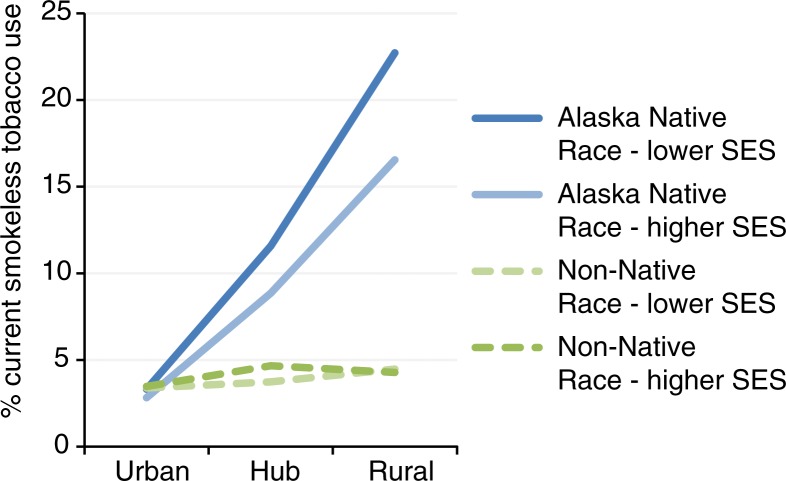
BACKGROUND: Tobacco use rates are exceptionally high among indigenous people in North America. Alaska Native, low socio-economic status (SES) and rural communities are high-priority populations for Alaska's Tobacco Control program. DESIGN: For the purpose of better informing tobacco control interventions, we conducted a descriptive study to describe high-priority groups using prevalence-based and proportion-based approaches. METHODS: With data from 22,311 adults interviewed for Alaska's 2006-2010 Behavioral Risk Factor Surveillance System (BRFSS), we used stratified analysis and logistic regression models to describe the current use of cigarettes and smokeless tobacco (SLT) (including iq'mik, a unique Alaska Native SLT product) among the 3 populations of interest. RESULTS: "Population segments" were created with combinations of responses for Alaska Native race, SES and community type. We identified the highest prevalence and highest proportion of tobacco users for each type of tobacco by "segment". For cigarette smoking, while the largest proportion (nearly one-third) of the state's smokers are non-Native, high SES and live in urban settings, this group also has lower smoking prevalence than most other groups. Alaska Native, low SES, rural residents had both high smoking prevalence (48%) and represented a large proportion of the state's smokers (nearly 10%). Patterns were similar for SLT, with non-Native high-SES urban residents making up the largest proportion of users despite lower prevalence, and Alaska Native, low SES, rural residents having high prevalence and making up a large proportion of users. For iq'mik use, Alaska Native people in rural settings were both the highest prevalence and proportion of users. CONCLUSION: While Alaska Native race, low SES status and community of residence can be considered alone when developing tobacco control interventions, creating "population segments" based on combinations of factors may be helpful for tailoring effective tobacco control strategies and messaging. Other countries or states may use a similar approach for describing and prioritizing populations.
Overview
CoChat Summary
Written by AI from the paper’s full text.
TL;DR
This descriptive analysis of 2006–2010 Alaska BRFSS data uses prevalence- and proportion-based “population segments” to identify high-priority tobacco control groups. It finds that Alaska Native, low-SES, rural residents have high smoking/SLT prevalence and make up substantial shares of users, while non-Native high-SES urban residents are the largest proportion of smokers/SLT users despite lower prevalence; iq’mik use is concentrated among Alaska Native rural residents.
Key findings
- Cigarette smoking prevalence was 21.3% overall; 41.2% among Alaska Native adults, 34.9% among lower SES adults, and 29.2% in rural areas. After adjustment, Alaska Native race (AOR 2.2), lower SES (AOR 2.1), and unemployment (AOR 2.0) remained associated with smoking; hub/rural residence was not significant after adjustment.
- SLT use was 4.9% overall; 12.3% among Alaska Native adults and 10.8% in rural areas. Adjusted odds remained higher for male (AOR 7.0), Alaska Native (AOR 2.4), and rural (AOR 2.4).
- Iq’mik use was 0.7% overall but 4.9% among Alaska Native adults. The top segment by both prevalence and proportion was Alaska Native, low SES, rural: 11.8% prevalence, 71.0% of iq’mik users, estimated 2,300 users.
- For cigarettes, non-Native high-SES urban residents were the largest proportion of smokers (32.3%, 33,400) but had 14.3% prevalence; Alaska Native low-SES rural residents had 47.9% prevalence and 9.5% of smokers (9,800). For SLT, non-Native high-SES urban residents were 34.2% of users (7,800) with 3.5% prevalence; Alaska Native low-SES rural residents had 22.7% prevalence and 18.9% of users (4,300).
Methods
- Data: 22,311 adults interviewed in the 2006–2010 Alaska Behavioral Risk Factor Surveillance System (BRFSS), a CDC-sponsored random-digit-dial landline telephone survey of adults older than 18 years, administered in English.
- Measures: current smoking (≥100 lifetime cigarettes and currently smoking every/some days), current SLT, and current iq’mik; lower SES = less than high-school education or income <185% of Alaska’s federal poverty level; Alaska Native race = self-reported AIAN; community type = urban, hub, or rural.
- Analysis: weighted and post-stratified to Alaska age/sex distribution; stratified analysis and logistic regression; 12 population segments created from combinations of Alaska Native race, SES, and community type; Stata 10.1 svytotal used for population estimates.
Limitations
- Stated: BRFSS is limited to English-speaking adults in landline households, possibly unrepresentative; current tobacco use did not include frequency, so some “current users” may be infrequent or inconsistent; SES and urban–hub–rural measures may misclassify intended factors such as resource access and remoteness.
- Evident from text: cross-sectional, self-reported data cannot establish causality or temporal change; pooling 2006–2010 may mask trends; iq’mik estimates rely on small numbers (e.g., 3,300 users) and some adjusted odds ratios have very wide confidence intervals.
Model-written summary. Check it against the paper before relying on it.
Integrity signals
Registry
Cites
Statistics
Figures
Verification
Claims the paper makes
51 Own result · 14 Own interpretation · 10 Not checked yet · 8 Own method · 4 Sources not found
A result the paper reports from its own data — it cites no other source for it, so there is none to check. The quote shows it is in the paper.
In the paper
“Being male, younger, Alaska Native, and living in hub or rural settings were all significantly associated with odds for higher SLT use after adjustment for other factors.”
plainstates an association- Asserted: passes — The authors put it forward as true.
- Checkable: passes — It can be checked against evidence.
- Load-bearing: passes — The paper’s conclusions depend on it.
- Based: passes — The paper gives a reason why it holds.
A result the paper reports from its own data — it cites no other source for it, so there is none to check. The quote shows it is in the paper.
In the paper
“After adjustment for other factors, being Alaska Native and living in hub or rural communities had extremely large odds ratios for association with the current iq'mik use; being female, having children in the home, and lower SES remained significant for increased odds of iq'mik use also.”
plainstates an association- Asserted: passes — The authors put it forward as true.
- Checkable: passes — It can be checked against evidence.
- Load-bearing: passes — The paper’s conclusions depend on it.
- Based: passes — The paper gives a reason why it holds.
A result the paper reports from its own data — it cites no other source for it, so there is none to check. The quote shows it is in the paper.
In the paper
“There were strong correlations between the 3 key variables of interest, measured using design-based Pearson Chi-square: Alaska Native race and community type ( x 2 723.2, p B 0.001), Alaska Native race and lower SES ( x 2 689.2, p B 0.001), and community type and lower SES ( x 2 190.1, p B 0.001) (data not shown).”
boostedstates an association- Asserted: passes — The authors put it forward as true.
- Checkable: passes — It can be checked against evidence.
- Load-bearing: passes — The paper’s conclusions depend on it.
- Based: passes — The paper gives a reason why it holds.
A result the paper reports from its own data — it cites no other source for it, so there is none to check. The quote shows it is in the paper.
In the paper
“After adjustment for all other demographic characteristics, most of the identified factors remained significantly associated with higher odds of smoking including male gender, younger age, being unemployed, lower SES or Alaska Native race.”
plainstates an association- Asserted: passes — The authors put it forward as true.
- Checkable: passes — It can be checked against evidence.
- Load-bearing: passes — The paper’s conclusions depend on it.
- Based: passes — The paper gives a reason why it holds.
A result the paper reports from its own data — it cites no other source for it, so there is none to check. The quote shows it is in the paper.
In the paper
“There were strong correlations between the 3 key variables of interest, measured using design-based Pearson Chi-square: Alaska Native race and community type ( x 2 723.2, p B 0.001), Alaska Native race and lower SES ( x 2 689.2, p B 0.001), and community type and lower SES ( x 2 190.1, p B 0.001) (data not shown).”
boostedstates an association- Asserted: passes — The authors put it forward as true.
- Checkable: passes — It can be checked against evidence.
- Load-bearing: passes — The paper’s conclusions depend on it.
- Based: passes — The paper gives a reason why it holds.
- It may state two separate claims as one. 25
- Probably not a substantial claim. 33
Create a free account to see these claims.
Create a free account to see these assumptions.
34 more claims
Create a free account to see all 87 claims and to verify the 10 references still open.
Citations
Cites
(2010) · PsycEXTRA Dataset · doi:10.1037/e590462011-001 · Cited by 1,805
Projective Techniques in Marketing Research
Haire, M. (1950) · Journal of Marketing · doi:10.1177/002224295001400501 · Cited by 303
Hardening and the hard-core smoker: concepts, evidence, and implications
Warner, K. E., & Burns, D. (2003) · Nicotine & Tobacco Research · doi:10.1080/1462220021000060428 · Cited by 221
Egeland, G. M., Cao, Z., & Young, T. K. (2011) · Canadian Medical Association Journal · doi:10.1503/cmaj.101801 · Cited by 87
Chateau-Degat, M.-L., Dewailly, É., Louchini, R., Counil, É., Noël, M., Ferland, A., Lucas, M., BPharm, B. V., Ékoé, J.-M., Ladouceur, R., et al. (2010) · Canadian Journal of Cardiology · doi:10.1016/s0828-282x(10)70398-6 · Cited by 40
The Art and Science of Marketing
Dowling, G. R. (2004) · doi:10.1093/acprof:oso/9780199269617.001.0001 · Cited by 37
Tobacco use in rural Alaska and the trampling tobacco project.
Beltz, D. N. (1996) · PubMed · Cited by 2
Cited by
Zahnd, W. E., Murphy, C., Knoll, M., Benavidez, G. A., Day, K. R., Ranganathan, R., Luke, P., Zgodic, A., Shi, K. S., Merrell, M. A., et al. (2021) · International Journal of Environmental Research and Public Health · doi:10.3390/ijerph18041384 · Cited by 141
Smokeless Tobacco Decision-Making Among Rural Adolescent Males in California
Couch, E. T., Darius, E., Walsh, M. M., & Chaffee, B. W. (2016) · Journal of Community Health · doi:10.1007/s10900-016-0286-3 · Cited by 33
Cumulative disadvantage as a framework for understanding rural tobacco use disparities.
Ozga, J. E., Romm, K. F., Turiano, N. A., Douglas, A. E., Dino, G., Alexander, L. A., & Blank, M. D. (2021) · Experimental and Clinical Psychopharmacology · doi:10.1037/pha0000476 · Cited by 27
Smoking prevalence in urban and rural populations: findings from California between 2001 and 2012
Liu, L., Edland, S. D., Myers, M. G., Hofstetter, C. R., & Al‐Delaimy, W. K. (2016) · The American Journal of Drug and Alcohol Abuse · doi:10.3109/00952990.2015.1125494 · Cited by 21
Hiratsuka, V. Y., Avey, J. P., Trinidad, S. B., Beans, J. A., & Robinson, R. F. (2015) · International Journal of Circumpolar Health · doi:10.3402/ijch.v74.27794 · Cited by 12
Metadata
- Authors
- Dilley, J. A., Peterson, E., Bobo, M., Pickle, K. E., & Rohde, K.
- Affiliations
- Oregon Health Authority (US)
- Alaska Department of Health and Social Services (US)
- Corresponding author
- Dilley, Julia A.
- ORCID
- Dilley, Julia A.
- Venue
- International Journal of Circumpolar Health
- Publisher
- Informa UK Limited
- Published
- 2013-01-31
- Volume
- 72
- Issue
- 1
- Pages
- 21582
- ISSN
- 1239-9736 (ISSN-L)
- 2242-3982
- PMC
- PMC3748436
- OpenAlex
- W2006619600
- Semantic Scholar
- 38f3fd9762612dbe97e12c2f4698b253a7dd08bd
- Cited by
- 13
- References
- 7
- Citations by year
- 2026: 1 · 2025: 1 · 2023: 2 · 2021: 2 · 2018: 1 · 2017: 1 · 2016: 3 · 2015: 2
- FWCI
- 1.63
- Type
- journal article
- Language
- en
- Open access
- gold
- doi.org
- Licence
- cc-by-nc
- Locations
- International Journal of Circumpolar Health (publishedVersion, cc-by-nc)
- Europe PMC (PubMed Central) (publishedVersion, cc-by)
- PubMed (publishedVersion)
- PubMed Central (publishedVersion, cc-by)
- DOAJ (DOAJ: Directory of Open Access Journals) (submittedVersion)
- Topics
- Health Sciences › Medicine › Public Health, Environmental and Occupational Health › Smoking Behavior and Cessation
- Health Sciences › Medicine › Oncology › Global Cancer Incidence and Screening
- Social Sciences › Health › Indigenous Health, Education, and Rights
- Keywords
- tobacco use prevalence, Alaska Natives, low socioeconomic status, rural inequality, cigarette smoking, smokeless tobacco, tobacco control interventions, population segmentation
- MeSH terms
- Adolescent, Adult, Age Factors, Aged, Alaska, Arctic Regions, Inuit, Female, Humans, Male, Middle Aged, Residence Characteristics, Sex Factors, Smoking, Socioeconomic Factors, Tobacco, Smokeless, Prevalence, Behavioral Risk Factor Surveillance System, Young Adult, Tobacco Use
About these checks
Registry, retraction, Cites and statistics results are computed, not judged, with one exception: a printed reference that no index lists is read once by a model before it counts as a citation error. Claims are extracted by a model and kept only when their quote appears verbatim in the text; each cited source is then checked, with a model’s help, for whether it says what the claim relies on. Those verdicts can be wrong — read the claim’s quote and the cited source before relying on one.
A language model drew the claims from the paper on 2026-11-11, under version 3 of the claim definition (model deepseek-v4.1-flash, prompt extract-v3).
A second model labelled each claim on 2026-11-11 (model jev-1.13-20260917, definition revision gold-guideline-v0.2).
Statistics and arithmetic are recomputed, not judged.
Confidence bands are shown only for fields calibrated on our annotated test set. None is calibrated yet, so no band is shown.
What counts as a claim ›How we measure confidence ›How we check this ›
Are you an author, or do you see a problem with this page? Request a review
