

Zero-Trust Architecture for Energy Grid Cybersecurity: Multi-Layered Authentication and Continuous Verification Framework
Open accessThe DOI matches its Crossref record; 27 of the 27 references it cites were found in a registry or an index; none of the 17 sources its claims cite is checked for support yet.
Abstract
The increasing digitalization of energy grid infrastructure has introduced unprecedented cybersecurity vulnerabilities, with traditional perimeter-based security models proving inadequate against sophisticated Advanced Persistent Threats (APTs) and insider attacks. This paper presents a novel Zero-Trust Architecture (ZTA) specifically designed for energy grid environments, integrating continuous authentication, microsegmentation, and real-time anomaly detection. Our framework implements a three-tier verification system combining cryptographic hardware attestation, behavioral biometrics, and machine learning-based traffic analysis to ensure that every access request is authenticated, authorized, and encrypted regardless of network location. We introduce a dynamic policy engine that adapts trust scores based on contextual risk factors including device health, geographic location, temporal patterns, and SCADA protocol anomalies. The proposed architecture was evaluated in a simulated smart grid testbed comprising 2,400 intelligent electronic devices (IEDs), 48 remote terminal units (RTUs), and 6 control centers. Experimental results demonstrate a 94.7% reduction in lateral movement capabilities for attackers, 98.2% accuracy in detecting anomalous DNP3 and IEC 61850 traffic patterns, and an average authentication latency of 47ms, which satisfies the stringent real-time requirements of grid operations (< 100ms for protection schemes). The system successfully mitigated simulated attacks including credential theft, man-in-the-middle attacks on Modbus/TCP communications, and compromised SCADA workstations while maintaining 99.97% operational availability. This research contributes a practical, deployable zero-trust framework that addresses the unique challenges of operational technology (OT) environments while preserving the low-latency, high-availability requirements critical to energy infrastructure.
Overview
CoChat Summary
TL;DR
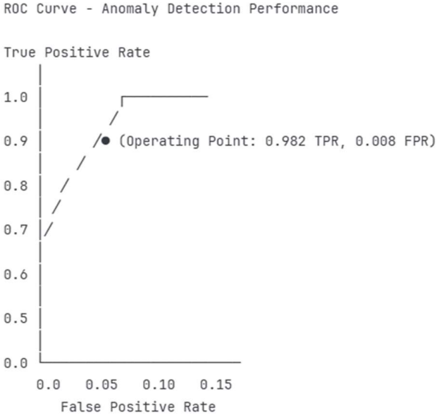
The paper proposes a zero-trust architecture for energy grids combining three-tier authentication, context-aware dynamic policy, microsegmentation, protocol-aware anomaly detection, and P4-based low-latency enforcement. It reports evaluation in a 2,400-device smart grid testbed with 98.2% anomaly detection accuracy, 0.8% false positive rate, 47ms average authentication latency, and 99.97% operational availability.
Key findings
- The three-tier authentication framework—TPM attestation, behavioral biometrics, and cryptographic certificate/TOTP validation—achieved mean latency of 47.3ms, within the stated SCADA threshold; caching reduced median latency from 47.3ms to 18.6ms with a 96.3% cache hit rate.
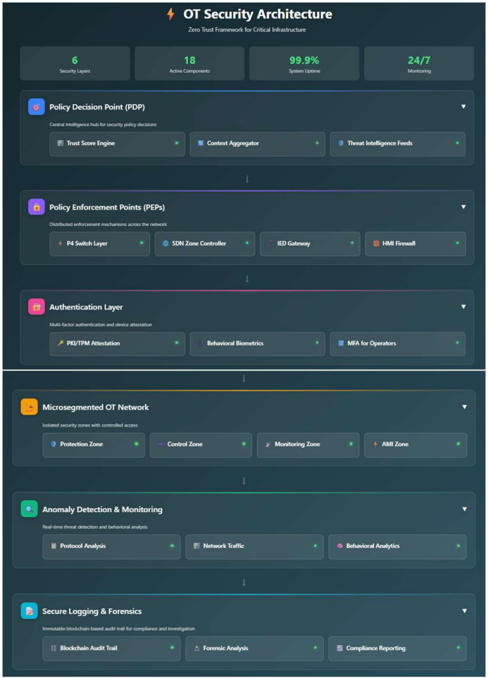
- The context-aware policy engine computes trust scores from 47 factors; parallel policy evaluation reduced decision time from 87.2ms sequential to 46.8ms parallel, a 46.3% improvement. P4 enforcement had mean 47μs latency versus 2.3ms software, maintained 83.4% of baseline throughput, and showed no packet loss below 118,000 pps.
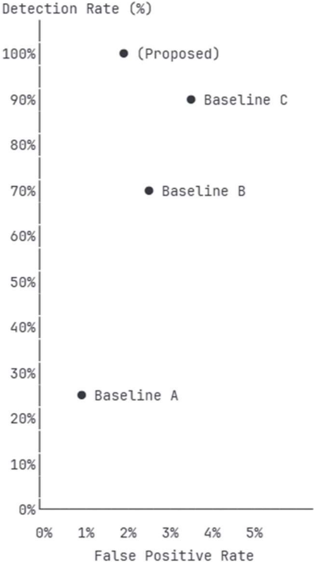
- The ML ensemble (Isolation Forest + LSTM + statistical analysis) achieved 98.2% detection accuracy and 0.8% false positive rate across DNP3, Modbus/TCP, and IEC 61850 traffic; the paper reports 100% detection across eight simulated attack scenarios with zero successful unauthorized commands and 99.97% operational availability.
- Microsegmentation results are reported inconsistently: the abstract states 94.7% reduction in lateral movement capabilities, the conclusion states 89.3% attack surface reduction, and Table III states a compromised monitoring-zone IED’s reach fell from 2,387 devices to 23 devices, a 99.0% reduction.
Methods
- Design: a six-component zero-trust architecture with three-tier authentication, a dynamic policy decision point using weighted trust scores, substation microsegmentation, protocol-aware deep packet inspection, ML-based anomaly detection, P4 inline policy enforcement, and automated key management.
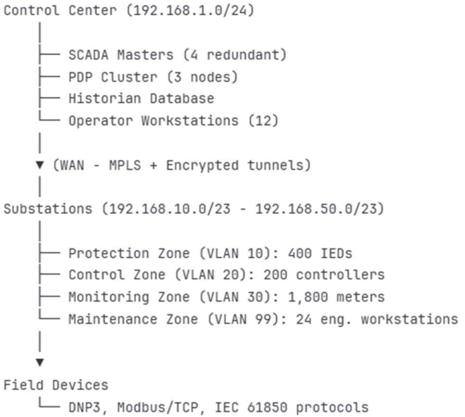
- Data/sample: a simulated smart grid testbed comprising 2,400 IEDs, 48 RTUs, and 6 control centers, with hardware including SEL/Siemens/ABB relays, P4 switches, Raspberry Pi RTUs, RTDS IEEE 118-bus simulation, and NS-3; generated traffic included 2,400 DNP3 RTUs polling every 2–5s, 400 GOOSE trip signals, 80 merging units at 4,800 samples/s, 800 Modbus PLCs, and 120 operator commands/hour during peak.
- Analysis: performance benchmarks for authentication latency, policy decision latency, throughput, and microsegmentation; eight attack simulations; false-positive analysis; comparison against three baselines; and statistical tests including Wilcoxon signed-rank (W = 47,234, p < 0.0001), chi-square (χ² = 892.4, df = 3, p < 0.0001), and Kaplan-Meier MTBF (8,760 hours vs. 4,380 hours, p < 0.01).
Limitations
- Paper-stated: TPM dependency and possible supply-chain backdoors; vulnerability to future quantum computing; behavioral model poisoning; scalability ceiling beyond 50,000 devices; high initial deployment cost ($650K capital for a medium utility); risk of false sense of security; legacy integration requiring proxies for 32% of field devices; early behavioral biometrics producing 8.7% false positives before tuning to 2.5%; and certificate management complexity.
- Evident from the text: the reported attack-surface/lateral-movement reductions are inconsistent across sections (94.7%, 89.3%, 99.0%, and a formula yielding 40.1%), and the evaluation is a simulated/testbed study rather than a live grid deployment.
Model-written summary. Check it against the paper before relying on it.
Integrity signals
Registry
Cites
Statistics
Figures




Verification
Claims the paper makes
0 Valid · 21 Not valid · 16 Not checked · 134 Own results and interpretations
A result the paper reports from its own data — it cites no other source for it, so there is none to check. The quote shows it is in the paper.
In the paper
“We develop a machine learning ensemble combining isolation forests, LSTM neural networks, and protocol state machines to detect anomalies in DNP3, Modbus/TCP, and IEC 61850 traffic with 98.2% accuracy and 0.8% false positive rate.”
§ Zero-Trust Architecture for Energy Grid Cybersecurity: Multi-Layered Authentication and Continuous Verification Framework > 3. Microsegmentation Strategy for Substations: We
plainstates a cause- Asserted: passes — The authors put it forward as true.
- Checkable: passes — It can be checked against evidence.
- Load-bearing: passes — The paper’s conclusions depend on it.
- Based: passes — The paper gives a reason why it holds.
- Rests on an assumption not shown here.
A result the paper reports from its own data — it cites no other source for it, so there is none to check. The quote shows it is in the paper.
In the paper
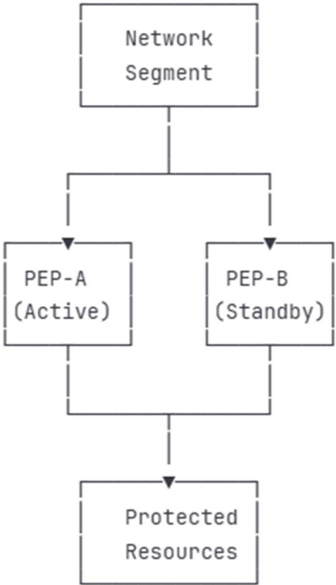
“We demonstrate a distributed policy enforcement architecture using programmable data plane (P4) switches that perform inline authorization checks with mean latency of 47μs”
§ Zero-Trust Architecture for Energy Grid Cybersecurity: Multi-Layered Authentication and Continuous Verification Framework > 3. Microsegmentation Strategy for Substations: We
boosted- Asserted: passes — The authors put it forward as true.
- Checkable: passes — It can be checked against evidence.
- Load-bearing: passes — The paper’s conclusions depend on it.
- Based: passes — The paper gives a reason why it holds.
- Rests on an assumption not shown here.
A result the paper reports from its own data — it cites no other source for it, so there is none to check. The quote shows it is in the paper.
In the paper
“an average authentication latency of 47ms”
§ Zero-Trust Architecture for Energy Grid Cybersecurity: Multi-Layered Authentication and Continuous Verification Framework > Abstract
plain- Asserted: passes — The authors put it forward as true.
- Checkable: passes — It can be checked against evidence.
- Load-bearing: passes — The paper’s conclusions depend on it.
- Based: passes — The paper gives a reason why it holds.
- Rests on an assumption not shown here.
A result the paper reports from its own data — it cites no other source for it, so there is none to check. The quote shows it is in the paper.
In the paper
“Experimental results demonstrate a 94.7% reduction in lateral movement capabilities for attackers”
§ Zero-Trust Architecture for Energy Grid Cybersecurity: Multi-Layered Authentication and Continuous Verification Framework > Abstract
boostedstates a cause- Asserted: passes — The authors put it forward as true.
- Checkable: passes — It can be checked against evidence.
- Load-bearing: passes — The paper’s conclusions depend on it.
- Based: passes — The paper gives a reason why it holds.
- Rests on an assumption not shown here.
The paper states this without a source or data behind it here, so there is nothing to check it against. The quote shows it is in the paper.
In the paper
“Our approach reduces the attack surface by 89.3% compared to flat substation networks.”
§ Zero-Trust Architecture for Energy Grid Cybersecurity: Multi-Layered Authentication and Continuous Verification Framework > 3. Microsegmentation Strategy for Substations: We
plainstates a cause- Asserted: passes — The authors put it forward as true.
- Checkable: passes — It can be checked against evidence.
- Load-bearing: passes — The paper’s conclusions depend on it.
- Based: unclear — It is unclear why the paper says it holds.
- Rests on an assumption not shown here.
62 more claims
Create a free account to see all 171 claims and every source verdict.
- Probably not a substantial claim. 64
- It may state two separate claims as one. 61
- The quote only partly states this claim. 3
- Borderline: one of the tests for a substantial claim is unclear. 3
Self-check
Percentages, sums and reported differences re-computed from the paper’s own numbers.
Each contradiction between two passages listed here was confirmed by an independent check.
Rated major: it would touch a result — a value a result rests on, reported and recomputed p-values on opposite sides of the significance level, two passages that conflict with no sign which is right, or a cited work retracted before this paper was published.
In the paper
§ Zero-Trust Architecture for Energy Grid Cybersecurity: Multi-Layered Authentication and Continuous Verification Framework > 2) Adaptive Policy Adjustment
“TS_threshold_adjusted = TS_threshold_base • (1 -α•TI_score) • (1 + β•OP_urgency)”
§ Zero-Trust Architecture for Energy Grid Cybersecurity: Multi-Layered Authentication and Continuous Verification Framework > 2) Adaptive Policy Adjustment
“During NERC Energy Emergency Alert (EEA) Level 3 conditions, operational urgency increases, slightly relaxing trust requirements to ensure operators can execute time-critical load-shedding commands.Conversely, elevated threat intelligence (e.g., active APT campaigns targeting energy sector) raises trust thresholds, requiring stronger authentication for all access.”
Rated major: it would touch a result — a value a result rests on, reported and recomputed p-values on opposite sides of the significance level, two passages that conflict with no sign which is right, or a cited work retracted before this paper was published.
In the paper
§ Zero-Trust Architecture for Energy Grid Cybersecurity: Multi-Layered Authentication and Continuous Verification Framework > Abstract
“an average authentication latency of 47ms, which satisfies the stringent real-time requirements of grid operations (< 100ms for protection schemes).”
§ Zero-Trust Architecture for Energy Grid Cybersecurity: Multi-Layered Authentication and Continuous Verification Framework > A. Motivation and Problem Statement
“operational technology (OT) networks demand deterministic, real-time communication with latencies typically below 10ms for protection relays and under 100ms for monitoring systems.”
Rated major: it would touch a result — a value a result rests on, reported and recomputed p-values on opposite sides of the significance level, two passages that conflict with no sign which is right, or a cited work retracted before this paper was published.
In the paper
§ Zero-Trust Architecture for Energy Grid Cybersecurity: Multi-Layered Authentication and Continuous Verification Framework > 3. Microsegmentation Strategy for Substations: We
“Our approach reduces the attack surface by 89.3% compared to flat substation networks.”
§ Zero-Trust Architecture for Energy Grid Cybersecurity: Multi-Layered Authentication and Continuous Verification Framework > CONCLUSION
“Attack surface reduction = 1 -(|E_micro| / |E_flat|) = 1 -0.599 = 40.1%”
Rated major: it would touch a result — a value a result rests on, reported and recomputed p-values on opposite sides of the significance level, two passages that conflict with no sign which is right, or a cited work retracted before this paper was published.
In the paper
§ Zero-Trust Architecture for Energy Grid Cybersecurity: Multi-Layered Authentication and Continuous Verification Framework > 3) Comparison with Existing Approaches
“Highest availability (99.97%) matching critical infrastructure requirements”
§ Zero-Trust Architecture for Energy Grid Cybersecurity: Multi-Layered Authentication and Continuous Verification Framework > A. Grid Operational Requirements
“The IEEE Gold Book (IEEE 493) documents industrial system availability targets, with critical substation equipment requiring 99.99-99.999%uptime.”
Rated minor: it would not touch a result — a value no result rests on, a p-value that stays on the same side of the significance level, or a conflict that is clerical, resolved elsewhere in the paper, or outside its own findings.
In the paper
§ Zero-Trust Architecture for Energy Grid Cybersecurity: Multi-Layered Authentication and Continuous Verification Framework > Abstract
“The proposed architecture was evaluated in a simulated smart grid testbed comprising 2,400 intelligent electronic devices (IEDs), 48 remote terminal units (RTUs), and 6 control centers.”
§ Zero-Trust Architecture for Energy Grid Cybersecurity: Multi-Layered Authentication and Continuous Verification Framework > 3) Traffic Generation
“DNP3 Traffic: 2,400 RTUs polling every 2-5 seconds (read analog/binary inputs)”
Citations
Cites
The publisher hasn’t deposited this paper’s reference list.
Research works printed but not linked: 6
- [1]1. J. Kindervag, "Build Security into Your Network's DNA: The Zero Trust Network Architecture," Forrester Research, Inc., Cambridge, MA, USA, Tech. Rep., 2010.
- [17]17. P. Bhatia, "Programmable Data Plane and P4 for Network Security Applications," IEEE Access, vol. 8, pp. 188800- 188814, 2020.
- [22]22. D. Grawrock, The Intel Safer Computing Initiative: Building Blocks for Trusted Computing. Hillsboro, OR, USA: Intel Press, 2006.
- [32]32. D. Ongaro and J. Ousterhout, "In Search of an Understandable Consensus Algorithm," in Proc. USENIX Annu. Technical Conf., Philadelphia, PA, USA, Jun. 2014, pp. 305-319.
- [35]35. Y. Wang, X. Xu, J. Zhang, L. Xu, Z. Wang, and G. Gu, "SRID: State Relation Based Intrusion Detection for False Data Injection Attacks in SCADA," in Proc. European Symp. Research Computer Security, Wroclaw, Poland, Sep. 2014, pp. 401-418.
- [43]43. R. B. Bobba, K. M. Rogers, Q. Wang, H. Khurana, K. Nahrstedt, and T. J. Overbye, "Detecting False Data Injection Attacks on DC State Estimation," in Proc. 1st Workshop Secure Control Systems, Stockholm, Sweden, Apr. 2010.
Metadata
- Authors
- Mohammed, K.
- Affiliations
- Independent Researcher
- Corresponding author
- Mohammed, Kazeem
- ORCID
- Mohammed, Kazeem
- Venue
- TechRxiv
- Published
- 2025-11-17
- OpenAlex
- W4416347672
- Cited by
- 0
- References
- 0
- Type
- posted content
- Language
- en
- Open access
- green
- doi.org
- Funders
- U.S. Department of Energy
- Topics
- Physical Sciences › Engineering › Control and Systems Engineering › Smart Grid Security and Resilience
- Physical Sciences › Computer Science › Computer Networks and Communications › Network Security and Intrusion Detection
- Physical Sciences › Computer Science › Information Systems › Information and Cyber Security
- Keywords
- zero-trust architecture, smart grid, continuous authentication, micro-segmentation, behavioral biometrics, hardware attestation, anomaly detection, dynamic access control, SCADA security, DNP3, IEC 61850, Modbus, lateral movement, insider attacks, advanced persistent threats, operational technology security, intelligent electronic devices, remote terminal units
About these checks
Registry, retraction, Cites and statistics results are computed, not judged, with one exception: a printed reference that no index lists is read once by a model before it counts as a citation error. Claims are extracted by a model and kept only when their quote appears verbatim in the text; each cited source is then checked, with a model’s help, for whether it says what the claim relies on. Those verdicts can be wrong — read the claim’s quote and the cited source before relying on one.
A language model drew the claims from the paper on 2026-10-09, under version 3 of the claim definition (model deepseek-v4.1-flash, prompt extract-v3).
A second model labelled each claim on 2026-10-09 (model jev-1.13-20260917, definition revision gold-guideline-v0.2).
Statistics and arithmetic are recomputed, not judged.
Confidence bands are shown only for fields calibrated on our annotated test set. None is calibrated yet, so no band is shown.
What counts as a claim ›How we measure confidence ›How we check this ›
Are you an author, or do you see a problem with this page? Request a review
How to cite
Cite CoChat for the checks on this page, and the paper for its own findings.
- This page
- CoChat. (2026). Citation check: Zero-Trust Architecture for Energy Grid Cybersecurity: Multi-Layered Authentication and Continuous Verification Framework. https://app.cochat.ai/papers/10.36227/techrxiv.176342124.49958931/v1
- The paper
- Mohammed, K. (2025). Zero-Trust Architecture for Energy Grid Cybersecurity: Multi-Layered Authentication and Continuous Verification Framework. TechRxiv. https://doi.org/10.36227/techrxiv.176342124.49958931/v1
Data sources
Bibliographic data: Semantic Scholar, OpenAlex, Crossref.
Contains information from the Semantic Scholar Academic Graph Datasets, made available under the ODC Attribution License (ODC-BY 1.0).
Semantic Scholar’s data is described in: Kinney, R., et al. (2023). The Semantic Scholar Open Data Platform. arXiv:2301.10140.
