

The DOI matches its Crossref record; 10 of the 10 references it cites were found in a registry or an index.
In Vitro Inhibitory Effects of Organic Acids Identified in Commercial Vinegars on α-Amylase and α-Glucosidase
Open accessAbstract
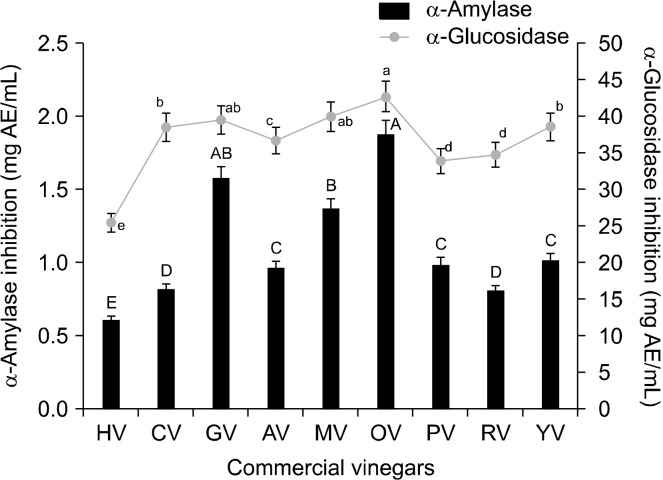
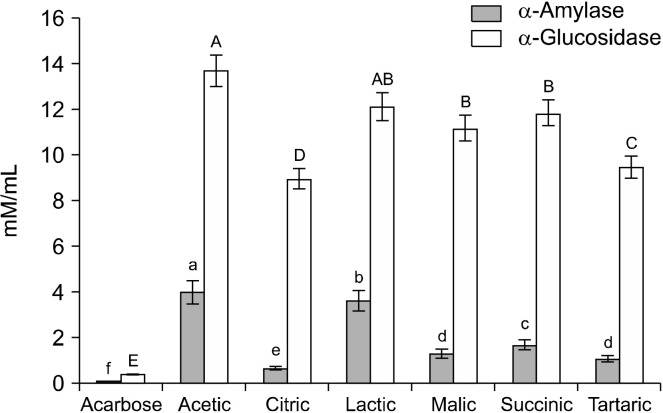
The aim of this work was to evaluate the inhibitory activities of organic acids identified from commercial vinegars on α-amylase and α-glucosidase. Six organic acids (acetic, citric, lactic, malic, succinic, and tartaric) were identified in nine commercial vinegars, whose contents varied considerably depending on the raw materials. Most of the fruit vinegars, comprised of various organic acids, were found to be more effective inhibitors against digestive enzymes than grain vinegars containing mainly acetic acid. Citric acid had the lowest ICSUB50/SUB values for α-amylase and α-glucosidase activities 0.64±0.04 μM/mL and 8.95±0.05 μM/mL, respectively, and thus exhibited the strongest antidiabetic effect. Mulberry fruit vinegar containing the highest content of total organic acid (111.02±1.50 ㎎/mL) showed the strongest digestive enzyme inhibitory impact. The results indicate that vinegars with higher contents of various organic acids hold strong potential against digestive enzymes.
Overview
The claims and statistics of this paper haven’t been checked yet.
Run the check — free, no account needed. It reads the open-access text and checks the sources it cites.
Integrity signals
Registry
Cites
Statistics
Figures
Verification
Claims the paper makes
The claims and statistics of this paper haven’t been checked yet.
Run the check — free, no account needed. It reads the open-access text and checks the sources it cites.
Claims other papers make about this one
Each is checked against this paper’s own text: does it say what the citing paper says it does?
The source backs part of the claim, not all of it — or backs it for a different population, condition or comparison.
In the citing paper
“Mulberry vinegar has been shown to retard carbohydrate digestion, thereby reducing postprandial blood glucose levels and enhancing insulin sensitivity through the inhibition of α-amylase and α-glucosidase activities.”
From The Metabolic Pathways of Yeast and Acetic Acid Bacteria During Fruit Vinegar Fermentation and Their Influence on Flavor Development (2025) · cites this paper as [92]
Experimental — accuracy not yet measuredThe cited source says what the claim attributes to it.
In the citing paper
“The primary constituents of mulberry vinegar are citric acid and tartaric acid [92].”
From The Metabolic Pathways of Yeast and Acetic Acid Bacteria During Fruit Vinegar Fermentation and Their Influence on Flavor Development (2025) · cites this paper as [92]
Self-check
Percentages, sums and reported differences re-computed from the paper’s own numbers.
The self-check needs the paper’s full text.
Citations
Cites
Varieties, Production, Composition and Health Benefits of Vinegars: A Review
Ho, C. W., Lazim, A. M., Fazry, S., Zaki, U. K. H. H., & Lim, S. J. (2017) · Food Chemistry · doi:10.1016/j.foodchem.2016.10.128 · Cited by 346
Kao, Y., Chang, H., Lee, M., & Chen, C. (2006) · Molecular Nutrition & Food Research · doi:10.1002/mnfr.200500109 · Cited by 318
Vinegar Functions on Health: Constituents, Sources, and Formation Mechanisms
Chen, H., Chen, T., Giudici, P., & Chen, F. (2016) · Comprehensive Reviews in Food Science and Food Safety · doi:10.1111/1541-4337.12228 · Cited by 232
Vinegar: medicinal uses and antiglycemic effect.
Johnston, C. S., & Gaas, C. A. (2006) · PubMed · Cited by 223
Ogawa, N., Satsu, H., Watanabe, H., Fukaya, M., Tsukamoto, Y., Miyamoto, Y., & Shimizu, M. (2000) · The Journal of Nutrition · doi:10.1093/jn/130.3.507 · Cited by 110
Cocchi, M., Durante, C., Grandi, M., Lambertini, P., Manzini, D., & Marchetti, A. (2006) · Talanta · doi:10.1016/j.talanta.2005.12.032 · Cited by 97
Vinegar (acetic acid) intake on glucose metabolism: A narrative review
Santos, H. O., de Moraes, W. M. A. M., da Silva, G. A. R., Prestes, J., & Schoenfeld, B. J. (2019) · Clinical Nutrition ESPEN · doi:10.1016/j.clnesp.2019.05.008 · Cited by 82
Marunaka, Y. (2018) · International Journal of Molecular Sciences · doi:10.3390/ijms19103244 · Cited by 70
Shishehbor, F., Mansoori, A., & Shirani, F. (2017) · Diabetes Research and Clinical Practice · doi:10.1016/j.diabres.2017.01.021 · Cited by 64
Mitrou, P., Petsiou, E., Papakonstantinou, E., Maratou, E., Lambadiari, V., Dimitriadis, P., Spanoudi, F., Raptis, S., & Dimitriadis, G. (2015) · European Journal of Clinical Nutrition · doi:10.1038/ejcn.2014.289 · Cited by 56
Research works printed but not linked: 4
- Bao T Xu Y Gowd V Zhao J Xie J Liang W 2016 Systematic study on phytochemicals and antioxidant activity of some new and common mulberry cultivars in China J Funct Foods 25 537 547 10.1016/j.jff.2016.07.001 · DOI
- Sanarico D Motta S Bertolini L Antonelli A 2003 HPLC determination of organic acids in traditional balsamic vinegar of Reggio Emilia J Liq Chromatogr Relat Technol 26 2177 2187 10.1081/JLC-120022402 · DOI
- Xia T Zhang B Duan W Zhang J Wang M 2020 Nutrients and bioactive components from vinegar: a fermented and functional food J Funct Foods 64 103681 https://doi.org/10.1016/j.jff.2019.103681 10.1016/j.jff.2019.103681 · DOI · Paper page
- Zhang L Hogan S Li J Sun S Canning C Zheng SJ 2011 Grape skin extract inhibits mammalian intestinal α-glucosidase activity and suppresses postprandial glycemic response in streptozocin-treated mice Food Chem 126 466 471 10.1016/j.foodchem.2010.11.016 · DOI
Cited by
Ge, Y., Wu, Y., Aihaiti, A., Wang, L., Wang, Y., Xing, J., Zhu, M., & Hong, J. (2025) · Microorganisms · doi:10.3390/microorganisms13030477 · Cited by 49
Metadata
- Authors
- Noh, Y.-H., Lee, D.-B., Lee, Y.-W., & Pyo, Y.-H.
- Affiliations
- Sungshin Women's University (KR)
- Corresponding author
- Pyo, Young-Hee
- Venue
- Preventive Nutrition and Food Science
- Published
- 2020-09-30
- Volume
- 25
- Issue
- 3
- Pages
- 319-324
- ISSN
- 1226-332X (ISSN-L)
- 2287-1098
- 2287-8602
- PMC
- PMC7541927
- OpenAlex
- W3091869828
- Cited by
- 27
- References
- 10
- Citations by year
- 2026: 4 · 2025: 11 · 2024: 8 · 2023: 2 · 2022: 1 · 2021: 1
- FWCI
- 0.75
- Type
- journal article
- Language
- en
- Open access
- green
- www.ncbi.nlm.nih.gov
- Licence
- cc-by-nc
- Locations
- Preventive Nutrition and Food Science (publishedVersion)
- PubMed Central (publishedVersion, cc-by-nc)
- PubMed (publishedVersion)
- Topics
- Health Sciences › Medicine › Endocrinology, Diabetes and Metabolism › Natural Antidiabetic Agents Studies
- Physical Sciences › Chemistry › Organic Chemistry › Carbohydrate Chemistry and Synthesis
- Life Sciences › Agricultural and Biological Sciences › Food Science › Food Nutrient Composition and Product Development
- Keywords
- vinegar, organic acids, α-amylase inhibition, α-glucosidase inhibition, antidiabetic activity, acetic acid, citric acid, lactic acid, malic acid, succinic acid, tartaric acid, fruit vinegar, digestive enzyme inhibition
About these checks
Registry, retraction, Cites and statistics results are computed, not judged, with one exception: a printed reference that no index lists is read once by a model before it counts as a citation error. Claims are extracted by a model and kept only when their quote appears verbatim in the text; each cited source is then checked, with a model’s help, for whether it says what the claim relies on. Those verdicts can be wrong — read the claim’s quote and the cited source before relying on one.
Statistics and arithmetic are recomputed, not judged.
Confidence bands are shown only for fields calibrated on our annotated test set. None is calibrated yet, so no band is shown.
What counts as a claim ›How we measure confidence ›How we check this ›
Are you an author, or do you see a problem with this page? Request a review
How to cite
Cite CoChat for the checks on this page, and the paper for its own findings.
- This page
- CoChat. (2026). Citation check: In Vitro Inhibitory Effects of Organic Acids Identified in Commercial Vinegars on α-Amylase and α-Glucosidase. https://app.cochat.ai/papers/10.3746/pnf.2020.25.3.319
- The paper
- Noh, Y.-H., Lee, D.-B., Lee, Y.-W., & Pyo, Y.-H. (2020). In Vitro Inhibitory Effects of Organic Acids Identified in Commercial Vinegars on α-Amylase and α-Glucosidase. Preventive Nutrition and Food Science. https://doi.org/10.3746/pnf.2020.25.3.319
Data sources
Bibliographic data: Semantic Scholar, OpenAlex, Crossref.
Contains information from the Semantic Scholar Academic Graph Datasets, made available under the ODC Attribution License (ODC-BY 1.0).
Semantic Scholar’s data is described in: Kinney, R., et al. (2023). The Semantic Scholar Open Data Platform. arXiv:2301.10140.
