

Methods to split cognitive task data for estimating split-half reliability: A comprehensive review and systematic assessment
Open accessPublished version of a preprint
The DOI matches its Crossref record; 46 of the 47 references it cites were found in a registry or an index.
Abstract
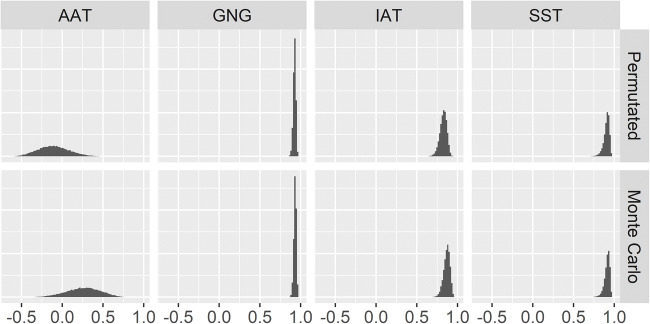
Estimating the reliability of cognitive task datasets is commonly done via split-half methods. We review four methods that differ in how the trials are split into parts: a first-second half split, an odd-even trial split, a permutated split, and a Monte Carlo-based split. Additionally, each splitting method could be combined with stratification by task design. These methods are reviewed in terms of the degree to which they are confounded with four effects that may occur in cognitive tasks: effects of time, task design, trial sampling, and non-linear scoring. Based on the theoretical review, we recommend Monte Carlo splitting (possibly in combination with stratification by task design) as being the most robust method with respect to the four confounds considered. Next, we estimated the reliabilities of the main outcome variables from four cognitive task datasets, each (typically) scored with a different non-linear algorithm, by systematically applying each splitting method. Differences between methods were interpreted in terms of confounding effects inflating or attenuating reliability estimates. For three task datasets, our findings were consistent with our model of confounding effects. Evidence for confounding effects was strong for time and task design and weak for non-linear scoring. When confounding effects occurred, they attenuated reliability estimates. For one task dataset, findings were inconsistent with our model but they may offer indicators for assessing whether a split-half reliability estimate is appropriate. Additionally, we make suggestions on further research of reliability estimation, supported by a compendium R package that implements each of the splitting methods reviewed here.
Overview
The claims and statistics of this paper haven’t been checked yet.
Free: it reads the open-access text and checks the first 5 claims that cite a source we can check. Create a free account to check every claim.
Integrity signals
Registry
Cites
Statistics
Figures
Verification
Claims the paper makes
The claims and statistics of this paper haven’t been checked yet.
Free: it reads the open-access text and checks the first 5 claims that cite a source we can check. Create a free account to check every claim.
Claims other papers make about this one
Each is checked against this paper’s own text: does it say what the citing paper says it does?
The cited source says what the claim attributes to it.
In the citing paper
“In this sample, Monte Carlo splitting (Pronk et al., 2022) with N = 500 replications revealed split-half correlations r = 0.75 for alerting x Flanker interaction [Flanker costs no cue - Flanker costs double cue ] , and r > 0.98 for remaining ANT measures of interest.”
From Externally orienting cues improve cognitive control in OCD (2024) · cites this paper as Pronk et al., 2022
Self-check
Percentages, sums and reported differences re-computed from the paper’s own numbers.
The self-check needs the paper’s full text.
Citations
Cites
A guideline of selecting and reporting intraclass correlation coefficients for reliability research
Koo, T. K., & Li, M. Y. (2016) · Journal of Chiropractic Medicine · doi:10.1016/j.jcm.2016.02.012 · Cited by 31,709
Intraclass correlations: Uses in assessing rater reliability.
Shrout, P. E., & Fleiss, J. L. (1979) · Psychological Bulletin · doi:10.1037/0033-2909.86.2.420 · Cited by 24,532
Measuring individual differences in implicit cognition: the implicit association test
Greenwald, A. G., McGhee, D. E., & Schwartz, J. L. K. (1998) · Journal of Personality and Social Psychology · doi:10.1037/0022-3514.74.6.1464 · Cited by 9,210
What is coefficient alpha? An examination of theory and applications
Cortina, J. M. (1993) · Journal of Applied Psychology · doi:10.1037/0021-9010.78.1.98 · Cited by 8,810 · cited 1×
“Traditionally, alpha is estimated by fitting a model of essential tau-equivalence on item-level data; each item has the same loading on the true score but has a unique mean and error variance (Cortina, 1993).”
MethodUnderstanding and using the Implicit Association Test: I. An improved scoring algorithm.
Greenwald, A. G., Nosek, B. A., & Banaji, M. R. (2003) · Journal of Personality and Social Psychology · doi:10.1037/0022-3514.85.2.197 · Cited by 5,815
Better Bootstrap Confidence Intervals
Efron, B. (1987) · Journal of the American Statistical Association · doi:10.1080/01621459.1987.10478410 · Cited by 3,364 · cited 2×
“…features of the splithalfr are support of Monte Carlo splitting, researcher-provided stratifi-cations and scoring algorithms, nonparametric bias-corrected and accelerated bootstrap confidence intervals (Efron, 1987; Efron & Narasimhan, 2018), and the option to match trials across participants.”
MethodBhattacharyya, A. (1943) · Medical Entomology and Zoology · Cited by 2,002
The reliability paradox: Why robust cognitive tasks do not produce reliable individual differences
Hedge, C., Powell, G., & Sumner, P. (2018) · Behavior Research Methods · doi:10.3758/s13428-017-0935-1 · Cited by 1,457
Corrections for extreme proportions and their biasing effects on estimated values ofd′
Hautus, M. J. (1995) · Behavior Research Methods, Instruments, & Computers · doi:10.3758/bf03203619 · Cited by 894 · cited 1×
“…was based on Heuer et al. (2007); d’ was based on the psycho R-package (Makowski, 2018), correcting for extreme values via the log-linear approach (Hautus, 1995); improved d-score was based on Greenwald et al. (2003); and Stop-Signal Reaction Time Ta bl e 1 O ve rv ie w of ta…”
MethodCoefficient Alpha and the Reliability of Composite Measurements
Novick, M. R., & Lewis, C. (1967) · Psychometrika · doi:10.1007/bf02289400 · Cited by 466
Cited by
Individual differences in computational psychiatry: A review of current challenges
Karvelis, P., Paulus, M. P., & Diaconescu, A. O. (2023) · Neuroscience & Biobehavioral Reviews · doi:10.1016/j.neubiorev.2023.105137 · Cited by 105
“Furthermore, even in tasks that do not induce strong trial-by-trial learning, split-half analysis comes with potential confounds and depends on how the trials are partitioned (Pronk et al., 2021; Parsons et al., 2019).”
Improving the Reliability of Cognitive Task Measures: A Narrative ReviewPreprint
Zorowitz, S., & Niv, Y. (2022) · PsyArXiv (OSF Preprints) · doi:10.1016/j.bpsc.2023.02.004 · Cited by 118
Comparative Test of Cronbach's Alpha Reliability Coefficient, Kr-20, Kr-21, And Split-Half Method
Setyaedhi, H. S. (2024) · Journal of Education Research and Evaluation · doi:10.23887/jere.v8i1.68164 · Cited by 92
“…of learning outcomes tests in the form of objective tests is carried out by "splitting in two," or the Split-Half Technique, or single test, single trial question items, namely odd-even and early-end numbered questions (Betul & Turan, 2019; Jago, 2019; Ossai & Chiekem, 2022; Pronk et al., 2022).”
MethodTesting the Biophilia theory: Automatic approach tendencies towards nature
Schiebel, T., Gallinat, J., & Kühn, S. (2021) · Journal of Environmental Psychology · doi:10.1016/j.jenvp.2021.101725 · Cited by 78
Charting Competence: A Holistic Scale for Measuring Proficiency in Artificial Intelligence Literacy
Yuan, C. W., Tsai, H.-Y. S., & Chen, Y.-T. (2024) · Journal of Educational Computing Research · doi:10.1177/07356331241261206 · Cited by 73
“Split-half reliability has been established to produce consistent and trustworthy evaluation of cognitive tasks at the group, instead of individual level, with Spearman-Brown adjusted Pearson correlation coef fi cient r = .96 (a value above .80 is acceptable) (Pronk et al., 2022).”
Anticipatory Anxiety and Wishful Thinking
Engelmann, J. B., Lebreton, M. P., Salem-Garcia, N., Schwardmann, P., & van der Weele, J. J. (2024) · American Economic Review · doi:10.1257/aer.20191068 · Cited by 56
Xu, I., Passell, E. J., Strong, R. W., Grinspoon, E. A., Wu, C. Y., Jung, L., Wilmer, J. B., & Germine, L. T. (2024) · Clinical Psychological Science · doi:10.1177/21677026241253826 · Cited by 51
“Although there are many other ways to calculate internal reliability, split-half reliability calculations tend to be intuitive and easy to visualize, especially for individuals who are not well versed in psychometric theory (Pronk et al., 2022).”
Cipora, K., van Dijck, J., Georges, C., Masson, N., Goebel, S. M., Willmes, K., Pesenti, M., Schiltz, C., & Nuerk, H. (2019) · PsyArXiv (OSF Preprints) · doi:10.31234/osf.io/bwyr3 · Cited by 51
Thunberg, C., Wiker, T., Bundt, C., & Huster, R. J. (2024) · Cortex · doi:10.1016/j.cortex.2024.02.008 · Cited by 36
Ganesan, K., Thompson, A., Smid, C. R., Cañigueral, R., Li, Y., Revill, G., Puetz, V. B., Bernhardt, B. C., Dosenbach, N. U. F., Kievit, R., et al. (2024) · Nature Neuroscience · doi:10.1038/s41593-024-01672-w · Cited by 33
Development and Validation of Nutrition Literacy Assessment Instrument for Chinese Pregnant Women
Zhou, Y., Lyu, Y., Zhao, R., Shi, H., Ye, W., Zhang, W., Li, R., & Xu, Y. (2022) · Nutrients · doi:10.3390/nu14142863 · Cited by 30
“The spilt-half reliability was another indicator used for evaluating the reliability [23].”
MethodPronk, T., Hirst, R. J., Wiers, R. W. H. J., & Murre, J. M. J. (2022) · Behavior Research Methods · doi:10.3758/s13428-022-01885-6 · Cited by 29
“We have restricted ourselves to Monte Carlo and permutated splitting because both have been considered relatively robust (Pronk et al., 2022), so any differences found between them in this study could be informative in recommending splitting methods for future research.”
MethodSelf-citationKahveci, S., Bathke, A. C., & Blechert, J. (2024) · Psychonomic Bulletin & Review · doi:10.3758/s13423-024-02597-y · Cited by 30
“We intend to contribute to recent efforts (Parsons et al., 2019; Pronk et al., 2022) to make adequate reliability assessment of implicit measures feasible and accessible.”
InfluentialMicrostate Analysis of Continuous Infant EEG: Tutorial and Reliability
Bagdasarov, A., Brunet, D., Michel, C. M., & Gaffrey, M. S. (2024) · Brain Topography · doi:10.1007/s10548-024-01043-5 · Cited by 27
Xia, C., Chen, H., Han, J., Zhang, D., & Li, K. (2024) · IEEE Transactions on Affective Computing · doi:10.1109/taffc.2024.3412032 · Cited by 25
“Reliability is fundamental in clinical settings and individual studies [66].”
Garre-Frutos, F., Vadillo, M. A., González, F., & Lupiáñez, J. (2024) · Behavior Research Methods · doi:10.3758/s13428-023-02329-5 · Cited by 28
“Fortunately, reporting reliability in experimental tasks has become a trivial matter due to the effort of the scientific community to develop software that facilitates the estimation of reliability through different methods (Parsons, 2021; Pronk et al., 2022).”
MethodMeasuring the acuity of the approximate number system in young children
Krajcsi, A., Chesney, D. L., Cipora, K., Coolen, I. E. J. I., Gilmore, C. K., Inglis, M., Libertus, M. E., Nuerk, H., Simms, V., & Reynvoet, B. (2024) · Developmental Review · doi:10.1016/j.dr.2024.101131 · Cited by 24
Schmitz, E. A., Jansen, B. R. J., Wiers, R. W. H. J., & Salemink, E. (2023) · Cognitive Therapy and Research · doi:10.1007/s10608-023-10390-9 · Cited by 23
Self-citationReliability of variability and complexity measures for task and task‐free BOLD fMRI
Wehrheim, M. H., Faskowitz, J., Schubert, A., & Fiebach, C. J. (2024) · Human Brain Mapping · doi:10.1002/hbm.26778 · Cited by 23
“…of brain activation parameters derived from task-based functional BOLD measurements (just as they are important for studying reliability in cognitive-experimental behavioral research; e.g., Pronk et al., 2022; Zorowitz & Niv, 2023), its application in our present work was limited by two facts.”
BackgroundMethodHomeostasis of a representational map in the neocortex
Noda, T., Kienle, E., Eppler, J.-B., Aschauer, D. F., Kaschube, M., Loewenstein, Y., & Rumpel, S. (2025) · Nature Neuroscience · doi:10.1038/s41593-025-01982-7 · Cited by 23
Kroon, A. C., van der Meer, T. G. L. A., & Pronk, T. (2022) · Human Communication Research · doi:10.1093/hcr/hqac004 · Cited by 21
Self-citationANÁLISIS PSICOMÉTRICO DEL GENERALIZED ANXIETY DISORDER-2 EN ADULTOS PERUANOS
Baños-Chaparro, J. (2022) · Revista de Investigaciones Universidad del Quindío · doi:10.33975/riuq.vol34n1.581 · Cited by 20
Ebert, K. D., Pham, G. T., Levi, S., & Eisenreich, B. R. (2023) · Behavior Research Methods · doi:10.3758/s13428-023-02078-5 · Cited by 20
“As a second approach we used bootstrap simulations to construct a confidence interval of split-half reliabilities by resampling participant data (Picheny et al., 2010; Pronk et al., 2022).”
MethodMahapatra, S. C., & Bellamkonda, R. S. (2022) · Journal of Retailing and Consumer Services · doi:10.1016/j.jretconser.2022.103162 · Cited by 20
Kadlec, J., Walsh, C. R., Sadé, U., Amir, A., Rissman, J., & Ramot, M. (2024) · Communications Psychology · doi:10.1038/s44271-024-00114-4 · Cited by 17
“1) 84,85,87 – 89 as this method has previously been suggested to be optimal for calculating the internal consistency of cognitive tasks 44,87,88,90 – 92 .”
MethodWiechert, S., Grafton, B., MacLeod, C., & Wiers, R. W. H. J. (2021) · International Journal of Environmental Research and Public Health · doi:10.3390/ijerph182413263 · Cited by 15
“First, the internal reliability of the attentional bias measure was determined using a split-half analysis conducted with the multicon [37] and splithalfr packages [38].”
Self-citationZhang, Z., Yang, L., Vékony, T., Wang, C., & Li, H. (2023) · Behavior Research Methods · doi:10.3758/s13428-023-02104-6 · Cited by 14
“The phenomenon might stem from confounding learning effects or strong dependence between trials (Pronk et al., 2022).”
InfluentialThe Chinese version of the Health Professional Communication Skills Scale: Psychometric evaluation
Zhong, X., Tang, F., Lai, D., Guo, X., Yang, X., Hu, R., Li, D., Lu, Y., Liu, S., & Leal‐Costa, C. (2023) · Frontiers in Psychology · doi:10.3389/fpsyg.2023.1125404 · Cited by 13
“to measure the split-half reliability; the HP-CSS items were divided into two parts, and the Spearman-Brown coefficients of odd-even items were calculated (Pronk et al., 2022).”
MethodDalal, A., Bhattacharya, S., & Chattopadhyay, S. (2023) · Journal of Enterprising Communities People and Places in the Global Economy · doi:10.1108/jec-03-2023-0035 · Cited by 13
Bera, S., & Bhattacharya, S. (2024) · IIM Ranchi Journal of Management Studies · doi:10.1108/irjms-11-2022-0109 · Cited by 13
Duhamel, E., Mihali, A., & Horga, G. (2023) · Journal of Neuroscience · doi:10.1523/jneurosci.0692-22.2023 · Cited by 12
Individual Differences in Holistic and Compositional Language Processing
McConnell, K. (2023) · Journal of Cognition · doi:10.5334/joc.283 · Cited by 12
Subiza‐Pérez, M., Vrotsou, K., Esnal, H., Kortajarena, M., Mujika, A., Mañeru, E. M., Aizpurua, P., Arrue, M., Mitxelena, X., Larrinaga-Torrontegui, U., et al. (2023) · Environmental Research · doi:10.1016/j.envres.2023.117789 · Cited by 12
Language Experience Predicts Eye Movements During Online Auditory Comprehension
James, A. N., Minnihan, C. J., & Watson, D. G. (2023) · Journal of Cognition · doi:10.5334/joc.285 · Cited by 13
Mapping the reliability multiverse of contextual cuing.
Vadillo, M. A., Malejka, S., & Shanks, D. R. (2025) · Journal of Experimental Psychology Learning Memory and Cognition · doi:10.1037/xlm0001410 · Cited by 12
Biggs, A. T., & Russell, D. W. (2024) · Safety Science · doi:10.1016/j.ssci.2024.106645 · Cited by 10
Liu, Z., Hu, M., Zheng, Y.-R., Sui, J., & Chuan-Peng, H. (2025) · Behavior Research Methods · doi:10.3758/s13428-024-02538-6 · Cited by 10
“Subsequently, we applied the three splitting approaches (Pronk et al., 2022).”
InfluentialPoverty, Brain Development, and Mental Health: Progress, Challenges, and Paths Forward
Monk, C. S., & Hardi, F. A. (2023) · Annual Review of Developmental Psychology · doi:10.1146/annurev-devpsych-011922-012402 · Cited by 10
Yangüez, M., Raine, L. B., Chanal, J. P., Bavelier, D., & Hillman, C. H. (2023) · Psychology of sport and exercise · doi:10.1016/j.psychsport.2023.102514 · Cited by 9
Wu, C., Zhang, H., Zhang, Y., Hu, M., Lin, Y., He, J., Li, S., Zhang, Y., & Lang, H. (2024) · BMC Nursing · doi:10.1186/s12912-024-01848-6 · Cited by 9
“For reliability analysis, we used Cronbach’s α coefficient, split-half reliability and test-retest reliability [37].”
MethodHuang, Y., Schunn, C. D., Guerra, J., & Brusilovsky, P. L. (2024) · ACM Transactions on Computing Education · doi:10.1145/3673239 · Cited by 8
“This splitting can be considered a variant of the commonly used split-half reliability method for assessing measure reliability [Pronk et al., 2022].”
Hernández‐Gutiérrez, D., Sorrel, M. Á., Shanks, D. R., & Vadillo, M. A. (2025) · Journal of Cognition · doi:10.5334/joc.419 · Cited by 9
Prein, J. C., Kalinke, S., Haun, D. B. M., & Bohn, M. (2023) · Behavior Research Methods · doi:10.3758/s13428-023-02159-5 · Cited by 9
“Similar to the results of Pronk et al. (2021), we found that more robust splitting methods that are less prone to task design or time confounds yielded higher reliability coefficients.”
MethodResultInfluentialReliability of individual differences in distractor suppression driven by statistical learning
Ivanov, Y., Theeuwes, J., & Bogaerts, L. (2023) · Behavior Research Methods · doi:10.3758/s13428-023-02157-7 · Cited by 10
“As discussed by Pronk et al. (2022), the bootstrap permutation approach is possibly better suited for estimating reliability coefficients of RT difference scores than standard odd-even trial splits.”
Methodsplithalfr: Estimate Split-Half Reliabilities
Pronk, T. (2019) · doi:10.32614/cran.package.splithalfr · Cited by 9
Self-citationBettencourt, C., Pires, L., Almeida, F., Vilar, M., Cruz, H., Leitão, J., & Gomes, A. A. (2024) · Behavioral Sciences · doi:10.3390/bs14040310 · Cited by 8
“Reliability for each neuropsychological test was estimated using the split-half approach and corrected with the Spearman–Brown prediction formula [72,73].”
MethodAcute Itch Induces Attentional Avoidance of Itch-related Information
Etty, S., George, D. N., van Laarhoven, A. I. M., & Holle, H. (2022) · Acta Dermato Venereologica · doi:10.2340/actadv.v102.1626 · Cited by 8
“Reliability of the reaction time measure was estimated using the R package splithalfr (19).”
MethodEvent‐related potentials of social comparisons in depression and social anxiety
Paz, V., Nicolaisen‐Sobesky, E., Fernández‐Theoduloz, G., Pérez, A., Constantino, F. C., Martínez‐Montes, E., Kessel, D., Cabana, Á., & Gradin, V. B. (2024) · Psychophysiology · doi:10.1111/psyp.14643 · Cited by 8
Waddington, G. S., & Witchalls, J. B. (2024) · Perceptual and Motor Skills · doi:10.1177/00315125241304169 · Cited by 7
“We also assessed split half reliability using the Spearman-Brown Adjusted Pearson r full (Pronk et al., 2022).”
Gruia, D. C., Giunchiglia, V., Coghlan, A., Brook, S., Banerjee, S., Kwan, J. S. K., Hellyer, P. J., Hampshire, A., & Geranmayeh, F. (2025) · Assessment · doi:10.1177/10731911251381572 · Cited by 7
“A well-known limitation of the split-half reliability is its dependency on a large number of trials, with shorter tasks having inherently low reliability estimates (Pronk et al., 2022).”
DeGrace, S., Romero‐Sanchiz, P., Tibbo, P. G., Barrett, S. P., Arenella, P. B., Cosman, T., Atasoy, P., Cousijn, J., Wiers, R. W. H. J., Keough, M. T., et al. (2023) · Behaviour Research and Therapy · doi:10.1016/j.brat.2023.104387 · Cited by 7
“A Monte Carlo split-half reliability estimate for the AAT was calculated using an established protocol (Pronk et al., 2022) wherein we calculated an RT difference score (push-pull) for each stimulus and stratified on study design characteristics (AAT stimulus type x cue condition).”
MethodSelf-citationQiu, Y., Griffiths, S., Norbury, C., & Taylor, J. S. H. (2023) · Developmental Psychology · doi:10.1037/dev0001563 · Cited by 7
“Using 5,000 random splits, the Spearman – Brown corrected reliability estimates (Parsons, 2021; Pronk et al., 2021) in Years 1, 3, and 6, respectively, were .71, .66, .72 for commission errors, .93, .89, .93 for impulsivity errors, .83, .74, .81 for omission errors, .86, .88, .90 for mean RT in…”
MethodHunsu, N. J., Adesope, O., & Yli-Piipari, S. R. (2024) · Frontiers in Education · doi:10.3389/feduc.2024.1239261 · Cited by 7
Temporal binding: Task-dependent variations and reliability across experimental paradigms
de Azevedo, G. B., Cravo, A. M., & Buehner, M. J. (2024) · Attention Perception & Psychophysics · doi:10.3758/s13414-024-02996-2 · Cited by 8
“To assess the internal reliability of our temporal binding measures and sessions, we conducted a Monte Carlo analysis with 5,000 iterations, following suggested guidelines (Hedge et al., 2018; Parsons et al., 2019; Pronk et al., 2022).”
Watson, P., Pearson, D., & Pelley, M. E. L. (2025) · Cognition & Emotion · doi:10.1080/02699931.2025.2459847 · Cited by 8
“Difference scores (computed for example by subtracting RT in one condition from another) typically have poor internal consistency and test-retest reliability (Edwards et al., 2024; Green et al., 2016; Pronk et al., 2022).”
van Deursen, D. S., Mobach, L., Salemink, E., Blankers, M., & Wiers, R. W. H. J. (2025) · Behaviour Research and Therapy · doi:10.1016/j.brat.2025.104718 · Cited by 7
Self-citationOnline monitoring technology for deep phenotyping of cognitive impairment after strokePreprint
Gruia, D. C., Giunchiglia, V., Coghlan, A., Brook, S., Banerjee, S., Kwan, J. S. K., Hellyer, P. J., Hampshire, A., & Geranmayeh, F. (2024) · medRxiv · doi:10.1101/2024.09.06.24313173 · Cited by 7
Bogdanov, M., Scott, J. N., Esfand, S. M., Boyle, B. W., Lees, T., Li, M., Woronko, S. E., Linton, S. R., Miller, C., Li, S., et al. (2025) · Cognitive Affective & Behavioral Neuroscience · doi:10.3758/s13415-025-01336-7 · Cited by 6
“…we calculated split-half reliabilities (split by odd vs. even trials) for behavioral and EEG-derived indices within a single testing day by using the Spearman-Brown correction (Hajcak et al., 2017; Pronk et al., 2022): where r xy is the Pearson correlation between both halves of each testing day.”
León, D. I. C., Ramos, M. P. L., Santillán-Valdiviezo, L. G., Tanguila-Tapuy, D. S., Morocho, G., Moyano-Arias, R. J., Yautibug-Apugllón, M. E., & Chacón-Luna, A. E. (2025) · Computers · doi:10.3390/computers14090370 · Cited by 6
Split‐sample reliability estimation in health care quality measurement: Once is not enough
Nieser, K. J., & Harris, A. H. S. (2024) · Health Services Research · doi:10.1111/1475-6773.14310 · Cited by 6
Dhiman, S., Goyal, R. K., Ajmera, P., & Gulati, S. (2025) · European Journal of Pediatrics · doi:10.1007/s00431-024-05963-z · Cited by 5
“This shows that the items are measuring the same concept [22] .”
Noise-induced differences in the complexity of spoken language
Pham, C. T., & Karuza, E. A. (2022) · Quarterly Journal of Experimental Psychology · doi:10.1177/17470218221124869 · Cited by 5
“Stroop RT difference scores were assessed through permutation-based split-half reliability (Parsons et al., 2019, see also Pronk et al., 2022) using the splithalf() function in the splithalf package (v. 0.7.2; Parsons, 2021) in R. Reliability was averaged across 5000 random splits, and then…”
MethodInfluentialRosemberg, C. R., Ojea, G. L., Alam, F., Garber, L., Stein, A., Benedictis, C. D., Jackson‐Maldonado, D., & Friend, M. (2024) · Cognitive Development · doi:10.1016/j.cogdev.2024.101488 · Cited by 5
A general method for estimating reliability using Bayesian Measurement UncertaintyPreprint
Bignardi, G., Kievit, R., & Bürkner, P. (2025) · PsyArXiv (OSF Preprints) · doi:10.31234/osf.io/h54k8_v1 · Cited by 5
Externally orienting cues improve cognitive control in OCD
Bednarek, L., Glover, S., Ma, X., Pittenger, C., & Pushkarskaya, H. (2024) · Journal of Behavior Therapy and Experimental Psychiatry · doi:10.1016/j.jbtep.2024.101959 · Cited by 4
Li, Z., Zhou, Y., Tan, Y., Zhu, X., Liu, W. Y., Chen, Y., Qin, Y., Li, R., Yu, L., Zhao, R., et al. (2023) · Nutrients · doi:10.3390/nu15153488 · Cited by 4
“Split-half reliability is also often used to test the consistency of the scale across dimensions [22].”
MethodChang, R., Zhang, M., Li, R., Zhu, Q., Dong, Y., Liu, Y., Chen, Y., Wang, Z., Huang, H., & Cai, Y. (2025) · Human Resources for Health · doi:10.1186/s12960-025-01034-y · Cited by 4
“Furthermore, drawing on the KSAO (Knowledge, Skill, Ability, and Others) theory proposed by Mirable in 1977 [22], the competency elements have been further refined [25].”
Development and factor structure of the teaching approach scale
Reho, M., Costa, S., Pirchio, S., Limone, P., Fuccio, R. D., & Gennaro, A. (2024) · Frontiers in Education · doi:10.3389/feduc.2024.1404326 · Cited by 4
Attentional bias in psoriasis: The role of processing time and emotional valence
Etty, S., George, D. N., van Laarhoven, A. I. M., Kleyn, C. E., Walton, S., & Holle, H. (2023) · British Journal of Health Psychology · doi:10.1111/bjhp.12712 · Cited by 4
Imagine chocolate: The craving experience questionnaire in the food domain
Röttger, M., van Alebeek, H., Aulbach, M. B., & Blechert, J. (2023) · Appetite · doi:10.1016/j.appet.2023.107173 · Cited by 6
“As these measures are still often in use, we additionally computed Cronbach ’ s alpha using the R-package psych (Revelle, 2022) and Spearman-Brown corrected test-retest coefficients using the R-package splithalfr (Pronk, Molenaar, Wiers, & Murre, 2022).”
MethodBurberg, T., Würth, S., Amesberger, G., & Finkenzeller, T. (2024) · Frontiers in Sports and Active Living · doi:10.3389/fspor.2024.1210546 · Cited by 4
Motka, F., Wittekind, C. E., Ascone, L., & Kühn, S. (2024) · Behaviour Research and Therapy · doi:10.1016/j.brat.2024.104672 · Cited by 4
Sari, D. P., Budiman, & Alamsyah, N. (2023) · TEMATIK · Cited by 4
Turkish validity and reliability study of obstetric quality of recovery score (OBSQOR-11)
Önal, Ö., Gürlek, B., & Küçükosman, N. (2023) · Medical Science and Discovery · doi:10.36472/msd.v10i2.846 · Cited by 3
Modality Synchronization When People With Aphasia Read With Text-to-Speech Support
Hux, K., Knollman-Porter, K., Wallace, S. E., Bevelhimer, A., & Singh, Y. (2024) · American Journal of Speech-Language Pathology · doi:10.1044/2024_ajslp-23-00334 · Cited by 3
Reliability of Tactile Perception and Suppression Measurements
Voudouris, D., Georgiadis, P., Fiehler, K., & Arikan, B. E. (2025) · IEEE Transactions on Haptics · doi:10.1109/toh.2025.3587742 · Cited by 3
“The second LMM tested if Δ thresholds change within and across days while accounting for movement speed (e.g., 37, 43; but see also [44], [45]).”
Alvarez, G., Jolink, T. A., West, T. N., Cardenas, M. N., Feldman, M. J., Cohen, J. R., & Muscatell, K. A. (2024) · Brain Behavior and Immunity · doi:10.1016/j.bbi.2024.09.010 · Cited by 3
Modelling Pavlovian biases in depressed and healthy young adults
Embrey, J. R., Garner, K., Salim, J., & Watson, P. (2025) · Neurobiology of Learning and Memory · doi:10.1016/j.nlm.2025.108092 · Cited by 3
Item Deletions Based on Difficulty Values and Discriminating Values
Chakrabartty, S. N. (2023) · Edukasiana Jurnal Inovasi Pendidikan · doi:10.56916/ejip.v2i4.455 · Cited by 3
“However, equality of factor loadings is rather rare for tests used in educational research (Pronk et al. 2022).”
Longhi, S., Seghieri, C., Ferré, F., taddeucci, L., & Nuti, S. (2024) · Health Services Management Research · doi:10.1177/09514848241304634 · Cited by 2
Burberg, T., Würth, S., Amesberger, G., Pannicke, B., & Finkenzeller, T. (2025) · International Journal of Sport and Exercise Psychology · doi:10.1080/1612197x.2025.2475791 · Cited by 2
Liu, S., Gao, Y., Xu, H., Wang, Y., Xu, G., Cai, Y., & Zhang, J. (2025) · Scientific Reports · doi:10.1038/s41598-025-99787-y · Cited by 2
“The relatively lower value of this coefficient may be due to the introduction of more random error when the items are randomly split into two halves 32 .”
Developmental Changes in Speech Frequency Weighting in Children
Bosen, A. K., Frenette, A., Spratford, M., Lewis, D., Walker, E. A., & McCreery, R. W. (2025) · Ear and Hearing · doi:10.1097/aud.0000000000001749 · Cited by 2
Bhattacharya, S., Das, A., & Dalal, A. (2024) · The Journal of Consumer Satisfaction, Dissatisfaction & Complaining Behavior · Cited by 2
Development and preliminary validation of an open access, open data and open outreach indicator
Vlachos, E., Ejstrup, R., Drachen, T. M., & Dorch, B. F. (2023) · Frontiers in Research Metrics and Analytics · doi:10.3389/frma.2023.1218213 · Cited by 2
“for statistical computing and graphics as well as a number of R supported packages (Warrens, 2016; Wickham, 2016; Pronk et al., 2021; R Core Team, 2022; Kassambara, 2023).”
Lei, Z., Jin, Z., Xie, K., Li, S., Feng, L., Zhang, J., & Li, L. (2024) · NeuroImage · doi:10.1016/j.neuroimage.2024.120552 · Cited by 2
Prein, J. C., Bednarski, F. M., Dzabatou, A., Frank, M. C., Henderson, A. M. E., Kalbitz, J., Kanngießer, P., Keşşafoğlu, D., Köymen, B., Manrique-Hernandez, M., et al. (2025) · Advances in Methods and Practices in Psychological Science · doi:10.1177/25152459241308170 · Cited by 2
“Second, using the function by_split from the splithalfr package (Pronk et al., 2022), data were stratified by target centrality, and a Pearson correlation was calculated between the matched halves.”
Altenburg, D., & Spruyt, A. (2025) · Cognition & Emotion · doi:10.1080/02699931.2025.2508396 · Cited by 2
“To estimate internal consistency of the IMPACT measure, we calculated Spearman-Brown corrected mean split-half correlations (see Pronk et al., 2022).”
Assessing the truth effect’s reliability and test–retest stability
Calio, F., Nadarevic, L., & Musch, J. (2025) · Consciousness and Cognition · doi:10.1016/j.concog.2025.103923 · Cited by 2
Kang, S., & Osinsky, R. (2023) · Frontiers in Psychology · doi:10.3389/fpsyg.2023.1279311 · Cited by 2
Automatic price appraisals: why they matter and how to measure them
Altenburg, D., & Spruyt, A. (2024) · Frontiers in Psychology · doi:10.3389/fpsyg.2024.1359007 · Cited by 2
“We estimated an overall internal consistency score using Spearman-Brown corrected mean split-half correlations (Pronk et al., 2022).”
MethodNuijs, M. D., Larsen, H., Grafton, B., MacLeod, C., Bögels, S. M., Wiers, R. W. H. J., & Salemink, E. (2025) · Journal of Behavior Therapy and Experimental Psychiatry · doi:10.1016/j.jbtep.2025.102030 · Cited by 1
Self-citationBosen, A. K., Kohlmeier, B. C., Harris, S., Neely, S. T., & Kamerer, A. M. (2025) · Auditory Perception & Cognition · doi:10.1080/25742442.2025.2489912 · Cited by 1
Kim, Y., & Lee, S. (2025) · 국토계획 · doi:10.17208/jkpa.2025.06.60.3.65 · Cited by 1
HD-tDCS improves conflict processing and general behavioral stability
Liu, R., Wang, M., Liu, Q., Jing, X., Hao, Q., Yu, H., & Wang, Y. (2025) · Scientific Reports · doi:10.1038/s41598-025-15337-6 · Cited by 1
“Split-half reliability is a commonly used method to assess the reliability of cognitive tasks 43,50 .”
Cheng, Y., Shi, J., Wei, Y., Luo, J., Shi, Y., & Jiang, Z. (2025) · Asian Journal of Psychiatry · doi:10.1016/j.ajp.2025.104790 · Cited by 1
Evaluation of Psychometric Properties of Tests used in Educational Research
Chakrabartty, S. N. (2026) · International Journal of Psychology and Educational Studies · doi:10.52380/ijpes.2026.13.1.1547 · Cited by 1
“Computation of Cronbach’s alpha needs pre -checking of its assumptions like uni-dimensionality and tau-equivalence i.e. equal factor loadings of items, which is rare for tests being used in educational research (Pronk et al. 2022).”
Cross-frequency interactions in band importance functions
Bosen, A. K., Rogers, A. J., McCreery, R. W., & Buss, E. (2026) · The Journal of the Acoustical Society of America · doi:10.1121/10.0042379 · Cited by 1
Wang, R., Dashtaki, A. S., Zhang, X., Tsigaridis, K. G., & Sternberg, R. J. (2026) · Intelligence · doi:10.1016/j.intell.2026.102006 · Cited by 1
Ramey, M. M. (2026) · Cognition · doi:10.1016/j.cognition.2026.106565 · Cited by 1
Metadata
- Authors
- Pronk, T., Molenaar, D., Wiers, R. W., & Murre, J.
- Affiliations
- University of Amsterdam (NL)
- Corresponding author
- Pronk, Thomas
- Venue
- Psychonomic Bulletin & Review
- Published
- 2021-06-07
- Volume
- 29
- Issue
- 1
- Pages
- 44-54
- ISSN
- 1069-9384 (ISSN-L)
- 1531-5320
- PMC
- PMC8858277
- OpenAlex
- W3164368159
- Cited by
- 123
- References
- 47
- Citations by year
- 2026: 14 · 2025: 34 · 2024: 40 · 2023: 26 · 2022: 7 · 2021: 2
- FWCI
- 3.68
- Type
- journal article
- Language
- en
- Open access
- hybrid
- doi.org
- Licence
- cc-by
- creativecommons.org/licenses/by/4.0 (tdm)
- creativecommons.org/licenses/by/4.0 (vor)
- Locations
- Psychonomic Bulletin & Review (publishedVersion, cc-by)
- PubMed Central (publishedVersion, cc-by)
- PubMed (publishedVersion)
- UvA-DARE (University of Amsterdam) (submittedVersion, cc-by)
- PsyArXiv (OSF Preprints) (submittedVersion)
- PsyArXiv (OSF Preprints) (submittedVersion, cc-by)
- Data Archiving and Networked Services (DANS) (submittedVersion, other-oa)
- Topics
- Social Sciences › Decision Sciences › Management Science and Operations Research › Psychometric Methodologies and Testing
- Social Sciences › Decision Sciences › Statistics, Probability and Uncertainty › Reliability and Agreement in Measurement
- Social Sciences › Psychology › Experimental and Cognitive Psychology › Cognitive Abilities and Testing
- Keywords
- split-half reliability, confounding, task design, reliability estimation, R package
- MeSH terms
- Algorithms, Cognition, Humans, Monte Carlo Method, Reproducibility of Results
About these checks
Registry, retraction, Cites and statistics results are computed, not judged, with one exception: a printed reference that no index lists is read once by a model before it counts as a citation error. Claims are extracted by a model and kept only when their quote appears verbatim in the text; each cited source is then checked, with a model’s help, for whether it says what the claim relies on. Those verdicts can be wrong — read the claim’s quote and the cited source before relying on one.
Statistics and arithmetic are recomputed, not judged.
Confidence bands are shown only for fields calibrated on our annotated test set. None is calibrated yet, so no band is shown.
What counts as a claim ›How we measure confidence ›How we check this ›
Are you an author, or do you see a problem with this page? Request a review
Data sources
Bibliographic data: Semantic Scholar, OpenAlex, Crossref.
Contains information from the Semantic Scholar Academic Graph Datasets, made available under the ODC Attribution License (ODC-BY 1.0).
Semantic Scholar’s data is described in: Kinney, R., et al. (2023). The Semantic Scholar Open Data Platform. arXiv:2301.10140.
