

The Panchromatic Hubble Andromeda Treasury: Triangulum Extended Region (PHATTER). II. The Spatially Resolved Recent Star Formation History of M33
Open accessThe DOI matches its Crossref record; 96 of the 96 references it cites were found in a registry or an index.
Abstract
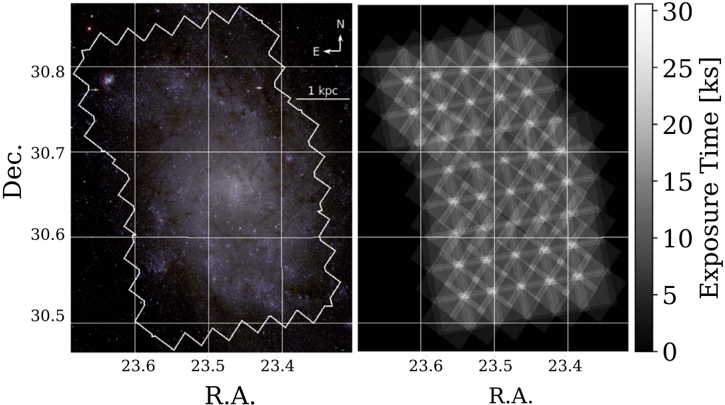
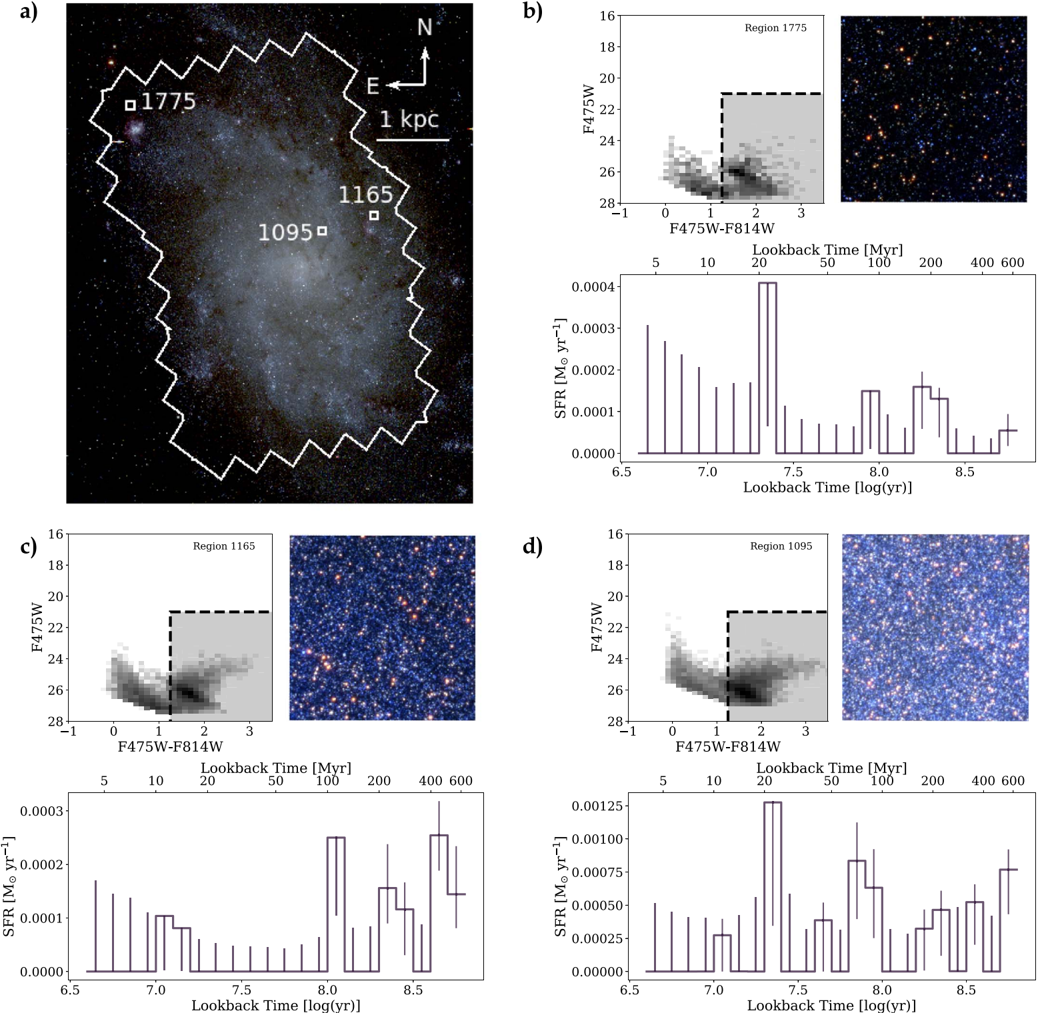
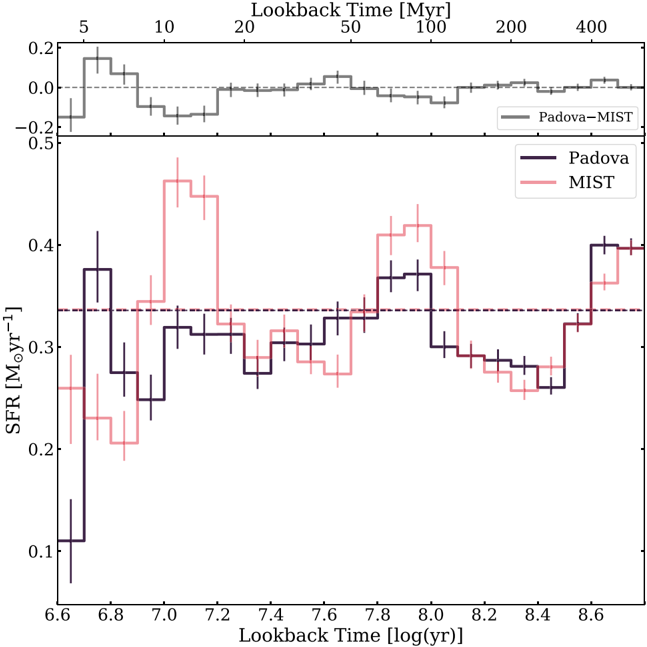
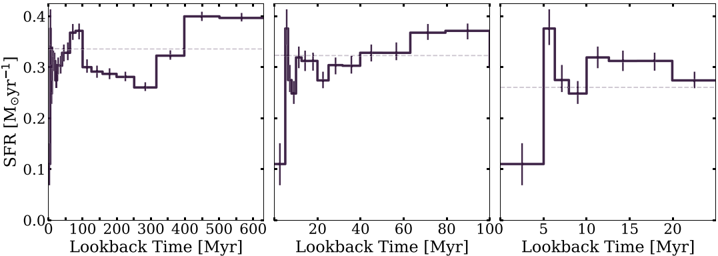
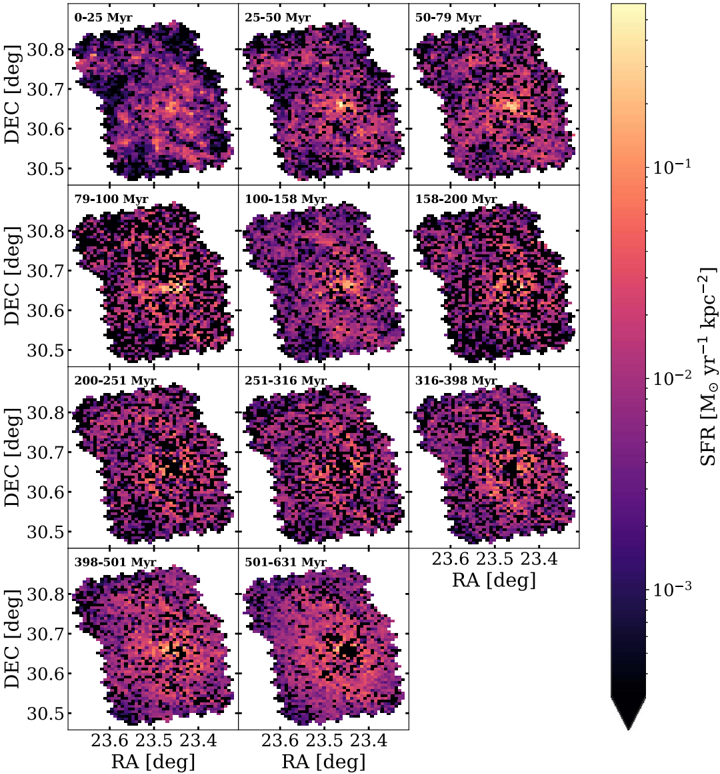
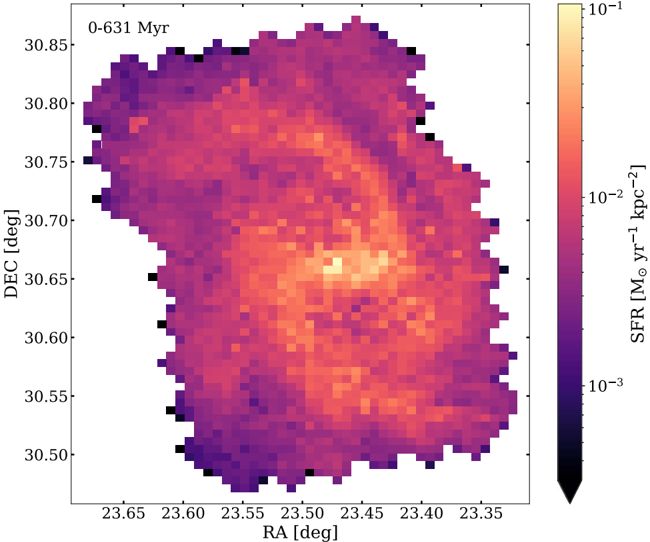
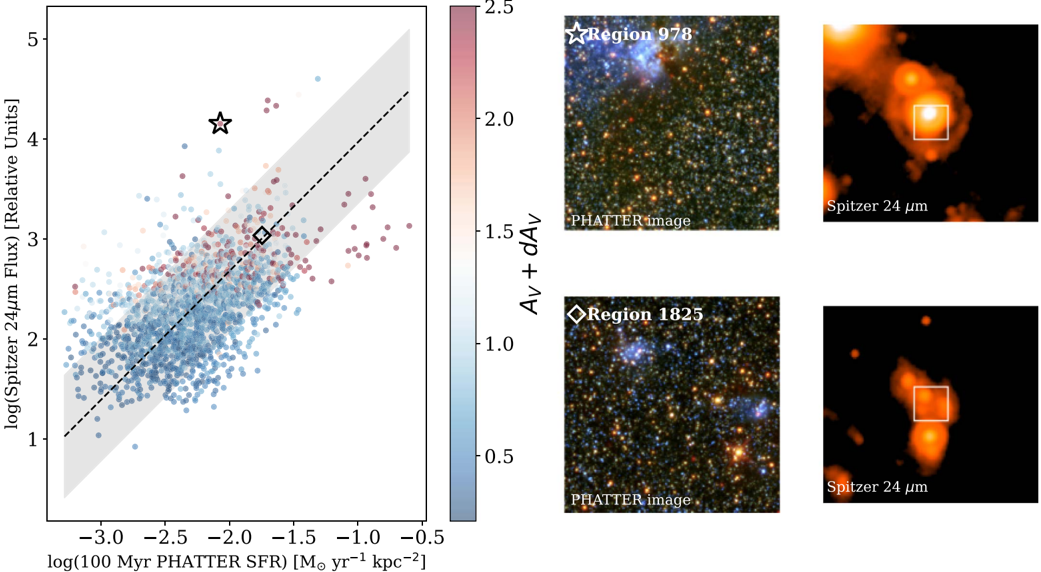
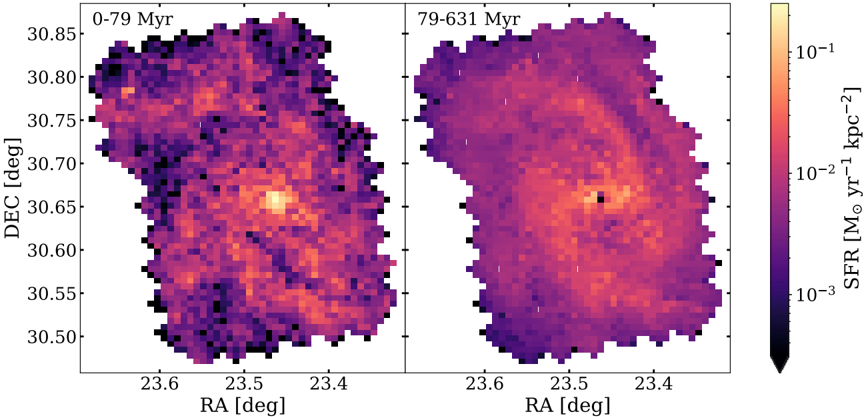
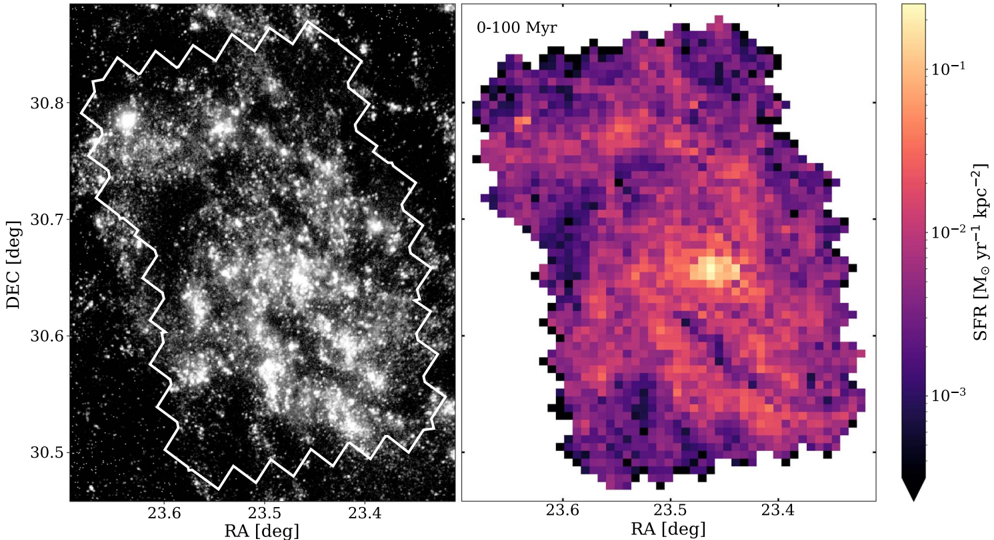
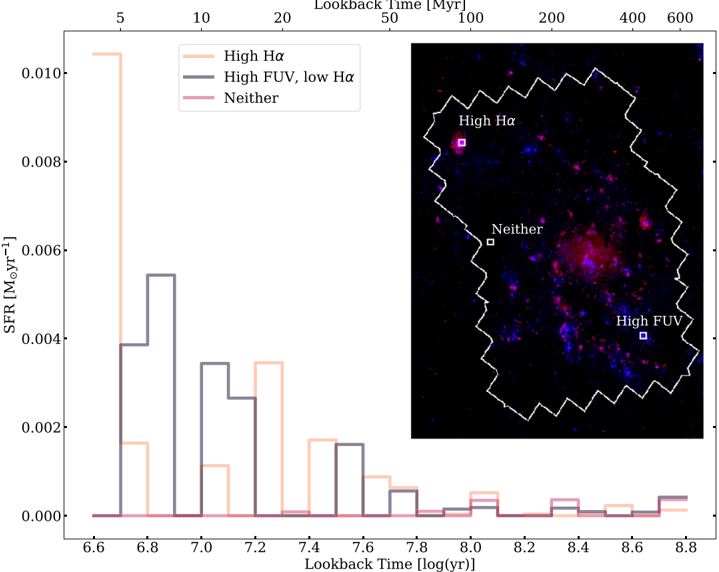
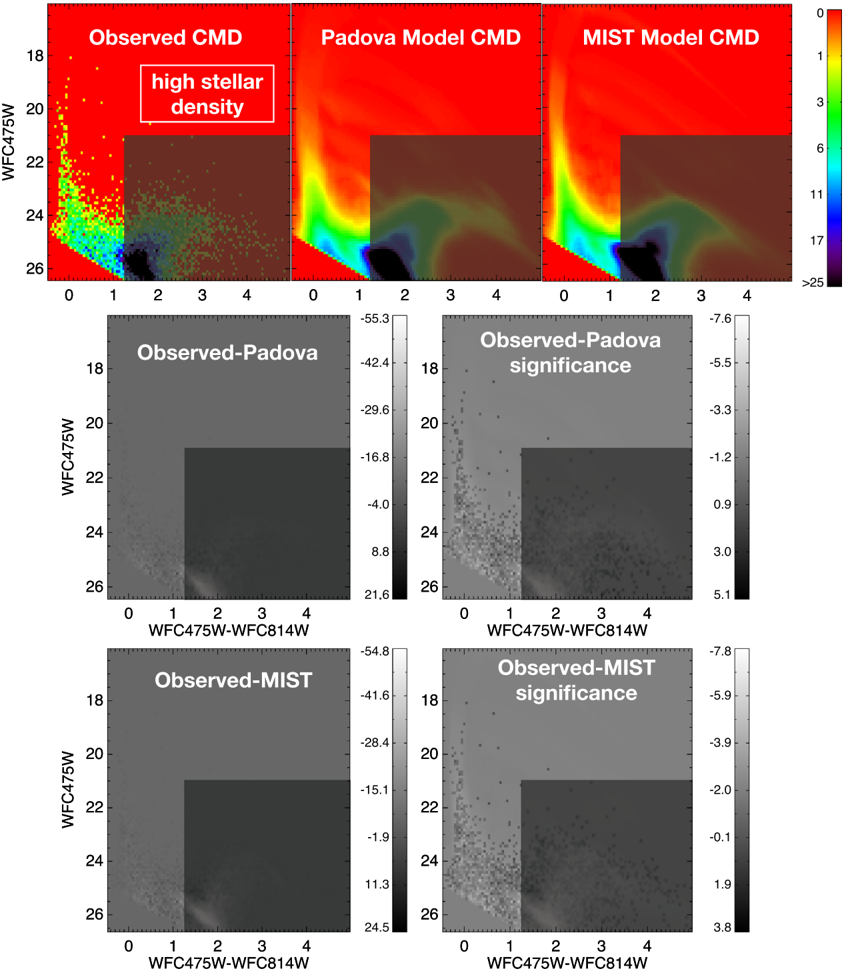
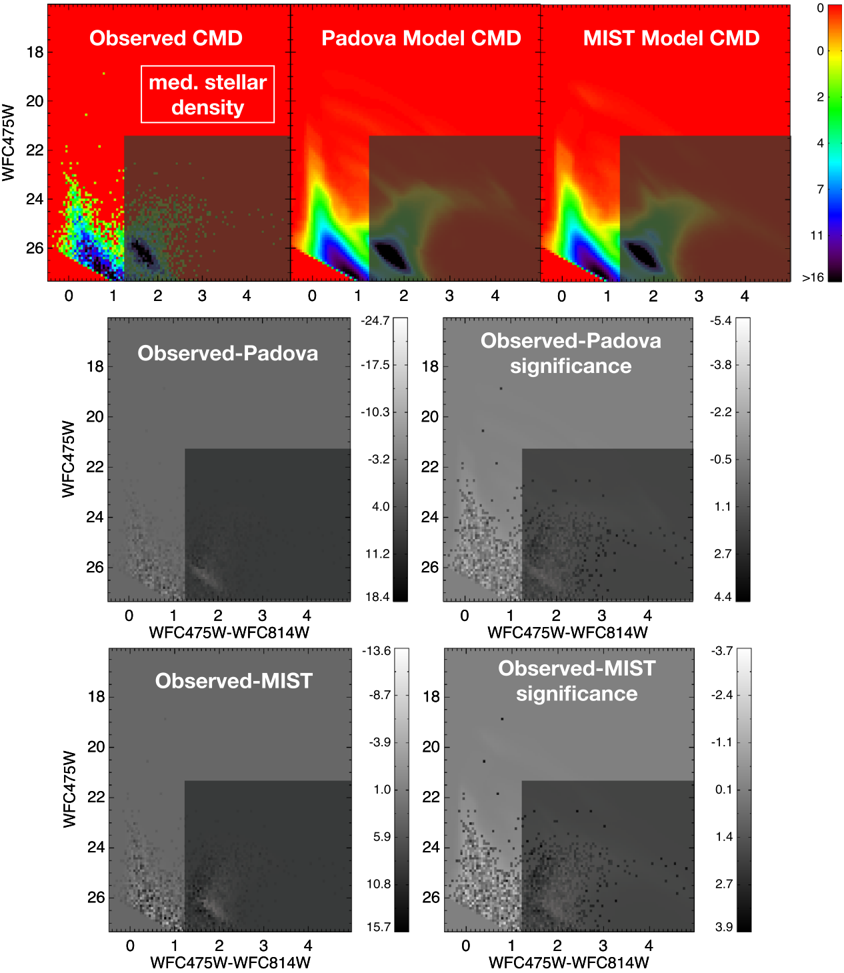
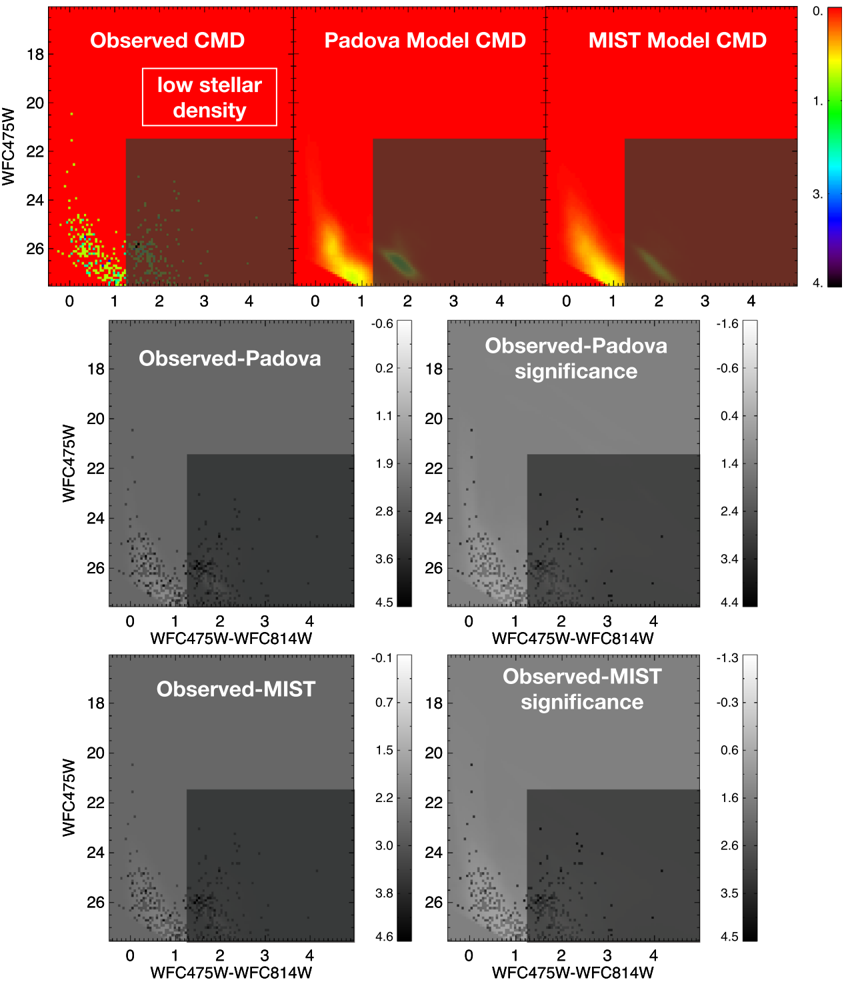
We measure the spatially resolved recent star formation history (SFH) of M33 using optical images taken with the Hubble Space Telescope as part of the Panchromatic Hubble Andromeda Treasury: Triangulum Extended Region (PHATTER) survey. The area covered by the observations used in this analysis covers a de-projected area of ∼38 kpc 2 and extends to ∼3.5 and ∼2 kpc from the center of M33 along the major and semimajor axes, respectively. We divide the PHATTER optical survey into 2005 regions that measure 24 arcsec, ∼100 pc, on a side and fit color–magnitude diagrams for each region individually to measure the spatially resolved SFH of M33 within the PHATTER footprint. There are significant fluctuations in the SFH on small spatial scales and also galaxy-wide scales that we measure back to about 630 Myr ago. We observe a more flocculent spiral structure in stellar populations younger than about 80 Myr, while the structure of the older stellar populations is dominated by two spiral arms. We also observe a bar in the center of M33, which dominates at ages older than about 80 Myr. Finally, we find that the mean star formation rate (SFR) over the last 100 Myr within the PHATTER footprint is 0.32 ± 0.02 M ⊙ yr −1 . We measure a current SFR (over the last 10 Myr) of 0.20 ± 0.03 M ⊙ yr −1 . This SFR is slightly higher than previous measurements from broadband estimates, when scaled to account for the fraction of the D25 area covered by the PHATTER survey footprint.
Overview
The claims and statistics of this paper haven’t been checked yet.
Free: it reads the open-access text and checks the first 5 claims that cite a source we can check. Create a free account to check every claim.
Integrity signals
Registry
Cites
Statistics
Figures
Verification
Claims the paper makes
The claims and statistics of this paper haven’t been checked yet.
Free: it reads the open-access text and checks the first 5 claims that cite a source we can check. Create a free account to check every claim.
Claims other papers make about this one
Each is checked against this paper’s own text: does it say what the citing paper says it does?
The source backs part of the claim, not all of it — or backs it for a different population, condition or comparison.
In the citing paper
“Second, the same MATCH -based fitting pipeline applied to M33 in the PHATTER survey recovers a recent SFH that is comparatively steady over the last 100 Myr and does not show an analogous global decline, even though the CMD depth, modeling assumptions, and extinction treatment are very similar (Lazzarini et al. 2022).”
From The Panchromatic Hubble Andromeda Southern Treasury (PHAST). II. The Spatially Resolved Recent Star Formation History in M31 (2026) · cites this paper as Lazzarini et al. 2022
Experimental — accuracy not yet measuredThe source backs part of the claim, not all of it — or backs it for a different population, condition or comparison.
In the citing paper
“Several recent studies have highlighted a systematic offset between these approaches, with FUV based SFR indicators yielding results that are smaller by factors ranging from 1.3 to 3 compared to those inferred from resolved stellar populations”
From The Panchromatic Hubble Andromeda Southern Treasury (PHAST). II. The Spatially Resolved Recent Star Formation History in M31 (2026) · cites this paper as Lazzarini et al. 2022
Experimental — accuracy not yet measuredThe source backs part of the claim, not all of it — or backs it for a different population, condition or comparison.
In the citing paper
“Other studies have found nonnegligible discrepancies, at the level of at least ∼ 50% in predicted FUV flux, even in systems where the recent SFH appears comparatively steady over the last 100 Myr”
From The Panchromatic Hubble Andromeda Southern Treasury (PHAST). II. The Spatially Resolved Recent Star Formation History in M31 (2026) · cites this paper as Lazzarini et al. 2022
Experimental — accuracy not yet measuredThe source backs part of the claim, not all of it — or backs it for a different population, condition or comparison.
In the citing paper
“We note that the Lazzarini et al. (2022) study did not include the finite IMF integration limits, and if we adopt the same IMF limits chosen here, the SFRs would be interpreted ∼ 20% lower than the published values. When taking into consideration this correction, the CMD based SFRs are brought closer into alignment with the FUV based SFR, but the CMD estimates are still a factor of 1.3 larger.”
From The Panchromatic Hubble Andromeda Southern Treasury (PHAST). II. The Spatially Resolved Recent Star Formation History in M31 (2026) · cites this paper as Lazzarini et al. (2022)
Experimental — accuracy not yet measuredThe cited source says what the claim attributes to it.
In the citing paper
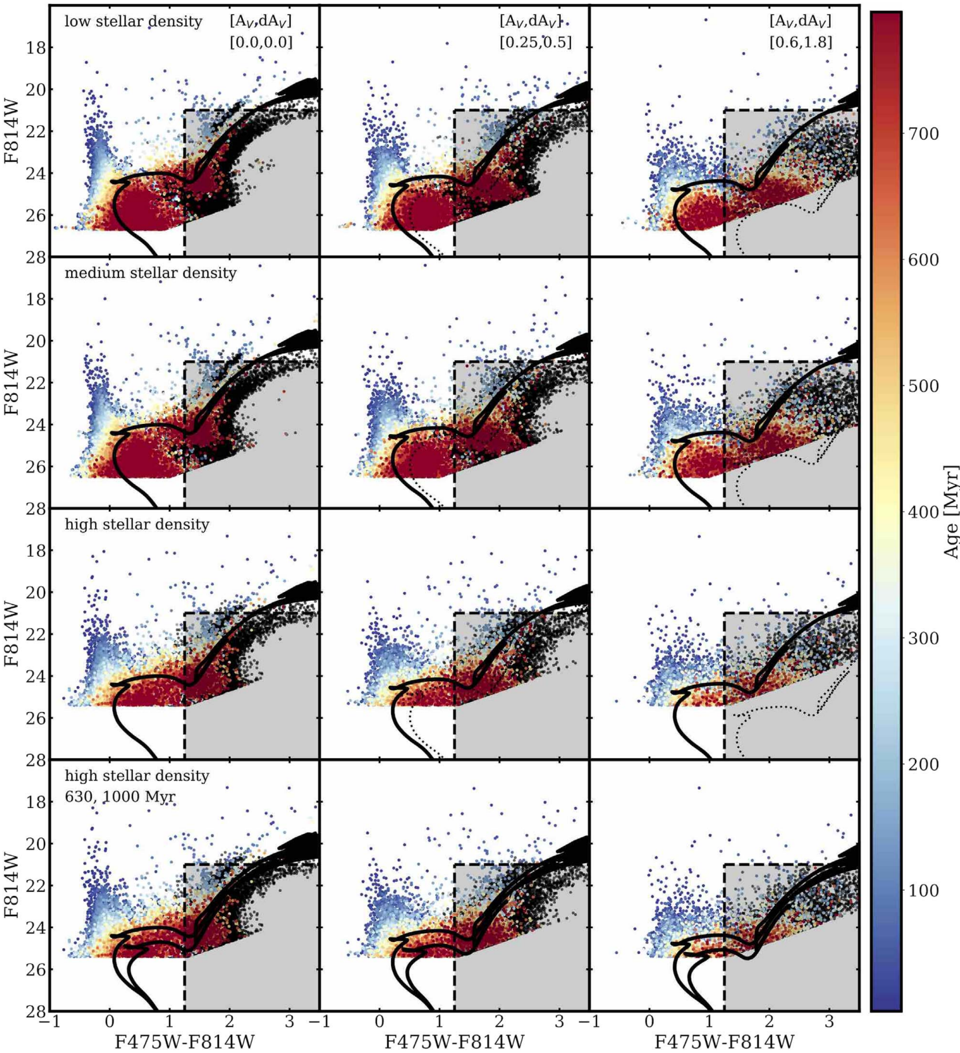
“We focus on the young stellar populations, following the practices of L15 and Lazzarini et al. (2022), by excluding regions of the CMD dominated by older stars by removing sources with F475W -F814W > 1.25 and F475W > 21, a color-magnitude cut that minimizes contamination from the RGB and red clump while preserving reddened massive stars and helium-burning phases.”
From The Panchromatic Hubble Andromeda Southern Treasury (PHAST). II. The Spatially Resolved Recent Star Formation History in M31 (2026) · cites this paper as Lazzarini et al. 2022
2 more claims about this paper
Create a free account to see every claim other papers make about this one.
Self-check
Percentages, sums and reported differences re-computed from the paper’s own numbers.
The self-check needs the paper’s full text.
Citations
Cites
On the variation of the initial mass function
Kroupa, P. (2001) · Monthly Notices of the Royal Astronomical Society · doi:10.1046/j.1365-8711.2001.04022.x · Cited by 7,499 · cited 4×
“In our fits, we define as inputs the age bins, metallicity, distance, extinction, binary fraction, and choice of IMF.”
MethodInfluentialBressan, A., Marigo, P., Girardi, L., Salasnich, B., Dal Cero, C., Rubele, S., & Nanni, A. (2012) · Monthly Notices of the Royal Astronomical Society · doi:10.1111/j.1365-2966.2012.21948.x · Cited by 4,174 · cited 1×
“Our recent SFHs should not be strongly sensitive to metallicity because the color of the upper main-sequence CMD feature that our SFHs rely on is not strongly impacted by metallicity (e.g., Bressan et al. 2012).”
BackgroundDuane, S., Kennedy, A. D., Pendleton, B. J., & Roweth, D. (1987) · Physics Letters B · doi:10.1016/0370-2693(87)91197-x · Cited by 3,872
Star Formation in the Milky Way and Nearby Galaxies
Kennicutt, R. C., & Evans, N. J. (2012) · Annual Review of Astronomy and Astrophysics · doi:10.1146/annurev-astro-081811-125610 · Cited by 2,902 · cited 4×
“The average SFR within the PHATTER footprint within the past 100Myr is useful to compare with SFR measurements involving broadband FUV flux (see Kennicutt & Evans 2012).”
BackgroundMethodInfluentialMESA ISOCHRONES AND STELLAR TRACKS (MIST) 0: METHODS FOR THE CONSTRUCTION OF STELLAR ISOCHRONES
Dotter, A. (2016) · The Astrophysical Journal Supplement Series · doi:10.3847/0067-0049/222/1/8 · Cited by 1,929 · cited 2×
“We perform our calculations using both the Padova (Marigo et al. 2008) isochrones with updated asymptotic giant branch (AGB) tracks (Girardi et al. 2010) and the MIST isochrones (Dotter 2016).”
MethodMarigo, P., Girardi, L., Bressan, A., Groenewegen, M. A. T., Silva, L., & Granato, G. L. (2008) · Astronomy & Astrophysics · doi:10.1051/0004-6361:20078467 · Cited by 1,553 · cited 2×
“We perform our calculations using both the Padova (Marigo et al. 2008) isochrones with updated asymptotic giant branch (AGB) tracks (Girardi et al. 2010) and the MIST isochrones (Dotter 2016).”
MethodOn the Spiral Structure of Disk Galaxies.
Lin, C. C., & Shu, F. H. (1964) · The Astrophysical Journal · doi:10.1086/147955 · Cited by 1,090 · cited 1×
“Second, a strong long-lived spiral pattern in the stellar mass (as traced by the RGB stars that dominate the disk mass) can act as a gravitational perturbation that helps confine the younger stars, following global density wave theory (e.g., Lindblad 1960; Lin & Shu 1964).”
BackgroundJarrett, T. H., Chester, T., Cutri, R., Schneider, S. E., & Huchra, J. P. (2003) · The Astronomical Journal · doi:10.1086/345794 · Cited by 1,040 · cited 1×
“NIR observations in the J, H, K bands and with the Two Micron All Sky Survey have previously revealed a stronger two-arm spiral structure within the inner disk of M33 (Regan & Vogel 1994; Jarrett et al. 2003).”
Modeling the Panchromatic Spectral Energy Distributions of Galaxies
Conroy, C. (2013) · Annual Review of Astronomy and Astrophysics · doi:10.1146/annurev-astro-082812-141017 · Cited by 959 · cited 1×
“Differences between stellar models mainly stem from how they model different aspects of stellar evolution including mass loss, convection, and rotation (Conroy 2013).”
BackgroundBell, E. F. (2003) · The Astrophysical Journal · doi:10.1086/367829 · Cited by 818
Self-citation
Research works printed but not linked: 2
- 46. Hernández-López, I., Athanassoula, E., Mújica, R., & Bosma, A. 2009, in Revista Mexicana de Astronomia y Astrofisica Conf. Ser. 37, A Long Walk Through Astronomy: A Celebration of Luis Carrasco's 60th Birthday, ed. E. Recillas, A. Luna, & Y. D. Mayya, 160
- 62. Lindblad, P. O. 1960, PhD thesis, Stockholm Univ.
Cited by
Massey, P., Neugent, K. F., Ekström, S., Georgy, C., & Meynet, G. (2023) · The Astrophysical Journal · doi:10.3847/1538-4357/aca665 · Cited by 46
“…also grateful to Dr. Nelson Caldwell for help in eliminating some of the clusters and background galaxies that were in the original sample of M31 RSG candidates, and to Dr. Margaret Lazzarini for calculating the average extinction of star-forming regions in M33 from Lazzarini et al. (2022) for us.”
BackgroundMethodEuclid : Early Release Observations – Deep anatomy of nearby galaxies
Hunt, L. K., Annibali, F., Cuillandre, J., Ferguson, A. M. N., Jablonka, P., Larsen, S. S., Marleau, F. R., Schinnerer, E., Schirmer, M., Stone, C., et al. (2025) · Astronomy and Astrophysics · doi:10.1051/0004-6361/202450781 · Cited by 53
JWST reveals star formation across a spiral arm in M33
Peltonen, J., Rosolowsky, E. W., Williams, T. G., Koch, E. W., Dolphin, A. E., Chastenet, J., Dalcanton, J. J., Ginsburg, A. G., Johnson, L. C., Leroy, A. K., et al. (2023) · Monthly Notices of the Royal Astronomical Society · doi:10.1093/mnras/stad3879 · Cited by 28
Self-citationJohnson, L. C., Wainer, T. M., TorresVillanueva, E. E., Seth, A. C., Williams, B. F., Durbin, M., Dalcanton, J. J., Weisz, D. R., Bell, E. F., Guhathakurta, P., et al. (2022) · The Astrophysical Journal · doi:10.3847/1538-4357/ac8def · Cited by 35
“We look forward to using robust star formation history fitting (Lazzarini et al. 2022) to inform recent SFR and ΣSFR determinations for M33, and aid future Γ determinations for the PHATTER cluster sample.”
MethodSelf-citationMazzi, A., Girardi, L., Trabucchi, M., Dalcanton, J. J., Luger, R., Marigo, P., Miglio, A., Costa, G., Chen, Y., Pastorelli, G., et al. (2023) · Monthly Notices of the Royal Astronomical Society · doi:10.1093/mnras/stad2952 · Cited by 20
Self-citationCohen, R. E., McQuinn, K. B. W., Murray, C. E., Williams, B. F., Choi, Y., Lindberg, C. W., Burhenne, C., Gordon, K. D., Merica-Jones, P. Y., Gilbert, K. M., et al. (2024) · The Astrophysical Journal · doi:10.3847/1538-4357/ad6cd5 · Cited by 22
Self-citationSmercina, A., Dalcanton, J. J., Williams, B. F., Durbin, M., Lazzarini, M., Bell, E. F., Choi, Y., Dolphin, A. E., Gilbert, K. M., Guhathakurta, P., et al. (2023) · The Astrophysical Journal · doi:10.3847/1538-4357/acf3e8 · Cited by 22
“We also acknowledge that the accuracy of the age estimates we obtain here will, of course, be impacted by the true shape of M33 ʼ s SFH. M33 ʼ s recent SFH appears to be close to constant over the past ∼ 600 Myr ( e.g., Lazzarini et al. 2022 ) ; however, its global ancient SFH is still uncertain.”
BackgroundMethodResultInfluentialSelf-citationMultiwavelength Characterization of the High-mass X-Ray Binary Population of M33
Lazzarini, M., Hinton, K., Shariat, C., Williams, B. F., Garofali, K., Dalcanton, J. J., Durbin, M., Antoniou, V., Binder, B. A., Eracleous, M., et al. (2023) · The Astrophysical Journal · doi:10.3847/1538-4357/acdbc8 · Cited by 12
“The SFR values come from spatially resolved recent SFHs of each galaxy (Lewis et al. 2015; Lazzarini et al. 2022).”
BackgroundMethodInfluentialSelf-citationCohen, R. E., McQuinn, K. B. W., Murray, C. E., Williams, B. F., Choi, Y., Lindberg, C. W., Burhenne, C., Gordon, K. D., Merica-Jones, P. Y., Bot, C., et al. (2024) · The Astrophysical Journal · doi:10.3847/1538-4357/ad76a6 · Cited by 15
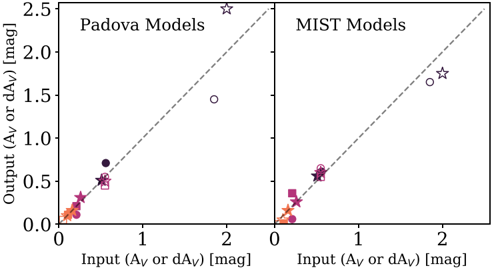
“A similar grid search technique has been implemented using MATCH in the past, but searching over two parameters (A V,fg and δ A V ) rather than three, using an identical grid spacing (Lewis et al. 2015; Lazzarini et al. 2022).”
MethodSelf-citationThe high energy X-ray probe: resolved X-ray populations in extragalactic environments
Lehmer, B. D., Garofali, K., Binder, B. A., Fornasini, F. M., Vulic, N., Zezas, A., Hornschemeier, A. E., Lazzarini, M., Moon, H., Venters, T., et al. (2023) · Frontiers in Astronomy and Space Sciences · doi:10.3389/fspas.2023.1293918 · Cited by 8
“The availability of detailed star-formation history maps for these galaxies (e.g. Harris and Zaritsky, 2004, 2009; Lewis et al., 2015; Lazzarini et al., 2022) from HST data allow us to identify the X-ray counterparts of the X-ray sources, characterize their donor stars (e.g., supergiant, Be-XRB,…”
BackgroundSelf-citationKinson, D. A., Oliveira, J. M., & van Loon, J. T. (2022) · Monthly Notices of the Royal Astronomical Society · doi:10.1093/mnras/stac2692 · Cited by 10
Binder, B. A., Anderson, A. K., Garofali, K., Lazzarini, M., & Williams, B. F. (2023) · Monthly Notices of the Royal Astronomical Society · doi:10.1093/mnras/stad1368 · Cited by 9
Self-citationTREX: Kinematic Characterization of a High-dispersion Intermediate-age Stellar Component in M33
Cullinane, L. R., Gilbert, K. M., Guhathakurta, P., Quirk, A. C. N., Escala, I., Smercina, A., Williams, B. F., Tollerud, E. J., Qu, J., & McConnell, K. (2023) · The Astrophysical Journal · doi:10.3847/1538-4357/ad003b · Cited by 8
Self-citationThe Masses of Supernova Remnant Progenitors in M33
Koplitz, B., Johnson, J. R., Williams, B. F., Díaz-Rodríguez, M., Murphy, J. W., Lazzarini, M., Guzman, J., Dalcanton, J. J., Dolphin, A. E., & Durbin, M. (2023) · The Astrophysical Journal · doi:10.3847/1538-4357/acc249 · Cited by 7
“The second sample is 2500 random draws of the grid SFHs from Lazzarini et al. (2022), which do not contain an SNR. Differences between the random and SNR samples provide additional evidence that the stellar populations near the SNRs are likely related to the progenitors, and not chance spatial…”
BackgroundMethodInfluentialSelf-citationWainer, T. M., Williams, B. F., Johnson, L. C., Weisz, D. R., Dalcanton, J. J., Seth, A. C., Dolphin, A., Durbin, M. J., Bell, E. F., Chen, Z., et al. (2024) · The Astronomical Journal · doi:10.3847/1538-3881/ad5a6e · Cited by 4
“To quantify the SFR associated with each cluster in our sample, we use the SF maps of Lazzarini et al. (2022) who fit color magnitude diagrams to resolved stars in 2005, ∼ 100 parsec regions.”
MethodResultInfluentialSelf-citationA First Look at Spatially Resolved Infrared Supernova Remnants in M33 with JWST
Sarbadhicary, S. K., Rosolowsky, E. W., Leroy, A. K., Williams, T. G., Koch, E. W., Peltonen, J., Smercina, A., Dalcanton, J. J., Glover, S. C. O., Lazzarini, M., et al. (2025) · The Astrophysical Journal · doi:10.3847/1538-4357/adec7a · Cited by 5
Self-citationMeasuring Star Formation Histories from Asymptotic Giant Branch Stars. I. A Demonstration in M31
Lee, A. J., Weisz, D. R., Ren, Y., Savino, A., & Dolphin, A. E. (2025) · The Astrophysical Journal · doi:10.3847/1538-4357/ae12f0 · Cited by 9
“…ASTs in select regions of specific stellar density and applying them more broadly is also used by the PHAT/PHATTER teams, who faced a similar computational challenge of running ASTs across the entire extent of their M31 and M33 footprints, respectively (Williams et al. 2017; Lazzarini et al. 2022).”
Self-citationWhere Do Stars Explode in the ISM?—The Distribution of Dense Gas around Evolved Massive Stars in M33
Sarbadhicary, S. K., Wagner, J., Koch, E. W., Chen, N. M., Leroy, A. K., Lahén, N., Rosolowsky, E. W., Neugent, K. F., Kim, C., Chomiuk, L. B., et al. (2026) · The Astrophysical Journal · doi:10.3847/1538-4357/ae3f33 · Cited by 14
“For example, the total stellar mass formed in the last ∼ 10 Myr in NGC 604 is 1.06 10 0.420.67 5 ( Lazzarini et al. 2022; note that maps measure star formation histories in ∼ 100 pc sized cells ) .”
InfluentialSelf-citationChoi, Y., Gilbert, K. M., Williams, B. F., Weisz, D. R., Skillman, E. D., Dalcanton, J. J., McQuinn, K. B. W., Dolphin, A. E., Pastorelli, G., Boyer, M. L., et al. (2025) · The Astronomical Journal · doi:10.3847/1538-3881/adc384 · Cited by 3
“…we follow the procedure described in the literature for using MATCH to determine the SFH that best reproduces the observed CMD (e.g., Dolphin 2002; Skill-man et al. 2003; McQuinn et al. 2010a; Weisz et al. 2011; Williams et al. 2011; Choi et al. 2015; Lewis et al. 2015; Lazzarini et al. 2022).”
Self-citationGuhathakurta, P., Filho, D. G., Bhattacharya, A. R., Cullinane, L. R., Dalcanton, J. J., Gilbert, K. M., Girardi, L., Kamath, A., Kirby, E. N., Maheshwari, A., et al. (2025) · The Astrophysical Journal · doi:10.3847/1538-4357/adcc2c · Cited by 2
Self-citationStars Born in the Wind: M82’s Outflow and Halo Star Formation
Rao, V. V., Smercina, A., Bell, E. F., Williams, B. F., Dalcanton, J. J., Dolphin, A. E., Leroy, A. K., Monachesi, A., Bailin, J., de Jong, R. S., et al. (2025) · The Astrophysical Journal · doi:10.3847/1538-4357/adfdce · Cited by 6
“Dolphin et al. 2003; Weisz et al. 2014; Lazzarini et al. 2022).”
Self-citationStars Born in the Wind. II. Widespread Extra-planar Star Formation in M82’s Halo
Rao, V. V., Bell, E. F., Smercina, A., Besirli, E., Dolphin, A. E., Monachesi, A., Williams, B., Dalcanton, J. J., & de Jong, R. S. (2026) · The Astrophysical Journal · doi:10.3847/1538-4357/ae5c99 · Cited by 4
“Since our focus is on the younger populations, we excluded the CMD regions occupied by the old RGB stars ( see, e.g., A. R. Lewis et al. 2015; M. Lazzarini et al. 2022 ) using the exclude_gates functionality of MATCH and restricted the fits to regions sensitive to populations formed within the last…”
Self-citationSubaru Suprime-Cam Wide-field BVI Stellar Photometry of the M33 Galaxy
Stonkutė, R., & Vansevičius, V. (2024) · The Astrophysical Journal Supplement Series · doi:10.3847/1538-4365/ad566e · Cited by 1
Discovery of Weak CN Stars in the Large Magellanic Cloud and Comparison to Stellar Models
Filho, D. G., Guhathakurta, P., Rinehart, S. M., Girardi, L., Marigo, P., Bhattacharya, A. R., & Olsen, K. A. G. (2025) · The Astrophysical Journal · doi:10.3847/1538-4357/adb030 · Cited by 2
Self-citationWainer, T. M., Williams, B. F., Chen, Z., Lazzarini, M., Dalcanton, J. J., Bell, E. F., Goold, K., Dolphin, A., Durbin, M. J., Dubón, S. L. F., et al. (2026) · The Astrophysical Journal · doi:10.3847/1538-4357/ae6db9
“We focus on the young stellar populations, following the practices of L15 and Lazzarini et al. (2022), by excluding regions of the CMD dominated by older stars by removing sources with F475W − F814W > 1.25 and F475W > 21, a color-magnitude cut that minimizes contamination from the RGB and red clump…”
InfluentialSelf-citationThe Progenitor Systems of Classical Novae in M31
Abelson, C. S., Badenes, C., Chomiuk, L. B., Williams, B. F., Breivik, K., Galbany, L., & Jiménez-Palau, C. (2025) · The Astrophysical Journal · doi:10.3847/1538-4357/adc68c · Cited by 2
“…to improve the resolution of the nova DTD. SAD maps similar to that of Williams et al. (2017) exist for other galaxies in the Local Group (e.g., Lazzarini et al. 2022 for M33, Mazzi et al. 2021; Harris & Zaritsky 2009 for the LMC, Rubele et al. 2018; Harris & Zaritsky 2004 for the SMC), with…”
Self-citationScylla at APOGEE: The Impact of Starbursts on the Chemical Evolution of the Magellanic Clouds
Escala, I., McQuinn, K. B. W., Hasselquist, S., Cohen, R. E., Johnson, J. W., Hayes, C. R., Burhenne, C., Ji, A. P., Lindberg, C. W., Merica-Jones, P. Y., et al. (2026) · The Astrophysical Journal · doi:10.3847/1538-4357/ae5a39 · Cited by 2
“During SFH fitting, MATCH was allowed to explore a grid in distance modulus ( m − M ) 0 , foreground extinction A V , and internal differential extinction δ A V ( see A. R. Lewis et al. 2015; M. Lazzarini et al. 2022 ) .”
Self-citationChandar, R., Floyd, M. R., Thilker, D. A., Henny, K. F., Whitmore, B. C., Lee, J. C., Deger, S., Dale, D. A., Larson, K. L., Boquien, M., et al. (2026) · The Astrophysical Journal · doi:10.3847/1538-4357/ae9753
“Spiral galaxies in general ( J. C. Lee et al. 2009; E. Silva-Villa & S. S. Larsen 2011; A. R. Lewis et al. 2015; E. Sacchi et al. 2019; M. Lazzarini et al. 2022 ) and certainly the combined groups studied here are expected to have experienced fairly constant SFHs over the past Gyr, so we can assume…”
InfluentialSelf-citation
Metadata
- Authors
- Lazzarini, M., Williams, B. F., Durbin, M. J., Dalcanton, J. J., Smercina, A., Bell, E. F., Choi, Y., Dolphin, A., Gilbert, K., Guhathakurta, P., Rosolowsky, E., Skillman, E., Telford, O. G., & Weisz, D.
- Affiliations
- California Institute of Technology (US)
- University of Washington (US)
- University of Michigan (US)
- Space Telescope Science Institute (US)
- RTX (United States) (US)
- University of California, Santa Cruz (US)
- University of Alberta (CA)
- University of Minnesota (US)
- Rutgers, The State University of New Jersey (US)
- University of California, Berkeley (US)
- ORCID
- Venue
- The Astrophysical Journal
- Publisher
- American Astronomical Society
- Published
- 2022-07-01
- Volume
- 934
- Issue
- 1
- Pages
- 76
- ISSN
- 0004-637X (ISSN-L)
- 1538-4357
- OpenAlex
- W4283456198
- Cited by
- 28
- References
- 96
- Citations by year
- 2026: 5 · 2025: 7 · 2024: 5 · 2023: 9 · 2022: 2
- FWCI
- 2.30
- Type
- journal article
- Language
- en
- Open access
- gold
- doi.org
- Licence
- cc-by
- creativecommons.org/licenses/by/4.0/ (vor, 26 d)
- iopscience.iop.org/info/page/text-and-data-mining (tdm, 26 d)
- Locations
- The Astrophysical Journal (publishedVersion, cc-by)
- UA Campus Repository (The University of Arizona) (acceptedVersion, cc-by)
- arXiv (Cornell University) (submittedVersion)
- CaltechAUTHORS (California Institute of Technology) (submittedVersion, cc-by)
- arXiv (Cornell University) (cc-by)
- Funders
- National Aeronautics and Space Administration (GO-14610)
- National Science Foundation (AST-2102721)
- Topics
- Physical Sciences › Physics and Astronomy › Astronomy and Astrophysics › Galaxies: Formation, Evolution, Phenomena
- Physical Sciences › Physics and Astronomy › Astronomy and Astrophysics › Stellar, planetary, and galactic studies
- Physical Sciences › Physics and Astronomy › Astronomy and Astrophysics › Astrophysics and Star Formation Studies
- Keywords
- M33, spatially resolved star formation, stellar populations, spiral arms, galactic bars, star formation rate, color-magnitude diagram
About these checks
Registry, retraction, Cites and statistics results are computed, not judged, with one exception: a printed reference that no index lists is read once by a model before it counts as a citation error. Claims are extracted by a model and kept only when their quote appears verbatim in the text; each cited source is then checked, with a model’s help, for whether it says what the claim relies on. Those verdicts can be wrong — read the claim’s quote and the cited source before relying on one.
Statistics and arithmetic are recomputed, not judged.
Confidence bands are shown only for fields calibrated on our annotated test set. None is calibrated yet, so no band is shown.
What counts as a claim ›How we measure confidence ›How we check this ›
Are you an author, or do you see a problem with this page? Request a review
Data sources
Bibliographic data: Semantic Scholar, OpenAlex, Crossref.
Contains information from the Semantic Scholar Academic Graph Datasets, made available under the ODC Attribution License (ODC-BY 1.0).
Semantic Scholar’s data is described in: Kinney, R., et al. (2023). The Semantic Scholar Open Data Platform. arXiv:2301.10140.
