

Discovery and Preliminary Characterization of a Third Interstellar Object: 3I/ATLAS
Open accessThe DOI matches its Crossref record; 83 of the 83 references it cites were found in a registry or an index; none of the 25 sources its claims cite is checked for support yet.
Abstract
We report initial observations aimed at the characterization of a third interstellar object. This object, 3I/ATLAS or C/2025 N1 (ATLAS), was discovered on 2025 July 1 UT and has an orbital eccentricity of e ∼ 6.1, perihelion of q ∼ 1.36 au, inclination of ∼175°, and hyperbolic velocity of V ∞ ∼ 58 km s −1 . We report deep stacked images obtained using the Canada–France–Hawaii Telescope and the Very Large Telescope that resolve a compact coma. Using images obtained from several smaller ground-based telescopes, we find minimal light-curve variation for the object over a ∼4 day time span. The visible/near-infrared spectral slope of the object is 17.1% ± 0.2%/100 nm, comparable to other interstellar objects and primitive solar system small bodies (comets and D-type asteroids). Moreover, 3I/ATLAS will be observable through early 2025 September, then unobservable by Earth-based observatories near perihelion due to low solar elongation. It will be observable again from the ground in late 2025 November. Although this limitation unfortunately prohibits detailed Earth-based observations at perihelion when the activity of 3I/ATLAS is likely to peak, spacecraft at Mars could be used to make valuable observations at this time.
Overview
CoChat Summary
TL;DR
3I/ATLAS is the third interstellar object discovered, with a strongly hyperbolic orbit (e ≈ 6.1, q ≈ 1.36 au, i ≈ 175°, v∞ ≈ 58 km s⁻¹) and a compact coma resolved by CFHT and VLT imaging. Preliminary photometry and spectroscopy show minimal light-curve variation over ~4 days and a moderately red spectral slope of 17.1% ± 0.2%/100 nm, similar to primitive solar system small bodies and other interstellar objects.
Key findings
- Discovery and orbit: 3I/ATLAS was discovered on 2025 July 1 UT by ATLAS Chile; an orbit fit using astrometry from 2025 May 22 to July 6 gives e = 6.1329072 ± 0.0162018, q = 1.3558541 ± 0.0019855 au, i = 175.11239 ± 0.00089°, and incoming v∞ = 57.942 ± 0.049 km s⁻¹, with barycentric e_b = 6.144 ± 0.016 and q_b = 1.3611 ± 0.0020 au.
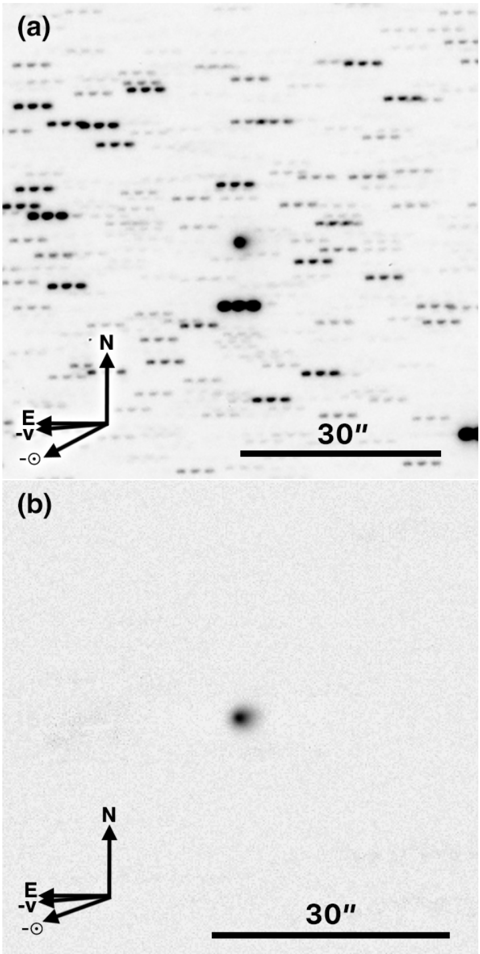
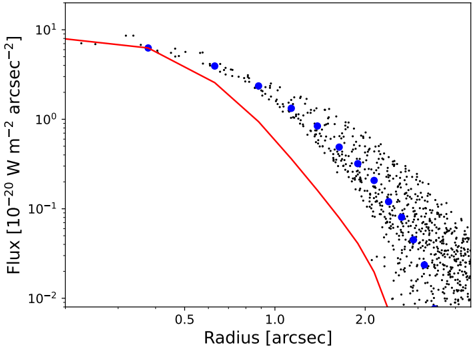
- Activity: CFHT and VLT stacked images resolve a compact coma; the VLT photometric profile shows a brightness excess extending over 4.0″ compared to field stars, with object FWHM 1.49 × 1.29 and elongation at PA 277°, coma out to 3.5″; CFHT object FWHM was 1.29 ± 0.02 versus stellar 0.72 ± 0.05.
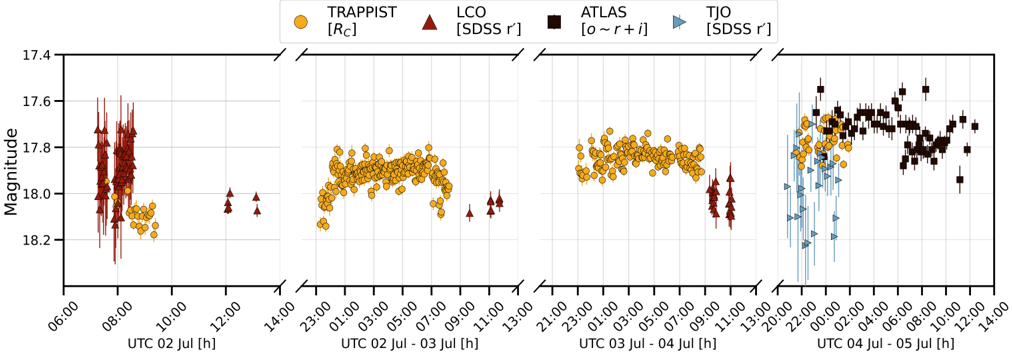
- Light curve: no periodicity is immediately apparent, with little brightness variation ≲0.2 mag over ~4 days, in contrast to 1I/‘Oumuamua’s ~3.5 mag; a 13 hr continuous ATLAS light curve agrees with a tentative 16.79 hr period and 0.08 mag amplitude reported by de la Fuente Marcos et al. (2025).
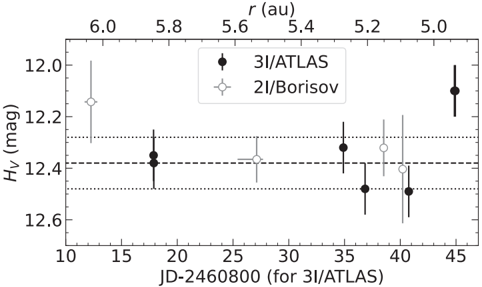
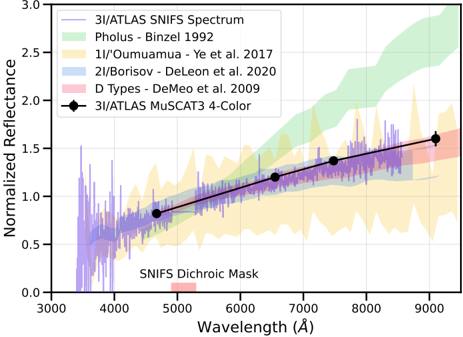
- Colors and spectrum: the SNIFS reflectance spectrum yields 17.1% ± 0.2%/100 nm; MuSCAT3 colors are g−r = 0.85 ± 0.03, r−i = 0.25 ± 0.03, and i−z = 0.20 ± 0.08, giving ~18%/100 nm, similar to 1I/‘Oumuamua (10% ± 6%/100 nm), 2I/Borisov (12% ± 1%/100 nm), and D-type asteroids. ZTF precovery photometry gives median H_V ~12.4 ± 0.1, with 2025 June 18 H_V = 12.1 ± 0.1 and LCO r-band data corresponding to H_V = 11.9, suggesting about 0.5 mag of excess brightening since early June; H_V = 12.4 ± 0.1 corresponds to a radius of ~10 ± 1 km for p_V = 0.05, as an upper limit.
Methods
- Discovery and follow-up observations used ATLAS Chile/Hawai‘i/Sutherland/Canary Islands, CFHT/MegaCam, VLT/FORS2, LCO 0.35 m telescopes, FTN/FTS, TRAPPIST-North/South, TJO, and the ATLAS network; spectroscopy used SNIFS on the UH 2.2 m telescope, and colors used MuSCAT3 on FTN.
- Orbit fitting used astrometry from 2025 May 22 to 2025 July 6, including VLT astrometry better than ±0.1 and LCO/FTN/FTS astrometry better than ±0.25, with Gaia DR3 as the reference catalog.
- Light-curve and color analysis used time-series photometry from 2025 July 2–5, ZTF precovery photometry from 2025 May 22 to June 18, aperture photometry and PSF-based forced photometry, and spectral slope measurements from SNIFS and MuSCAT3 colors.
Limitations
- Stated: ZTF precovery data had no reported uncertainties, so the standard deviation of points from May 22 to June 14 was adopted as an approximate uncertainty; the CFHT magnitude was considered unreliable due to a crowded field; PSF-based forced photometry may underreport the brightness of extended sources; the G = 0.15 phase function may be inappropriate for an object with unknown coma and surface scattering, potentially making the density estimate significantly incorrect; H_V was measured when active, so the limiting search volume corresponds to the inert nucleus; perihelion will not be easily observable from Earth-based observatories due to low solar elongation and the object being on the opposite side of the Sun.
- Evident from the text: the characterization is preliminary, based on a short arc and limited time span; activity and coma can suppress rotational light-curve variations and contaminate colors, and the later, redder colors may be heavily affected by ejected dust; more detailed light-curve analysis is deferred to future work.
Model-written summary. Check it against the paper before relying on it.
Integrity signals
Registry
Cites
Statistics
Figures
Verification
Claims the paper makes
0 Valid · 2 Not valid · 14 Not checked · 50 Own results and interpretations
A result the paper states — it cites no source for it, so there is none to check. The quote shows it is in the paper.
In the paper
“hyperbolic velocity of V ∞ ∼ 58 km s -1”
- Also stated in: § Note. · plain
“results in an incoming velocity v ∞ = (57.942± 0.049) km s -1”
§ Discovery and Preliminary Characterization of a Third Interstellar Object: 3I/ATLAS > Abstract
plain- Asserted: passes — The authors put it forward as true.
- Checkable: passes — It can be checked against evidence.
- Load-bearing: passes — The paper’s conclusions depend on it.
- Based: passes — The paper gives a reason why it holds.
- Also stated in: § Note. · plain
A result the paper reports from its own data — it cites no other source for it, so there is none to check. The quote shows it is in the paper.
In the paper
“This value, together with an incoming pericenter distance of q b = (1.3611± 0.0020) au”
§ Discovery and Preliminary Characterization of a Third Interstellar Object: 3I/ATLAS > Note.
plain- Asserted: passes — The authors put it forward as true.
- Checkable: passes — It can be checked against evidence.
- Load-bearing: passes — The paper’s conclusions depend on it.
- Based: passes — The paper gives a reason why it holds.
A result the paper reports from its own data — it cites no other source for it, so there is none to check. The quote shows it is in the paper.
In the paper
“Prediscovery detections from 2025 June 28 to 29 were identified in Zwicky Transient Facility (ZTF; E. C. Bellm et al. 2019; M. J. Graham et al. 2019) survey data 6 hr after the initial detection by ATLAS on 2025 July 1, extending the orbital arc from 3.3 hr to 3 days.”
§ Discovery and Preliminary Characterization of a Third Interstellar Object: 3I/ATLAS > 2.1. Discovery
plainstates a cause- Asserted: passes — The authors put it forward as true.
- Checkable: passes — It can be checked against evidence.
- Load-bearing: passes — The paper’s conclusions depend on it.
- Based: passes — The paper gives a reason why it holds.
A result the paper reports from its own data — it cites no other source for it, so there is none to check. The quote shows it is in the paper.
In the paper
“perihelion of q ∼ 1.36 au”
§ Discovery and Preliminary Characterization of a Third Interstellar Object: 3I/ATLAS > Abstract
plain- Asserted: passes — The authors put it forward as true.
- Checkable: passes — It can be checked against evidence.
- Load-bearing: unclear — It is unclear whether the paper’s conclusions depend on it.
- Based: passes — The paper gives a reason why it holds.
A result the paper reports from its own data — it cites no other source for it, so there is none to check. The quote shows it is in the paper.
In the paper
“Figure 3(a) shows the stacked composite image of these data in which faint activity is visible.”
§ Discovery and Preliminary Characterization of a Third Interstellar Object: 3I/ATLAS > 3.1. Activity
plain- Asserted: passes — The authors put it forward as true.
- Checkable: passes — It can be checked against evidence.
- Load-bearing: passes — The paper’s conclusions depend on it.
- Based: passes — The paper gives a reason why it holds.
31 more claims
Create a free account to see all 66 claims and to verify the 23 references still open.
- It may state two separate claims as one. 25
- Probably not a substantial claim. 8
- The quote only partly states this claim. 1
Self-check
Percentages, sums and reported differences re-computed from the paper’s own numbers.
Each contradiction between two passages listed here was confirmed by an independent check.
Rated minor: it would not touch a result — a value no result rests on, a p-value that stays on the same side of the significance level, or a conflict that is clerical, resolved elsewhere in the paper, or outside its own findings.
In the paper
§ Discovery and Preliminary Characterization of a Third Interstellar Object: 3I/ATLAS > 4. Discussion
“Figure 4. Photometric profile of the VLT image (Figure 3(a)).”
§ Discovery and Preliminary Characterization of a Third Interstellar Object: 3I/ATLAS > 4. Discussion
“(a) Stacked gri-band image cut out from CFHT on 2025 July 2 and (b) R-band composite image from VLT on 2025 July 4, both showing faint activity.”
Rated minor: it would not touch a result — a value no result rests on, a p-value that stays on the same side of the significance level, or a conflict that is clerical, resolved elsewhere in the paper, or outside its own findings.
In the paper
§ Discovery and Preliminary Characterization of a Third Interstellar Object: 3I/ATLAS > 4. Discussion
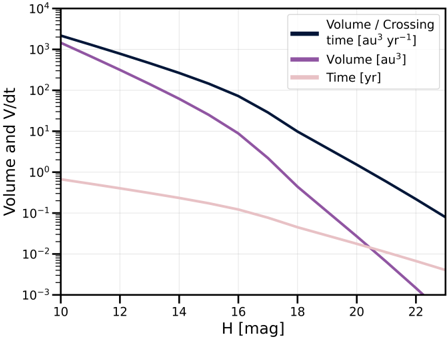
“In this case since H V of 3I/ATLAS was measured when active, this limiting search volume corresponds to the absolute brightness of the inert nucleus.”
§ Discovery and Preliminary Characterization of a Third Interstellar Object: 3I/ATLAS > 3.1. Activity
“For reference, H V = 12.4 ± 0.1 corresponds to a radius of ∼(10 ± 1) km for a geometric albedo of p V = 0.05 typical of comets, but this is an upper limit, given that the object was active during the observations used to derive this result.”
Citations
Cites
Gaia Data Release 3: Summary of the content and survey properties
Gaia Collaboration, Vallenari, A., Brown, A. G. A., Prusti, T., de Bruijne, J. H. J., Arenou, F., Babusiaux, C., Biermann, M., Creevey, O. L., Ducourant, C., et al. (2023) · Astronomy & Astrophysics · doi:10.1051/0004-6361/202243940 · Cited by 4,181
The Zwicky Transient Facility: System Overview, Performance, and First Results
Bellm, E. C., Kulkarni, S. R., Graham, M. J., Dekany, R., Smith, R. M., Riddle, R., Masci, F. J., Helou, G., Prince, T. A., Adams, S. M., et al. (2019) · Publications of the Astronomical Society of the Pacific · doi:10.1088/1538-3873/aaecbe · Cited by 2,065 · cited 2×
“Prediscovery detections from 2025 June 28 to 29 were identified in Zwicky Transient Facility ( ZTF; E. C. Bellm et al. 2019; M. J. Graham et al. 2019 ) survey data 6 hr after the initial detection by ATLAS on 2025 July 1, extending the orbital arc from 3.3 hr to 3 days.”
InfluentialSelf-citationATLAS: A High-cadence All-sky Survey System
Tonry, J. L., Denneau, L., Heinze, A. N., Stalder, B., Smith, K. W., Smartt, S. J., Stubbs, C. W., Weiland, H. J., & Rest, A. (2018) · Publications of the Astronomical Society of the Pacific · doi:10.1088/1538-3873/aabadf · Cited by 1,229 · cited 4×
“Therefore we adopt this standard deviation as an approximate uncertainty level for all ZTF photometry reported here for 3I / ATLAS based on the scatter in the available photometric points between 2025 May 22 and June 14.”
InfluentialSelf-citationAn extension of the Bus asteroid taxonomy into the near-infrared
DeMeo, F. E., Binzel, R. P., Slivan, S. M., & Bus, S. J. (2009) · Icarus · doi:10.1016/j.icarus.2009.02.005 · Cited by 941 · cited 2×
“It is similar, though somewhat redder, to that retrieved for 1I / “Oumuamua ( 10% ± 6% / 100 nm, Q.-Z. Ye et al. 2017 ) and 2I / Borisov ( 12% ± 1% / 100 nm J. de León et al. 2020 ) , both of which are slightly redder than the D-type asteroids ( F. E. DeMeo et al. 2009 ) .”
The Zwicky Transient Facility: Science Objectives
Graham, M. J., Kulkarni, S. R., Bellm, E. C., Adams, S. M., Barbarino, C., Blagorodnova, N., Bodewits, D., Bolin, B., Brady, P. R., Cenko, S. B., et al. (2019) · Publications of the Astronomical Society of the Pacific · doi:10.1088/1538-3873/ab006c · Cited by 832 · cited 2×
“Prediscovery detections from 2025 June 28 to 29 were identified in Zwicky Transient Facility ( ZTF; E. C. Bellm et al. 2019; M. J. Graham et al. 2019 ) survey data 6 hr after the initial detection by ATLAS on 2025 July 1, extending the orbital arc from 3.3 hr to 3 days.”
InfluentialSelf-citationThe Pan-STARRS1 Database and Data Products
Flewelling, H. A., Magnier, E. A., Chambers, K. C., Heasley, J. N., Holmberg, C., Huber, M. E., Sweeney, W., Waters, C. Z., Calamida, A., Casertano, S., et al. (2020) · The Astrophysical Journal Supplement Series · doi:10.3847/1538-4365/abb82d · Cited by 646 · cited 2×
“TRAPPIST-North ( TN; MPC code Z53 ) is located at the Oukaimeden observatory in Morocco, and TRAPPIST-South ( TS; MPC code I40 ) is located at the ESO La Silla Observatory in Chile.”
InfluentialSelf-citationEmpirical color transformations between SDSS photometry and other photometric systems
Jordi, K., Grebel, E. K., & Ammon, K. (2006) · Astronomy & Astrophysics · doi:10.1051/0004-6361:20066082 · Cited by 581 · cited 1×
“We compute inferred V -band absolute magnitude from these data assuming a standard asteroidal phase function ( E. Bowell et al. 1989 ) assuming G = 0.15 and solar colors ( J. Holmberg et al. 2006; K. Jordi et al. 2006 ) .”
InfluentialA brief visit from a red and extremely elongated interstellar asteroid
Meech, K. J., Weryk, R., Micheli, M., Kleyna, J. T., Hainaut, O. R., Jedicke, R., Wainscoat, R. J., Chambers, K. C., Keane, J. V., Petric, A., et al. (2017) · Nature · doi:10.1038/nature25020 · Cited by 424
Self-citationDesign and Operation of the ATLAS Transient Science Server
Smith, K. W., Smartt, S. J., Young, D. R., Tonry, J. L., Denneau, L., Flewelling, H., Heinze, A. N., Weiland, H. J., Stalder, B., Rest, A., et al. (2020) · Publications of the Astronomical Society of the Pacific · doi:10.1088/1538-3873/ab936e · Cited by 357 · cited 2×
“Therefore we adopt this standard deviation as an approximate uncertainty level for all ZTF photometry reported here for 3I / ATLAS based on the scatter in the available photometric points between 2025 May 22 and June 14.”
Self-citationMegaCam: the new Canada-France-Hawaii Telescope wide-field imaging camera
Boulade, O., Charlot, X., Abbon, P., Aune, S., Borgeaud, P., Carton, P.-H., Carty, M., Da Costa, J., Deschamps, H., Desforge, D., et al. (2003) · SPIE Proceedings · doi:10.1117/12.459890 · Cited by 280
The ATLAS All-Sky Stellar Reference Catalog
Tonry, J. L., Denneau, L., Flewelling, H., Heinze, A. N., Onken, C. A., Smartt, S. J., Stalder, B., Weiland, H. J., & Wolf, C. (2018) · The Astrophysical Journal · doi:10.3847/1538-4357/aae386 · Cited by 279 · cited 4×
“Figure 5 also includes the corresponding H V of 2I / Borisov’s unresolved coma from prediscovery ZTF observations of that comet ( Q. Ye et al. 2020 ) at similar r for comparison.”
InfluentialSelf-citationNon-gravitational acceleration in the trajectory of 1I/2017 U1 (‘Oumuamua)
Micheli, M., Farnocchia, D., Meech, K. J., Buie, M. W., Hainaut, O. R., Prialnik, D., Schörghofer, N., Weaver, H. A., Chodas, P. W., Kleyna, J. T., et al. (2018) · Nature · doi:10.1038/s41586-018-0254-4 · Cited by 219 · cited 4×
“Alternatively, 1I / ‘Oumuamua could have been outgassing volatiles with low levels of dust production, rendering it photometrically inactive in all extant observations ( M. Seligman 2023 ) .”
InfluentialSelf-citationHolmberg, J., Flynn, C., & Portinari, L. (2006) · Monthly Notices of the Royal Astronomical Society · doi:10.1111/j.1365-2966.2005.09832.x · Cited by 217 · cited 3×
“We compute inferred V -band absolute magnitude from these data assuming a standard asteroidal phase function ( E. Bowell et al. 1989 ) assuming G = 0.15 and solar colors ( J. Holmberg et al. 2006; K. Jordi et al. 2006 ) .”
InfluentialSNIFS: a wideband integral field spectrograph with microlens arrays
Lantz, B., Aldering, G., Antilogus, P., Bonnaud, C., Capoani, L., Castera, A., Copin, Y., Dubet, D., Gangler, E., Henault, F., et al. (2004) · SPIE Proceedings · doi:10.1117/12.512493 · Cited by 175
Interstellar Interloper 1I/2017 U1: Observations from the NOT and WIYN Telescopes
Jewitt, D., Luu, J., Rajagopal, J., Kotulla, R., Ridgway, S., Liu, W., & Augusteijn, T. (2017) · The Astrophysical Journal Letters · doi:10.3847/2041-8213/aa9b2f · Cited by 174 · cited 1×
“For one, 1I / ‘Oumuamua displayed no visible activity ( D. Jewitt et al. 2017; K. J. Meech et al. 2017; Q.-Z. Ye et al. 2017; D. E. Trilling et al. 2018 ) , yet nongravitational acceleration was detected in its trajectory at the ∼ 30 σ level ( M. Micheli et al. 2018 ) .”
The carbon monoxide-rich interstellar comet 2I/Borisov
Bodewits, D., Noonan, J. W., Feldman, P. D., Bannister, M. T., Farnocchia, D., Harris, W. M., Li, J., Mandt, K. E., Parker, J. W., & Xing, Z. (2020) · Nature Astronomy · doi:10.1038/s41550-020-1095-2 · Cited by 160 · cited 1×
“…seen in comets ( C. Opitom et al. 2019; M. T. Bannister et al. 2020; T. Kareta et al. 2020; H. W. Lin et al. 2020; Z. Xing et al. 2020; K. Aravind et al. 2021; S. Bagnulo et al. 2021 ) , it had a high enrichment of CO relative to H 2 O ( D. Bodewits et al. 2020; M. A. Cordiner et al. 2020 ) .”
Self-citationUnusually high CO abundance of the first active interstellar comet
Cordiner, M., Milam, S. N., Biver, N., Bockelée-Morvan, D., Roth, N. X., Bergin, E. A., Jehin, E., Remijan, A. J., Charnley, S. B., Mumma, M. J., et al. (2020) · Nature Astronomy · doi:10.1038/s41550-020-1087-2 · Cited by 154 · cited 1×
“…seen in comets ( C. Opitom et al. 2019; M. T. Bannister et al. 2020; T. Kareta et al. 2020; H. W. Lin et al. 2020; Z. Xing et al. 2020; K. Aravind et al. 2021; S. Bagnulo et al. 2021 ) , it had a high enrichment of CO relative to H 2 O ( D. Bodewits et al. 2020; M. A. Cordiner et al. 2020 ) .”
Self-citationInitial characterization of interstellar comet 2I/Borisov
Guzik, P., Drahus, M., Rusek, K., Waniak, W., Cannizzaro, G., & Pastor-Marazuela, I. (2019) · Nature Astronomy · doi:10.1038/s41550-019-0931-8 · Cited by 145 · cited 1×
“Meanwhile, 2I / Borisov displayed clear outgassing and dust ejection activity ( A. Fitzsimmons et al. 2019; D. Jewitt & J. Luu 2019; G. Cremonese et al. 2020; P. Guzik et al. 2020; M.-T. Hui et al. 2020; Y. Kim et al. 2020; A. J. McKay et al. 2020; Q. Ye et al. 2020; B. Yang et al. 2021 ) .”
Initial Characterization of Interstellar Comet 2I/2019 Q4 (Borisov)
Jewitt, D., & Luu, J. (2019) · The Astrophysical Journal Letters · doi:10.3847/2041-8213/ab530b · Cited by 133 · cited 1×
“Meanwhile, 2I / Borisov displayed clear outgassing and dust ejection activity ( A. Fitzsimmons et al. 2019; D. Jewitt & J. Luu 2019; G. Cremonese et al. 2020; P. Guzik et al. 2020; M.-T. Hui et al. 2020; Y. Kim et al. 2020; A. J. McKay et al. 2020; Q. Ye et al. 2020; B. Yang et al. 2021 ) .”
Interstellar Interlopers: Number Density and Origin of ‘Oumuamua-like Objects
Do, A., Tucker, M. A., & Tonry, J. (2018) · The Astrophysical Journal Letters · doi:10.3847/2041-8213/aaae67 · Cited by 127 · cited 4×
“Moreover, 2I / Borisov’s coma was similarly red ( see, e.g., J. de León et al. 2020 ) , but the object was also significantly more active at the time of the color observations.”
InfluentialSelf-citationSpectroscopy and thermal modelling of the first interstellar object 1I/2017 U1 ‘Oumuamua
Fitzsimmons, A., Snodgrass, C., Rozitis, B., Yang, B., Hyland, M., Seccull, T., Bannister, M. T., Fraser, W. C., Jedicke, R., & Lacerda, P. (2017) · Nature Astronomy · doi:10.1038/s41550-017-0361-4 · Cited by 125 · cited 3×
“…6:6:1 geometry ( M. M. Knight et al. 2017; K. J. Meech et al. 2017; M. J. S. Belton et al. 2018; ; W. C. Fraser et al. 2018; S. Mashchenko 2019; A. G. Taylor et al. 2023 ) and had a moderately red reflectance spectrum ( K. J. Meech et al. 2017; Q.-Z. Ye et al. 2017; A. Fitzsimmons et al. 2018 ) .”
Self-citationSpitzer Observations of Interstellar Object 1I/‘Oumuamua
Trilling, D. E., Mommert, M., Hora, J. L., Farnocchia, D., Chodas, P. W., Giorgini, J. D., Smith, H. A., Carey, S. J., Lisse, C. M., Werner, M. W., et al. (2018) · The Astronomical Journal · doi:10.3847/1538-3881/aae88f · Cited by 120 · cited 1×
“For one, 1I / ‘Oumuamua displayed no visible activity ( D. Jewitt et al. 2017; K. J. Meech et al. 2017; Q.-Z. Ye et al. 2017; D. E. Trilling et al. 2018 ) , yet nongravitational acceleration was detected in its trajectory at the ∼ 30 σ level ( M. Micheli et al. 2018 ) .”
Self-citationJewitt, D. C., & Seligman, D. Z. (2023) · Annual Review of Astronomy and Astrophysics · doi:10.1146/annurev-astro-071221-054221 · Cited by 117
Self-citation2I/Borisov: A C 2 -depleted interstellar comet
Opitom, C., Fitzsimmons, A., Jehin, E., Moulane, Y., Hainaut, O., Meech, K. J., Yang, B., Snodgrass, C., Micheli, M., Keane, J. V., et al. (2019) · Astronomy and Astrophysics · doi:10.1051/0004-6361/201936959 · Cited by 113 · cited 1×
“Although 2I / Borisov’s coma was found to contain volatile species typically seen in comets ( C. Opitom et al. 2019; M. T. Bannister et al. 2020; T. Kareta et al. 2020; H. W. Lin et al. 2020; Z. Xing et al. 2020; K. Aravind et al. 2021; S. Bagnulo et al. 2021 ) , it had a high enrichment of CO…”
Self-citationPHOTOMETRYPIPELINE: An automated pipeline for calibrated photometry
Mommert, M. (2017) · Astronomy and Computing · doi:10.1016/j.ascom.2016.11.002 · Cited by 107 · cited 4×
“The data output by the LCO reduction pipelines were processed with PHOTOMETRY-PIPELINE ( M. Mommert 2017 ) , which performs SCAMP astrometric solutions against Gaia DR3 ( Gaia Collaboration et al. 2023 ) and aperture photometry using apertures with radii of 1.46 ( 5.4 pixels ) and calibrated to…”
InfluentialEvidence that 1I/2017 U1 (‘Oumuamua) was Composed of Molecular Hydrogen Ice
Seligman, D. Z., & Laughlin, G. (2020) · The Astrophysical Journal Letters · doi:10.3847/2041-8213/ab963f · Cited by 104
Self-citationKinematics of the Interstellar Vagabond 1I/‘Oumuamua (A/2017 U1)
Mamajek, E. E. (2017) · Research Notes of the AAS · doi:10.3847/2515-5172/aa9bdc · Cited by 102 · cited 1×
“These objects had velocities of V ∞ ∼ 26 and V ∞ ∼ 32 km s − 1 respectively, which approximately correspond to ages of ∼ 10 2 and ∼ 10 3 Myr ( E. Gaidos et al. 2017 Hsieh et al. 2021 ) .”
Detection of CN Gas in Interstellar Object 2I/Borisov
Fitzsimmons, A., Hainaut, O., Meech, K. J., Jehin, E., Moulane, Y., Opitom, C., Yang, B., Keane, J. V., Kleyna, J. T., Micheli, M., et al. (2019) · The Astrophysical Journal Letters · doi:10.3847/2041-8213/ab49fc · Cited by 96 · cited 1×
“Meanwhile, 2I / Borisov displayed clear outgassing and dust ejection activity ( A. Fitzsimmons et al. 2019; D. Jewitt & J. Luu 2019; G. Cremonese et al. 2020; P. Guzik et al. 2020; M.-T. Hui et al. 2020; Y. Kim et al. 2020; A. J. McKay et al. 2020; Q. Ye et al. 2020; B. Yang et al. 2021 ) .”
Self-citationThe tumbling rotational state of 1I/‘Oumuamua
Fraser, W. C., Pravec, P., Fitzsimmons, A., Lacerda, P., Bannister, M. T., Snodgrass, C., & Smolic, I. (2018) · Nature Astronomy · doi:10.1038/s41550-018-0398-z · Cited by 94 · cited 2×
“…∼ 3.5 mag corresponding to an extreme oblate 6:6:1 geometry ( M. M. Knight et al. 2017; K. J. Meech et al. 2017; M. J. S. Belton et al. 2018; ; W. C. Fraser et al. 2018; S. Mashchenko 2019; A. G. Taylor et al. 2023 ) and had a moderately red reflectance spectrum ( K. J. Meech et al. 2017; Q.-Z.…”
Influential1I/2017 U1 (‘Oumuamua) is Hot: Imaging, Spectroscopy, and Search of Meteor Activity
Ye 叶, Q.-Z. 泉., Zhang, Q., Kelley, M. S. P., & Brown, P. G. (2017) · The Astrophysical Journal Letters · doi:10.3847/2041-8213/aa9a34 · Cited by 91 · cited 5×
“In addition, 1I / ‘Oumuamua displayed brightness variations of ∼ 3.5 mag corresponding to an extreme oblate 6:6:1 geometry ( M. M. Knight et al. 2017; K. J. Meech et al. 2017; M. J. S. Belton et al. 2018; ; W. C. Fraser et al. 2018; S. Mashchenko 2019; A. G. Taylor et al. 2023 ) and had a moderately red reflectance sp…”
InfluentialSelf-citationModelling the light curve of ‘Oumuamua: evidence for torque and disc-like shape
Mashchenko, S. (2019) · Monthly Notices of the Royal Astronomical Society · doi:10.1093/mnras/stz2380 · Cited by 82 · cited 1×
“…to an extreme oblate 6:6:1 geometry ( M. M. Knight et al. 2017; K. J. Meech et al. 2017; M. J. S. Belton et al. 2018; ; W. C. Fraser et al. 2018; S. Mashchenko 2019; A. G. Taylor et al. 2023 ) and had a moderately red reflectance spectrum ( K. J. Meech et al. 2017; Q.-Z. Ye et al. 2017; A.…”
Solar System Science with LSST
Jones, L., Chesley, S. R., Connolly, A. J., Harris, A. W., Ivezić, Ž., Knežević, Z., Kubica, J., Milani, A., & Trilling, D. E. (2009) · Earth Moon and Planets · doi:10.1007/s11038-009-9305-z · Cited by 79 · cited 2×
“Moreover, 2I / Borisov’s coma was similarly red ( see, e.g., J. de León et al. 2020 ) , but the object was also significantly more active at the time of the color observations.”
Hallatt, T., & Wiegert, P. (2020) · The Astronomical Journal · doi:10.3847/1538-3881/ab7336 · Cited by 75 · cited 1×
“Although there is little hope of identifying the exact home system for a given interstellar object ( T. Hallatt & P. Wiegert 2020 ) , they provide the best opportunity to directly measure the properties of small bodies that formed outside of our solar system.”
Origin of Interstellar Object A/2017 U1 in a Nearby Young Stellar Association?
Gaidos, E. J., Williams, J. P., & Kraus, A. L. (2017) · Research Notes of the AAS · doi:10.3847/2515-5172/aa9851 · Cited by 75 · cited 2×
“These objects had velocities of V ∞ ∼ 26 and V ∞ ∼ 32 km s − 1 respectively, which approximately correspond to ages of ∼ 10 2 and ∼ 10 3 Myr ( E. Gaidos et al. 2017 Hsieh et al. 2021 ) .”
Detection of a Water Tracer in Interstellar Comet 2I/Borisov
McKay, A., Cochran, A. L., Russo, N. D., & DiSanti, M. A. (2020) · The Astrophysical Journal Letters · doi:10.3847/2041-8213/ab64ed · Cited by 75 · cited 1×
“Meanwhile, 2I / Borisov displayed clear outgassing and dust ejection activity ( A. Fitzsimmons et al. 2019; D. Jewitt & J. Luu 2019; G. Cremonese et al. 2020; P. Guzik et al. 2020; M.-T. Hui et al. 2020; Y. Kim et al. 2020; A. J. McKay et al. 2020; Q. Ye et al. 2020; B. Yang et al. 2021 ) .”
‘Oumuamua as a Messenger from the Local Association
Feng, F., & Jones, H. R. A. (2018) · The Astrophysical Journal Letters · doi:10.3847/2041-8213/aaa404 · Cited by 73
Desch, S. J., & Jackson, A. P. (2021) · Journal of Geophysical Research Planets · doi:10.1029/2020je006807 · Cited by 71
Water Production Rates and Activity of Interstellar Comet 2I/Borisov
Xing, Z., Bodewits, D., Noonan, J., & Bannister, M. T. (2020) · The Astrophysical Journal Letters · doi:10.3847/2041-8213/ab86be · Cited by 70 · cited 2×
“…to contain volatile species typically seen in comets ( C. Opitom et al. 2019; M. T. Bannister et al. 2020; T. Kareta et al. 2020; H. W. Lin et al. 2020; Z. Xing et al. 2020; K. Aravind et al. 2021; S. Bagnulo et al. 2021 ) , it had a high enrichment of CO relative to H 2 O ( D. Bodewits et al.…”
Self-citationKnight, M. M., Protopapa, S., Kelley, M. S. P., Farnham, T. L., Bauer, J. M., Bodewits, D., Feaga, L. M., & Sunshine, J. M. (2017) · The Astrophysical Journal Letters · doi:10.3847/2041-8213/aa9d81 · Cited by 69 · cited 2×
“In addition, 1I / ‘Oumuamua displayed brightness variations of ∼ 3.5 mag corresponding to an extreme oblate 6:6:1 geometry ( M. M. Knight et al. 2017; K. J. Meech et al. 2017; M. J. S. Belton et al. 2018; ; W. C. Fraser et al. 2018; S. Mashchenko 2019; A. G. Taylor et al. 2023 ) and had a…”
InfluentialSelf-citationTucker, M. A., Shappee, B. J., Huber, M. E., Payne, A. V., Do, A., Hinkle, J. T., de Jaeger, T., Ashall, C., Desai, D., Hoogendam, W. B., et al. (2022) · Publications of the Astronomical Society of the Pacific · doi:10.1088/1538-3873/aca719 · Cited by 65
Self-citationThe Excited Spin State of 1I/2017 U1 ‘Oumuamua
Belton, M. J. S., Hainaut, O., Meech, K. J., Mueller, B. E. A., Kleyna, J. T., Weaver, H. A., Buie, M. W., Drahus, M., Guzik, P., Wainscoat, R. J., et al. (2018) · The Astrophysical Journal Letters · doi:10.3847/2041-8213/aab370 · Cited by 62 · cited 2×
“…∼ 3.5 mag corresponding to an extreme oblate 6:6:1 geometry ( M. M. Knight et al. 2017; K. J. Meech et al. 2017; M. J. S. Belton et al. 2018; ; W. C. Fraser et al. 2018; S. Mashchenko 2019; A. G. Taylor et al. 2023 ) and had a moderately red reflectance spectrum ( K. J. Meech et al. 2017; Q.-Z. Ye…”
InfluentialSelf-citationPre-discovery Activity of New Interstellar Comet 2I/Borisov beyond 5 au
Ye, Q., Kelley, M. S. P., Bolin, B., Bodewits, D., Farnocchia, D., Masci, F. J., Meech, K. J., Micheli, M. V., Weryk, R. J., Bellm, E. C., et al. (2020) · The Astronomical Journal · doi:10.3847/1538-3881/ab659b · Cited by 60 · cited 2×
“Meanwhile, 2I / Borisov displayed clear outgassing and dust ejection activity ( A. Fitzsimmons et al. 2019; D. Jewitt & J. Luu 2019; G. Cremonese et al. 2020; P. Guzik et al. 2020; M.-T. Hui et al. 2020; Y. Kim et al. 2020; A. J. McKay et al. 2020; Q. Ye et al. 2020; B. Yang et al. 2021 ) .”
Self-citationCarbon Chain Depletion of 2I/Borisov
Kareta, T., Andrews, J. E., Noonan, J. W., Harris, W. M., Smith, N., O’Brien, P., Sharkey, B. N. L., Reddy, V., Springmann, A., Lejoly, C., et al. (2020) · The Astrophysical Journal Letters · doi:10.3847/2041-8213/ab6a08 · Cited by 60 · cited 1×
“Although 2I / Borisov’s coma was found to contain volatile species typically seen in comets ( C. Opitom et al. 2019; M. T. Bannister et al. 2020; T. Kareta et al. 2020; H. W. Lin et al. 2020; Z. Xing et al. 2020; K. Aravind et al. 2021; S. Bagnulo et al. 2021 ) , it had a high enrichment of CO…”
Self-citation1I/‘Oumuamua as an N2 Ice Fragment of an exo‐Pluto Surface: I. Size and Compositional Constraints
Jackson, A. P., & Desch, S. J. (2021) · Journal of Geophysical Research Planets · doi:10.1029/2020je006706 · Cited by 59
Detection of Diatomic Carbon in 2I/Borisov
Lin, H. W., Lee, C., Gerdes, D. W., Adams, F. C., Becker, J., Napier, K. J., & Markwardt, L. (2020) · The Astrophysical Journal Letters · doi:10.3847/2041-8213/ab6bd9 · Cited by 54 · cited 2×
“Although 2I / Borisov’s coma was found to contain volatile species typically seen in comets ( C. Opitom et al. 2019; M. T. Bannister et al. 2020; T. Kareta et al. 2020; H. W. Lin et al. 2020; Z. Xing et al. 2020; K. Aravind et al. 2021; S. Bagnulo et al. 2021 ) , it had a high enrichment of CO…”
Could 1I/’Oumuamua be an Icy Fractal Aggregate?
Moro‐Martín, A. (2019) · The Astrophysical Journal Letters · doi:10.3847/2041-8213/ab05df · Cited by 53
Acceleration of 1I/‘Oumuamua from radiolytically produced H2 in H2O ice
Bergner, J. B., & Seligman, D. Z. (2023) · Nature · doi:10.1038/s41586-022-05687-w · Cited by 53
Self-citationMPEC 2025-N12 : 3I/ATLAS = C/2025 N1 (ATLAS)
Minor Planet Center Staff (2025) · Small Bodies Node SBN of NASA's Planetary Data System (PDS)- Archives · doi:10.48377/mpec/2025-n12 · Cited by 49
Interstellar comet 2I/Borisov as seen by MUSE: C$_2$, NH$_2$ and red CN detectionsPreprint
Bannister, M. T., Opitom, C., Fitzsimmons, A., Moulane, Y., Jehin, E., Seligman, D. Z., Rousselot, P., Knight, M. M., Marsset, M., Schwamb, M. E., et al. (2020) · arXiv (Cornell University) · doi:10.48550/arxiv.2001.11605 · Cited by 49 · cited 2×
“Although 2I / Borisov’s coma was found to contain volatile species typically seen in comets ( C. Opitom et al. 2019; M. T. Bannister et al. 2020; T. Kareta et al. 2020; H. W. Lin et al. 2020; Z. Xing et al. 2020; K. Aravind et al. 2021; S. Bagnulo et al. 2021 ) , it had a high enrichment of CO…”
Self-citationComa Anisotropy and the Rotation Pole of Interstellar Comet 2I/Borisov
Kim, Y., Jewitt, D., Mutchler, M., Agarwal, J., Hui, M.-T., & Weaver, H. (2020) · The Astrophysical Journal Letters · doi:10.3847/2041-8213/ab9228 · Cited by 44 · cited 1×
“Meanwhile, 2I / Borisov displayed clear outgassing and dust ejection activity ( A. Fitzsimmons et al. 2019; D. Jewitt & J. Luu 2019; G. Cremonese et al. 2020; P. Guzik et al. 2020; M.-T. Hui et al. 2020; Y. Kim et al. 2020; A. J. McKay et al. 2020; Q. Ye et al. 2020; B. Yang et al. 2021 ) .”
The Interstellar Object ’Oumuamua as a Fractal Dust Aggregate
Flekkøy, E. G., Luu, J. X., & Toussaint, R. (2019) · The Astrophysical Journal Letters · doi:10.3847/2041-8213/ab4f78 · Cited by 42 · cited 1×
“Somewhat counterintuitively, it has also been demonstrated that such hypothetical structures bound together by weak van der Waals forces could survive tidal disruption from the solar gravity ( E. G. Flekkøy et al. 2019 ) .”
Unusual polarimetric properties for interstellar comet 2I/Borisov
Bagnulo, S., Cellino, A., Kolokolova, L., Nežić, R., Santana-Ros, T., Borisov, G., Christou, A. A., Bendjoya, P., & Devogèle, M. (2021) · Nature Communications · doi:10.1038/s41467-021-22000-x · Cited by 42 · cited 1×
“…species typically seen in comets ( C. Opitom et al. 2019; M. T. Bannister et al. 2020; T. Kareta et al. 2020; H. W. Lin et al. 2020; Z. Xing et al. 2020; K. Aravind et al. 2021; S. Bagnulo et al. 2021 ) , it had a high enrichment of CO relative to H 2 O ( D. Bodewits et al. 2020; M. A. Cordiner…”
Self-citationConstraints on the Occurrence of ‘Oumuamua-Like Objects
Levine, W. G., Cabot, S. H. C., Seligman, D. Z., & Laughlin, G. (2021) · The Astrophysical Journal · doi:10.3847/1538-4357/ac1fe6 · Cited by 41
Self-citationPhysical Characterization of Interstellar Comet 2I/2019 Q4 (Borisov)
Hui, M.-T., Ye, Q., Föhring, D., Hung, D., & Tholen, D. J. (2020) · The Astronomical Journal · doi:10.3847/1538-3881/ab9df8 · Cited by 41 · cited 1×
“Meanwhile, 2I / Borisov displayed clear outgassing and dust ejection activity ( A. Fitzsimmons et al. 2019; D. Jewitt & J. Luu 2019; G. Cremonese et al. 2020; P. Guzik et al. 2020; M.-T. Hui et al. 2020; Y. Kim et al. 2020; A. J. McKay et al. 2020; Q. Ye et al. 2020; B. Yang et al. 2021 ) .”
Self-citationCompact pebbles and the evolution of volatiles in the interstellar comet 2I/Borisov
Yang, B., Li, A., Cordiner, M., Chang, C.-S., Hainaut, O., Williams, J. P., Meech, K. J., Keane, J. V., & Villard, E. (2021) · Nature Astronomy · doi:10.1038/s41550-021-01336-w · Cited by 41
Self-citationDark Comets? Unexpectedly Large Nongravitational Accelerations on a Sample of Small Asteroids
Seligman, D. Z., Farnocchia, D., Micheli, M., Vokrouhlický, D., Taylor, A. G., Chesley, S. R., Bergner, J. B., Vereš, P., Hainaut, O., Meech, K. J., et al. (2023) · The Planetary Science Journal · doi:10.3847/psj/acb697 · Cited by 40
Self-citationDust Environment Model of the Interstellar Comet 2I/Borisov
Cremonese, G., Fulle, M., Cambianica, P., Munaretto, G., Capria, M. T., Forgia, F. L., Lazzarin, M., Migliorini, A., Boschin, W., Milani, G., et al. (2020) · The Astrophysical Journal Letters · doi:10.3847/2041-8213/ab8455 · Cited by 40 · cited 1×
“Meanwhile, 2I / Borisov displayed clear outgassing and dust ejection activity ( A. Fitzsimmons et al. 2019; D. Jewitt & J. Luu 2019; G. Cremonese et al. 2020; P. Guzik et al. 2020; M.-T. Hui et al. 2020; Y. Kim et al. 2020; A. J. McKay et al. 2020; Q. Ye et al. 2020; B. Yang et al. 2021 ) .”
Aravind, K., Ganesh, S., Venkataramani, K., Sahu, D. K., Angchuk, D., Sivarani, T., & Unni, A. (2021) · Monthly Notices of the Royal Astronomical Society · doi:10.1093/mnras/stab084 · Cited by 39 · cited 2×
“…typically seen in comets ( C. Opitom et al. 2019; M. T. Bannister et al. 2020; T. Kareta et al. 2020; H. W. Lin et al. 2020; Z. Xing et al. 2020; K. Aravind et al. 2021; S. Bagnulo et al. 2021 ) , it had a high enrichment of CO relative to H 2 O ( D. Bodewits et al. 2020; M. A. Cordiner et al.…”
’Oumuamua as a Cometary Fractal Aggregate: The “Dust Bunny” Model
Luu, J. X., Flekkøy, E. G., & Toussaint, R. (2020) · The Astrophysical Journal Letters · doi:10.3847/2041-8213/abafa7 · Cited by 37 · cited 1×
“It was also hypothesized that such a fractal aggregate could form in the coma of an undiscovered parent interstellar comet ( J. X. Luu et al. 2020 ) .”
Evidence Suggesting That ‘Oumuamua Is the ∼30 Myr Old Product of a Molecular Cloud
Hsieh, C.-H., Laughlin, G., & Arce, H. G. (2021) · The Astrophysical Journal · doi:10.3847/1538-4357/ac0729 · Cited by 35 · cited 2×
“These objects had velocities of V ∞ ∼ 26 and V ∞ ∼ 32 km s − 1 respectively, which approximately correspond to ages of ∼ 10 2 and ∼ 10 3 Myr ( E. Gaidos et al. 2017 Hsieh et al. 2021 ) .”
de León, J., Licandro, J., de la Fuente Marcos, C., de la Fuente Marcos, R., Lara, L. M., Moreno, F., Pinilla-Alonso, N., Serra-Ricart, M., De Prá, M., Tozzi, G. P., et al. (2020) · Monthly Notices of the Royal Astronomical Society · doi:10.1093/mnras/staa1190 · Cited by 34 · cited 3×
“Moreover, 2I / Borisov’s coma was similarly red ( see, e.g., J. de León et al. 2020 ) , but the object was also significantly more active at the time of the color observations.”
Seligman, D. Z., & Moro‐Martín, A. (2022) · Contemporary Physics · doi:10.1080/00107514.2023.2203976 · Cited by 33
Self-citationIcy Grains from the Nucleus of Comet C/2013 US10 (Catalina)
Protopapa, S., Kelley, M. S. P., Yang, B., Bauer, J. M., Kolokolova, L., Woodward, C. E., Keane, J. V., & Sunshine, J. M. (2018) · The Astrophysical Journal Letters · doi:10.3847/2041-8213/aad33b · Cited by 33 · cited 2×
“The spectral slope measured here is slightly higher than the average for cometary dust ( see modeling and discussions of typical solar system comets in S. Protopapa et al. 2018; T. Kareta et al. 2023; Figure 3 of L. Kolokolova et al. 2024 ) , but not significantly so.”
Self-citationPalomar and Apache Point Spectrophotometry of Interstellar Comet 3I/ATLAS
Belyakov, M., Fremling, C., Graham, M. J., Bolin, B., Kilic, M., Jewett, G., Lisse, C. M., Ingebretsen, C., Davis, M. R., & Wong, I. (2025) · Research Notes of the AAS · doi:10.3847/2515-5172/adf059 · Cited by 31
(523599) 2003 RM: The Asteroid that Wanted to be a Comet
Farnocchia, D., Seligman, D. Z., Granvik, M., Hainaut, O., Meech, K. J., Micheli, M., Weryk, R. J., Chesley, S. R., Christensen, E., Koschny, D., et al. (2023) · The Planetary Science Journal · doi:10.3847/psj/acb25b · Cited by 30
Self-citationThe optical spectrum of 5145 Pholus
Binzel, R. P. (1992) · Icarus · doi:10.1016/0019-1035(92)90185-a · Cited by 29 · cited 2×
“However, it is not as red as seen in some outer solar system objects ( e.g., Pholus, R. P. Binzel 1992 ) .”
InfluentialA kinematical age for the interstellar object 1I/’Oumuamua
Almeida-Fernandes, F., & Rocha–Pinto, H. J. (2018) · Monthly Notices of the Royal Astronomical Society · doi:10.1093/mnras/sty2202 · Cited by 28
Assessing the Formation of Solid Hydrogen Objects in Starless Molecular Cloud Cores
Levine, W. G., & Laughlin, G. (2021) · The Astrophysical Journal · doi:10.3847/1538-4357/abec85 · Cited by 27
The LCO Outbursting Objects Key Project: Overview and Year 1 Status
Lister, T. A., Kelley, M. S. P., Holt, C. E., Hsieh, H. H., Bannister, M. T., Verma, A., Dobson, M. M., Knight, M. M., Moulane, Y., Schwamb, M. E., et al. (2022) · The Planetary Science Journal · doi:10.3847/psj/ac7a31 · Cited by 26
Self-citationSekanina, Z. (2019) · arXiv · doi:10.48550/arxiv.1905.00935 · Cited by 25
Is the Interstellar Object 3I/ATLAS Alien Technology?Preprint
Hibberd, A., Crowl, A., & Loeb, A. (2025) · arXiv · doi:10.48550/arxiv.2507.12213 · Cited by 24
Some Pertinent Issues for Interstellar Panspermia Raised after the Discovery of 1I/‘Oumuamua
Desch, S. J., & Jackson, A. P. (2022) · Astrobiology · doi:10.1089/ast.2021.0199 · Cited by 17
Two distinct populations of dark comets delineated by orbits and sizes
Seligman, D. Z., Farnocchia, D., Micheli, M., Hainaut, O., Hsieh, H. H., Feinstein, A. D., Chesley, S. R., Taylor, A. G., Masiero, J. R., & Meech, K. J. (2024) · Proceedings of the National Academy of Sciences · doi:10.1073/pnas.2406424121 · Cited by 16
Self-citationThe dynamical origins of the dark comets and a proposed evolutionary track
Taylor, A. G., Steckloff, J. K., Seligman, D. Z., Farnocchia, D., Dones, L., Vokrouhlický, D., Nesvorný, D., & Micheli, M. (2024) · Icarus · doi:10.1016/j.icarus.2024.116207 · Cited by 14
Self-citationIce, Ice, Maybe? Investigating 46P/Wirtanen’s Inner Coma for Icy Grains
Kareta, T., Noonan, J. W., Harris, W. M., & Springmann, A. (2023) · The Planetary Science Journal · doi:10.3847/psj/accc28 · Cited by 11
Self-citationTaylor, A. G., Seligman, D. Z., Hainaut, O., & Meech, K. J. (2023) · The Planetary Science Journal · doi:10.3847/psj/acf617 · Cited by 9
Self-citationSnapshot of a new interstellar comet: 3I/ATLAS has a red and featureless spectrum
Opitom, C., Snodgrass, C., Jehin, E., Bannister, M. T., Bufanda, E., Deam, S. E., Dorsey, R., Ferrais, M., Hmiddouch, S., Knight, M. M., et al. (2025) · arXiv · doi:10.48550/arxiv.2507.05226
Self-citationNear-Discovery Observations of Interstellar Comet 3I/ATLAS with the NASA Infrared Telescope Facility
Kareta, T., Champagne, C., McClure, L., Emery, J., Sharkey, B. N. L., Bauer, J. M., Connelly, M., Rayner, J., Thomas, C., Reddy, V., et al. (2025) · arXiv · doi:10.48550/arxiv.2507.12234
Self-citationHopkins, M. J., Dorsey, R. C., Forbes, J. C., Bannister, M. T., Lintott, C. J., & Leicester, B. (2025) · arXiv · doi:10.48550/arxiv.2507.05318
Moro-Martín, A. (2022) · arXiv · doi:10.48550/arxiv.2205.04277
The Kinematic Age of 3I/ATLAS and its Implications for Early Planet Formation
Taylor, A. G., & Seligman, D. Z. (2025) · arXiv · doi:10.48550/arxiv.2507.08111
Self-citationThe Feasibility of a Spacecraft Flyby with the Third Interstellar Object 3I/ATLAS from Earth or Mars
Yaginuma, A., Frincke, T., Seligman, D. Z., Mandt, K., DellaGiustina, D. N., Peña-Asensio, E., Taylor, A. G., & Nolan, M. C. (2025) · arXiv · doi:10.48550/arxiv.2507.15755
Self-citation
Research works printed but not linked: 10
- Alarcon, M. R., Serra-Ricart, M., Licandro, J., et al. 2025, ATel, 17264, 1A
- Biver, N., Dello Russo, N., Opitom, C., & Rubin, M. 2024, in Comets III, ed. K. J. Meech et al. (University of Arizona Press), 459
- Borisov, G., Durig, D. T., Sato, H., et al. 2019, Comet C/2019 Q4 (Borisov), Central Bureau Electronic Telegrams, 4666, 1
- Bowell, E., Hapke, B., Domingue, D., et al. 1989, in Asteroids II (Tucson, AZ: Univ. of Arizona Press), 524
- de la Fuente Marcos, R., Licandro, J., Alarcon, M. R., et al. 2025, arXiv:2507. 12922
- Fitzsimmons, A., Meech, K., Matrà, L., & Pfalzner, S. 2024, in Comets III, ed. K. J. Meech et al. (Tucson, AZ: Univ. of Arizona Press), 731
- Jehin, E., Gillon, M., Queloz, D., et al. 2011, Msngr, 145, 2
- Jewitt, D., & Luu, J. 2025, ATel, 17263, 1J
- Kolokolova, L., Kelley, M. S. P., Kimura, H., & Hoang, T. 2024, in Comets III, ed. K. J. Meech et al. (Tucson, AZ: Univ. of Arizona Press), 621
- Yang, B., Meech, K. J., Connelley, M., & Keane, J. V. 2025, arXiv:2507. 14916
Cited by
JWST Detection of a Carbon-dioxide-dominated Gas Coma Surrounding Interstellar Object 3I/ATLAS
Cordiner, M., Roth, N. X., Kelley, M. S. P., Bodewits, D., Charnley, S. B., Drozdovskaya, M. N., Farnocchia, D., Micheli, M. V., Milam, S. N., Opitom, C., et al. (2025) · The Astrophysical Journal Letters · doi:10.3847/2041-8213/ae0647 · Cited by 107
Self-citationSnapshot of a new interstellar comet: 3I/ATLAS has a red and featureless spectrum
Opitom, C., Snodgrass, C., Jehin, E., Bannister, M. T., Bufanda, E., Deam, S., Dorsey, R. C., Ferrais, M., Hmiddouch, S., Knight, M. M., et al. (2025) · Monthly Notices of the Royal Astronomical Society Letters · doi:10.1093/mnrasl/slaf095 · Cited by 73
Self-citationHopkins, M. J., Dorsey, R. C., Forbes, J. C., Bannister, M. T., Lintott, C. J., & Leicester, B. (2025) · The Astrophysical Journal Letters · doi:10.3847/2041-8213/adfbf4 · Cited by 68
“4 au, 3I is a quietly active comet with a compact coma (Seligman et al. 2025; Jewitt & Luu 2025; Alarcon et al. 2025); hence the absolute magnitude of 3I from the earliest photometry ( H V = 11 .”
NSF-DOE Vera C. Rubin Observatory Observations of Interstellar Comet 3I/ATLAS (C/2025 N1)
Chandler, C. O., Bernardinelli, P. H., Jurić, M., Singh, D., Hsieh, H. H., Sullivan, I. S., Jones, L., Kurlander, J. A., Vavilov, D., Eggl, S., et al. (2026) · The Astrophysical Journal Letters · doi:10.3847/2041-8213/ae4b3a · Cited by 66
“Based on the published data from the ATLAS sur-vey’s discovery of 3I/ATLAS at the time, Loeb (2025) notes that 3I/ATLAS’s earlier estimated nucleus size of r n ∼ 10 km implies a local number density n 0 ∼ 3 × 10 − 4 au − 3 , which would overproduce interstellar mass. (Jewitt et al. 2025, with HST,…”
Self-citationThe Kinematic Age of 3I/ATLAS and Its Implications for Early Planet Formation
Taylor, A. G., & Seligman, D. Z. (2025) · The Astrophysical Journal Letters · doi:10.3847/2041-8213/adfa28 · Cited by 55
Self-citation
Metadata
- Authors
- Seligman, D. Z., Micheli, M., Farnocchia, D., Denneau, L., Noonan, J. W., Hsieh, H. H., Santana-Ros, T., Tonry, J., Auchettl, K., Conversi, L., Devogèle, M., Faggioli, L., Feinstein, A. D., Fenucci, M., Ferrais, M., Frincke, T., Gillon, M., Hainaut, O. R., Hart, K., Hoffman, A., Holt, C. E., Hoogendam, W. B., Huber, M. E., Jehin, E., Kareta, T., Keane, J. V., Kelley, M. S. P., Lister, T., Mandt, K., Manfroid, J., Marčeta, D., Meech, K. J., Amine Miftah, M., Morgan, M., Ocaña, F., Peña-Asensio, E., Shappee, B. J., Siverd, R. J., Taylor, A. G., Tucker, M. A., Wainscoat, R., Weryk, R., Wray, J. J., Yaginuma, A., Yang, B., Ye 叶, Q. 泉., & Zhang, Q.
- Affiliations
- Michigan State University (US)
- Jet Propulsion Laboratory (US)
- University of Hawaiʻi at Mānoa (US)
- Auburn University (US)
- Planetary Science Institute (US)
- University of Alicante (ES)
- The University of Melbourne (AU)
- University of Central Florida (US)
- University of Liège (BE)
- European Southern Observatory (DE)
- Las Cumbres Observatory Global Telescope Network (US)
- Lowell Observatory (US)
- U.S. National Science Foundation (US)
- University of Maryland, College Park (US)
- Goddard Space Flight Center (US)
- University of Belgrade (RS)
- University of California, Santa Barbara (US)
- University of Michigan (US)
- The Ohio State University (US)
- Western University (CA)
- Georgia Institute of Technology (US)
- Universidad Diego Portales (CL)
- ORCID
- Seligman, Darryl Z.
- Micheli, Marco
- Farnocchia, Davide
- Denneau, Larry
- Noonan, John W.
- Hsieh, Henry H.
- Santana-Ros, Toni
- Tonry, John
- Auchettl, Katie
- Conversi, Luca
- Devogèle, Maxime
- Faggioli, Laura
- Feinstein, Adina D.
- Fenucci, Marco
- Ferrais, Marin
- Frincke, Tessa
- Gillon, Michael
- Hainaut, Olivier R.
- Hart, Kyle
- Hoffman, Andrew
- Holt, Carrie E.
- Hoogendam, Willem B.
- Huber, Mark E.
- Jehin, Emmanuel
- Kareta, Theodore
- Keane, Jacqueline V.
- Kelley, Michael S. P.
- Lister, Tim
- Mandt, Kathleen
- Manfroid, Jean
- Marčeta, Dušan
- Meech, Karen J.
- Amine Miftah, Mohamed
- Morgan, Marvin
- Ocaña, Francisco
- Peña-Asensio, Eloy
- Shappee, Benjamin J.
- Siverd, Robert J.
- Taylor, Aster G.
- Tucker, Michael A.
- Wainscoat, Richard
- Weryk, Robert
- Wray, James J.
- Yaginuma, Atsuhiro
- Yang, Bin
- Ye 叶, Quanzhi 泉志
- Zhang, Qicheng
- Venue
- The Astrophysical Journal Letters
- Publisher
- American Astronomical Society
- Published
- 2025-08-13
- Volume
- 989
- Issue
- 2
- Pages
- L36
- ISSN
- 2041-8205 (ISSN-L)
- 2041-8213
- OpenAlex
- W6947763008
- Cited by
- 123
- References
- 73
- Citations by year
- 2026: 88 · 2025: 35
- FWCI
- 56.49
- Type
- journal article
- Language
- en
- Open access
- gold
- doi.org
- Licence
- cc-by
- creativecommons.org/licenses/by/4.0/ (vor)
- iopscience.iop.org/info/page/text-and-data-mining (tdm)
- Locations
- The Astrophysical Journal Letters (publishedVersion, cc-by)
- ORBi (University of Liège) (acceptedVersion, other-oa)
- DOAJ (DOAJ: Directory of Open Access Journals) (submittedVersion)
- Funders
- National Science Foundation (AST-2303553, AST-2407205, 1842402 and 2236415)
- National Aeronautics and Space Administration (80NM0018D0004, HST-HF2-51530.001-A, HST-GO-17087, NN12AR55G)
- Ministerio de Ciencia e Innovación (PGC2021)
- Simons Foundation (SFI-PD-Pivot Mentor-00009672)
- Hertz Foundation (NA)
- Science Fund of the Republic of Serbia (7453)
- Topics
- Physical Sciences › Earth and Planetary Sciences › Space and Planetary Science › Astro and Planetary Science
- Physical Sciences › Physics and Astronomy › Astronomy and Astrophysics › Stellar, planetary, and galactic studies
- Physical Sciences › Engineering › Aerospace Engineering › Space Satellite Systems and Control
- Keywords
- 3I/ATLAS, interstellar objects, comet discovery, light curves, spectral slope, orbital elements, solar elongation
About these checks
Registry, retraction, Cites and statistics results are computed, not judged, with one exception: a printed reference that no index lists is read once by a model before it counts as a citation error. Claims are extracted by a model and kept only when their quote appears verbatim in the text; each cited source is then checked, with a model’s help, for whether it says what the claim relies on. Those verdicts can be wrong — read the claim’s quote and the cited source before relying on one.
A language model drew the claims from the paper on 2026-11-28, under version 3 of the claim definition (model deepseek-v4.1-flash, prompt extract-v3).
A second model labelled each claim on 2026-11-28 (model jev-1.13-20260917, definition revision gold-guideline-v0.2).
Statistics and arithmetic are recomputed, not judged.
Confidence bands are shown only for fields calibrated on our annotated test set. None is calibrated yet, so no band is shown.
What counts as a claim ›How we measure confidence ›How we check this ›
Are you an author, or do you see a problem with this page? Request a review
Data sources
Bibliographic data: Semantic Scholar, OpenAlex, Crossref.
Contains information from the Semantic Scholar Academic Graph Datasets, made available under the ODC Attribution License (ODC-BY 1.0).
Semantic Scholar’s data is described in: Kinney, R., et al. (2023). The Semantic Scholar Open Data Platform. arXiv:2301.10140.
