

The DOI matches its Crossref record; 21 of the 22 references it cites were found in a registry or an index.
Development of a career coaching model for medical students
Open accessAbstract
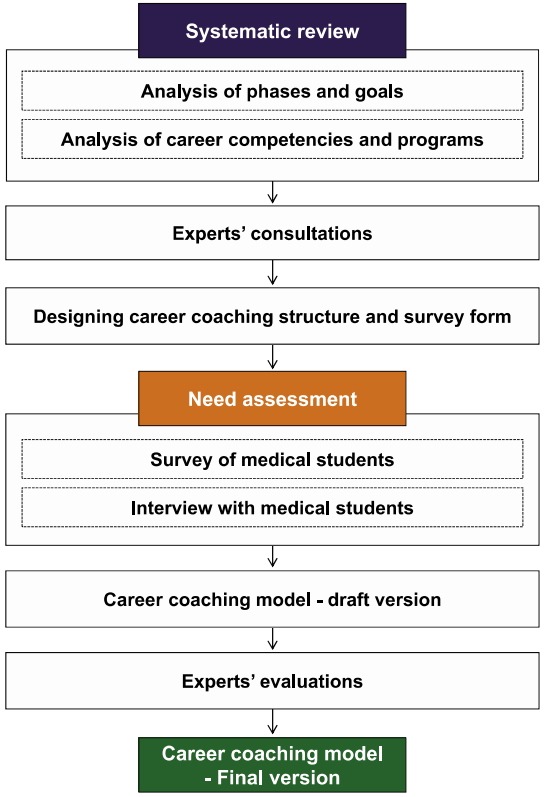
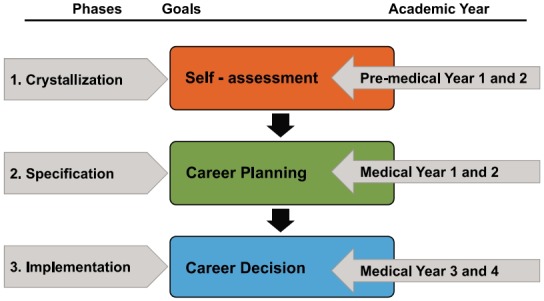
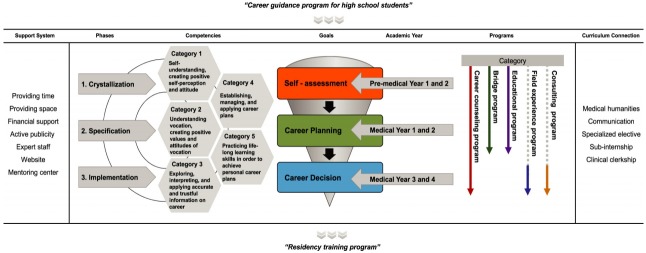
PURPOSE: Deciding on a future career path or choosing a career specialty is an important academic decision for medical students. The purpose of this study is to develop a career coaching model for medical students. METHODS: This research was carried out in three steps. The first step was systematic review of previous studies. The second step was a need assessment of medical students. The third step was a career coaching model using the results acquired from the researched literature and the survey. RESULTS: The career coaching stages were defined as three big phases: The career coaching stages were defined as the "crystallization" period (Pre-medical year 1 and 2), "specification" period (medical year 1 and 2), and "implementation" period (medical year 3 and 4). CONCLUSION: The career coaching model for medical students can be used in programming career coaching contents and also in identifying the outcomes of career coaching programs at an institutional level.
Overview
The claims and statistics of this paper haven’t been checked yet.
Run the check — free, no account needed. It reads the open-access text and checks the sources it cites.
Integrity signals
Registry
Cites
Statistics
Figures
Verification
Claims the paper makes
The claims and statistics of this paper haven’t been checked yet.
Run the check — free, no account needed. It reads the open-access text and checks the sources it cites.
Claims other papers make about this one
Each is checked against this paper’s own text: does it say what the citing paper says it does?
The source backs part of the claim, not all of it — or backs it for a different population, condition or comparison.
In the citing paper
“| Coaching process related | Coaching model | Institution Specific | [29,96] |”
From Coaching in undergraduate and graduate medical education: a scoping review of success factors, barriers, and outcomes (2026) · cites this paper as [29]
Experimental — accuracy not yet measured
Self-check
Percentages, sums and reported differences re-computed from the paper’s own numbers.
The self-check needs the paper’s full text.
Citations
Cites
A life-span, life-space approach to career development
Super, D. (1980) · Journal of Vocational Behavior · doi:10.1016/0001-8791(80)90056-1 · Cited by 4,875
A theory of vocational development.
Super, D. E. (1953) · American Psychologist · doi:10.1037/h0056046 · Cited by 1,346
Herma, J. L. V., Ginsburg, S. W., & Axelrad, S. (1951) · Columbia University Press eBooks · doi:10.7312/ginz92170 · Cited by 823
Ramanan, R. A., Taylor, W. C., Davis, R. B., & Phillips, R. S. (2006) · Journal of General Internal Medicine · doi:10.1111/j.1525-1497.2006.00346.x · Cited by 256
Burnout and career choice motivation in medical students
Pagnin, D., de Queiroz, V., Filho, M. A. D. O., Gonzalez, N. V. A., Salgado, A. E. T., Oliveira, B. C. E., Lodi, C. S., & Melo, R. M. D. S. (2013) · Medical Teacher · doi:10.3109/0142159x.2013.769673 · Cited by 143
College Career Courses: Design and Accountability
Folsom, B., & Reardon, R. C. (2003) · Journal of Career Assessment · doi:10.1177/1069072703255875 · Cited by 105
Zink, B. J., Hammoud, M. M., Middleton, E. B., Moroney, D., & Schigelone, A. R. S. (2007) · Teaching and Learning in Medicine · doi:10.1080/10401330709336624 · Cited by 67
Career Intentions of UNITRA Medical Students and their Perceptions about the Future
Dambisya, Y. M. (2003) · Education for Health · doi:10.1080/13576280310001607442 · Cited by 40
The Challenge of Teaching Professionalism
Beauchamp, G. (2004) · Annals of the Academy of Medicine Singapore · doi:10.47102/annals-acadmedsg.gallie · Cited by 32
Hur, Y. (2009) · Yonsei Medical Journal · doi:10.3349/ymj.2009.50.6.751 · Cited by 21
Self-citation
Cited by
Sorted by citations
What do we know about coaching in medical education? A literature review
Lovell, B. (2018) · Medical Education · doi:10.1111/medu.13482 · Cited by 277
Howse, K., Harris, J., & Dalgarno, N. (2017) · Academic Medicine · doi:10.1097/acm.0000000000001720 · Cited by 37
Hur, Y., Cho, A. R., Song, E. J., & Kim, S. (2018) · Journal of Educational Evaluation for Health Professions · doi:10.3352/jeehp.2018.15.10 · Cited by 18
“Therefore, we developed a SCCP for medical students in each academic year based on the career coaching model [3,4].”
Self-citationDevelopment of a systematic career coaching program for medical students
Hur, Y., Cho, A.-R., & Kwon, M. (2018) · Korean journal of medical education · doi:10.3946/kjme.2018.80 · Cited by 16
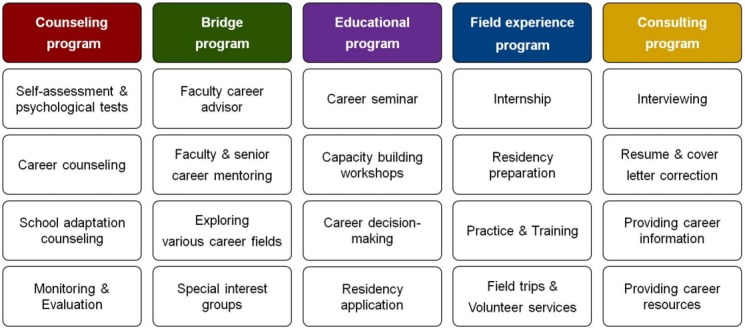
“We were able to design the items derived during the analytical process were arranged according to five career-coaching categories that had been developed in a previous study: career counseling, bridging, educational, field experience, and consulting [20].”
MethodInfluentialSelf-citationAvidan, A., Weissman, C., Elchalal, U., Tandeter, H. B., & Zisk‐Rony, R. Y. (2018) · Israel Journal of Health Policy Research · doi:10.1186/s13584-018-0215-2 · Cited by 13
“Therefore, the 5th year appears to be an opportune time for medical schools to begin career counseling and for department chairs and residency program directors to start marketing their specialties and residency programs [22].”
BackgroundTang, H., Wang, J., Liu, Q., Bao, J., & Zeng, W. (2024) · BMJ Open · doi:10.1136/bmjopen-2023-083697 · Cited by 6
Alamri, A. M. (2023) · King Khalid University Journal of Health Sciences · doi:10.4103/kkujhs.kkujhs_14_23 · Cited by 4
A Systematic Career Advising Model and Strategies for Medical Students
Lee, Y. (2022) · Korean Medical Education Review · doi:10.17496/kmer.2022.24.3.193 · Cited by 3
Johnson, J. W., Graham, L., Williams, E. W., Campbell, C. L., Thomas, N., & Gossell‐Williams, M. (2021) · International Journal of Medical Students · doi:10.5195/ijms.2021.1049 · Cited by 3
Experience Sharing: Being a Part of the Journal Club
Singh, A., & Yogi, P. (2020) · Journal of Nepal Medical Association · doi:10.31729/jnma.4845 · Cited by 3
Career coach preferences of medical students: coaching specialist or specialistic coach?
Fris, D. A. H., Vianen, A. E. M. V., van Hooft, E. A. J., de Hoog, M., & de Pagter, A. P. J. (2023) · BMC Medical Education · doi:10.1186/s12909-023-04882-1 · Cited by 5
“Career coaching in medical education is gaining popularity in practice and research on the topic is growing [1–3].”
BackgroundXTRA study protocol: eXploring medical sTudents’ caReer reAdiness—a cross-sectional study in the UK
Godoi, A., McDade‐Kumar, M., Virk, F., Casteleyn, C., Marei, O., Yang, T., Moussa, A., Aman, K., Byrne, M. H. V., Baptiste, P., et al. (2022) · Journal of Surgical Protocols and Research Methodologies · doi:10.1093/jsprm/snac008 · Cited by 2
Mukherjee, B., Pfleeger, J., Custodio, H., Roca, M. R., Khalsa, G., & Clanton, C. (2026) · Medical Education Online · doi:10.1080/10872981.2026.2687304 · Cited by 1
Seth, R., Mortimore, G., Gould, J., & Sorice, V. (2025) · Medical Education · doi:10.1111/medu.70106 · Cited by 1
“20 This mechanistic difference is especially relevant in PME, where trainees must transition from external dependency to autonomous professional decision-making.”
Strengthening the Process of Implementation of Coaching in Medical Education Settings
Shrivastava, S. R., & Shrivastava, P. (2022) · Journal of the Scientific Society · doi:10.4103/jss.jss_55_21 · Cited by 1
Construction and validation of a medical career readiness inventory
Godoi, A., Casteleyn, C., Virk, F., McDade‐Kumar, M., Byrne, M. H. V., Moussa, A., Baptiste, P., & Tombs, M. (2024) · The Clinical Teacher · doi:10.1111/tct.13733 · Cited by 1
Design and Implementation of a Career Planning Program at Chonnam National University Medical School
Han, E., & Chung, E. (2024) · Korean Medical Education Review · doi:10.17496/kmer.23.033 · Cited by 1
Role of Structured Career Counselling in Speciality Selection among Post Graduate Trainees
Mansoor, M. (2022) · Pakistan Journal of Medical and Health Sciences · doi:10.53350/pjmhs22169107
Career Guidance to Help Medical School Students Choose a Specialty after Graduation
Lee, S. W. (2024) · Korean Medical Education Review · doi:10.17496/kmer.23.038
Career Counseling Unit: Its Relevance and Importance in Medical Colleges
Salam, M. A. (2025) · TAJ Journal of Teachers Association · doi:10.70818/taj.v38i04.0358
Fris, D. A. H., Vianen, A. E. M. V., van Hooft, E. A. J., de Hoog, M., & de Pagter, A. P. J. (2024) · Figshare · doi:10.6084/m9.figshare.26657353
Fris, D. A. H., Vianen, A. E. M. V., van Hooft, E. A. J., de Hoog, M., & de Pagter, A. P. J. (2024) · Figshare · doi:10.6084/m9.figshare.26657350
Fris, D. A. H., Vianen, A. E. M. V., van Hooft, E. A. J., de Hoog, M., & de Pagter, A. P. J. (2024) · Figshare · doi:10.6084/m9.figshare.26657356
Metadata
- Authors
- Hur, Y.
- Affiliations
- Konyang University (KR)
- Corresponding author
- Hur, Yera
- ORCID
- Hur, Yera
- Venue
- Korean Journal of Medical Education
- Publisher
- Korean Society of Medical Education
- Published
- 2016-01-27
- Volume
- 28
- Issue
- 1
- Pages
- 127-136
- ISSN
- 1225-8067 (ISSN-L)
- 2005-727X
- 2005-7288
- PMC
- PMC4926935
- OpenAlex
- W2281025662
- Cited by
- 23
- References
- 22
- Citations by year
- 2026: 1 · 2025: 2 · 2024: 7 · 2023: 2 · 2022: 4 · 2021: 1 · 2020: 1 · 2018: 3 · 2017: 2
- FWCI
- 3.79
- Type
- journal article
- Language
- en
- Open access
- gold
- doi.org
- Licence
- Locations
- Korean journal of medical education (publishedVersion, cc-by-nc)
- PubMed Central (publishedVersion, cc-by-nc)
- PubMed (publishedVersion)
- DOAJ (DOAJ: Directory of Open Access Journals) (submittedVersion, cc-by-sa)
- Funders
- National Research Foundation of Korea (2014S1A5A2A01013740)
- Topics
- Social Sciences › Gender Studies › Diversity and Career in Medicine
- Social Sciences › Education › Innovations in Medical Education
- Social Sciences › Education › Mentoring and Academic Development
- Keywords
- career coaching, medical students, career choice, career development model, needs assessment, medical education
- MeSH terms
- Mentoring, Career Choice, Education, Medical, Undergraduate, Education, Premedical, Female, Humans, Male, Medicine, Students, Medical, Program Development
About these checks
Registry, retraction, Cites and statistics results are computed, not judged, with one exception: a printed reference that no index lists is read once by a model before it counts as a citation error. Claims are extracted by a model and kept only when their quote appears verbatim in the text; each cited source is then checked, with a model’s help, for whether it says what the claim relies on. Those verdicts can be wrong — read the claim’s quote and the cited source before relying on one.
Statistics and arithmetic are recomputed, not judged.
Confidence bands are shown only for fields calibrated on our annotated test set. None is calibrated yet, so no band is shown.
What counts as a claim ›How we measure confidence ›How we check this ›
Are you an author, or do you see a problem with this page? Request a review
