

The DOI matches its Crossref record; 41 of the 42 references it cites were found in a registry or an index; none of the 8 sources its claims cite is checked for support yet.
Fluid intake, hydration status and body mass changes in U-15 judo athletes during a training day
Open accessAbstract
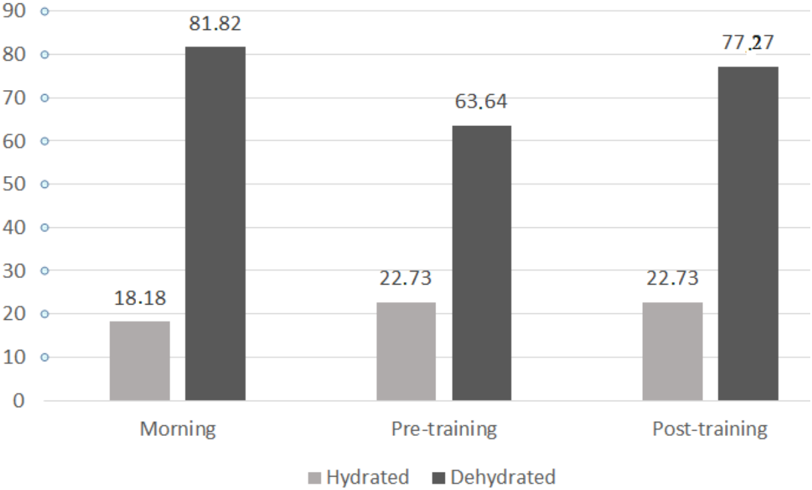
Despite numerous studies related to dehydration there is still a lack of scientific literature presenting hydration status and fluid intake of judo athletes during different periods. Therefore, the aim of this study was to investigate, fluid intake, hydration status and body weight changes of young judo athletes during a typical day of training in preparation period. Twenty-two young judo athletes (age: 12 ± 0.7 y, experience: 3.5 ± 1.1) voluntarily participated in this study. Hydration status and weight were examined in the morning, before and immediately after the training. All athletes trained 90 min and they consumed fluids ad libitum during the exercise. According to morning urine specific gravity (USG) values, 81.2% of the athletes were dehydrated while only 18.8% of the athletes were euhydrated. Pre-training urine measurements showed that 63.64% of the athletes presented dehydration and 77.27% of the athletes completed the training in dehydrated condition despite fluid availability during the training. Mean body weight loss during training was -0.64 ± 0.66%. It can be concluded that young judo athletes presented high prevalence of dehydration as indicated by USG values. Most of the athletes were dehydrated during a typical training day and completed the training in more dehydrated conditions compared to pre training values despite ad libitum fluid intake. It is of great importance to evaluate hydration status of the athletes before training to refrain from common practice of fluid restriction for weight loss and adverse effects of a persistent state of fluid deficit on physical and health related state.
Overview
CoChat Summary
TL;DR
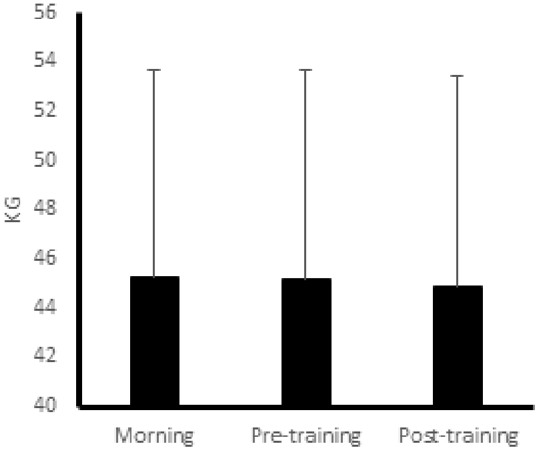
In 22 U-15 Turkish judo athletes during a 90-min preparatory-phase training day, most were dehydrated by morning urine specific gravity (USG) and remained or became more dehydrated post-training despite ad libitum fluid access. Body weight decreased significantly across the day, with a mean training loss of 0.64 ± 0.66%.
Key findings
- Morning USG showed 81.2% dehydrated and 18.8% euhydrated; pre-training, 63.64% were dehydrated, and 77.27% completed training dehydrated despite fluid availability.
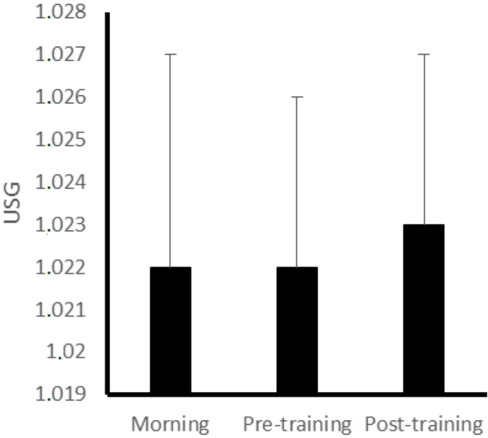
- USG did not differ significantly across morning, pre-training, and post-training (F1-21 = 1.60; p = 0.22; ES = 0.071 [small effect]); values were 1.022 ± 0.005, 1.023 ± 0.004, and 1.024 ± 0.004, respectively.
- Body weight differed significantly among measurements (F1-21 = 13.52, p < 0.000; table p = 0.001), with differences between pre-training and post-training (p = 0.000) and between morning and post-training (p < 0.01); mean weight loss during training was 0.64 ± 0.66% (−0.27 kg).
- No significant correlations were found between fluid intake and body weight change percentage (r = 0.18 [small]; p = 0.43; 95% CI = −0.56 to 0.27) or between fluid intake and USG change percentage (r = −0.15 [small]; p = 0.52; 95% CI = −0.53 to 0.29).
Methods
- Descriptive study of 22 U-15 regional/national-level Turkish judo athletes (reported as 14 males and 7 females; age 12 ± 0.7 y; judo experience 3.5 ± 1.1 y) during a typical 90-min preparatory-phase training session; fluids were consumed ad libitum, and athletes were not informed about the nature of the study. Training hall conditions were 28.3°C and 56% humidity.
- Measurements were taken in the morning, before training, and immediately after training: hydration status via USG using a digital refractometer (euhydrated defined as USG ≤ 1.020 g mL⁻¹), body weight, body composition by bioelectrical impedance, and stature by stadiometer; percentage weight loss was calculated according to Scott, Horswill, and Dick (1994).
- Analysis used one-way repeated-measures ANOVA with Tukey HSD post-hoc tests, Pearson product correlations, SPSS 20, and significance set at p < 0.05.
Limitations
- The paper states it did not control potential effects on USG such as prior training or supplement use, and that the study was primarily limited by the small number of athletes.
- The paper states future studies are warranted to present the real effects of dehydration on judo performance at all competitive age groups.
- Evident from the text: the reported sample of 22 athletes is inconsistent with the listed “14 males and 7 females” (21 athletes), and no absolute fluid intake values are reported despite fluid intake being monitored.
Model-written summary. Check it against the paper before relying on it.
Integrity signals
Registry
Cites
Statistics
Figures
Verification
Claims the paper makes
0 Valid · 0 Not valid · 7 Not checked · 15 Own results and interpretations
A result the paper reports from its own data — it cites no other source for it, so there is none to check. The quote shows it is in the paper.
In the paper
“Pre-training urine measurements showed that 63.64% of the athletes presented dehydration”
- Also stated in: § Results · plain
“In view of pre-training USG measurements, they displayed that 63.64% of the athletes presented dehydration.”
§ Fluid intake, hydration status and body mass changes in U-15 judo athletes during a training day > Abstract
plain- Asserted: passes — The authors put it forward as true.
- Checkable: passes — It can be checked against evidence.
- Load-bearing: passes — The paper’s conclusions depend on it.
- Based: passes — The paper gives a reason why it holds.
- Also stated in: § Results · plain
A result the paper reports from its own data — it cites no other source for it, so there is none to check. The quote shows it is in the paper.
In the paper
“Considering the USG values comparison (among the morning, pre and post training outcomes), there were no significant differences (F1-21=1.60;p=0.22;ES=0.071 [small effect]) (Table 3).”
§ Fluid intake, hydration status and body mass changes in U-15 judo athletes during a training day > Results
plain- Asserted: passes — The authors put it forward as true.
- Checkable: passes — It can be checked against evidence.
- Load-bearing: passes — The paper’s conclusions depend on it.
- Based: passes — The paper gives a reason why it holds.
A result the paper reports from its own data — it cites no other source for it, so there is none to check. The quote shows it is in the paper.
In the paper
“77.27% of the athletes completed the training in dehydrated condition despite fluid availability during the training.”
- Also stated in: § Results · plain
“Despite fluid availability of all athletes during the training 77.27% of the athletes completed the training in dehydrated condition.”
§ Fluid intake, hydration status and body mass changes in U-15 judo athletes during a training day > Abstract
plain- Asserted: passes — The authors put it forward as true.
- Checkable: passes — It can be checked against evidence.
- Load-bearing: passes — The paper’s conclusions depend on it.
- Based: passes — The paper gives a reason why it holds.
- Also stated in: § Results · plain
A result the paper reports from its own data — it cites no other source for it, so there is none to check. The quote shows it is in the paper.
In the paper
“Mean body weight loss during training was -0.64 ± 0.66%.”
- Also stated in: § Results · plain
“weight loss percentage during the training was 0.64 ± 0.66% (-0.27 kg) (Figure 2)”
§ Fluid intake, hydration status and body mass changes in U-15 judo athletes during a training day > Abstract
plain- Asserted: passes — The authors put it forward as true.
- Checkable: passes — It can be checked against evidence.
- Load-bearing: unclear — It is unclear whether the paper’s conclusions depend on it.
- Based: passes — The paper gives a reason why it holds.
- Also stated in: § Results · plain
None of the sources cited for this claim have been checked yet.
In the paper
“USG is accepted as a valid and reliable way of monitoring hydration status (Cheuvront & Sawka, 2005;Meyer et al., 2016)”
§ Fluid intake, hydration status and body mass changes in U-15 judo athletes during a training day > Discussion
What the sources say
- Not matchedcites Cheuvront & Sawka, 2005
Couldn’t be matched to a paper in Crossref, so it can’t be checked.
- Not checked yetcites Meyer et al., 2016 source
plain- Asserted: passes — The authors put it forward as true.
- Checkable: passes — It can be checked against evidence.
- Load-bearing: passes — The paper’s conclusions depend on it.
- Based: passes — The paper gives a reason why it holds.
- Not matched
4 more claims
Create a free account to see all 22 claims and to verify the 5 references still open.
- It may state two separate claims as one. 11
- Probably not a substantial claim. 7
Self-check
Percentages, sums and reported differences re-computed from the paper’s own numbers.
Each contradiction between two passages listed here was confirmed by an independent check.
Rated minor: it would not touch a result — a value no result rests on, a p-value that stays on the same side of the significance level, or a conflict that is clerical, resolved elsewhere in the paper, or outside its own findings.
In the paper
§ Fluid intake, hydration status and body mass changes in U-15 judo athletes during a training day > Discussion
“presented elevated first morning USG samples (USG < 1.020), which proved that the athletes adopted inadequate rehydration habits outside practice”
§ Fluid intake, hydration status and body mass changes in U-15 judo athletes during a training day > Measurements
“USG values were classified as USG of ≤ 1020 g mL -1 is indicative of being euhydrated (Popowski et al., 2001).”
Rated minor: it would not touch a result — a value no result rests on, a p-value that stays on the same side of the significance level, or a conflict that is clerical, resolved elsewhere in the paper, or outside its own findings.
In the paper
“Twenty-two (14 males and 7 females) under-15 regional and national level Turkish judo athletes (12±0.7 years) agreed to participate in the project.”
§ Fluid intake, hydration status and body mass changes in U-15 judo athletes during a training day > Participants
Reported 22 · recomputed 21
Rated minor: it would not touch a result — a value no result rests on, a p-value that stays on the same side of the significance level, or a conflict that is clerical, resolved elsewhere in the paper, or outside its own findings.
In the paper
§ Fluid intake, hydration status and body mass changes in U-15 judo athletes during a training day > Results
“there were no significant differences (F1-21=1.60;p=0.22;ES=0.071 [small effect])”
§ Fluid intake, hydration status and body mass changes in U-15 judo athletes during a training day > Statistical analysis
“A oneway analysis of variance with repeated measures (ANOVA) was performed to assess changes in the dependent variables (USG and total body weight) using time (morning, pre and post training) as the factor.”
Rated minor: it would not touch a result — a value no result rests on, a p-value that stays on the same side of the significance level, or a conflict that is clerical, resolved elsewhere in the paper, or outside its own findings.
In the paper
§ Fluid intake, hydration status and body mass changes in U-15 judo athletes during a training day > Results
“According to morning USG values, 81.2% of the athletes were dehydrated while only 18.8% of the athletes were euhydrated (Figure 1).”
§ Fluid intake, hydration status and body mass changes in U-15 judo athletes during a training day > Abstract
“Twenty-two young judo athletes (age: 12 ± 0.7 y, experience: 3.5 ± 1.1) voluntarily participated in this study.”
Citations
Cites
American College of Sports Medicine position stand
Otis, C. L. (1997) · Medical Entomology and Zoology · Cited by 4,407
American College of Sports Medicine Position Stand: Exercise and Fluid Replacement
Shephard, R. J. (2007) · Yearbook of Sports Medicine · doi:10.1016/s0162-0908(08)70206-x · Cited by 667
Dehydration: Physiology, Assessment, and Performance Effects
Cheuvront, S. N., & Kenefick, R. W. (2014) · Comprehensive Physiology · doi:10.1002/cphy.c130017 · Cited by 461
José, G.-A., Mora-Rodríguez, R., Below, P. R., & Coyle, E. F. (1997) · Journal of Applied Physiology · doi:10.1152/jappl.1997.82.4.1229 · Cited by 390
Fluid Balance and Endurance Exercise Performance
Cheuvront, S. N., Carter, R., & Sawka, M. N. (2003) · Current Sports Medicine Reports · doi:10.1249/00149619-200308000-00006 · Cited by 379
Blood and urinary measures of hydration status during progressive acute dehydration
POPOWSKI, L. A., OPPLIGER, R. A., PATRICK LAMBERT, G., JOHNSON, R. F., KIM JOHNSON, A., & GISOLFI, C. V. (2001) · Medicine & Science in Sports & Exercise · doi:10.1097/00005768-200105000-00011 · Cited by 345
Effects of fluid ingestion on cognitive function after heat stress or exercise-induced dehydration
Cian, C., Barraud, P. A., Melin, B., & Raphel, C. (2001) · International Journal of Psychophysiology · doi:10.1016/s0167-8760(01)00142-8 · Cited by 327
Prevalence, Magnitude, and Methods of Rapid Weight Loss among Judo Competitors
GIANNINI ARTIOLI, G., GUALANO, B., FRANCHINI, E., SCAGLIUSI, F. B., TAKESIAN, M., FUCHS, M., & LANCHA, A. H. (2010) · Medicine & Science in Sports & Exercise · doi:10.1249/mss.0b013e3181ba8055 · Cited by 325
Kavouras, S. A. (2002) · Current Opinion in Clinical Nutrition and Metabolic Care · doi:10.1097/00075197-200209000-00010 · Cited by 322
Urinary Indices during Dehydration, Exercise, and Rehydration
Armstrong, L. E., Herrera Soto, J. A., Hacker, F. T., Casa, D. J., Kavouras, S. A., & Maresh, C. M. (1998) · International Journal of Sport Nutrition · doi:10.1123/ijsn.8.4.345 · Cited by 306
Judelson, D. A., Maresh, C. M., Anderson, J. M., Armstrong, L. E., Casa, D. J., Kraemer, W. J., & Volek, J. S. (2007) · Sports Medicine · doi:10.2165/00007256-200737100-00006 · Cited by 216
Muscle water and electrolytes following varied levels of dehydration in man
Costill, D. L., Cote, R., & Fink, W. (1976) · Journal of Applied Physiology · doi:10.1152/jappl.1976.40.1.6 · Cited by 175
The effect of voluntary dehydration on cognitive functions of elementary school children
Bar-David, Y., Urkin, J., & Kozminsky, E. (2005) · Acta Paediatrica · doi:10.1080/08035250500254670 · Cited by 168
Influence of Hydration on Physiological Function and Performance During Trail Running in the Heat
Casa, D. J., Stearns, R. L., Lopez, R. M., Ganio, M. S., McDermott, B. P., Walker Yeargin, S., Yamamoto, L. M., Mazerolle, S. M., Roti, M. W., Armstrong, L. E., et al. (2010) · Journal of Athletic Training · doi:10.4085/1062-6050-45.2.147 · Cited by 156
Edwards, A. M., Mann, M. E., Marfell-Jones, M. J., Rankin, D. M., Noakes, T. D., & Shillington, D. P. (2007) · British Journal of Sports Medicine · doi:10.1136/bjsm.2006.033860 · Cited by 155
Effects of drinking supplementary water at school on cognitive performance in children
Fadda, R., Rapinett, G., Grathwohl, D., Parisi, M., Fanari, R., Calò, C. M., & Schmitt, J. A. J. (2012) · Appetite · doi:10.1016/j.appet.2012.07.005 · Cited by 130
Physiological aspects of sport training and performance
Hoffman, J. R. (2003) · Choice Reviews Online · doi:10.5860/choice.40-5261 · Cited by 129
Physiological Aspects of Sport Training and Performance
Hoffman, J. R. (2002) · Human Kinetics eBooks · doi:10.5040/9781492596806 · Cited by 125
Franchini, É., Branco, B. H. M., Agostinho, M. F., Calmet, M., & Candau, R. B. (2014) · The Journal of Strength and Conditioning Research · doi:10.1519/jsc.0000000000000460 · Cited by 118
Progressive Dehydration Causes a Progressive Decline in Basketball Skill Performance
BAKER, L. B., DOUGHERTY, K. A., CHOW, M., & KENNEY, W. L. (2007) · Medicine & Science in Sports & Exercise · doi:10.1249/mss.0b013e3180574b02 · Cited by 116
Physical and Physiological Characteristics of Judo Athletes: An Update
Torres‐Luque, G., Hernández‐García, R., Escobar-Molina, R., Garatachea, N., & Nikolaidis, P. Τ. (2016) · Sports · doi:10.3390/sports4010020 · Cited by 111
Rapid Weight Loss Among Adolescents Participating In Competitive Judo
Berkovich, B.-E., Eliakim, A., Nemet, D., Stark, A. H., & Sinai, T. (2015) · International Journal of Sport Nutrition and Exercise Metabolism · doi:10.1123/ijsnem.2015-0196 · Cited by 104
Osterberg, K. L., Horswill, C. A., & Baker, L. B. (2009) · Journal of Athletic Training · doi:10.4085/1062-6050-44.1.53 · Cited by 102
Combined effect of heat stress, dehydration and exercise on neuromuscular function in humans
Ftaiti, F., Grélot, L., Coudreuse, J. M., Nicol, C., & Coudreuse, J. M. (2001) · European Journal of Applied Physiology · doi:10.1007/s004210000339 · Cited by 94
Hydration Assessment of Athletes
Cheuvront, S. N., Sawka, M. N., Sawka, M. N., Facsm, P. D., & Ma, N. (2015) · Cited by 81
Fluid balance during training in elite young athletes of different sports
Arnaoutis, G., Kavouras, S. A., Angelopoulou, A., Skoulariki, C., Bismpikou, S., Mourtakos, S., & Sidossis, L. S. (2015) · Journal of Strength and Conditioning Research · doi:10.1519/jsc.0000000000000400 · Cited by 68
Detanico, D., Kons, R. L., Fukuda, D. H., & Teixeira, A. S. (2020) · Research Quarterly for Exercise and Sport · doi:10.1080/02701367.2019.1679334 · Cited by 67
Dehydration Impairs Vigilance-Related Attention in Male Basketball Players
BAKER, L. B., CONROY, D. E., & KENNEY, W. L. (2007) · Medicine & Science in Sports & Exercise · doi:10.1097/mss.0b013e3180471ff2 · Cited by 66
The Effect of Water Restriction on Anaerobic Power and Vertical Jumping Height in Basketball Players
Hoffman, J., Stavsky, H., & Folk, B. (1995) · International Journal of Sports Medicine · doi:10.1055/s-2007-972994 · Cited by 63
Hydration Status in Elite Wrestlers, Judokas, Boxers, and Taekwondo Athletes on Competition Day
Pettersson, S., & Berg, C. M. (2014) · International Journal of Sport Nutrition and Exercise Metabolism · doi:10.1123/ijsnem.2013-0100 · Cited by 59
Palmer, M. S., & Spriet, L. L. (2008) · Applied Physiology, Nutrition, and Metabolism · doi:10.1139/h08-011 · Cited by 56
The effect of hypohydration on endothelial function in young healthy adults
Arnaoutis, G., Kavouras, S. A., Stratakis, N., Likka, M., Mitrakou, A., Papamichael, C. M., Sidossis, L. S., & Stamatelopoulos, K. S. (2016) · European Journal of Nutrition · doi:10.1007/s00394-016-1170-8 · Cited by 50
Acute weight gain in collegiate wrestlers following a tournament weigh-in
SCOTT, J. R., Horswill, C. A., & Dick, R. W. (1994) · Medicine & Science in Sports & Exercise · doi:10.1249/00005768-199409000-00017 · Cited by 36
Carroll, H. A., Betts, J. A., & Johnson, L. (2016) · British Journal Of Nutrition · doi:10.1017/s0007114516003688 · Cited by 35
Hydration status in adolescent judo athletes before and after training in the heat
Rivera-Brown, A. M., & De Félix-Dávila, R. A. (2012) · International Journal of Sports Physiology and Performance · doi:10.1123/ijspp.7.1.39 · Cited by 29
Ceylan, B., Baydil, B., & Aydos, L. (2021) · Revista de artes marciales asiáticas · doi:10.18002/rama.v16i2.7020 · Cited by 22
Self-citationDehydration and Acute Weight Gain of Athletes Before Sport Competitions
Gürses, V. V., Ceylan, B., Akgül, M. Ş., Baydil, B., Hussein, H. A., & Bădău, D. (2018) · Revista de Chimie · doi:10.37358/rc.18.11.6710 · Cited by 14
Self-citationFluid Balance, Hydration, and Athletic Performance
Meyer, F., Szygula, Z., & Wilk, B. (2016) · doi:10.1201/b19037 · Cited by 11
Monitoring Hydration Status of Elite Judo Athletes During a Competition Day
Ceylan, B., Akgül, M. Ş., Gürses, V. V., Baydil, B., & Aydos, L. (2020) · Turkish Journal of Sport and Exercise · doi:10.15314/tsed.657490 · Cited by 6
Self-citation
Research works printed but not linked: 2
- Cian, C., Koulmann, N., Barraud, P. A., Raphel, C., Jimenez, C., & Melin, B. (2000). Influences of variations in body hydration on cognitive function: effect of hyperhydration, heat stress, and exercise-induced dehydration. Journal of Psychophysiology, 14(1), 29-36. DOI: https://doi.org/10.1027/0269-8803.14.1.29 Acta Scientiarum. Health Sciences, v. 44, e57233, 2022 · DOI
- Judelson, D. A., Maresh, C. M., Anderson, J. M., Armstrong, L. E., Casa, D. J., Kraemer, W. J., & Volek, J. S. (2007). Hydration and muscular performance. Sports Medicine, 37(10), 907-921.
Cited by
Acute Dehydration Impairs Performance and Physiological Responses in Highly Trained Judo Athletes
Ceylan, B., Kons, R. L., Detanico, D., & Šimenko, J. (2022) · Biology · doi:10.3390/biology11060872 · Cited by 39
Self-citationPapaoikonomou, G., Apergi, K., & Malisova, O. (2025) · Children · doi:10.3390/children12020171 · Cited by 13
Ceylan, B., Taşcan, M. B., Šimenko, J., & Balcı, Ş. S. (2022) · International Journal of Sports Science & Coaching · doi:10.1177/17479541221122433 · Cited by 8
Self-citationSales, J. M., Gomes, J. H., Matins, B., Resende, C. F., & Mendes, R. R. (2025) · Revista Brasileira de Fisiologia do Exercício · doi:10.33233/rbfex.v24i1.5648
Hydration and hydration monitoring in combat sports
Ceylan, B. (2025) · Buleria (Universidad de León)
Self-citation
Metadata
- Authors
- Ceylan, B., & Santos, L.
- Affiliations
- Kastamonu University (TR)
- ORCID
- Ceylan, Bayram
- Venue
- Acta Scientiarum. Health Sciences
- Publisher
- Universidade Estadual de Maringa
- Published
- 2022-01-17
- Volume
- 44
- Pages
- e57233
- ISSN
- 1679-9291 (ISSN-L)
- 1807-8648
- OpenAlex
- W3186466173
- Cited by
- 8
- References
- 42
- Citations by year
- 2026: 3 · 2025: 3 · 2022: 2
- FWCI
- 0.74
- Type
- journal article
- Language
- en
- Open access
- diamond
- doi.org
- Locations
- Acta Scientiarum Health Sciences (publishedVersion, cc-by)
- Buleria (Universidad de León) (submittedVersion, cc-by-nc-nd)
- DOAJ (DOAJ: Directory of Open Access Journals) (submittedVersion, cc-by-sa)
- DOAJ (DOAJ: Directory of Open Access Journals) (submittedVersion)
- Redalyc (Universidad Autónoma del Estado de México) (submittedVersion)
- Topics
- Health Sciences › Medicine › Physiology (medical) › Thermoregulation and physiological responses
- Social Sciences › Safety Research › Martial Arts: Techniques, Psychology, and Education
- Health Sciences › Medicine › Orthopedics and Sports Medicine › Sports Performance and Training
- Keywords
- dehydration, hydration status, fluid intake, judo athletes, youth athletes, urine specific gravity, weight loss, training day, fluid deficit
About these checks
Registry, retraction, Cites and statistics results are computed, not judged, with one exception: a printed reference that no index lists is read once by a model before it counts as a citation error. Claims are extracted by a model and kept only when their quote appears verbatim in the text; each cited source is then checked, with a model’s help, for whether it says what the claim relies on. Those verdicts can be wrong — read the claim’s quote and the cited source before relying on one.
A language model drew the claims from the paper on 2026-11-14, under version 3 of the claim definition (model deepseek-v4.1-flash, prompt extract-v3).
A second model labelled each claim on 2026-11-14 (model jev-1.13-20260917, definition revision gold-guideline-v0.2).
Statistics and arithmetic are recomputed, not judged.
Confidence bands are shown only for fields calibrated on our annotated test set. None is calibrated yet, so no band is shown.
What counts as a claim ›How we measure confidence ›How we check this ›
Are you an author, or do you see a problem with this page? Request a review
Data sources
Bibliographic data: Semantic Scholar, OpenAlex, Crossref.
Contains information from the Semantic Scholar Academic Graph Datasets, made available under the ODC Attribution License (ODC-BY 1.0).
Semantic Scholar’s data is described in: Kinney, R., et al. (2023). The Semantic Scholar Open Data Platform. arXiv:2301.10140.
