

Application of 3D Electromagnetic Articulography in Dentistry: Mastication and Deglutition Analysis. Protocol Report
Open accessThe DOI matches its Crossref record; 21 of the 21 references it cites were found in a registry or an index.
Abstract
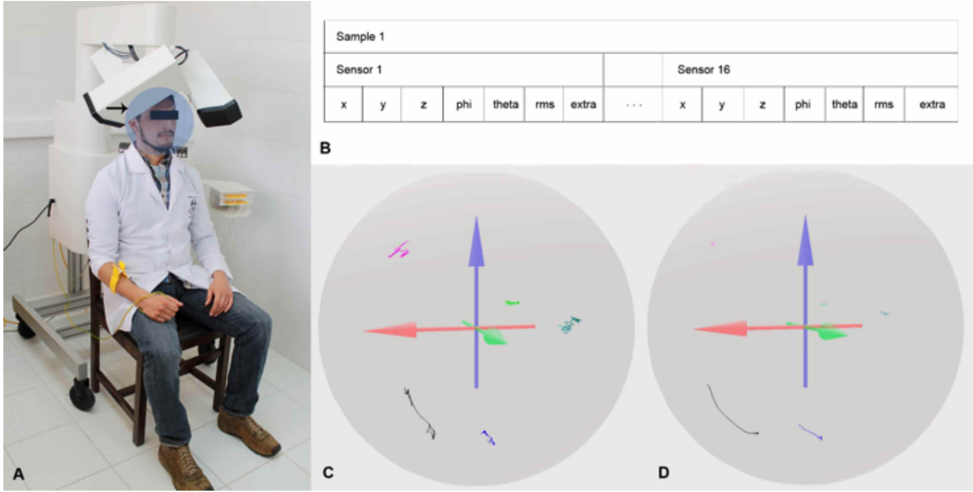
The Stomatognathic System (SS) is an integrated and coordinated morphofunctional unit, consisting of skeletal, muscular, angiological, nervous, glandular and dental structures that work in harmony to perform different functions such as chewing, swallowing, speaking, breathing, tasting and esthetics.The study of SS physiology is crucial to achieving a correct maintenance of its normal function or restoration.Thus, we developed a protocol to record mandibular movement, chewing and swallowing (saliva and water) by using the 3D-electromagnetic articulograph AG501 at the Oral Physiology Laboratory of the Research Centre for Dental Sciences (CICO).This tool has been used for decades in speech and phonetic research and it is able to record, present and evaluate articulated structure movement data in real time.The articulograph provides an ordered data matrix (values for the x, y, z axes, among others) for the recorded movement, which is stored in binary files that can be processed by different software.One of these is MATLAB ® , allowing us to perform a quick, clear and understandable analysis.The existence of a standardized methodology for recording allows an accurate description of the stages to perform different types of measurements according to the researcher's objective.This has opened the way for a new type of oral physiology analysis based on study reproducibility, which is considered one of the bases of scientific methodology.
Overview
The claims and statistics of this paper haven’t been checked yet.
Free: it reads the open-access text and checks the first 5 claims that cite a source we can check. Create a free account to check every claim.
Integrity signals
Registry
Cites
Statistics
Figures
Verification
Claims the paper makes
The claims and statistics of this paper haven’t been checked yet.
Free: it reads the open-access text and checks the first 5 claims that cite a source we can check. Create a free account to check every claim.
Self-check
Percentages, sums and reported differences re-computed from the paper’s own numbers.
The self-check needs the paper’s full text.
Citations
Cites
Determinants of masticatory performance in dentate adults
Hatch, J. P., Shinkai, R. S. A., Sakai, S., Rugh, J. D., & Paunovich, E. D. (2001) · Archives of Oral Biology · doi:10.1016/s0003-9969(01)00023-1 · Cited by 502 · cited 1×
“Many factors in SS can affect masticatory function; however, the most affected is dental state (Hatch et al., 2001; Lepley et al., 2011).”
BackgroundPediatric Swallowing and Feeding: Assessment and Management
Arvedson, J. C., & Brodsky, L. S. (2001) · Medical Entomology and Zoology · Cited by 256
Narayanan, S., Toutios, A., Ramanarayanan, V., Lammert, A., Kim, J., Lee, S., Nayak, K., Kim, Y.-C., Zhu, Y., Goldstein, L., et al. (2014) · The Journal of the Acoustical Society of America · doi:10.1121/1.4890284 · Cited by 180
Lepley, C. R., Throckmorton, G. S., Ceen, R. F., & Buschang, P. H. (2011) · American Journal of Orthodontics and Dentofacial Orthopedics · doi:10.1016/j.ajodo.2009.07.025 · Cited by 161 · cited 1×
“Many factors in SS can affect masticatory function; however, the most affected is dental state (Hatch et al., 2001; Lepley et al., 2011).”
BackgroundTongue Pressure Patterns During Water Swallowing
Kennedy, D., Kieser, J. A., Bolter, C. P., Swain, M. V., Singh, B., & Waddell, J. N. (2009) · Dysphagia · doi:10.1007/s00455-009-9223-2 · Cited by 88 · cited 2×
“, 2014) and intraoral pressure behavior during this process (Kydd & Toda, 1962; Hind et al., 2005; Kennedy et al., 2010).”
BackgroundPhysiologic Development of Tongue–Jaw Coordination From Childhood to Adulthood
Cheng, H. Y., Murdoch, B. E., GoozÉe, J. V., & Scott, D. H. (2007) · Journal of Speech Language and Hearing Research · doi:10.1044/1092-4388(2007/025 · Cited by 55
Felton, S. M., Gaige, T. A., Reese, T. G., Wedeen, V. J., & Gilbert, R. (2007) · Journal of Applied Physiology · doi:10.1152/japplphysiol.01070.2006 · Cited by 51
Tongue pressures exerted on the hard palate during swallowing
Kydd, W. L., & Toda, J. M. (1962) · The Journal of the American Dental Association · doi:10.14219/jada.archive.1962.0271 · Cited by 48 · cited 1×
“…deglutition, studies mainly focus on describing different swallowing patterns (Williamson et al., 1990; Yagi et al., 2015), tongue movement in the sagittal plane (Bourdiol et al., 2014) and intraoral pressure behavior during this process (Kydd & Toda, 1962; Hind et al., 2005; Kennedy et al., 2010).”
BackgroundThe Effects of Intraoral Pressure Sensors on Normal Young and Old Swallowing Patterns
Hind, J. A., Nicosia, M. A., Gangnon, R. E., & Robbins, J. (2005) · Dysphagia · doi:10.1007/s00455-005-0020-2 · Cited by 39 · cited 1×
“…deglutition, studies mainly focus on describing different swallowing patterns (Williamson et al., 1990; Yagi et al., 2015), tongue movement in the sagittal plane (Bourdiol et al., 2014) and intraoral pressure behavior during this process (Kydd & Toda, 1962; Hind et al., 2005; Kennedy et al., 2010).”
BackgroundSwallowing patterns in human subjects with and without temporomandibular dysfunction
Williamson, E. H., Hall, J. T., & Zwemer, J. D. (1990) · American Journal of Orthodontics and Dentofacial Orthopedics · doi:10.1016/0889-5406(90)70016-6 · Cited by 38 · cited 2×
“Regarding deglutition, studies mainly focus on describing different swallowing patterns (Williamson et al., 1990; Yagi et al., 2015), tongue movement in the sagittal plane (Bourdiol et al.”
BackgroundEffect of complete and partial removable dentures on chewing movements
Gonçalves, T. M. S. V., Vilanova, L. S. R., Gonçalves, L. M., & Garcia, R. C. M. R. (2013) · Journal of Oral Rehabilitation · doi:10.1111/joor.12125 · Cited by 37 · cited 1×
“Other studies have complemented these analyses by adding variables such as the maximum speed of the phases of each chewing cycle and mean mandibular opening (Gonçalves et al., 2014).”
BackgroundTongue‐mandible coupling movements during saliva swallowing
Bourdiol, P., Mishellany‐Dutour, A., Peyron, M., & Woda, A. (2014) · Journal of Oral Rehabilitation · doi:10.1111/joor.12135 · Cited by 30 · cited 2×
“…deglutition, studies mainly focus on describing different swallowing patterns (Williamson et al., 1990; Yagi et al., 2015), tongue movement in the sagittal plane (Bourdiol et al., 2014) and intraoral pressure behavior during this process (Kydd & Toda, 1962; Hind et al., 2005; Kennedy et al., 2010).”
BackgroundEvaluation of articulation of Turkish phonemes after removable partial denture application
Özbeki, M., Tulunoglu, I. F., Özkan, S., & Öktemer, M. (2003) · Brazilian Dental Journal · doi:10.1590/s0103-64402003000200010 · Cited by 27 · cited 1×
“Among all the available methodologies for recording, describing and analyzing SS functions, Electromagnetic Articulography (EMA) stands out; it has been used in speech and phonetic research for decades (Ozbek et al., 2003; Katz & McNeil, 2010; Narayanan et al., 2014).”
MethodVisartico: a visualization tool for articulatory data
Ouni, S., Mangeonjean, L., & Steiner, I. (2012) · Interspeech (USB) · doi:10.21437/interspeech.2012-510 · Cited by 23 · cited 4×
“It is possible to use different software for the processing of these files, and our research group developed reports with two: VisArtico and MATLAB®.”
BackgroundInfluentialKatz, W., & Mcneil, M. (2010) · Perspectives on Neurophysiology and Neurogenic Speech and Language Disorders · doi:10.1044/nnsld20.3.73 · Cited by 21 · cited 1×
“Among all the available methodologies for recording, describing and analyzing SS functions, Electromagnetic Articulography (EMA) stands out; it has been used in speech and phonetic research for decades (Ozbek et al., 2003; Katz & McNeil, 2010; Narayanan et al., 2014).”
MethodKarlsson, S. A., & Jemt, T. (1991) · PubMed · Cited by 19
(2017) · Omeka S (Universidad de La Frontera) · Cited by 19
Self-citationFuentes, R., Navarro, P., Curiqueo, A., & Ottone, N. E. (2015) · PubMed Central · Cited by 18
Self-citationSwallowing and breathing patterns during sleep in patients with obstructive sleep apnea
Yagi, K., Lowe, A. A., Ayas, N., Fleetham, J. A., & Almeida, F. R. (2014) · Sleep And Breathing · doi:10.1007/s11325-014-1031-8 · Cited by 17 · cited 2×
“Regarding deglutition, studies mainly focus on describing different swallowing patterns (Williamson et al., 1990; Yagi et al., 2015), tongue movement in the sagittal plane (Bourdiol et al.”
BackgroundHow masticatory function and periodontal disease relate to senile dementia
Watanabe, Y., Hirano, H., & Matsushita, K. (2014) · Japanese Dental Science Review · doi:10.1016/j.jdsr.2014.09.002 · Cited by 16 · cited 1×
“The masticatory function is characterized by motor, rhythmic and learned responses, which are combined with reflection and voluntary motions, with conscious control from start to finish (Manns, 2011); chewing can be intentionally accelerated, slowed or stopped (Watanabe et al., 2015).”
BackgroundJurczyk, K. (2012) · Pan Stanford Publishing eBooks · doi:10.1201/b13255-3 · Cited by 3
Research works printed but not linked: 2
- [2]2. Barreto, J. F. Sistema estomatognático y esquema corporal. Colomb. Med., 30(4):173-80, 1999.
- [20]20. Okeson, J. P.; Sosa, G.; Bumann, A.; Bumann, U. & Lotzmann, U. Tratamiento de Oclusión y Afecciones Temporomandibulares. 5 th ed. Amsterdam, Elsevier, 2008.
Cited by
A review of data collection practices using electromagnetic articulography
Rebernik, T., Jacobi, J., Jonkers, R., Noiray, A., & Wieling, M. B. (2021) · Laboratory Phonology Journal of the Association for Laboratory Phonology · doi:10.5334/labphon.237 · Cited by 94
Farfán, N. C., Lezcano, M. F., Navarro-Cáceres, P. E., Sandoval-Vidal, H. P., Martinez-Gomis, J., Muñoz, L., Marinelli, F., & Fuentes, R. (2023) · Diagnostics · doi:10.3390/diagnostics13142405 · Cited by 7
Self-citationCerda, C., Lezcano, M. F., Marinelli, F., Alarcón-Apablaza, J., & Fuentes, R. (2023) · Journal of Clinical Medicine · doi:10.3390/jcm12144822 · Cited by 9
Self-citationMarinelli, F., Venegas, C., Ruiz, J., Farfán-Beltrán, N., Staub, E., Navarro, P., Alarcón-Apablaza, J., & Fuentes, R. (2024) · Bioengineering · doi:10.3390/bioengineering11030229 · Cited by 1
“These induce electric current in the receptor coils, and the equipment uses this information to determine the position of each receptor coil [17].”
BackgroundMethodInfluentialSelf-citationArias, A., Saravia, D., Quintana, M., Días, F. J., Lezcano, M. F., Farfán, C., & Fuentes, R. (2019) · International journal of odontostomatology · doi:10.4067/s0718-381x2019000400466
Self-citation
Metadata
- Authors
- Fuentes, R., Dias, F., Álvarez, G., Lezcano, M. F., Farfán, C., Astete, N., & Arias, A.
- Affiliations
- Universidad de La Frontera (CL)
- Corresponding author
- Fuentes, Ramón
- Venue
- International journal of odontostomatology
- Published
- 2018-03
- Volume
- 12
- Issue
- 1
- Pages
- 105-112
- ISSN
- 0718-3801 (ISSN-L)
- 0718-381X
- OpenAlex
- W2902430419
- Cited by
- 5
- References
- 21
- Citations by year
- 2024: 1 · 2023: 2 · 2021: 1 · 2019: 1
- FWCI
- 0.81
- Type
- journal article
- Language
- en
- Open access
- diamond
- doi.org
- Licence
- cc-by-nc
- Locations
- International journal of odontostomatology (publishedVersion, cc-by-nc)
- LA Referencia (Red Federada de Repositorios Institucionales de Publicaciones Científicas) (publishedVersion, other-oa)
- Americanae (AECID Library) (submittedVersion, other-oa)
- Funders
- Universidad de La Frontera
- Topics
- Health Sciences › Dentistry › Oral Surgery › Temporomandibular Joint Disorders
- Health Sciences › Dentistry › Orthodontics › Orthodontics and Dentofacial Orthopedics
- Physical Sciences › Engineering › Biomedical Engineering › Muscle activation and electromyography studies
- Keywords
- stomatognathic system, mastication, swallowing, mandibular movement, saliva swallowing, water swallowing, recording protocols, reproducibility, oral physiology
About these checks
Registry, retraction, Cites and statistics results are computed, not judged, with one exception: a printed reference that no index lists is read once by a model before it counts as a citation error. Claims are extracted by a model and kept only when their quote appears verbatim in the text; each cited source is then checked, with a model’s help, for whether it says what the claim relies on. Those verdicts can be wrong — read the claim’s quote and the cited source before relying on one.
Statistics and arithmetic are recomputed, not judged.
Confidence bands are shown only for fields calibrated on our annotated test set. None is calibrated yet, so no band is shown.
What counts as a claim ›How we measure confidence ›How we check this ›
Are you an author, or do you see a problem with this page? Request a review
Data sources
Bibliographic data: Semantic Scholar, OpenAlex, Crossref.
Contains information from the Semantic Scholar Academic Graph Datasets, made available under the ODC Attribution License (ODC-BY 1.0).
Semantic Scholar’s data is described in: Kinney, R., et al. (2023). The Semantic Scholar Open Data Platform. arXiv:2301.10140.
