

New 14C evidence for the Late Neolithic-Early Bronze Age transition in Southeast Europe
Open accessThe DOI matches its Crossref record; 22 of the 23 references it cites were found in a registry or an index; none of the 24 sources its claims cite is checked for support yet.
Abstract
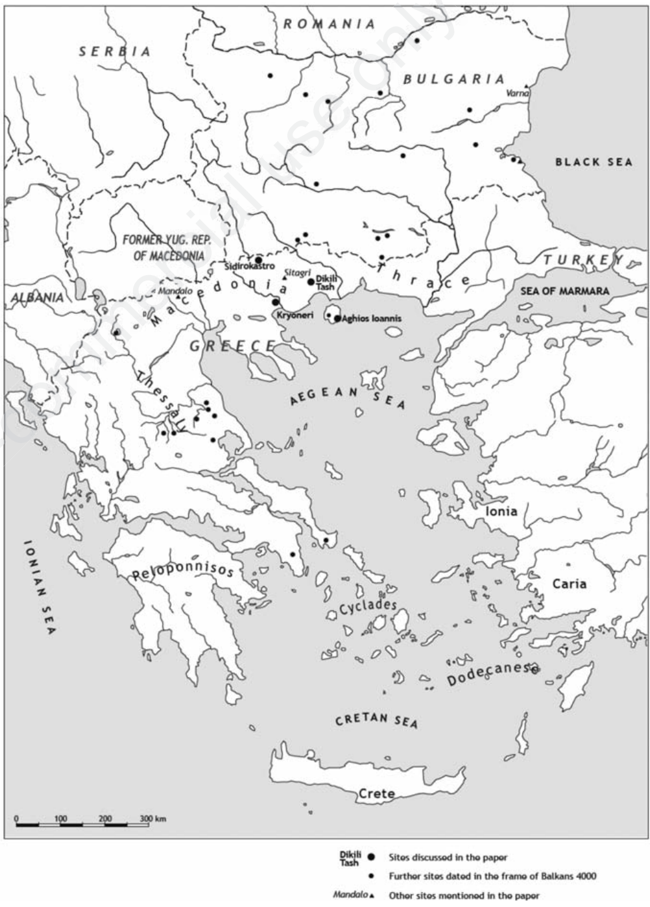
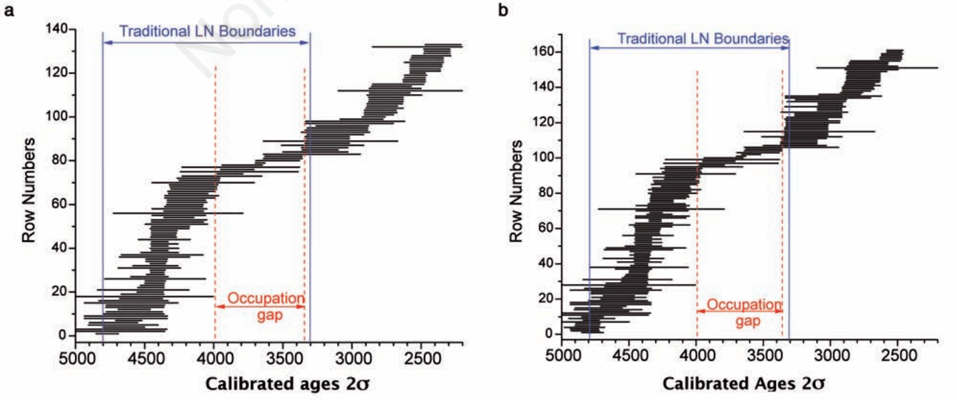
The transition from the Late Neolithic (LN) period (locally also called Final Neolithic or Chalcolithic) to the Early Bronze Age (EBA) in Greece and the Southeast Balkans is an obscure period in human history. Previous radiocarbon evidence showed that in settlements with stratigraphical sequences stretching out on both periods, the absolute dates featured a gap ranging from 700 to 1000 years (roughly between 4000 and 3300/3000 cal. BC). On the other hand, there is only scarce evidence about settlements that would have been founded during the missing period, thus arising questions of paramount importance about the human occupational strategies in this period. Investigation tackling this particular problem is carried out within the framework of a broader research project (Balkans-4000) funded by the French National Research Agency (ANR). Here we discuss the latest radiocarbon results from three recently excavated multilayer settlements on the continental Greek Eastern Macedonia: Dikili Tash, Kryoneri and Sidirokastro. In all cases, the existing LN radiocarbon dates do not go beyond about 4000 BC, whereas the earliest EBA layer dates begin at around 3300 BC. A date in the last 1/3rd of the 4th millennium BC is also the date suggested for the one-layer transitional settlement on the neighbouring island of Thasos (Aghios Ioannis). The fact that the gap affects settlements of different types and locations, although there are no signs of major environmental changes, suggests that the reasons of their possible total or partial abandonment are more likely to be social than strictly environmental.
Overview
CoChat Summary
TL;DR
New radiocarbon dating from four Greek sites reinforces a centuries-long gap between Late Neolithic and Early Bronze Age occupation in Southeast Europe, with LN dates ending around 4000 cal BC and EBA layers beginning around 3300 cal BC. The authors argue the abandonment pattern is more likely social than environmental.
Key findings
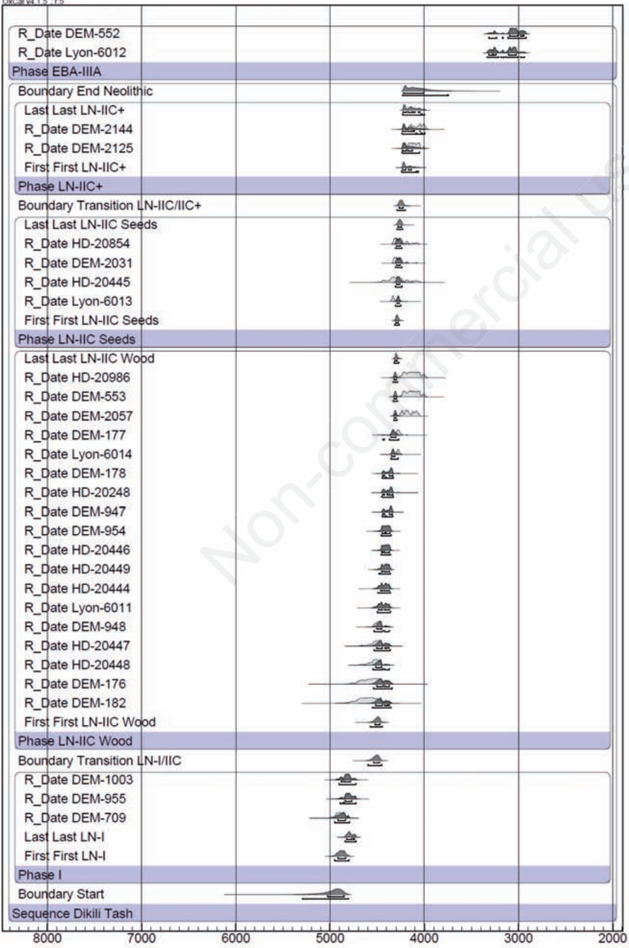
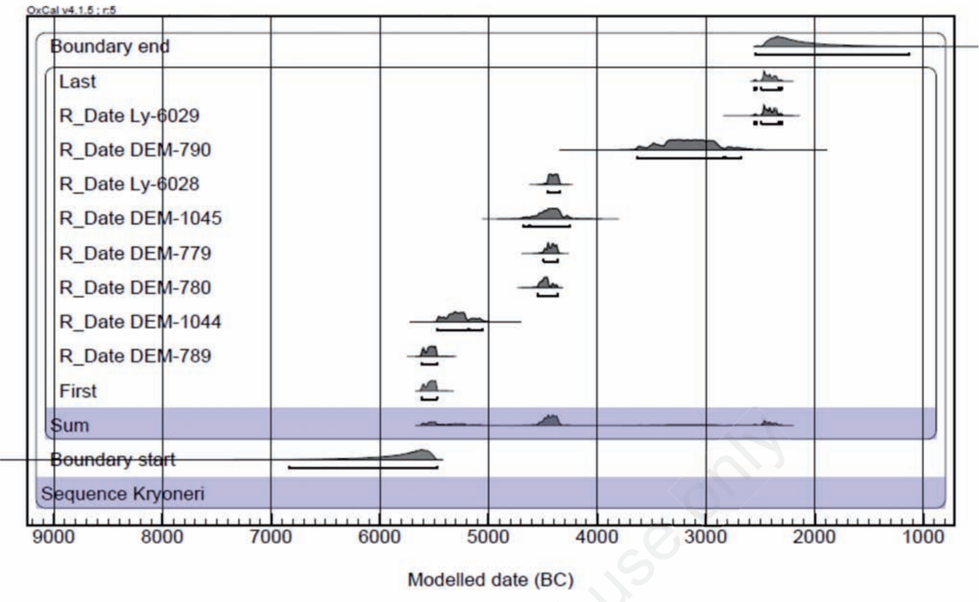
- In the three long-sequence sites (Dikili Tash, Kryoneri, Sidirokastro), no or very few dates fall after about 4250 cal BC; at Dikili Tash the modeled last LN II sample falls in 4230–3999 cal BC (mean 4135±66 cal BC), with a destruction episode around 4260±17 BC, and at Kryoneri the latest LN II date is 4460–4360 cal BC.
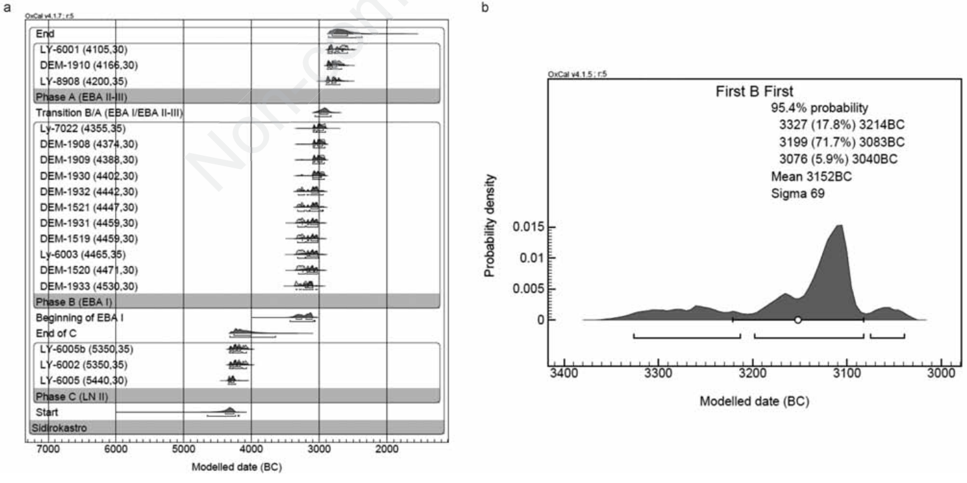
- Earliest EBA dates begin around 3300 cal BC; Sidirokastro’s 14 new dates include LN II phase C at 4370–4060 BC and EBA dates at 3350–2600 cal BC, with a modeled mean gap of 837±211 years, while OxCal modeling of phase B suggests EBA I does not begin before about 3200 cal BC and may start closer to 3100 than 3300 cal BC.
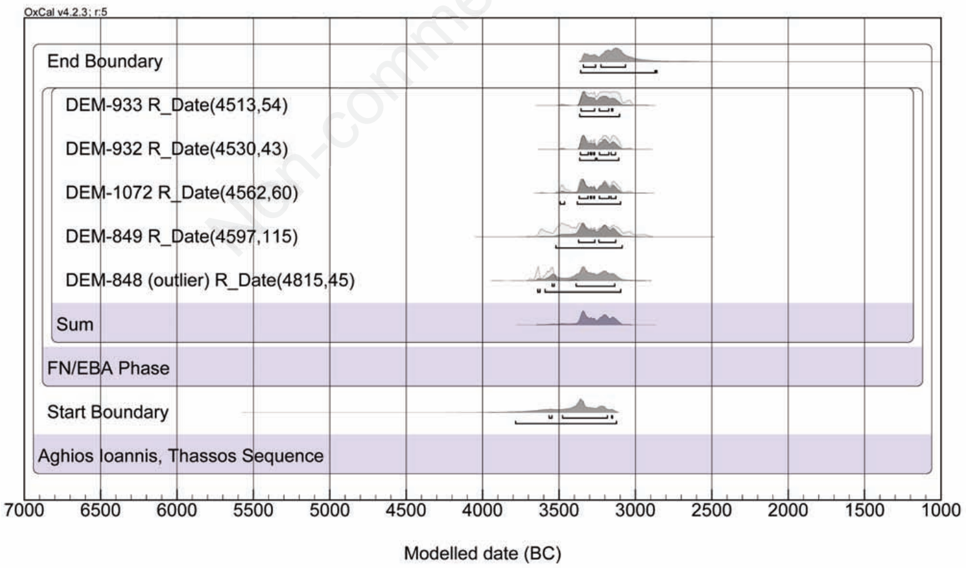
- Aghios Ioannis on Thasos, a single-layer transitional site, has four samples grouping at 3370–3100 cal BC, with one likely outlier at 3700–3400 cal BC; this may represent a stage just preceding mature EBA I.
- The gap affects different settlement types and locations without signs of major environmental change, suggesting social rather than strictly environmental causes.
Methods
- New samples were collected from secure, well-defined archaeological contexts in freshly excavated settlements with long occupation sequences, plus one-layer transitional sites; the broader project produced some 200 radiocarbon dates from 31 sites in Greece and Bulgaria, with detailed discussion here of Dikili Tash, Kryoneri, Sidirokastro, and comparison to Aghios Ioannis.
- Three dating methods were used concurrently: Gas Proportional Counting (Laboratory of Archaeometry, NCSR Demokritos), Liquid Scintillation Counting (Lyon Centre for Radiocarbon Dating), and Accelerator Mass Spectrometry (CEA Saclay, under the Lyon lab).
- Calibrated 2σ dates were analyzed and Bayesian statistical modeling was applied using OxCal v4.1.5, treating archaeological phases as groups.
Limitations
- Stated in the paper: many available radiocarbon dates have large deviations/error bars (oldest up to ±160 BP years); a calibration plateau around 3300–3000 BC spreads calibrated dates and prevents discrimination between events near 3300 and 3000 BC; Kryoneri has a small excavated area; Dikili Tash has only one useful EBA I date; Aghios Ioannis has a possible outlier; full results and detailed analysis are to be presented elsewhere.
- Evident from the text: sample distribution across the 31 sites is not uniform, with some sites represented by only one or two samples, and the detailed conclusions rest on four sites.
- Evident from the text: the Kryoneri gap estimate is based on very few dates, including a single reliable date from the second half of the 3rd millennium BC.
Model-written summary. Check it against the paper before relying on it.
Integrity signals
Registry
Cites
Statistics
Figures

Verification
Claims the paper makes
0 Valid · 0 Not valid · 14 Not checked · 52 Own results and interpretations
A result the paper reports from its own data — it cites no other source for it, so there is none to check. The quote shows it is in the paper.
In the paper
“But the only reliable date (Lyon-6029) is from the second half of the 3 rd millennium BC, i.e. from an advanced stage of the Early Bronze Age (EBA II); this would agree also with the mobile finds.”
§ New 14 C evidence for the Late Neolithic-Early Bronze Age transition in Southeast Europe > Results and Discussion
plainSingle case- Asserted: passes — The authors put it forward as true.
- Checkable: passes — It can be checked against evidence.
- Load-bearing: passes — The paper’s conclusions depend on it.
- Based: passes — The paper gives a reason why it holds.
A result the paper reports from its own data — it cites no other source for it, so there is none to check. The quote shows it is in the paper.
In the paper
“Four of them (2 bone samples DEM-932 and 933, and 2 charcoals DEM-849 and 1072) group nicely in the last part of the 4 th millennium (3370-3100 cal.BC).”
§ New 14 C evidence for the Late Neolithic-Early Bronze Age transition in Southeast Europe > Results and Discussion
plainn = 4- Asserted: passes — The authors put it forward as true.
- Checkable: passes — It can be checked against evidence.
- Load-bearing: passes — The paper’s conclusions depend on it.
- Based: passes — The paper gives a reason why it holds.
A result the paper reports from its own data — it cites no other source for it, so there is none to check. The quote shows it is in the paper.
In the paper
“A series of radiocarbon dates, unpublished so far, suggested the absence of layers that could be assigned to the early 4 th millennium; AMS dating of a few additional samples from the same contexts should allow completing the data.”
§ New 14 C evidence for the Late Neolithic-Early Bronze Age transition in Southeast Europe > The sites
hedged- Asserted: passes — The authors put it forward as true.
- Checkable: passes — It can be checked against evidence.
- Load-bearing: passes — The paper’s conclusions depend on it.
- Based: passes — The paper gives a reason why it holds.
A result the paper reports from its own data — it cites no other source for it, so there is none to check. The quote shows it is in the paper.
In the paper
“and a more discrete reoccupation of some parts until roughly 4000 cal.BC (Phase IIC+).”
§ New 14 C evidence for the Late Neolithic-Early Bronze Age transition in Southeast Europe > Results and Discussion
plain- Asserted: passes — The authors put it forward as true.
- Checkable: passes — It can be checked against evidence.
- Load-bearing: unclear — It is unclear whether the paper’s conclusions depend on it.
- Based: passes — The paper gives a reason why it holds.
A result the paper reports from its own data — it cites no other source for it, so there is none to check. The quote shows it is in the paper.
In the paper
“This is very clear at Dikili Tash, where it dates the destruction of a group of houses with material typical of the last LN phase (Dikili Tash IIC, more or less synchronous to Karanovo VI).”
§ New 14 C evidence for the Late Neolithic-Early Bronze Age transition in Southeast Europe > Conclusions
boostedstates a causeSingle case- Asserted: passes — The authors put it forward as true.
- Checkable: passes — It can be checked against evidence.
- Load-bearing: passes — The paper’s conclusions depend on it.
- Based: passes — The paper gives a reason why it holds.
39 more claims
Create a free account to see all 66 claims and to verify the 11 references still open.
- It may state two separate claims as one. 20
- Probably not a substantial claim. 6
Self-check
Percentages, sums and reported differences re-computed from the paper’s own numbers.
Each contradiction between two passages listed here was confirmed by an independent check.
Rated minor: it would not touch a result — a value no result rests on, a p-value that stays on the same side of the significance level, or a conflict that is clerical, resolved elsewhere in the paper, or outside its own findings.
In the paper
§ New 14 C evidence for the Late Neolithic-Early Bronze Age transition in Southeast Europe > Abstract
“In all cases, the existing LN radiocarbon dates do not go beyond about 4000 BC, whereas the earliest EBA layer dates begin at around 3300 BC.”
§ New 14 C evidence for the Late Neolithic-Early Bronze Age transition in Southeast Europe > Results and Discussion
“But the only reliable date (Lyon-6029) is from the second half of the 3 rd millennium BC, i.e. from an advanced stage of the Early Bronze Age (EBA II);”
Citations
Cites
Bayesian Analysis of Radiocarbon Dates
Bronk Ramsey, C. (2009) · Radiocarbon · doi:10.1017/s0033822200033865 · Cited by 8,725
Review of Aegean Prehistory V: The Neolithic and Bronze Age of Northern Greece
Andreou, S., Fotiadis, M., & Kotsakis, K. (1996) · American Journal of Archaeology · doi:10.2307/507028 · Cited by 180
Görsdorf, J., & Bojadziev, J. (1996) · Eurasia antiqua: Zeitschrift für Archäologie Eurasiens · Cited by 136
Papathanasopoulos, G. (1996) · Cited by 115
Co2 Gas Proportional Counting in Radiocarbon Dating — Review and Perspective
Kromer, B., & Münnich, K. O. (1992) · Springer eBooks · doi:10.1007/978-1-4757-4249-7_13 · Cited by 99
Self-citationArtemis, the New 14C AMS at LMC14 in Saclay, France
Cottereau, E., Arnold, M., Moreau, C., Baqué, D., Bavay, D., Caffy, I., Comby, C., Dumoulin, J.-P., Hain, S., Perron, M., et al. (2007) · Radiocarbon · doi:10.1017/s0033822200042211 · Cited by 99
Chronology of prehistoric cultures in Bulgaria
Boyadzhiev, Y. (1995) · Cited by 92
The Neolithic, Eneolithic and transitional period in Bulgarian prehistory
Todorova, K. (1995) · Cited by 74
Les civilisations égéennes du Néolithique et de l'âge du Bronze
Treuil, R., Darcque, P., Poursat, J.-C., Touchais, G., Faugères, L., Kourtessi-Philippakis, G., Lespez, L., Olivier, J., Ruijgh, C. J., & Sarian, H. (2008) · HAL · Cited by 66
Self-citationThe Eneolithic Period in Bulgaria in the Fifth Millennium B.C.
(1978) · BAR Publishing eBooks · doi:10.30861/9780860540274 · Cited by 58
New perspectives on the Varna cemetery (Bulgaria) – AMS dates and social implications
Higham, T., Chapman, J., Slavchev, V., Gaydarska, B., Honch, N., Yordanov, Y., & Dimitrova, B. (2007) · Antiquity · doi:10.1017/s0003598x00095636 · Cited by 41
Tsirtsoni, Z. (2016) · doi:10.4000/books.momeditions.498 · Cited by 35
Self-citationBetancourt, P. P. (1996) · Bulletin of the American Schools of Oriental Research · doi:10.2307/1357300 · Cited by 34
Foucher, P., Juan, C., & Oberlin, C. (2008) · HAL · Cited by 28
Self-citationThe Absolute Chronology of the Aegean Early Bronze Age: Archaeology, Radiocarbon and History
Dever, W. G., & Manning, S. W. (1998) · Journal of the American Oriental Society · doi:10.2307/606094 · Cited by 27
Maniatis, Y., & Papadopoulos, S. (2011) · Radiocarbon · doi:10.1017/s0033822200034330 · Cited by 20
Self-citationEvidence from Dikili Tash (Eastern Macedonia, Greece) and the tell issue
Darcque, P., & Tsirtsoni, Z. (2010) · HAL · Cited by 12
Self-citationDarcque, P., Koukouli-Chryssanthaki, H., Malamidou, D., & Tsirtsoni, Z. (2009) · Bulletin de correspondance hellénique · doi:10.3406/bch.2009.7578 · Cited by 12
Self-citationRadiocarbon Dating of the Neolithic Early Bronze Age Site of Mandalo, W Macedonia
Maniatis, Y., & Kromer, B. (1990) · Radiocarbon · doi:10.1017/s0033822200040145 · Cited by 11
Self-citationThe Absolute Chronology of the Aegean Early Bronze Age: Archaeology, Radiocarbon, and History
Pullen, D. J., & Manning, S. W. (1997) · Journal of Field Archaeology · doi:10.2307/530695 · Cited by 9
Chronology of Greece and South-east Europe in the Final Neolithic and Early Bronze Age
Johnson, M. (1999) · Proceedings of the Prehistoric Society · doi:10.1017/s0079497x00002048 · Cited by 5
Roque, C., Guibert, P., Vartanian, E., Bechtel, F., Treuil, R., Darcque, P., Koukouli‐Chryssanthaki, H., & Malamidou, D. (2002) · Archaeometry · doi:10.1111/1475-4754.t01-1-00089 · Cited by 2
Self-citation
Research works printed but not linked: 8
- Adrymi-Sismani V, 2007. [Le site chalcoli- thique de Microthèbes au carrefour du monde Égéen et des Balkans du nord]. [Chapter in French]. In: I. Galanaki, H. Tomas, Y. Galanakis, R. Laffineur (eds.) Between the Aegean and the Baltic Seas. Université de Liège-University of Texas at Austin, Liège-Austin, pp 73-9.
- Anthony DW, Chi JY, 2009. The lost world of old Europe. The Danube valley, 5000-3500 BC. ISAW-Princeton University Press, Princeton-Oxford.
- Darcque P, Koukouli-Chryssanthaki H, Malamidou D, Treuil R, Tsirtsoni Z, 2007. Recent researches at the Neolithic settle- ment of Dikili Tash, Eastern Macedonia, Greece: an overview. In: H. Todorova, M. Stefanovich, G. Ivanov (eds.). The Struma/Strymon River Valley in Prehistory. Proceedings of the International Symposium Strymon Praehistorikos, 2004 Sep 27-Oct 1, Kjustendil-Blagoevgrad, Bulgaria, and Serres-Amphipolis, Greece. Gerda Henkel, Sofia, pp 247-56.
- Darcque P, Koukouli-Chryssanthaki H, Malamidou D, Tsirtsoni Z, 2009. [Rapport sur les travaux de l'École française d'Athènes en 2008: Dikili Tash]. [Article in French]. Bulletin de Correspondance Hellénique 133:529-41.
- In: N. Goutas, L. Klaric, D. Pesesse, P. Guillermin (eds.) [À la recherche des identités gravettiennes: actualités, ques- tionnements et perspectives. Actes de la table ronde d'Aix-en-Provence, 6-8 octobre 2008]. [Proc. in French]. Société Préhistorique Française, Paris.
- Todorova, M. Stefanovich, G. Ivanov (eds.) The Struma/Strymon River Valley in Prehistory. Proceedings of the International Symposium Strymon Praehistorikos, 2004 Sep 27-Oct 1, Kjustendil-Blagoevgrad, Bulgaria, and Serres-Amphipolis, Greece. Gerda Henkel, Sofia, pp 297-308.
- Todorova H, 1978. The Eneolithic period in Bulgaria in the 5th millenium B.C. Archaeopress, Oxford.
- Treuil R, 1992. [Dikili Tash, village préhisto- rique de Macédoine orientale, I. Fouilles de Jean Deshayes (1961-1975), vol. 1]. [Book in French]. Ecole française d'Athènes, Athens.
Cited by
Long-term trends of land use and demography in Greece: A comparative study
Weiberg, E. L., Bevan, A., Kouli, K., Katsianis, M., Woodbridge, J., Bonnier, A., Engel, M., Finné, M., Fyfe, R., Maniatis, Y., et al. (2019) · The Holocene · doi:10.1177/0959683619826641 · Cited by 121
Self-citationValamoti, S.-M. (2014) · Vegetation History and Archaeobotany · doi:10.1007/s00334-014-0487-6 · Cited by 68
Middle Holocene rapid environmental changes and human adaptation in Greece
Lespez, L., Glais, A., López-Sáez, J.-A., Drézen, Y. L., Tsirtsoni, Z., Davidson, R., Birée, L., & Malamidou, D. (2016) · Quaternary Research · doi:10.1016/j.yqres.2016.02.002 · Cited by 62
Self-citationNeolithic Thessaly: radiocarbon dated periods and phases
Reingruber, A., Toufexis, G., Kyparissi‐Apostolika, N., Anetakis, M., Maniatis, Y., & Facorellis, Y. (2017) · Documenta Praehistorica · doi:10.4312/dp.3 · Cited by 33
Self-citationModifiable reporting unit problems and time series of long-term human activity
Bevan, A., & Crema, E. R. (2020) · Philosophical Transactions of the Royal Society B Biological Sciences · doi:10.1098/rstb.2019.0726 · Cited by 32
Metadata
- Authors
- Maniatis, Y., Tsirtsoni, Z., Oberlin, C., Darcque, P., Koukouli-Chryssanthaki, C., Malamidou, D., Siros, T., Miteletsis, M., Papadopoulos, S., & Kromer, B.
- Affiliations
- National Centre of Scientific Research "Demokritos" (GR)
- Centre National de la Recherche Scientifique (FR)
- Hellenic Ministry of Culture and Sports (GR)
- Heidelberg University (DE)
- Corresponding author
- Maniatis, Yannis
- Venue
- Open Journal of Archaeometry
- Publisher
- PAGEPress Publications
- Published
- 2014-05-14
- Volume
- 2
- Issue
- 1
- ISSN
- 2038-1948 (ISSN-L)
- 2038-1956
- OpenAlex
- W2059922947
- Cited by
- 15
- References
- 23
- Citations by year
- 2026: 1 · 2025: 1 · 2024: 1 · 2020: 2 · 2019: 1 · 2018: 2 · 2017: 2 · 2016: 3 · 2015: 1 · 2014: 1
- FWCI
- 3.45
- Type
- journal article
- Language
- en
- Open access
- diamond
- doi.org
- Licence
- Locations
- Open Journal of Archaeometry (publishedVersion, cc-by-nc)
- HAL (submittedVersion)
- Funders
- Agence Nationale de la Recherche (ANR-07-JCJC-0072)
- Topics
- Social Sciences › Archeology › Archaeology and ancient environmental studies
- Social Sciences › Arts and Humanities › Archeology (arts and humanities) › Ancient and Medieval Archaeology Studies
- Social Sciences › Arts and Humanities › Archeology (arts and humanities) › Archaeological and Geological Studies
- Keywords
- Late Neolithic, Early Bronze Age, radiocarbon chronology, Eastern Macedonia, Dikili Tash, Thasos, settlement abandonment, social change, 4th millennium BC
About these checks
Registry, retraction, Cites and statistics results are computed, not judged, with one exception: a printed reference that no index lists is read once by a model before it counts as a citation error. Claims are extracted by a model and kept only when their quote appears verbatim in the text; each cited source is then checked, with a model’s help, for whether it says what the claim relies on. Those verdicts can be wrong — read the claim’s quote and the cited source before relying on one.
A language model drew the claims from the paper on 2026-11-23, under version 3 of the claim definition (model deepseek-v4.1-flash, prompt extract-v3).
A second model labelled each claim on 2026-11-23 (model jev-1.13-20260917, definition revision gold-guideline-v0.2).
Statistics and arithmetic are recomputed, not judged.
Confidence bands are shown only for fields calibrated on our annotated test set. None is calibrated yet, so no band is shown.
What counts as a claim ›How we measure confidence ›How we check this ›
Are you an author, or do you see a problem with this page? Request a review
Data sources
Bibliographic data: Semantic Scholar, OpenAlex, Crossref.
Contains information from the Semantic Scholar Academic Graph Datasets, made available under the ODC Attribution License (ODC-BY 1.0).
Semantic Scholar’s data is described in: Kinney, R., et al. (2023). The Semantic Scholar Open Data Platform. arXiv:2301.10140.
